

Super Gap: The Leader's Question
 |
Description
Book Introduction
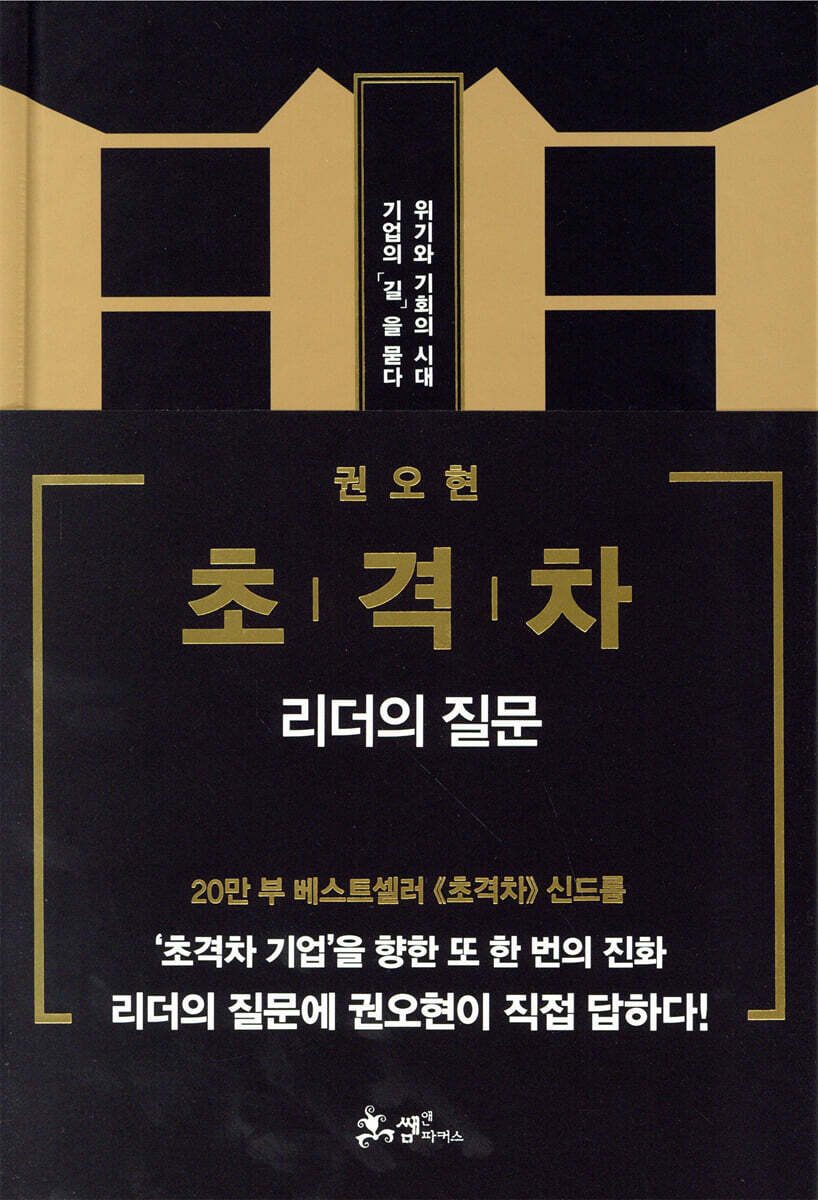
Samsung Electronics Chairman Kwon Oh-hyun offers solutions to the most pressing questions for business executives and organizational leaders striving to become "super-gap companies." Following his 2018 book "Super Gap," which sold over 200,000 copies, Samsung Electronics Chairman Kwon Oh-hyun returns after a two-year silence to address the practical concerns and realistic questions leaders face.
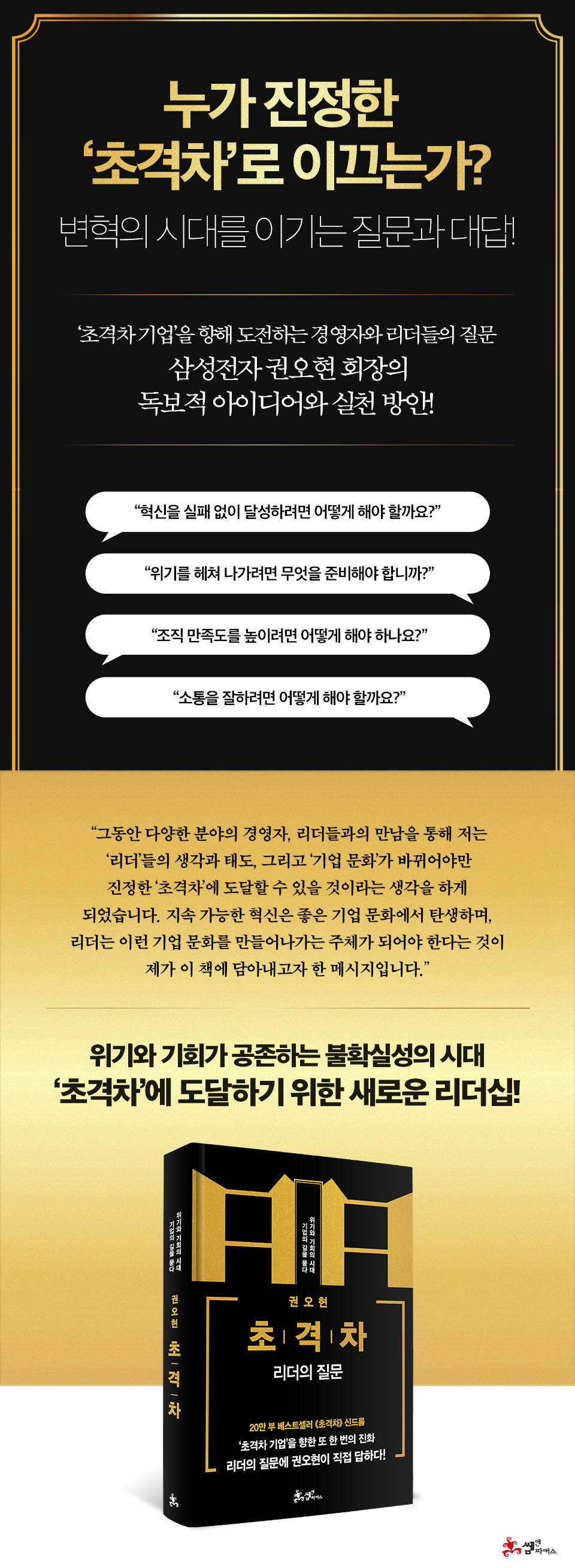
"Super Gap: Questions from Leaders" contains three chapters on "Leaders," "Innovation," and "Culture," a total of 32 concerns and questions derived from meetings with leaders, and the core message that "Sustainable innovation is born from a good corporate culture, and leaders must be the ones creating such a corporate culture." "How can we achieve innovation without failure?" "What should we prioritize before starting a business?" "What should we prepare to overcome a crisis?" The question-centered structure, derived from the vivid process of how organizations operate in real-life management settings, is not only the greatest evolution from the previous work, but also faithfully captures the issues that leaders of all organizations must address on the path to "super gap." "In this age of crisis and opportunity, who will do what and how to achieve the ultimate breakthrough?" This book will provide useful answers to the leaders of the present and future. |
- You can preview some of the book's contents.
Preview
index
Prologue | Time to Leap Again
Chapter 1: Leaders: A Leader in Innovation and Culture
Q.
What kind of leadership is needed in the new era?
_The path of a manager, the path of a manager
Q.
What should we prepare to overcome the crisis?
Heroes are born in troubled times.
Q.
How do you know if someone is a good candidate?
_Who is the best talent?
Q.
How should we best select a CEO?
_Align all judgment criteria with the future
Q.
What should you look for when choosing a CEO?
If the organization is worth a thousand nyang, the leader is worth nine hundred nyang.
Q.
What should top executives watch out for?
A Leader Trapped in a Prison of Fear
Q.
How do I delegate authority?
Don't do things you don't have to do
Q.
How can I manage my time well?
Advice for Thought Leaders
Q.
How should owners and professional managers divide their roles?
_The role of the owner, the role of the professional manager
Q.
How do a leader's responsibilities change depending on the company's circumstances?
_Are you ready to transform at any time?
Q.
How should we utilize internal and external talent?
_The risks of smart people
Q.
What should leaders do to prepare for the future?
_Leader in sustainable innovation and culture
[Discovery of the Class] Details on Delegation of Authority and Output
Chapter 2: Innovation: Conditions for Survival and Growth
Q.
How should leaders innovate?
_Something that must be pushed forward with life on the line
Q.
What are the prerequisites for successful innovation?
_To leap forward to 'world class'
Q.
How can we best select, identify, and utilize talent?
_Discard the existing talent framework.
Q.
How do I know if someone is a good fit for my organization?
_How do you know what kind of person he is?
Q.
What kind of training system is needed to develop future leaders?
From violinist to conductor
Q.
How can we achieve innovation without failure?
_Choose out the rotten apples immediately.
Q.
How can we develop insight?
_The person who puts the water in the bowl is the leader himself
Q.
What should be the top priority before starting a business?
_Three criteria that determine the future of a business
Q.
How can we develop our decision-making skills?
Innovation doesn't happen on the safe road.
Q.
What should a company focus on at each stage of growth?
_Ultimately reaching status up
[Discovery of the 4th Industrial Revolution] What is the 4th Industrial Revolution?
Chapter 3: Culture: The Foundation for Achieving Super-Gap
Q.
What direction should organizational culture pursue in the future?
_Three keywords for a super-gap organization
Q.
How can we maintain an organizational culture that enables innovation?
_Challenge, Create, Collaborate
Q.
How should we structure our organizations to achieve high performance?
From homogeneous to heterogeneous values
Q.
How can I communicate well?
A leader who 'communicates', a leader who 'shows communication'
Q.
How do I set management goals to gain trust?
_Should I go far or should I go fast?
Q.
How can I increase organizational satisfaction?
_Principles and systems for reducing complaints
Q.
How do you retain talented people?
An organization where capable people work for a long time
Q.
How can we prevent major accidents?
_The beginning and end of problem solving
Q.
Is there a way to break down departmental egoism?
_To create an organization that has no choice but to cooperate
Q.
How can we achieve a win-win situation for both parties?
A culture of consideration learned from the principles of negotiation
Epilogue | For New Leadership in a New Era
Chapter 1: Leaders: A Leader in Innovation and Culture
Q.
What kind of leadership is needed in the new era?
_The path of a manager, the path of a manager
Q.
What should we prepare to overcome the crisis?
Heroes are born in troubled times.
Q.
How do you know if someone is a good candidate?
_Who is the best talent?
Q.
How should we best select a CEO?
_Align all judgment criteria with the future
Q.
What should you look for when choosing a CEO?
If the organization is worth a thousand nyang, the leader is worth nine hundred nyang.
Q.
What should top executives watch out for?
A Leader Trapped in a Prison of Fear
Q.
How do I delegate authority?
Don't do things you don't have to do
Q.
How can I manage my time well?
Advice for Thought Leaders
Q.
How should owners and professional managers divide their roles?
_The role of the owner, the role of the professional manager
Q.
How do a leader's responsibilities change depending on the company's circumstances?
_Are you ready to transform at any time?
Q.
How should we utilize internal and external talent?
_The risks of smart people
Q.
What should leaders do to prepare for the future?
_Leader in sustainable innovation and culture
[Discovery of the Class] Details on Delegation of Authority and Output
Chapter 2: Innovation: Conditions for Survival and Growth
Q.
How should leaders innovate?
_Something that must be pushed forward with life on the line
Q.
What are the prerequisites for successful innovation?
_To leap forward to 'world class'
Q.
How can we best select, identify, and utilize talent?
_Discard the existing talent framework.
Q.
How do I know if someone is a good fit for my organization?
_How do you know what kind of person he is?
Q.
What kind of training system is needed to develop future leaders?
From violinist to conductor
Q.
How can we achieve innovation without failure?
_Choose out the rotten apples immediately.
Q.
How can we develop insight?
_The person who puts the water in the bowl is the leader himself
Q.
What should be the top priority before starting a business?
_Three criteria that determine the future of a business
Q.
How can we develop our decision-making skills?
Innovation doesn't happen on the safe road.
Q.
What should a company focus on at each stage of growth?
_Ultimately reaching status up
[Discovery of the 4th Industrial Revolution] What is the 4th Industrial Revolution?
Chapter 3: Culture: The Foundation for Achieving Super-Gap
Q.
What direction should organizational culture pursue in the future?
_Three keywords for a super-gap organization
Q.
How can we maintain an organizational culture that enables innovation?
_Challenge, Create, Collaborate
Q.
How should we structure our organizations to achieve high performance?
From homogeneous to heterogeneous values
Q.
How can I communicate well?
A leader who 'communicates', a leader who 'shows communication'
Q.
How do I set management goals to gain trust?
_Should I go far or should I go fast?
Q.
How can I increase organizational satisfaction?
_Principles and systems for reducing complaints
Q.
How do you retain talented people?
An organization where capable people work for a long time
Q.
How can we prevent major accidents?
_The beginning and end of problem solving
Q.
Is there a way to break down departmental egoism?
_To create an organization that has no choice but to cooperate
Q.
How can we achieve a win-win situation for both parties?
A culture of consideration learned from the principles of negotiation
Epilogue | For New Leadership in a New Era
Detailed image
Into the book
After the publication of "Super Gap," not only various concerns arising in real-world management settings, but also questions about specific methodologies I didn't specifically mention in the book began to take center stage in conversations.
“There are so many things a CEO has to worry about, what should I prioritize?”, “How do I identify and find good talent?”, “How do I know when the best time is to expand my business? Or when should I close it?”, “What and how should I prepare to achieve sustainable growth after starting a business?”, “I’m planning to reform the company, but is it better to hire internally or should I look for someone externally?”, “What kind of training is needed to develop the person I’ve chosen as my successor into a great manager?”, “What should I look for to know if he or she is truly competent and suitable?”, “What should I do if I have differences of opinion about management with my father, the founder?”, etc. Depending on each person’s situation, realistic and diverse questions naturally followed, ranging from talent, organization, system design to the future of the company.
I couldn't tell everyone there the answer, but I was able to freely discuss my experiences and the ideas I had been thinking about.
Listening to the diverse concerns and stories from the field, I realized my own shortcomings and it was a valuable time for me to re-examine topics I hadn't thought deeply about before.
At the same time, I realized that many managers and organizational leaders still face similar concerns.
There are no single, definitive solution to many management-related questions, as each company faces unique circumstances.
There have been many times when I, too, have had to share ideas that I had only had as ideas and could not actually put them into practice.
But I've been refining my thinking to find answers that might be helpful, and I've come to the point where I want to offer more actionable ideas.
--- p.13~14
The world is changing rapidly, but we still cling to a corporate culture from decades ago.
While it's true that sectors like government, government-affiliated public enterprises, and education are in dire need of change, these organizations are complexly intertwined with various other social factors, making them difficult to fix.
But businesses are different.
If a company doesn't change, it will fail.
Through my meetings with startups, small and medium-sized enterprises, and their managers, successors, and professional managers across various fields, I've come to believe that only by changing the mindset and attitude of "leaders," as well as the "corporate culture," can we truly achieve a "super gap."
A good leader must constantly think about and implement ways to achieve sustainable innovation, leading the organization and its members to embed the spirit of challenge, creativity, and collaboration into the corporate culture.
Even if we continue to do what we have been doing so far, the business may somehow continue to function.
But such a company will never develop.
In this day and age, it would be impossible to even survive.
You can't expect success through a single innovation to last forever.
Just because a country has the best constitution in the world doesn't mean it will run well on its own.
That's why a leader's attitude and mindset are so important.
The message I sought to convey in this book is that sustainable innovation is born from a good corporate culture, and that leaders must be the ones to create such a corporate culture.
--- p.26~27
Our country's business leaders are overusing the word crisis.
When business performance is poor or shows no signs of improvement, we habitually say, "This is a crisis, but work discipline is so lax that it's like this."
Creating a sense of crisis or bringing up work discipline is like blaming your employees for your own mistakes.
There is no case where an organization fails because its members are lazy.
If you keep saying that management is difficult or that there is a crisis, employees will be nervous at first, but they will become resistant to the same words repeated every year and will accept them without feeling any discomfort.
Even when a real crisis comes, you won't believe it.
It's like the lie of the shepherd boy.
The more we habitually use the word "crisis," the more it becomes stale, and members begin to wonder, "Have we ever been in a crisis?"
So, leaders should never use the word crisis carelessly.
A leader like this can never be called a good leader.
No one likes a crisis, but if you're well prepared, you can turn it into an opportunity to achieve a "super gap" that no one can match.
Crisis and opportunity are two sides of the same coin.
Only capable people can turn a crisis into an opportunity.
There is a saying, “Heroes emerge in troubled times.”
In peaceful and stable times, it's difficult to discern differences among employees because new challenges are rare.
But in a crisis, you can see who the exceptional talents are.
Such talents are truly valuable.
--- p.39~41
Just as the head of a household makes the most important plans, so too should the leader make the most important plans for change and growth in a company.
However, many company leaders often pass on the work they should be doing to their subordinates, using the excuse that they are busy.
It's like a parent asking a high school student to plan important family plans.
Some leaders instruct their planning or sales teams to research the direction the company should take and what needs to be done in the future and come up with countermeasures.
Subordinates hire consulting firms and report back with only nice-sounding, empty words—the words the leader wants to hear.
Leaving the fate of the company to others, to subordinates, is the greatest dereliction of duty on the part of a leader.
We have entered an era where simply maximizing internal efficiency and ensuring smooth functioning is no longer enough to create synergy.
Maximizing productivity to steal from others in the same market is a zero-sum game and cannot be considered true growth.
Creating synergy is not about maximizing efficiency, but about creating an impact on the market, that is, a large effect.
To create synergy, you need a leader who can step outside his own sphere and see things from a higher level.
When someone who has only walked a single path in one field becomes the CEO, it is not because he is incompetent, but because he does not understand other things, and as a result, the company ends up failing to create synergy.
A leader cannot do everything alone.
So maybe we need to redefine competence.
Until now, those who excelled in a single field were considered competent, but going forward, leaders who listen well to other opinions, facilitate mutual feedback, and create a flexible organizational culture will be considered competent.
--- p.124~125
One of the long-standing problems with our country's corporate personnel system is that there are too many and too complex job title systems.
Assistant manager, manager, deputy manager, department head...
In addition, there are directors, managing directors, executive directors, vice presidents, presidents, vice-chairmen, and chairman...
A closer look at this system reveals a mixture of ranks and positions.
I think this system should be simplified in the future.
In the past, a manager could exist as an actual head of a department.
In the days when there were departments, it was not unusual to have department heads.
However, in today's organizations, it has no meaning other than the fact that one has reached the level of a section chief or department head, not a manager or department head.
From the perspective of the organization members, as long as this system exists, they will feel dissatisfied because they are not promoted to manager or treated as a department head.
As a result, useless things like eating and drinking to appease complaints occur.
How can we solve this problem?
I think this system can be simply divided into 'working-level' and 'executive-level'.
Within the working level, positions are divided into two or three grades, and capable people are appointed according to the position.
It would be sufficient to assign positions appropriate to their responsibilities and authority, but divide non-executive level employees into junior and senior employees.
I think the same goes for executives.
The title can be kept simple, but the position can be customized to suit your needs.
--- p.152~153
In a diverse culture or organization, there is a saying, “As long as you don’t harm me, I will accept whatever you do.
Let me hear your story.
I maintain the attitude of “If it’s good, I’ll accept it.”
On the other hand, in places where there is no diversity, all decisions are made based on 'me' or 'you'.
This is why the term NIH (Not Invented Here) syndrome came into being.
This phrase means "not made here," and refers to an exclusive culture that does not recognize technologies or research achievements developed elsewhere.
Of course, there are many companies in our country that are striving to secure diversity by pursuing a heterogeneous culture internally.
Now is the time to boldly break the homogeneous culture not only within organizations but also across our society.
The attempt to replace department heads to "destroy silos," as I mentioned in "Super Gap," was also intended to break up a kind of homogeneous organization.
This is the first prerequisite for surviving and competing with the world.
Homogeneous organizations are eager to compete with each other.
In other words, they think that they will become the winner simply by defeating their rivals.
In most cases like this, rather than doing something challenging to overwhelm the opponent, they often wait for the opponent to make a mistake.
Such a strategy may reduce the probability of failure, but it will inevitably lead to the decline of the organization as a whole.
On the other hand, heterogeneous organizations are inherently evaluated in absolute terms.
In other words, the standard is whether you have the best skills, regardless of the opponent's mistakes.
If a homogeneous organization focuses on ‘efficiency,’ a heterogeneous organization focuses on ‘effectiveness.’
“There are so many things a CEO has to worry about, what should I prioritize?”, “How do I identify and find good talent?”, “How do I know when the best time is to expand my business? Or when should I close it?”, “What and how should I prepare to achieve sustainable growth after starting a business?”, “I’m planning to reform the company, but is it better to hire internally or should I look for someone externally?”, “What kind of training is needed to develop the person I’ve chosen as my successor into a great manager?”, “What should I look for to know if he or she is truly competent and suitable?”, “What should I do if I have differences of opinion about management with my father, the founder?”, etc. Depending on each person’s situation, realistic and diverse questions naturally followed, ranging from talent, organization, system design to the future of the company.
I couldn't tell everyone there the answer, but I was able to freely discuss my experiences and the ideas I had been thinking about.
Listening to the diverse concerns and stories from the field, I realized my own shortcomings and it was a valuable time for me to re-examine topics I hadn't thought deeply about before.
At the same time, I realized that many managers and organizational leaders still face similar concerns.
There are no single, definitive solution to many management-related questions, as each company faces unique circumstances.
There have been many times when I, too, have had to share ideas that I had only had as ideas and could not actually put them into practice.
But I've been refining my thinking to find answers that might be helpful, and I've come to the point where I want to offer more actionable ideas.
--- p.13~14
The world is changing rapidly, but we still cling to a corporate culture from decades ago.
While it's true that sectors like government, government-affiliated public enterprises, and education are in dire need of change, these organizations are complexly intertwined with various other social factors, making them difficult to fix.
But businesses are different.
If a company doesn't change, it will fail.
Through my meetings with startups, small and medium-sized enterprises, and their managers, successors, and professional managers across various fields, I've come to believe that only by changing the mindset and attitude of "leaders," as well as the "corporate culture," can we truly achieve a "super gap."
A good leader must constantly think about and implement ways to achieve sustainable innovation, leading the organization and its members to embed the spirit of challenge, creativity, and collaboration into the corporate culture.
Even if we continue to do what we have been doing so far, the business may somehow continue to function.
But such a company will never develop.
In this day and age, it would be impossible to even survive.
You can't expect success through a single innovation to last forever.
Just because a country has the best constitution in the world doesn't mean it will run well on its own.
That's why a leader's attitude and mindset are so important.
The message I sought to convey in this book is that sustainable innovation is born from a good corporate culture, and that leaders must be the ones to create such a corporate culture.
--- p.26~27
Our country's business leaders are overusing the word crisis.
When business performance is poor or shows no signs of improvement, we habitually say, "This is a crisis, but work discipline is so lax that it's like this."
Creating a sense of crisis or bringing up work discipline is like blaming your employees for your own mistakes.
There is no case where an organization fails because its members are lazy.
If you keep saying that management is difficult or that there is a crisis, employees will be nervous at first, but they will become resistant to the same words repeated every year and will accept them without feeling any discomfort.
Even when a real crisis comes, you won't believe it.
It's like the lie of the shepherd boy.
The more we habitually use the word "crisis," the more it becomes stale, and members begin to wonder, "Have we ever been in a crisis?"
So, leaders should never use the word crisis carelessly.
A leader like this can never be called a good leader.
No one likes a crisis, but if you're well prepared, you can turn it into an opportunity to achieve a "super gap" that no one can match.
Crisis and opportunity are two sides of the same coin.
Only capable people can turn a crisis into an opportunity.
There is a saying, “Heroes emerge in troubled times.”
In peaceful and stable times, it's difficult to discern differences among employees because new challenges are rare.
But in a crisis, you can see who the exceptional talents are.
Such talents are truly valuable.
--- p.39~41
Just as the head of a household makes the most important plans, so too should the leader make the most important plans for change and growth in a company.
However, many company leaders often pass on the work they should be doing to their subordinates, using the excuse that they are busy.
It's like a parent asking a high school student to plan important family plans.
Some leaders instruct their planning or sales teams to research the direction the company should take and what needs to be done in the future and come up with countermeasures.
Subordinates hire consulting firms and report back with only nice-sounding, empty words—the words the leader wants to hear.
Leaving the fate of the company to others, to subordinates, is the greatest dereliction of duty on the part of a leader.
We have entered an era where simply maximizing internal efficiency and ensuring smooth functioning is no longer enough to create synergy.
Maximizing productivity to steal from others in the same market is a zero-sum game and cannot be considered true growth.
Creating synergy is not about maximizing efficiency, but about creating an impact on the market, that is, a large effect.
To create synergy, you need a leader who can step outside his own sphere and see things from a higher level.
When someone who has only walked a single path in one field becomes the CEO, it is not because he is incompetent, but because he does not understand other things, and as a result, the company ends up failing to create synergy.
A leader cannot do everything alone.
So maybe we need to redefine competence.
Until now, those who excelled in a single field were considered competent, but going forward, leaders who listen well to other opinions, facilitate mutual feedback, and create a flexible organizational culture will be considered competent.
--- p.124~125
One of the long-standing problems with our country's corporate personnel system is that there are too many and too complex job title systems.
Assistant manager, manager, deputy manager, department head...
In addition, there are directors, managing directors, executive directors, vice presidents, presidents, vice-chairmen, and chairman...
A closer look at this system reveals a mixture of ranks and positions.
I think this system should be simplified in the future.
In the past, a manager could exist as an actual head of a department.
In the days when there were departments, it was not unusual to have department heads.
However, in today's organizations, it has no meaning other than the fact that one has reached the level of a section chief or department head, not a manager or department head.
From the perspective of the organization members, as long as this system exists, they will feel dissatisfied because they are not promoted to manager or treated as a department head.
As a result, useless things like eating and drinking to appease complaints occur.
How can we solve this problem?
I think this system can be simply divided into 'working-level' and 'executive-level'.
Within the working level, positions are divided into two or three grades, and capable people are appointed according to the position.
It would be sufficient to assign positions appropriate to their responsibilities and authority, but divide non-executive level employees into junior and senior employees.
I think the same goes for executives.
The title can be kept simple, but the position can be customized to suit your needs.
--- p.152~153
In a diverse culture or organization, there is a saying, “As long as you don’t harm me, I will accept whatever you do.
Let me hear your story.
I maintain the attitude of “If it’s good, I’ll accept it.”
On the other hand, in places where there is no diversity, all decisions are made based on 'me' or 'you'.
This is why the term NIH (Not Invented Here) syndrome came into being.
This phrase means "not made here," and refers to an exclusive culture that does not recognize technologies or research achievements developed elsewhere.
Of course, there are many companies in our country that are striving to secure diversity by pursuing a heterogeneous culture internally.
Now is the time to boldly break the homogeneous culture not only within organizations but also across our society.
The attempt to replace department heads to "destroy silos," as I mentioned in "Super Gap," was also intended to break up a kind of homogeneous organization.
This is the first prerequisite for surviving and competing with the world.
Homogeneous organizations are eager to compete with each other.
In other words, they think that they will become the winner simply by defeating their rivals.
In most cases like this, rather than doing something challenging to overwhelm the opponent, they often wait for the opponent to make a mistake.
Such a strategy may reduce the probability of failure, but it will inevitably lead to the decline of the organization as a whole.
On the other hand, heterogeneous organizations are inherently evaluated in absolute terms.
In other words, the standard is whether you have the best skills, regardless of the opponent's mistakes.
If a homogeneous organization focuses on ‘efficiency,’ a heterogeneous organization focuses on ‘effectiveness.’
--- p.229~230
Publisher's Review
The 200,000-copy bestseller "Super Gap" syndrome
The ultra-gap 'practice' strategy returns after two years!
Another evolution toward becoming a "super-gap company"
Kwon Oh-hyun answers the leader's questions himself!
Former Chairman Kwon Oh-hyun joined Samsung Electronics as a semiconductor researcher and rose to become CEO.
His book, "Super Gap," which contains his 33-year management strategy, immediately attracted extraordinary attention from domestic companies and leaders as well as overseas upon its publication in 2018.
Two years later, in 2020, after completing his term as chairman of Samsung Electronics Advanced Institute of Technology and stepping down from the front lines of management, he returned to the current companies and leaders, where "overcoming crises" has become a hot topic, with his new book, "Super Gap: Questions for Leaders."
Since the publication of "Super Gap" in 2018, Chairman Kwon Oh-hyun has not appeared in interviews or lectures despite great interest from the media and business community, piqued readers' curiosity.
People wanted to hear more of Kwon Oh-hyun's "specific and actionable know-how and ideas that can help companies of all sizes reach the next level."
But instead of expounding on the book or answering questions impromptu in public, the author spent two years meeting with experts from various fields, startup founders, business successors, and professional managers, as well as leaders of small and medium-sized businesses, sharing the practical questions and diverse concerns that stemmed from "Super Gap."
“Actually, before publishing the book, I received more questions about general economic trends and Samsung’s success story than about specific business activities like my management methods, organizational management, and talent management.
However, after the publication of "Super Gap," not only various concerns arising in actual management settings, but also questions about specific methodologies that I didn't specifically mention in the book began to take center stage in conversations." (p. 13)
These ongoing meetings and questions naturally led to deeper reflection on "practical and sustainable ideas for addressing the challenges leaders and organizations facing as they strive for the next big thing," gradually forming the framework for a new book.
"Super Gap: The Leader's Questions" is a book filled with Samsung Electronics Chairman Kwon Oh-hyun's wealth of expertise and new ideas, offering solutions to the most pressing questions facing today's business executives and organizational leaders.
Just as a skilled surgeon at the operating table applies a sharp scalpel to the affected area with perfect precision, the author clearly presents his thoughts, honed through long experience and keen intuition, to leaders who cling to existing ways of thinking and are afraid of change.
32 Concerns and Questions from Real-World Management
Things that must be addressed on the road to 'super gap'
"Super Gap: Questions from Leaders" is divided into three chapters: "Leaders," "Innovation," and "Culture," and is written in the format of the author personally answering 32 questions and concerns raised during meetings with leaders.
"How can I achieve innovation without failure?" "What should I prioritize before starting a business?" "How should I best select, identify, and utilize talent?" "What should I prepare to navigate a crisis?" "How can I increase organizational satisfaction?" "How can I communicate effectively?" "How can I know when the best time to expand my business is?"
This question-centered structure, which emerged from the vivid process of an organization operating in an actual management setting, is not only the greatest evolutionary difference from the previous work, "Super Gap," but also faithfully captures the issues that all organizational leaders must address on the path to "Super Gap."
So why leadership, innovation, and culture?
"Through my meetings with startups, small and medium-sized enterprises, and their managers, successors, and professional managers across various fields, I've come to believe that only by changing the mindset and attitude of 'leaders,' as well as the 'corporate culture,' can we truly achieve a 'super gap.'
You can't expect success through a single innovation to last forever.
“Sustainable innovation is born from a good corporate culture, and leaders must be the ones to create this corporate culture. This is the message I wanted to convey in this book.” (pp. 26-27)
Creating a corporate culture that fosters sustainable innovation through the leader's thorough planning and commitment to execution.
The core message that runs through this book is in line with the principle of evolution, which states that mutations arise by chance and that superior genes thrive from generation to generation according to the principle of survival of the fittest.
According to the author's analogy, 'mutations by chance' in nature become 'innovations by plan' in business, and 'prosperity through genetics' in nature becomes 'growth through culture' in business.
In other words, all companies must create a corporate culture that fosters innovation through thorough planning and the will to execute, in order to achieve a significant gap.
A leader who creates sustainable innovation and a good corporate culture
Completing the DNA of innovation with a culture of challenge, creativity, and collaboration.
In Chapter 1, "Leaders - Pioneers of Innovation and Culture," the author sharply criticizes the anachronistic behavior of leaders who are trapped in the outdated framework of "maximizing efficiency" and "management."
In the 1980s and 1990s, when not making mistakes was considered the highest virtue, leaders who were "professional managers" who were involved from A to Z were considered competent. However, in today's environment, they only become obstacles to corporate development.
A leader fit for the new era must take time to reflect and “align all judgment criteria with the future.”
A leader who is always focused on the future will be able to respond quickly and flexibly across all business activities, no matter what crisis arises.
In particular, the author's perspective on the 'knowledge (ability)' and 'wisdom (vessel)' of a leader accurately indicates the direction that today's leaders should pursue.
“These days, there are many people with a lot of knowledge, but there don’t seem to be many people with wisdom.
This is because they only accumulate knowledge organized by instructors, but fail to truly understand the essence of that knowledge and turn it into wisdom that can be applied to management.
“Knowledge may be accumulated through learning and memory alone, but wisdom can only be gained through thinking and reflecting on oneself, and building one’s own philosophy.” (pp. 61-62)
This passage makes us ponder once again why, despite the unusually high number of lectures and seminars for business leaders and the constant sellout of breakfast lectures, relatively few companies are successful.
Chapter 2, 'Innovation - Conditions for Growth and Survival', consists of questions and answers related to how to create a system.
While leaders are undoubtedly the driving force behind innovation, they cannot do everything alone. They need systems and talented individuals to support them.
The author's firsthand accounts of technological innovations achieved in the field, along with episodes about "Samsung's defining moments" that highlighted the insights of Chairman Lee Byung-chul and Chairman Lee Kun-hee, help readers gain a deeper understanding of the essence of innovation.
This will be an interesting read for anyone considering starting a new business or considering how and when to close an existing one.
In addition, the author divides the growth stages of a company into four stages: 'start-up (foundation) - scale-up (growth) - scope-up (expansion) - status-up (ultra-gap)', and suggests strategies that a company should pursue at each stage.
Most companies in our country have been stuck in the 'scale-up' stage for a long time, and most of them are unable to grow further and are entering a period of decline.
So what is this somewhat unfamiliar-sounding 'status up'?
“If you look it up in the dictionary, ‘status’ means ‘position’ or ‘rank,’ but it also means ‘high position.’
Status Up is the highest level a company can reach.
“Status Up, simply put, means having a platform that has become a global standard, like Google’s search algorithm, Amazon’s e-commerce, social media like Facebook, and Apple’s App Store.” (p. 198)
According to the 4-step criteria, there is no company in our country that has yet reached Status Up.
Nonetheless, the author encourages promising venture entrepreneurs to push further, saying that if they have good ideas and technologies and go out into the world and scale, they can reach status-up status.
In Chapter 3, “The Foundation for Achieving Cultural Super-Gap,” the three key words are challenge, creation, and cooperation.
Just as the author presented the core message from the principles of evolutionary theory that “sustainable innovation is born from a good corporate culture, and leaders must be the ones creating such a corporate culture,” the three elements for creating a good corporate culture also took hints from the evolutionary process of humans (Homo sapiens).
Unlike other species, humans alone have developed civilization and culture through challenge, creation, and cooperation.
The very existence of Homo sapiens is a super gap.
The author further concretizes the three elements of a hyper-gap organization so that anyone can put them into practice in the field.
First, to create a culture of 'challenge', members must be given 'opportunities' to fully demonstrate their abilities, and the results must be followed by fair 'evaluation'.
Second, to create a culture of 'creation', we must select and nurture 'curious' talents, and pursue 'diversity' by breaking away from the uniform culture of command and obedience.
Third, to create a culture of cooperation, the method of communication must change to ensure a good feedback loop, and trust among members is essential in the process of achieving a common goal.
Only when all these elements run smoothly under the leadership of a good leader can a company lay the foundation for achieving a 'super gap.'
“Leaders have a responsibility to develop the DNA of innovation into a corporate culture of challenge, creativity, and collaboration.
A leader is someone who does exactly this.
“We absolutely need leaders who can make these things happen in our companies and lead a culture where innovation becomes sustainable.” (p. 122)
In an age of uncertainty, crisis and opportunity are two sides of the same coin.
A new leadership to finally reach the 'super gap'
The main topics covered in 『Super Gap: The Leader's Questions』 are the things the author "wanted to realize while in office, but remained as ideas due to practical circumstances or lack of opportunity" (p. 27).
However, these ideas, which had remained mere ideas, evolved into concrete, actionable content through the realistic questions leaders raised in the previous work, "Super Gap," and the author's deep reflection to answer them.
So how can we accept and implement such proposals in the face of epochal changes and uncertainties that even the most exceptional leaders cannot control? Furthermore, the COVID-19 pandemic that struck in 2020 has drastically altered not only industrial structures but also the daily lives of individuals.
The author says that in times like these, we must demonstrate leadership and boldly push forward ideas to achieve a breakthrough.
“This kind of unexpected uncertainty will continue to emerge, causing anxiety for both individuals and organizations.
The world to come will unfold in a new way that we have never imagined before.
We are entering a new world, a period of transformation.
During times of transformation, everyone feels anxious and insecure, but for those who are prepared, it can also be an opportunity to take another leap forward.
Many great companies and ideas are born in times of chaos.
“Because you are doing something that no one has tried before, you have no competitors, and even if you fail, you have nothing to lose.” (pp. 288-289)
If I were to ask again one question that runs through this entire book, it could be summarized as follows:
"In this age of crisis and opportunity, who will do what and how to achieve the super gap?" "Super Gap: A Leader's Question" will provide useful answers to the leaders of the present and future.
The ultra-gap 'practice' strategy returns after two years!
Another evolution toward becoming a "super-gap company"
Kwon Oh-hyun answers the leader's questions himself!
Former Chairman Kwon Oh-hyun joined Samsung Electronics as a semiconductor researcher and rose to become CEO.
His book, "Super Gap," which contains his 33-year management strategy, immediately attracted extraordinary attention from domestic companies and leaders as well as overseas upon its publication in 2018.
Two years later, in 2020, after completing his term as chairman of Samsung Electronics Advanced Institute of Technology and stepping down from the front lines of management, he returned to the current companies and leaders, where "overcoming crises" has become a hot topic, with his new book, "Super Gap: Questions for Leaders."
Since the publication of "Super Gap" in 2018, Chairman Kwon Oh-hyun has not appeared in interviews or lectures despite great interest from the media and business community, piqued readers' curiosity.
People wanted to hear more of Kwon Oh-hyun's "specific and actionable know-how and ideas that can help companies of all sizes reach the next level."
But instead of expounding on the book or answering questions impromptu in public, the author spent two years meeting with experts from various fields, startup founders, business successors, and professional managers, as well as leaders of small and medium-sized businesses, sharing the practical questions and diverse concerns that stemmed from "Super Gap."
“Actually, before publishing the book, I received more questions about general economic trends and Samsung’s success story than about specific business activities like my management methods, organizational management, and talent management.
However, after the publication of "Super Gap," not only various concerns arising in actual management settings, but also questions about specific methodologies that I didn't specifically mention in the book began to take center stage in conversations." (p. 13)
These ongoing meetings and questions naturally led to deeper reflection on "practical and sustainable ideas for addressing the challenges leaders and organizations facing as they strive for the next big thing," gradually forming the framework for a new book.
"Super Gap: The Leader's Questions" is a book filled with Samsung Electronics Chairman Kwon Oh-hyun's wealth of expertise and new ideas, offering solutions to the most pressing questions facing today's business executives and organizational leaders.
Just as a skilled surgeon at the operating table applies a sharp scalpel to the affected area with perfect precision, the author clearly presents his thoughts, honed through long experience and keen intuition, to leaders who cling to existing ways of thinking and are afraid of change.
32 Concerns and Questions from Real-World Management
Things that must be addressed on the road to 'super gap'
"Super Gap: Questions from Leaders" is divided into three chapters: "Leaders," "Innovation," and "Culture," and is written in the format of the author personally answering 32 questions and concerns raised during meetings with leaders.
"How can I achieve innovation without failure?" "What should I prioritize before starting a business?" "How should I best select, identify, and utilize talent?" "What should I prepare to navigate a crisis?" "How can I increase organizational satisfaction?" "How can I communicate effectively?" "How can I know when the best time to expand my business is?"
This question-centered structure, which emerged from the vivid process of an organization operating in an actual management setting, is not only the greatest evolutionary difference from the previous work, "Super Gap," but also faithfully captures the issues that all organizational leaders must address on the path to "Super Gap."
So why leadership, innovation, and culture?
"Through my meetings with startups, small and medium-sized enterprises, and their managers, successors, and professional managers across various fields, I've come to believe that only by changing the mindset and attitude of 'leaders,' as well as the 'corporate culture,' can we truly achieve a 'super gap.'
You can't expect success through a single innovation to last forever.
“Sustainable innovation is born from a good corporate culture, and leaders must be the ones to create this corporate culture. This is the message I wanted to convey in this book.” (pp. 26-27)
Creating a corporate culture that fosters sustainable innovation through the leader's thorough planning and commitment to execution.
The core message that runs through this book is in line with the principle of evolution, which states that mutations arise by chance and that superior genes thrive from generation to generation according to the principle of survival of the fittest.
According to the author's analogy, 'mutations by chance' in nature become 'innovations by plan' in business, and 'prosperity through genetics' in nature becomes 'growth through culture' in business.
In other words, all companies must create a corporate culture that fosters innovation through thorough planning and the will to execute, in order to achieve a significant gap.
A leader who creates sustainable innovation and a good corporate culture
Completing the DNA of innovation with a culture of challenge, creativity, and collaboration.
In Chapter 1, "Leaders - Pioneers of Innovation and Culture," the author sharply criticizes the anachronistic behavior of leaders who are trapped in the outdated framework of "maximizing efficiency" and "management."
In the 1980s and 1990s, when not making mistakes was considered the highest virtue, leaders who were "professional managers" who were involved from A to Z were considered competent. However, in today's environment, they only become obstacles to corporate development.
A leader fit for the new era must take time to reflect and “align all judgment criteria with the future.”
A leader who is always focused on the future will be able to respond quickly and flexibly across all business activities, no matter what crisis arises.
In particular, the author's perspective on the 'knowledge (ability)' and 'wisdom (vessel)' of a leader accurately indicates the direction that today's leaders should pursue.
“These days, there are many people with a lot of knowledge, but there don’t seem to be many people with wisdom.
This is because they only accumulate knowledge organized by instructors, but fail to truly understand the essence of that knowledge and turn it into wisdom that can be applied to management.
“Knowledge may be accumulated through learning and memory alone, but wisdom can only be gained through thinking and reflecting on oneself, and building one’s own philosophy.” (pp. 61-62)
This passage makes us ponder once again why, despite the unusually high number of lectures and seminars for business leaders and the constant sellout of breakfast lectures, relatively few companies are successful.
Chapter 2, 'Innovation - Conditions for Growth and Survival', consists of questions and answers related to how to create a system.
While leaders are undoubtedly the driving force behind innovation, they cannot do everything alone. They need systems and talented individuals to support them.
The author's firsthand accounts of technological innovations achieved in the field, along with episodes about "Samsung's defining moments" that highlighted the insights of Chairman Lee Byung-chul and Chairman Lee Kun-hee, help readers gain a deeper understanding of the essence of innovation.
This will be an interesting read for anyone considering starting a new business or considering how and when to close an existing one.
In addition, the author divides the growth stages of a company into four stages: 'start-up (foundation) - scale-up (growth) - scope-up (expansion) - status-up (ultra-gap)', and suggests strategies that a company should pursue at each stage.
Most companies in our country have been stuck in the 'scale-up' stage for a long time, and most of them are unable to grow further and are entering a period of decline.
So what is this somewhat unfamiliar-sounding 'status up'?
“If you look it up in the dictionary, ‘status’ means ‘position’ or ‘rank,’ but it also means ‘high position.’
Status Up is the highest level a company can reach.
“Status Up, simply put, means having a platform that has become a global standard, like Google’s search algorithm, Amazon’s e-commerce, social media like Facebook, and Apple’s App Store.” (p. 198)
According to the 4-step criteria, there is no company in our country that has yet reached Status Up.
Nonetheless, the author encourages promising venture entrepreneurs to push further, saying that if they have good ideas and technologies and go out into the world and scale, they can reach status-up status.
In Chapter 3, “The Foundation for Achieving Cultural Super-Gap,” the three key words are challenge, creation, and cooperation.
Just as the author presented the core message from the principles of evolutionary theory that “sustainable innovation is born from a good corporate culture, and leaders must be the ones creating such a corporate culture,” the three elements for creating a good corporate culture also took hints from the evolutionary process of humans (Homo sapiens).
Unlike other species, humans alone have developed civilization and culture through challenge, creation, and cooperation.
The very existence of Homo sapiens is a super gap.
The author further concretizes the three elements of a hyper-gap organization so that anyone can put them into practice in the field.
First, to create a culture of 'challenge', members must be given 'opportunities' to fully demonstrate their abilities, and the results must be followed by fair 'evaluation'.
Second, to create a culture of 'creation', we must select and nurture 'curious' talents, and pursue 'diversity' by breaking away from the uniform culture of command and obedience.
Third, to create a culture of cooperation, the method of communication must change to ensure a good feedback loop, and trust among members is essential in the process of achieving a common goal.
Only when all these elements run smoothly under the leadership of a good leader can a company lay the foundation for achieving a 'super gap.'
“Leaders have a responsibility to develop the DNA of innovation into a corporate culture of challenge, creativity, and collaboration.
A leader is someone who does exactly this.
“We absolutely need leaders who can make these things happen in our companies and lead a culture where innovation becomes sustainable.” (p. 122)
In an age of uncertainty, crisis and opportunity are two sides of the same coin.
A new leadership to finally reach the 'super gap'
The main topics covered in 『Super Gap: The Leader's Questions』 are the things the author "wanted to realize while in office, but remained as ideas due to practical circumstances or lack of opportunity" (p. 27).
However, these ideas, which had remained mere ideas, evolved into concrete, actionable content through the realistic questions leaders raised in the previous work, "Super Gap," and the author's deep reflection to answer them.
So how can we accept and implement such proposals in the face of epochal changes and uncertainties that even the most exceptional leaders cannot control? Furthermore, the COVID-19 pandemic that struck in 2020 has drastically altered not only industrial structures but also the daily lives of individuals.
The author says that in times like these, we must demonstrate leadership and boldly push forward ideas to achieve a breakthrough.
“This kind of unexpected uncertainty will continue to emerge, causing anxiety for both individuals and organizations.
The world to come will unfold in a new way that we have never imagined before.
We are entering a new world, a period of transformation.
During times of transformation, everyone feels anxious and insecure, but for those who are prepared, it can also be an opportunity to take another leap forward.
Many great companies and ideas are born in times of chaos.
“Because you are doing something that no one has tried before, you have no competitors, and even if you fail, you have nothing to lose.” (pp. 288-289)
If I were to ask again one question that runs through this entire book, it could be summarized as follows:
"In this age of crisis and opportunity, who will do what and how to achieve the super gap?" "Super Gap: A Leader's Question" will provide useful answers to the leaders of the present and future.
GOODS SPECIFICS
- Date of issue: September 10, 2020
- Format: Hardcover book binding method guide
- Page count, weight, size: 296 pages | 614g | 145*210*20mm
- ISBN13: 9791165342159
- ISBN10: 1165342154
You may also like
카테고리
korean


korean

![GQ KOREA Mark (Monthly): December [2025]](http://librairie.coreenne.fr/cdn/shop/files/8ef265dbbfbf186523ed75ba7319009d.jpg?v=1765340328&width=3840)


