

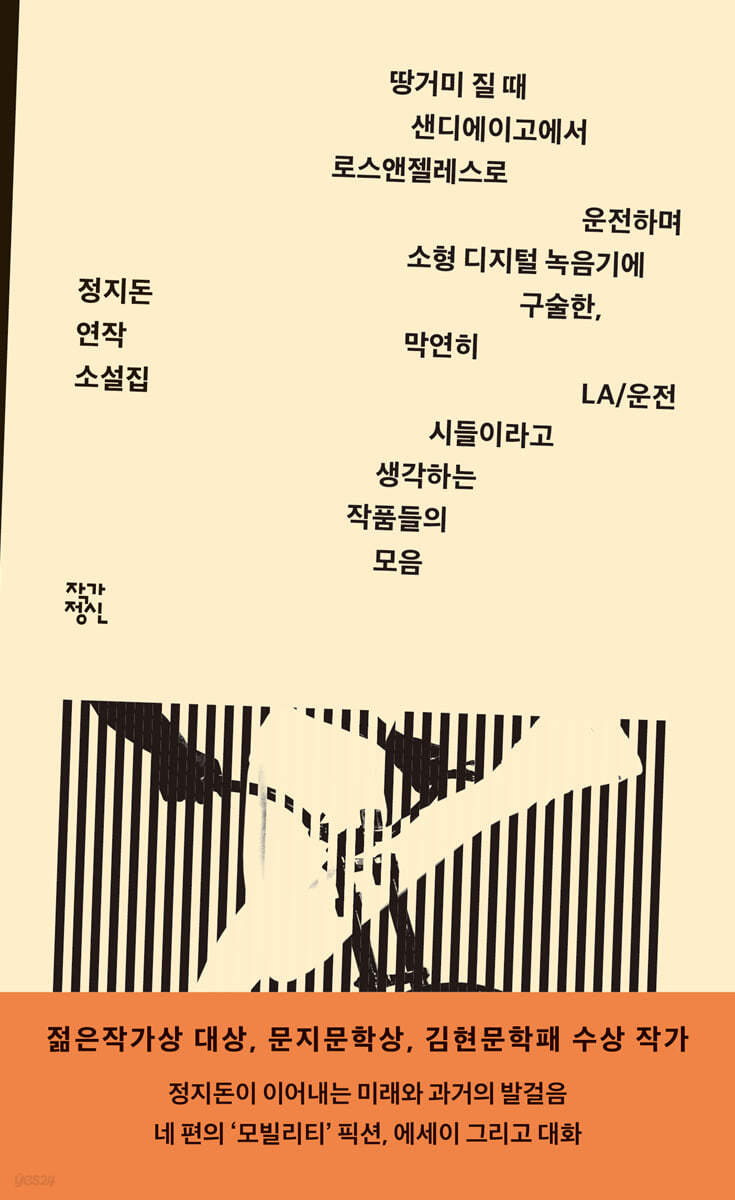
A collection of works that I vaguely consider LA/driving poems, dictated into a small digital recorder while driving from San Diego to Los Angeles during the winter.
 |
Description
Book Introduction
Captain America running and Winter Soldier walking,
Shared kickboards and bicycles dominate the streets… …
Unique thoughts and chatter about cities, people, places and movements!
For the past ten years since his debut, author Ji-don Jeong has been receiving renewed attention for his unique style and language. His first collection of short stories, 『A collection of works vaguely thought of as LA/Driving Poems, dictated to a small digital recorder while driving from San Diego to Los Angeles at dusk』, has been published.
In this series, Jeong Ji-don continues to tell various stories about place and movement, focusing on the concept of "mobility," once again unfolding new literary possibilities and his own unique world.
The four novels in the collection are set in Paris and Seoul and revolve around the everyday yet bizarre incidents that Na and his partner M experience as they walk and run around the city.
At the same time, from Walter Benjamin's walks to Captain America's runs, Jeong Ji-don's unique and charming references to 'mobility' and witty insights continue in an interesting way.
The somewhat unfamiliar term ‘mobility’ is a concept that “includes movement, the representation and meaning of movement that cannot be separated from it, and movement that is specifically experienced.” Jeong Ji-don actively brings this concept into the novel and expands movement or movement to mean “more than just going from A to B” (Eunbyeol Ahn, addition).
In this way, the stories about 'mobility' that he incorporates into his novels are not limited to mere physical distance or place, but rather convey diverse questions about humanity and the world, such as the way people relate to each other and novels to each other.
In addition to the four novels, the collection includes the author's essays on walking and the city, cultural researcher Eunbyeol Ahn's "Addition" on "Mobility," "Train of Thought," and affectionate and sincere conversations between the two.
These writings do not merely provide commentary and annotations to the included novels, but rather connect with the novels and continuously create new stories about 'mobility.'
This book, which does not attempt to stay in one place but continues to move forward, will present readers with new movements and places they have never experienced before.
Pumpkin stones are large, round stones used to strengthen the floor of houses and other places.
These stones, which were broken and lost countless times during the process of city construction, are often considered meaningless and trivial, or indeed, they are, but to me, these digressions seem like structures that support the world.
A universe of objects, memories, and anecdotes whose roles are difficult to guess, whose boundaries between truth and falsehood are unclear, and whose very existence is sometimes unclear.
Walking is a radical act of encountering these gaps.
_From the essay "Counterclockwise"
Shared kickboards and bicycles dominate the streets… …
Unique thoughts and chatter about cities, people, places and movements!
For the past ten years since his debut, author Ji-don Jeong has been receiving renewed attention for his unique style and language. His first collection of short stories, 『A collection of works vaguely thought of as LA/Driving Poems, dictated to a small digital recorder while driving from San Diego to Los Angeles at dusk』, has been published.
In this series, Jeong Ji-don continues to tell various stories about place and movement, focusing on the concept of "mobility," once again unfolding new literary possibilities and his own unique world.
The four novels in the collection are set in Paris and Seoul and revolve around the everyday yet bizarre incidents that Na and his partner M experience as they walk and run around the city.
At the same time, from Walter Benjamin's walks to Captain America's runs, Jeong Ji-don's unique and charming references to 'mobility' and witty insights continue in an interesting way.
The somewhat unfamiliar term ‘mobility’ is a concept that “includes movement, the representation and meaning of movement that cannot be separated from it, and movement that is specifically experienced.” Jeong Ji-don actively brings this concept into the novel and expands movement or movement to mean “more than just going from A to B” (Eunbyeol Ahn, addition).
In this way, the stories about 'mobility' that he incorporates into his novels are not limited to mere physical distance or place, but rather convey diverse questions about humanity and the world, such as the way people relate to each other and novels to each other.
In addition to the four novels, the collection includes the author's essays on walking and the city, cultural researcher Eunbyeol Ahn's "Addition" on "Mobility," "Train of Thought," and affectionate and sincere conversations between the two.
These writings do not merely provide commentary and annotations to the included novels, but rather connect with the novels and continuously create new stories about 'mobility.'
This book, which does not attempt to stay in one place but continues to move forward, will present readers with new movements and places they have never experienced before.
Pumpkin stones are large, round stones used to strengthen the floor of houses and other places.
These stones, which were broken and lost countless times during the process of city construction, are often considered meaningless and trivial, or indeed, they are, but to me, these digressions seem like structures that support the world.
A universe of objects, memories, and anecdotes whose roles are difficult to guess, whose boundaries between truth and falsehood are unclear, and whose very existence is sometimes unclear.
Walking is a radical act of encountering these gaps.
_From the essay "Counterclockwise"
- You can preview some of the book's contents.
Preview
index
"A collection of works that I vaguely think of as LA/driving poems, dictated to a small digital recorder while driving from San Diego to Los Angeles during the rainy season." p.6
"The child was so cute and young that when he saw a doll, he would try to take out its eyes to see what was behind them." p.40
"Now is the time for heroes to act" p.78
Internal Circulation, p.109
Author's essay "Counterclockwise" p.141
Transfer: Addendum to "Train of Thought"_Eunbyeol Ahn (Cultural Researcher) p.152
Conversation Stop Don*An Eun-byeol p.178
"The child was so cute and young that when he saw a doll, he would try to take out its eyes to see what was behind them." p.40
"Now is the time for heroes to act" p.78
Internal Circulation, p.109
Author's essay "Counterclockwise" p.141
Transfer: Addendum to "Train of Thought"_Eunbyeol Ahn (Cultural Researcher) p.152
Conversation Stop Don*An Eun-byeol p.178
Into the book
The reason I don't like novels is because they are not a suitable medium for describing walking.
The same goes for poetry.
Poetry makes walking an eternal act.
Or in a moment.
---From "A collection of works that I vaguely think of as LA/driving poems, dictated to a small digital recorder while driving from San Diego to Los Angeles during the rainy season."
As M said, Paris was full of shared scooters.
The bicycle with the baguette in the basket was nowhere to be found.
Nowadays, people don't pedal hard, don't own their own cars, and don't walk.
No need for a stop, no need for a parking lot, no need for an arcade.
(...)
The means of transportation is the political system.
Representative democracy and the nation-state will collapse due to the sharing economy.
Instead, giant corporations are unifying the world?
---From "A collection of works that I vaguely think of as LA/driving poems, dictated to a small digital recorder while driving from San Diego to Los Angeles during the rainy season."
Em was holding the steering wheel.
According to the account of British critic Scott Dixon, who died in the Battle of Gallipoli, driving at night is like driving on a plank suspended in mid-air.
All sense of speed, direction, and movement disappears, and nothing exists except the low hum of the engine and the whisper of Hongye.
Soon my boundaries also become blurred.
Scott Dixon's writings are among the first to capture the strangeness of driving before it became an essential human skill.
Em enters the field of vision of night drivers in an early 20th century coastal village in a foreign land where artificial light does not exist.
---「The child was so cute and young that when he saw a doll, he would try to take out its eyes to see what was behind them.」
Em said she returned to the 10th district, had coffee and a pint of pimento at a cafe, and bought some denim at a boutique on the way home.
It was a denim from Okayama, a Japanese brand that I had been keeping an eye on, and they were selling it.
Cheaper than Korea?
No, more expensive.
But when asked why he bought it, Em shook his head.
You don't understand what consumption means.
Of course I didn't understand.
Is it something like vanity?
no.
geopolitics.
Em said.
---From "Now is the time for heroes to act"
The conditions of the left that Deleuze spoke of came to mind.
“Being left-wing” means “looking far ahead.”
For him, the Left was a matter of the streets and a geopolitical man.
Thinking of distant people and distant events as if they were your own.
On the other hand, the right wing is a group of people who only think about their own front yard.
In that sense, Koreans are conservatives on both the left and the right… … .
"You?" asks the hazy figure of M.
I remember the blond hair and forearms of the white man who threatened me.
I think of people far away.
But that distance is not space, but time, and it is a place that can be traveled like space within ideas and media… … .
---From "Now is the time for heroes to act"
There was a novel densely printed on beige A4 paper.
The title is 'Squirrel Cage' and the author is Michi-Michi.
Hojun smiled shyly and said that Michi-Michi was his pen name.
Only then did I realize that this person was just like me, nothing special.
It was a strange timing, but that's what happened.
“But I don’t think it’s crazy,” I said to Hojun after quite some time had passed.
It was too flashy a name to be used as a pen name.
Hojun nodded.
He said he thought so too, which is why he changed his name a while ago.
Changed your name? Hojun said he changed his real name to Michi Michi.
The same goes for poetry.
Poetry makes walking an eternal act.
Or in a moment.
---From "A collection of works that I vaguely think of as LA/driving poems, dictated to a small digital recorder while driving from San Diego to Los Angeles during the rainy season."
As M said, Paris was full of shared scooters.
The bicycle with the baguette in the basket was nowhere to be found.
Nowadays, people don't pedal hard, don't own their own cars, and don't walk.
No need for a stop, no need for a parking lot, no need for an arcade.
(...)
The means of transportation is the political system.
Representative democracy and the nation-state will collapse due to the sharing economy.
Instead, giant corporations are unifying the world?
---From "A collection of works that I vaguely think of as LA/driving poems, dictated to a small digital recorder while driving from San Diego to Los Angeles during the rainy season."
Em was holding the steering wheel.
According to the account of British critic Scott Dixon, who died in the Battle of Gallipoli, driving at night is like driving on a plank suspended in mid-air.
All sense of speed, direction, and movement disappears, and nothing exists except the low hum of the engine and the whisper of Hongye.
Soon my boundaries also become blurred.
Scott Dixon's writings are among the first to capture the strangeness of driving before it became an essential human skill.
Em enters the field of vision of night drivers in an early 20th century coastal village in a foreign land where artificial light does not exist.
---「The child was so cute and young that when he saw a doll, he would try to take out its eyes to see what was behind them.」
Em said she returned to the 10th district, had coffee and a pint of pimento at a cafe, and bought some denim at a boutique on the way home.
It was a denim from Okayama, a Japanese brand that I had been keeping an eye on, and they were selling it.
Cheaper than Korea?
No, more expensive.
But when asked why he bought it, Em shook his head.
You don't understand what consumption means.
Of course I didn't understand.
Is it something like vanity?
no.
geopolitics.
Em said.
---From "Now is the time for heroes to act"
The conditions of the left that Deleuze spoke of came to mind.
“Being left-wing” means “looking far ahead.”
For him, the Left was a matter of the streets and a geopolitical man.
Thinking of distant people and distant events as if they were your own.
On the other hand, the right wing is a group of people who only think about their own front yard.
In that sense, Koreans are conservatives on both the left and the right… … .
"You?" asks the hazy figure of M.
I remember the blond hair and forearms of the white man who threatened me.
I think of people far away.
But that distance is not space, but time, and it is a place that can be traveled like space within ideas and media… … .
---From "Now is the time for heroes to act"
There was a novel densely printed on beige A4 paper.
The title is 'Squirrel Cage' and the author is Michi-Michi.
Hojun smiled shyly and said that Michi-Michi was his pen name.
Only then did I realize that this person was just like me, nothing special.
It was a strange timing, but that's what happened.
“But I don’t think it’s crazy,” I said to Hojun after quite some time had passed.
It was too flashy a name to be used as a pen name.
Hojun nodded.
He said he thought so too, which is why he changed his name a while ago.
Changed your name? Hojun said he changed his real name to Michi Michi.
---From "Internal Circulation"
Publisher's Review
Without arriving anywhere
A collection of novels that vaguely continue to advance somewhere.
In the first novel in the series and the title piece, “A collection of what I vaguely think of as LA/driving poems, dictated into a small digital recorder while driving from San Diego to Los Angeles at dusk,” “I” say I am in Paris to write “a novel-essay about a walker,” but I have no concrete plans.
M, who is staying in Paris with him, has long since stopped writing poetry and now 'decides' to make films.
The two figures discuss how they would create their work around the theme of movement or movement over drinks and coffee on a sweltering Parisian summer day.
The scenes where they chat about their plans seem to humorously show the situation where there is no progress in creation.
At the same time, paradoxically, the way they delay the completion of their work, as if taking a slow stroll, the seemingly endless conversation itself completes the novel and creates life.
Meanwhile, the stories about 'mobility' that 'I' unfolds through various references unexpectedly weave together the brilliant thoughts and humorous chatter that we have come to expect from Jeong Ji-don's short stories.
The texts of Flaubert's "Sentimental Education," Yi Mun-yeol's "A Walk Through World Masterpieces," Walter Benjamin, Lee Man-hee's "Holiday," Rousseau's "Captain America: The Winter Soldier," Agnes Varda's films, and even the sharing economy system are covered, and the thoughts that flow without distinction of media or genre provide readers with the pleasure of reading.
Captain America: The Winter Soldier begins with a jog.
The act that symbolizes Captain America is running.
His running is unrivaled among characters who can fly or teleport.
It is a shabby yet human and dynamic act, a physical act.
In contrast, Captain America's enemy, the Siberian cyborg Winter Soldier, never runs.
In “Holiday,” Shin Seong-il runs, but the camera does not reveal his running body.
This self-deprecating and misogynistic figure has no body and therefore no freedom.
He is thoroughly modernist.
Captain America, on the other hand, is realistic and Winter Soldier is socialist realism.
_From "A collection of works that I vaguely think of as LA/driving poems, dictated into a small digital recorder while driving from San Diego to Los Angeles during the rainy season"
Beyond the dichotomy of truth and lies
The scenes, scenes called 'reality' that are being performed here and now
In "The child was so cute and young that when she looked at a doll, she would try to pluck out its eyes to see what was behind them," 'I' and M are staying in Paris following the previous novel, and go on a trip to Normandy with two indexes, a couple with the same name.
Another motif that forms the axis of the work is André Breton's novel 'Nadja', and in the form of variations on this novel, various characters and stories are connected, from Em to surrealist Marcel Moore.
Breton aims to create a literature different from existing literature by writing “according to real life” using real people who were his government and artists as main characters.
However, he gave the character the pseudonym 'Naja', and unlike the novel's reputation as a classic of surrealism, the real Naja is forgotten by the world and leads a difficult life.
Reflecting on this problematic work, ‘I’ asks, “Are all the stories recorded in ‘Naja’ true?”
This is a question about the novel of 'I' who writes "novels and essays" beyond 'Naja', and can be said to be a fundamental exploration of literature or life itself.
'I' does not make a judgment about whether something is true or not, but leaves behind the sentence, "True literature cannot distinguish between truth and falsehood," and continues to move on to the next place.
Around the time France was occupied by the Nazis, Claude Caen and Marcel Moore bought a mansion on the British island of Jersey and secluded themselves there, creating works that were surreal and unrealistically intertwined in their own kingdom.
Their work was a true form of resistance art, a rare kind of event that appeared and disappeared only in that moment and place.
_「The child was so cute and young that when he saw the doll, he would try to take out the eyes to see what was behind them.」
“A universe of opaque objects, memories, anecdotes.
Walking is a radical act of encountering these gaps.”
The two following works revolve around the events that unfold as M and 'I' meet unique characters.
In "Now is the Time for Heroes," Em experiences a bizarre incident where her shared bike is stolen and, with the help of NC, a Korean exchange student with a somewhat invisible appearance, she finds her bike in a Parisian underground space called the "Wunderkammer."
The setting of "Inner Circulation" is Seoul, and the story continues with anecdotes about Ho-jun, who always comes to 'Na's' book talks or lectures, and the stories of novelists such as William Burroughs, David Ohl, and Lovecraft, centered around the novels he writes under the pen name 'Michi Michi', or "series of notes slowly advancing toward a novel."
Like the properties of walking described in “A collection of works that I vaguely think of as LA/Driving Poems, dictated into a small digital recorder while driving from San Diego to Los Angeles during the rainy season,” Jeong Ji-don’s novels continually stretch out time and unfold in unexpected directions.
Also, unlike running, it is not goal-oriented and is not reduced to the development and conclusion of events.
Jeong Ji-don simply reads the stories that are laid out and gathers them together, vaguely and sometimes radically arranging them in the novel so that “they can find their own place.”
We wander along the “paths of travel of dreams” (“Inner Circulation”) that his novels explore, connecting the fragments of our own lives in ways we had never known before.
Em shook her head.
I'll just walk.
NC said not to worry.
This bike has done more than this, and this level of adversity is no problem.
NC put on his helmet, turned on the carbide lamp attached to his helmet like a miner, and slowly started pedaling forward.
The bicycle carrying M and NC slowly rode along the dark national road.
I moved at a pace not much different from walking, but at times I felt as if I was sliding on black ice, and perhaps because of the unusual temperature, a soft, warm Mediterranean breeze blew across the Parisian night sky in mid-September.
_From "Now is the time for heroes to act"
A collection of novels that vaguely continue to advance somewhere.
In the first novel in the series and the title piece, “A collection of what I vaguely think of as LA/driving poems, dictated into a small digital recorder while driving from San Diego to Los Angeles at dusk,” “I” say I am in Paris to write “a novel-essay about a walker,” but I have no concrete plans.
M, who is staying in Paris with him, has long since stopped writing poetry and now 'decides' to make films.
The two figures discuss how they would create their work around the theme of movement or movement over drinks and coffee on a sweltering Parisian summer day.
The scenes where they chat about their plans seem to humorously show the situation where there is no progress in creation.
At the same time, paradoxically, the way they delay the completion of their work, as if taking a slow stroll, the seemingly endless conversation itself completes the novel and creates life.
Meanwhile, the stories about 'mobility' that 'I' unfolds through various references unexpectedly weave together the brilliant thoughts and humorous chatter that we have come to expect from Jeong Ji-don's short stories.
The texts of Flaubert's "Sentimental Education," Yi Mun-yeol's "A Walk Through World Masterpieces," Walter Benjamin, Lee Man-hee's "Holiday," Rousseau's "Captain America: The Winter Soldier," Agnes Varda's films, and even the sharing economy system are covered, and the thoughts that flow without distinction of media or genre provide readers with the pleasure of reading.
Captain America: The Winter Soldier begins with a jog.
The act that symbolizes Captain America is running.
His running is unrivaled among characters who can fly or teleport.
It is a shabby yet human and dynamic act, a physical act.
In contrast, Captain America's enemy, the Siberian cyborg Winter Soldier, never runs.
In “Holiday,” Shin Seong-il runs, but the camera does not reveal his running body.
This self-deprecating and misogynistic figure has no body and therefore no freedom.
He is thoroughly modernist.
Captain America, on the other hand, is realistic and Winter Soldier is socialist realism.
_From "A collection of works that I vaguely think of as LA/driving poems, dictated into a small digital recorder while driving from San Diego to Los Angeles during the rainy season"
Beyond the dichotomy of truth and lies
The scenes, scenes called 'reality' that are being performed here and now
In "The child was so cute and young that when she looked at a doll, she would try to pluck out its eyes to see what was behind them," 'I' and M are staying in Paris following the previous novel, and go on a trip to Normandy with two indexes, a couple with the same name.
Another motif that forms the axis of the work is André Breton's novel 'Nadja', and in the form of variations on this novel, various characters and stories are connected, from Em to surrealist Marcel Moore.
Breton aims to create a literature different from existing literature by writing “according to real life” using real people who were his government and artists as main characters.
However, he gave the character the pseudonym 'Naja', and unlike the novel's reputation as a classic of surrealism, the real Naja is forgotten by the world and leads a difficult life.
Reflecting on this problematic work, ‘I’ asks, “Are all the stories recorded in ‘Naja’ true?”
This is a question about the novel of 'I' who writes "novels and essays" beyond 'Naja', and can be said to be a fundamental exploration of literature or life itself.
'I' does not make a judgment about whether something is true or not, but leaves behind the sentence, "True literature cannot distinguish between truth and falsehood," and continues to move on to the next place.
Around the time France was occupied by the Nazis, Claude Caen and Marcel Moore bought a mansion on the British island of Jersey and secluded themselves there, creating works that were surreal and unrealistically intertwined in their own kingdom.
Their work was a true form of resistance art, a rare kind of event that appeared and disappeared only in that moment and place.
_「The child was so cute and young that when he saw the doll, he would try to take out the eyes to see what was behind them.」
“A universe of opaque objects, memories, anecdotes.
Walking is a radical act of encountering these gaps.”
The two following works revolve around the events that unfold as M and 'I' meet unique characters.
In "Now is the Time for Heroes," Em experiences a bizarre incident where her shared bike is stolen and, with the help of NC, a Korean exchange student with a somewhat invisible appearance, she finds her bike in a Parisian underground space called the "Wunderkammer."
The setting of "Inner Circulation" is Seoul, and the story continues with anecdotes about Ho-jun, who always comes to 'Na's' book talks or lectures, and the stories of novelists such as William Burroughs, David Ohl, and Lovecraft, centered around the novels he writes under the pen name 'Michi Michi', or "series of notes slowly advancing toward a novel."
Like the properties of walking described in “A collection of works that I vaguely think of as LA/Driving Poems, dictated into a small digital recorder while driving from San Diego to Los Angeles during the rainy season,” Jeong Ji-don’s novels continually stretch out time and unfold in unexpected directions.
Also, unlike running, it is not goal-oriented and is not reduced to the development and conclusion of events.
Jeong Ji-don simply reads the stories that are laid out and gathers them together, vaguely and sometimes radically arranging them in the novel so that “they can find their own place.”
We wander along the “paths of travel of dreams” (“Inner Circulation”) that his novels explore, connecting the fragments of our own lives in ways we had never known before.
Em shook her head.
I'll just walk.
NC said not to worry.
This bike has done more than this, and this level of adversity is no problem.
NC put on his helmet, turned on the carbide lamp attached to his helmet like a miner, and slowly started pedaling forward.
The bicycle carrying M and NC slowly rode along the dark national road.
I moved at a pace not much different from walking, but at times I felt as if I was sliding on black ice, and perhaps because of the unusual temperature, a soft, warm Mediterranean breeze blew across the Parisian night sky in mid-September.
_From "Now is the time for heroes to act"
GOODS SPECIFICS
- Date of issue: March 28, 2023
- Page count, weight, size: 228 pages | 248g | 118*195*20mm
- ISBN13: 9791160263060
- ISBN10: 116026306X
You may also like
카테고리
korean


korean

![GQ KOREA Mark (Monthly): December [2025]](http://librairie.coreenne.fr/cdn/shop/files/8ef265dbbfbf186523ed75ba7319009d.jpg?v=1765340328&width=3840)


