

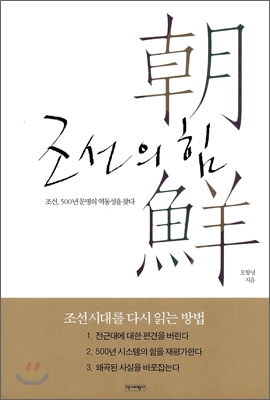
Joseon's power
 |
Description
Book Introduction
The idea of Joseon as a lost 500 years is over!
Re-evaluating Joseon's strength
Joseon was the last dynasty.
As Joseon fell into a colony and democracy, a modern political system, was introduced, the Joseon Dynasty was actively denied.
At best, it was only brought to light in historical dramas.
This perception of history is not unrelated to a worldview that values modern values.
Japanese colonial rule also played a role.
According to the colonial view of history and the modern-oriented understanding of history, Joseon was simply an incompetent country that was unable to wisely overcome the crisis of national ruin due to factional strife.
There are also contrasting claims.
In world history, it is difficult to find a precedent for a dynasty that has lasted for over 500 years.
Although it eventually disappeared, the basic position of historians who view Joseon positively is that the reason Joseon was able to endure for 500 years was because of its excellent political system and ruling ideology.
“The Power of Joseon” represents the latter position.
This book is an attempt to refute existing misunderstandings and negative views of the Joseon Dynasty and to reevaluate the power of Joseon that led the dynasty for 500 years.
We aim to re-evaluate the value of Joseon by analyzing its systems, including Munchiju, Daedongbeop, Silok, and Gangsang.
Efforts to correct prejudices about Joseon's Neo-Confucianism, factional strife, and King Danjong, which have been disparaged by distorted historical views since the modern era, can also be seen throughout the book.
Re-evaluating Joseon's strength
Joseon was the last dynasty.
As Joseon fell into a colony and democracy, a modern political system, was introduced, the Joseon Dynasty was actively denied.
At best, it was only brought to light in historical dramas.
This perception of history is not unrelated to a worldview that values modern values.
Japanese colonial rule also played a role.
According to the colonial view of history and the modern-oriented understanding of history, Joseon was simply an incompetent country that was unable to wisely overcome the crisis of national ruin due to factional strife.
There are also contrasting claims.
In world history, it is difficult to find a precedent for a dynasty that has lasted for over 500 years.
Although it eventually disappeared, the basic position of historians who view Joseon positively is that the reason Joseon was able to endure for 500 years was because of its excellent political system and ruling ideology.
“The Power of Joseon” represents the latter position.
This book is an attempt to refute existing misunderstandings and negative views of the Joseon Dynasty and to reevaluate the power of Joseon that led the dynasty for 500 years.
We aim to re-evaluate the value of Joseon by analyzing its systems, including Munchiju, Daedongbeop, Silok, and Gangsang.
Efforts to correct prejudices about Joseon's Neo-Confucianism, factional strife, and King Danjong, which have been disparaged by distorted historical views since the modern era, can also be seen throughout the book.
- You can preview some of the book's contents.
Preview
index
prolog
Chapter 1: The Flower of Civilization
Chapter 2: The Real Record, That Rock-Like Power
Chapter 3 Constitution and the Lectures
Chapter 4: The Law of the Great East, an Innovative System
Chapter 5: The Old Future, Joseon Neo-Confucianism
Chapter 6: The Resurrection of King Gwanghae
Chapter 7: Partisan Strife and Misunderstandings about Qi
Chapter 8: Setting History Straight - King Danjong and the Six Martyred Ministers
Epilogue
Americas
Chapter 1: The Flower of Civilization
Chapter 2: The Real Record, That Rock-Like Power
Chapter 3 Constitution and the Lectures
Chapter 4: The Law of the Great East, an Innovative System
Chapter 5: The Old Future, Joseon Neo-Confucianism
Chapter 6: The Resurrection of King Gwanghae
Chapter 7: Partisan Strife and Misunderstandings about Qi
Chapter 8: Setting History Straight - King Danjong and the Six Martyred Ministers
Epilogue
Americas
Publisher's Review
The two faces of Joseon, brilliant or distorted
Joseon has two faces.
The Joseon Dynasty is sometimes celebrated in brilliant light, but at other times it is banished from our past in a distorted form.
Joseon is a great legacy that illuminates our past, but at the same time, it is also a trace of a distant past that has nothing to do with us (and sometimes we do not want to reveal).
Today, countless movies, dramas, and publications are competing to deal with Joseon, glorifying the spirit and people of the Joseon Dynasty.
But on the other hand, Joseon is still a shameful portrait of the past, burdened with the yoke of being 'pre-modern,' 'a ruined nation,' and 'outdated.'
Between the brilliance and distortion, the positivity and negativity, of this strangely two-faced face, our eyes and hearts as we look at 'Joseon' are also wavering.
What exactly is Joseon to us?
The author's ultimate message in this book, "The Power of Joseon," is to confront the power and limitations of Joseon's 500 years as they were.
In that sense, this book will serve as a historical textbook, providing new perspectives and a point of reflection for readers seeking to gain a correct understanding of the power and misunderstandings of the Joseon Dynasty.
Joseon's Power vs. Joseon's Misconceptions: Reflecting on the Reality
The most important point emphasized in this book, “The Power of Joseon,” is to reread Joseon “as it was,” or to see Joseon differently by breaking away from the existing perception of the Joseon Dynasty.
In short, the intention is to break free from ignorance and distortion about Joseon by accurately dividing and examining the positive and negative elements of Joseon.
Above all, the dynamism that led the Joseon Dynasty for 500 years must be fully acknowledged, and the misunderstandings about Joseon that have been distorted by prejudice and speculation must be put into their proper place.
Joseon always valued cultural rule over military rule, and continuously recorded historical records to maintain historical legitimacy.
He also attempted to harmonize the laws of the state with the moral code of individuals, and to reform the system to systematically solve the people's pressing livelihood problems.
Therefore, in order to re-evaluate Joseon's potential, we must first break free from the prejudice that the pre-modern era is a flawed past.
Of course, we shouldn't overestimate the past, but we shouldn't outrageously disparage it just because it's old.
At the same time, we must be wary of and correct the distorted historical interpretations and evaluations of Joseon that arose during colonialism and modernization.
The most important thing of all is to see our past 'as it was'.
Only then can we understand Joseon's dynamism and resolve misunderstandings about it.
The Power of Joseon: The Power of Civilization, Annals of the Joseon Dynasty, Kang Sang, and the Daedong Law
Discovering the dynamism of Joseon is like exploring the thick layers of Joseon itself.
This is an act of reviewing the historical facts accumulated in our past, and at the same time, it is an act of affirming who we are today.
Unless we see the full force of our cultural heritage, neither our past nor our present will ever find their true face.
This book emphasizes that the Joseon civilization, which lasted for over 500 years, had a system that made it possible, and that it had several central axes.
Chapter 1, ‘The Flower of Civilization’, shows that civilization was at the core of Joseon’s systems and ideology.
The civil service system was centered around the Gyeongyeon, which was in charge of the king's education; the Eon-gwan, which was in charge of criticizing and impeaching historical and political events; and the Sa-gwan, which was in charge of recording accurate history.
Joseon believed that the power of writing and education was most important in order to shake off the temptation of force and tyranny and to pass down and maintain the dynasty from generation to generation in a civilized manner.
How accountable an institution is depends on how its authority and power are 'managed'.
Joseon knew very well that cultural rule was stronger than any kind of military rule.
Joseon was maintained through the meeting of institutions and ideas, the tension between power and culture, and precisely in that balance.
Chapter 2, 'The Annals of the Joseon Dynasty, That Rock-Like Power', is a story about the massive historical infrastructure called the Annals of the Joseon Dynasty, left behind by the historians among the three 'Troika' of the above-mentioned civil service.
In fact, the record called 『Sillok』 is the most familiar to people among the heritages of the Joseon Dynasty.
However, surprisingly little is known about the specific production process or meaning.
The Annals of the Joseon Dynasty are a cultural infrastructure that vividly illustrates the question of how to infuse historical tension and mission into a single system.
It provides a detailed and interesting introduction to why Joseon put so much effort into compiling the Annals of the Joseon Dynasty.
The spirit of Joseon's Annals, which sought to reflect on its own era through the power of the mirror called history, is also what is most desperately needed in Korea today.
Without the Annals of Joseon, one cannot even imagine Joseon civilization.
Chapter 3, "Constitution and Lectures," and Chapter 4, "Daedong Law, an Innovative System," specifically show how the great civilization of Joseon attempted to resolve legal and economic issues through what structure and system.
Joseon organized its government around the Gyeongguk Daejeon, which corresponds to today's constitution.
That is the rule of law.
And as for informal daily life, the norms for community life were established based on the Confucian classics called the Four Books.
This is the rule of etiquette.
Here we can see the power of the Joseon social system that maintained a balance between official law and private morality.
This article will also be very useful for understanding past and present cultural differences regarding law and norms.
The 'Daedong Law' was, in modern terms, a policy that considered "how to solve the thorny livelihood problems of the people, especially tax issues."
The people who suffer under taxes that are out of touch with reality, and the efforts to alleviate their suffering, are also tasks that the government must address today.
The process of Joseon's 200-year promotion of the Daedong Law clearly demonstrates what innovation in the national administration system is and how it should be achieved.
In this process, we can correct existing misunderstandings about the entities promoting the Daedong Law and consider what so-called "national policy" is.
Misconceptions about Joseon: Joseon Neo-Confucianism, King Gwanghaegun, factional strife, and King Danjong (and the Six Martyred Ministers)
Chapter 5, ‘The Old Future, Joseon Seongrihak’, is about Seongrihak, which permeates the spirit of Joseon.
Neo-Confucianism or Zhu Xi's teachings are often criticized as the main culprit that led to the downfall of Joseon.
Although it is misunderstood as an academic discipline that mainly focuses on empty talk and ignores real-world issues, the Neo-Confucianism that the author discovered was a very everyday academic discipline with the keywords of 'the Doctrine of the Mean and the People.'
There are traces of constant struggle to overcome the gap between reality and ideals, and there is the maternal spirit that gave birth to our great thinkers, including Toegye and Yulgok.
Although it has been distorted by partisan interests in later generations, the value of its basic spirit cannot be underestimated, even compared to today's philosophies and thoughts.
In particular, this book focuses on the everyday nature of Neo-Confucianism, and introduces a variety of issues that need to be reexamined among the existing discussions on the history of Joseon thought, such as the orthodoxy and heresy of Joseon's history of thought, Joseon's Neo-Confucianism and Yangmingism, and Neo-Confucianism and Silhak.
Chapter 6, ‘The Resurrection of King Gwanghaegun’, covers various discussions about King Gwanghaegun.
Chapters 6 and 7 in particular focus on cases of distorted representations of Joseon.
The author was astonished while organizing data on King Gwanghaegun, who is often cited as a representative example of pragmatic diplomacy.
Of course, there were some parts that were questionable during that time, but when we actually opened the lid, we saw that the distortion of facts and logic used to support Gwanghaegun was extremely serious.
Through misinterpretation of historical materials and the resulting claims of a false pretense, the original identity of King Gwanghae disappeared and he was 'resurrected' as a great king.
Although there may be differences in perspectives based on interests or values, we must strongly criticize the fact that these differences in perspectives are caused by distortions of facts and logic.
Because it is a matter of basis and common sense.
In that respect, understanding the era of King Gwanghaegun is also a key topic that determines the perspective on the Joseon Dynasty.
Chapter 7, 'Party Strife and Misunderstandings about Qi', is an extension of Chapter 6 and raises questions about viewpoints that contain distortions and errors in facts and logic.
Through various media, he discovered that the perception of people in the Joseon Dynasty was very similar to the 'Kongjwi and Patjwi' structure that simply divided good and evil, and he sharply criticized the countless prejudices and distortions it created.
Criticism of partisan strife based on colonialism and the theory of Zhu Li and Zhu Zi that fails to integrate Zhu Xi's teachings can also be said to be the harmful effects of simple dichotomies.
As an appendix, I have included two articles titled ‘Debate with Lee Deok-il’ that were published in the Hankyoreh newspaper.
Chapter 8, 'Correcting History - King Danjong and the Six Martyrs', deals with the reinstatement of King Danjong and the Six Martyrs. This period was none other than the reign of King Sukjong, when Jang Hui-bin and the Seoin (Noron) and Namin factions were said to have been at odds with each other.
The Joseon-style 'history correction' was carried out until the time when it was gradually considered to be 'on the verge of collapse'.
This feat, which took more than 200 years, was a monumental event that restored history based on facts, as well as a long journey of Joseon intellectuals to acknowledge what was "right."
This process also clearly shows that the tendency to easily forget the past, commonly referred to as 'pot mentality', is not in our genes.
Joseon has two faces.
The Joseon Dynasty is sometimes celebrated in brilliant light, but at other times it is banished from our past in a distorted form.
Joseon is a great legacy that illuminates our past, but at the same time, it is also a trace of a distant past that has nothing to do with us (and sometimes we do not want to reveal).
Today, countless movies, dramas, and publications are competing to deal with Joseon, glorifying the spirit and people of the Joseon Dynasty.
But on the other hand, Joseon is still a shameful portrait of the past, burdened with the yoke of being 'pre-modern,' 'a ruined nation,' and 'outdated.'
Between the brilliance and distortion, the positivity and negativity, of this strangely two-faced face, our eyes and hearts as we look at 'Joseon' are also wavering.
What exactly is Joseon to us?
The author's ultimate message in this book, "The Power of Joseon," is to confront the power and limitations of Joseon's 500 years as they were.
In that sense, this book will serve as a historical textbook, providing new perspectives and a point of reflection for readers seeking to gain a correct understanding of the power and misunderstandings of the Joseon Dynasty.
Joseon's Power vs. Joseon's Misconceptions: Reflecting on the Reality
The most important point emphasized in this book, “The Power of Joseon,” is to reread Joseon “as it was,” or to see Joseon differently by breaking away from the existing perception of the Joseon Dynasty.
In short, the intention is to break free from ignorance and distortion about Joseon by accurately dividing and examining the positive and negative elements of Joseon.
Above all, the dynamism that led the Joseon Dynasty for 500 years must be fully acknowledged, and the misunderstandings about Joseon that have been distorted by prejudice and speculation must be put into their proper place.
Joseon always valued cultural rule over military rule, and continuously recorded historical records to maintain historical legitimacy.
He also attempted to harmonize the laws of the state with the moral code of individuals, and to reform the system to systematically solve the people's pressing livelihood problems.
Therefore, in order to re-evaluate Joseon's potential, we must first break free from the prejudice that the pre-modern era is a flawed past.
Of course, we shouldn't overestimate the past, but we shouldn't outrageously disparage it just because it's old.
At the same time, we must be wary of and correct the distorted historical interpretations and evaluations of Joseon that arose during colonialism and modernization.
The most important thing of all is to see our past 'as it was'.
Only then can we understand Joseon's dynamism and resolve misunderstandings about it.
The Power of Joseon: The Power of Civilization, Annals of the Joseon Dynasty, Kang Sang, and the Daedong Law
Discovering the dynamism of Joseon is like exploring the thick layers of Joseon itself.
This is an act of reviewing the historical facts accumulated in our past, and at the same time, it is an act of affirming who we are today.
Unless we see the full force of our cultural heritage, neither our past nor our present will ever find their true face.
This book emphasizes that the Joseon civilization, which lasted for over 500 years, had a system that made it possible, and that it had several central axes.
Chapter 1, ‘The Flower of Civilization’, shows that civilization was at the core of Joseon’s systems and ideology.
The civil service system was centered around the Gyeongyeon, which was in charge of the king's education; the Eon-gwan, which was in charge of criticizing and impeaching historical and political events; and the Sa-gwan, which was in charge of recording accurate history.
Joseon believed that the power of writing and education was most important in order to shake off the temptation of force and tyranny and to pass down and maintain the dynasty from generation to generation in a civilized manner.
How accountable an institution is depends on how its authority and power are 'managed'.
Joseon knew very well that cultural rule was stronger than any kind of military rule.
Joseon was maintained through the meeting of institutions and ideas, the tension between power and culture, and precisely in that balance.
Chapter 2, 'The Annals of the Joseon Dynasty, That Rock-Like Power', is a story about the massive historical infrastructure called the Annals of the Joseon Dynasty, left behind by the historians among the three 'Troika' of the above-mentioned civil service.
In fact, the record called 『Sillok』 is the most familiar to people among the heritages of the Joseon Dynasty.
However, surprisingly little is known about the specific production process or meaning.
The Annals of the Joseon Dynasty are a cultural infrastructure that vividly illustrates the question of how to infuse historical tension and mission into a single system.
It provides a detailed and interesting introduction to why Joseon put so much effort into compiling the Annals of the Joseon Dynasty.
The spirit of Joseon's Annals, which sought to reflect on its own era through the power of the mirror called history, is also what is most desperately needed in Korea today.
Without the Annals of Joseon, one cannot even imagine Joseon civilization.
Chapter 3, "Constitution and Lectures," and Chapter 4, "Daedong Law, an Innovative System," specifically show how the great civilization of Joseon attempted to resolve legal and economic issues through what structure and system.
Joseon organized its government around the Gyeongguk Daejeon, which corresponds to today's constitution.
That is the rule of law.
And as for informal daily life, the norms for community life were established based on the Confucian classics called the Four Books.
This is the rule of etiquette.
Here we can see the power of the Joseon social system that maintained a balance between official law and private morality.
This article will also be very useful for understanding past and present cultural differences regarding law and norms.
The 'Daedong Law' was, in modern terms, a policy that considered "how to solve the thorny livelihood problems of the people, especially tax issues."
The people who suffer under taxes that are out of touch with reality, and the efforts to alleviate their suffering, are also tasks that the government must address today.
The process of Joseon's 200-year promotion of the Daedong Law clearly demonstrates what innovation in the national administration system is and how it should be achieved.
In this process, we can correct existing misunderstandings about the entities promoting the Daedong Law and consider what so-called "national policy" is.
Misconceptions about Joseon: Joseon Neo-Confucianism, King Gwanghaegun, factional strife, and King Danjong (and the Six Martyred Ministers)
Chapter 5, ‘The Old Future, Joseon Seongrihak’, is about Seongrihak, which permeates the spirit of Joseon.
Neo-Confucianism or Zhu Xi's teachings are often criticized as the main culprit that led to the downfall of Joseon.
Although it is misunderstood as an academic discipline that mainly focuses on empty talk and ignores real-world issues, the Neo-Confucianism that the author discovered was a very everyday academic discipline with the keywords of 'the Doctrine of the Mean and the People.'
There are traces of constant struggle to overcome the gap between reality and ideals, and there is the maternal spirit that gave birth to our great thinkers, including Toegye and Yulgok.
Although it has been distorted by partisan interests in later generations, the value of its basic spirit cannot be underestimated, even compared to today's philosophies and thoughts.
In particular, this book focuses on the everyday nature of Neo-Confucianism, and introduces a variety of issues that need to be reexamined among the existing discussions on the history of Joseon thought, such as the orthodoxy and heresy of Joseon's history of thought, Joseon's Neo-Confucianism and Yangmingism, and Neo-Confucianism and Silhak.
Chapter 6, ‘The Resurrection of King Gwanghaegun’, covers various discussions about King Gwanghaegun.
Chapters 6 and 7 in particular focus on cases of distorted representations of Joseon.
The author was astonished while organizing data on King Gwanghaegun, who is often cited as a representative example of pragmatic diplomacy.
Of course, there were some parts that were questionable during that time, but when we actually opened the lid, we saw that the distortion of facts and logic used to support Gwanghaegun was extremely serious.
Through misinterpretation of historical materials and the resulting claims of a false pretense, the original identity of King Gwanghae disappeared and he was 'resurrected' as a great king.
Although there may be differences in perspectives based on interests or values, we must strongly criticize the fact that these differences in perspectives are caused by distortions of facts and logic.
Because it is a matter of basis and common sense.
In that respect, understanding the era of King Gwanghaegun is also a key topic that determines the perspective on the Joseon Dynasty.
Chapter 7, 'Party Strife and Misunderstandings about Qi', is an extension of Chapter 6 and raises questions about viewpoints that contain distortions and errors in facts and logic.
Through various media, he discovered that the perception of people in the Joseon Dynasty was very similar to the 'Kongjwi and Patjwi' structure that simply divided good and evil, and he sharply criticized the countless prejudices and distortions it created.
Criticism of partisan strife based on colonialism and the theory of Zhu Li and Zhu Zi that fails to integrate Zhu Xi's teachings can also be said to be the harmful effects of simple dichotomies.
As an appendix, I have included two articles titled ‘Debate with Lee Deok-il’ that were published in the Hankyoreh newspaper.
Chapter 8, 'Correcting History - King Danjong and the Six Martyrs', deals with the reinstatement of King Danjong and the Six Martyrs. This period was none other than the reign of King Sukjong, when Jang Hui-bin and the Seoin (Noron) and Namin factions were said to have been at odds with each other.
The Joseon-style 'history correction' was carried out until the time when it was gradually considered to be 'on the verge of collapse'.
This feat, which took more than 200 years, was a monumental event that restored history based on facts, as well as a long journey of Joseon intellectuals to acknowledge what was "right."
This process also clearly shows that the tendency to easily forget the past, commonly referred to as 'pot mentality', is not in our genes.
GOODS SPECIFICS
- Date of issue: February 5, 2010
- Page count, weight, size: 327 pages | 446g | 153*224*30mm
- ISBN13: 9788976965356
- ISBN10: 8976965353
You may also like
카테고리
korean


korean

![GQ KOREA Mark (Monthly): December [2025]](http://librairie.coreenne.fr/cdn/shop/files/8ef265dbbfbf186523ed75ba7319009d.jpg?v=1765340328&width=3840)


