

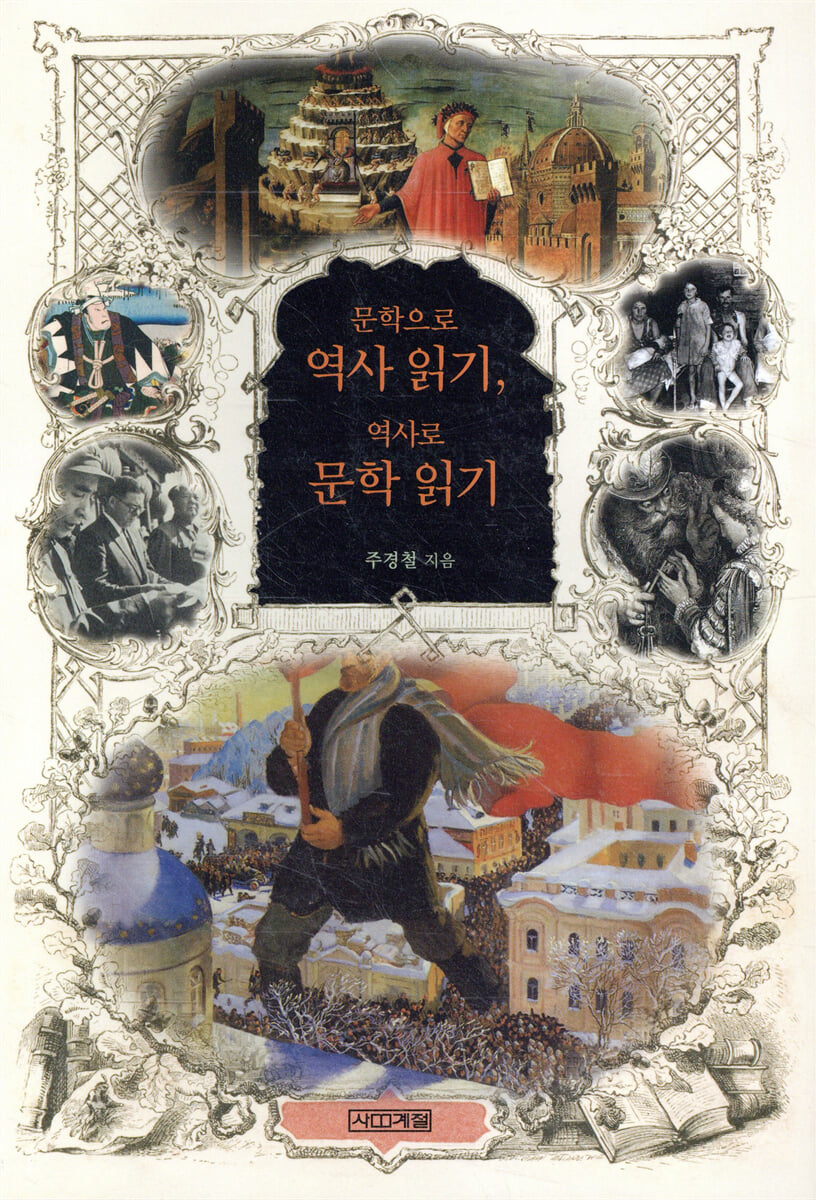
Reading history through literature, reading literature through history
 |
Description
Book Introduction
From Aesop's fables of ancient Greece to modern Chinese novels,
By harmoniously weaving together literary texts and historical records, it provides a close look into the inner lives of the people of that time.
Historical records are the best source for accurately understanding past times, but it is difficult to read between the lines of records with only fact-based sources.
The author, who chose the medium of "literature" to effectively revive the hidden meanings and stories within objectively described history, interestingly unravels the flow of the times and the people delicately embedded within it.
The author allows us to see a cross-section of Greek society from the perspective of slaves through Aesop's Fables, and in Dante's Divine Comedy, through the "Purgatorio" section, he points out how the afterlife was restructured by adding purgatory to the dichotomy of heaven and hell.
He traces the author's inner thoughts, which can be found in many of his works, and conveys them in an easily understandable manner through detailed explanations.
The structure of this book, which deals with both literature and history, allows us to experience history not as a mere, flat, stuffed fact, but as a living time that occurred in real life.
Through this, readers not only have a closer look at history, but also have the opportunity to understand literary works they already know more deeply.
By harmoniously weaving together literary texts and historical records, it provides a close look into the inner lives of the people of that time.
Historical records are the best source for accurately understanding past times, but it is difficult to read between the lines of records with only fact-based sources.
The author, who chose the medium of "literature" to effectively revive the hidden meanings and stories within objectively described history, interestingly unravels the flow of the times and the people delicately embedded within it.
The author allows us to see a cross-section of Greek society from the perspective of slaves through Aesop's Fables, and in Dante's Divine Comedy, through the "Purgatorio" section, he points out how the afterlife was restructured by adding purgatory to the dichotomy of heaven and hell.
He traces the author's inner thoughts, which can be found in many of his works, and conveys them in an easily understandable manner through detailed explanations.
The structure of this book, which deals with both literature and history, allows us to experience history not as a mere, flat, stuffed fact, but as a living time that occurred in real life.
Through this, readers not only have a closer look at history, but also have the opportunity to understand literary works they already know more deeply.
- You can preview some of the book's contents.
Preview
index
Where literature and history meet
How a Wise Slave Lives - Aesop's Fables
A citizen does not flatter a tyrant - Aeschylus' "Agamemnon"
Gaining Wisdom Through Suffering - Aeschylus' Oresteia Trilogy
A fatal medieval love story - Tristan and Izz
A Massive Restructuring of the Afterlife - Dante's Purgatorio from the Divine Comedy
A World of Human Love that Transcends Death - Boccaccio's Decameron
The Arab Commercial World and Literature - Sinbad the Sailor and Sinbad the Porter
Bushido is about dying - 『Shushingura』
Fairy Tale Wedding Stories - "Bluebeard" and "The White Bird"
Pugachev's Rebellion and Pushkin - Pushkin's The Captain's Daughter
The French Revolution, the Empire, and Women - Madame Stahl's "Corinna"
A Coming-of-Age Novel in the Age of Imperialism - Robert Stevenson's Treasure Island
He who rules the sea rules the world - Jules Verne's Twenty Thousand Leagues Under the Sea
A soul as free as a cedar tree - Henry David Thoreau's "Civil Disobedience" and "Walden"
From the Author of "The Stars" to a Patriotic Poet - A Collection of Short Stories by Alphonse Daudet
The cultural icon that dominated the 20th century - Edgar Rice Burroughs' Tarzan
The dark power of the East threatening the West - Bram Stoker's Dracula
A Journey into a Dark Future - H.G. Wells' The Time Machine
Awakening to the World's Great Soul - John Steinbeck's The Grapes of Wrath
A Poetic Commentary on 20th-Century History - Brecht's "The Sorrow of the Survivor"
Darkness in the Age of Nuclear War - William Golding's Lord of the Flies
The Pure Love that Survived the Madness of the Cultural Revolution - Wei Hua's "The Story of Selling Blood"
How a Wise Slave Lives - Aesop's Fables
A citizen does not flatter a tyrant - Aeschylus' "Agamemnon"
Gaining Wisdom Through Suffering - Aeschylus' Oresteia Trilogy
A fatal medieval love story - Tristan and Izz
A Massive Restructuring of the Afterlife - Dante's Purgatorio from the Divine Comedy
A World of Human Love that Transcends Death - Boccaccio's Decameron
The Arab Commercial World and Literature - Sinbad the Sailor and Sinbad the Porter
Bushido is about dying - 『Shushingura』
Fairy Tale Wedding Stories - "Bluebeard" and "The White Bird"
Pugachev's Rebellion and Pushkin - Pushkin's The Captain's Daughter
The French Revolution, the Empire, and Women - Madame Stahl's "Corinna"
A Coming-of-Age Novel in the Age of Imperialism - Robert Stevenson's Treasure Island
He who rules the sea rules the world - Jules Verne's Twenty Thousand Leagues Under the Sea
A soul as free as a cedar tree - Henry David Thoreau's "Civil Disobedience" and "Walden"
From the Author of "The Stars" to a Patriotic Poet - A Collection of Short Stories by Alphonse Daudet
The cultural icon that dominated the 20th century - Edgar Rice Burroughs' Tarzan
The dark power of the East threatening the West - Bram Stoker's Dracula
A Journey into a Dark Future - H.G. Wells' The Time Machine
Awakening to the World's Great Soul - John Steinbeck's The Grapes of Wrath
A Poetic Commentary on 20th-Century History - Brecht's "The Sorrow of the Survivor"
Darkness in the Age of Nuclear War - William Golding's Lord of the Flies
The Pure Love that Survived the Madness of the Cultural Revolution - Wei Hua's "The Story of Selling Blood"
Into the book
What kind of ancient Greek society did Aesop live in? Perhaps we view Greek civilization through a somewhat biased lens.
It is a place where the legendary architect Phidias builds the most magnificent temple in human history, where in the evenings citizens go to see performances of the great works of Aeschylus or Aristophanes, and where great philosophers like Socrates hold profound conversations in the streets.
Of course, the existence of such elements made ancient Greek civilization a profound source of inspiration for later Western civilization, but I want to emphasize that we should not only look at these shining aspects.
--- p.14
In fact, looking back, we cannot help but wonder why Agamemnon, Clytemnestra, or Orestes suffered.
The mythical explanation that such suffering is due to a curse passed down from our distant ancestors is difficult to accept with our current sensibilities.
Why should we be destroyed by the will of a god we cannot understand? Yet, faced with such a dilemma, the Greeks never complained of injustice.
Their idea is that humans are bound to disaster by some unknown force that originates beyond the limits of our perception.
Therefore, the protagonists of tragedies do not lament their fate, but rather face it with dignity and then fall magnificently.
--- p.37
The one-legged pirate, the sailor carrying a parrot on his shoulder, the black spot that announced judgment and execution within the pirate group, and the punishment method of disembarking the sailor on a deserted island were all widely known through this work (Treasure Island).
In fact, these elements do not exist only in novels, but actually existed in the maritime world of the past.
Rather, the most unrealistic thing is the existence of 'Treasure Island', the main subject of this novel.
A tropical island where pirates hid their plundered treasures, and a secret map marking its location is an intriguing story that captures our imagination, but the likelihood of such a thing actually happening is slim.
Contrary to popular belief, the cargo plundered by pirates was not gold or silver, but rather common cargo such as grain, dyes, and leather goods. The money earned from selling this plundered cargo was quickly spent.
Pirates were desperate to make a living, and even if they had spare money, they would waste it recklessly and had no habit of saving for tomorrow.
--- p.143
After the defeat in the Franco-Prussian War, a desire for revenge took root in the hearts of the French in the late 19th and early 20th centuries.
The Germans, too, prepared for war with France in fear and dread.
Now, both west and east of the Rhine, a belligerent nationalism was growing, heralding a bloody war.
The poet, whose heart was as warm as the scenery of Provence, could not help but be an ardent nationalist.
World War I, which resulted in the deaths of tens of millions of people, was being prepared in people's minds like this.
Among the soldiers who were mobilized in the name of their country during World War I and died from machine gun and poison gas attacks in a trench in a foreign land, there must have been someone like the innocent shepherd who looked up at the stars on a summer night in Provence with the head of the girl Stephanette on his shoulder.
It is a place where the legendary architect Phidias builds the most magnificent temple in human history, where in the evenings citizens go to see performances of the great works of Aeschylus or Aristophanes, and where great philosophers like Socrates hold profound conversations in the streets.
Of course, the existence of such elements made ancient Greek civilization a profound source of inspiration for later Western civilization, but I want to emphasize that we should not only look at these shining aspects.
--- p.14
In fact, looking back, we cannot help but wonder why Agamemnon, Clytemnestra, or Orestes suffered.
The mythical explanation that such suffering is due to a curse passed down from our distant ancestors is difficult to accept with our current sensibilities.
Why should we be destroyed by the will of a god we cannot understand? Yet, faced with such a dilemma, the Greeks never complained of injustice.
Their idea is that humans are bound to disaster by some unknown force that originates beyond the limits of our perception.
Therefore, the protagonists of tragedies do not lament their fate, but rather face it with dignity and then fall magnificently.
--- p.37
The one-legged pirate, the sailor carrying a parrot on his shoulder, the black spot that announced judgment and execution within the pirate group, and the punishment method of disembarking the sailor on a deserted island were all widely known through this work (Treasure Island).
In fact, these elements do not exist only in novels, but actually existed in the maritime world of the past.
Rather, the most unrealistic thing is the existence of 'Treasure Island', the main subject of this novel.
A tropical island where pirates hid their plundered treasures, and a secret map marking its location is an intriguing story that captures our imagination, but the likelihood of such a thing actually happening is slim.
Contrary to popular belief, the cargo plundered by pirates was not gold or silver, but rather common cargo such as grain, dyes, and leather goods. The money earned from selling this plundered cargo was quickly spent.
Pirates were desperate to make a living, and even if they had spare money, they would waste it recklessly and had no habit of saving for tomorrow.
--- p.143
After the defeat in the Franco-Prussian War, a desire for revenge took root in the hearts of the French in the late 19th and early 20th centuries.
The Germans, too, prepared for war with France in fear and dread.
Now, both west and east of the Rhine, a belligerent nationalism was growing, heralding a bloody war.
The poet, whose heart was as warm as the scenery of Provence, could not help but be an ardent nationalist.
World War I, which resulted in the deaths of tens of millions of people, was being prepared in people's minds like this.
Among the soldiers who were mobilized in the name of their country during World War I and died from machine gun and poison gas attacks in a trench in a foreign land, there must have been someone like the innocent shepherd who looked up at the stars on a summer night in Provence with the head of the girl Stephanette on his shoulder.
--- p.187
Publisher's Review
Encountering History in the World of Literature
There is no subject better than history for understanding how the world works.
So people look back and reflect on past history.
The paths that humans have taken in each era and space have become history, and countless lives have come and gone along those paths.
But no matter how vividly it is written, historical records cannot help but be fact-based.
It is not enough to fully recreate the human scent, breath, and flashes of the spirit.
Ultimately, true restoration of history is impossible, and the gaps between the lines of records can only be filled with imagination and interpretation.
In times like these, literary works born with the spirit of the times continue to be passed down, becoming a kaleidoscope that shows us parts that are difficult to obtain from historical records.
People who lived in previous eras, and the writers (individual writers or the people) who recreated them in literary works, have expressed their emotions, experiences, and knowledge of their lives, and their intimate inner thoughts about how they responded to the outside world, in various ways in their literary works.
『Reading History through Literature, Reading Literature through History』 is a literary and historical story told through twenty-three works of Western literature by Professor Joo Kyung-chul (Professor, College of Liberal Arts and Department of Western History, Seoul National University), who has written several historical textbooks with a deep insight into the fields of Western history and Western cultural history.
You might think that factual history and emotional literature don't go together, but even without considering the cultural-historical method, which is a non-political historical research method, we have already understood history and sensed the times through literary works.
As a historian, the author reads literary works with the intention of understanding the history and people of the past more closely.
This book is the result of that work.
The backstory of history pieced together through twenty-three literary works
The author selects works by period from ancient Greece to modern China and attempts a cross-reading of literature and history.
Literary works that everyone has likely heard of at least once but have not always been easy to read are interpreted and reconstructed through the author's keen eye, providing a fresh, enjoyable experience and literary and historical richness.
Thus, Aesop's Fables allows us to see a cross-section of Greek society from the perspective of slaves, a perspective somewhat different from that previously seen, and gives us food for thought.
In Dante's "Divine Comedy," the "Purgatorio" section shows how the afterlife was restructured by adding purgatory to the dichotomy of heaven and hell, and how this was reflected in literary works.
In "Shinchurra," it shows how Japanese Bushido was formed and culturally expanded and reproduced to reach the present day, and it provides commentary on the meaning of seppuku and the glorification of death.
In "Treasure Island," the history of the relationship between the state and pirates is described through the lens of the first era of overseas expansion during the era of modern imperialism.
Meanwhile, through “Bluebeard” and “White Bird,” it introduces how fairy tales and folk tales can be included in historical narratives.
"Bluebeard" and "White Bird" have similar plots, but they are set in different regions and eras and contain very different content and messages.
Historians analyze these things to understand the nature and values of people in the past.
In addition, it uncovers and tells the hidden historical backgrounds of literary works that have had a great influence on the world, such as Jules Verne's "Twenty Thousand Leagues Under the Sea," William Golding's "Lord of the Flies," and Burroughs' "Tarzan." It also illuminates how painful history is projected onto the human spirit and expressed in works such as Primo Levi's "If This Is a Man," Brecht's "The Sorrows of the Survivor," and Wei Hua's "The Story of a Blood Merchant."
By the time you finish reading this book, you will have a completely different perspective than when you read a history book. You will have a holistic sense that history is truly a path that countless people have walked for a long time, and you will have the strange experience of seeing each and every one of those people's footsteps unfold before your eyes like a panorama.
It is the result of a meeting between literary sensibility and historical perspective.
In this way, 『Reading History through Literature, Reading Literature through History』 is a book that presents a new perspective on understanding literary works.
This book allows readers who are captivated by the charm of literature, as well as those who feel somewhat distant from literature, to fully grasp the meaning of the work, while at the same time allowing readers who feel distant from history to enjoyably encounter history through literature.
There is no subject better than history for understanding how the world works.
So people look back and reflect on past history.
The paths that humans have taken in each era and space have become history, and countless lives have come and gone along those paths.
But no matter how vividly it is written, historical records cannot help but be fact-based.
It is not enough to fully recreate the human scent, breath, and flashes of the spirit.
Ultimately, true restoration of history is impossible, and the gaps between the lines of records can only be filled with imagination and interpretation.
In times like these, literary works born with the spirit of the times continue to be passed down, becoming a kaleidoscope that shows us parts that are difficult to obtain from historical records.
People who lived in previous eras, and the writers (individual writers or the people) who recreated them in literary works, have expressed their emotions, experiences, and knowledge of their lives, and their intimate inner thoughts about how they responded to the outside world, in various ways in their literary works.
『Reading History through Literature, Reading Literature through History』 is a literary and historical story told through twenty-three works of Western literature by Professor Joo Kyung-chul (Professor, College of Liberal Arts and Department of Western History, Seoul National University), who has written several historical textbooks with a deep insight into the fields of Western history and Western cultural history.
You might think that factual history and emotional literature don't go together, but even without considering the cultural-historical method, which is a non-political historical research method, we have already understood history and sensed the times through literary works.
As a historian, the author reads literary works with the intention of understanding the history and people of the past more closely.
This book is the result of that work.
The backstory of history pieced together through twenty-three literary works
The author selects works by period from ancient Greece to modern China and attempts a cross-reading of literature and history.
Literary works that everyone has likely heard of at least once but have not always been easy to read are interpreted and reconstructed through the author's keen eye, providing a fresh, enjoyable experience and literary and historical richness.
Thus, Aesop's Fables allows us to see a cross-section of Greek society from the perspective of slaves, a perspective somewhat different from that previously seen, and gives us food for thought.
In Dante's "Divine Comedy," the "Purgatorio" section shows how the afterlife was restructured by adding purgatory to the dichotomy of heaven and hell, and how this was reflected in literary works.
In "Shinchurra," it shows how Japanese Bushido was formed and culturally expanded and reproduced to reach the present day, and it provides commentary on the meaning of seppuku and the glorification of death.
In "Treasure Island," the history of the relationship between the state and pirates is described through the lens of the first era of overseas expansion during the era of modern imperialism.
Meanwhile, through “Bluebeard” and “White Bird,” it introduces how fairy tales and folk tales can be included in historical narratives.
"Bluebeard" and "White Bird" have similar plots, but they are set in different regions and eras and contain very different content and messages.
Historians analyze these things to understand the nature and values of people in the past.
In addition, it uncovers and tells the hidden historical backgrounds of literary works that have had a great influence on the world, such as Jules Verne's "Twenty Thousand Leagues Under the Sea," William Golding's "Lord of the Flies," and Burroughs' "Tarzan." It also illuminates how painful history is projected onto the human spirit and expressed in works such as Primo Levi's "If This Is a Man," Brecht's "The Sorrows of the Survivor," and Wei Hua's "The Story of a Blood Merchant."
By the time you finish reading this book, you will have a completely different perspective than when you read a history book. You will have a holistic sense that history is truly a path that countless people have walked for a long time, and you will have the strange experience of seeing each and every one of those people's footsteps unfold before your eyes like a panorama.
It is the result of a meeting between literary sensibility and historical perspective.
In this way, 『Reading History through Literature, Reading Literature through History』 is a book that presents a new perspective on understanding literary works.
This book allows readers who are captivated by the charm of literature, as well as those who feel somewhat distant from literature, to fully grasp the meaning of the work, while at the same time allowing readers who feel distant from history to enjoyably encounter history through literature.
GOODS SPECIFICS
- Date of issue: December 21, 2009
- Page count, weight, size: 272 pages | 476g | 153*224*20mm
- ISBN13: 9788958284321
- ISBN10: 8958284323
You may also like
카테고리
korean


korean

![GQ KOREA Mark (Monthly): December [2025]](http://librairie.coreenne.fr/cdn/shop/files/8ef265dbbfbf186523ed75ba7319009d.jpg?v=1765340328&width=3840)


