

The Age of Blood and Thunder
 |
Description
Book Introduction
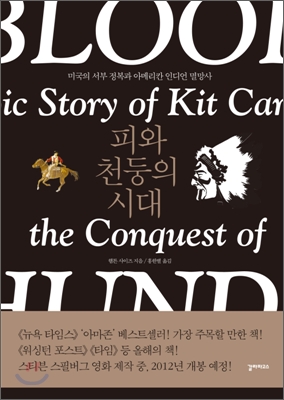
"The Age of Blood and Thunder" is a book that tells the story of the American conquest of the West in the 19th century, a time of chaos and contradiction; in other words, the story of the destruction of the American Indians and the turbulent lives of those who lived through that harsh time.
At the center of this whirlwind tale are the slaughterers and the slaughtered: Kit Carson and the Navajo.
This book delves into the historical truth behind how Kit Carson, an illiterate mountain man and a faithful friend of the Indians, became the main culprit in the massacre of the Indians and was reborn as a hero of the Western era. It also depicts with heartbreaking realism how the Navajo tribe, once the most prosperous of the American Indians, was destroyed by the land-hungry and the greedy.
This book, which combines a balanced perspective based on extensive historical materials, a thrilling narrative, a fast-paced plot, and elegant and detailed descriptions, is considered a masterpiece of documentary literature that combines the pleasure of reading with historical emotion.
This book is essential for understanding the actual process through which the United States conquered the West, as it dynamically unfolds major scenes of American history, such as the Mexican War and the Civil War.
At the center of this whirlwind tale are the slaughterers and the slaughtered: Kit Carson and the Navajo.
This book delves into the historical truth behind how Kit Carson, an illiterate mountain man and a faithful friend of the Indians, became the main culprit in the massacre of the Indians and was reborn as a hero of the Western era. It also depicts with heartbreaking realism how the Navajo tribe, once the most prosperous of the American Indians, was destroyed by the land-hungry and the greedy.
This book, which combines a balanced perspective based on extensive historical materials, a thrilling narrative, a fast-paced plot, and elegant and detailed descriptions, is considered a masterpiece of documentary literature that combines the pleasure of reading with historical emotion.
This book is essential for understanding the actual process through which the United States conquered the West, as it dynamically unfolds major scenes of American history, such as the Mexican War and the Civil War.
- You can preview some of the book's contents.
Preview
index
Prologue: The sound of horse hooves
Part 1: New People
1.
A journey to a new world
2.
Guardians of the Shining World
3.
Father of the U.S. Cavalry
4.
Carson and the Singing Pool
5.
Great Warrior of the Blue Bead Mountain
6.
James K.
Who is Fork?
7.
Fremont's first expedition
8.
divine providence
9.
The one who finds the way and the one who becomes a legend
10.
Broken Hope
11.
Ambition that is gradually revealed
12.
We are friends, not enemies
13.
Narbona Mountain Road
14.
midnight surprise attack
15.
Excellent actor
16.
Perfect slaughter
17.
The extinguished fire of Montezuma
18.
That's your job, Mr. Carson.
19.
Wailing sound
20.
Someone will come to us
21.
The chapter of downfall and triumph
22.
Completely different people
Part 2: A Divided Nation
23.
Changed plans
24.
Meeting with strangers
25.
Passing the Devil's Toll Road
26.
broken promises
27.
The longest and most dangerous expedition
28.
The Last of Taos Pueblo
29.
Mercury of America, Kit Carson
30.
Time finally makes everything fair
31.
huge ruins
32.
The tragic death of a great leader
33.
The Knot of Death, Revenge Begins
34.
A Promise with the Blind
35.
Blood and Thunder
Part 3: The Return of the Murderous Monster
36.
The Age of Fear
37.
Rio Grande stained with blood
38.
Battle of Glorietta
39.
James Henry Carleton's second appearance
40.
The beginning of the Bosqueredondo experiment
41.
General Order 15
42.
Navajo Surrender
43.
long way
44.
The last battle of my life
45.
The situation of the tribes
46.
Carson Crosses Purgatory
Epilogue: We Walk Among Beauty
Translator's Note
main
References
Search
Source of images and photos
Part 1: New People
1.
A journey to a new world
2.
Guardians of the Shining World
3.
Father of the U.S. Cavalry
4.
Carson and the Singing Pool
5.
Great Warrior of the Blue Bead Mountain
6.
James K.
Who is Fork?
7.
Fremont's first expedition
8.
divine providence
9.
The one who finds the way and the one who becomes a legend
10.
Broken Hope
11.
Ambition that is gradually revealed
12.
We are friends, not enemies
13.
Narbona Mountain Road
14.
midnight surprise attack
15.
Excellent actor
16.
Perfect slaughter
17.
The extinguished fire of Montezuma
18.
That's your job, Mr. Carson.
19.
Wailing sound
20.
Someone will come to us
21.
The chapter of downfall and triumph
22.
Completely different people
Part 2: A Divided Nation
23.
Changed plans
24.
Meeting with strangers
25.
Passing the Devil's Toll Road
26.
broken promises
27.
The longest and most dangerous expedition
28.
The Last of Taos Pueblo
29.
Mercury of America, Kit Carson
30.
Time finally makes everything fair
31.
huge ruins
32.
The tragic death of a great leader
33.
The Knot of Death, Revenge Begins
34.
A Promise with the Blind
35.
Blood and Thunder
Part 3: The Return of the Murderous Monster
36.
The Age of Fear
37.
Rio Grande stained with blood
38.
Battle of Glorietta
39.
James Henry Carleton's second appearance
40.
The beginning of the Bosqueredondo experiment
41.
General Order 15
42.
Navajo Surrender
43.
long way
44.
The last battle of my life
45.
The situation of the tribes
46.
Carson Crosses Purgatory
Epilogue: We Walk Among Beauty
Translator's Note
main
References
Search
Source of images and photos
Into the book
“Christopher Carson was a charming man.
Everyone said that.
He was loyal, honest and kind.
He acted bravely and charmingly in many important situations.
There were many instances where people's lives were saved without expecting any reward or recognition.
He was a good Samaritan, and even a hero.
On the other hand, he was a natural born killer.
It is not easy to connect the affectionate nature that many people talk about with his violent outbursts (……) If you offended him, you were sure to be punished.
“They pursued revenge as if it were something sacred, and they clung to it with such tenacity and persistence that it could be called tribal.” --- p.24
“Narbonna was not convinced by America’s logic.
How could Americans wage war against Mexicans, then immediately declare themselves friends of Mexicans and vow to defeat their enemies (the Navajos)? Could there really be such fickle people? Then Narbona heard an explosion.
It was a tremendous sound of American cannons firing (……) It is said that many American Indians at the time had an extremely irrational fear of American firearms.
Narbona realized that these were completely different types of people.
The rumors were right.
The Americans really did shoot lightning (……) Narbona called them succinctly:
“New people.” --- pp.198-199
“Colonel Washington didn’t know it, but the very idea of making a treaty with the Navajos was ludicrous (…) All the Navajos wanted was for the Villagana (Americans) to leave as quickly as possible, and if they could just write something on a piece of paper and the Americans would leave, they would be happy to do so.
What is paper? Most Navajos have never even seen paper.
The same goes for pens and writing.
The Navajo customs were so different from those of the United States that the Navajo had no idea what the United States really wanted (……) Washington had written the treaty in advance.
It was a thick document full of lofty ideals and some tough demands.
(……) But like the Treaty of Doniphan three years earlier, this treaty was nothing but garbage.
With no cultural understanding at all, and with the translation from English to Spanish to Navajo, how much the meaning would have changed (……) Still, the Navajos agreed.
How else could it have been done?” --- pp.387-388
“It was only natural that popular novelists began to fictionalize Kit Carson at will (…) It goes without saying how the nation was starving for a heroic figure who could symbolize the self-evident turbulence of destiny that had so dramatically changed America (…) Perhaps people took solace in the fact that an unusual, yet equally ordinary, American already lived in the West, helping America succeed and simplifying the complex theme of conquest.” --- pp.403-405
“Bosque Redondo is surrounded by Navajo lands, nearly 650 kilometers away, a world completely separate from the majestic red rock world the Navajo know and love.
Carleton's plan, however, was to carry out forced migration on a scale not seen since the 1830s.
In the 1830s, the Cherokee Indians of the southeastern United States were forcibly relocated and forced to travel the gruesome "Trail of Tears" to Oklahoma.
They had to fight to force the Navajos into the Bosqueredondo plantation.
“The Diné will never voluntarily leave their land.” --- p.517
“They had nothing but the old clothes on their bodies.
They trudged through the spring snow that was blowing hard across the high desert, lined up in a single line for several kilometers.
Even before they left Navajo land, tears welled up in their eyes from longing for their homeland (……) They had no idea where they were going or what kind of life awaited them there.
They simply continued to walk eastward (……) Hundreds of Navajos collapsed from disease, cold, and exhaustion.
Most of the Indians were almost naked and soon suffered from frostbite.
“One hundred and ten people lost their lives on the road before this unfortunate group reached Bosque.” --- pp.563-565
“A few days later, on June 1st, the treaty was finalized.
The Navajos were forced to live within a new reservation that was much smaller than their original lands.
All four sacred mountains were outside the reservation (……) After Barboncito, Manuelito, and other leaders signed the treaty with an X, Sherman told the Navajos they were free to return to their homeland (……) The next morning the journey began.
It was another great mass migration, but this time it was voluntary and joyful (……) When they reached the Rio Grande and saw the Blue Pearl Mountains, the Navajos sat down and wept.
According to Manuelito, 'I wondered if this was really our mountain.
We felt like talking to the land.
“I was so happy.”
Everyone said that.
He was loyal, honest and kind.
He acted bravely and charmingly in many important situations.
There were many instances where people's lives were saved without expecting any reward or recognition.
He was a good Samaritan, and even a hero.
On the other hand, he was a natural born killer.
It is not easy to connect the affectionate nature that many people talk about with his violent outbursts (……) If you offended him, you were sure to be punished.
“They pursued revenge as if it were something sacred, and they clung to it with such tenacity and persistence that it could be called tribal.” --- p.24
“Narbonna was not convinced by America’s logic.
How could Americans wage war against Mexicans, then immediately declare themselves friends of Mexicans and vow to defeat their enemies (the Navajos)? Could there really be such fickle people? Then Narbona heard an explosion.
It was a tremendous sound of American cannons firing (……) It is said that many American Indians at the time had an extremely irrational fear of American firearms.
Narbona realized that these were completely different types of people.
The rumors were right.
The Americans really did shoot lightning (……) Narbona called them succinctly:
“New people.” --- pp.198-199
“Colonel Washington didn’t know it, but the very idea of making a treaty with the Navajos was ludicrous (…) All the Navajos wanted was for the Villagana (Americans) to leave as quickly as possible, and if they could just write something on a piece of paper and the Americans would leave, they would be happy to do so.
What is paper? Most Navajos have never even seen paper.
The same goes for pens and writing.
The Navajo customs were so different from those of the United States that the Navajo had no idea what the United States really wanted (……) Washington had written the treaty in advance.
It was a thick document full of lofty ideals and some tough demands.
(……) But like the Treaty of Doniphan three years earlier, this treaty was nothing but garbage.
With no cultural understanding at all, and with the translation from English to Spanish to Navajo, how much the meaning would have changed (……) Still, the Navajos agreed.
How else could it have been done?” --- pp.387-388
“It was only natural that popular novelists began to fictionalize Kit Carson at will (…) It goes without saying how the nation was starving for a heroic figure who could symbolize the self-evident turbulence of destiny that had so dramatically changed America (…) Perhaps people took solace in the fact that an unusual, yet equally ordinary, American already lived in the West, helping America succeed and simplifying the complex theme of conquest.” --- pp.403-405
“Bosque Redondo is surrounded by Navajo lands, nearly 650 kilometers away, a world completely separate from the majestic red rock world the Navajo know and love.
Carleton's plan, however, was to carry out forced migration on a scale not seen since the 1830s.
In the 1830s, the Cherokee Indians of the southeastern United States were forcibly relocated and forced to travel the gruesome "Trail of Tears" to Oklahoma.
They had to fight to force the Navajos into the Bosqueredondo plantation.
“The Diné will never voluntarily leave their land.” --- p.517
“They had nothing but the old clothes on their bodies.
They trudged through the spring snow that was blowing hard across the high desert, lined up in a single line for several kilometers.
Even before they left Navajo land, tears welled up in their eyes from longing for their homeland (……) They had no idea where they were going or what kind of life awaited them there.
They simply continued to walk eastward (……) Hundreds of Navajos collapsed from disease, cold, and exhaustion.
Most of the Indians were almost naked and soon suffered from frostbite.
“One hundred and ten people lost their lives on the road before this unfortunate group reached Bosque.” --- pp.563-565
“A few days later, on June 1st, the treaty was finalized.
The Navajos were forced to live within a new reservation that was much smaller than their original lands.
All four sacred mountains were outside the reservation (……) After Barboncito, Manuelito, and other leaders signed the treaty with an X, Sherman told the Navajos they were free to return to their homeland (……) The next morning the journey began.
It was another great mass migration, but this time it was voluntary and joyful (……) When they reached the Rio Grande and saw the Blue Pearl Mountains, the Navajos sat down and wept.
According to Manuelito, 'I wondered if this was really our mountain.
We felt like talking to the land.
“I was so happy.”
--- p.624
Publisher's Review
『Ages of Blood and Thunder: The Conquest of the West and the Destruction of the American Indian』(hereafter referred to as 『Ages of Blood and Thunder』) was selected as the 2006 'Book of the Year' by numerous influential media outlets including TIME, The Washington Post, The Denver Post, The Minneapolis Star Tribune, Book Sense, Mountain and Plains Books, The San Francisco Chronicle, The Salt Lake Tribune, The Seattle Times, The Seattle Post-Intelligencer, The Portland Oregonian, and The History Book Club. It is the representative work of the world-renowned bestselling author Hampton Sides, which is being introduced in Korea for the first time.
It was immediately hailed as a "most noteworthy book" and became a New York Times and Amazon bestseller, and was named a "Best History Book" by the History Book Club and the Western Writers Association of America.
It is a masterpiece with a dramatic narrative, fun, and emotion that rivals the novel, and is currently being produced as a film by director Steven Spielberg.
It is expected to reveal its grand form around 2012.
"The Age of Blood and Thunder" is a book that deals with the conquest of the West in 19th-century America, a time of chaos and contradiction, and at the same time tells the story of the destruction and downfall of the American Indians.
At the center of this whirlwind narrative are the slaughterers and the slaughtered: Kit Carson and the Navajo.
This book delves into the historical truth behind the conquest of the American West, how Kit Carson, an illiterate mountain man and a faithful friend of the Indians, became the main culprit in the massacre of the Indians and was reborn as a hero of the Western era. It also depicts with heartbreaking realism how the Navajo, once the most prosperous of the American Indians, was destroyed by the land-hungry and the greedy.
It is a masterpiece of documentary literature that combines a balanced perspective based on extensive historical materials, a thrilling narrative, a fast-paced development, and detailed and flowing descriptions, providing both reading pleasure and historical inspiration.
It is also an essential book for understanding the actual process through which the United States conquered the West, as it dynamically unfolds major scenes of American history, such as the Mexican War and the Civil War.
It consists of three parts: "The New People," "A Nation Divided," and "The Return of the Killer Monster," and all of the content is written based on the author Hampton Sizes' passionate and meticulous research and objective and accurate data.
First, in Part 1, "New People," the book's main character, Kit Carson, the Navajo, and other figures related to the conquest of the West appear one by one, opening the prelude to a long story.
The story of Carson's birth and upbringing, the process by which he, who had maintained close and good relations with the Indians, came to stand against the Navajo, the changes in the circumstances surrounding the Navajo, and the beginning of the conquest of the West are all interestingly presented.
In Part 2, "A Nation Divided," the inevitable confrontation between the Navajo and the United States unfolds in earnest, and key scenes in American history, such as the Mexican War, are dealt with prominently in the relationships between the characters involved.
We can glimpse the fierce struggle for territory and power, the defining moments of history where joy and frustration intersect.
Finally, in Part 3, "The Return of the Murderous Monster," we look into the final stages of the war between the American forces and the Navajo, its tragic ending, and the events surrounding the Civil War and the death of Kit Carson.
You will discover a dark shadow cast over America's splendid glory, built on the sacrifices of many.
At the end of the book, notes, references, and indexes are included to help readers understand the content.
The emergence of 'new people'
American history is, in a word, a 'history of blood.'
America built its present-day 'empire' at the cost of countless sacrifices and deaths.
This book paints a picture of the 19th-century West, one of the most brutal and turbulent periods in American history.
At the center of it all is, without fail, Kit Carson, the greatest hero of the Western era.
There are also American Indians who became the greatest victims of conquest.
Among them, this book sheds light on the Navajo Indians, who once boasted the largest population but are now almost in decline.
Born “in a log cabin in Madison County, Kentucky, in 1809,” Kit Carson is a somewhat unfamiliar figure to us, but a very familiar icon of the Western era to Americans.
His family, like many Americans of the time, were pioneers who “settled in the wilderness near the Missouri River (…) and cultivated a large tract of land.”
The area near the Missouri River Valley where he lived had long been inhabited by indigenous peoples such as the “Winnebago, Potawatomi, and Kickapoo Indians,” and Carson naturally mingled with them.
Carson “understood the nature of the Indians better than anyone else” and respected their ways.
However, Carson's life takes a completely different turn when he joins the western expedition of military topographer Fremont, another key figure in the conquest of the West.
The Navajo were the largest American Indian tribe based in the New Mexico region, living a nomadic life and farming.
However, when Europeans set foot on the vast New World, and after Spain and Mexico, even the United States began to encroach on their territory, they, like other Indians, were drawn into an inevitable war.
The Navajo have been fighting fiercely against both Spain and Mexico.
But these Americans were different.
A monologue by Narbona, a Navajo elder, clearly shows the extent of the American Indians' fear of Americans at the time.
“Narbonna was not convinced by America’s logic.
How could Americans wage war against Mexicans, then immediately declare themselves friends of Mexicans and vow to defeat their enemies (the Navajos)? Could there really be such fickle people? Then Narbona heard an explosion.
It was a tremendous sound of American cannons firing (……) It is said that many American Indians at the time had an extremely irrational fear of American firearms.
Narbona realized that these were completely different types of people.
The rumors were right.
The Americans really did shoot lightning (……) Narbona called them succinctly:
“New people.” Will they give in or fight to win?
As a “new era” ushered in by “new people” is implied, the Navajo are faced with a difficult choice.
Author Hampton Sides, using passionate research and extensive historical materials, sought to faithfully recreate the contradictory days of a time symbolized by "blood" and "thunder," a time filled with brutal death and the eardrum-shattering sound of artillery, and the lives of the people who lived there.
This kind of effort shines through, especially in Part 1 of this book, "New People."
In Part 1, which serves as a prelude to a longer story, characters including Kit Carson and the Navajo appear sequentially in each chapter to complete the outline of the conquest of the West.
The process is quite specific and exciting.
Above all, the author develops the story in a very effective and meticulous manner.
By revealing the voices of different characters in each chapter, it is structured so that each person can look at an event from their own perspective.
That is why, although it is a historical novel, it feels like a well-written novel.
The historical facts unearthed by the author are refined into a single story with a narrative, and the characters' actions become persuasive.
And it is at this point that the reader of this book succeeds in forming a sense of empathy.
America's endless desire for conquest
America's territorial expansion policy was already in full swing.
The United States came to proclaim its "manifest destiny" with the logic that "in order for the millions of people who increase every year to grow freely, they must expand further and occupy the entire continent God gave them."
Eventually, the United States invaded Mexico in 1846 to take over the western territories that Mexico had owned.
Part 2 of this book, "A Nation Divided," focuses heavily on the Mexican War and the people surrounding it, and the conflict between the Navajo and the United States unfolds in earnest.
The Mexican War was the first "war of conquest" in which the United States military attempted to invade and occupy vast territories in other countries.
It was “blatant robbery on an enormous scale.”
The then US President James K.
Fork harbors ambitions to “cover a distance of nearly 1,600 kilometers and conquer an area half the size of the United States at that time.”
“Then, after reaching Santa Fe and taking possession of New Mexico, he continued westward, conquering all of present-day Arizona, Colorado, Utah, and part of Nevada, and finally reaching California, where he would achieve the crowning achievement of waving the American flag over the blue Pacific.”
However, the president's dream, which seemed reckless, eventually became a reality thanks to the efforts of many people, including Carson.
Carson, who participated in Fremont's expedition, gained the trust of his superiors and solidified his position.
Then, he meets General Stephen Watts Kearney, the commander of the Western Army, and plays a key role in the conquest.
Although Kearny had easily conquered New Mexico, which was then Mexican territory, he was tasked with the crucial task of driving out the Navajos, who were rampaging throughout New Mexico and showing no signs of retreating.
Accordingly, he hires Carson, who knows more about the Indians than anyone else, as his guide and accelerates the expulsion of the Navajos.
But Carson was never a “hater of Indians.”
There was no such thing as “abstract racist hatred.”
Carson “killed Native Americans, but he also befriended them, loved them, buried them, and married them.”
Carson's actions seem at first glance inconsistent.
But that was precisely the era of blood and thunder, a time of irrational confusion and contradictions.
The author, Size, portrays Carson neither as an exaggerated hero nor as an ugly Indian massacrer.
I simply describe them as 'humans' as they are, from the perspective of observing and recording.
On the one hand, the Navajo could not understand all this.
They “had no concept of America.
Washington D.
What is C., James K.
Fork had no idea who he was or what his manifest destiny was.
I knew almost nothing about white people, and I never imagined that there could be people on this planet with such different appearances, behaviors, speech, religions, and societies.
“I couldn’t understand why they came such a long way to leave their footprints here, so far from the land where their ancestors lived.”
However, it was not possible to remain worried about the impending trials forever.
The Navajos, realizing that the United States is a formidable opponent, try to avoid conflict by enduring humiliating treaties.
But their pledges of peace are constantly being revised to suit America's tastes, with each new rumor of gold, each new discovery of a rich-looking patch of land, or any number of other reasons.
Ultimately, the Navajo are forced to fight with all their might against the United States.
The real war surrounding the West was about to begin.
Stolen land
The United States gained enormous territory through the Mexican War.
However, this federation, which was made up of vast lands, was suffering from difficult problems that were piled up everywhere.
One of them was the issue of slavery.
The North, which developed commerce and industry and valued moral justification and the realization of democratic values, fundamentally took a position opposing slavery.
However, the South, which relied on large-scale agriculture for its economic activities, needed cheap labor.
The South is vehemently opposed to the abolition of slavery.
Eventually, in 1861, the South and the North began a fierce battle with no room for retreat, and America was once again plunged into the vortex of war.
Carson's activities continue even at this time.
He sided with the North and played a crucial role in the Northern Army's victory.
But ultimately, the biggest mission he had to take on was to become the leader of the Indian Wars, the Operation to Exterminate the Navajo.
Feeling burdened, Carson politely declines.
However, it was not easy to disobey the orders of a superior to whom one had pledged loyalty.
Eventually, he sets foot in Canyon de Chelly, also known as Devil's Canyon, where the Navajos are concentrated, in order to completely eradicate them.
In the late spring of 1862, the United States now began to plan a "different attack on the Navajo."
An ambitious and decisive plan.
The plan was to carve away some of the Diné (Navajo) lands and create a true Navajo reservation far to the west (……) The time for a more moderate approach has passed.
This time, it would be the ultimate solution, the final battle.
Colonel Canby, who led the plan, wrote to his superiors in Washington:
“There is no alternative but to exterminate the Navajo or to colonize them far from their settlements, separating them from the inhabitants of the New Mexico Territory.” The colonel fails to carry out his plan.
However, Canby's plan is carried out in an even more brutal manner by his successor, an officer named James Carleton.
The final chapter of this book, Part 3, "The Return of the Murderous Monster," reveals the full story of this tragic tale, along with dramatic scenes from the Civil War.
Carlton was known as “a pedant, a thorough man, a perfectionist who knew no regrets.”
His personality made it possible to design the Bosque Redondo Navajo Reservation.
Carson took everything the Navajo had through the Canyon de Chelly "scorched earth operation."
The Navajos surrendered completely.
Now the survivors had to leave with tears in their eyes for the sanctuary they had been assigned.
However, the road to Bosque Redondo required tremendous patience and stamina.
On this route, many Navajos die from the shock of being driven from their homeland, the bitter cold, and extreme hunger.
This is the famous Navajo “long way.”
The Navajo's long journey is one of the saddest and most poignant chapters in the entire book.
The size is a very realistic and detailed reenactment of one of the most tragic events in Navajo history.
“They had nothing but the old clothes on their bodies.
They trudged through the spring snow that was blowing hard across the high desert, lined up in a single line for several kilometers.
Even before I left Navajo land, tears welled up in my eyes from longing for my homeland.
(……) They didn’t know where they were going and what kind of life awaited them there.
They simply continued to walk eastward (……) Hundreds of Navajos collapsed from disease, cold, and exhaustion.
Most of the Indians were almost naked and soon suffered from frostbite.
“One hundred and ten people lost their lives on the road before this unfortunate group reached Bosque.”
However, the Bosqueredondo plan ended in complete failure.
The Navajos could not adapt to reservation life.
Moreover, they still had no intention of abandoning their existing customs.
The forced farming was a complete failure and there was nothing to eat except government aid.
Carlton was overly obsessed with his own plans, but was ultimately unable to avoid responsibility for their failure and was dismissed.
Here in Bosque Redondo alone, one-third of the Navajo population died.
It was a tragic incident.
Eventually, the Navajos are freed from this cursed land and allowed to return to their homeland.
“It was a new sanctuary much smaller than their original land.”
Yet, on their way back home, “when they reached the Rio Grande and saw the Blue Bead Mountain (one of their sacred mountains), the Navajos sat down and wept.
According to Manuelito, 'I wondered if this was really our mountain.
We felt like talking to the land.
“I was so happy.”
The Navajos still live within this reservation.
Not only the Navajo, but most of the Indians who survived the Western Era are today confined to harsh reservations that are little more than prisons, barely holding on to the ties of their unfortunate past.
The lives of American Indians remain difficult due to national tragedy, lost identity, discrimination, and the practical problems of making a living.
The year the Navajos entered the new reservation, Carson became ill and died.
Although he was later widely revered as a hero of the Western conquest and for his crucial role in securing territory, he is now being re-evaluated in the face of the stigma of being the chief perpetrator of the genocide of the Indians and the epitome of a contradictory human being.
This book is not about the glory of conquering the West, nor is it about the instructive lives of Indians.
It is a book that objectively and strictly depicts the chaotic times and historical facts symbolized by 'blood' and 'thunder' as if observing them from afar.
But what moves us about this book is not simply the listing of facts, but the fact that it engraves within it the life of a human being who rejoices, grieves, breathes, and sheds tears.
Size never stopped his earnest research to capture the turbulent lives of those who lived through rough times, those who were merely 'humans'.
This book is also significant in that it introduces the little-known figure of Carson to Korea for the first time.
Another point that cannot be overlooked is that it fully illuminates the history of the Navajo, who have a tragic history but have not received as much attention as other American Indians.
The most honest, objective, and concrete book on the conquest of the West.
『The Age of Blood and Thunder』 is a book that will soon be considered a classic, living up to its title of 'masterpiece of documentary literature.'
It was immediately hailed as a "most noteworthy book" and became a New York Times and Amazon bestseller, and was named a "Best History Book" by the History Book Club and the Western Writers Association of America.
It is a masterpiece with a dramatic narrative, fun, and emotion that rivals the novel, and is currently being produced as a film by director Steven Spielberg.
It is expected to reveal its grand form around 2012.
"The Age of Blood and Thunder" is a book that deals with the conquest of the West in 19th-century America, a time of chaos and contradiction, and at the same time tells the story of the destruction and downfall of the American Indians.
At the center of this whirlwind narrative are the slaughterers and the slaughtered: Kit Carson and the Navajo.
This book delves into the historical truth behind the conquest of the American West, how Kit Carson, an illiterate mountain man and a faithful friend of the Indians, became the main culprit in the massacre of the Indians and was reborn as a hero of the Western era. It also depicts with heartbreaking realism how the Navajo, once the most prosperous of the American Indians, was destroyed by the land-hungry and the greedy.
It is a masterpiece of documentary literature that combines a balanced perspective based on extensive historical materials, a thrilling narrative, a fast-paced development, and detailed and flowing descriptions, providing both reading pleasure and historical inspiration.
It is also an essential book for understanding the actual process through which the United States conquered the West, as it dynamically unfolds major scenes of American history, such as the Mexican War and the Civil War.
It consists of three parts: "The New People," "A Nation Divided," and "The Return of the Killer Monster," and all of the content is written based on the author Hampton Sizes' passionate and meticulous research and objective and accurate data.
First, in Part 1, "New People," the book's main character, Kit Carson, the Navajo, and other figures related to the conquest of the West appear one by one, opening the prelude to a long story.
The story of Carson's birth and upbringing, the process by which he, who had maintained close and good relations with the Indians, came to stand against the Navajo, the changes in the circumstances surrounding the Navajo, and the beginning of the conquest of the West are all interestingly presented.
In Part 2, "A Nation Divided," the inevitable confrontation between the Navajo and the United States unfolds in earnest, and key scenes in American history, such as the Mexican War, are dealt with prominently in the relationships between the characters involved.
We can glimpse the fierce struggle for territory and power, the defining moments of history where joy and frustration intersect.
Finally, in Part 3, "The Return of the Murderous Monster," we look into the final stages of the war between the American forces and the Navajo, its tragic ending, and the events surrounding the Civil War and the death of Kit Carson.
You will discover a dark shadow cast over America's splendid glory, built on the sacrifices of many.
At the end of the book, notes, references, and indexes are included to help readers understand the content.
The emergence of 'new people'
American history is, in a word, a 'history of blood.'
America built its present-day 'empire' at the cost of countless sacrifices and deaths.
This book paints a picture of the 19th-century West, one of the most brutal and turbulent periods in American history.
At the center of it all is, without fail, Kit Carson, the greatest hero of the Western era.
There are also American Indians who became the greatest victims of conquest.
Among them, this book sheds light on the Navajo Indians, who once boasted the largest population but are now almost in decline.
Born “in a log cabin in Madison County, Kentucky, in 1809,” Kit Carson is a somewhat unfamiliar figure to us, but a very familiar icon of the Western era to Americans.
His family, like many Americans of the time, were pioneers who “settled in the wilderness near the Missouri River (…) and cultivated a large tract of land.”
The area near the Missouri River Valley where he lived had long been inhabited by indigenous peoples such as the “Winnebago, Potawatomi, and Kickapoo Indians,” and Carson naturally mingled with them.
Carson “understood the nature of the Indians better than anyone else” and respected their ways.
However, Carson's life takes a completely different turn when he joins the western expedition of military topographer Fremont, another key figure in the conquest of the West.
The Navajo were the largest American Indian tribe based in the New Mexico region, living a nomadic life and farming.
However, when Europeans set foot on the vast New World, and after Spain and Mexico, even the United States began to encroach on their territory, they, like other Indians, were drawn into an inevitable war.
The Navajo have been fighting fiercely against both Spain and Mexico.
But these Americans were different.
A monologue by Narbona, a Navajo elder, clearly shows the extent of the American Indians' fear of Americans at the time.
“Narbonna was not convinced by America’s logic.
How could Americans wage war against Mexicans, then immediately declare themselves friends of Mexicans and vow to defeat their enemies (the Navajos)? Could there really be such fickle people? Then Narbona heard an explosion.
It was a tremendous sound of American cannons firing (……) It is said that many American Indians at the time had an extremely irrational fear of American firearms.
Narbona realized that these were completely different types of people.
The rumors were right.
The Americans really did shoot lightning (……) Narbona called them succinctly:
“New people.” Will they give in or fight to win?
As a “new era” ushered in by “new people” is implied, the Navajo are faced with a difficult choice.
Author Hampton Sides, using passionate research and extensive historical materials, sought to faithfully recreate the contradictory days of a time symbolized by "blood" and "thunder," a time filled with brutal death and the eardrum-shattering sound of artillery, and the lives of the people who lived there.
This kind of effort shines through, especially in Part 1 of this book, "New People."
In Part 1, which serves as a prelude to a longer story, characters including Kit Carson and the Navajo appear sequentially in each chapter to complete the outline of the conquest of the West.
The process is quite specific and exciting.
Above all, the author develops the story in a very effective and meticulous manner.
By revealing the voices of different characters in each chapter, it is structured so that each person can look at an event from their own perspective.
That is why, although it is a historical novel, it feels like a well-written novel.
The historical facts unearthed by the author are refined into a single story with a narrative, and the characters' actions become persuasive.
And it is at this point that the reader of this book succeeds in forming a sense of empathy.
America's endless desire for conquest
America's territorial expansion policy was already in full swing.
The United States came to proclaim its "manifest destiny" with the logic that "in order for the millions of people who increase every year to grow freely, they must expand further and occupy the entire continent God gave them."
Eventually, the United States invaded Mexico in 1846 to take over the western territories that Mexico had owned.
Part 2 of this book, "A Nation Divided," focuses heavily on the Mexican War and the people surrounding it, and the conflict between the Navajo and the United States unfolds in earnest.
The Mexican War was the first "war of conquest" in which the United States military attempted to invade and occupy vast territories in other countries.
It was “blatant robbery on an enormous scale.”
The then US President James K.
Fork harbors ambitions to “cover a distance of nearly 1,600 kilometers and conquer an area half the size of the United States at that time.”
“Then, after reaching Santa Fe and taking possession of New Mexico, he continued westward, conquering all of present-day Arizona, Colorado, Utah, and part of Nevada, and finally reaching California, where he would achieve the crowning achievement of waving the American flag over the blue Pacific.”
However, the president's dream, which seemed reckless, eventually became a reality thanks to the efforts of many people, including Carson.
Carson, who participated in Fremont's expedition, gained the trust of his superiors and solidified his position.
Then, he meets General Stephen Watts Kearney, the commander of the Western Army, and plays a key role in the conquest.
Although Kearny had easily conquered New Mexico, which was then Mexican territory, he was tasked with the crucial task of driving out the Navajos, who were rampaging throughout New Mexico and showing no signs of retreating.
Accordingly, he hires Carson, who knows more about the Indians than anyone else, as his guide and accelerates the expulsion of the Navajos.
But Carson was never a “hater of Indians.”
There was no such thing as “abstract racist hatred.”
Carson “killed Native Americans, but he also befriended them, loved them, buried them, and married them.”
Carson's actions seem at first glance inconsistent.
But that was precisely the era of blood and thunder, a time of irrational confusion and contradictions.
The author, Size, portrays Carson neither as an exaggerated hero nor as an ugly Indian massacrer.
I simply describe them as 'humans' as they are, from the perspective of observing and recording.
On the one hand, the Navajo could not understand all this.
They “had no concept of America.
Washington D.
What is C., James K.
Fork had no idea who he was or what his manifest destiny was.
I knew almost nothing about white people, and I never imagined that there could be people on this planet with such different appearances, behaviors, speech, religions, and societies.
“I couldn’t understand why they came such a long way to leave their footprints here, so far from the land where their ancestors lived.”
However, it was not possible to remain worried about the impending trials forever.
The Navajos, realizing that the United States is a formidable opponent, try to avoid conflict by enduring humiliating treaties.
But their pledges of peace are constantly being revised to suit America's tastes, with each new rumor of gold, each new discovery of a rich-looking patch of land, or any number of other reasons.
Ultimately, the Navajo are forced to fight with all their might against the United States.
The real war surrounding the West was about to begin.
Stolen land
The United States gained enormous territory through the Mexican War.
However, this federation, which was made up of vast lands, was suffering from difficult problems that were piled up everywhere.
One of them was the issue of slavery.
The North, which developed commerce and industry and valued moral justification and the realization of democratic values, fundamentally took a position opposing slavery.
However, the South, which relied on large-scale agriculture for its economic activities, needed cheap labor.
The South is vehemently opposed to the abolition of slavery.
Eventually, in 1861, the South and the North began a fierce battle with no room for retreat, and America was once again plunged into the vortex of war.
Carson's activities continue even at this time.
He sided with the North and played a crucial role in the Northern Army's victory.
But ultimately, the biggest mission he had to take on was to become the leader of the Indian Wars, the Operation to Exterminate the Navajo.
Feeling burdened, Carson politely declines.
However, it was not easy to disobey the orders of a superior to whom one had pledged loyalty.
Eventually, he sets foot in Canyon de Chelly, also known as Devil's Canyon, where the Navajos are concentrated, in order to completely eradicate them.
In the late spring of 1862, the United States now began to plan a "different attack on the Navajo."
An ambitious and decisive plan.
The plan was to carve away some of the Diné (Navajo) lands and create a true Navajo reservation far to the west (……) The time for a more moderate approach has passed.
This time, it would be the ultimate solution, the final battle.
Colonel Canby, who led the plan, wrote to his superiors in Washington:
“There is no alternative but to exterminate the Navajo or to colonize them far from their settlements, separating them from the inhabitants of the New Mexico Territory.” The colonel fails to carry out his plan.
However, Canby's plan is carried out in an even more brutal manner by his successor, an officer named James Carleton.
The final chapter of this book, Part 3, "The Return of the Murderous Monster," reveals the full story of this tragic tale, along with dramatic scenes from the Civil War.
Carlton was known as “a pedant, a thorough man, a perfectionist who knew no regrets.”
His personality made it possible to design the Bosque Redondo Navajo Reservation.
Carson took everything the Navajo had through the Canyon de Chelly "scorched earth operation."
The Navajos surrendered completely.
Now the survivors had to leave with tears in their eyes for the sanctuary they had been assigned.
However, the road to Bosque Redondo required tremendous patience and stamina.
On this route, many Navajos die from the shock of being driven from their homeland, the bitter cold, and extreme hunger.
This is the famous Navajo “long way.”
The Navajo's long journey is one of the saddest and most poignant chapters in the entire book.
The size is a very realistic and detailed reenactment of one of the most tragic events in Navajo history.
“They had nothing but the old clothes on their bodies.
They trudged through the spring snow that was blowing hard across the high desert, lined up in a single line for several kilometers.
Even before I left Navajo land, tears welled up in my eyes from longing for my homeland.
(……) They didn’t know where they were going and what kind of life awaited them there.
They simply continued to walk eastward (……) Hundreds of Navajos collapsed from disease, cold, and exhaustion.
Most of the Indians were almost naked and soon suffered from frostbite.
“One hundred and ten people lost their lives on the road before this unfortunate group reached Bosque.”
However, the Bosqueredondo plan ended in complete failure.
The Navajos could not adapt to reservation life.
Moreover, they still had no intention of abandoning their existing customs.
The forced farming was a complete failure and there was nothing to eat except government aid.
Carlton was overly obsessed with his own plans, but was ultimately unable to avoid responsibility for their failure and was dismissed.
Here in Bosque Redondo alone, one-third of the Navajo population died.
It was a tragic incident.
Eventually, the Navajos are freed from this cursed land and allowed to return to their homeland.
“It was a new sanctuary much smaller than their original land.”
Yet, on their way back home, “when they reached the Rio Grande and saw the Blue Bead Mountain (one of their sacred mountains), the Navajos sat down and wept.
According to Manuelito, 'I wondered if this was really our mountain.
We felt like talking to the land.
“I was so happy.”
The Navajos still live within this reservation.
Not only the Navajo, but most of the Indians who survived the Western Era are today confined to harsh reservations that are little more than prisons, barely holding on to the ties of their unfortunate past.
The lives of American Indians remain difficult due to national tragedy, lost identity, discrimination, and the practical problems of making a living.
The year the Navajos entered the new reservation, Carson became ill and died.
Although he was later widely revered as a hero of the Western conquest and for his crucial role in securing territory, he is now being re-evaluated in the face of the stigma of being the chief perpetrator of the genocide of the Indians and the epitome of a contradictory human being.
This book is not about the glory of conquering the West, nor is it about the instructive lives of Indians.
It is a book that objectively and strictly depicts the chaotic times and historical facts symbolized by 'blood' and 'thunder' as if observing them from afar.
But what moves us about this book is not simply the listing of facts, but the fact that it engraves within it the life of a human being who rejoices, grieves, breathes, and sheds tears.
Size never stopped his earnest research to capture the turbulent lives of those who lived through rough times, those who were merely 'humans'.
This book is also significant in that it introduces the little-known figure of Carson to Korea for the first time.
Another point that cannot be overlooked is that it fully illuminates the history of the Navajo, who have a tragic history but have not received as much attention as other American Indians.
The most honest, objective, and concrete book on the conquest of the West.
『The Age of Blood and Thunder』 is a book that will soon be considered a classic, living up to its title of 'masterpiece of documentary literature.'
GOODS SPECIFICS
- Date of issue: November 16, 2009
- Page count, weight, size: 704 pages | 948g | 148*213*40mm
- ISBN13: 9788990809292
- ISBN10: 8990809290
You may also like
카테고리
korean


korean

![GQ KOREA Mark (Monthly): December [2025]](http://librairie.coreenne.fr/cdn/shop/files/8ef265dbbfbf186523ed75ba7319009d.jpg?v=1765340328&width=3840)


