

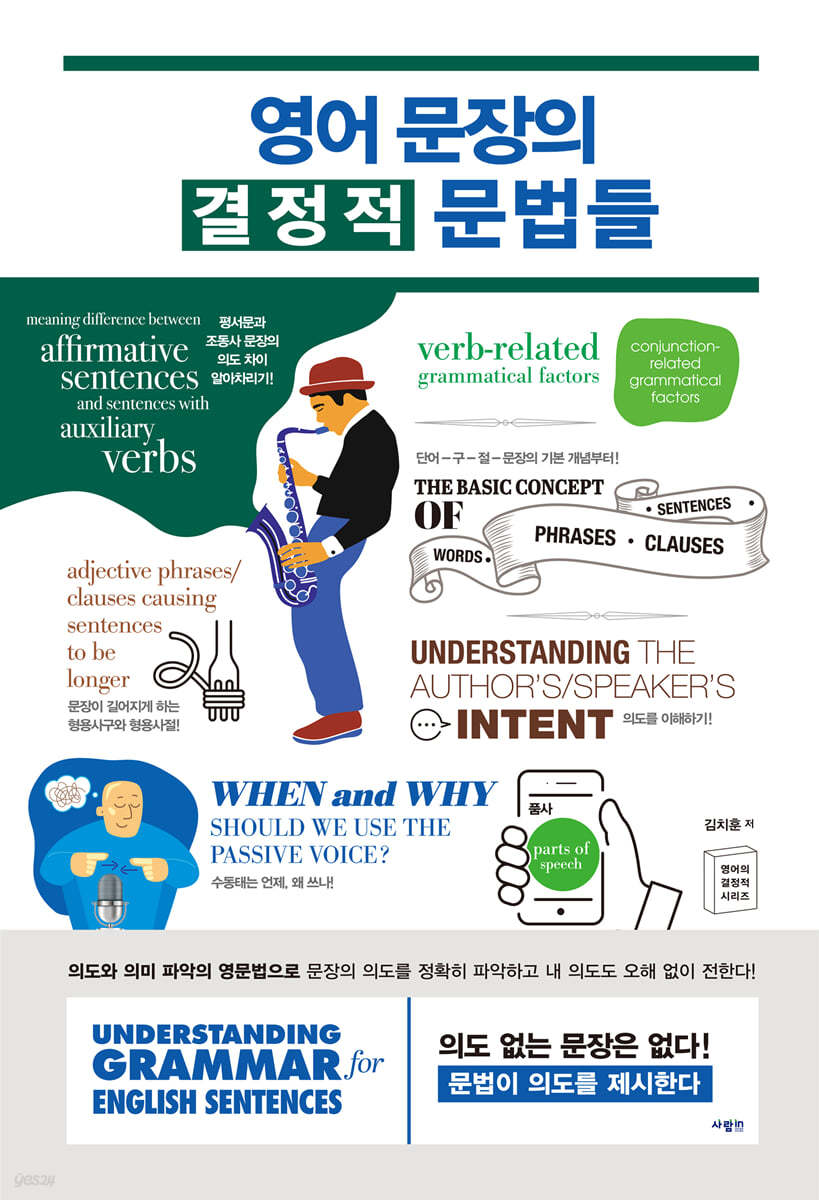
Crucial Grammar Rules of English Sentences
 |
Description
Book Introduction
There's no such thing as an intentionless sentence! Grammar reveals intent.
Grammar is the primary element that reveals the speaker's and writer's intentions.
There are twelve tenses in English to convey different intentions and different focuses of emphasis, so the passive voice is necessary.
There is no need to even mention auxiliary verbs, whose meaning and intention change depending on whether they are used or not.
The shift from studying grammar for grammar's sake to grammar for understanding intent is necessary to accurately understand other people's sentences and express one's own sentences accurately.
『The Crucial Grammar of English Sentences』 emphasizes the grammatical elements that indicate intent, allowing sentences to be read differently and reveal their intent.
Grammar is the primary element that reveals the speaker's and writer's intentions.
There are twelve tenses in English to convey different intentions and different focuses of emphasis, so the passive voice is necessary.
There is no need to even mention auxiliary verbs, whose meaning and intention change depending on whether they are used or not.
The shift from studying grammar for grammar's sake to grammar for understanding intent is necessary to accurately understand other people's sentences and express one's own sentences accurately.
『The Crucial Grammar of English Sentences』 emphasizes the grammatical elements that indicate intent, allowing sentences to be read differently and reveal their intent.
- You can preview some of the book's contents.
Preview
index
Introduction
Four Commandments for Studying English Grammar
5 Things You Won't Find in Other Grammar Books
Structure and Use of This Book
PART 1 Essential Basics
Chapter 1: Understanding Intentions: Basic Concepts
UNIT 1 Words, Phrases, and Clauses
01 Definitions of Words, Phrases, and Clauses | 02 Differences Between Sentences and Clauses | 03 Prepositional Phrases and Conjunction Clauses
UNIT 2 Parts of Speech - Nouns
01 Noun Position | 02 Noun Phrases | 03 Noun Clauses | PLUS Confusing if-clauses
UNIT 3 Parts of Speech - Adjectives
01 The reason adjectives exist is because of nouns | 02 The reason adjectives make English sentences longer
UNIT 4 Parts of Speech - Verbs
PLUS, there is only one main verb indicating tense in a sentence!
UNIT 5 Parts of Speech - Adverbs
01 Adverbial Phrases | PLUS Adverbial Phrases whose meaning changes depending on the context
02 Adverbial Clauses | 03 Distinction between Noun Clauses and Adverbial Clauses
UNIT 6 Parts of Speech - Conjunctions and Prepositions
01 Conjunctions | 02 Prepositional Phrases | PLUS Prepositions of Time vs.
Prepositions of place
Attention! Forget the idea that prepositions have only one meaning! | PLUS: An Effective Preposition Study Method
PART 2 Grammar Related to Verbs
Chapter 1 Tenses that Express Intention
UNIT 1 Present Tense
01 Simple Present Tense | Attention! The Unwavering Present Tense
02 Present Progressive Tense | Read it differently
UNIT 2 PAST TENSE
01 Simple Past Tense | 02 Past Progressive Tense | 03 More Elaborate Past Meaning: Used to + Infinitive | Read Differently
UNIT 3 Present Perfect Tense 1
01 When talking about or asking about an experience | PLUS I didn't live abroad.
vs.
I've never lived abroad.
02 When referring to a state that began in the past and remains true in the present | Read differently
UNIT 4 Present Perfect Tense 2
01 Past Tense Control Devices in Gerund Phrases | 02 Past Tense Control Devices in To-Infinitives | Read Differently
UNIT 5 Past Perfect Tense
01 When talking about or asking about experiences before a specific point in the past | 02 When you need to clarify the order of two events that happened in the past
UNIT 6 Future Tense
01 Difference between will and be going to | PLUS Will and be going to be used differently depending on the situation
PLUS Misunderstandings Caused by Misuse of "Be Going To" | 02 Expressing the Future Using Present Progressive Tense (am/are/is + V-ing)
Attention! The Difference Between "Be Going To" and Present Progressive | Read Differently
Chapter 2 Sentence Forms That Are No Longer a Requirement
UNIT 1 Subject + Verb (+ Adverbial Phrase) = Form 1
UNIT 2 Subject + Verb + Complement (Adjective (Phrase), Noun (Phrase)) = 2 Forms
01 Type 2 Sentence | Attention! Why You Must Completely Understand the Nominative Complement | 02 Subject-Subject Syntax (Type 2)
UNIT 3 Subject + Verb + Object (Noun (Phrase/Clause)) = 3 Forms
UNIT 4 Subject + Verb + Object + Object = 4 Forms
UNIT 5 Subject + Verb + Object + Objective Complement = 5 Forms
Chapter 3: Auxiliary Verbs: A Key Element That Changes Intention
UNIT 1 Auxiliary Verbs of Obligation and Prohibition: must, have to, should
01 The Difference Between Must and Have to | 02 The Difference Between Must and Should | Expressions That Replace PLUS Must Not
PLUS must used when conveying personal opinions
UNIT 2: Auxiliary Verbs of Guess and Certainty: must, may, cannot
01 must | PLUS Must ≠ Fact | 02 may | PLUS The difference between may and might
03 cannot | PLUS Cannot ≠ Fact
UNIT 3 can & could
01 When could is used as the past tense of can | 02 The difference between could and can
03 Usage of can not found in Korean grammar books
UNIT 4 will & would
01 When would is used as the past tense of will | 02 The difference between will and would | Reading differently
Chapter 4 Passive Voice in Focus of Intention
UNIT 1 Why Use the Passive Voice
01 Because Doer is not important in sentence 02 | Because Doer is not known in sentence 03
03 In sentence 03, Doer is too obvious or clear | 04 When to use active voice vs.
When using passive voice
UNIT 2 Passive Voice in Combination with Various Tenses
01 Simple present passive voice: am/are/is + pp
| 02 Present progressive passive voice: be verb (am/are/is) + being + pp
03 Simple past passive: was/were + pp
| 04 Past Progressive Passive: was/were + being + pp
05 Future passive voice: will + be + pp
& am/are/is going to + be + pp
06 Present Perfect Passive: have/has + been + pp
| 07 Past Perfect Passive: had + been + pp
PLUS Active Verbs You Should Know When They're in Passive | Read Differently
Chapter 5: The versatile to-infinitive
UNIT 1 Nominal Use of the Infinitive
01 To-infinitive placed in front of the verb (subject) | 02 To-infinitive placed in the back of the verb (object)
03 To-infinitive placed after a verb (component) | 04 Interrogative + to-infinitive
UNIT 2 Adjectival Use of the Infinitive
01 Adjectival usage of to-infinitive that must not include a preposition
Attention! 'Noun + to-infinitive' is not always an adjectival usage!
UNIT 3 Adverbial Use of the Infinitive
01 To-infinitive modifying verbs | PLUS not to + verb infinitive vs.
to not + verb infinitive
02 To-infinitive modifying adjectives | Attention! Enough can also be used as a noun!
PLUS the unique to-infinitive, 'be verb + to-infinitive'
UNIT 4 Semantic Subject of the Infinitive
01 The reason why the semantic subject of the to-infinitive is presented | 02 The difference in meaning when there is a semantic subject and when there is not
03 In the 5th form, the subject of the to-infinitive is
UNIT 5 Tense Control of the Infinitive
01 The meaning of 'to + verb infinitive' in sentence 02 | The meaning of 'to have pp' in sentence 03
Attention! Verbs that use pp as an object or complement
PLUS: Memorize these useful to-infinitive phrases without asking or questioning | Read them differently
Chapter 6: Gerunds, a necessity for advanced communication
UNIT 1 Position of Gerunds
01 Gerund (subject) used before a verb | 02 Gerund (object) used after a verb
PLUS Verbs that take to-infinitive vs. verbs that take to-infinitive at a glance
Verbs that take gerunds
03 Gerunds (complements) used after verbs | 04 Gerunds (objects) used after prepositions
UNIT 2 Semantic Subjects of Gerunds
01 Meaning of the Subject | 02 Differences in Meaning Depending on the Presence or Absence of a Subject
UNIT 3 Tense Control of Gerunds
PLUS: Gerund Phrases You Need to Know Without Asking | Read Differently
Chapter 7: Participles: A Solution to Understanding Long and Difficult Sentences
UNIT 1 The relationship between the present participle (V-ing) and the noun it modifies
01 Active Relationship | 02 Ongoing Relationship | 03 Gerund vs.
present participle
UNIT 2 The relationship between past participles (pp) and the nouns they modify
01 Passive Relationship | Attention! Past participles don't necessarily mean passive!
02 The Meaning of Past Participles After Nouns | 03 How to Use Present and Past Participles Depending on the Situation
UNIT 3 Past tense vs. past tense verbs in sentences
past participle
Read it differently
Chapter 8: The Best Economy of Language: Participle Phrases
Unit 1 Present Participle Phrase (V-ing)
01 Understanding the Meaning of Present Participle Phrases | Attention! What if there's a noun before the participle phrase?
02 Meanings of Conjunctions Commonly Used in Participle Phrases | Different Readings
UNIT 2 Past Participle Phrases (pp)
PLUS Past Participle Phrases with Different Meanings | Read them Differently
UNIT 3 Tense Control in Participle Phrases
01 The meaning of "having pp" in sentence 02 | The meaning of "(having been) pp" in sentence 03 | Different readings
UNIT 4 V-ing in English sentences
01 V-ing in the progressive tense: Verb role | 02 V-ing in the gerund: Noun role
Attention! V-ing after the verb be: gerund vs.
Progressive
03 V-ing in the Present Participle: Acting as an Adjective | 04 V-ing in the Present Participle Phrase: Acting as a Conjunctive Clause
Attention! When a present participle phrase immediately follows a complete clause | Read differently
PART 3 Grammar Related to Conjunctions
Chapter 1: The Subjunctive Mood: How Intention Changes with Tense Combinations
UNIT 1 Zero Conditional
PLUS 0 In the conditional sentence, "when" is sometimes used instead of "if." | Read differently
UNIT 2 First Conditional
01 When talking about something that is likely to happen or almost certain to happen in the future
02 Various conjunctions used instead of if | Does the present tense replace the future tense in the adverbial clause of the PLUS condition?
03 Differences in the Feeling of the 0-Statement and 1-Statement | Reading Differently
UNIT 3 Second Conditional
01 Imagination and assumption about present or future situations | 02 If the subject were vs.
If the subject was
03 1st condition vs. 2nd condition depending on the situation
Two-Family Law | Read Differently
UNIT 4 Third Conditional
01 Imagining and Assuming Past Situations | 02 Mixed Conditionals | Reading Differently
UNIT 5 Unusual Conditional Forms
01 Without, But for | 02 Should, Were, Had | Attention! Should + (regardless of subject) verb infinitive
Read it differently
Chapter 2 Relative Clauses Account for 50% of Sentence Reading
UNIT 1 Relative Pronoun Clauses and Relative Adverb Clauses
01 Commonalities Between Relative Pronoun Clauses and Relative Adverb Clauses | 02 Differences Between Relative Pronoun Clauses and Relative Adverb Clauses
UNIT 2 Relative Pronoun Clauses
01 who(m), which, that | who vs. as a PLUS connection device
whom
02 Three Types of Incomplete Clauses After Relative Pronouns | 03 Comma (,) + Relative Pronoun
04 Relative Pronoun whose | 05 Relative Pronoun what
UNIT 3 Relative Adverbial Clauses
01 Relative Adverb "Why" | 02 Relative Adverb "When" | 03 Relative Adverb "Where" | 04 Relative Adverb "How" | Read Differently
UNIT 4 Complex Relative Clauses
01 Complex relative pronouns used as noun clauses | PLUS whoever vs.
whomever
PLUS: Useful expressions to know without asking or questioning: "whatever!" | 02 Complex relative clauses used as adverbial clauses
Read it differently
Chapter 3 Indirect Questions with Politeness
UNIT 1 Word order in indirect questions
01 Indirect questions with interrogative pronouns | 02 Indirect questions without interrogative pronouns
UNIT 2 Differences in the Feeling of Direct and Indirect Questions
UNIT 3 Indirect questions, not interrogative sentences
Read it differently
Editor's Note
Four Commandments for Studying English Grammar
5 Things You Won't Find in Other Grammar Books
Structure and Use of This Book
PART 1 Essential Basics
Chapter 1: Understanding Intentions: Basic Concepts
UNIT 1 Words, Phrases, and Clauses
01 Definitions of Words, Phrases, and Clauses | 02 Differences Between Sentences and Clauses | 03 Prepositional Phrases and Conjunction Clauses
UNIT 2 Parts of Speech - Nouns
01 Noun Position | 02 Noun Phrases | 03 Noun Clauses | PLUS Confusing if-clauses
UNIT 3 Parts of Speech - Adjectives
01 The reason adjectives exist is because of nouns | 02 The reason adjectives make English sentences longer
UNIT 4 Parts of Speech - Verbs
PLUS, there is only one main verb indicating tense in a sentence!
UNIT 5 Parts of Speech - Adverbs
01 Adverbial Phrases | PLUS Adverbial Phrases whose meaning changes depending on the context
02 Adverbial Clauses | 03 Distinction between Noun Clauses and Adverbial Clauses
UNIT 6 Parts of Speech - Conjunctions and Prepositions
01 Conjunctions | 02 Prepositional Phrases | PLUS Prepositions of Time vs.
Prepositions of place
Attention! Forget the idea that prepositions have only one meaning! | PLUS: An Effective Preposition Study Method
PART 2 Grammar Related to Verbs
Chapter 1 Tenses that Express Intention
UNIT 1 Present Tense
01 Simple Present Tense | Attention! The Unwavering Present Tense
02 Present Progressive Tense | Read it differently
UNIT 2 PAST TENSE
01 Simple Past Tense | 02 Past Progressive Tense | 03 More Elaborate Past Meaning: Used to + Infinitive | Read Differently
UNIT 3 Present Perfect Tense 1
01 When talking about or asking about an experience | PLUS I didn't live abroad.
vs.
I've never lived abroad.
02 When referring to a state that began in the past and remains true in the present | Read differently
UNIT 4 Present Perfect Tense 2
01 Past Tense Control Devices in Gerund Phrases | 02 Past Tense Control Devices in To-Infinitives | Read Differently
UNIT 5 Past Perfect Tense
01 When talking about or asking about experiences before a specific point in the past | 02 When you need to clarify the order of two events that happened in the past
UNIT 6 Future Tense
01 Difference between will and be going to | PLUS Will and be going to be used differently depending on the situation
PLUS Misunderstandings Caused by Misuse of "Be Going To" | 02 Expressing the Future Using Present Progressive Tense (am/are/is + V-ing)
Attention! The Difference Between "Be Going To" and Present Progressive | Read Differently
Chapter 2 Sentence Forms That Are No Longer a Requirement
UNIT 1 Subject + Verb (+ Adverbial Phrase) = Form 1
UNIT 2 Subject + Verb + Complement (Adjective (Phrase), Noun (Phrase)) = 2 Forms
01 Type 2 Sentence | Attention! Why You Must Completely Understand the Nominative Complement | 02 Subject-Subject Syntax (Type 2)
UNIT 3 Subject + Verb + Object (Noun (Phrase/Clause)) = 3 Forms
UNIT 4 Subject + Verb + Object + Object = 4 Forms
UNIT 5 Subject + Verb + Object + Objective Complement = 5 Forms
Chapter 3: Auxiliary Verbs: A Key Element That Changes Intention
UNIT 1 Auxiliary Verbs of Obligation and Prohibition: must, have to, should
01 The Difference Between Must and Have to | 02 The Difference Between Must and Should | Expressions That Replace PLUS Must Not
PLUS must used when conveying personal opinions
UNIT 2: Auxiliary Verbs of Guess and Certainty: must, may, cannot
01 must | PLUS Must ≠ Fact | 02 may | PLUS The difference between may and might
03 cannot | PLUS Cannot ≠ Fact
UNIT 3 can & could
01 When could is used as the past tense of can | 02 The difference between could and can
03 Usage of can not found in Korean grammar books
UNIT 4 will & would
01 When would is used as the past tense of will | 02 The difference between will and would | Reading differently
Chapter 4 Passive Voice in Focus of Intention
UNIT 1 Why Use the Passive Voice
01 Because Doer is not important in sentence 02 | Because Doer is not known in sentence 03
03 In sentence 03, Doer is too obvious or clear | 04 When to use active voice vs.
When using passive voice
UNIT 2 Passive Voice in Combination with Various Tenses
01 Simple present passive voice: am/are/is + pp
| 02 Present progressive passive voice: be verb (am/are/is) + being + pp
03 Simple past passive: was/were + pp
| 04 Past Progressive Passive: was/were + being + pp
05 Future passive voice: will + be + pp
& am/are/is going to + be + pp
06 Present Perfect Passive: have/has + been + pp
| 07 Past Perfect Passive: had + been + pp
PLUS Active Verbs You Should Know When They're in Passive | Read Differently
Chapter 5: The versatile to-infinitive
UNIT 1 Nominal Use of the Infinitive
01 To-infinitive placed in front of the verb (subject) | 02 To-infinitive placed in the back of the verb (object)
03 To-infinitive placed after a verb (component) | 04 Interrogative + to-infinitive
UNIT 2 Adjectival Use of the Infinitive
01 Adjectival usage of to-infinitive that must not include a preposition
Attention! 'Noun + to-infinitive' is not always an adjectival usage!
UNIT 3 Adverbial Use of the Infinitive
01 To-infinitive modifying verbs | PLUS not to + verb infinitive vs.
to not + verb infinitive
02 To-infinitive modifying adjectives | Attention! Enough can also be used as a noun!
PLUS the unique to-infinitive, 'be verb + to-infinitive'
UNIT 4 Semantic Subject of the Infinitive
01 The reason why the semantic subject of the to-infinitive is presented | 02 The difference in meaning when there is a semantic subject and when there is not
03 In the 5th form, the subject of the to-infinitive is
UNIT 5 Tense Control of the Infinitive
01 The meaning of 'to + verb infinitive' in sentence 02 | The meaning of 'to have pp' in sentence 03
Attention! Verbs that use pp as an object or complement
PLUS: Memorize these useful to-infinitive phrases without asking or questioning | Read them differently
Chapter 6: Gerunds, a necessity for advanced communication
UNIT 1 Position of Gerunds
01 Gerund (subject) used before a verb | 02 Gerund (object) used after a verb
PLUS Verbs that take to-infinitive vs. verbs that take to-infinitive at a glance
Verbs that take gerunds
03 Gerunds (complements) used after verbs | 04 Gerunds (objects) used after prepositions
UNIT 2 Semantic Subjects of Gerunds
01 Meaning of the Subject | 02 Differences in Meaning Depending on the Presence or Absence of a Subject
UNIT 3 Tense Control of Gerunds
PLUS: Gerund Phrases You Need to Know Without Asking | Read Differently
Chapter 7: Participles: A Solution to Understanding Long and Difficult Sentences
UNIT 1 The relationship between the present participle (V-ing) and the noun it modifies
01 Active Relationship | 02 Ongoing Relationship | 03 Gerund vs.
present participle
UNIT 2 The relationship between past participles (pp) and the nouns they modify
01 Passive Relationship | Attention! Past participles don't necessarily mean passive!
02 The Meaning of Past Participles After Nouns | 03 How to Use Present and Past Participles Depending on the Situation
UNIT 3 Past tense vs. past tense verbs in sentences
past participle
Read it differently
Chapter 8: The Best Economy of Language: Participle Phrases
Unit 1 Present Participle Phrase (V-ing)
01 Understanding the Meaning of Present Participle Phrases | Attention! What if there's a noun before the participle phrase?
02 Meanings of Conjunctions Commonly Used in Participle Phrases | Different Readings
UNIT 2 Past Participle Phrases (pp)
PLUS Past Participle Phrases with Different Meanings | Read them Differently
UNIT 3 Tense Control in Participle Phrases
01 The meaning of "having pp" in sentence 02 | The meaning of "(having been) pp" in sentence 03 | Different readings
UNIT 4 V-ing in English sentences
01 V-ing in the progressive tense: Verb role | 02 V-ing in the gerund: Noun role
Attention! V-ing after the verb be: gerund vs.
Progressive
03 V-ing in the Present Participle: Acting as an Adjective | 04 V-ing in the Present Participle Phrase: Acting as a Conjunctive Clause
Attention! When a present participle phrase immediately follows a complete clause | Read differently
PART 3 Grammar Related to Conjunctions
Chapter 1: The Subjunctive Mood: How Intention Changes with Tense Combinations
UNIT 1 Zero Conditional
PLUS 0 In the conditional sentence, "when" is sometimes used instead of "if." | Read differently
UNIT 2 First Conditional
01 When talking about something that is likely to happen or almost certain to happen in the future
02 Various conjunctions used instead of if | Does the present tense replace the future tense in the adverbial clause of the PLUS condition?
03 Differences in the Feeling of the 0-Statement and 1-Statement | Reading Differently
UNIT 3 Second Conditional
01 Imagination and assumption about present or future situations | 02 If the subject were vs.
If the subject was
03 1st condition vs. 2nd condition depending on the situation
Two-Family Law | Read Differently
UNIT 4 Third Conditional
01 Imagining and Assuming Past Situations | 02 Mixed Conditionals | Reading Differently
UNIT 5 Unusual Conditional Forms
01 Without, But for | 02 Should, Were, Had | Attention! Should + (regardless of subject) verb infinitive
Read it differently
Chapter 2 Relative Clauses Account for 50% of Sentence Reading
UNIT 1 Relative Pronoun Clauses and Relative Adverb Clauses
01 Commonalities Between Relative Pronoun Clauses and Relative Adverb Clauses | 02 Differences Between Relative Pronoun Clauses and Relative Adverb Clauses
UNIT 2 Relative Pronoun Clauses
01 who(m), which, that | who vs. as a PLUS connection device
whom
02 Three Types of Incomplete Clauses After Relative Pronouns | 03 Comma (,) + Relative Pronoun
04 Relative Pronoun whose | 05 Relative Pronoun what
UNIT 3 Relative Adverbial Clauses
01 Relative Adverb "Why" | 02 Relative Adverb "When" | 03 Relative Adverb "Where" | 04 Relative Adverb "How" | Read Differently
UNIT 4 Complex Relative Clauses
01 Complex relative pronouns used as noun clauses | PLUS whoever vs.
whomever
PLUS: Useful expressions to know without asking or questioning: "whatever!" | 02 Complex relative clauses used as adverbial clauses
Read it differently
Chapter 3 Indirect Questions with Politeness
UNIT 1 Word order in indirect questions
01 Indirect questions with interrogative pronouns | 02 Indirect questions without interrogative pronouns
UNIT 2 Differences in the Feeling of Direct and Indirect Questions
UNIT 3 Indirect questions, not interrogative sentences
Read it differently
Editor's Note
Detailed image
.jpg)
Publisher's Review
English grammar focused on fundamentals, principles, and concepts
Even if you've been studying English for over 10 years, there are few people who have a clear understanding of the concepts of phrases, clauses, and sentences.
Many people do not know that there are only three places where nouns can be placed: before the verb, after the verb, and after the preposition, which is essential for understanding sentence structure.
You may not realize that the same prepositional phrase, on the table, can sometimes be used as an adjective phrase and sometimes as an adverbial phrase.
The same goes for the principle of sentence length and the principle that there is only one basic verb in a sentence.
"The Essential Grammar of English Sentences" clearly conveys the fundamental concepts that English learners must know, but have often neglected to fully grasp.
If you have a solid foundation, you will be able to study grammar with certainty.
English grammar that focuses on reading the intent of sentences
Even a seemingly simple sentence like “I have breakfast” contains the speaker’s or writer’s intentions.
In normal times, the country provides information about the behavior of people on a daily basis.
I ate it yesterday, I ate it today, and if nothing happens, I'll eat it tomorrow too.
The present tense is what conveys this intention.
Knowing the nature of the present tense and its intention in this simple sentence, it seems that the speaker of this sentence intends to eat breakfast unless something special happens.
These are things that can never be understood with just an explanation like, 'The present tense is the 3rd person singular, so add -s to the verb.'
"The Essential Grammar of English Sentences" helps you read sentences more precisely by explaining the reasons and intentions behind the use of grammatical elements in sentences.
English grammar that focuses on 'why' rather than 'how' to use it
If you look at English sentences, there are quite a few conjunctions.
So far, we've only learned that conjunctions are words that connect sentences, but we haven't learned exactly why we should use them.
The reason why we need to use conjunctions is because there can only be one main verb in an English sentence.
Then, the counterattack comes right away, saying, "What are you talking about?"
If you look at a long sentence, there are multiple verbs.
But if you look closely at those sentences, there are conjunctions in each one.
That is, conjunctions were used for highly developed communication while maintaining the principle that there should be only one verb as the backbone of the entire sentence.
Knowing this makes English sentences look different.
In this way, 『The Crucial Grammar of English Sentences』 explains why grammatical elements should be written this way.
Even if you've been studying English for over 10 years, there are few people who have a clear understanding of the concepts of phrases, clauses, and sentences.
Many people do not know that there are only three places where nouns can be placed: before the verb, after the verb, and after the preposition, which is essential for understanding sentence structure.
You may not realize that the same prepositional phrase, on the table, can sometimes be used as an adjective phrase and sometimes as an adverbial phrase.
The same goes for the principle of sentence length and the principle that there is only one basic verb in a sentence.
"The Essential Grammar of English Sentences" clearly conveys the fundamental concepts that English learners must know, but have often neglected to fully grasp.
If you have a solid foundation, you will be able to study grammar with certainty.
English grammar that focuses on reading the intent of sentences
Even a seemingly simple sentence like “I have breakfast” contains the speaker’s or writer’s intentions.
In normal times, the country provides information about the behavior of people on a daily basis.
I ate it yesterday, I ate it today, and if nothing happens, I'll eat it tomorrow too.
The present tense is what conveys this intention.
Knowing the nature of the present tense and its intention in this simple sentence, it seems that the speaker of this sentence intends to eat breakfast unless something special happens.
These are things that can never be understood with just an explanation like, 'The present tense is the 3rd person singular, so add -s to the verb.'
"The Essential Grammar of English Sentences" helps you read sentences more precisely by explaining the reasons and intentions behind the use of grammatical elements in sentences.
English grammar that focuses on 'why' rather than 'how' to use it
If you look at English sentences, there are quite a few conjunctions.
So far, we've only learned that conjunctions are words that connect sentences, but we haven't learned exactly why we should use them.
The reason why we need to use conjunctions is because there can only be one main verb in an English sentence.
Then, the counterattack comes right away, saying, "What are you talking about?"
If you look at a long sentence, there are multiple verbs.
But if you look closely at those sentences, there are conjunctions in each one.
That is, conjunctions were used for highly developed communication while maintaining the principle that there should be only one verb as the backbone of the entire sentence.
Knowing this makes English sentences look different.
In this way, 『The Crucial Grammar of English Sentences』 explains why grammatical elements should be written this way.
GOODS SPECIFICS
- Date of issue: April 10, 2023
- Page count, weight, size: 280 pages | 666g | 170*250*15mm
- ISBN13: 9788960498037
- ISBN10: 8960498033
You may also like
카테고리
korean


korean

![GQ KOREA Mark (Monthly): December [2025]](http://librairie.coreenne.fr/cdn/shop/files/8ef265dbbfbf186523ed75ba7319009d.jpg?v=1765340328&width=3840)


