

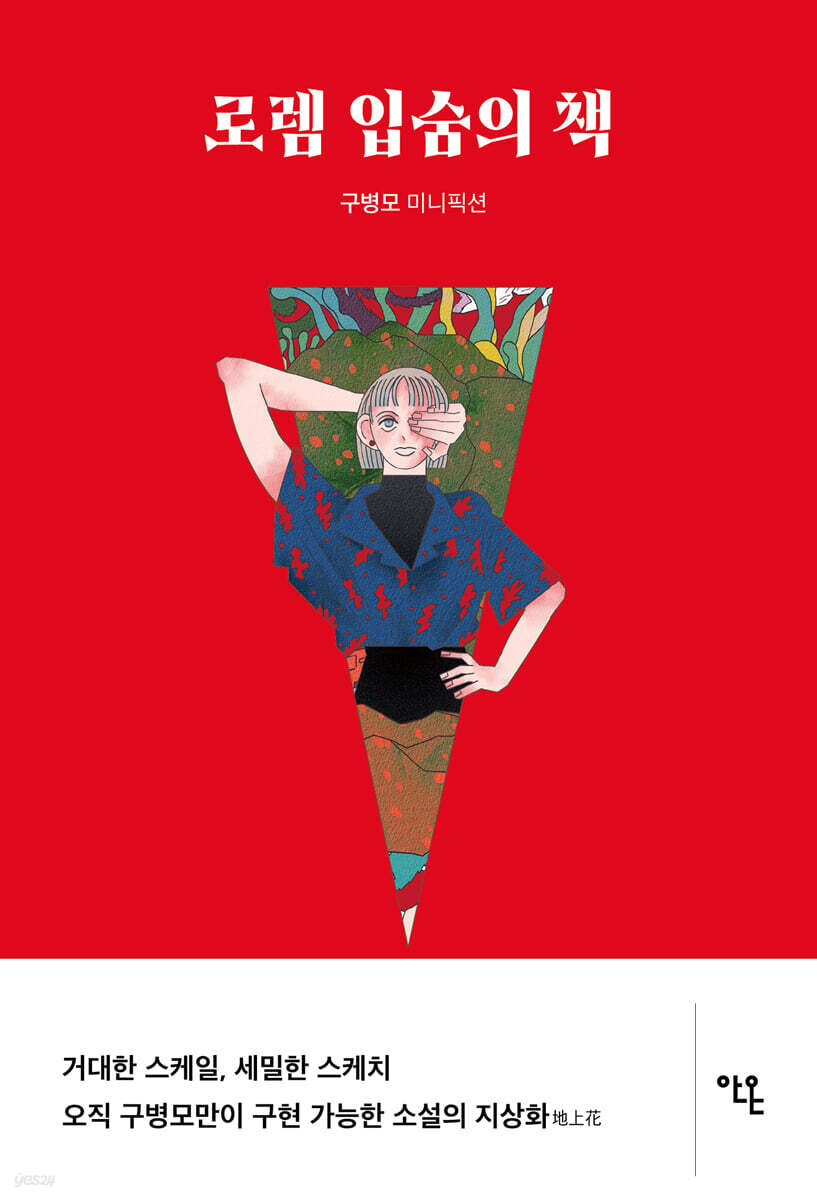
The Book of Lorem Ipsum
 |
Description
Book Introduction
- A word from MD
-
The right to read Gu Byeong-mo's novelsGu Byeong-mo, a writer who can write novels with his own style in any volume.
Gu Byeong-mo's sharp message and aesthetic colors were expressed in 13 mini-fictions, each about 50 pages long and 200 characters long.
A collection of novels that offers a glimpse into the process of contemplating novels and the world, as if looking at delicate sketches, as well as fantasies sharper than reality.February 7, 2023. Novel/Poetry PD Kim Yu-ri
Huge scale, detailed sketches
Only Gu Byeong-mo can implement
The novel's ground painting
Gu Byeong-mo's mini-fiction book, "The Book of Lorem Ipsum," was published by Anon Books.
In this book, which contains thirteen works, each about fifty pages long and 200 characters long, the author displays the aesthetic colors he has shown so far in a more intense manner, while also fully displaying his ability to novelize invisible ideas and consciousness.
The thirteen colors, each of which appears different, can only be seen in their true form by looking down from a high altitude, which can only be reached after reading the entire novel.
Just like the moment you encounter the Nazca Lines, these works are so surprising that the more you look at them, the more breathtaking the messages (or lack thereof) meticulously etched into their short lengths are.
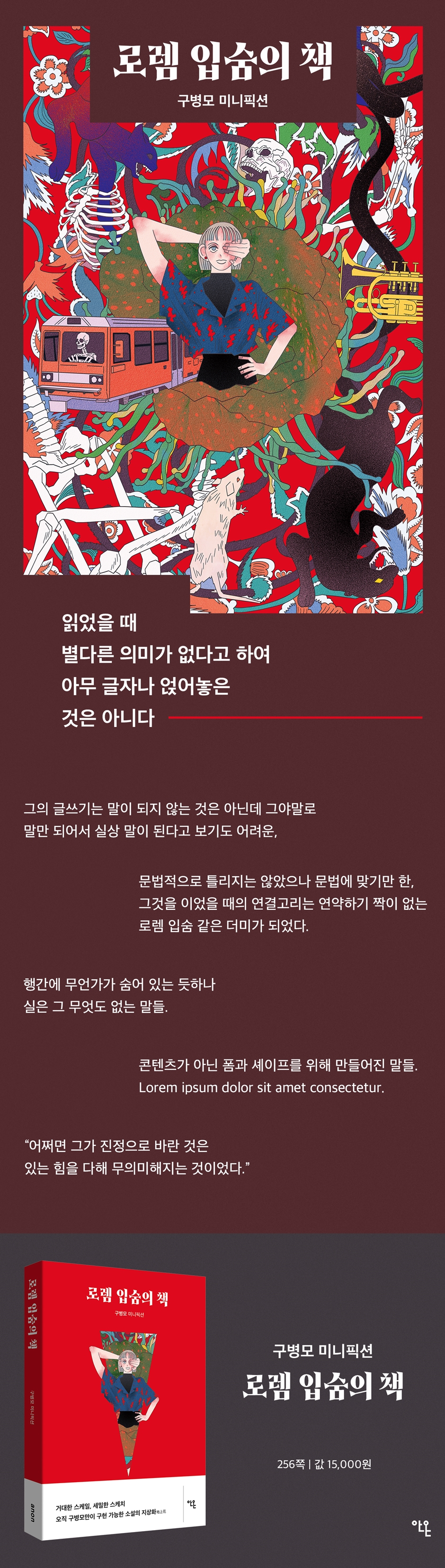
'Lorem Ipsum' is simply random dummy text, poured over to be shaped without any meaning, but its meaningless unfamiliarity leads us into a world of perfection and polish.
Whether it's a concept of good and evil, an attitude toward language or art, or a sense of crisis for a generation or era, the author doesn't easily reveal his intentions, but rather novelizes them and reveals them through their structure.
The brilliance of this ability to meticulously novelize such grand ideas is evident in the numerous works included in The Book of Lorem Ipsum.
This is the author's unique and meticulous response to the novel and the world, and it reads like a solemn pledge.
If the struggle to question the very existence of novels is an unavoidable task for both writers and readers, I hope to reach that far-off height with the novels collected here.
Only Gu Byeong-mo can implement
The novel's ground painting
Gu Byeong-mo's mini-fiction book, "The Book of Lorem Ipsum," was published by Anon Books.
In this book, which contains thirteen works, each about fifty pages long and 200 characters long, the author displays the aesthetic colors he has shown so far in a more intense manner, while also fully displaying his ability to novelize invisible ideas and consciousness.
The thirteen colors, each of which appears different, can only be seen in their true form by looking down from a high altitude, which can only be reached after reading the entire novel.
Just like the moment you encounter the Nazca Lines, these works are so surprising that the more you look at them, the more breathtaking the messages (or lack thereof) meticulously etched into their short lengths are.
'Lorem Ipsum' is simply random dummy text, poured over to be shaped without any meaning, but its meaningless unfamiliarity leads us into a world of perfection and polish.
Whether it's a concept of good and evil, an attitude toward language or art, or a sense of crisis for a generation or era, the author doesn't easily reveal his intentions, but rather novelizes them and reveals them through their structure.
The brilliance of this ability to meticulously novelize such grand ideas is evident in the numerous works included in The Book of Lorem Ipsum.
This is the author's unique and meticulous response to the novel and the world, and it reads like a solemn pledge.
If the struggle to question the very existence of novels is an unavoidable task for both writers and readers, I hope to reach that far-off height with the novels collected here.
- You can preview some of the book's contents.
Preview
index
The City of Cremation | The Exile of the God-Man | The Dream of Eternity | The Right to Have a Verb | Fly, Odin | Art is a Closed Door | The Initiator | The Palace and the Man of Hamelin | Long Sleeve | Horses Born into the World | A Ragged Face | Reasonable and Plausible | The Alcove of Time
Detailed image
Into the book
The rookie plucked a feather from the wing on my shoulder.
With its taut, thick feathers, it began to slowly scrape the stone floor, applying force to the ground.
There was no need to rush, as the newcomer was guaranteed eternity.
With a rhythm like music that has just begun to play and has hundreds of measures and phrases left until it reaches its climax, with a gesture like that of a painter who has touched the brush without any special technique but has captured the wonder in the dots and lines he has encountered by chance.
The line that the rookie began to draw seemed to stretch out in an amorphous manner at first glance.
---From "The Exile of a Divine Man"
Perhaps what he truly wanted was to become meaningless with all his might.
All the writings that countless writers, including himself, had churned out or spit out might have been nothing more than an endless repetition of Lorem Ipsum, and the more he wrote, the more he realized that writing nothing was as good as writing anything. When he realized this, he finally accepted that writing nothing—that the absence of any writing at all—was the ultimate writing he had dreamed of.
Just as there is no music more perfect than silence, just as a blank canvas without a single dot overpowers a colorful painting, just as not being born is the safest life.
---From "The Right to Have a Verb"
Now you can run away to a place where no one knows you.
No, you have to run away.
There is a limit to how far we can run, so I wish we could fly, but without God's care, neither you nor I would be able to do that.
We are all equal in our finiteness and insignificance.
---From "Fly, Odin"
Since rats are not extinct, there must be plenty of them living somewhere, and human culture and civilization have simply managed them so that they do not end up on our bedding or tables, or at least so that they are less visible to people.
To avoid threatening the lives of innocent citizens, they simply pretended not to exist, pretended not to know that they were alive.
So, this was, so to speak, a management failure.
It was impossible for a rat to be in a house with a baby.
As expectations for reconstruction were rising, the landlord was planning to significantly increase the deposit next time, and her husband was no longer in a position to receive a loan.
There was no answer other than running away.
---From "The Palace and the Man of Hamelin"
When he grows up, he might become a pine tree with his arms outstretched.
As if something with plant genes was born as a human by mistake from a dozing god.
It creates shade with both arms, and soon it may reach up to the sky.
---From "Long Sleeve"
To have words is to become a god.
If you abuse words, you will eventually think that you own those words.
There may come a day when everyone becomes their own god, and in reality, everyone already claims to be a god and does not fear God.
Therefore, eliminating certain words will not only alleviate the injustice and inconvenience in human society, but will also ultimately help them become children of God.
Won is not at all discouraged by the series of failures and moves on to the next city.
The world is wide and there are many cities.
Perhaps the cities of this world will remain until all words registered in the dictionary of God are erased.
With its taut, thick feathers, it began to slowly scrape the stone floor, applying force to the ground.
There was no need to rush, as the newcomer was guaranteed eternity.
With a rhythm like music that has just begun to play and has hundreds of measures and phrases left until it reaches its climax, with a gesture like that of a painter who has touched the brush without any special technique but has captured the wonder in the dots and lines he has encountered by chance.
The line that the rookie began to draw seemed to stretch out in an amorphous manner at first glance.
---From "The Exile of a Divine Man"
Perhaps what he truly wanted was to become meaningless with all his might.
All the writings that countless writers, including himself, had churned out or spit out might have been nothing more than an endless repetition of Lorem Ipsum, and the more he wrote, the more he realized that writing nothing was as good as writing anything. When he realized this, he finally accepted that writing nothing—that the absence of any writing at all—was the ultimate writing he had dreamed of.
Just as there is no music more perfect than silence, just as a blank canvas without a single dot overpowers a colorful painting, just as not being born is the safest life.
---From "The Right to Have a Verb"
Now you can run away to a place where no one knows you.
No, you have to run away.
There is a limit to how far we can run, so I wish we could fly, but without God's care, neither you nor I would be able to do that.
We are all equal in our finiteness and insignificance.
---From "Fly, Odin"
Since rats are not extinct, there must be plenty of them living somewhere, and human culture and civilization have simply managed them so that they do not end up on our bedding or tables, or at least so that they are less visible to people.
To avoid threatening the lives of innocent citizens, they simply pretended not to exist, pretended not to know that they were alive.
So, this was, so to speak, a management failure.
It was impossible for a rat to be in a house with a baby.
As expectations for reconstruction were rising, the landlord was planning to significantly increase the deposit next time, and her husband was no longer in a position to receive a loan.
There was no answer other than running away.
---From "The Palace and the Man of Hamelin"
When he grows up, he might become a pine tree with his arms outstretched.
As if something with plant genes was born as a human by mistake from a dozing god.
It creates shade with both arms, and soon it may reach up to the sky.
---From "Long Sleeve"
To have words is to become a god.
If you abuse words, you will eventually think that you own those words.
There may come a day when everyone becomes their own god, and in reality, everyone already claims to be a god and does not fear God.
Therefore, eliminating certain words will not only alleviate the injustice and inconvenience in human society, but will also ultimately help them become children of God.
Won is not at all discouraged by the series of failures and moves on to the next city.
The world is wide and there are many cities.
Perhaps the cities of this world will remain until all words registered in the dictionary of God are erased.
---From "Words Born into the World"
Publisher's Review
Discover the broad horizons of Koo Byung-mo's novels in one book.
The ability to make readers appreciate the scale and hidden intentions of a novel only after reading it with interest is perhaps the strength of author Koo Byung-mo, a strength that even other novelists covet.
Themes that seem impossible to grasp always pass through the writer's body, take on the form of stories and characters, and clearly reveal their outlines.
The first work in the Book of Lorem Ipsum, "The City of Cosmetics," seems to reveal the good and evil sides of humanity through a city's funeral policy where a "nano seed" implanted in a person's body at birth blooms into a flower after death, proving their life. However, it implements a rhetoric that shows that just as no one is necessarily good or evil, there are other social contradictions hidden in the distinction between good and evil.
"The Exile of the Divine Man" is a grand imagination about the birth of the Nazca Lines.
The conflict between the absolute and the divine hidden in mysterious natural phenomena builds a story.
In "Eternal Dream," the 'I' unexpectedly meets someone in the library who asks to buy a dream, and ends up selling a meaningless dream.
As you enjoy comfort, using it for living expenses and rent, you no longer remember the dream you had the night before, and as you continue to repeat the empty dream, you begin to talk about another dream, a dream you had but could not realize, and the story of putting a price on that lost dream unfolds like a dream.
"The Right to Have Verbs" is a work that hints at the title of this book, "The Book of Ipsum Lorem."
The author's statement that he wanted to write a novel that seemed to make no sense at all, but that it was only a story about a person who writes a novel that makes no sense, reveals the author's challenge to the novel and his will to pursue a novel that is not stereotyped and elusive.
In "Fly, Odin," the 'I' trains dogs to be mobilized for war and tries not to have any feelings for them.
The determination that there is no need to love those who will be used for cruel biological experiments or as anti-tank bombs is put in jeopardy as 'Odin' is about to be deployed.
There is a vivid novelistic preposition hidden within the story that allows us to empathize with the devastation of war that is still raging around the world.
"Art is a Closed Door" is a novel that maximizes the cruelty of the various audition shows that have swept the media today.
Unlike real-life auditions, the auditions in this work are battlegrounds where life and death are at stake.
The time given to them was 90 seconds.
Moreover, the novel's confrontation with the judges, who seem to have little interest in artistic achievement, is impressive.
"The Entrancer" depicts a future in which the medieval dueling system has been revived.
People who want and carry out private punishment rather than law enforcement, which has complicated procedures and cannot guarantee results.
As an 'attendant' who plays as important a role as a party to such a duel, 'I' leave a final letter to my daughter.
"The Palace and the Man of Hamelin" closely depicts a 24-pyeong (approximately 80 square meters) apartment that has not been renovated for a long time.
I, the tenant, had a child and was now in full charge of raising the child and doing all the housework. I put my house up for sale a long time ago to get out of here, but the contract was not finalized and winter arrived.
Then one day, a strange man comes to the house and claims that there are rats in the house.
The reality and the management that tries to hide it bring to light the violence behind any administrative power.
"Long Sleeves" is a story about a friend who has noticeably longer arms than others, which makes him the butt of jokes and causes him inconvenience, but who saves him from a crisis.
For a moment, it may seem like a mistake on God's part, but it is actually a manifestation of his incredible ability to create a large shadow with his two arms.
The main character of “Words Born into the World,” Won, is “an angel who stole God’s dictionary.”
Won wants to erase certain words from a huge dictionary to give humanity a better world.
It makes us wonder if humans would live better lives and become better communities if words like attack, loneliness, and pollution were erased from God's dictionary.
〈Ragged Face〉 is a transparent human.
As a physically transparent person, not a metaphorical one, I try to live without causing harm to others, but it is not easy.
He tries to use his talents to contribute to justice and the public good, but all he gets in return is cold treatment.
Now I want to have a face like everyone else.
But it is not possible because there is no one in the world who knows my face.
The 'I' in 'Sure and Plausible' is a novelist.
In this story, which is clearly fictional and about revising a novel while working on its publication, we can get a glimpse into author Gu Byeong-mo's attitude and values toward novels.
It is also a paradox of everything we believe to be right and plausible.
〈Time's Wall〉 is about a pendant that can travel through time like space, and witnesses the tragedy of 100 years in the future. However, it shows that humans are not beings who reflect on or adjust their present just because they glimpsed the despair of the future.
In this way, despite the seemingly limited format of minifiction, author Koo Byung-mo ruthlessly crosses and conquers the boundaries between territory and time, between humans and gods, proving that the completeness and potential of a novel cannot be determined by its size.
That is why I say that just because it is a short novel, it does not mean that it is less valuable.
In addition to the extensive and detailed stories, this book also includes author notes for each work, including the starting point of the work and the author's thoughts after writing it, adding to the enjoyment of reading.
While we understand the novelistic abilities of author Koo Byung-mo, we sometimes misunderstood him and made unreasonable demands based on what we believed to be reasonable and plausible grounds.
Now, we can fully enjoy the depth of Gu Byeong-mo's work, layered on top of its brevity, with 『The Book of Lorem Ipsum』, which contains the broad horizons and essence of author Gu Byeong-mo in one volume.
The ability to make readers appreciate the scale and hidden intentions of a novel only after reading it with interest is perhaps the strength of author Koo Byung-mo, a strength that even other novelists covet.
Themes that seem impossible to grasp always pass through the writer's body, take on the form of stories and characters, and clearly reveal their outlines.
The first work in the Book of Lorem Ipsum, "The City of Cosmetics," seems to reveal the good and evil sides of humanity through a city's funeral policy where a "nano seed" implanted in a person's body at birth blooms into a flower after death, proving their life. However, it implements a rhetoric that shows that just as no one is necessarily good or evil, there are other social contradictions hidden in the distinction between good and evil.
"The Exile of the Divine Man" is a grand imagination about the birth of the Nazca Lines.
The conflict between the absolute and the divine hidden in mysterious natural phenomena builds a story.
In "Eternal Dream," the 'I' unexpectedly meets someone in the library who asks to buy a dream, and ends up selling a meaningless dream.
As you enjoy comfort, using it for living expenses and rent, you no longer remember the dream you had the night before, and as you continue to repeat the empty dream, you begin to talk about another dream, a dream you had but could not realize, and the story of putting a price on that lost dream unfolds like a dream.
"The Right to Have Verbs" is a work that hints at the title of this book, "The Book of Ipsum Lorem."
The author's statement that he wanted to write a novel that seemed to make no sense at all, but that it was only a story about a person who writes a novel that makes no sense, reveals the author's challenge to the novel and his will to pursue a novel that is not stereotyped and elusive.
In "Fly, Odin," the 'I' trains dogs to be mobilized for war and tries not to have any feelings for them.
The determination that there is no need to love those who will be used for cruel biological experiments or as anti-tank bombs is put in jeopardy as 'Odin' is about to be deployed.
There is a vivid novelistic preposition hidden within the story that allows us to empathize with the devastation of war that is still raging around the world.
"Art is a Closed Door" is a novel that maximizes the cruelty of the various audition shows that have swept the media today.
Unlike real-life auditions, the auditions in this work are battlegrounds where life and death are at stake.
The time given to them was 90 seconds.
Moreover, the novel's confrontation with the judges, who seem to have little interest in artistic achievement, is impressive.
"The Entrancer" depicts a future in which the medieval dueling system has been revived.
People who want and carry out private punishment rather than law enforcement, which has complicated procedures and cannot guarantee results.
As an 'attendant' who plays as important a role as a party to such a duel, 'I' leave a final letter to my daughter.
"The Palace and the Man of Hamelin" closely depicts a 24-pyeong (approximately 80 square meters) apartment that has not been renovated for a long time.
I, the tenant, had a child and was now in full charge of raising the child and doing all the housework. I put my house up for sale a long time ago to get out of here, but the contract was not finalized and winter arrived.
Then one day, a strange man comes to the house and claims that there are rats in the house.
The reality and the management that tries to hide it bring to light the violence behind any administrative power.
"Long Sleeves" is a story about a friend who has noticeably longer arms than others, which makes him the butt of jokes and causes him inconvenience, but who saves him from a crisis.
For a moment, it may seem like a mistake on God's part, but it is actually a manifestation of his incredible ability to create a large shadow with his two arms.
The main character of “Words Born into the World,” Won, is “an angel who stole God’s dictionary.”
Won wants to erase certain words from a huge dictionary to give humanity a better world.
It makes us wonder if humans would live better lives and become better communities if words like attack, loneliness, and pollution were erased from God's dictionary.
〈Ragged Face〉 is a transparent human.
As a physically transparent person, not a metaphorical one, I try to live without causing harm to others, but it is not easy.
He tries to use his talents to contribute to justice and the public good, but all he gets in return is cold treatment.
Now I want to have a face like everyone else.
But it is not possible because there is no one in the world who knows my face.
The 'I' in 'Sure and Plausible' is a novelist.
In this story, which is clearly fictional and about revising a novel while working on its publication, we can get a glimpse into author Gu Byeong-mo's attitude and values toward novels.
It is also a paradox of everything we believe to be right and plausible.
〈Time's Wall〉 is about a pendant that can travel through time like space, and witnesses the tragedy of 100 years in the future. However, it shows that humans are not beings who reflect on or adjust their present just because they glimpsed the despair of the future.
In this way, despite the seemingly limited format of minifiction, author Koo Byung-mo ruthlessly crosses and conquers the boundaries between territory and time, between humans and gods, proving that the completeness and potential of a novel cannot be determined by its size.
That is why I say that just because it is a short novel, it does not mean that it is less valuable.
In addition to the extensive and detailed stories, this book also includes author notes for each work, including the starting point of the work and the author's thoughts after writing it, adding to the enjoyment of reading.
While we understand the novelistic abilities of author Koo Byung-mo, we sometimes misunderstood him and made unreasonable demands based on what we believed to be reasonable and plausible grounds.
Now, we can fully enjoy the depth of Gu Byeong-mo's work, layered on top of its brevity, with 『The Book of Lorem Ipsum』, which contains the broad horizons and essence of author Gu Byeong-mo in one volume.
GOODS SPECIFICS
- Date of issue: January 31, 2023
- Page count, weight, size: 256 pages | 294g | 128*188*20mm
- ISBN13: 9791192638072
- ISBN10: 1192638077
You may also like
카테고리
korean


korean

![GQ KOREA Mark (Monthly): December [2025]](http://librairie.coreenne.fr/cdn/shop/files/8ef265dbbfbf186523ed75ba7319009d.jpg?v=1765340328&width=3840)


