

The Law of Invincible Ideas
 |
Description
Book Introduction
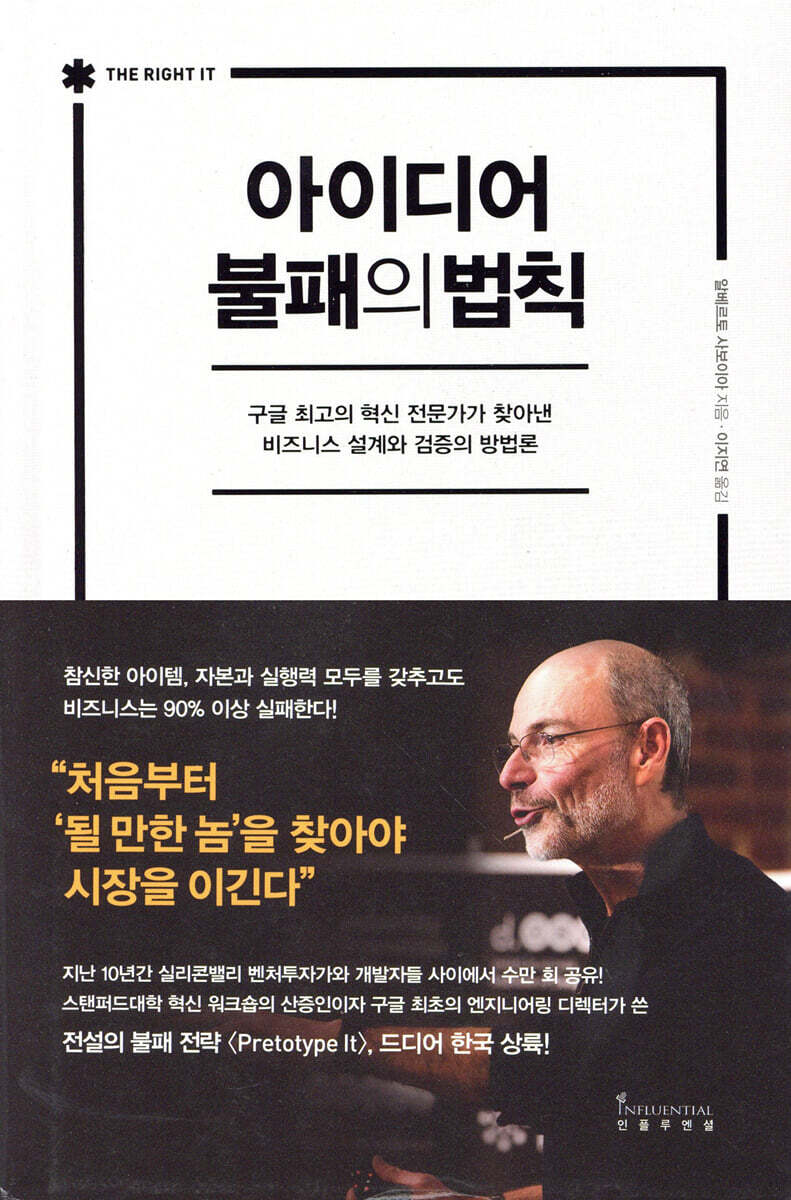
Google's first engineering director and Stanford University innovation master The culmination of Alberto Savoia's 30-year idea validation strategy. ★ A legendary bible shared tens of thousands of times among Silicon Valley venture capitalists and aspiring entrepreneurs over the past decade! ★ Strongly recommended by IT industry leaders, including Professor Jaeseung Jeong and VC Jeongmin Lim (former head of Google Campus Seoul). Most new products or ideas fail in the market. The only way to break the rule of failure is to 'design an idea that will work from the beginning.' Alberto Savoia, Google's first director of engineering, an innovation expert, and an "innovation master" who has lectured on idea validation strategies at Stanford University for many years, proposes the optimal methodology for designing outstanding ideas. The core of his verification strategy for finding "good guys" that he discovered through his own experience of success and failure and observing the rise and fall of leading Silicon Valley companies for over 30 years is the "pretotype" technique. Eight pre-to-type techniques for testing the viability of an idea in the cheapest, easiest, and fastest way possible, along with strategies for analyzing and utilizing the meaningful data obtained through these techniques! Over the past decade, countless entrepreneurs and startups, including those at Google, Amazon, Dell, and New Balance, have avoided bitter failure and achieved remarkable success with the help of this book and lectures. Now it's your turn. |
- You can preview some of the book's contents.
Preview
index
Recommended Preface: To all market explorers who seek to hunt failure and capture success (by Jaeseung Jeong)
People who read this book first and praised it
Introduction: Why Our Perfect Idea Failed So Miserably
│Part 1│ The Unchangeable Fact
Chapter 1: The Law of Market Failure
Failure is not an option, absolutely not! │The Law of Market Failure│What is Market Failure, Market Success? │The Probability of Failure│The Equation for Success│We Never Fail?│Failure Fear│The Pattern of Failure FLOP
Chapter 2
The Undoable │ Thoughtland │ Suri Suri Masuri Focus Group │ The Four Monsters That Invoke Failure │ Thoughtland and Positive Errors │ Thoughtland and Negative Errors │ Escaping Thoughtland
Chapter 3: Put Your Thoughts Aside and Gather Data
Collect Their Data│Collect 'Your Own Data'│Summary
Part 2: How to Collect Useful Data
Chapter 4 Thinking Tools
Market Response Hypothesis│Speak in Numbers│Narrowing the Scope
Chapter 5 Pretotyping Tools
IBM speech recognition technology case study│Pretotyping│In search of pretotypes│Mechanical Turk pretotype│Pinocchio pretotype│Fake door pretotype│Exterior pretotype│YouTube pretotype│One night pretotype│Infiltrator pretotype│Brand change pretotype│Transformation and combination│The essence of pretotypes
Chapter 6 Analysis Tools
Active Investment Indicator│Will-Be-Nam Scale
Part 3: Flexible Strategies
Chapter 7: Strategic Tools
Strategy 1: Think Globally, Test Locally│Strategy 2: It's Better to Test Today Than Tomorrow│Strategy 3: Think Cheap, Cheaper, Cheapest│Strategy 4: Fix It, Turn It Around, Try It All, and Stop
Chapter 8 Completion Case: Bus U
Think Clearly│Test│Analyze and Iterate│A Lucky Incident│Some Notes on the Bus U Case
Chapter 9: Final Request
Summary│What to Make
Acknowledgements
Glossary of Terms
Search
People who read this book first and praised it
Introduction: Why Our Perfect Idea Failed So Miserably
│Part 1│ The Unchangeable Fact
Chapter 1: The Law of Market Failure
Failure is not an option, absolutely not! │The Law of Market Failure│What is Market Failure, Market Success? │The Probability of Failure│The Equation for Success│We Never Fail?│Failure Fear│The Pattern of Failure FLOP
Chapter 2
The Undoable │ Thoughtland │ Suri Suri Masuri Focus Group │ The Four Monsters That Invoke Failure │ Thoughtland and Positive Errors │ Thoughtland and Negative Errors │ Escaping Thoughtland
Chapter 3: Put Your Thoughts Aside and Gather Data
Collect Their Data│Collect 'Your Own Data'│Summary
Part 2: How to Collect Useful Data
Chapter 4 Thinking Tools
Market Response Hypothesis│Speak in Numbers│Narrowing the Scope
Chapter 5 Pretotyping Tools
IBM speech recognition technology case study│Pretotyping│In search of pretotypes│Mechanical Turk pretotype│Pinocchio pretotype│Fake door pretotype│Exterior pretotype│YouTube pretotype│One night pretotype│Infiltrator pretotype│Brand change pretotype│Transformation and combination│The essence of pretotypes
Chapter 6 Analysis Tools
Active Investment Indicator│Will-Be-Nam Scale
Part 3: Flexible Strategies
Chapter 7: Strategic Tools
Strategy 1: Think Globally, Test Locally│Strategy 2: It's Better to Test Today Than Tomorrow│Strategy 3: Think Cheap, Cheaper, Cheapest│Strategy 4: Fix It, Turn It Around, Try It All, and Stop
Chapter 8 Completion Case: Bus U
Think Clearly│Test│Analyze and Iterate│A Lucky Incident│Some Notes on the Bus U Case
Chapter 9: Final Request
Summary│What to Make
Acknowledgements
Glossary of Terms
Search
Detailed image

Into the book
3am.
I couldn't sleep at all.
In six hours, the last board meeting of the company I co-founded will be held.
After five years of hard work and trying many new things to get the business back on track, I now had no choice but to accept a bargain sale offer.
It was a company that had been recognized for its technological prowess and possessed valuable assets.
Dozens of people I hired, people who believed in me and my vision, will soon be unemployed.
As we entered the conference room, the three top venture capital firms in the world who had entrusted us with $25 million, provided us with connections, and provided us with advice would be eyeing me, my co-founder, and our executive team with a glare.
I was bitten by the beast called failure.
The pain was like hell
--- p.
17, from the "Preface"
'Thoughts' alone cannot determine whether an idea is 'good enough' or not.
No matter how deeply you think about it, it's the same.
You can't make decisions based on other people's thoughts or opinions.
Even if it is the opinion of 'experts', it is the same.
You are not Nostradamus.
I'm not Nostradamus, nor am anyone else.
At best, our predictions turn out to be 'sometimes' correct.
And most of it is 'luck'.
The nature of a 'good guy' is not something that can be derived through deduction or induction in 'Thought Land'.
The 'good guys' have to be discovered through experiments in the real world.
Yet, most market research is based on thought-land.
Why market research based on thought-land is dangerous can be clearly seen by looking at the most common market research tool, the 'focus group'.
--- p.
66, from “Chapter 1: The Law of Market Failure”
Webvan's founders decided to create a new company that would allow people to easily order groceries online and have them delivered to their homes by van at a set time.
People (business analysts, grocery industry consultants, internet experts) all unanimously said that this was a huge market opportunity.
Most of the potential consumers interviewed also responded enthusiastically.
“That’s a great story.
“I hate picking out groceries, waiting in line, and hauling them to my car—I really hate that kind of stuff.” After receiving over $100 million in funding from some of the industry’s top venture capital firms, Webvan quickly started hiring people, buying things, and building buildings.
(Omitted) But for some reason, the promise of large-scale consumers to buy groceries online rather than waiting in line never came to fruition.
In 2001, about two years after starting operations, Webvan filed for bankruptcy.
--- p.
83~84, from “The Guy Who Will Be Chapter 2”
One of the valuable habits I've learned while working at Google is to avoid vague terms and use numbers whenever possible.
If 'data over opinion' is more important, then the best way to express that data is to 'speak in numbers.'
For example, instead of saying, "I think we'd get a few more clicks if we made the 'Sign Up' button a little wider," a seasoned Googler would convert "a little wider" and "a little more clicks" into concrete quantities, turning this vague opinion into a testable hypothesis.
By speaking in numbers, vague beliefs become clearly stated, testable hypotheses.
In this case, it becomes clear how to design the experiment.
--- p.
114, from “Chapter 4 Thinking Tools”
Google Glass promised a lot of promise, but it didn't live up to initial expectations, and the project was eventually canceled.
First of all, there was a lot of interest at first, and many people were willing to pay $1,500.
But the result was just the opposite.
Google Glass is a great example of how, while initial interest and investment are necessary, these alone don't determine whether a product is "good enough."
Especially for companies like Google or Apple, it's relatively easy to create buzz around new ideas.
What really matters is whether that initial buzz translates into sustained interest and consistent usage.
By combining YouTube Pretotype with its Explorer program, Google was able to not only gauge initial interest in the product but also track whether that enthusiasm persisted after the initial excitement wore off.
--- p.
198-199, from “Chapter 5 Free Typing Tools”
Over the years, working with hundreds of teams on thousands of new product ideas, I've noticed the following pattern:
Teams that spend too much time on ideas and their data in Thinkland and then months rewriting their business plan usually fail.
Teams that rush to launch with minimal planning and validation usually fail.
Teams that rush to 'test' the market usually succeed.
In other words, you shouldn't spend too much time in Idealand, but you shouldn't rush the market launch of the finished product either.
Instead, use your eagerness to launch your product to 'test' the market first.
--- p.
276-277, from “Chapter 7: Strategic Tools”
People wanted to know how Elon Musk dealt with the crushing frustration and unrelenting stress.
Musk responded:
“There are definitely better answers than mine.
I just try to embrace the pain and really cherish what I'm doing." (Omitted) Make sure you're creating a 'good guy' and make sure it's something you really cherish before you even start creating it.
In other words, for an idea to ultimately be successful, it is not enough to simply know that the idea is a "good one" in the marketplace.
The idea should be to be the 'one to be' for 'you'.
They must fit each other in both directions.
I couldn't sleep at all.
In six hours, the last board meeting of the company I co-founded will be held.
After five years of hard work and trying many new things to get the business back on track, I now had no choice but to accept a bargain sale offer.
It was a company that had been recognized for its technological prowess and possessed valuable assets.
Dozens of people I hired, people who believed in me and my vision, will soon be unemployed.
As we entered the conference room, the three top venture capital firms in the world who had entrusted us with $25 million, provided us with connections, and provided us with advice would be eyeing me, my co-founder, and our executive team with a glare.
I was bitten by the beast called failure.
The pain was like hell
--- p.
17, from the "Preface"
'Thoughts' alone cannot determine whether an idea is 'good enough' or not.
No matter how deeply you think about it, it's the same.
You can't make decisions based on other people's thoughts or opinions.
Even if it is the opinion of 'experts', it is the same.
You are not Nostradamus.
I'm not Nostradamus, nor am anyone else.
At best, our predictions turn out to be 'sometimes' correct.
And most of it is 'luck'.
The nature of a 'good guy' is not something that can be derived through deduction or induction in 'Thought Land'.
The 'good guys' have to be discovered through experiments in the real world.
Yet, most market research is based on thought-land.
Why market research based on thought-land is dangerous can be clearly seen by looking at the most common market research tool, the 'focus group'.
--- p.
66, from “Chapter 1: The Law of Market Failure”
Webvan's founders decided to create a new company that would allow people to easily order groceries online and have them delivered to their homes by van at a set time.
People (business analysts, grocery industry consultants, internet experts) all unanimously said that this was a huge market opportunity.
Most of the potential consumers interviewed also responded enthusiastically.
“That’s a great story.
“I hate picking out groceries, waiting in line, and hauling them to my car—I really hate that kind of stuff.” After receiving over $100 million in funding from some of the industry’s top venture capital firms, Webvan quickly started hiring people, buying things, and building buildings.
(Omitted) But for some reason, the promise of large-scale consumers to buy groceries online rather than waiting in line never came to fruition.
In 2001, about two years after starting operations, Webvan filed for bankruptcy.
--- p.
83~84, from “The Guy Who Will Be Chapter 2”
One of the valuable habits I've learned while working at Google is to avoid vague terms and use numbers whenever possible.
If 'data over opinion' is more important, then the best way to express that data is to 'speak in numbers.'
For example, instead of saying, "I think we'd get a few more clicks if we made the 'Sign Up' button a little wider," a seasoned Googler would convert "a little wider" and "a little more clicks" into concrete quantities, turning this vague opinion into a testable hypothesis.
By speaking in numbers, vague beliefs become clearly stated, testable hypotheses.
In this case, it becomes clear how to design the experiment.
--- p.
114, from “Chapter 4 Thinking Tools”
Google Glass promised a lot of promise, but it didn't live up to initial expectations, and the project was eventually canceled.
First of all, there was a lot of interest at first, and many people were willing to pay $1,500.
But the result was just the opposite.
Google Glass is a great example of how, while initial interest and investment are necessary, these alone don't determine whether a product is "good enough."
Especially for companies like Google or Apple, it's relatively easy to create buzz around new ideas.
What really matters is whether that initial buzz translates into sustained interest and consistent usage.
By combining YouTube Pretotype with its Explorer program, Google was able to not only gauge initial interest in the product but also track whether that enthusiasm persisted after the initial excitement wore off.
--- p.
198-199, from “Chapter 5 Free Typing Tools”
Over the years, working with hundreds of teams on thousands of new product ideas, I've noticed the following pattern:
Teams that spend too much time on ideas and their data in Thinkland and then months rewriting their business plan usually fail.
Teams that rush to launch with minimal planning and validation usually fail.
Teams that rush to 'test' the market usually succeed.
In other words, you shouldn't spend too much time in Idealand, but you shouldn't rush the market launch of the finished product either.
Instead, use your eagerness to launch your product to 'test' the market first.
--- p.
276-277, from “Chapter 7: Strategic Tools”
People wanted to know how Elon Musk dealt with the crushing frustration and unrelenting stress.
Musk responded:
“There are definitely better answers than mine.
I just try to embrace the pain and really cherish what I'm doing." (Omitted) Make sure you're creating a 'good guy' and make sure it's something you really cherish before you even start creating it.
In other words, for an idea to ultimately be successful, it is not enough to simply know that the idea is a "good one" in the marketplace.
The idea should be to be the 'one to be' for 'you'.
They must fit each other in both directions.
--- p.
353-354, from “Chapter 9, Final Request”
353-354, from “Chapter 9, Final Request”
Publisher's Review
"I thought failure was something only people who weren't prepared for! My plans were perfect! But I failed!"
― The Truth Learned by Google's First Director of Engineering, Who Observed the Rise and Fall of Silicon Valley for 30 Years
No matter how innovative the idea, how much capital, and how much execution power you have, 90 percent of new products and business ideas that hit the market fail.
Alberto Savoia, Google's first engineering director and a key figure in Google's history, and author who has witnessed the rise and fall of countless startups in Silicon Valley for 30 years, calls this cruel truth the "law of market failure."
The only way to break this rule of failure is to find a "good idea" from the beginning and design it properly.
Why was the novel "The Martian" "the right one" and New Coke (Coca-Cola's new cola brand launched in 1985) "the wrong one"? Why did the seemingly reckless Airbnb succeed, and why did the globally-watched "Google Glass" fail miserably? The secret that determined their fates lies hidden in Alberto Savoia's debut work, "The Right It."
According to the author, while all developers and professionals are struggling to develop ideas in "thoughtland," a fictional environment riddled with errors and confirmation bias, a beast called "failure" prowls around looking for prey.
Failure is always cruel to everyone.
Even for the author who was on a smooth road, a painful failure came unexpectedly.
Airbnb, which seemed reckless, succeeded, but Google Glass, which everyone was paying attention to, failed!
Google, after starting at Sun Microsystems, achieved a $100 million exit, but failure was not an exception.
Even at this very moment, millions of people around the world are working hard to turn ideas that would be a success if they were just released into reality.
You can change the world by becoming the next Google, the next vaccine, the next Harry Potter, the next Benz.
But unfortunately, even if everyone works equally hard at the same time, most new products, new businesses, and new services fail miserably when they are launched into the market.
The reason most of these failed was that they were 'bad ideas' from the start, meaning that they would fail even if executed competently.
Then why on earth did they develop something that would 'not work'?
Surely, at first, it seemed like a fresh, groundbreaking, and promising idea.
We have conducted market research, both large and small, for both startups and large corporations.
The problem is that this market research is often conducted within the aforementioned 'Thinking Land'.
The author dissected the corpses of countless products that failed despite extensive market research, and discovered a pattern of miserable failure due to market research entangled with experts' subjective biases, impulsive judgments, beliefs, preferences, and predictions.
Alberto Savoia, the author who led Google and Sun Microsystems during their heyday and founded three startups himself, successfully exited them for $100 million, also sold his company for a pittance after five years of focused business failure.
He confessed his painful experience at that time as “being bitten by the beast called failure,” and decided to fight back against the beast by writing this book.
“Please, forget about expert opinions and get ‘customer response data’ cheaply, quickly, and locally!”
― The most flexible and powerful tool to alleviate the anxiety of failure: 'Pretotype' and its utilization strategy.
The new book, "The Unbeatable Law of Ideas," offers the most flexible and powerful tools and strategies to alleviate the anxiety of failure with minimal time and energy.
Alberto named this strategy 'pretotype'.
A prototype is a model made before mass-producing an actual product, and the word 'prototype' means something before (pre-) (pp. 137-138).
Pretotyping is a testing step to determine whether an idea is a "good one" that will succeed or not. In this book, the author explains the verification strategy by specifying a total of eight techniques.
These include the Mechanical Turk pretotype, which allows customers to experience a service while a person acts as a stand-in for the product behind the scenes; YouTube pretotypes that utilize YouTube promotional videos like Google Glass; an external pretotype that checks actual customer reactions with a "buy" button on a fake website; and an overnight pretotype that checks customer reactions through a one-time experiment.
Airbnb, now a global unicorn company, leveraged overnight pre-to-types to gather potential customer data and realized that this business was a "good one."
Andy Weir's novel "The Martian," written by a software engineer turned author, is also a prime example of freetotyping.
In this way, Alberto Savoia presents an exciting and practical idea validation technique that can be immediately applied to all entrepreneurs and businesspeople who want to introduce new ideas, products, and business models to the market, using examples from Silicon Valley companies.
In this book, the author strongly advises that instead of spending expensive money on market testing or wasting time and effort on seeking expert opinions, you should obtain your own 'data' in the form of numbers, cheaply (the author suggests under $100), quickly, locally.
The methodology for obtaining this is ‘freetotyping’.
A PDF file that became a legend for venture capitalists and aspiring entrepreneurs after 10 years, becoming the "bible of innovation."
― Praise from IT industry leaders, including Stanford University Professor Tina Seelig, KAIST Professor Jaeseung Jeong, and VC Jeongmin Lim
An interesting fact is that this book is also a product of free typing.
Author Alberto Savoia produced several copies of the 2011 booklet Pretotyping, which outlined the key points of his idea validation methodology.
The intention was to verify the book's utility and reader response before proper publication.
After a while, as word of mouth spread and orders from developers around me continued to come in, I ended up uploading the PDF file online.
Over the next decade, the file was shared tens of thousands of times (by our own estimate) among venture capitalists, developers, and aspiring entrepreneurs in Silicon Valley, and was even translated into over a dozen languages and distributed for free.
His colleague, Tina Seelig, a professor of management science and engineering at Stanford University, who witnessed this, chided him, saying, “Stop making excuses and just sit down and write that damn book.” Thanks to this, he eventually signed a contract with HarperCollins, a major American publisher, and the book was officially published in 2019, meeting Korean readers in 2020.
Over the past decade, countless entrepreneurs and founders, including those at Google, Amazon, Dell, and New Balance, have avoided bitter failures and achieved remarkable success with the help of this book and lectures.
Through the author's lectures and writings, the business bible 『The Law of Invincible Ideas』 has been praised by leaders representing the Korean IT and startup industry, including VC Jeongmin Lim, former head of Google Campus Seoul and co-CEO of 500 Startups, who were familiar with the 'pretotype' technique, as well as Professor Jaeseung Jeong of KAIST, Jeongwook Lim, Na-ri Lee, and So-ryeong Park. We hope that readers will be able to dramatically increase their chances of business success.
Cheap, easy, and fast, above all! Before your precious funds are invested in a hopeless idea.
― The Truth Learned by Google's First Director of Engineering, Who Observed the Rise and Fall of Silicon Valley for 30 Years
No matter how innovative the idea, how much capital, and how much execution power you have, 90 percent of new products and business ideas that hit the market fail.
Alberto Savoia, Google's first engineering director and a key figure in Google's history, and author who has witnessed the rise and fall of countless startups in Silicon Valley for 30 years, calls this cruel truth the "law of market failure."
The only way to break this rule of failure is to find a "good idea" from the beginning and design it properly.
Why was the novel "The Martian" "the right one" and New Coke (Coca-Cola's new cola brand launched in 1985) "the wrong one"? Why did the seemingly reckless Airbnb succeed, and why did the globally-watched "Google Glass" fail miserably? The secret that determined their fates lies hidden in Alberto Savoia's debut work, "The Right It."
According to the author, while all developers and professionals are struggling to develop ideas in "thoughtland," a fictional environment riddled with errors and confirmation bias, a beast called "failure" prowls around looking for prey.
Failure is always cruel to everyone.
Even for the author who was on a smooth road, a painful failure came unexpectedly.
Airbnb, which seemed reckless, succeeded, but Google Glass, which everyone was paying attention to, failed!
Google, after starting at Sun Microsystems, achieved a $100 million exit, but failure was not an exception.
Even at this very moment, millions of people around the world are working hard to turn ideas that would be a success if they were just released into reality.
You can change the world by becoming the next Google, the next vaccine, the next Harry Potter, the next Benz.
But unfortunately, even if everyone works equally hard at the same time, most new products, new businesses, and new services fail miserably when they are launched into the market.
The reason most of these failed was that they were 'bad ideas' from the start, meaning that they would fail even if executed competently.
Then why on earth did they develop something that would 'not work'?
Surely, at first, it seemed like a fresh, groundbreaking, and promising idea.
We have conducted market research, both large and small, for both startups and large corporations.
The problem is that this market research is often conducted within the aforementioned 'Thinking Land'.
The author dissected the corpses of countless products that failed despite extensive market research, and discovered a pattern of miserable failure due to market research entangled with experts' subjective biases, impulsive judgments, beliefs, preferences, and predictions.
Alberto Savoia, the author who led Google and Sun Microsystems during their heyday and founded three startups himself, successfully exited them for $100 million, also sold his company for a pittance after five years of focused business failure.
He confessed his painful experience at that time as “being bitten by the beast called failure,” and decided to fight back against the beast by writing this book.
“Please, forget about expert opinions and get ‘customer response data’ cheaply, quickly, and locally!”
― The most flexible and powerful tool to alleviate the anxiety of failure: 'Pretotype' and its utilization strategy.
The new book, "The Unbeatable Law of Ideas," offers the most flexible and powerful tools and strategies to alleviate the anxiety of failure with minimal time and energy.
Alberto named this strategy 'pretotype'.
A prototype is a model made before mass-producing an actual product, and the word 'prototype' means something before (pre-) (pp. 137-138).
Pretotyping is a testing step to determine whether an idea is a "good one" that will succeed or not. In this book, the author explains the verification strategy by specifying a total of eight techniques.
These include the Mechanical Turk pretotype, which allows customers to experience a service while a person acts as a stand-in for the product behind the scenes; YouTube pretotypes that utilize YouTube promotional videos like Google Glass; an external pretotype that checks actual customer reactions with a "buy" button on a fake website; and an overnight pretotype that checks customer reactions through a one-time experiment.
Airbnb, now a global unicorn company, leveraged overnight pre-to-types to gather potential customer data and realized that this business was a "good one."
Andy Weir's novel "The Martian," written by a software engineer turned author, is also a prime example of freetotyping.
In this way, Alberto Savoia presents an exciting and practical idea validation technique that can be immediately applied to all entrepreneurs and businesspeople who want to introduce new ideas, products, and business models to the market, using examples from Silicon Valley companies.
In this book, the author strongly advises that instead of spending expensive money on market testing or wasting time and effort on seeking expert opinions, you should obtain your own 'data' in the form of numbers, cheaply (the author suggests under $100), quickly, locally.
The methodology for obtaining this is ‘freetotyping’.
A PDF file that became a legend for venture capitalists and aspiring entrepreneurs after 10 years, becoming the "bible of innovation."
― Praise from IT industry leaders, including Stanford University Professor Tina Seelig, KAIST Professor Jaeseung Jeong, and VC Jeongmin Lim
An interesting fact is that this book is also a product of free typing.
Author Alberto Savoia produced several copies of the 2011 booklet Pretotyping, which outlined the key points of his idea validation methodology.
The intention was to verify the book's utility and reader response before proper publication.
After a while, as word of mouth spread and orders from developers around me continued to come in, I ended up uploading the PDF file online.
Over the next decade, the file was shared tens of thousands of times (by our own estimate) among venture capitalists, developers, and aspiring entrepreneurs in Silicon Valley, and was even translated into over a dozen languages and distributed for free.
His colleague, Tina Seelig, a professor of management science and engineering at Stanford University, who witnessed this, chided him, saying, “Stop making excuses and just sit down and write that damn book.” Thanks to this, he eventually signed a contract with HarperCollins, a major American publisher, and the book was officially published in 2019, meeting Korean readers in 2020.
Over the past decade, countless entrepreneurs and founders, including those at Google, Amazon, Dell, and New Balance, have avoided bitter failures and achieved remarkable success with the help of this book and lectures.
Through the author's lectures and writings, the business bible 『The Law of Invincible Ideas』 has been praised by leaders representing the Korean IT and startup industry, including VC Jeongmin Lim, former head of Google Campus Seoul and co-CEO of 500 Startups, who were familiar with the 'pretotype' technique, as well as Professor Jaeseung Jeong of KAIST, Jeongwook Lim, Na-ri Lee, and So-ryeong Park. We hope that readers will be able to dramatically increase their chances of business success.
Cheap, easy, and fast, above all! Before your precious funds are invested in a hopeless idea.
GOODS SPECIFICS
- Date of issue: March 30, 2020
- Format: Hardcover book binding method guide
- Page count, weight, size: 384 pages | 670g | 140*210*30mm
- ISBN13: 9791189995560
- ISBN10: 1189995565
You may also like
카테고리
korean


korean

![ELLE 엘르 스페셜 에디션 A형 : 12월 [2025]](http://librairie.coreenne.fr/cdn/shop/files/b8e27a3de6c9538896439686c6b0e8fb.jpg?v=1766436872&width=3840)


