

The courage of a leader
 |
Description
Book Introduction
“Why are the world’s top 1% leaders so obsessed with Brené Brown?”
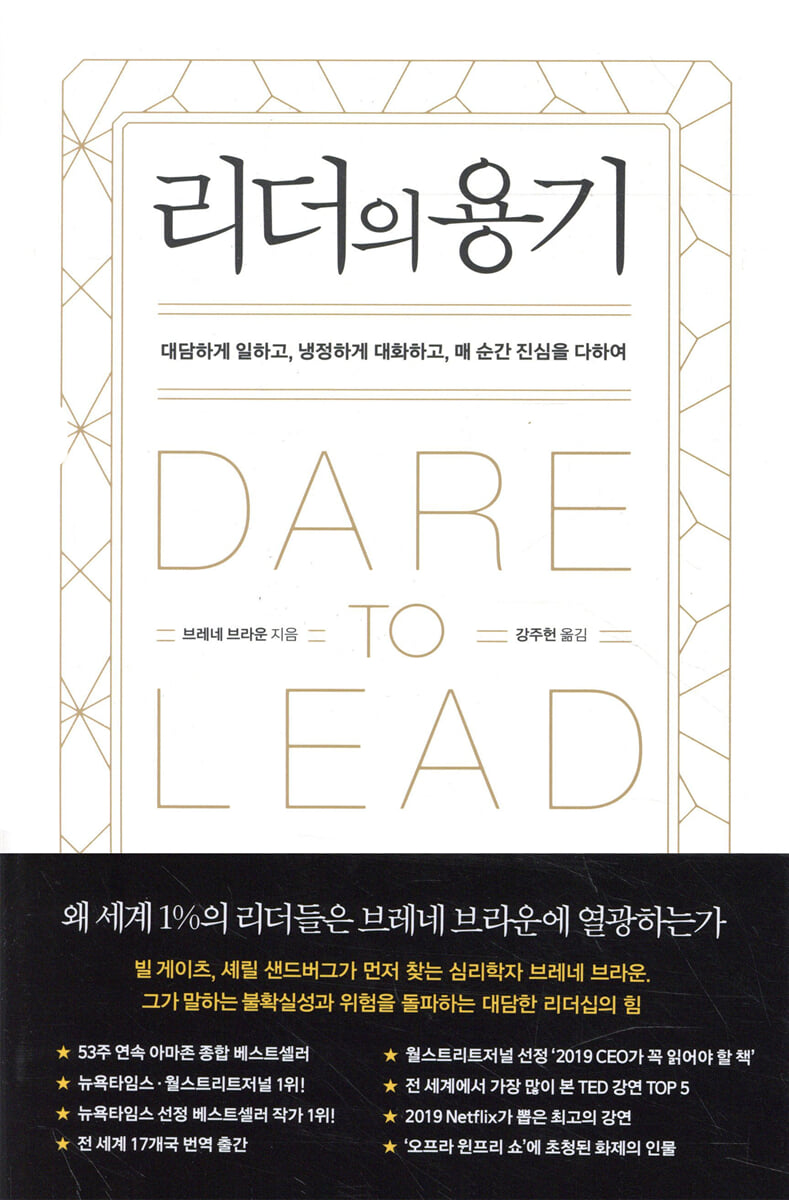
Brené Brown, the psychologist Bill Gates and Sheryl Sandberg seek out first for advice. The power of bold leadership that overcomes uncertainty and risk, as he speaks of it. In this rapidly changing era, there are many ‘sleepless CEOs.’ From communicating with the new millennial generation to overhauling social structures, the intensity and complexity of change are driving a growing number of leaders who are struggling to understand what to do and what role to play. The direction and speed of change may be different for each person, but everyone seems to agree on the prediction that if we don't change, we will be eliminated or perish. A curious phenomenon has recently emerged among Silicon Valley CEOs: they are venting their management woes to psychologists rather than economists or management scholars, seeking advice. The protagonist is Brené Brown, a top American psychologist who achieved 57 million views for her TED talk, setting a record for being one of the 'Top 5 most-viewed TED talks worldwide.' After seven years of interviewing leaders from startups to Fortune 50 companies and analyzing 400,000 pieces of data, she finally compiled "The Secrets of Leadership" into a book. The book that was born this way remained on the Amazon bestseller list for 53 consecutive weeks, was ranked #1 in the New York Times, Wall Street Journal, and Weekly, and was selected as one of the 'Books CEOs Must Read in 2019' by the Wall Street Journal. Brené Brown's book, "The Courage to Lead," which is the culmination of 20 years of research, offers insightful advice on how to foster a sense of belonging and empathy through productive communication, techniques for creating innovative change, how to cultivate organizational resilience that will not crumble in the face of failure, and how to gain the sincere trust of team members. It also contains detailed solutions to organizational problems through various research materials and case studies. |
- You can preview some of the book's contents.
Preview
index
Letter to the Reader
Introduction - What Makes Leaders Different? Overcoming Crisis and Moving Forward
Part 1 - Acknowledging Vulnerability
Vulnerability:
You can't muster courage without admitting your shortcomings.
Chapter 1: How Vulnerable Are You?
- The simplest way to distinguish between loyal and treacherous officials
- 6 Misconceptions About Vulnerability
- Admitting your shortcomings doesn't mean you're weak.
Chapter 2: The Courage to Face What You Want to Hide
- The shocking truth Luke faced after beheading Darth Vader
- Are you lonely now?
Chapter 3: The moment of significance when leaders and team members become one.
- The secret of leadership that doesn't crumble even when experiencing failure
- One feeling shared by leaders from 40 countries
· Chapter 4: How Do Vulnerabilities Expose Your Organization?
- Admit your shame or become a sociopath!
- Confusing emotions: shame and guilt, humiliation and embarrassment
Why People Who Got Fired from the Bill Gates Foundation Aren't Angry
- Hasty agreement can be toxic.
5 Techniques to Develop Empathy
- Six Barriers to Organizational Communication
- The woman who swore during the interview regrets it
Chapter 5: The Special Power of Creating the Best Organizational Culture
- Conversational skills that lead the millennial generation
The secret behind H&M's growth from 3 billion won in sales to 17 billion won.
Tools for Uncomfortable Conversations: Silence Only Destroys Trust
Part 2 - Living by Your Values
Values:
A leader never remains silent about difficult issues.
- 3-step technique for living according to values
10 Signs You're Ready for Productive Communication
- How can I stay ‘myself’ at work?
- What it means to 'know your values'
Part 3 - Trust Boldly
Reliability:
A bold leader is someone who makes courageous choices rather than seeking comfort.
- Leader's verbal habits that lower team members' morale
- Seven criteria for evaluating organizational trustworthiness
- A special strategy for a perceptive leader to gain the trust of his team members.
- Trust is always formed in small moments.
Part 4 - Learning to Get Back Up
Resilience:
If we don't confront the wounds stained by failure and frustration, we become slaves to them.
- An argument that started with a spam message
- 6 Common Tactics for Passing On Emotions
- The secret of people who do not become slaves to their emotions
Why Rumors Spread Like Fact at Work
- What makes a company with $388.4 billion in annual revenue different from its employee evaluation methods?
- Delta: The Truth Gap You Must Know
- Story Rumble: The first project an organization that has experienced failure should undertake.
- How do revolutionary changes happen?
Acknowledgements
Praise poured in for this book
Translator's Note
References
Summary of Key Terms
Introduction - What Makes Leaders Different? Overcoming Crisis and Moving Forward
Part 1 - Acknowledging Vulnerability
Vulnerability:
You can't muster courage without admitting your shortcomings.
Chapter 1: How Vulnerable Are You?
- The simplest way to distinguish between loyal and treacherous officials
- 6 Misconceptions About Vulnerability
- Admitting your shortcomings doesn't mean you're weak.
Chapter 2: The Courage to Face What You Want to Hide
- The shocking truth Luke faced after beheading Darth Vader
- Are you lonely now?
Chapter 3: The moment of significance when leaders and team members become one.
- The secret of leadership that doesn't crumble even when experiencing failure
- One feeling shared by leaders from 40 countries
· Chapter 4: How Do Vulnerabilities Expose Your Organization?
- Admit your shame or become a sociopath!
- Confusing emotions: shame and guilt, humiliation and embarrassment
Why People Who Got Fired from the Bill Gates Foundation Aren't Angry
- Hasty agreement can be toxic.
5 Techniques to Develop Empathy
- Six Barriers to Organizational Communication
- The woman who swore during the interview regrets it
Chapter 5: The Special Power of Creating the Best Organizational Culture
- Conversational skills that lead the millennial generation
The secret behind H&M's growth from 3 billion won in sales to 17 billion won.
Tools for Uncomfortable Conversations: Silence Only Destroys Trust
Part 2 - Living by Your Values
Values:
A leader never remains silent about difficult issues.
- 3-step technique for living according to values
10 Signs You're Ready for Productive Communication
- How can I stay ‘myself’ at work?
- What it means to 'know your values'
Part 3 - Trust Boldly
Reliability:
A bold leader is someone who makes courageous choices rather than seeking comfort.
- Leader's verbal habits that lower team members' morale
- Seven criteria for evaluating organizational trustworthiness
- A special strategy for a perceptive leader to gain the trust of his team members.
- Trust is always formed in small moments.
Part 4 - Learning to Get Back Up
Resilience:
If we don't confront the wounds stained by failure and frustration, we become slaves to them.
- An argument that started with a spam message
- 6 Common Tactics for Passing On Emotions
- The secret of people who do not become slaves to their emotions
Why Rumors Spread Like Fact at Work
- What makes a company with $388.4 billion in annual revenue different from its employee evaluation methods?
- Delta: The Truth Gap You Must Know
- Story Rumble: The first project an organization that has experienced failure should undertake.
- How do revolutionary changes happen?
Acknowledgements
Praise poured in for this book
Translator's Note
References
Summary of Key Terms
Detailed image

Into the book
A leader is not someone who wields status or power.
A courageous person who sees the potential in people and ideas and gives that potential a chance.
--- From "Letter to Readers"
Boldness doesn't mean "I'm willing to fail," it means "I might fail, but I'll give it my all anyway."
The bold leaders I've met so far are those who know failure, but not frustration.
--- From "Acknowledging Vulnerability"
The final lesson I learned from Roosevelt's quote is, "Never listen to the advice of someone who hasn't been a fighter in the arena and been beaten."
People who move forward according to their own beliefs are clearly figuring out 'what opinions about themselves are truly important.'
There are quite a few people who give nonsense advice to fighters who boldly jump into the arena without having ever fought themselves.
Don't even reread or ruminate on those stories.
Don't let that evaluation keep you in your mind and bring up your bad points.
--- From "How Vulnerable Are You"
Working and researching with teams for a long time, I've learned that 'expressing opinions clearly' is the most important thing.
Since then, everything has changed, from how we communicate to how we negotiate with external partners.
Clarity is simple, yet it drives change.
Clarity is kindness, and uncertainty is unkindness.
--- From "The Courage to Face the Face You Want to Hide"
We all have times when we find ourselves zigzagging and evading.
The zigzag represents the energy we expend as we try to avoid the bullet of vulnerability.
For example, when I have to call someone in difficulty, I first visualize it in my head and write a script.
But I think if I call the next morning, things will get better.
Then, thinking that email would be better than phone, I start writing the email again.
After going back and forth like this, I eventually collapse from exhaustion.
But the fact remains that we need to contact them somehow.
--- From "Leadership Armed with Armor"
Melinda Gates said:
“Bill and I meet with every Foundation staff member three or four times a year to expose vulnerabilities.
That encounter is an important opportunity to connect us with them, to feel a sense of belonging and to become one.
“Many employees come back to us even after the meeting, and instead of keeping them at arm’s length, we can help them find fulfillment in what they can do better.”
--- From "6 Barriers to Organizational Communication"
When you lead with a 'wounded heart', you end up stealing other people's ideas, constantly comparing yourself, pretending to know everything, and desperately trying to appear 'important' in the organization.
It is important to identify the "source of pain" that has a major impact on how a leader leads his team and, more broadly, how he displays it to his team members.
Otherwise, the leader will be lonely forever.
--- From "The Secret of Leadership That Doesn't Collapse Even When Failing"
Falsely revealing vulnerability has no effect.
Rather, it fosters distrust.
Nothing is more frustrating and frustrating to team members than trying to manipulate them through their vulnerability.
Vulnerability is not a personal marketing tool or a self-disclosure strategy.
Acknowledging vulnerability is not a way to avoid situations that cause us anxiety, worry, and reveal our emotions.
It's about accepting that situation.
A courageous person who sees the potential in people and ideas and gives that potential a chance.
--- From "Letter to Readers"
Boldness doesn't mean "I'm willing to fail," it means "I might fail, but I'll give it my all anyway."
The bold leaders I've met so far are those who know failure, but not frustration.
--- From "Acknowledging Vulnerability"
The final lesson I learned from Roosevelt's quote is, "Never listen to the advice of someone who hasn't been a fighter in the arena and been beaten."
People who move forward according to their own beliefs are clearly figuring out 'what opinions about themselves are truly important.'
There are quite a few people who give nonsense advice to fighters who boldly jump into the arena without having ever fought themselves.
Don't even reread or ruminate on those stories.
Don't let that evaluation keep you in your mind and bring up your bad points.
--- From "How Vulnerable Are You"
Working and researching with teams for a long time, I've learned that 'expressing opinions clearly' is the most important thing.
Since then, everything has changed, from how we communicate to how we negotiate with external partners.
Clarity is simple, yet it drives change.
Clarity is kindness, and uncertainty is unkindness.
--- From "The Courage to Face the Face You Want to Hide"
We all have times when we find ourselves zigzagging and evading.
The zigzag represents the energy we expend as we try to avoid the bullet of vulnerability.
For example, when I have to call someone in difficulty, I first visualize it in my head and write a script.
But I think if I call the next morning, things will get better.
Then, thinking that email would be better than phone, I start writing the email again.
After going back and forth like this, I eventually collapse from exhaustion.
But the fact remains that we need to contact them somehow.
--- From "Leadership Armed with Armor"
Melinda Gates said:
“Bill and I meet with every Foundation staff member three or four times a year to expose vulnerabilities.
That encounter is an important opportunity to connect us with them, to feel a sense of belonging and to become one.
“Many employees come back to us even after the meeting, and instead of keeping them at arm’s length, we can help them find fulfillment in what they can do better.”
--- From "6 Barriers to Organizational Communication"
When you lead with a 'wounded heart', you end up stealing other people's ideas, constantly comparing yourself, pretending to know everything, and desperately trying to appear 'important' in the organization.
It is important to identify the "source of pain" that has a major impact on how a leader leads his team and, more broadly, how he displays it to his team members.
Otherwise, the leader will be lonely forever.
--- From "The Secret of Leadership That Doesn't Collapse Even When Failing"
Falsely revealing vulnerability has no effect.
Rather, it fosters distrust.
Nothing is more frustrating and frustrating to team members than trying to manipulate them through their vulnerability.
Vulnerability is not a personal marketing tool or a self-disclosure strategy.
Acknowledging vulnerability is not a way to avoid situations that cause us anxiety, worry, and reveal our emotions.
It's about accepting that situation.
--- From "6 Misconceptions About Vulnerability"
Publisher's Review
Google, Pixar, Walt Disney, the Bill & Melinda Gates Foundation…
The Secrets of Leadership Revealed After Seven Years of Research with the World's Best Companies
What do Nokia, Toshiba, and GE, once considered industry leaders, have in common? They all collapsed due to flawed leadership and an inflexible organizational culture.
Nokia's downfall stemmed from a complete lack of internal unity during a crisis, Toshiba's rigidly hierarchical organizational culture, and GE's downfall stemmed from leadership that failed to communicate with its employees.
So what's the difference between a company that falters in a moment of crisis and one that overcomes danger and moves forward? Brené Brown found the answer in "bold leadership."
When an organization faces a crisis, leaders also feel fear.
It's hard to be confident in the decisions you make, and it's hard to unite team members who are disintegrating from anxiety.
But after seven years of research with the world's leading companies, she has discovered how to generate grounded confidence and instill a strong sense of belonging, trust, and empathy in organizations.
And finally, in "The Courage of a Leader," the culmination of 20 years of research, he detailed a four-step method for developing bold leadership.
Bold leaders who overcome crises don't pretend to have the "right answer."
He did not avoid uncomfortable or awkward conversations or situations, and he honestly acknowledged his shortcomings.
In fact, Google, Pixar, Walt Disney, and Oprah Winfrey have said that they were greatly influenced by her, and the Bill & Melinda Gates Foundation confessed that “Bill and Melinda Gates have been transformed into leaders who do not lose trust and empathy by communicating with all the staff of the foundation through Brené’s advice.”
The author says:
“A leader with bold leadership never falls.
Even when experiencing failure, the organization becomes stronger and moves forward as one.
If we are still stuck in old leadership styles like strong charisma and perfectionism, it is time for all leaders to face their fears and demonstrate a new kind of leadership.”
Who are the true leaders that millennials want?
Brené Brown, America's leading psychologist, sought after by global CEOs.
Many leaders who come to her confess that they are lonely and having a hard time.
This is because the organizational situations that leaders face are very complex.
Some people happen to be leaders, while others try to do well but don't know how.
A common concern is conflict arising from generational diversity.
Leaders now have to go beyond simply leading an organization and resolve complex interpersonal conflicts.
The author advises, “As times change, the form of leadership must also change.”
Machiavellian leadership, which sought to increase productivity through strong control and rewards, no longer works for the millennial generation that is driving the new corporate culture.
They know how to distinguish between mere sympathy and genuine empathy, and they constantly pursue change and innovation.
We also demand a horizontal and equal opportunity organizational culture, while also wanting bold leaders who make the courageous choice to live out their values rather than seek comfort.
This book contains the "secrets of leadership" that Brené Brown discovered after analyzing research data from 400,000 companies of all sizes, from startups to the Fortune 50.
The book also contains various examples of conversational skills that drive the millennial era and how to foster trust and empathy among team members to facilitate smooth communication in an organization.
When intergenerational conflict is resolved, it leads to a sense of belonging, which increases productivity and efficiency.
An organizational culture created in this way creates a sense that both leaders and team members are working together toward a common goal, which immediately leads to explosive performance.
You who do not run a business,
3 Reasons Why You Should Read This Book, Even If You're Not a Leader
Brené Brown questions whether even people who don't run a business or lead an organization should read this book.
Do you really think you are not a leader?
The first step to bold leadership, she says, is acknowledging vulnerability.
This also means revealing your true self and living 'truly'.
We want to have the strength to overcome crises in both life and work.
Anyone who wants to find a way out of a crisis, communicate freely and openly, and increase productivity and efficiency with brilliant ideas needs to become a leader.
Even if you aim for perfection, you can't achieve perfection.
Only when we acknowledge our shortcomings can we open our eyes to new things and broaden our horizons.
But we always try to appear strong, regardless of our rank or status.
Also, the onlookers around us scold us for not doing better.
That's why we hide our weaknesses and arm ourselves with armor and helmets to appear strong.
But as the author quotes Theodore Roosevelt, “It is not the people who talk outside the stadium who are important.
A sense of accomplishment and honor belong to those who stand on the playing field, covered in dust, sweat, and blood.” Aren't you also in the playing field of life? It's up to you whether you will lead or be led.
Do you want to live a life of constant learning? Do you want to move forward? This book will give you the courage and boldness to do so.
The Secrets of Leadership Revealed After Seven Years of Research with the World's Best Companies
What do Nokia, Toshiba, and GE, once considered industry leaders, have in common? They all collapsed due to flawed leadership and an inflexible organizational culture.
Nokia's downfall stemmed from a complete lack of internal unity during a crisis, Toshiba's rigidly hierarchical organizational culture, and GE's downfall stemmed from leadership that failed to communicate with its employees.
So what's the difference between a company that falters in a moment of crisis and one that overcomes danger and moves forward? Brené Brown found the answer in "bold leadership."
When an organization faces a crisis, leaders also feel fear.
It's hard to be confident in the decisions you make, and it's hard to unite team members who are disintegrating from anxiety.
But after seven years of research with the world's leading companies, she has discovered how to generate grounded confidence and instill a strong sense of belonging, trust, and empathy in organizations.
And finally, in "The Courage of a Leader," the culmination of 20 years of research, he detailed a four-step method for developing bold leadership.
Bold leaders who overcome crises don't pretend to have the "right answer."
He did not avoid uncomfortable or awkward conversations or situations, and he honestly acknowledged his shortcomings.
In fact, Google, Pixar, Walt Disney, and Oprah Winfrey have said that they were greatly influenced by her, and the Bill & Melinda Gates Foundation confessed that “Bill and Melinda Gates have been transformed into leaders who do not lose trust and empathy by communicating with all the staff of the foundation through Brené’s advice.”
The author says:
“A leader with bold leadership never falls.
Even when experiencing failure, the organization becomes stronger and moves forward as one.
If we are still stuck in old leadership styles like strong charisma and perfectionism, it is time for all leaders to face their fears and demonstrate a new kind of leadership.”
Who are the true leaders that millennials want?
Brené Brown, America's leading psychologist, sought after by global CEOs.
Many leaders who come to her confess that they are lonely and having a hard time.
This is because the organizational situations that leaders face are very complex.
Some people happen to be leaders, while others try to do well but don't know how.
A common concern is conflict arising from generational diversity.
Leaders now have to go beyond simply leading an organization and resolve complex interpersonal conflicts.
The author advises, “As times change, the form of leadership must also change.”
Machiavellian leadership, which sought to increase productivity through strong control and rewards, no longer works for the millennial generation that is driving the new corporate culture.
They know how to distinguish between mere sympathy and genuine empathy, and they constantly pursue change and innovation.
We also demand a horizontal and equal opportunity organizational culture, while also wanting bold leaders who make the courageous choice to live out their values rather than seek comfort.
This book contains the "secrets of leadership" that Brené Brown discovered after analyzing research data from 400,000 companies of all sizes, from startups to the Fortune 50.
The book also contains various examples of conversational skills that drive the millennial era and how to foster trust and empathy among team members to facilitate smooth communication in an organization.
When intergenerational conflict is resolved, it leads to a sense of belonging, which increases productivity and efficiency.
An organizational culture created in this way creates a sense that both leaders and team members are working together toward a common goal, which immediately leads to explosive performance.
You who do not run a business,
3 Reasons Why You Should Read This Book, Even If You're Not a Leader
Brené Brown questions whether even people who don't run a business or lead an organization should read this book.
Do you really think you are not a leader?
The first step to bold leadership, she says, is acknowledging vulnerability.
This also means revealing your true self and living 'truly'.
We want to have the strength to overcome crises in both life and work.
Anyone who wants to find a way out of a crisis, communicate freely and openly, and increase productivity and efficiency with brilliant ideas needs to become a leader.
Even if you aim for perfection, you can't achieve perfection.
Only when we acknowledge our shortcomings can we open our eyes to new things and broaden our horizons.
But we always try to appear strong, regardless of our rank or status.
Also, the onlookers around us scold us for not doing better.
That's why we hide our weaknesses and arm ourselves with armor and helmets to appear strong.
But as the author quotes Theodore Roosevelt, “It is not the people who talk outside the stadium who are important.
A sense of accomplishment and honor belong to those who stand on the playing field, covered in dust, sweat, and blood.” Aren't you also in the playing field of life? It's up to you whether you will lead or be led.
Do you want to live a life of constant learning? Do you want to move forward? This book will give you the courage and boldness to do so.
GOODS SPECIFICS
- Date of publication: December 9, 2019
- Page count, weight, size: 428 pages | 622g | 152*225*25mm
- ISBN13: 9788901238746
- ISBN10: 8901238748
You may also like
카테고리
korean


korean

![ELLE 엘르 스페셜 에디션 A형 : 12월 [2025]](http://librairie.coreenne.fr/cdn/shop/files/b8e27a3de6c9538896439686c6b0e8fb.jpg?v=1766436872&width=3840)


