

The Mediterranean World after the Fall of Rome (Part 1)
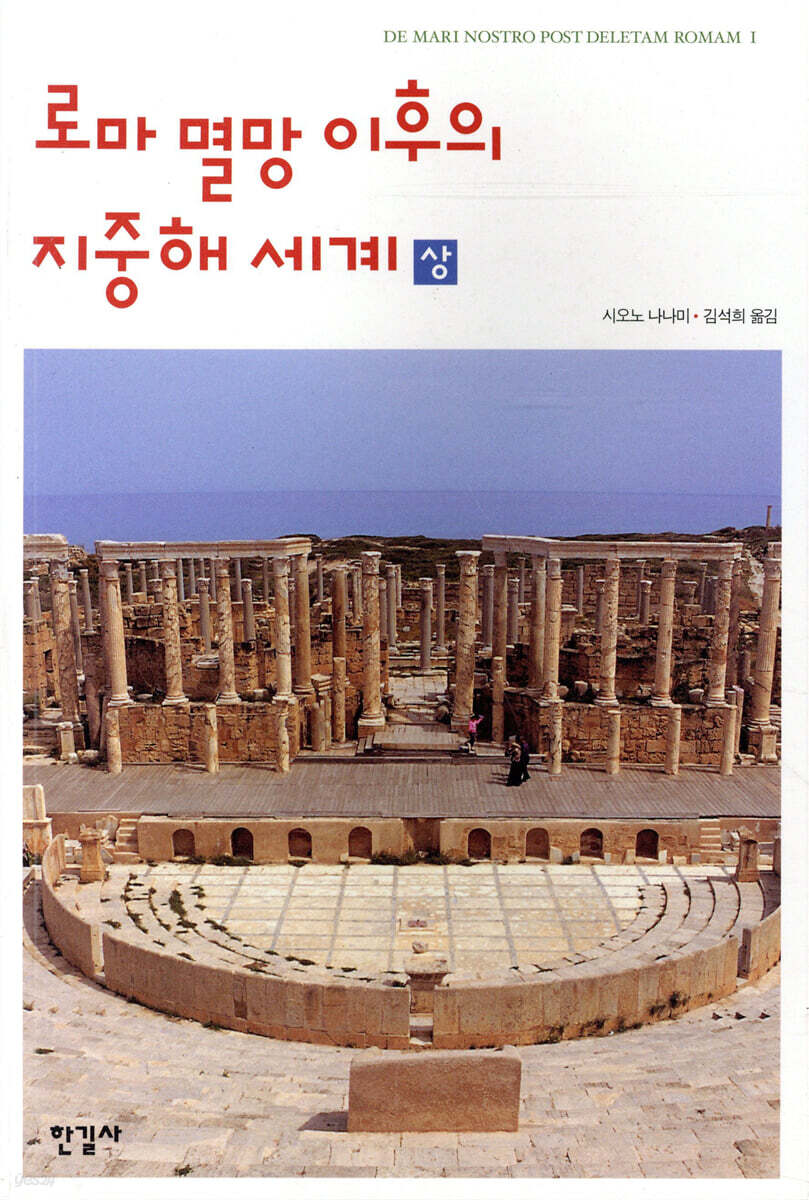 |
Description
Book Introduction
Another historical masterpiece born from Shiono's penmanship
The Mediterranean world is shocked by the invasion of 'Islamic pirates.'
The Mediterranean Sea entered an era of warlordism after the collapse of Pax Romana.
The sea, which had been 'peaceful' under the Roman Empire, became the scene of a fierce power struggle after the fall of Rome.
"The Mediterranean World after the Fall of Rome" is a historical textbook about the Mediterranean world after Rome written by Nanami Shiono, author of "The Story of the Romans."
After the 'peace' maintained by Rome was broken, the Mediterranean world was shocked by the invasion of 'Islamic pirates'.
The sight of Saracen pirates running rampant in the Mediterranean was an event that the West could not possibly tolerate.
Thus, Christian nations eventually emerged and the Mediterranean became a battleground between Islam and Christianity.
Christian nations launched 'crusades' for religious reasons, and monastic orders and knightly orders waged fierce battles.
Meanwhile, the Islamic forces that controlled the sea naturally sought to advance beyond the sea, and the fierce battle in the Mediterranean Sea expanded to the territories surrounding the Mediterranean Sea.
The Mediterranean became a new arena of conflict after Rome.
How will the power struggle between Islam and Christianity, largely driven by "religious" reasons, unfold? We hear the fascinating story of the Mediterranean world through the voice of Shiono Nanami, who brings Roman history to life.
The Mediterranean world is shocked by the invasion of 'Islamic pirates.'
The Mediterranean Sea entered an era of warlordism after the collapse of Pax Romana.
The sea, which had been 'peaceful' under the Roman Empire, became the scene of a fierce power struggle after the fall of Rome.
"The Mediterranean World after the Fall of Rome" is a historical textbook about the Mediterranean world after Rome written by Nanami Shiono, author of "The Story of the Romans."
After the 'peace' maintained by Rome was broken, the Mediterranean world was shocked by the invasion of 'Islamic pirates'.
The sight of Saracen pirates running rampant in the Mediterranean was an event that the West could not possibly tolerate.
Thus, Christian nations eventually emerged and the Mediterranean became a battleground between Islam and Christianity.
Christian nations launched 'crusades' for religious reasons, and monastic orders and knightly orders waged fierce battles.
Meanwhile, the Islamic forces that controlled the sea naturally sought to advance beyond the sea, and the fierce battle in the Mediterranean Sea expanded to the territories surrounding the Mediterranean Sea.
The Mediterranean became a new arena of conflict after Rome.
How will the power struggle between Islam and Christianity, largely driven by "religious" reasons, unfold? We hear the fascinating story of the Mediterranean world through the voice of Shiono Nanami, who brings Roman history to life.
- You can preview some of the book's contents.
Preview
index
pirate
preface
Chapter 1: From the Inland Sea to the Sea of the Border
The rise of Islam
Saracens
pirate
hijacking
New entry
Holy Roman Empire
The targeted monastery
Jihad
Dreaming of Scipio
To Rome
Fall of Palermo
Islamic societies in North Africa
Gaeta, Naples, Amalfi
Back to Rome
The Temple (Guerra Santa)
Republic of the Sea
Saracen Tower
Fall of Syracuse
Crusades before the 'Crusades'
An Angeukgok - A Kind of Symbiosis
Islamic Tolerance
Islam-Sicily
Miracle of the Mediterranean
Chapter 2: The Age of Jihad and the Holy War (Guerra Santa)
Ongoing piracy
Italy, rise up
The Normans came
Italian maritime city-states
Amalfi, Pisa, Genoa
Venice's countermeasures against pirates
The era of the 'Crusades'
Hit before you get hit
The Last Crusade
Italian businesspeople
traded goods
Saracen's Gold
Chapter 3 Two Borderless Organizations
Order of the Rescue
Rescue Knights
Chronology
List of picture sources
Appendix - The Saracen Tower
Liguria region
Tuscany region
Lazio region
Abruzzo Molise region
Puglia and Basilicata
Campania region
Calabria region
Sicily region
Sardinia region
Malta
preface
Chapter 1: From the Inland Sea to the Sea of the Border
The rise of Islam
Saracens
pirate
hijacking
New entry
Holy Roman Empire
The targeted monastery
Jihad
Dreaming of Scipio
To Rome
Fall of Palermo
Islamic societies in North Africa
Gaeta, Naples, Amalfi
Back to Rome
The Temple (Guerra Santa)
Republic of the Sea
Saracen Tower
Fall of Syracuse
Crusades before the 'Crusades'
An Angeukgok - A Kind of Symbiosis
Islamic Tolerance
Islam-Sicily
Miracle of the Mediterranean
Chapter 2: The Age of Jihad and the Holy War (Guerra Santa)
Ongoing piracy
Italy, rise up
The Normans came
Italian maritime city-states
Amalfi, Pisa, Genoa
Venice's countermeasures against pirates
The era of the 'Crusades'
Hit before you get hit
The Last Crusade
Italian businesspeople
traded goods
Saracen's Gold
Chapter 3 Two Borderless Organizations
Order of the Rescue
Rescue Knights
Chronology
List of picture sources
Appendix - The Saracen Tower
Liguria region
Tuscany region
Lazio region
Abruzzo Molise region
Puglia and Basilicata
Campania region
Calabria region
Sicily region
Sardinia region
Malta
Publisher's Review
Pax Romana collapses and the Mediterranean enters an era of warlordism.
The 'Islamic pirates' ruled the unruly Mediterranean.
Saracen pirates who shout 'Sword in the right hand, Koran in the left' and commit kidnapping and plundering.
The Christian nations finally rose up against this atrocity.
The monastery and the knights come to life and engage in a fierce battle to rescue the kidnapped people.
Even after completing "The Roman Story," Shiono never rested.
Where will Shiono Nanami's writing journey end?
Where does the source of that amazing writing ability, which traces history with coolness and exhilaration, come from?
At the end of 2006, at the age of seventy, when he finally completed the fifteen-year journey of writing 『Roman Stories』 (15 volumes), Shiono could no longer think of a follow-up work on a more serious subject.
Even if there were, it was just a light historical essay or a piece of writing reflecting on one's life as a writer.
He himself revealed his thoughts on the completion of the book, saying that he wanted to break free from the obsession of having to publish at least one book a year and have a long 'summer vacation' that he had never had before.
But contrary to what he said, he hasn't had any rest in the past two years.
After a short break, I was once again trapped in the prison of writing, obsessed with something I had to write about.
This is because I have returned to readers with two unexpectedly thick volumes, 『The Mediterranean World after the Fall of Rome』 (volumes 1 and 2).
Was the fall of the Roman Empire a pity? No, wasn't it the Mediterranean, the sea of civilization, the setting of the Iliad, that had captivated him since his sixteenth school days?
As an outstanding historical writer, it would have been difficult to resist the temptation to depict the splendid patterns of civilization and the human drama etched across the blue waves of the Mediterranean.
Rome fell when the Mediterranean ceased to be an "inland sea."
In Volume 15 of "Roman Stories," "The End of the Roman World," Nanami Shiono devotes the final chapter, "Post Imperium," to explaining the end of the Roman Empire, going beyond the commonly referred to fall of the Western Roman Empire in 476.
That is, it covers the period up to the 7th century 'after the empire', because Sion ultimately sought to view the end of the Roman Empire from the perspective of the end of civilization.
Another important criterion for such a perspective was the change in the Mediterranean world.
Sion believed that the Mediterranean ceased to be an 'inland sea' (mare interunm) of the Roman Empire.
For the Romans, who created and maintained a great empire encompassing Europe, the Middle East, and North Africa, the problems that arose in all the regions surrounding the Mediterranean Sea, which they called “our sea,” were problems that had to be solved by their own efforts, “our problems” that only they could solve.
In other words, the northern and southern parts of the Mediterranean were part of the same Roman civilization.
But after the 7th century, the Mediterranean became a border that divided the two sides rather than a road connecting them, and the Roman world disappeared.
So what on earth happened in that Mediterranean world?
A clash between Christian and Islamic civilizations that will determine the fate of the Mediterranean.
『The Mediterranean World after the Fall of Rome』 is an extension of 'The Story of the Romans' and covers a historical period of approximately 1,000 years spanning the Middle Ages and Renaissance, and illuminates the enormous shadow of the new civilization, the Islamic power (Saracen pirates/Ottoman Empire), on the Mediterranean world that became a no man's land after the collapse of 'Pax Romana' (Roman peace).
The book depicts the unprecedented devastation of Saracen pirates in the uncharted seas from the 8th to the 10th centuries, and the difficult counterattack of the Christian world.
In particular, it briefly describes the activities of the four major maritime city-states of Italy and the Crusades, and also covers the martyrdom activities of the Order of the Deliverers and the Knights Templar, which were formed with the goal of rescuing numerous Christians who had been kidnapped by pirates and enslaved in North Africa.
The second volume depicts the fierce battle between the Ottoman Empire, which attempted a large-scale offensive against the West with pirates after capturing Constantinople in 1453, and the Christian coalition opposing it.
The game features the fascinating battles of strength and brain strategies between brilliant historical monarchs and outstanding leaders, including Suleiman I, Mehmed II, Francis I, Charles I (Charles V), Pope Leo X, the pirate Barbarossa, and Andrea Doria, and depicts wars between civilizations that determined the fate of the Mediterranean, such as the Battle of Preveza, the Battle of Djerba, the Siege of Cyprus, and the Battle of Lepanto.
"The Mediterranean World after the Fall of Rome" is a book that allows one to examine all of Shiono's previous works on Rome and the Renaissance in one place.
If the books 『Story of the City by the Sea』, 『The Fall of Constantinople』, 『The Siege of Rhodes』, 『The Battle of Lepanto』, 『My Friend Machiavelli』, 『Women of the Renaissance』, and 『The Agents of God』 are like 'trees', then this book is like 'forest'.
To properly recreate the various aspects of the human world called history, one needs a perspective that sees both the "trees" and the "forest." Shiono stands in the middle of the Mediterranean Sea, looking broadly around, forwards, backwards, and left.
Islamic pirates ravage the Mediterranean in the name of "holy war."
The main topic that Shiono deals with in this book is undoubtedly ‘pirates.’
Even today in the 21st century, we occasionally come across foreign news reports about pirates appearing in the Somali Sea or the Strait of Malacca, but the pirates that shocked the Mediterranean a thousand years ago were so-called "official pirates" called "corsaro" (Italian corsaro), whose etymology is from medieval Latin, and thus a national-scale countermeasure was necessary.
Unlike the unofficial pirates 'pirata' (Italian pirata) who were simply seeking personal gain, it refers to those who had a state or religion behind them, whether officially or tacitly.
Since Muhammad was born in Mecca on the Arabian Peninsula in 570 and began his missionary work in 613, the wave of Islamization has spread rapidly westward, as if an inkwell had been poured onto a large blank sheet of paper.
In 642 AD, Alexandria was conquered and Egypt was Islamized, and by 698 AD, when Carthage fell, all of North Africa was already under Islamic rule.
When the Muslims conquered North Africa, the people of the Christian world who faced them across the Mediterranean Sea called the Muslim Arabs 'Saracens'.
After the fall of the Roman Empire, peace and security disappeared, and the Muslims, who became the masters of the southern Mediterranean, where the waves were calm and the sunlight poured in abundantly, turned to piracy, which offered easy profits.
Moreover, their religion (Islam) justified the harm done to the infidels in the name of ‘holy war’.
The Saracen pirates, who carried out kidnappings and plundering while shouting, "Sword in the right hand, Koran in the left," truly sent tremors through the Christian world.
While almost every region in the Mediterranean was suffering damage from the waves, the Pope of Rome was helpless, and the Byzantine Empire, which had a duty to guarantee safety, could only send a fleet in name only, as if to silence the attackers.
The only countermeasure was to build countless watchtowers ('Saracen Towers') on high ground along the coast so that invading pirates could be spotted as quickly as possible and then run away.
In short, it was a truly difficult time for the common people of the medieval Mediterranean to live in.
"Establishing Pax (peace) is not military, but political will."
The emergence of pirates was a symbolic event that showed the collapse of the Roman order and the disappearance of the spirit of law that the Romans held most dear.
During the Roman Empire's heyday, the emperors who ascended the throne all had one thing in mind: if they could not ensure the safety of their people, they would be disqualified as rulers.
Although Rome did not achieve the high artistic culture or profound thought of Greece, it at least implemented a system that ensured safety.
While it may not have been a noble value, the Romans created a more substantial foundation for human society.
Shiono's realistic and cool-headed perspective on reading history with a focus on pirates can also be sufficiently inferred from the following description of 'Pax' (peace).
“Peace cannot be achieved by simply wishing for it.
It is truly unfortunate for humanity, but peace can only be realized when we clearly state and act on our commitment to not tolerate anyone who disturbs the peace.
Therefore, it was not military force but political will that established peace.”
“People who despair of reality easily turn to God.”
It is difficult to argue which is superior in terms of culture and civilization.
However, the desire to further develop one's power by making the most of it was superior, at least in the early Middle Ages, to Islam.
It was unfortunate for the inhabitants of the Christian world that they poured their passion into piracy.
After all, while it took 300 years for Christianity to become the official religion of the Roman Empire, it took only 100 years for the shadow of Islam to spread across the Mediterranean.
What is the reason? It's often said to be the result of a combination of the pervasive power of new religions and the Arab people's desire for conquest.
However, the Byzantine Empire, also known as the Eastern Roman Empire, was divided again due to disputes over Christian doctrine, officials became corrupt, and heavy taxes were imposed on the common people.
When evils overlap like this, the people are bound to suffer.
People who despair of reality tend to look for someone they can easily rely on.
Medieval people were deeply religious.
In these dark times, when there was no hope for the future and misery, there was no one to believe in or rely on but God.
Innocent Christian citizens captured as slaves have no choice but to convert in order to survive.
Shiono also presents a realistic view on religion.
“Profound teachings may cleanse the mind and bring peace after death, but they do not impart the power to act in this world where we live.
“A concrete, worldly advantage becomes the catalyst for a decisive step forward for humanity.”
Today, all Mediterranean coastal regions are attractive tourist destinations.
It is hard to imagine that such places were once uninhabited and ravaged by pirates.
In any case, the history of the Mediterranean world cannot be told without mentioning the Islamic pirates who raided from North Africa for over a thousand years, from the 7th to the 18th centuries.
At the end of the book, Shiono writes about his impressions of 'peace' as follows:
“Every time I look at these tourist destinations from the sea, and every time I come across the ‘Saracen Tower’, now used as a restaurant or nightclub, I can’t help but think that ‘pax’ (peace) is ultimately about ensuring the safety of ordinary citizens.
And I think with a bitter smile welling up.
“Humans are creatures who can get along quite well among themselves as long as their safety is guaranteed.”
The 'Islamic pirates' ruled the unruly Mediterranean.
Saracen pirates who shout 'Sword in the right hand, Koran in the left' and commit kidnapping and plundering.
The Christian nations finally rose up against this atrocity.
The monastery and the knights come to life and engage in a fierce battle to rescue the kidnapped people.
Even after completing "The Roman Story," Shiono never rested.
Where will Shiono Nanami's writing journey end?
Where does the source of that amazing writing ability, which traces history with coolness and exhilaration, come from?
At the end of 2006, at the age of seventy, when he finally completed the fifteen-year journey of writing 『Roman Stories』 (15 volumes), Shiono could no longer think of a follow-up work on a more serious subject.
Even if there were, it was just a light historical essay or a piece of writing reflecting on one's life as a writer.
He himself revealed his thoughts on the completion of the book, saying that he wanted to break free from the obsession of having to publish at least one book a year and have a long 'summer vacation' that he had never had before.
But contrary to what he said, he hasn't had any rest in the past two years.
After a short break, I was once again trapped in the prison of writing, obsessed with something I had to write about.
This is because I have returned to readers with two unexpectedly thick volumes, 『The Mediterranean World after the Fall of Rome』 (volumes 1 and 2).
Was the fall of the Roman Empire a pity? No, wasn't it the Mediterranean, the sea of civilization, the setting of the Iliad, that had captivated him since his sixteenth school days?
As an outstanding historical writer, it would have been difficult to resist the temptation to depict the splendid patterns of civilization and the human drama etched across the blue waves of the Mediterranean.
Rome fell when the Mediterranean ceased to be an "inland sea."
In Volume 15 of "Roman Stories," "The End of the Roman World," Nanami Shiono devotes the final chapter, "Post Imperium," to explaining the end of the Roman Empire, going beyond the commonly referred to fall of the Western Roman Empire in 476.
That is, it covers the period up to the 7th century 'after the empire', because Sion ultimately sought to view the end of the Roman Empire from the perspective of the end of civilization.
Another important criterion for such a perspective was the change in the Mediterranean world.
Sion believed that the Mediterranean ceased to be an 'inland sea' (mare interunm) of the Roman Empire.
For the Romans, who created and maintained a great empire encompassing Europe, the Middle East, and North Africa, the problems that arose in all the regions surrounding the Mediterranean Sea, which they called “our sea,” were problems that had to be solved by their own efforts, “our problems” that only they could solve.
In other words, the northern and southern parts of the Mediterranean were part of the same Roman civilization.
But after the 7th century, the Mediterranean became a border that divided the two sides rather than a road connecting them, and the Roman world disappeared.
So what on earth happened in that Mediterranean world?
A clash between Christian and Islamic civilizations that will determine the fate of the Mediterranean.
『The Mediterranean World after the Fall of Rome』 is an extension of 'The Story of the Romans' and covers a historical period of approximately 1,000 years spanning the Middle Ages and Renaissance, and illuminates the enormous shadow of the new civilization, the Islamic power (Saracen pirates/Ottoman Empire), on the Mediterranean world that became a no man's land after the collapse of 'Pax Romana' (Roman peace).
The book depicts the unprecedented devastation of Saracen pirates in the uncharted seas from the 8th to the 10th centuries, and the difficult counterattack of the Christian world.
In particular, it briefly describes the activities of the four major maritime city-states of Italy and the Crusades, and also covers the martyrdom activities of the Order of the Deliverers and the Knights Templar, which were formed with the goal of rescuing numerous Christians who had been kidnapped by pirates and enslaved in North Africa.
The second volume depicts the fierce battle between the Ottoman Empire, which attempted a large-scale offensive against the West with pirates after capturing Constantinople in 1453, and the Christian coalition opposing it.
The game features the fascinating battles of strength and brain strategies between brilliant historical monarchs and outstanding leaders, including Suleiman I, Mehmed II, Francis I, Charles I (Charles V), Pope Leo X, the pirate Barbarossa, and Andrea Doria, and depicts wars between civilizations that determined the fate of the Mediterranean, such as the Battle of Preveza, the Battle of Djerba, the Siege of Cyprus, and the Battle of Lepanto.
"The Mediterranean World after the Fall of Rome" is a book that allows one to examine all of Shiono's previous works on Rome and the Renaissance in one place.
If the books 『Story of the City by the Sea』, 『The Fall of Constantinople』, 『The Siege of Rhodes』, 『The Battle of Lepanto』, 『My Friend Machiavelli』, 『Women of the Renaissance』, and 『The Agents of God』 are like 'trees', then this book is like 'forest'.
To properly recreate the various aspects of the human world called history, one needs a perspective that sees both the "trees" and the "forest." Shiono stands in the middle of the Mediterranean Sea, looking broadly around, forwards, backwards, and left.
Islamic pirates ravage the Mediterranean in the name of "holy war."
The main topic that Shiono deals with in this book is undoubtedly ‘pirates.’
Even today in the 21st century, we occasionally come across foreign news reports about pirates appearing in the Somali Sea or the Strait of Malacca, but the pirates that shocked the Mediterranean a thousand years ago were so-called "official pirates" called "corsaro" (Italian corsaro), whose etymology is from medieval Latin, and thus a national-scale countermeasure was necessary.
Unlike the unofficial pirates 'pirata' (Italian pirata) who were simply seeking personal gain, it refers to those who had a state or religion behind them, whether officially or tacitly.
Since Muhammad was born in Mecca on the Arabian Peninsula in 570 and began his missionary work in 613, the wave of Islamization has spread rapidly westward, as if an inkwell had been poured onto a large blank sheet of paper.
In 642 AD, Alexandria was conquered and Egypt was Islamized, and by 698 AD, when Carthage fell, all of North Africa was already under Islamic rule.
When the Muslims conquered North Africa, the people of the Christian world who faced them across the Mediterranean Sea called the Muslim Arabs 'Saracens'.
After the fall of the Roman Empire, peace and security disappeared, and the Muslims, who became the masters of the southern Mediterranean, where the waves were calm and the sunlight poured in abundantly, turned to piracy, which offered easy profits.
Moreover, their religion (Islam) justified the harm done to the infidels in the name of ‘holy war’.
The Saracen pirates, who carried out kidnappings and plundering while shouting, "Sword in the right hand, Koran in the left," truly sent tremors through the Christian world.
While almost every region in the Mediterranean was suffering damage from the waves, the Pope of Rome was helpless, and the Byzantine Empire, which had a duty to guarantee safety, could only send a fleet in name only, as if to silence the attackers.
The only countermeasure was to build countless watchtowers ('Saracen Towers') on high ground along the coast so that invading pirates could be spotted as quickly as possible and then run away.
In short, it was a truly difficult time for the common people of the medieval Mediterranean to live in.
"Establishing Pax (peace) is not military, but political will."
The emergence of pirates was a symbolic event that showed the collapse of the Roman order and the disappearance of the spirit of law that the Romans held most dear.
During the Roman Empire's heyday, the emperors who ascended the throne all had one thing in mind: if they could not ensure the safety of their people, they would be disqualified as rulers.
Although Rome did not achieve the high artistic culture or profound thought of Greece, it at least implemented a system that ensured safety.
While it may not have been a noble value, the Romans created a more substantial foundation for human society.
Shiono's realistic and cool-headed perspective on reading history with a focus on pirates can also be sufficiently inferred from the following description of 'Pax' (peace).
“Peace cannot be achieved by simply wishing for it.
It is truly unfortunate for humanity, but peace can only be realized when we clearly state and act on our commitment to not tolerate anyone who disturbs the peace.
Therefore, it was not military force but political will that established peace.”
“People who despair of reality easily turn to God.”
It is difficult to argue which is superior in terms of culture and civilization.
However, the desire to further develop one's power by making the most of it was superior, at least in the early Middle Ages, to Islam.
It was unfortunate for the inhabitants of the Christian world that they poured their passion into piracy.
After all, while it took 300 years for Christianity to become the official religion of the Roman Empire, it took only 100 years for the shadow of Islam to spread across the Mediterranean.
What is the reason? It's often said to be the result of a combination of the pervasive power of new religions and the Arab people's desire for conquest.
However, the Byzantine Empire, also known as the Eastern Roman Empire, was divided again due to disputes over Christian doctrine, officials became corrupt, and heavy taxes were imposed on the common people.
When evils overlap like this, the people are bound to suffer.
People who despair of reality tend to look for someone they can easily rely on.
Medieval people were deeply religious.
In these dark times, when there was no hope for the future and misery, there was no one to believe in or rely on but God.
Innocent Christian citizens captured as slaves have no choice but to convert in order to survive.
Shiono also presents a realistic view on religion.
“Profound teachings may cleanse the mind and bring peace after death, but they do not impart the power to act in this world where we live.
“A concrete, worldly advantage becomes the catalyst for a decisive step forward for humanity.”
Today, all Mediterranean coastal regions are attractive tourist destinations.
It is hard to imagine that such places were once uninhabited and ravaged by pirates.
In any case, the history of the Mediterranean world cannot be told without mentioning the Islamic pirates who raided from North Africa for over a thousand years, from the 7th to the 18th centuries.
At the end of the book, Shiono writes about his impressions of 'peace' as follows:
“Every time I look at these tourist destinations from the sea, and every time I come across the ‘Saracen Tower’, now used as a restaurant or nightclub, I can’t help but think that ‘pax’ (peace) is ultimately about ensuring the safety of ordinary citizens.
And I think with a bitter smile welling up.
“Humans are creatures who can get along quite well among themselves as long as their safety is guaranteed.”
GOODS SPECIFICS
- Date of issue: July 7, 2009
- Page count, weight, size: 404 pages | 738g | 153*224*30mm
- ISBN13: 9788935661916
- ISBN10: 8935661910
You may also like
카테고리
korean


korean

![GQ KOREA Mark (Monthly): December [2025]](http://librairie.coreenne.fr/cdn/shop/files/8ef265dbbfbf186523ed75ba7319009d.jpg?v=1765340328&width=3840)


