

resolve
 |
Description
Book Introduction
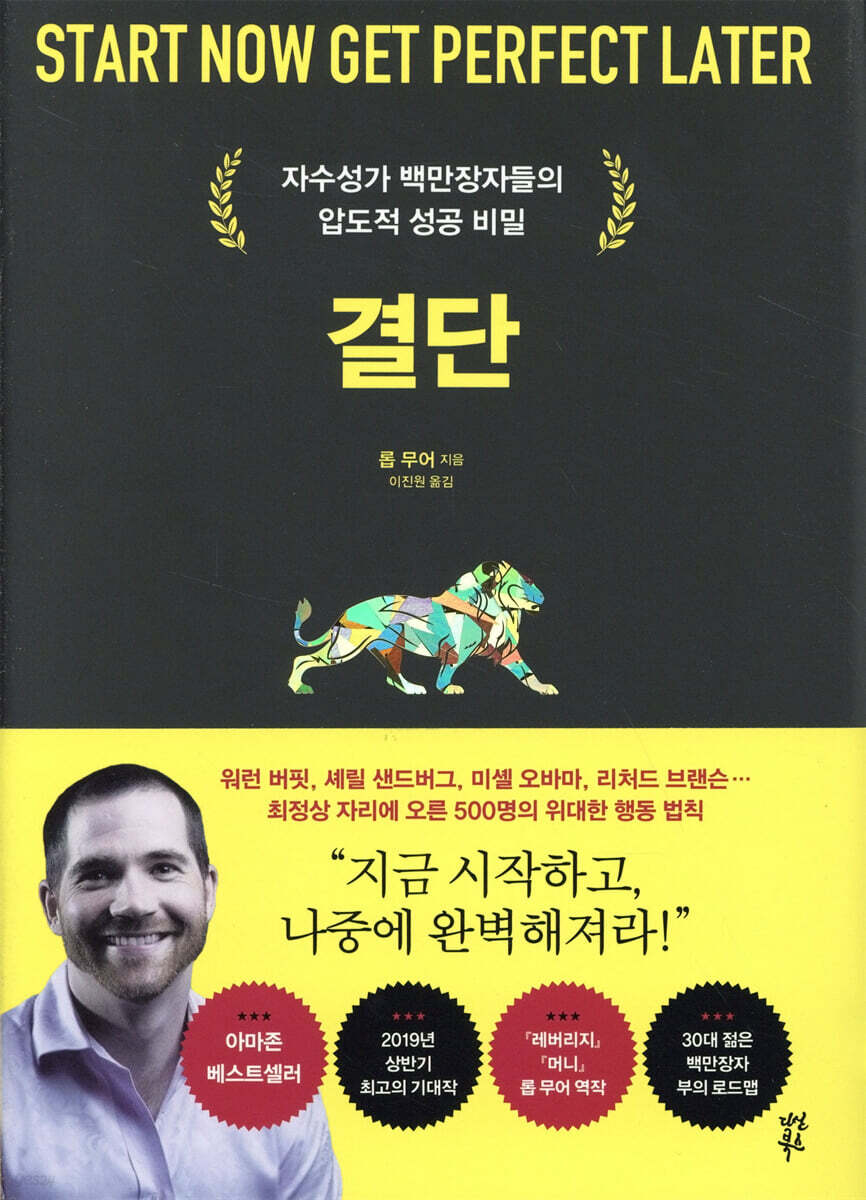
Rob Moore, a 30-something millionaire and Britain's fastest-growing self-made man, has published his latest book. Rob Moore, who created surprising waves around the world with his previous works, Money and Leverage, has recently released a new book, Decision, which is considered to be his most surprising work to date and has quickly become an Amazon bestseller. Rob Moore has met countless millionaires and entrepreneurs and has discovered one surprising commonality among those who achieve extraordinary success despite similar circumstances. They all achieved success in different fields and in different ways, but they realized that they had a unique 'determination', and through 'Determination', they went on to reveal the secret of the determination that enabled these self-made millionaires to succeed. People who made a fortune through self-made means, despite having average economic standing, intelligence, perseverance, and personality, had extraordinary 'decision muscles.' They all pushed forward intuitively based on their own experience and knowledge. How did they cultivate the ability to make simple decisions amidst the maze of countless choices? What is it about their decisiveness that has led to their extraordinary success? How profound is the powerful execution and power of ideas brought about by decisiveness, and how can decisions change behavioral habits? This book clearly reveals the previously unknown secrets of the behavioral habits of 500 self-made millionaires around the world, giving you amazing tools to turn small ideas into powerful actions and modest ambitions into amazing habits. And it will guide you on the fastest path to success. |
- You can preview some of the book's contents.
Preview
index
introduction.
Decide faster, better, and more ambitiously
Chapter 1.
What 500 Self-Made Millionaires Have in Common: Determination
You're Not Really Lazy | Procrastination Is a Self-Protection Mechanism | Why Do You Hesitate, Why Are You Unsure? | Asking for Help Is a Sign of Strength | The Hidden Benefits of Procrastination | The Tug-of-War Between You and Your Tasks
Chapter 2.
It is impossible to be fully prepared.
There is never a perfect time | Time to do nothing | Get rid of the illusion of being busy | Don't put it off until tomorrow | The trap of multitasking | Eureka starts with a small decision | You can change course at any time | The past does not determine the future | People judge you anyway | The worst attitude is to decide nothing | When you want to do this and that
Chapter 3.
There are no bad decisions in the world.
Decisions You Wouldn't Make Again | Don't Be Afraid of Overwhelm | Four Decision Scenarios | Reduce Importance and Eliminate Permanence | Don't Fake It Until You Make It | Think Big, Start Small | How to Accomplish More in Less Time | Build Your Decision Muscle to Make Smart Decisions
Chapter 4.
To be or not to be, that is the question
Setting priorities | Are you busy, productive, or efficient? | Make a 'leverage' list | 'When' is more important than 'what' | The Pomodoro technique | Finding solutions with minimal effort | 10 strategies to deal with lies | Train your environment | Fire yourself for interfering | Never do it yourself | 3 steps to maximum productivity | Don't be afraid of missing opportunities
Chapter 5.
The Secret to Decision Making That Creates Wealth and Success
Intuition vs. Information | Eliminate Investment Risk | Scenario Planning | Simple but Powerful Thinking | Assess Opportunity Costs | No Decision Is Everlasting | Don't Overexperiment | The Power of "I Was Wrong" | The Law of Proportional Decision-Making | Crowdsource | Iterate on Small Scales
Chapter 6.
The ability to make difficult and important decisions quickly
Life is a marathon, not a sprint | The Law of Vacuum Prosperity | The Law of Least Effort | A life without vision has no purpose | Manage your inner fool | 6 steps to making tough decisions | Focus on your strengths and get in the flow | The 5 laws of commitment | You know what to do | Develop the control to make the right decisions | The law of least resistance | Common qualities of great innovators and leaders | The WISLR law to master time
Finishing the book.
You have exceptional abilities and talents that the world needs.
Decide faster, better, and more ambitiously
Chapter 1.
What 500 Self-Made Millionaires Have in Common: Determination
You're Not Really Lazy | Procrastination Is a Self-Protection Mechanism | Why Do You Hesitate, Why Are You Unsure? | Asking for Help Is a Sign of Strength | The Hidden Benefits of Procrastination | The Tug-of-War Between You and Your Tasks
Chapter 2.
It is impossible to be fully prepared.
There is never a perfect time | Time to do nothing | Get rid of the illusion of being busy | Don't put it off until tomorrow | The trap of multitasking | Eureka starts with a small decision | You can change course at any time | The past does not determine the future | People judge you anyway | The worst attitude is to decide nothing | When you want to do this and that
Chapter 3.
There are no bad decisions in the world.
Decisions You Wouldn't Make Again | Don't Be Afraid of Overwhelm | Four Decision Scenarios | Reduce Importance and Eliminate Permanence | Don't Fake It Until You Make It | Think Big, Start Small | How to Accomplish More in Less Time | Build Your Decision Muscle to Make Smart Decisions
Chapter 4.
To be or not to be, that is the question
Setting priorities | Are you busy, productive, or efficient? | Make a 'leverage' list | 'When' is more important than 'what' | The Pomodoro technique | Finding solutions with minimal effort | 10 strategies to deal with lies | Train your environment | Fire yourself for interfering | Never do it yourself | 3 steps to maximum productivity | Don't be afraid of missing opportunities
Chapter 5.
The Secret to Decision Making That Creates Wealth and Success
Intuition vs. Information | Eliminate Investment Risk | Scenario Planning | Simple but Powerful Thinking | Assess Opportunity Costs | No Decision Is Everlasting | Don't Overexperiment | The Power of "I Was Wrong" | The Law of Proportional Decision-Making | Crowdsource | Iterate on Small Scales
Chapter 6.
The ability to make difficult and important decisions quickly
Life is a marathon, not a sprint | The Law of Vacuum Prosperity | The Law of Least Effort | A life without vision has no purpose | Manage your inner fool | 6 steps to making tough decisions | Focus on your strengths and get in the flow | The 5 laws of commitment | You know what to do | Develop the control to make the right decisions | The law of least resistance | Common qualities of great innovators and leaders | The WISLR law to master time
Finishing the book.
You have exceptional abilities and talents that the world needs.
Detailed image

Into the book
No matter what time of year, age, or level of experience and wisdom you have, you can make both good decisions that will make you proud and bad decisions that will make you miserable.
I've always wanted to be someone who makes decisions more easily, but I've learned that to do that, I have to get better.
Whether you're preparing for a business or investment, studying to prepare for a long-term future, or just happened to stumble upon this book, I wanted to write a book about decision-making that would benefit everyone.
I'm confident that learning how to make smarter, faster decisions—and banish procrastination and pressure on a personal, professional, social, and financial level—will greatly benefit your life.
I hope this book will help you achieve better health, wealth, happiness, and determination.
--- p.9
“I’m lazy.” You’ve probably said this to yourself before.
Do you perhaps think of laziness as some kind of "badge of honor"? Like someone who once examined their DNA under a microscope and discovered the "procrastinator" gene.
You have to be careful about the labels you put on yourself.
The thoughts you have about yourself are the result of your own soreness.
The labels you put on yourself are of your own making.
Do you think, "I always procrastinate" or "I have decision-making difficulties?" There's no need to label yourself a "procrastinator."
Because that's a lie.
--- p.16
When I ask candidates to share their "weaknesses" with me to find someone to work with, one of the most common answers I hear is, "I'm a perfectionist."
This word was used to mean that there were no weaknesses.
Self-proclaimed perfectionists often try to highlight their perfectionism as a key strength, saying things like, "Because I'm a perfectionist, I'm incredibly capable at what I do."
If you pick them, they will leave the company in half a year.
They can't do anything that isn't set out for them.
--- p.46
Any (big) decision should start with a simple first step to reduce its importance and avoid dwelling on it forever.
If you had to eat an elephant, how would you eat it? One bite at a time? If you have a big goal you absolutely must achieve, set a big goal that motivates you, but don't let it overwhelm you.
Set a big goal and then let it go.
You can start with very small steps at first.
An acorn grows into an oak tree.
A journey of a thousand miles begins with a single step.
If you know and don't do it, it's just ignorance.
Make big decisions with your heart, but small decisions with your head.
--- p.123
The paradoxical void that many people find themselves in is the space between the 'comfortable known' and the 'uncomfortable unknown.'
The former is safe, but all wisdom and creativity are latent and suppressed.
The uncertain unknown is somewhat scary.
You feel intimidated because you don't feel ready to face it, but there all your infinite, untapped resources are stored there, ready and waiting for the opportunity.
If necessary, you should take it out.
Instead of letting all your creativity and problem-solving skills go dormant, get comfortable being uncomfortable.
Start now and perfect later.
And let all your potential wisdom flow out from you.
--- p.170
Your evil is fighting against your good.
Your addictions are fighting against your vision.
Your heart is fighting against your head.
You are fighting between what you 'feel you should' do and what other people say you 'should' do.
You try to feel satisfied later for a better tomorrow, but you are fighting against your survival instinct in today's danger.
You could call this discipline.
Discipline can be defined as 'doing what you know you have to do, even if you don't like it.'
Here are some simple ways to improve discipline, combat the natural urge to use "carrot and stick," and maximize productivity through ruthless efficiency.
--- pp.193~194
As we age, our habits and personality traits become more ingrained in us, so we repeat our own patterns.
This is both a good thing and a bad thing.
If you keep making the same bad and stupid mistakes over and over again and don't learn from them, then you have a problem.
But what balances these problems is the recurring patterns of our strengths.
No one can do everything well, but no one can do everything badly.
We each have our own values and purposes.
It's better to focus primarily on your strengths and leave your weaknesses to someone else, rather than investing a lot of time and energy trying to change what you can't change.
I've always wanted to be someone who makes decisions more easily, but I've learned that to do that, I have to get better.
Whether you're preparing for a business or investment, studying to prepare for a long-term future, or just happened to stumble upon this book, I wanted to write a book about decision-making that would benefit everyone.
I'm confident that learning how to make smarter, faster decisions—and banish procrastination and pressure on a personal, professional, social, and financial level—will greatly benefit your life.
I hope this book will help you achieve better health, wealth, happiness, and determination.
--- p.9
“I’m lazy.” You’ve probably said this to yourself before.
Do you perhaps think of laziness as some kind of "badge of honor"? Like someone who once examined their DNA under a microscope and discovered the "procrastinator" gene.
You have to be careful about the labels you put on yourself.
The thoughts you have about yourself are the result of your own soreness.
The labels you put on yourself are of your own making.
Do you think, "I always procrastinate" or "I have decision-making difficulties?" There's no need to label yourself a "procrastinator."
Because that's a lie.
--- p.16
When I ask candidates to share their "weaknesses" with me to find someone to work with, one of the most common answers I hear is, "I'm a perfectionist."
This word was used to mean that there were no weaknesses.
Self-proclaimed perfectionists often try to highlight their perfectionism as a key strength, saying things like, "Because I'm a perfectionist, I'm incredibly capable at what I do."
If you pick them, they will leave the company in half a year.
They can't do anything that isn't set out for them.
--- p.46
Any (big) decision should start with a simple first step to reduce its importance and avoid dwelling on it forever.
If you had to eat an elephant, how would you eat it? One bite at a time? If you have a big goal you absolutely must achieve, set a big goal that motivates you, but don't let it overwhelm you.
Set a big goal and then let it go.
You can start with very small steps at first.
An acorn grows into an oak tree.
A journey of a thousand miles begins with a single step.
If you know and don't do it, it's just ignorance.
Make big decisions with your heart, but small decisions with your head.
--- p.123
The paradoxical void that many people find themselves in is the space between the 'comfortable known' and the 'uncomfortable unknown.'
The former is safe, but all wisdom and creativity are latent and suppressed.
The uncertain unknown is somewhat scary.
You feel intimidated because you don't feel ready to face it, but there all your infinite, untapped resources are stored there, ready and waiting for the opportunity.
If necessary, you should take it out.
Instead of letting all your creativity and problem-solving skills go dormant, get comfortable being uncomfortable.
Start now and perfect later.
And let all your potential wisdom flow out from you.
--- p.170
Your evil is fighting against your good.
Your addictions are fighting against your vision.
Your heart is fighting against your head.
You are fighting between what you 'feel you should' do and what other people say you 'should' do.
You try to feel satisfied later for a better tomorrow, but you are fighting against your survival instinct in today's danger.
You could call this discipline.
Discipline can be defined as 'doing what you know you have to do, even if you don't like it.'
Here are some simple ways to improve discipline, combat the natural urge to use "carrot and stick," and maximize productivity through ruthless efficiency.
--- pp.193~194
As we age, our habits and personality traits become more ingrained in us, so we repeat our own patterns.
This is both a good thing and a bad thing.
If you keep making the same bad and stupid mistakes over and over again and don't learn from them, then you have a problem.
But what balances these problems is the recurring patterns of our strengths.
No one can do everything well, but no one can do everything badly.
We each have our own values and purposes.
It's better to focus primarily on your strengths and leave your weaknesses to someone else, rather than investing a lot of time and energy trying to change what you can't change.
--- p.284
Publisher's Review
Even in moments of hesitation
The world changes quickly!
Don't imagine, don't calculate in advance, break the chain of thought!
How to make better, more ambitious, and faster decisions and initiatives
Have you ever thought, even just once, "I procrastinate when making decisions" or "I have trouble making decisions"? If so, you're being deceived by a false you.
It's not your fault that you procrastinate.
It's not because you're particularly indecisive, because you like to procrastinate, or because you have decision-making difficulties.
Author Rob Moore says, “Procrastination is due to an ‘empty space’ that has taken up residence within us.”
It is comfortable to stay in 'empty space'.
In that comfortable place where you already know, there are many other unimportant things scattered around, where you can close your eyes to the unfamiliar, ignore the uncomfortable, and replace the anxious with the familiar.
The 'empty space' where one remains still without making a decision is like a pot that slowly heats up.
We are the frogs caught in it.
How long will you remain in this empty space inside the pot? While you don't choose, the pot slowly heats up and threatens you.
We must escape from the void that threatens our lives.
We must not mistake indecision for a stage of progress, staying in an empty space and thinking that we are 'doing something'.
Author Rob Moore repeatedly says, “Get rid of the illusion that you have to make some huge, grand decision.”
In the book, the author presents specific and practical methods to accurately know and achieve desired goals, such as 'finding solutions with minimal effort, how to fire yourself for interfering, 3 steps to maximize productivity, WISLR law to control time, law of vacuum prosperity, and 6 steps for making difficult decisions.'
"Decision" teaches us about the decision-making mechanism that allows us to ride the flow by focusing on our strengths without hesitation.
This book guides us into the exciting world of decision-making, based on solid case studies and experiences, in six chapters: how powerful the execution and power of ideas brought about by determination are, how behavioral habits can change due to determination, what is so different about the determination of those who have built their own wealth that they have achieved extraordinary success, and how to develop the decision-making muscle.
You will be amazed to see how the energy within us can explode.
The world changes rapidly even when you are only mentally contemplating the millions of possibilities between choice and surrender.
There are so many people who live in an 'empty space' for decades, waiting for the 'right time', and only after a long time has passed do they look back on their past and regret it over and over again.
I deeply regret not starting a business sooner, marrying (or divorcing) someone, or spending more time with my children.
Now is the time to break free from the cycle of repeated regret.
If you have a goal you want to achieve right now, if you have a desire but are struggling to figure out how to get there, if you need some tools to spark your ideas and ambitions, this book will empower you with the determination and drive to no longer hesitate before opportunities.
The world changes quickly!
Don't imagine, don't calculate in advance, break the chain of thought!
How to make better, more ambitious, and faster decisions and initiatives
Have you ever thought, even just once, "I procrastinate when making decisions" or "I have trouble making decisions"? If so, you're being deceived by a false you.
It's not your fault that you procrastinate.
It's not because you're particularly indecisive, because you like to procrastinate, or because you have decision-making difficulties.
Author Rob Moore says, “Procrastination is due to an ‘empty space’ that has taken up residence within us.”
It is comfortable to stay in 'empty space'.
In that comfortable place where you already know, there are many other unimportant things scattered around, where you can close your eyes to the unfamiliar, ignore the uncomfortable, and replace the anxious with the familiar.
The 'empty space' where one remains still without making a decision is like a pot that slowly heats up.
We are the frogs caught in it.
How long will you remain in this empty space inside the pot? While you don't choose, the pot slowly heats up and threatens you.
We must escape from the void that threatens our lives.
We must not mistake indecision for a stage of progress, staying in an empty space and thinking that we are 'doing something'.
Author Rob Moore repeatedly says, “Get rid of the illusion that you have to make some huge, grand decision.”
In the book, the author presents specific and practical methods to accurately know and achieve desired goals, such as 'finding solutions with minimal effort, how to fire yourself for interfering, 3 steps to maximize productivity, WISLR law to control time, law of vacuum prosperity, and 6 steps for making difficult decisions.'
"Decision" teaches us about the decision-making mechanism that allows us to ride the flow by focusing on our strengths without hesitation.
This book guides us into the exciting world of decision-making, based on solid case studies and experiences, in six chapters: how powerful the execution and power of ideas brought about by determination are, how behavioral habits can change due to determination, what is so different about the determination of those who have built their own wealth that they have achieved extraordinary success, and how to develop the decision-making muscle.
You will be amazed to see how the energy within us can explode.
The world changes rapidly even when you are only mentally contemplating the millions of possibilities between choice and surrender.
There are so many people who live in an 'empty space' for decades, waiting for the 'right time', and only after a long time has passed do they look back on their past and regret it over and over again.
I deeply regret not starting a business sooner, marrying (or divorcing) someone, or spending more time with my children.
Now is the time to break free from the cycle of repeated regret.
If you have a goal you want to achieve right now, if you have a desire but are struggling to figure out how to get there, if you need some tools to spark your ideas and ambitions, this book will empower you with the determination and drive to no longer hesitate before opportunities.
GOODS SPECIFICS
- Date of issue: April 12, 2019
- Format: Hardcover book binding method guide
- Page count, weight, size: 324 pages | 643g | 155*217*23mm
- ISBN13: 9791130621388
- ISBN10: 1130621383
You may also like
카테고리
korean


korean

![ELLE 엘르 스페셜 에디션 A형 : 12월 [2025]](http://librairie.coreenne.fr/cdn/shop/files/b8e27a3de6c9538896439686c6b0e8fb.jpg?v=1766436872&width=3840)


