

original contractor
 |
Description
Book Introduction
- A word from MD
-
China during the modern upheaval restored by Wei HuaA new novel by Wei Hua, written over 23 years, set in 1900s China.
How far will the upheaval of the times shake the fate of ordinary citizens?
Like Lin Xiangfu, who wanders in search of the unknown city of 'Wenqing', if everyone lives with 'Wenqing' in their hearts, countless promises will become reality.
December 2, 2022. Novel/Poetry PD Lee Na-young
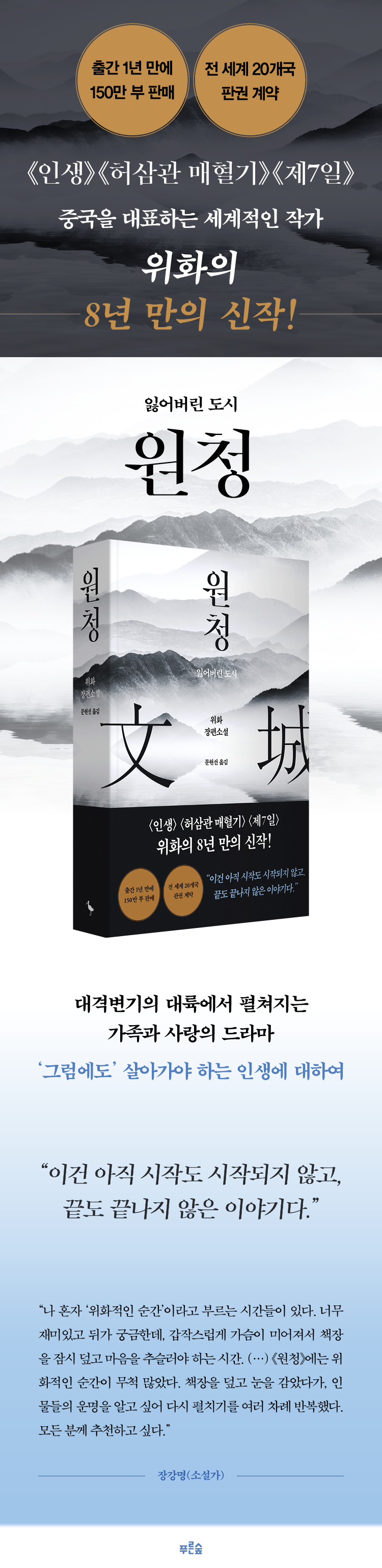
1.5 million copies sold upon local publication
Copyright sales to over 20 countries overseas
The Weihua fever shook the continent again after eight years.
“A masterpiece that makes you think about the fate of the times beyond your own personal fortune!”
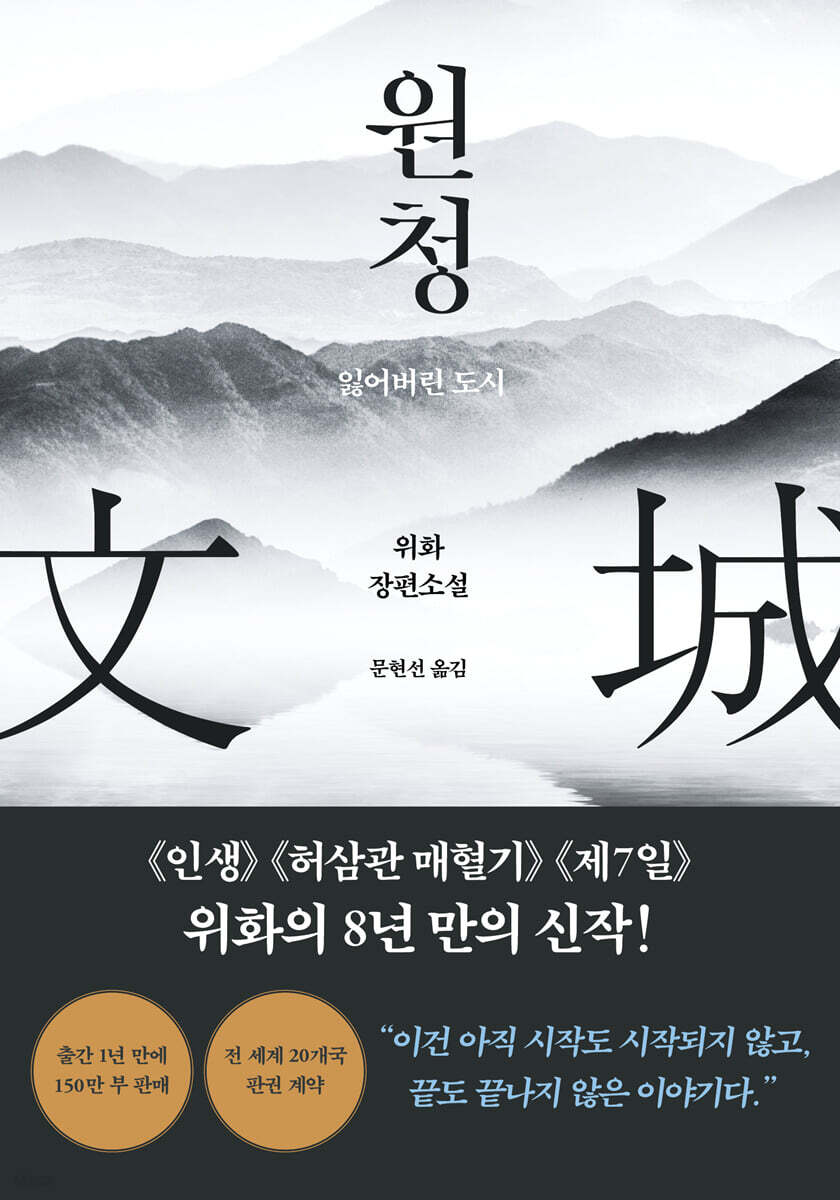
The new novel 『Yuanqing: The Lost City』 by the continent's greatest master, Wi Hwa, has been published by Blue Forest Publishing.
『Woncheong』 became a bestseller immediately after its publication, reaffirming its peak popularity by selling over 1.5 million copies within a year of its publication.
The Chinese daily [China Youth Daily] reported on this phenomenon, saying, “In literary circles, the question ‘Have you read Yuanqing’ has become a greeting,” and “It has become a major incident in the literary world in 2021.”
Set during a period of great upheaval, with the old era represented by the Qing Dynasty coming to an end and the new era of the Republic of China rising, 『Yuanqing』 is Wei Hua's first biographical novel, and can be said to be the definitive edition of Wei Hua's world in terms of its scale and completeness.
Lin Xiangfu's journey to find the unknown city of 'Woncheong' unfolds a drama of ordinary people caught in the midst of natural disasters, chaos, and war.
In moments of life and death, how should individuals, families, and communities navigate? Wi Hwa, who has captivatingly depicted humanism shining brightly in adversity in works like "Life," "The Story of Selling Blood," and "The Seventh Day," presents a moving and insightful journey in "Woncheong" that surpasses his previous works.
Domestic readers who first read 『Original Text』 in a tentative version also gave it enthusiastic praise.
“A masterpiece that makes you think about the fate of the times beyond your personal fortune.” “It taught me that accepting life isn’t just ‘giving up.’” “It gives you faith in humanity in the midst of a tragicomedy.” “I couldn’t hold back my tears in the last chapter.” With its endless adventures toward the unknown city of Woncheong, a heartbreaking romance spanning decades, and the citizens’ struggles to protect their families from war and bandits, Woncheong will surely provide timeless emotions to literature readers thirsty for masterpieces.
Copyright sales to over 20 countries overseas
The Weihua fever shook the continent again after eight years.
“A masterpiece that makes you think about the fate of the times beyond your own personal fortune!”
The new novel 『Yuanqing: The Lost City』 by the continent's greatest master, Wi Hwa, has been published by Blue Forest Publishing.
『Woncheong』 became a bestseller immediately after its publication, reaffirming its peak popularity by selling over 1.5 million copies within a year of its publication.
The Chinese daily [China Youth Daily] reported on this phenomenon, saying, “In literary circles, the question ‘Have you read Yuanqing’ has become a greeting,” and “It has become a major incident in the literary world in 2021.”
Set during a period of great upheaval, with the old era represented by the Qing Dynasty coming to an end and the new era of the Republic of China rising, 『Yuanqing』 is Wei Hua's first biographical novel, and can be said to be the definitive edition of Wei Hua's world in terms of its scale and completeness.
Lin Xiangfu's journey to find the unknown city of 'Woncheong' unfolds a drama of ordinary people caught in the midst of natural disasters, chaos, and war.
In moments of life and death, how should individuals, families, and communities navigate? Wi Hwa, who has captivatingly depicted humanism shining brightly in adversity in works like "Life," "The Story of Selling Blood," and "The Seventh Day," presents a moving and insightful journey in "Woncheong" that surpasses his previous works.
Domestic readers who first read 『Original Text』 in a tentative version also gave it enthusiastic praise.
“A masterpiece that makes you think about the fate of the times beyond your personal fortune.” “It taught me that accepting life isn’t just ‘giving up.’” “It gives you faith in humanity in the midst of a tragicomedy.” “I couldn’t hold back my tears in the last chapter.” With its endless adventures toward the unknown city of Woncheong, a heartbreaking romance spanning decades, and the citizens’ struggles to protect their families from war and bandits, Woncheong will surely provide timeless emotions to literature readers thirsty for masterpieces.
- You can preview some of the book's contents.
Preview
index
Preface to the Korean Edition - There is a desire in everyone's heart.
original contractor
Another story
original contractor
Another story
Detailed image
Into the book
Lin Xiangfu paused for a moment and then spoke in a determined tone.
“If you leave again without saying anything, I will come looking for you.
“I will carry my child and go to the ends of the earth to find you.”
When Lin Xiangfu finished speaking, he realized that his hand had already been guided by Xiao Mei and was on her face.
Xiaomei's tears flowed down between his fingers, and he hesitated for a moment as if searching for direction.
--- p.79
“When will it stop snowing?”
Lin Xiangfu shook his head.
He didn't know either.
Lin Xiangfu, holding his daughter in his arms, walked around Shijin, knocking on each door.
The women of Shijin were more generous and peaceful than the men in the snow-covered world.
Although her expression was stiff, she did her housework just like before.
As they moved around the house, Lin Xiangfu could feel that there was still human breath in the frozen Shijin.
--- p.112
All along the way, Lin Xiangfu kept muttering to Lin Baizi.
He said that he would not take a new wife, Lin Baizi would have no siblings, and that everything he did from now on would be for Lin Baizi.
Little Lin Baizi knew that his father was talking to him, so he would just say, “Yes,” whenever Lin Xiangfu said something.
--- p.139
This northern peasant had a longing for the land that was difficult to express in words, a longing similar to a child clinging to its mother's arms.
Twelve years ago, after a whirlwind had passed and he had lost his daughter, he saw for the first time in the rising morning sunlight the vast fields where water and land intermingled.
Even though uprooted trees were scattered everywhere, rice plants were lying here and there like trampled weeds, and the planks of a wrecked ship, numerous belts, thick timbers, and bare roofs were floating on the water, Lin Xiangfu could still see the original, rich Wanwudang in this ruined landscape.
It's like discovering the beauty of youth in the face of an old woman.
--- p.147
The monk's mother, who had come out wearing a cotton vest and carrying a lantern, saw Cheon Yao-woo and asked him.
“Whose house is this?”
“He’s a hostage we captured from Shijin.”
For the next four days and nights, Tian Yao Yu suffered from a high fever in the monk's wooden shed.
My eyes became foggy and blurry, I could hear a dripping sound like water was pouring from my ears, and my body felt heavy as a stone.
Tian Yao-u vaguely felt a group of monks come in several times and say something in front of him.
The thing I saw most while I was sick was the monk's mother.
Every time the old woman came in, she held out both hands, always holding water, porridge, or sometimes ginger soup, and speaking in a hoarse voice.
“Drink some water…….
Eat some porridge… … .
“Have some ginger soup… … .”
After four days of struggling between life and death, when she came to on the morning of the fifth day, Tian Yao Yu heard the clear sound of birds and saw the sunlight streaming through the wooden window.
--- p.230
That night, seven monks and sixty-nine members of Cheon Yongryang's group spent the night together in Chen Village.
They sat around and discussed what to do next.
The monk confessed to Cheon Yong-ryang that the seven of them had broken away before attacking Shi Jin because they could not tolerate Jang Do-kki's tyranny.
The monk said.
“In these troubled times, if you farm, you will be plundered by bandits or killed, and if you become a bandit, you cannot survive without plundering.”
Cheon Yong-ryang replied.
“It is not shameful to live as a bandit in troubled times, but even if you are a bandit, you must have a good heart.”
--- p.365
She stopped crying and wiped the tears from her eyes with the hem of her clothes.
Tears are shed when there is hope, so when I became desperate, my heart felt at ease.
She got up and brought warm water to wash her father-in-law and mother-in-law's feet as usual, even though her mother-in-law had already gone upstairs.
--- p.443
Xiaomei said.
“This time you’re going to have to wait a very long time.”
“I’ll wait no matter how long it takes.”
“If something happens, I might die there.”
“I’ll wait until you die in Dingchuan.”
The two looked at each other with tears in their eyes, then laughed through their tears.
“If you leave again without saying anything, I will come looking for you.
“I will carry my child and go to the ends of the earth to find you.”
When Lin Xiangfu finished speaking, he realized that his hand had already been guided by Xiao Mei and was on her face.
Xiaomei's tears flowed down between his fingers, and he hesitated for a moment as if searching for direction.
--- p.79
“When will it stop snowing?”
Lin Xiangfu shook his head.
He didn't know either.
Lin Xiangfu, holding his daughter in his arms, walked around Shijin, knocking on each door.
The women of Shijin were more generous and peaceful than the men in the snow-covered world.
Although her expression was stiff, she did her housework just like before.
As they moved around the house, Lin Xiangfu could feel that there was still human breath in the frozen Shijin.
--- p.112
All along the way, Lin Xiangfu kept muttering to Lin Baizi.
He said that he would not take a new wife, Lin Baizi would have no siblings, and that everything he did from now on would be for Lin Baizi.
Little Lin Baizi knew that his father was talking to him, so he would just say, “Yes,” whenever Lin Xiangfu said something.
--- p.139
This northern peasant had a longing for the land that was difficult to express in words, a longing similar to a child clinging to its mother's arms.
Twelve years ago, after a whirlwind had passed and he had lost his daughter, he saw for the first time in the rising morning sunlight the vast fields where water and land intermingled.
Even though uprooted trees were scattered everywhere, rice plants were lying here and there like trampled weeds, and the planks of a wrecked ship, numerous belts, thick timbers, and bare roofs were floating on the water, Lin Xiangfu could still see the original, rich Wanwudang in this ruined landscape.
It's like discovering the beauty of youth in the face of an old woman.
--- p.147
The monk's mother, who had come out wearing a cotton vest and carrying a lantern, saw Cheon Yao-woo and asked him.
“Whose house is this?”
“He’s a hostage we captured from Shijin.”
For the next four days and nights, Tian Yao Yu suffered from a high fever in the monk's wooden shed.
My eyes became foggy and blurry, I could hear a dripping sound like water was pouring from my ears, and my body felt heavy as a stone.
Tian Yao-u vaguely felt a group of monks come in several times and say something in front of him.
The thing I saw most while I was sick was the monk's mother.
Every time the old woman came in, she held out both hands, always holding water, porridge, or sometimes ginger soup, and speaking in a hoarse voice.
“Drink some water…….
Eat some porridge… … .
“Have some ginger soup… … .”
After four days of struggling between life and death, when she came to on the morning of the fifth day, Tian Yao Yu heard the clear sound of birds and saw the sunlight streaming through the wooden window.
--- p.230
That night, seven monks and sixty-nine members of Cheon Yongryang's group spent the night together in Chen Village.
They sat around and discussed what to do next.
The monk confessed to Cheon Yong-ryang that the seven of them had broken away before attacking Shi Jin because they could not tolerate Jang Do-kki's tyranny.
The monk said.
“In these troubled times, if you farm, you will be plundered by bandits or killed, and if you become a bandit, you cannot survive without plundering.”
Cheon Yong-ryang replied.
“It is not shameful to live as a bandit in troubled times, but even if you are a bandit, you must have a good heart.”
--- p.365
She stopped crying and wiped the tears from her eyes with the hem of her clothes.
Tears are shed when there is hope, so when I became desperate, my heart felt at ease.
She got up and brought warm water to wash her father-in-law and mother-in-law's feet as usual, even though her mother-in-law had already gone upstairs.
--- p.443
Xiaomei said.
“This time you’re going to have to wait a very long time.”
“I’ll wait no matter how long it takes.”
“If something happens, I might die there.”
“I’ll wait until you die in Dingchuan.”
The two looked at each other with tears in their eyes, then laughed through their tears.
--- p.510
Publisher's Review
Life, The Story of Heo Sam-gwan Selling Blood, The Seventh Day
A new work by world-renowned author Wi Hwa, first in eight years!
Finally, the most 'disturbing moment' born from the hands of a master!
Wei Hua, a world-renowned Chinese author who is truly a representative of China, has returned after eight years with his new work, 『Yuan Qing: The Lost City』.
Wi Hwa, who has always depicted people who live their lives without giving up even in desperate situations, has also depicted the noble footsteps of humans on an endless journey in 『Woncheong』.
The story of Lin Xiangfu's eventful life unfolds as he searches for the unknown city of Yuanqing amidst the turbulent times of the Qing Dynasty and the beginning of the Republic of China.
Is life simply a matter of following a predetermined destiny? Wei Hua asks.
“The torrent of time forces everyone to make their own choices.
This hasn't even started yet.
“It is a story that has no end.” Any reader who is wondering how to live his life will be able to find a clue in 『Woncheong』, which was crafted with the master’s skills.
In his recommendation, author Jang Gang-myeong called the miraculous moment that can only be felt in Wihwa's works a "wehwa-like moment."
“There are times that I call ‘disturbing moments’ by myself.
It's so much fun and I'm curious about what happens next, but then my heart suddenly starts to pound, so I have to put the book down for a moment and collect my thoughts.
After reading his book, I always find myself making a resolution deep in my heart.
Let's be good to those around us.
Let's accept misfortune calmly.
Let's not be cruel.
Let's stop the war.
“There were many uncomfortable moments in ‘Woncheong.’” Readers who have experienced ‘discomfort moments’ through Wi Hwa’s works such as ‘Life,’ ‘The Story of Selling Blood,’ and ‘The Seventh Day,’ as well as readers who are encountering Wi Hwa for the first time, now is the time to face the most uncomfortable moments.
『Woncheong』 sold 1.5 million copies in China upon its publication, once again sparking a craze for Wei Hua after eight years, and its copyrights were sold to over 20 countries, confirming its global popularity.
A work that became a dream come true for young people
A period of great upheaval in China, restored with the master's skill over 23 years
From the beginning, Wei Hua had the ambition to recreate modern China in the 1900s through literature.
By reconstructing the life of the 20th century into a story, we have constantly asked questions about where 21st century China came from and where it should go.
『Life』, which begins with the Great Leap Forward in the 1950s.
Even 『The Story of Selling Blood』, set during the Cultural Revolution in the 1960s, and 『Brothers』, which portrays capitalist Chinese society, were all extensions of such attempts.
The new work, "Yuanqing," is the final piece of the puzzle of Wei Hua, and is set in the early 1900s, during the Xinhai Revolution, when the Qing Dynasty ended and the Republic of China began.
It is a period of great upheaval, with one era ending and a new one rising, and can be said to be the largest work of its kind.
Even in terms of writing, 『Woncheong』 took the longest time.
『Woncheong』, which began full-scale work in 1998, was published a full eight years after 『Brothers』 in 2005 and 『The 7th Day』 in 2013.
The reason it took so long was because 『Woncheong』 was connected to Wihwa's long-held dream in his twenties of writing a biographical novel.
Wi Hwa, who had been writing works based on a realistic foundation, revised them over a long period of time to establish them on a new literary foundation, and finally created a dramatic story of a turbulent era filled with natural disasters, adventures, wars, and theft by exquisitely blending fact and fantasy.
The work "Yuanqing," which was written by a writer who rose to the ranks of a master and achieved his grand dream in his youth through great effort, was recorded as a major event in the Chinese literary world in 2021.
Readers who have previously encountered Wei Hua's works through works such as "The Story of Heo Sam-gwan Selling Blood" and "Life" will be able to complete the topography of 20th-century China with "Yuanqing" and enjoy Wei Hua's new narrative style that they have not encountered before.
Moreover, for readers encountering Wei Hua's work for the first time, 『Woncheong』 will be remembered for a long time as a masterpiece that possesses both the dignity of a classic and the fun of the genre.
Is life just a matter of following a predetermined fate?
The sublime footsteps of humanity on a journey that has only a beginning and no end.
Although it is set in a time of chaos, no historical heroes appear in the story of Wei Hua.
Even at a crossroads of great change, Wihwa, as it has always done, presents an 'ordinary' person as the protagonist.
The storms of history usually completely destroy the citizen.
When war and famine strike, citizens turn to thieves to survive, and soldiers who should protect citizens instead rob them.
In the face of the changing times, "ordinary fate" is so ruthless. Is life simply a matter of following the predetermined destiny of the times? Is the individual helpless in the face of the times? Through Lin Xiangfu, who continues on a journey with only a beginning and no end, Wei Hua demonstrates why life must be lived, no matter how harsh the fate.
As author Jang Gang-myeong, who wrote the recommendation, said, reading 『Woncheong』 makes you close your eyes and think about fate.
“I closed the book, closed my eyes, and opened it again several times, wanting to know the fate of the characters.
“I would like to recommend it to everyone.”
In the preface to the Korean edition, Wihwa talks about resonance, saying, “There is a desire in everyone’s heart.”
Just like the tear stains that I suddenly discovered in a moving passage of a book I borrowed from the library, the moment when tears meet and emotions meet is resonance, and this resonance is what 『Woncheong』 was trying to express.
“There are so many things in the world that you can’t know even if you want to know them, and that you can’t find even if you want to find them.
Every time, we search, guess, and piece together in our imaginations.” Doesn't the saying that everyone has a source of resentment in their hearts mean that everyone has something unknown and unsearchable, and that if only we understood that fact, we could resonate with one another? Wihwa concludes by asking whether there has been a story like "Resentment" in Korea.
Why wouldn't there be someone here wandering around looking for a piece of an unknown destiny?
And so, the book is closed and the moment of resonance comes when tears meet.
A new work by world-renowned author Wi Hwa, first in eight years!
Finally, the most 'disturbing moment' born from the hands of a master!
Wei Hua, a world-renowned Chinese author who is truly a representative of China, has returned after eight years with his new work, 『Yuan Qing: The Lost City』.
Wi Hwa, who has always depicted people who live their lives without giving up even in desperate situations, has also depicted the noble footsteps of humans on an endless journey in 『Woncheong』.
The story of Lin Xiangfu's eventful life unfolds as he searches for the unknown city of Yuanqing amidst the turbulent times of the Qing Dynasty and the beginning of the Republic of China.
Is life simply a matter of following a predetermined destiny? Wei Hua asks.
“The torrent of time forces everyone to make their own choices.
This hasn't even started yet.
“It is a story that has no end.” Any reader who is wondering how to live his life will be able to find a clue in 『Woncheong』, which was crafted with the master’s skills.
In his recommendation, author Jang Gang-myeong called the miraculous moment that can only be felt in Wihwa's works a "wehwa-like moment."
“There are times that I call ‘disturbing moments’ by myself.
It's so much fun and I'm curious about what happens next, but then my heart suddenly starts to pound, so I have to put the book down for a moment and collect my thoughts.
After reading his book, I always find myself making a resolution deep in my heart.
Let's be good to those around us.
Let's accept misfortune calmly.
Let's not be cruel.
Let's stop the war.
“There were many uncomfortable moments in ‘Woncheong.’” Readers who have experienced ‘discomfort moments’ through Wi Hwa’s works such as ‘Life,’ ‘The Story of Selling Blood,’ and ‘The Seventh Day,’ as well as readers who are encountering Wi Hwa for the first time, now is the time to face the most uncomfortable moments.
『Woncheong』 sold 1.5 million copies in China upon its publication, once again sparking a craze for Wei Hua after eight years, and its copyrights were sold to over 20 countries, confirming its global popularity.
A work that became a dream come true for young people
A period of great upheaval in China, restored with the master's skill over 23 years
From the beginning, Wei Hua had the ambition to recreate modern China in the 1900s through literature.
By reconstructing the life of the 20th century into a story, we have constantly asked questions about where 21st century China came from and where it should go.
『Life』, which begins with the Great Leap Forward in the 1950s.
Even 『The Story of Selling Blood』, set during the Cultural Revolution in the 1960s, and 『Brothers』, which portrays capitalist Chinese society, were all extensions of such attempts.
The new work, "Yuanqing," is the final piece of the puzzle of Wei Hua, and is set in the early 1900s, during the Xinhai Revolution, when the Qing Dynasty ended and the Republic of China began.
It is a period of great upheaval, with one era ending and a new one rising, and can be said to be the largest work of its kind.
Even in terms of writing, 『Woncheong』 took the longest time.
『Woncheong』, which began full-scale work in 1998, was published a full eight years after 『Brothers』 in 2005 and 『The 7th Day』 in 2013.
The reason it took so long was because 『Woncheong』 was connected to Wihwa's long-held dream in his twenties of writing a biographical novel.
Wi Hwa, who had been writing works based on a realistic foundation, revised them over a long period of time to establish them on a new literary foundation, and finally created a dramatic story of a turbulent era filled with natural disasters, adventures, wars, and theft by exquisitely blending fact and fantasy.
The work "Yuanqing," which was written by a writer who rose to the ranks of a master and achieved his grand dream in his youth through great effort, was recorded as a major event in the Chinese literary world in 2021.
Readers who have previously encountered Wei Hua's works through works such as "The Story of Heo Sam-gwan Selling Blood" and "Life" will be able to complete the topography of 20th-century China with "Yuanqing" and enjoy Wei Hua's new narrative style that they have not encountered before.
Moreover, for readers encountering Wei Hua's work for the first time, 『Woncheong』 will be remembered for a long time as a masterpiece that possesses both the dignity of a classic and the fun of the genre.
Is life just a matter of following a predetermined fate?
The sublime footsteps of humanity on a journey that has only a beginning and no end.
Although it is set in a time of chaos, no historical heroes appear in the story of Wei Hua.
Even at a crossroads of great change, Wihwa, as it has always done, presents an 'ordinary' person as the protagonist.
The storms of history usually completely destroy the citizen.
When war and famine strike, citizens turn to thieves to survive, and soldiers who should protect citizens instead rob them.
In the face of the changing times, "ordinary fate" is so ruthless. Is life simply a matter of following the predetermined destiny of the times? Is the individual helpless in the face of the times? Through Lin Xiangfu, who continues on a journey with only a beginning and no end, Wei Hua demonstrates why life must be lived, no matter how harsh the fate.
As author Jang Gang-myeong, who wrote the recommendation, said, reading 『Woncheong』 makes you close your eyes and think about fate.
“I closed the book, closed my eyes, and opened it again several times, wanting to know the fate of the characters.
“I would like to recommend it to everyone.”
In the preface to the Korean edition, Wihwa talks about resonance, saying, “There is a desire in everyone’s heart.”
Just like the tear stains that I suddenly discovered in a moving passage of a book I borrowed from the library, the moment when tears meet and emotions meet is resonance, and this resonance is what 『Woncheong』 was trying to express.
“There are so many things in the world that you can’t know even if you want to know them, and that you can’t find even if you want to find them.
Every time, we search, guess, and piece together in our imaginations.” Doesn't the saying that everyone has a source of resentment in their hearts mean that everyone has something unknown and unsearchable, and that if only we understood that fact, we could resonate with one another? Wihwa concludes by asking whether there has been a story like "Resentment" in Korea.
Why wouldn't there be someone here wandering around looking for a piece of an unknown destiny?
And so, the book is closed and the moment of resonance comes when tears meet.
GOODS SPECIFICS
- Publication date: December 2, 2022
- Page count, weight, size: 588 pages | 610g | 140*200*35mm
- ISBN13: 9791156751298
- ISBN10: 1156751292
You may also like
카테고리
korean


korean

![GQ KOREA Mark (Monthly): December [2025]](http://librairie.coreenne.fr/cdn/shop/files/8ef265dbbfbf186523ed75ba7319009d.jpg?v=1765340328&width=3840)


