

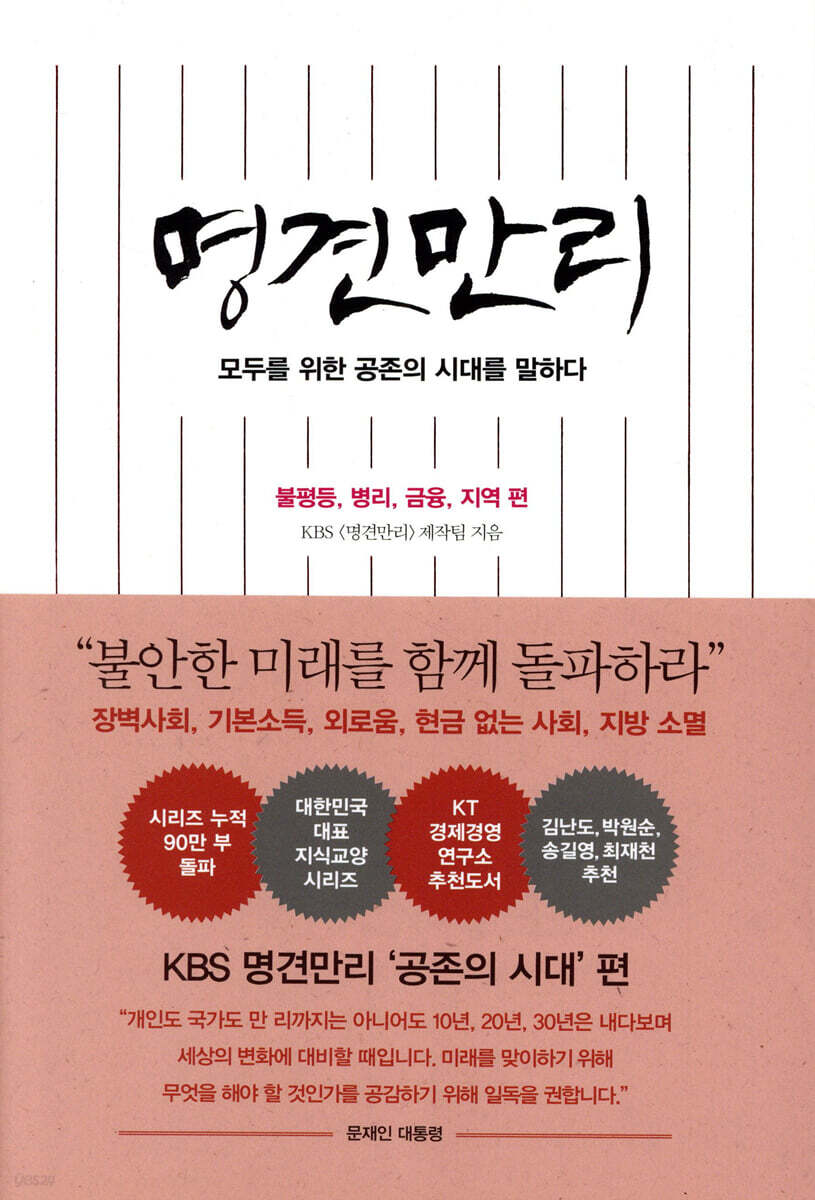
The Age of Coexistence
 |
Description
Book Introduction
“A valuable book that suggests ways to live well together and inspires change.” Seong Tae-yoon (Professor of Economics, Yonsei University) The [Myungkyunmanri] series shocked the world by raising new discourses on the most important issues facing humanity in the future, such as population shock, education, and technology. In this fourth book, 『Myeonggyeonmanri: The Era of Coexistence』, we explore the path to 'coexistence', which is newly required of humanity for a sustainable society. Through the four themes of 'inequality, pathology, finance, and region,' you will encounter alternatives and wisdom discovered around the world to create a society where everyone prospers together. The issues that humanity is already paying attention to have changed from the past. The essential knowledge required to survive is also changing. For the next 50 years, humanity will continue to ponder the questions raised in this book and seek answers. Readers who want a holistic view of how the world we live in operates and changes today will find the most up-to-date discourse and solutions in this book. I hope that through this book, you will gain the opportunity to discover new possibilities that you had never thought of before, trapped by preconceptions, amidst the vast currents that you have seen and felt but failed to properly perceive. This book will be a must-read not only for young people with uncertain futures, but also for middle-aged and older people who have to live longer lives. |
- You can preview some of the book's contents.
Preview
index
Prologue | Another world is possible when you don't give up hope.
Part 1: Inequality
Chapter 1.
A New Imagination for Coexistence in the Age of Hereditary Succession
A society without wealth disparity
China only 2 percent, Japan 18.5 percent, and the United States 28.9 percent.
This is the percentage of wealthy people with assets of over $1 billion who became wealthy through inheritance or gifts.
In South Korea? A whopping 74.1 percent of wealthy people inherit their wealth.
In South Korea, where the ladder of social mobility is disappearing and a new hereditary society is emerging, how can we break down class barriers and coexist?
Chapter 2.
Is an 'educational ladder' necessary?
A society where you don't have to climb up
How can we break the cycle of 'poor children' becoming 'poor college students', 'poor office workers', and then 'poor parents' who then give birth to 'poor children' again?
What if our education wasn't a vertical ladder leading to a single destination, but rather a series of horizontal bridges stretching in all directions? We need a completely different educational paradigm.
Chapter 3.
If you do the same work for the same amount of time, you should get paid the same amount.
A society where one can survive solely on labor
20 years since the IMF foreign exchange crisis.
Over the years, high barriers have emerged in our society between large and small businesses, and between regular and non-regular workers.
At a time when even the IMF, which previously called for restructuring, is warning about Korea's irregular employment problem, what can be done to resolve the job imbalance?
Chapter 4.
To overcome the chaebol era
_A society that competes fairly
Korea's unique corporate governance structure, unlike any other in the world, is even listed in English dictionaries as "chaebol." These conglomerates dominate society, monopolizing both capital and systems.
To create a fair ecosystem, we must begin making fateful changes now.
Part 2: Psychopathy
Chapter 5.
Are there happy individuals in an unhappy society?
_Are mental health issues really a personal matter?
An Australian prime minister has resigned from his post after admitting he suffers from depression.
His confession caused a great stir in Australian society.
Australia's 'Mental Health First Aid Centre', which recognized that mental first aid is as necessary as physical first aid, is now spreading across Australia and around the world.
Why did they view individual mental health as a social problem?
Chapter 6.
Connection, the Key to Unlocking Loneliness
Why Loneliness is a Social Problem
The British government became the first in the world to appoint a Minister for Loneliness in 2018.
The idea is to view loneliness, an individual emotion, as a social disease and for the government to step in and solve it.
Movements around the world to connect people with people and spaces with spaces.
We too must begin discussing the keyword that can solve loneliness, 'connection,' before it's too late.
Part 3: Finance (FinTech)
Chapter 7.
The Cashless War of 'Money'
Is a cashless society coming?
In a world where even church donations and street busking sponsorships are being made through simple payment apps, cash is disappearing.
Sweden, a leader in the 'cashless society', is projected to see its cash usage rate drop to 0.5 percent by 2020.
Could a cashless society be our bright future?
Chapter 8.
Cryptocurrency and Blockchain: Bubble or Revolution?
Is the era of blockchain coming?
Cryptocurrency is a currency that exists only as numbers on a computer, and cannot be stored in a wallet or touched with your hands.
However, it is called the second Internet revolution, and the competition for dominance in virtual currency and blockchain technology is fierce.
What is the reality of the virtual currency that is causing a huge vortex around the world?
And how far can blockchain technology go?
Part 4_Region
Chapter 9.
How Cities Change People
Restore connectivity to disconnected cities
No one can live alone in the city.
Whether at home or on the street, people must meet people and spaces must meet spaces.
‘Connectivity’ is a prerequisite for a livable city.
No matter how fancy the buildings are, if no one lives in them, it is a dead city.
We take a look at the efforts of countries around the world to make cities spaces for encounter and exchange.
Chapter 10.
Is the Destruction of Local Government an Inevitable Future?
_Conditions of the region you want to live in
Population, investment, production, labor opportunities, and development potential are all declining.
Because of this, the province is also on the path to extinction.
The disappearance of small and medium-sized cities in the provinces is not a problem unique to those cities.
It places a huge burden on both the incoming and outgoing populations, and the costs that society as a whole must bear also increase.
Is there really a way to protect the province?
Part 1: Inequality
Chapter 1.
A New Imagination for Coexistence in the Age of Hereditary Succession
A society without wealth disparity
China only 2 percent, Japan 18.5 percent, and the United States 28.9 percent.
This is the percentage of wealthy people with assets of over $1 billion who became wealthy through inheritance or gifts.
In South Korea? A whopping 74.1 percent of wealthy people inherit their wealth.
In South Korea, where the ladder of social mobility is disappearing and a new hereditary society is emerging, how can we break down class barriers and coexist?
Chapter 2.
Is an 'educational ladder' necessary?
A society where you don't have to climb up
How can we break the cycle of 'poor children' becoming 'poor college students', 'poor office workers', and then 'poor parents' who then give birth to 'poor children' again?
What if our education wasn't a vertical ladder leading to a single destination, but rather a series of horizontal bridges stretching in all directions? We need a completely different educational paradigm.
Chapter 3.
If you do the same work for the same amount of time, you should get paid the same amount.
A society where one can survive solely on labor
20 years since the IMF foreign exchange crisis.
Over the years, high barriers have emerged in our society between large and small businesses, and between regular and non-regular workers.
At a time when even the IMF, which previously called for restructuring, is warning about Korea's irregular employment problem, what can be done to resolve the job imbalance?
Chapter 4.
To overcome the chaebol era
_A society that competes fairly
Korea's unique corporate governance structure, unlike any other in the world, is even listed in English dictionaries as "chaebol." These conglomerates dominate society, monopolizing both capital and systems.
To create a fair ecosystem, we must begin making fateful changes now.
Part 2: Psychopathy
Chapter 5.
Are there happy individuals in an unhappy society?
_Are mental health issues really a personal matter?
An Australian prime minister has resigned from his post after admitting he suffers from depression.
His confession caused a great stir in Australian society.
Australia's 'Mental Health First Aid Centre', which recognized that mental first aid is as necessary as physical first aid, is now spreading across Australia and around the world.
Why did they view individual mental health as a social problem?
Chapter 6.
Connection, the Key to Unlocking Loneliness
Why Loneliness is a Social Problem
The British government became the first in the world to appoint a Minister for Loneliness in 2018.
The idea is to view loneliness, an individual emotion, as a social disease and for the government to step in and solve it.
Movements around the world to connect people with people and spaces with spaces.
We too must begin discussing the keyword that can solve loneliness, 'connection,' before it's too late.
Part 3: Finance (FinTech)
Chapter 7.
The Cashless War of 'Money'
Is a cashless society coming?
In a world where even church donations and street busking sponsorships are being made through simple payment apps, cash is disappearing.
Sweden, a leader in the 'cashless society', is projected to see its cash usage rate drop to 0.5 percent by 2020.
Could a cashless society be our bright future?
Chapter 8.
Cryptocurrency and Blockchain: Bubble or Revolution?
Is the era of blockchain coming?
Cryptocurrency is a currency that exists only as numbers on a computer, and cannot be stored in a wallet or touched with your hands.
However, it is called the second Internet revolution, and the competition for dominance in virtual currency and blockchain technology is fierce.
What is the reality of the virtual currency that is causing a huge vortex around the world?
And how far can blockchain technology go?
Part 4_Region
Chapter 9.
How Cities Change People
Restore connectivity to disconnected cities
No one can live alone in the city.
Whether at home or on the street, people must meet people and spaces must meet spaces.
‘Connectivity’ is a prerequisite for a livable city.
No matter how fancy the buildings are, if no one lives in them, it is a dead city.
We take a look at the efforts of countries around the world to make cities spaces for encounter and exchange.
Chapter 10.
Is the Destruction of Local Government an Inevitable Future?
_Conditions of the region you want to live in
Population, investment, production, labor opportunities, and development potential are all declining.
Because of this, the province is also on the path to extinction.
The disappearance of small and medium-sized cities in the provinces is not a problem unique to those cities.
It places a huge burden on both the incoming and outgoing populations, and the costs that society as a whole must bear also increase.
Is there really a way to protect the province?
Detailed image

Into the book
The barriers to entry that exist throughout our society are becoming thicker, to the point where it can be called a society of barriers rather than a society of gaps.
What are the conditions for breaking down barriers and moving toward a society where everyone coexists? To embrace a future where everyone can thrive, we need a new imagination.
The world is now seeking new ways to coexist.
Countries like Finland, Germany, the Netherlands, and Spain are experimenting with policies for coexistence through basic income.
To build the community's foundation for a sustainable future.
France, Austria, Sweden, and other countries have created institutional mechanisms to allow people of different classes to live together.
It is part of an effort to eliminate discrimination and separation and restore the power of relationships.
--- From "Prologue - Another world is possible when you don't give up hope"
The results of the Mincome Project, a basic income experiment conducted by the Manitoba government, defied everyone's expectations.
Most of the residents who participated in the experiment used the basic income as a stepping stone to design a better life.
The idea that giving people cash would make them lazy was also completely untrue.
“The impact of basic income on working hours was very small.
Only two groups reduced their working hours, the first being married women.
In the 1970s, maternity leave was only four weeks.
Married women have been able to take advantage of the basic income to extend their leave when they give birth.
The second group whose working hours were significantly reduced were adolescent males.
They found full-time jobs a little later.
Instead of dropping out of high school at 16, I went for an extra year and graduated.” --- 「Chapter 1.
From “A New Imagination for Coexistence in the Age of Hereditary Succession”
In the Netherlands, part-time jobs are considered full-time jobs and receive the same social security benefits.
There is no disadvantage to working less.
Women in this country rarely have career breaks due to marriage and childbirth, as they can adjust their working hours to suit their circumstances.
Professor Ton Wildhagen of Tilburg University analyzes how the Netherlands was able to create stable jobs with less work.
“The Netherlands has not forgotten two things.
The first was that low-quality part-time jobs cannot sustain households, and the second was that a social security system must be established for part-time or irregular jobs.” --- 「Chapter 3.
From "If you do the same work for the same amount of time, you get paid the same amount of money"
After the massive tent protests of 2011, change began in Israel.
In particular, efforts to break up the monopoly of conglomerates continued.
The most notable of these is the change in the mobile communications industry.
As new companies entered the market dominated by conglomerates and competition arose, immediate economic effects emerged.
Cell phone bills dropped by a whopping 90 percent, from 300-500 shekels per month to 50 shekels (about 15,000 won) in one year.
Israeli political columnist Asher Skechers says Israelis' perceptions have changed.
“People are beginning to understand why the pyramid structure is flawed.” --- 「Chapter 4.
From "To overcome the era of conglomerates"
We expect that when a society's economic situation worsens, the mental health of its members will also deteriorate.
In fact, our country lives up to this expectation.
In Korea, the unemployment rate more than doubled following the 1997 IMF economic crisis, and the suicide rate also increased rapidly.
But Sweden produced different results in similar situations to ours.
Sweden, which experienced an economic crisis in 1991, lost 10 percent of its workers.
However, the suicide rate has been steadily decreasing regardless of the economic situation.
This is because the Swedish government has actively helped unemployed people return to good jobs so that they do not feel frustrated or abandoned by society.
--- Chapter 5.
From “There are no happy individuals in an unhappy society”
“I appoint Tracey Crouch as Minister for Loneliness.
She will actively address the issue of ‘loneliness,’ which has been a key agenda of the British government.” In January 2018, British Prime Minister Theresa May appointed the world’s first ‘Minister for Loneliness.’
It was a declaration of the government's will to see loneliness as a social disease and to step in to solve it.
Loneliness has long been considered a personal emotional problem, but it has now emerged as a social issue that the community must address together.
--- Chapter 6.
From “Connection, the Key to Unlocking Loneliness”
Sweden is the country closest to becoming a cashless society in the world.
Sweden's cash usage rate already fell to 1.4 percent in 2016 and is projected to fall to 0.5 percent by 2020.
Swedish shops are allowed to openly refuse cash, except in pharmacies and other places.
The number of stores accepting cash fell to 15 percent of all stores in 2016.
When using public transportation such as buses and subways, you can only pay with a credit card or smartphone app.
The use of cash is prohibited by law.
However, this cashless society is a global trend, not just in Sweden.
Denmark stopped printing currency in 2017 and legally recognized the right of shopkeepers to refuse cash payments.
The eurozone also stopped issuing high-denomination 500-euro notes in January 2018.
--- Chapter 7.
From "The Cashless War of Money"
What if you could wake up to the chime of birds instead of the alarm clock, and ride your bike to work at an IT venture, surrounded by nature instead of crowded subways and crowded buses? In Kamiyama Town, a small mountain village in Japan, people live just such a life.
Kamimiyama-cho, a town with a severely aging population, began to experience significant change 10 years ago, thanks to the local government and non-profit organizations renovating vacant houses, renting them out as offices at low prices, and establishing a startup infrastructure.
Satellite offices of Tokyo-based IT venture companies began opening one after another in the town's vacant old houses, and now 16 companies have established themselves in Kamiyama-cho.
The barn was also transformed into a comfortable office.
If you want to get some fresh air while working, you can take your laptop outside and work from a hammock while looking at the green nature.
What are the conditions for breaking down barriers and moving toward a society where everyone coexists? To embrace a future where everyone can thrive, we need a new imagination.
The world is now seeking new ways to coexist.
Countries like Finland, Germany, the Netherlands, and Spain are experimenting with policies for coexistence through basic income.
To build the community's foundation for a sustainable future.
France, Austria, Sweden, and other countries have created institutional mechanisms to allow people of different classes to live together.
It is part of an effort to eliminate discrimination and separation and restore the power of relationships.
--- From "Prologue - Another world is possible when you don't give up hope"
The results of the Mincome Project, a basic income experiment conducted by the Manitoba government, defied everyone's expectations.
Most of the residents who participated in the experiment used the basic income as a stepping stone to design a better life.
The idea that giving people cash would make them lazy was also completely untrue.
“The impact of basic income on working hours was very small.
Only two groups reduced their working hours, the first being married women.
In the 1970s, maternity leave was only four weeks.
Married women have been able to take advantage of the basic income to extend their leave when they give birth.
The second group whose working hours were significantly reduced were adolescent males.
They found full-time jobs a little later.
Instead of dropping out of high school at 16, I went for an extra year and graduated.” --- 「Chapter 1.
From “A New Imagination for Coexistence in the Age of Hereditary Succession”
In the Netherlands, part-time jobs are considered full-time jobs and receive the same social security benefits.
There is no disadvantage to working less.
Women in this country rarely have career breaks due to marriage and childbirth, as they can adjust their working hours to suit their circumstances.
Professor Ton Wildhagen of Tilburg University analyzes how the Netherlands was able to create stable jobs with less work.
“The Netherlands has not forgotten two things.
The first was that low-quality part-time jobs cannot sustain households, and the second was that a social security system must be established for part-time or irregular jobs.” --- 「Chapter 3.
From "If you do the same work for the same amount of time, you get paid the same amount of money"
After the massive tent protests of 2011, change began in Israel.
In particular, efforts to break up the monopoly of conglomerates continued.
The most notable of these is the change in the mobile communications industry.
As new companies entered the market dominated by conglomerates and competition arose, immediate economic effects emerged.
Cell phone bills dropped by a whopping 90 percent, from 300-500 shekels per month to 50 shekels (about 15,000 won) in one year.
Israeli political columnist Asher Skechers says Israelis' perceptions have changed.
“People are beginning to understand why the pyramid structure is flawed.” --- 「Chapter 4.
From "To overcome the era of conglomerates"
We expect that when a society's economic situation worsens, the mental health of its members will also deteriorate.
In fact, our country lives up to this expectation.
In Korea, the unemployment rate more than doubled following the 1997 IMF economic crisis, and the suicide rate also increased rapidly.
But Sweden produced different results in similar situations to ours.
Sweden, which experienced an economic crisis in 1991, lost 10 percent of its workers.
However, the suicide rate has been steadily decreasing regardless of the economic situation.
This is because the Swedish government has actively helped unemployed people return to good jobs so that they do not feel frustrated or abandoned by society.
--- Chapter 5.
From “There are no happy individuals in an unhappy society”
“I appoint Tracey Crouch as Minister for Loneliness.
She will actively address the issue of ‘loneliness,’ which has been a key agenda of the British government.” In January 2018, British Prime Minister Theresa May appointed the world’s first ‘Minister for Loneliness.’
It was a declaration of the government's will to see loneliness as a social disease and to step in to solve it.
Loneliness has long been considered a personal emotional problem, but it has now emerged as a social issue that the community must address together.
--- Chapter 6.
From “Connection, the Key to Unlocking Loneliness”
Sweden is the country closest to becoming a cashless society in the world.
Sweden's cash usage rate already fell to 1.4 percent in 2016 and is projected to fall to 0.5 percent by 2020.
Swedish shops are allowed to openly refuse cash, except in pharmacies and other places.
The number of stores accepting cash fell to 15 percent of all stores in 2016.
When using public transportation such as buses and subways, you can only pay with a credit card or smartphone app.
The use of cash is prohibited by law.
However, this cashless society is a global trend, not just in Sweden.
Denmark stopped printing currency in 2017 and legally recognized the right of shopkeepers to refuse cash payments.
The eurozone also stopped issuing high-denomination 500-euro notes in January 2018.
--- Chapter 7.
From "The Cashless War of Money"
What if you could wake up to the chime of birds instead of the alarm clock, and ride your bike to work at an IT venture, surrounded by nature instead of crowded subways and crowded buses? In Kamiyama Town, a small mountain village in Japan, people live just such a life.
Kamimiyama-cho, a town with a severely aging population, began to experience significant change 10 years ago, thanks to the local government and non-profit organizations renovating vacant houses, renting them out as offices at low prices, and establishing a startup infrastructure.
Satellite offices of Tokyo-based IT venture companies began opening one after another in the town's vacant old houses, and now 16 companies have established themselves in Kamiyama-cho.
The barn was also transformed into a comfortable office.
If you want to get some fresh air while working, you can take your laptop outside and work from a hammock while looking at the green nature.
--- 「Chapter 10.
Is the extinction of local governments an inevitable future?
Is the extinction of local governments an inevitable future?
Publisher's Review
Why Global Entrepreneurs Advocate for Basic Income
Why the British Government Appointed a Minister for Loneliness
Why Loneliness is a Social Problem
Is a cashless society a rosy future?
· Is cryptocurrency a bubble or a revolution?
Will fat eventually disappear?
800,000 readers in Korea are excited
The latest installment in the KBS 『Myeonggyeon Manri』 series!
『Myeonggyeonmanri』, which shares bright wisdom and bold imagination that foresees a new era.
In this installment of "Myeonggyeonmanri: The Era of Coexistence," we shed light on the skewed social landscape and focus on the path of "coexistence" and "symbiosis," which have become essential choices for the sustainability of humanity.
Just a few years ago, the Fourth Industrial Revolution, hailed as the greatest technological revolution in human history, brought with it a surge of curiosity and anticipation for a new era fueled by artificial intelligence, the Internet of Things, and ICT (Information and Communication Technology).
However, in the midst of prolonged structural low growth, inequality and polarization have reached unbearable limits.
Now, rather than curiosity about the future, there is a growing sense of anxiety that if things continue like this, we may perish together.
Now, humanity is seeking a new way to overcome these times.
『Myeonggyeonmanri』 focuses on the ways of coexistence that the entire world has discovered.
First, the "Inequality" section introduces efforts by countries around the world to find a new paradigm of coexistence and restore hope amidst prolonged structural low growth and economic polarization.
It includes welfare experiments such as basic income being conducted around the world, innovations in the educational paradigm that build a horizontal ladder, and bold alternatives that will change the Korean corporate governance structure.
In the 'Pathology' section, we traced the social factors of mental illness, which had previously been perceived as a problem of the individual's mind.
It examines how the alienation and isolation of individuals impacts society as a whole, and conversely, how community life can be designed differently when viewed as a social problem.
In the 'Finance' section, the reality and pros and cons of virtual currency, which is causing a stir around the world, were highlighted, and the future unfolding with blockchain technology was forecast.
It also forecasts the future of the "cashless society," which is becoming a global trend, and captures the future of finance that fintech technology will transform.
The 'Regional' section explores ways to restore urban connectivity and new alternatives to revitalize rural areas.
In particular, it identifies solutions to the problem of rural extinction, which is impacting both rural and urban areas, particularly in relation to population cliff, quality of life, and job issues.
To welcome a future where humanity can all live together, we now need an imagination that is completely different from the paradigm of the past growth era.
Through 『Myeonggyeonmanri: The Age of Coexistence』, I hope to explore the conditions for breaking down barriers and moving toward a society of coexistence.
A healthy future is possible when we create an ecosystem where we all work together, not just in our own league.
In a world filled with uncertainty, you will find the wisdom needed to create a different future.
Top experts and countless public
New knowledge content created together
『Myunggyeonmanri』 is a new knowledge content created by gathering the wisdom of Korea's top experts and the public.
It garnered much attention with the appearances of leading figures in our society, from top experts in each field such as Kim Nan-do, Kim Young-ran, Song Gil-young, and Choi Jae-cheon to cultural figures such as Seo Tai-ji, Sung Seok-je, and Jang Jin.
It is evaluated that the so-called 'lecturementary (Lecture+Documentary)' format, which combines lectures and documentaries, has effectively brought the urgent agenda of our society to public discussion and led to the evolution of content.
"Myunggyeonmanri" captures current changes and future opportunities through various trends, cases, and data.
The most notable feature of this book is that it focuses on potential ‘opportunities’ rather than ‘problems.’
While there has been a lot of content diagnosing society and predicting the future, many of them have stopped at providing anxious predictions or warnings about the future ahead.
However, 『Myeonggyeonmanri』 shares the most cutting-edge solutions discovered by experts and contemporaries around the world, demanding differentiated thinking and a shift in perspective.
For example, rather than pushing people to develop creativity that machines can't match when it comes to jobs, we should focus on how we approach employment and ask about the role of communities and businesses.
In this way, it presents a different way to find answers to obvious problems through a different approach than before.
For each topic, we offer a balanced approach to the issue, drawing on robust reporting based on peer-reviewed data, a wealth of domestic and international analysis, and data from global institutions, research institutes, and experts.
It also helps with visual understanding and emotional approach through photos, pictograms, and graphs.
At the end of the article, the production team includes crucial episodes from the reporting process that were not revealed during the broadcast, interviews, and reporting notes that explain the production intentions.
The back of the book provides "Further Reading" suggestions to further expand your thinking on the topics covered in the book.
The issues that humanity is already paying attention to have changed from the past.
The essential knowledge required to survive is also changing.
For the next 50 years, humanity will continue to ponder the questions raised in this book and seek answers.
Readers who want a holistic view of how the world we live in operates and changes today will find the most up-to-date discourse and solutions in this book.
I hope that through this book, you will gain the opportunity to discover new possibilities that you had never thought of before, trapped by preconceptions, amidst the vast currents that you have seen and felt but failed to properly perceive.
This book will be a must-read not only for young people with uncertain futures, but also for middle-aged and older people who have to live longer lives.
Why the British Government Appointed a Minister for Loneliness
Why Loneliness is a Social Problem
Is a cashless society a rosy future?
· Is cryptocurrency a bubble or a revolution?
Will fat eventually disappear?
800,000 readers in Korea are excited
The latest installment in the KBS 『Myeonggyeon Manri』 series!
『Myeonggyeonmanri』, which shares bright wisdom and bold imagination that foresees a new era.
In this installment of "Myeonggyeonmanri: The Era of Coexistence," we shed light on the skewed social landscape and focus on the path of "coexistence" and "symbiosis," which have become essential choices for the sustainability of humanity.
Just a few years ago, the Fourth Industrial Revolution, hailed as the greatest technological revolution in human history, brought with it a surge of curiosity and anticipation for a new era fueled by artificial intelligence, the Internet of Things, and ICT (Information and Communication Technology).
However, in the midst of prolonged structural low growth, inequality and polarization have reached unbearable limits.
Now, rather than curiosity about the future, there is a growing sense of anxiety that if things continue like this, we may perish together.
Now, humanity is seeking a new way to overcome these times.
『Myeonggyeonmanri』 focuses on the ways of coexistence that the entire world has discovered.
First, the "Inequality" section introduces efforts by countries around the world to find a new paradigm of coexistence and restore hope amidst prolonged structural low growth and economic polarization.
It includes welfare experiments such as basic income being conducted around the world, innovations in the educational paradigm that build a horizontal ladder, and bold alternatives that will change the Korean corporate governance structure.
In the 'Pathology' section, we traced the social factors of mental illness, which had previously been perceived as a problem of the individual's mind.
It examines how the alienation and isolation of individuals impacts society as a whole, and conversely, how community life can be designed differently when viewed as a social problem.
In the 'Finance' section, the reality and pros and cons of virtual currency, which is causing a stir around the world, were highlighted, and the future unfolding with blockchain technology was forecast.
It also forecasts the future of the "cashless society," which is becoming a global trend, and captures the future of finance that fintech technology will transform.
The 'Regional' section explores ways to restore urban connectivity and new alternatives to revitalize rural areas.
In particular, it identifies solutions to the problem of rural extinction, which is impacting both rural and urban areas, particularly in relation to population cliff, quality of life, and job issues.
To welcome a future where humanity can all live together, we now need an imagination that is completely different from the paradigm of the past growth era.
Through 『Myeonggyeonmanri: The Age of Coexistence』, I hope to explore the conditions for breaking down barriers and moving toward a society of coexistence.
A healthy future is possible when we create an ecosystem where we all work together, not just in our own league.
In a world filled with uncertainty, you will find the wisdom needed to create a different future.
Top experts and countless public
New knowledge content created together
『Myunggyeonmanri』 is a new knowledge content created by gathering the wisdom of Korea's top experts and the public.
It garnered much attention with the appearances of leading figures in our society, from top experts in each field such as Kim Nan-do, Kim Young-ran, Song Gil-young, and Choi Jae-cheon to cultural figures such as Seo Tai-ji, Sung Seok-je, and Jang Jin.
It is evaluated that the so-called 'lecturementary (Lecture+Documentary)' format, which combines lectures and documentaries, has effectively brought the urgent agenda of our society to public discussion and led to the evolution of content.
"Myunggyeonmanri" captures current changes and future opportunities through various trends, cases, and data.
The most notable feature of this book is that it focuses on potential ‘opportunities’ rather than ‘problems.’
While there has been a lot of content diagnosing society and predicting the future, many of them have stopped at providing anxious predictions or warnings about the future ahead.
However, 『Myeonggyeonmanri』 shares the most cutting-edge solutions discovered by experts and contemporaries around the world, demanding differentiated thinking and a shift in perspective.
For example, rather than pushing people to develop creativity that machines can't match when it comes to jobs, we should focus on how we approach employment and ask about the role of communities and businesses.
In this way, it presents a different way to find answers to obvious problems through a different approach than before.
For each topic, we offer a balanced approach to the issue, drawing on robust reporting based on peer-reviewed data, a wealth of domestic and international analysis, and data from global institutions, research institutes, and experts.
It also helps with visual understanding and emotional approach through photos, pictograms, and graphs.
At the end of the article, the production team includes crucial episodes from the reporting process that were not revealed during the broadcast, interviews, and reporting notes that explain the production intentions.
The back of the book provides "Further Reading" suggestions to further expand your thinking on the topics covered in the book.
The issues that humanity is already paying attention to have changed from the past.
The essential knowledge required to survive is also changing.
For the next 50 years, humanity will continue to ponder the questions raised in this book and seek answers.
Readers who want a holistic view of how the world we live in operates and changes today will find the most up-to-date discourse and solutions in this book.
I hope that through this book, you will gain the opportunity to discover new possibilities that you had never thought of before, trapped by preconceptions, amidst the vast currents that you have seen and felt but failed to properly perceive.
This book will be a must-read not only for young people with uncertain futures, but also for middle-aged and older people who have to live longer lives.
GOODS SPECIFICS
- Date of issue: February 25, 2019
- Page count, weight, size: 316 pages | 600g | 152*225*19mm
- ISBN13: 9791186560976
- ISBN10: 1186560975
You may also like
카테고리
korean


korean

![ELLE 엘르 스페셜 에디션 A형 : 12월 [2025]](http://librairie.coreenne.fr/cdn/shop/files/b8e27a3de6c9538896439686c6b0e8fb.jpg?v=1766436872&width=3840)


