

Bill Bryson's Audacious English Walk
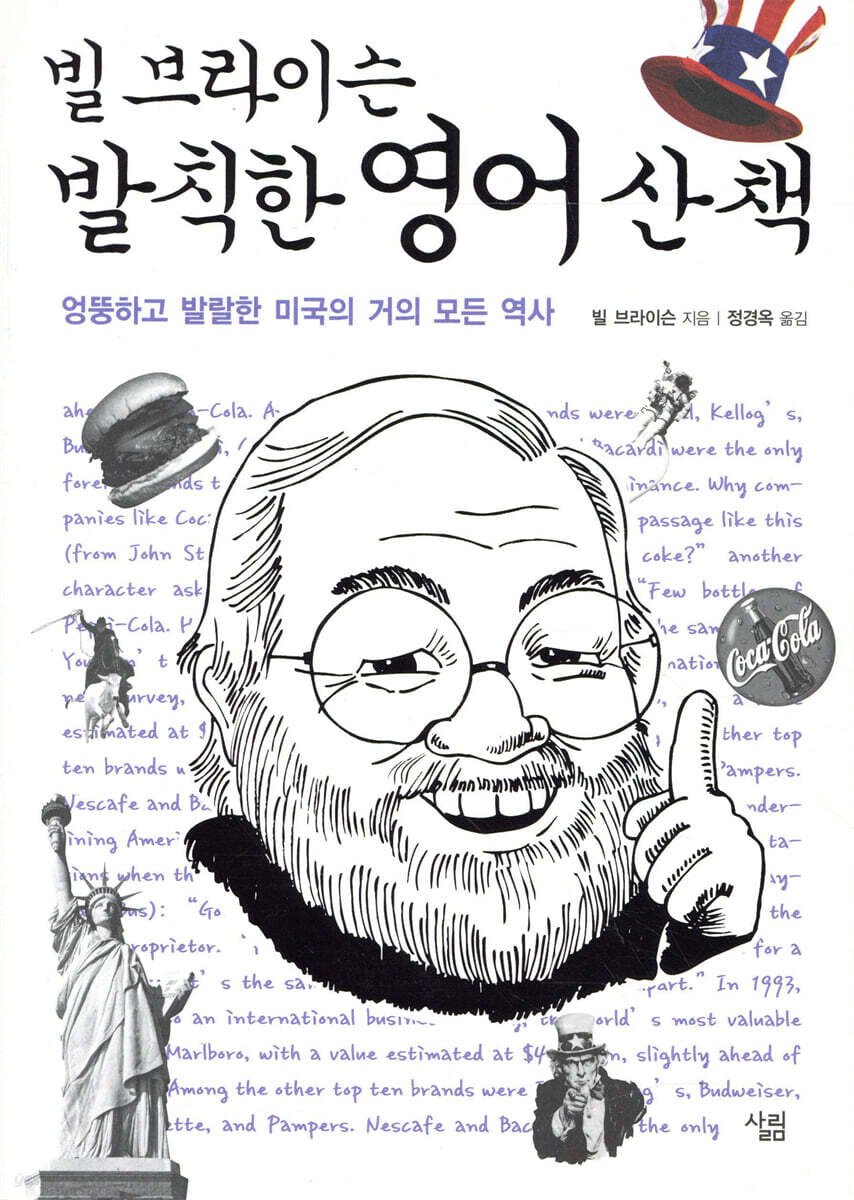 |
Description
Book Introduction
A humorous American pioneering story surrounding English
Bill Bryson has been recognized as one of the most humorous writers alive, with his unique wit and witty banter.
This time, we'll explore the history of the United States surrounding the English language.
"Bill Bryson's Bold English Walks" is the first history book to be introduced in Korea in six years, after his representative work, the science book "A Brief History of Nearly Everything," which had been followed by travel stories and essays. It once again confirms his true colors, as he conveys his extensive knowledge in a pleasant manner.
This book is a serious exploration of American English and a history of almost everything made in America.
This fascinating book explores how the United States, after breaking away from Britain, laid the foundation for a superpower, how the first inventions and ideas transformed human life, and the impact of encountering new cultures on the planet, unfolding over nearly 1,000 years of American history.
Historical facts that even Americans are mistaken about, the origins of English expressions that the general public is unaware of, and stories like jewels buried in the back alleys of history make us realize once again what joy reading is.
Bill Bryson has been recognized as one of the most humorous writers alive, with his unique wit and witty banter.
This time, we'll explore the history of the United States surrounding the English language.
"Bill Bryson's Bold English Walks" is the first history book to be introduced in Korea in six years, after his representative work, the science book "A Brief History of Nearly Everything," which had been followed by travel stories and essays. It once again confirms his true colors, as he conveys his extensive knowledge in a pleasant manner.
This book is a serious exploration of American English and a history of almost everything made in America.
This fascinating book explores how the United States, after breaking away from Britain, laid the foundation for a superpower, how the first inventions and ideas transformed human life, and the impact of encountering new cultures on the planet, unfolding over nearly 1,000 years of American history.
Historical facts that even Americans are mistaken about, the origins of English expressions that the general public is unaware of, and stories like jewels buried in the back alleys of history make us realize once again what joy reading is.
- You can preview some of the book's contents.
Preview
index
preface
Chapter 1: The Arrival of the Mayflower and the History Before It
Chapter 2: Becoming an American
Chapter 3: "The Desire for Democracy" - America in the Revolutionary Era
Chapter 4: Establishment of the State
Chapter 5: Dawn Breaks - The Making of an American Identity
Chapter 6: America on a Pile of Money - The Age of Invention
Chapter 7: Strange Place Names Created by Odd Ideas
Chapter 8: The Westward Expansion: A Clear Mission
Chapter 9: The Melting Pot of Race - American Immigration
Chapter 10: The Good Times of Leaving: A Trip to America
Chapter 11: What to Eat? - American Food
Chapter 12: Popularized Luxury: American Shopping Culture
Chapter 13: Etiquette and Other Matters
Chapter 14: The Age of Advertising Arrives
Chapter 15: The Golden Egg Industry: The Invasion of Film
Chapter 16: America's Pleasures in Sports and Play
Chapter 17: The Emergence of New Words Created by Politics and War
Chapter 18: Sex and Other Pleasures
Chapter 19: From Kitty Hawk to Jumbo Jets: The Sky Opens
Chapter 20: The Dawn of the Space Age
Chapter 21: American English Today
Translator's Note
Americas
Search
Chapter 1: The Arrival of the Mayflower and the History Before It
Chapter 2: Becoming an American
Chapter 3: "The Desire for Democracy" - America in the Revolutionary Era
Chapter 4: Establishment of the State
Chapter 5: Dawn Breaks - The Making of an American Identity
Chapter 6: America on a Pile of Money - The Age of Invention
Chapter 7: Strange Place Names Created by Odd Ideas
Chapter 8: The Westward Expansion: A Clear Mission
Chapter 9: The Melting Pot of Race - American Immigration
Chapter 10: The Good Times of Leaving: A Trip to America
Chapter 11: What to Eat? - American Food
Chapter 12: Popularized Luxury: American Shopping Culture
Chapter 13: Etiquette and Other Matters
Chapter 14: The Age of Advertising Arrives
Chapter 15: The Golden Egg Industry: The Invasion of Film
Chapter 16: America's Pleasures in Sports and Play
Chapter 17: The Emergence of New Words Created by Politics and War
Chapter 18: Sex and Other Pleasures
Chapter 19: From Kitty Hawk to Jumbo Jets: The Sky Opens
Chapter 20: The Dawn of the Space Age
Chapter 21: American English Today
Translator's Note
Americas
Search
Into the book
Amerigo Vespucci, who blew his nose without lifting a finger
When it comes to the immortality of language, no one has blown their nose as much as the Italian-born businessman Amerigo Vespucci, who is known only for his name.
Even if coincidence and error were involved, how could two continents bear his name? In 1504-1505, a collection of letters written by an anonymous author, titled "The New World," began circulating in Florence. It stated that Amerigo Vespucci was not only the captain of a sailing ship but also the discoverer of the New World.
That wasn't the only mistake.
Professor Martin Waldseemüller of a small university in eastern France, who was working on a revision of Ptolemy's map, came across a letter circulated in the Florentine area during his research and was so impressed by the plausible content of Vespucci's explorations that he gave the New World his name.
--- pp.30~31, from the arrival of the Mayflower and its preceding history
Why Talking About Turkeys Means "To Be Honest"
The expression 'to talk turkey' comes from a famous story, which may or may not be true, about an Indian and a border man.
According to the story, whenever a man of the border cut a hunted animal in half, he would say this:
“You have a horse.
Then I'll have the turkey.
"If you want, I'll have the turkey, and you can have the dung beetle." After a few such incidents, the Indian interrupted the frontiersman and asked him something like this:
“Look, when can I say I’m going to have a turkey?” or something similar.
--- p.128, At Dawn - The Making of American Identity Among the United States
The underrated great speech: Lincoln's Gettysburg Address
As always, Everett's speech was full of literary allusions, flowery flourishes, and obscure historical facts that were out of place for the occasion.
It was around 2 p.m., after two boring and cold hours, that he finally finished his speech to thunderous applause.
It was applause born of relief that the message was finally delivered.
Next in line was President Lincoln.
Even though the atmosphere was such that Lincoln was expected to just give his conclusions, his speech was too short.
The Gettysburg Address consisted of 268 words, two-thirds of which were monosyllabic, and consisted mostly of ten short, direct, and concise sentences.
It only took 2 minutes.
According to attendees, it was over so quickly that official photographers were still checking their cameras by the time the president sat down.
Lincoln thought his speech was a failure.
Many people agreed with his thoughts.
The Chicago Times wrote:
“The foolish, dull, and insipid speech of the man who was to be introduced to foreign intellectuals as the President of the United States stained the cheeks of all the Americans present with shame.” Even the newspapers sympathetic to Lincoln barely reported his speech.
It took a long time for it to be recognized as one of the greatest speeches in history.
--- pp.139~142, from At Dawn - The Making of American Identity
Morse and Edison, who were talented but not morally great.
Morse was fortunate throughout his life to have benefited from people more generous and accomplished than himself.
In Paris, he visited Louis Daguerre and persuaded him to show him his newly invented method of photography.
Then he returned to the US and made a lot of money by taking and selling photos that way.
On that trip to France, he also stole a magnet, an important piece of long-distance communication invented by Louis Breguet, to study in his spare time.
… … Even to put it nicely, Edison’s personality was flawed.
He couldn't ignore his competitors, he stole other people's inventions as his own, and he bullied his assistants badly.
He also did not hesitate to resort to bribery when pushed to the limit, once giving New Jersey legislators $1,000 each in exchange for passing laws that favored his interests.
If it is too much to call him a shameless liar, he could be called a person who treasures the truth.
There is a famous anecdote that cannot be separated from him.
When his assistant asked him how wide the film should be, he bent his thumb and other fingers and said, “This much should be enough.” From then on, the width of movie film was set at 35 millimeters.
As Douglas Collins points out, he probably didn't invent his own film, but rather used a 70mm wide, 15m long Kodak film.
If you cut it in half, you'll naturally end up with a film that's 35 millimeters wide and 30 meters long.
Coincidentally, it is exactly the same size as the film that Edison first invented.
--- pp.161,167~169, from America Sitting on a Pile of Money - The Age of Invention
Was Neil Armstrong's famous words as he took his first steps on the moon wrong?
Neil Armstrong said this when he first set foot on the moon.
Armstrong spoke solemnly, with millions watching.
“One small step for man, one giant leap for mankind.” These words were printed in thousands of headlines the next day, but everyone was so absorbed in Armstrong’s success that no one seemed to notice the repetition of the synonym.
According to historian Richard Hanser, Armstrong was surprised and disappointed when he returned to Earth to find that his words had been misquoted in many places.
What he said was, “That’s one small step for a man, one giant leap for mankind.”
The indefinite article was omitted during the transmission process.
When it comes to the immortality of language, no one has blown their nose as much as the Italian-born businessman Amerigo Vespucci, who is known only for his name.
Even if coincidence and error were involved, how could two continents bear his name? In 1504-1505, a collection of letters written by an anonymous author, titled "The New World," began circulating in Florence. It stated that Amerigo Vespucci was not only the captain of a sailing ship but also the discoverer of the New World.
That wasn't the only mistake.
Professor Martin Waldseemüller of a small university in eastern France, who was working on a revision of Ptolemy's map, came across a letter circulated in the Florentine area during his research and was so impressed by the plausible content of Vespucci's explorations that he gave the New World his name.
--- pp.30~31, from the arrival of the Mayflower and its preceding history
Why Talking About Turkeys Means "To Be Honest"
The expression 'to talk turkey' comes from a famous story, which may or may not be true, about an Indian and a border man.
According to the story, whenever a man of the border cut a hunted animal in half, he would say this:
“You have a horse.
Then I'll have the turkey.
"If you want, I'll have the turkey, and you can have the dung beetle." After a few such incidents, the Indian interrupted the frontiersman and asked him something like this:
“Look, when can I say I’m going to have a turkey?” or something similar.
--- p.128, At Dawn - The Making of American Identity Among the United States
The underrated great speech: Lincoln's Gettysburg Address
As always, Everett's speech was full of literary allusions, flowery flourishes, and obscure historical facts that were out of place for the occasion.
It was around 2 p.m., after two boring and cold hours, that he finally finished his speech to thunderous applause.
It was applause born of relief that the message was finally delivered.
Next in line was President Lincoln.
Even though the atmosphere was such that Lincoln was expected to just give his conclusions, his speech was too short.
The Gettysburg Address consisted of 268 words, two-thirds of which were monosyllabic, and consisted mostly of ten short, direct, and concise sentences.
It only took 2 minutes.
According to attendees, it was over so quickly that official photographers were still checking their cameras by the time the president sat down.
Lincoln thought his speech was a failure.
Many people agreed with his thoughts.
The Chicago Times wrote:
“The foolish, dull, and insipid speech of the man who was to be introduced to foreign intellectuals as the President of the United States stained the cheeks of all the Americans present with shame.” Even the newspapers sympathetic to Lincoln barely reported his speech.
It took a long time for it to be recognized as one of the greatest speeches in history.
--- pp.139~142, from At Dawn - The Making of American Identity
Morse and Edison, who were talented but not morally great.
Morse was fortunate throughout his life to have benefited from people more generous and accomplished than himself.
In Paris, he visited Louis Daguerre and persuaded him to show him his newly invented method of photography.
Then he returned to the US and made a lot of money by taking and selling photos that way.
On that trip to France, he also stole a magnet, an important piece of long-distance communication invented by Louis Breguet, to study in his spare time.
… … Even to put it nicely, Edison’s personality was flawed.
He couldn't ignore his competitors, he stole other people's inventions as his own, and he bullied his assistants badly.
He also did not hesitate to resort to bribery when pushed to the limit, once giving New Jersey legislators $1,000 each in exchange for passing laws that favored his interests.
If it is too much to call him a shameless liar, he could be called a person who treasures the truth.
There is a famous anecdote that cannot be separated from him.
When his assistant asked him how wide the film should be, he bent his thumb and other fingers and said, “This much should be enough.” From then on, the width of movie film was set at 35 millimeters.
As Douglas Collins points out, he probably didn't invent his own film, but rather used a 70mm wide, 15m long Kodak film.
If you cut it in half, you'll naturally end up with a film that's 35 millimeters wide and 30 meters long.
Coincidentally, it is exactly the same size as the film that Edison first invented.
--- pp.161,167~169, from America Sitting on a Pile of Money - The Age of Invention
Was Neil Armstrong's famous words as he took his first steps on the moon wrong?
Neil Armstrong said this when he first set foot on the moon.
Armstrong spoke solemnly, with millions watching.
“One small step for man, one giant leap for mankind.” These words were printed in thousands of headlines the next day, but everyone was so absorbed in Armstrong’s success that no one seemed to notice the repetition of the synonym.
According to historian Richard Hanser, Armstrong was surprised and disappointed when he returned to Earth to find that his words had been misquoted in many places.
What he said was, “That’s one small step for a man, one giant leap for mankind.”
The indefinite article was omitted during the transmission process.
--- pp.614~615, from The Beginning of the Space Age
Publisher's Review
Bill Bryson, the humorousest living writer
The second history textbook to be introduced in Korea after 『A Brief History of Nearly Everything』!
Bill Bryson's true colors as a cheerful knowledge transmitter, not just as a travel writer, are fully revealed.
A humorous American history, encompassing history and customs, blends with the history of the English language!
Bestselling author Bill Bryson is back with another amazing book.
Recognized as one of the most humorous living writers with his signature wit and witty banter, this time he explores the history of the United States surrounding the English language.
This book is the first historical textbook to be introduced in Korea in six years, after his representative work, the popular science textbook 『A Brief History of Nearly Everything』, which had been followed by travel stories and essays, and once again confirms his true colors as a writer who conveys his extensive knowledge in a pleasant manner.
How can you possibly tell history in English? Don't worry, it's Bill Bryson! This book is a serious exploration of American English and covers the history of nearly everything created in America.
This fascinating book explores how the United States, after breaking away from Britain, laid the foundation for a superpower, how the first inventions and ideas transformed human life, and the impact of encountering new cultures on the planet, unfolding over nearly 1,000 years of American history.
Historical facts that even Americans are mistaken about, the origins of English expressions that the general public is unaware of, and stories like jewels buried in the back alleys of history make us realize once again what joy reading is.
Columbus, who discovered the New World, and Amerigo Vespucci, who left his name on the American continent, never set foot on what is now the United States, and the Battle of Bunker Hill, known as the first fierce battle between British and American forces, actually took place on Breed's Hill, not Bunker Hill.
Patrick Henry's famous line, "Give me liberty or give me death," is not true, and America declared independence on July 2nd, not July 4th.
The riots on Boston's King Street were dramatized and widely publicized in Paul Lieber's famous print, "The Boston Massacre."
Thomas Jefferson, the author of the Declaration of Independence, known as a great piece of political prose, had to suffer the humiliation of having to delete about a quarter of his original manuscript and add 146 words, and Lincoln's Gettysburg Address, considered one of the greatest speeches in history, was criticized as a "speech that shamed the American people" at the time and was not properly introduced to the press.
Jeans were called Levi's until the 1940s, and many traditional Italian dishes were actually made in the United States.
Bill Bryson also tells interesting stories full of wit and humor, not the dry knowledge we know from textbooks, but in a historical setting, full of excitement like a Western action film.
In this book, we hear stories of people who became famous in history through sheer coincidence and mistake, stories of insignificant events that were packaged as if they were great events in history and used for political propaganda, stories of great people who were not properly evaluated in their time, stories of people who had outstanding talent but were not very morally outstanding, and the origins of expressions we use without knowing much about.
Among them, you can naturally take a walk with the author along the path that American English has taken.
The second history textbook to be introduced in Korea after 『A Brief History of Nearly Everything』!
Bill Bryson's true colors as a cheerful knowledge transmitter, not just as a travel writer, are fully revealed.
A humorous American history, encompassing history and customs, blends with the history of the English language!
Bestselling author Bill Bryson is back with another amazing book.
Recognized as one of the most humorous living writers with his signature wit and witty banter, this time he explores the history of the United States surrounding the English language.
This book is the first historical textbook to be introduced in Korea in six years, after his representative work, the popular science textbook 『A Brief History of Nearly Everything』, which had been followed by travel stories and essays, and once again confirms his true colors as a writer who conveys his extensive knowledge in a pleasant manner.
How can you possibly tell history in English? Don't worry, it's Bill Bryson! This book is a serious exploration of American English and covers the history of nearly everything created in America.
This fascinating book explores how the United States, after breaking away from Britain, laid the foundation for a superpower, how the first inventions and ideas transformed human life, and the impact of encountering new cultures on the planet, unfolding over nearly 1,000 years of American history.
Historical facts that even Americans are mistaken about, the origins of English expressions that the general public is unaware of, and stories like jewels buried in the back alleys of history make us realize once again what joy reading is.
Columbus, who discovered the New World, and Amerigo Vespucci, who left his name on the American continent, never set foot on what is now the United States, and the Battle of Bunker Hill, known as the first fierce battle between British and American forces, actually took place on Breed's Hill, not Bunker Hill.
Patrick Henry's famous line, "Give me liberty or give me death," is not true, and America declared independence on July 2nd, not July 4th.
The riots on Boston's King Street were dramatized and widely publicized in Paul Lieber's famous print, "The Boston Massacre."
Thomas Jefferson, the author of the Declaration of Independence, known as a great piece of political prose, had to suffer the humiliation of having to delete about a quarter of his original manuscript and add 146 words, and Lincoln's Gettysburg Address, considered one of the greatest speeches in history, was criticized as a "speech that shamed the American people" at the time and was not properly introduced to the press.
Jeans were called Levi's until the 1940s, and many traditional Italian dishes were actually made in the United States.
Bill Bryson also tells interesting stories full of wit and humor, not the dry knowledge we know from textbooks, but in a historical setting, full of excitement like a Western action film.
In this book, we hear stories of people who became famous in history through sheer coincidence and mistake, stories of insignificant events that were packaged as if they were great events in history and used for political propaganda, stories of great people who were not properly evaluated in their time, stories of people who had outstanding talent but were not very morally outstanding, and the origins of expressions we use without knowing much about.
Among them, you can naturally take a walk with the author along the path that American English has taken.
GOODS SPECIFICS
- Date of issue: April 27, 2009
- Page count, weight, size: 678 pages | 846g | 152*215*35mm
- ISBN13: 9788952211064
- ISBN10: 8952211065
You may also like
카테고리
korean


korean

![GQ KOREA Mark (Monthly): December [2025]](http://librairie.coreenne.fr/cdn/shop/files/8ef265dbbfbf186523ed75ba7319009d.jpg?v=1765340328&width=3840)


