

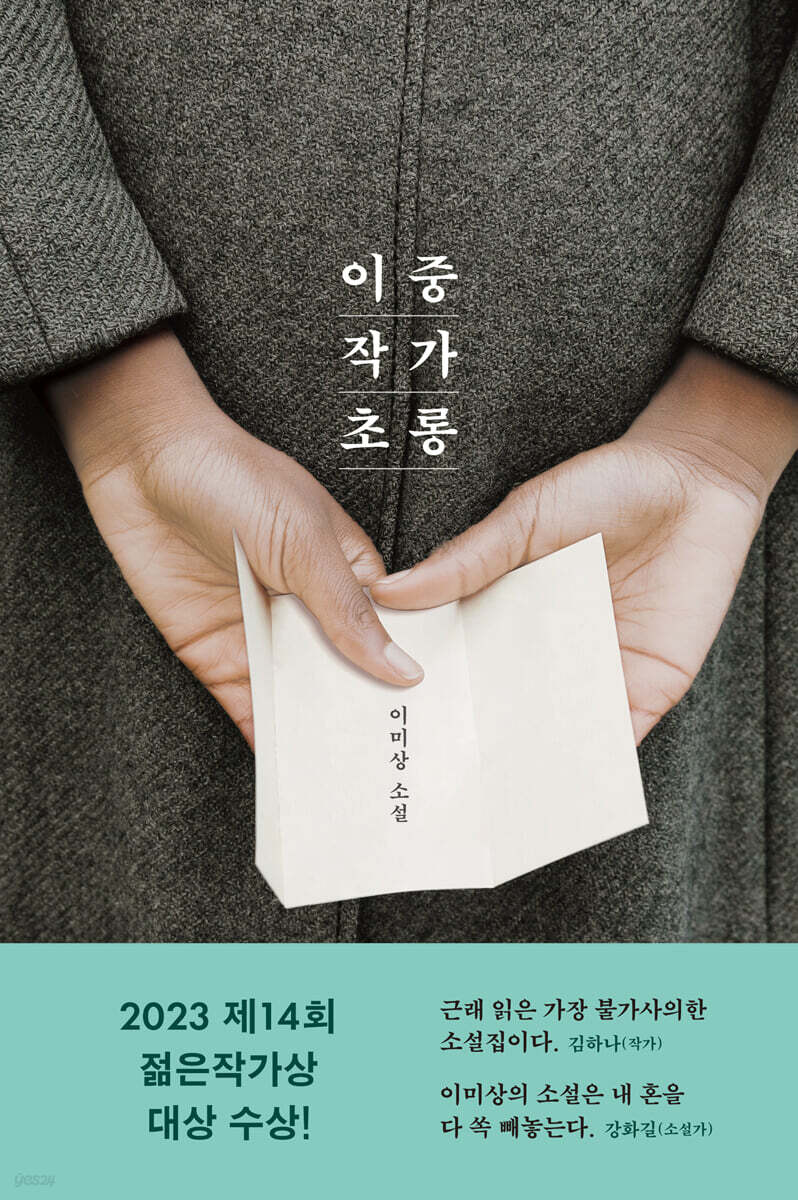
Double writer Chorong
 |
Description
Book Introduction
- A word from MD
-
A collection of novels that keeps making me feel something rising upThe first novel collection by author Im Sang.
It is full of novels that bring everyday problems into literature and leave behind powerful messages.
As befitting a writer known as a 'monster rookie', he doesn't lose his wit while pointing out reality.
A collection of novels that, as I read each one, I feel something inside me being stirred.
December 6, 2022. Novel/Poetry PD Lee Na-young
So that no one's name will be forgotten as 'unknown'
Writing with the aspiration to break down the violence of reality and rewrite it anew
Young Writer Award winner Lee Mi-sang publishes her first novel collection.
In the summer of 2018, a new writer's debut work, "Hagin," was mentioned in the quarterly review of Munhakdongne, a cutting-edge publication where young critics quickly introduce noteworthy short stories each season.
The work, which was evaluated as “a novel with a uniquely problematic nature” (literary critic Han Seol), was selected as the winner of the Young Writer’s Award the following year, receiving praise for containing “anecdotes of a comical nature that are difficult to find among new writers these days” (literary critic Hwang Jong-yeon).
It was an unusual moment for a new writer to win the Young Writer Award for his debut work, following novelist Choi Eun-young's "Shoko's Smile."
The reason there was so much speculation about who the author was, who “wrote such a powerful novel” and “whose work is unknown beyond his debut” (literary critic Kwon Hee-chul), was because there was no information about the winner and because the winning work was not published in a traditional literary magazine or a spring literary contest, but rather submitted to a webzine.
Lee Mi-sang, a writer who is both unfamiliar and welcome, worthy of the title of "new star" who brings a breath of fresh air to the literary world, first made his name known in the Korean literary world.
Since that unusual appearance, Im Sang has attracted attention by publishing short stories that display his unique experimental spirit and cultivate his own sense of problem.
This is evidenced by works such as “When a Woman Rides the Subway,” which was selected as a “Novel of the Season” (Winter 2020) by Munhak-kwa-Jiseongsa, which was praised for portraying the anxiety of female subway passengers “exaggeratedly and humorously, like the scene of a survival game” (literary critic Jo Yeon-jeong); “Double Writer Chorong,” which was selected as a “Novel of the Season” (Winter 2021) and received the comment that “it does not give up humor in the sentences while dealing with heavy questions” (literary critic Jo Yeon-jeong); and “The Adventure of Aunt Morae, Mokgyeong, and Mu-gyeong,” which was selected as both a “Novel of the Season” (Summer 2022) by Jaum and Moeum, and “Novel of the Season” (Summer 2022) and received the comment that “it deconstructs, subverts, and reconstructs the existing narrative about care” (literary critic Ahn Seo-hyun) with a captivating story that monopolizes the grammar of the adventure narrative and horror genre.
The first novel collection of such an imaginary author, 『Double Writer Chorong』, contains eight short stories that boast sharp language, bold form, and plots that catch the reader off guard.
These unique works will provide a thrilling literary reading experience for readers who have been thirsting for new novels.
Writing with the aspiration to break down the violence of reality and rewrite it anew
Young Writer Award winner Lee Mi-sang publishes her first novel collection.
In the summer of 2018, a new writer's debut work, "Hagin," was mentioned in the quarterly review of Munhakdongne, a cutting-edge publication where young critics quickly introduce noteworthy short stories each season.
The work, which was evaluated as “a novel with a uniquely problematic nature” (literary critic Han Seol), was selected as the winner of the Young Writer’s Award the following year, receiving praise for containing “anecdotes of a comical nature that are difficult to find among new writers these days” (literary critic Hwang Jong-yeon).
It was an unusual moment for a new writer to win the Young Writer Award for his debut work, following novelist Choi Eun-young's "Shoko's Smile."
The reason there was so much speculation about who the author was, who “wrote such a powerful novel” and “whose work is unknown beyond his debut” (literary critic Kwon Hee-chul), was because there was no information about the winner and because the winning work was not published in a traditional literary magazine or a spring literary contest, but rather submitted to a webzine.
Lee Mi-sang, a writer who is both unfamiliar and welcome, worthy of the title of "new star" who brings a breath of fresh air to the literary world, first made his name known in the Korean literary world.
Since that unusual appearance, Im Sang has attracted attention by publishing short stories that display his unique experimental spirit and cultivate his own sense of problem.
This is evidenced by works such as “When a Woman Rides the Subway,” which was selected as a “Novel of the Season” (Winter 2020) by Munhak-kwa-Jiseongsa, which was praised for portraying the anxiety of female subway passengers “exaggeratedly and humorously, like the scene of a survival game” (literary critic Jo Yeon-jeong); “Double Writer Chorong,” which was selected as a “Novel of the Season” (Winter 2021) and received the comment that “it does not give up humor in the sentences while dealing with heavy questions” (literary critic Jo Yeon-jeong); and “The Adventure of Aunt Morae, Mokgyeong, and Mu-gyeong,” which was selected as both a “Novel of the Season” (Summer 2022) by Jaum and Moeum, and “Novel of the Season” (Summer 2022) and received the comment that “it deconstructs, subverts, and reconstructs the existing narrative about care” (literary critic Ahn Seo-hyun) with a captivating story that monopolizes the grammar of the adventure narrative and horror genre.
The first novel collection of such an imaginary author, 『Double Writer Chorong』, contains eight short stories that boast sharp language, bold form, and plots that catch the reader off guard.
These unique works will provide a thrilling literary reading experience for readers who have been thirsting for new novels.
- You can preview some of the book's contents.
Preview
index
True _007
That Friend _043
Double Writer Chorong _071
When a woman takes the subway _109
A Night Without Tears _153
Murderers' Grave _181
Walk with your knees together _215
The Adventures of Aunt Sand, Mok-gyeong, and Mu-gyeong _273
Commentary | A Perspective on Revolution _313
Jeon Seung-min (literary critic)
Author's Note _349
That Friend _043
Double Writer Chorong _071
When a woman takes the subway _109
A Night Without Tears _153
Murderers' Grave _181
Walk with your knees together _215
The Adventures of Aunt Sand, Mok-gyeong, and Mu-gyeong _273
Commentary | A Perspective on Revolution _313
Jeon Seung-min (literary critic)
Author's Note _349
Into the book
I liked that saying.
A man who does it is a man who is somewhere between a man who insists on duty and an irresponsible man.
He is not a stubborn man who has to do what he says he will do, nor is he an insincere man who says he will do something but doesn't do it. He is a man who does it in a listless manner with a little bit of energy.
---From "Hagin"
Gyu's imagination stops there.
There's no way she's my wife.
If he were a husband, he would never call himself wife.
Because men in the student movement call their wives ‘that friend.’
Because I love myself for calling my wife that friend.
That friend as a substitute for comrade.
As long as you call it that, you are still young and still a fighter.
---From "That Friend"
In the novel writing class, a certain phrase suddenly became popular.
Sino-Korean words that were not commonly used, such as Bokgi and Odok, became popular, and then everyone used them whenever they wanted.
Evil, was one of those words.
Just as 'retrospection' sounds more plausible than 'review' and 'misreading' sounds more plausible than 'misreading', 'short-sightedness' would have been sufficient, but people insisted on using the expression 'bad' to describe Chorong's novel, and there was the awkward exaggeration of literature that ends up making an 'Ah!' when it should have been an 'Ah', and the unfair sensation it evokes were lingering.
Chorong knew that well, but that didn't mean she could be less hurt.
---From "Double Writer Chorong"
I was shaken from the depths of my heart.
The helplessness of not being able to recognize my side through writing alone, and the bewilderment that the intensity radiating from writing was not a sign of sincerity, made me even more obsessed with the truth, with whether the writing and the writer's heart were one.
---From "Double Writer Chorong"
Sujin draws vertical lines on her face every day.
Starting from the crown of the head, sweep across the forehead, down the bridge of the nose, and down the lips.
Then there is a moment of silence, a somewhat conventional silence.
It's going to be a mess soon anyway.
As expected, Soojin's head is soon split in half.
---From "When a Woman Takes the Subway"
“I survived!”
'I'm alive!'
Sujin and the faces run up the subway stairs in joy.
As Sujin jumps, the faces flap like rabbit ears.
The flaming cross-sections clap and fall in the air, making a clap sound.
Faces bouncing all over the body!
---From "When a Woman Takes the Subway"
Sujin started writing alone again.
On nights when I couldn't write a novel, I tried to at least write in a vocabulary notebook.
Then, I gradually tried not to differentiate between writing novels and writing words, and I realized that only then could I continue.
She called her novels "stacks of paper," tried to bring art down to the everyday, and ultimately tried to erase the very word "down," but she knew that there was a certain sense of entitlement in them, and yet she knew that it was her struggle, a secret struggle.
---From "A Night That Doesn't Tina"
The hard-boiled lady starts running.
A giant sandwich is chasing her.
Sandwich covered in sea moss.
Nothing can hold her back.
She's getting faster and faster.
Become numb.
It becomes cruel.
Become free.
---From "The Murderers' Grave"
Something I can do, but really don't want to do.
Something I don't want to do even if I have to beat myself to death.
It's actually so scary.
Why is it that believing one can do something brings more shame to a person than believing one cannot do something?
A man who does it is a man who is somewhere between a man who insists on duty and an irresponsible man.
He is not a stubborn man who has to do what he says he will do, nor is he an insincere man who says he will do something but doesn't do it. He is a man who does it in a listless manner with a little bit of energy.
---From "Hagin"
Gyu's imagination stops there.
There's no way she's my wife.
If he were a husband, he would never call himself wife.
Because men in the student movement call their wives ‘that friend.’
Because I love myself for calling my wife that friend.
That friend as a substitute for comrade.
As long as you call it that, you are still young and still a fighter.
---From "That Friend"
In the novel writing class, a certain phrase suddenly became popular.
Sino-Korean words that were not commonly used, such as Bokgi and Odok, became popular, and then everyone used them whenever they wanted.
Evil, was one of those words.
Just as 'retrospection' sounds more plausible than 'review' and 'misreading' sounds more plausible than 'misreading', 'short-sightedness' would have been sufficient, but people insisted on using the expression 'bad' to describe Chorong's novel, and there was the awkward exaggeration of literature that ends up making an 'Ah!' when it should have been an 'Ah', and the unfair sensation it evokes were lingering.
Chorong knew that well, but that didn't mean she could be less hurt.
---From "Double Writer Chorong"
I was shaken from the depths of my heart.
The helplessness of not being able to recognize my side through writing alone, and the bewilderment that the intensity radiating from writing was not a sign of sincerity, made me even more obsessed with the truth, with whether the writing and the writer's heart were one.
---From "Double Writer Chorong"
Sujin draws vertical lines on her face every day.
Starting from the crown of the head, sweep across the forehead, down the bridge of the nose, and down the lips.
Then there is a moment of silence, a somewhat conventional silence.
It's going to be a mess soon anyway.
As expected, Soojin's head is soon split in half.
---From "When a Woman Takes the Subway"
“I survived!”
'I'm alive!'
Sujin and the faces run up the subway stairs in joy.
As Sujin jumps, the faces flap like rabbit ears.
The flaming cross-sections clap and fall in the air, making a clap sound.
Faces bouncing all over the body!
---From "When a Woman Takes the Subway"
Sujin started writing alone again.
On nights when I couldn't write a novel, I tried to at least write in a vocabulary notebook.
Then, I gradually tried not to differentiate between writing novels and writing words, and I realized that only then could I continue.
She called her novels "stacks of paper," tried to bring art down to the everyday, and ultimately tried to erase the very word "down," but she knew that there was a certain sense of entitlement in them, and yet she knew that it was her struggle, a secret struggle.
---From "A Night That Doesn't Tina"
The hard-boiled lady starts running.
A giant sandwich is chasing her.
Sandwich covered in sea moss.
Nothing can hold her back.
She's getting faster and faster.
Become numb.
It becomes cruel.
Become free.
---From "The Murderers' Grave"
Something I can do, but really don't want to do.
Something I don't want to do even if I have to beat myself to death.
It's actually so scary.
Why is it that believing one can do something brings more shame to a person than believing one cannot do something?
---From "The Adventures of Aunt Sand, Mokgyeong, and Mu-gyeong"
Publisher's Review
A novel with a sharp humor that criticizes the ills of our society and culture.
"Hagin" and "That Friend," which are the starting points of Im Sang's novels, are a series of works featuring the husband "Kim" and his wife "Gyu," a couple from the 86 generation who devoted themselves to the student movement, and their friend "Ji-gyeong."
In "Hagin," the narrator, Kim, believes that his daughter, Bominarae, is less intellectually capable than his friends' children, and sends her to study abroad in the United States in order to somehow get her into a good university, but encounters an unexpected situation.
In the process, the latent academic elitism and materialism within 'Kim', a member of the student activist generation, the so-called 'educated generation', rise to the surface.
In this way, "Hagin" is a powerful black comedy that makes people laugh by poking fun at the moral fallacies of characters who appear to be upright on the outside.
If "Hagin" is told through the voice of the male speaker "Kim," "That Friend" is told through the voice of the female speaker "Gyu."
'Gyu' finds out that 'Ji-kyung', a member of the group she goes out with her husband, is having an affair with her husband, 'Kim'.
The novel then compellingly unfolds how 'Gyu', as a fellow woman, tries to view and understand 'Ji-gyeong' and her life.
"That Friend" is a novel with a unique epilogue that challenges the existing male-oriented perspective of student movement literature and symbolizes women's solidarity.
The title piece, "Double Writer Chorong," depicts the plight of a prominent novelist, Chorong, who finds herself in trouble when someone distributes a work she wrote during her early days on the Internet without permission.
Although both works dealt with the same female victim of illegal filming, in her debut work she focused entirely on the inner character of the character, while in her practice work she easily reconciled the victim and the perpetrator, leading to criticism from many who found this duplicity unacceptable. As a result, 'Chorong' was instantly branded as a deceptive writer.
However, as winners of writing contests across the country using the name "Chorong" began to appear one after another, "Chorong," who was considered deserving of burial in the literary world, paradoxically began to dominate the literary world as a large number of anonymous writers.
"Dual Writer Chorong" delivers a satirical catharsis in which 'Chorong', who is in danger of not being able to exist under the name of a specific writer, survives by becoming everyone's name.
By doing so, it is a provocative work that criticizes the current cultural climate that attacks only the obscene aspects while ignoring the essence of the incident, and asks what is truly missing when examining the ethics of writing and representation.
"What kind of novel did Chorong write that people even call it evil? "Auntie's Burnt Pearl Sweater," once easily accessible online? Now difficult to read? Far from being evil, it's a conventional novel.
You will probably be disappointed if you read it.
“Even so, the reason the word ‘evil’ came out that day was not because the novel was evil, but because we were intoxicated by the word ‘evil.’” _Page 74
“The hard-boiled lady starts running.
She's getting faster and faster.
Become numb.
It becomes cruel.
“Become free.”
An indispensable feature of Im Sang's novel world is the feminist perspective that permeates the entire work.
"When a Woman Takes the Subway" is a work that exemplifies such characteristics.
In this novel, which experimentally dramatizes the anxiety and fear that 'Soojin' experiences on the subway, the theatrical monologue that 'Soojin' delivers while splitting into Face I and Face II creates a strange sense of unfamiliarity.
When we think about the misogynistic incidents that have occurred in Korean society in places like the subway, that unfamiliarity is actually a realistic fear and sense of anxiety that any woman who has used the subway has felt at least once.
"The Murderers' Grave" is a work whose charm can be fully appreciated when read in conjunction with "When a Woman Takes the Subway."
This novel delivers a unique thrill by blurring the lines between reality and imagination through the premise that notorious murderers from both home and abroad are buried together in a virtual space called the "Murderers' Graveyard."
In particular, the novel's sharp sense of problem is revealed in the scene where the area where those who killed women are buried is divided into the area where those who killed men are buried, and Aileen Wuornos, who is buried in the area where she is considered "insignificant" (p. 188) among them "just because she is a woman" despite being a serial killer, is called out.
The murderers' repeated declaration, "Aim for a better place to rest!" (p. 189), seems to show, with bizarre imagination and satire, that there is a hierarchy and discrimination between the sexes in the way criminals are viewed.
"The Adventures of Aunt Sand, Mokgyeong, and Mu-gyeong" is the author's latest work, which keeps readers on the edge of their seats by showing the thriller aspect and feminist message of the previous two works in a unique plot. It is an adventure narrative in which an aunt takes sisters Mokgyeong and Mu-gyeong on a hunting trip into the mountains, and is a pseudo-mother-daughter narrative that perfectly depicts the solidarity that grows between an aunt and her niece.
This novel is also notable for its frame-structured narrative.
The past narratives of the three people, Gomo, Mok-gyeong, and Mu-gyeong, are ‘inside’, and another story surrounds the ‘outside’ of it.
This is a conversation between the author sisters discussing the artistic technique of the novel, “one room,” that is, “a winding path, using sentences sparingly, and then suddenly bursting with an epiphany” (p. 276).
The mutual influence that occurs as the story of the author sisters, located 'outside', passes through the 'inside' stories of Gomo, Mok-gyeong, and Mu-gyeong, disentangles the hierarchy of the text, which has only one center, and conveys the precious virtue of making us listen to the vivid voices of the characters hidden within the subtle folds of the story.
“Starting with your debut, don’t you think it’s strange that you’re a writer from now on, and that you’re really writing from this point on?”
"Walk with your knees together" is an autobiographical story that partially reflects the author's experience of a pilgrimage to the Holy Land in Europe, which he went on at the urging of his parents to help him overcome puberty, as revealed in an interview included in the special booklet 'New Face Book' of 'Double Writer Chorong'.
The narrator, 'I', is a writer, and through the first-person plural narrator 'we', he revives the stories of teenage characters who display their lively desires between taboo sex and forced sex.
However, at the end of the work, a reader sends a letter of protest, sharply pointing out that female adolescents face greater dangers than male adolescents in an unfamiliar foreign land, and admitting that 'I' had ignored that difference, attaches the letter as the ending of the novel, thereby elevating the anonymous reader to the position of a 'writer' as well.
Including "Walk with Your Knees Together," there are many characters who write novels in Im Sang's novels.
There are characters who become writers, like 'Chorong' in 'Double Writer Chorong', but there are also characters who aspire to be writers, like 'Sujin' in 'A Night That Doesn't Shine'.
Sujin consistently sends her novels to K Publishing, which accepts submissions from unpublished authors, and the editor of K Publishing, Sujin's only reader, sends her a critically serious rejection email.
Just as Soojin devotes her time to writing novels every night, the editor also engages in the intense labor of reading.
What their time spent writing and reading symbolizes is that even if one is not recognized as a writer, if one continues to write, if what one writes reaches someone, the act itself is 'becoming a writer.'
“Starting with your debut, isn’t it strange that from now on you are a writer, and that from this writing onwards you are a real writer?” (Chorong, the Double Writer, pp. 81-82) Chorong’s question seems to offer a hint as it connects with the world of the work “A Night That Doesn’t Smell.”
If we think about the time when ‘studying’ and ‘reading’ were considered rights reserved for a certain class, generation, and gender, it seems that Im Sang’s novel dreams of a “revolution” (p. 73) that will break down the hierarchy of authority and ultimately bring about free liberation.
The will to remember those who, like 'Sujin', write in their own language somewhere, and the hope that they will not disappear into anonymity.
The author's pen name 'Unknown' seems to reflect his intention to be with such people.
We look forward to Im Sang's next novel, which will surprise us with even fresher works.
“If you think of literature as too big and grand, you become afraid of writing.
But the writing doesn't seem to be that scary.
At least for me.
It may be a childish expression, but I still think writing is like a friend to me” _From the author’s note
“All the arts that have led the times were already subversive in their time.
The power of the novel lies precisely in this literary imagination, the power to provoke and challenge readers, to place them in uncomfortable and awkward situations, and to drive them to live in their own time more than anyone else.
It is a revolutionary force.
I close the novel and realize.
This novel is exactly the one I've been waiting for.
I've really been waiting for a novel like this.
“Literature is freedom.” _ Jeon Seung-min (literary critic), commentary
Lastly, let's point out that the unusual titles characteristic of Im Sang novels provide food for thought by connecting them to the worldview of each work.
The word "그친구" ("그친구"), which is written by combining "그" and "친구," allows us to look into the other side of the way activist men address their wives, and the coined word "지하철하다" ("When a woman takes the subway"), which combines the object "subway" with the verb "하다," also makes us sense the anxiety and struggles of women in that place.
The title, which seems to question the relationship between the three characters by creating a strange rhythm like 'The Adventures of Aunt Sand, Mok-gyeong, and Mu-gyeong', is also unique.
The titles of Im Sang's novels, which remind us that novels are a branch of language art through their unique linguistic formats and, above all, hint at the novel's problematic awareness through them, truly foreshadow the birth of the adjective "Im Sang-sang."
"Hagin" and "That Friend," which are the starting points of Im Sang's novels, are a series of works featuring the husband "Kim" and his wife "Gyu," a couple from the 86 generation who devoted themselves to the student movement, and their friend "Ji-gyeong."
In "Hagin," the narrator, Kim, believes that his daughter, Bominarae, is less intellectually capable than his friends' children, and sends her to study abroad in the United States in order to somehow get her into a good university, but encounters an unexpected situation.
In the process, the latent academic elitism and materialism within 'Kim', a member of the student activist generation, the so-called 'educated generation', rise to the surface.
In this way, "Hagin" is a powerful black comedy that makes people laugh by poking fun at the moral fallacies of characters who appear to be upright on the outside.
If "Hagin" is told through the voice of the male speaker "Kim," "That Friend" is told through the voice of the female speaker "Gyu."
'Gyu' finds out that 'Ji-kyung', a member of the group she goes out with her husband, is having an affair with her husband, 'Kim'.
The novel then compellingly unfolds how 'Gyu', as a fellow woman, tries to view and understand 'Ji-gyeong' and her life.
"That Friend" is a novel with a unique epilogue that challenges the existing male-oriented perspective of student movement literature and symbolizes women's solidarity.
The title piece, "Double Writer Chorong," depicts the plight of a prominent novelist, Chorong, who finds herself in trouble when someone distributes a work she wrote during her early days on the Internet without permission.
Although both works dealt with the same female victim of illegal filming, in her debut work she focused entirely on the inner character of the character, while in her practice work she easily reconciled the victim and the perpetrator, leading to criticism from many who found this duplicity unacceptable. As a result, 'Chorong' was instantly branded as a deceptive writer.
However, as winners of writing contests across the country using the name "Chorong" began to appear one after another, "Chorong," who was considered deserving of burial in the literary world, paradoxically began to dominate the literary world as a large number of anonymous writers.
"Dual Writer Chorong" delivers a satirical catharsis in which 'Chorong', who is in danger of not being able to exist under the name of a specific writer, survives by becoming everyone's name.
By doing so, it is a provocative work that criticizes the current cultural climate that attacks only the obscene aspects while ignoring the essence of the incident, and asks what is truly missing when examining the ethics of writing and representation.
"What kind of novel did Chorong write that people even call it evil? "Auntie's Burnt Pearl Sweater," once easily accessible online? Now difficult to read? Far from being evil, it's a conventional novel.
You will probably be disappointed if you read it.
“Even so, the reason the word ‘evil’ came out that day was not because the novel was evil, but because we were intoxicated by the word ‘evil.’” _Page 74
“The hard-boiled lady starts running.
She's getting faster and faster.
Become numb.
It becomes cruel.
“Become free.”
An indispensable feature of Im Sang's novel world is the feminist perspective that permeates the entire work.
"When a Woman Takes the Subway" is a work that exemplifies such characteristics.
In this novel, which experimentally dramatizes the anxiety and fear that 'Soojin' experiences on the subway, the theatrical monologue that 'Soojin' delivers while splitting into Face I and Face II creates a strange sense of unfamiliarity.
When we think about the misogynistic incidents that have occurred in Korean society in places like the subway, that unfamiliarity is actually a realistic fear and sense of anxiety that any woman who has used the subway has felt at least once.
"The Murderers' Grave" is a work whose charm can be fully appreciated when read in conjunction with "When a Woman Takes the Subway."
This novel delivers a unique thrill by blurring the lines between reality and imagination through the premise that notorious murderers from both home and abroad are buried together in a virtual space called the "Murderers' Graveyard."
In particular, the novel's sharp sense of problem is revealed in the scene where the area where those who killed women are buried is divided into the area where those who killed men are buried, and Aileen Wuornos, who is buried in the area where she is considered "insignificant" (p. 188) among them "just because she is a woman" despite being a serial killer, is called out.
The murderers' repeated declaration, "Aim for a better place to rest!" (p. 189), seems to show, with bizarre imagination and satire, that there is a hierarchy and discrimination between the sexes in the way criminals are viewed.
"The Adventures of Aunt Sand, Mokgyeong, and Mu-gyeong" is the author's latest work, which keeps readers on the edge of their seats by showing the thriller aspect and feminist message of the previous two works in a unique plot. It is an adventure narrative in which an aunt takes sisters Mokgyeong and Mu-gyeong on a hunting trip into the mountains, and is a pseudo-mother-daughter narrative that perfectly depicts the solidarity that grows between an aunt and her niece.
This novel is also notable for its frame-structured narrative.
The past narratives of the three people, Gomo, Mok-gyeong, and Mu-gyeong, are ‘inside’, and another story surrounds the ‘outside’ of it.
This is a conversation between the author sisters discussing the artistic technique of the novel, “one room,” that is, “a winding path, using sentences sparingly, and then suddenly bursting with an epiphany” (p. 276).
The mutual influence that occurs as the story of the author sisters, located 'outside', passes through the 'inside' stories of Gomo, Mok-gyeong, and Mu-gyeong, disentangles the hierarchy of the text, which has only one center, and conveys the precious virtue of making us listen to the vivid voices of the characters hidden within the subtle folds of the story.
“Starting with your debut, don’t you think it’s strange that you’re a writer from now on, and that you’re really writing from this point on?”
"Walk with your knees together" is an autobiographical story that partially reflects the author's experience of a pilgrimage to the Holy Land in Europe, which he went on at the urging of his parents to help him overcome puberty, as revealed in an interview included in the special booklet 'New Face Book' of 'Double Writer Chorong'.
The narrator, 'I', is a writer, and through the first-person plural narrator 'we', he revives the stories of teenage characters who display their lively desires between taboo sex and forced sex.
However, at the end of the work, a reader sends a letter of protest, sharply pointing out that female adolescents face greater dangers than male adolescents in an unfamiliar foreign land, and admitting that 'I' had ignored that difference, attaches the letter as the ending of the novel, thereby elevating the anonymous reader to the position of a 'writer' as well.
Including "Walk with Your Knees Together," there are many characters who write novels in Im Sang's novels.
There are characters who become writers, like 'Chorong' in 'Double Writer Chorong', but there are also characters who aspire to be writers, like 'Sujin' in 'A Night That Doesn't Shine'.
Sujin consistently sends her novels to K Publishing, which accepts submissions from unpublished authors, and the editor of K Publishing, Sujin's only reader, sends her a critically serious rejection email.
Just as Soojin devotes her time to writing novels every night, the editor also engages in the intense labor of reading.
What their time spent writing and reading symbolizes is that even if one is not recognized as a writer, if one continues to write, if what one writes reaches someone, the act itself is 'becoming a writer.'
“Starting with your debut, isn’t it strange that from now on you are a writer, and that from this writing onwards you are a real writer?” (Chorong, the Double Writer, pp. 81-82) Chorong’s question seems to offer a hint as it connects with the world of the work “A Night That Doesn’t Smell.”
If we think about the time when ‘studying’ and ‘reading’ were considered rights reserved for a certain class, generation, and gender, it seems that Im Sang’s novel dreams of a “revolution” (p. 73) that will break down the hierarchy of authority and ultimately bring about free liberation.
The will to remember those who, like 'Sujin', write in their own language somewhere, and the hope that they will not disappear into anonymity.
The author's pen name 'Unknown' seems to reflect his intention to be with such people.
We look forward to Im Sang's next novel, which will surprise us with even fresher works.
“If you think of literature as too big and grand, you become afraid of writing.
But the writing doesn't seem to be that scary.
At least for me.
It may be a childish expression, but I still think writing is like a friend to me” _From the author’s note
“All the arts that have led the times were already subversive in their time.
The power of the novel lies precisely in this literary imagination, the power to provoke and challenge readers, to place them in uncomfortable and awkward situations, and to drive them to live in their own time more than anyone else.
It is a revolutionary force.
I close the novel and realize.
This novel is exactly the one I've been waiting for.
I've really been waiting for a novel like this.
“Literature is freedom.” _ Jeon Seung-min (literary critic), commentary
Lastly, let's point out that the unusual titles characteristic of Im Sang novels provide food for thought by connecting them to the worldview of each work.
The word "그친구" ("그친구"), which is written by combining "그" and "친구," allows us to look into the other side of the way activist men address their wives, and the coined word "지하철하다" ("When a woman takes the subway"), which combines the object "subway" with the verb "하다," also makes us sense the anxiety and struggles of women in that place.
The title, which seems to question the relationship between the three characters by creating a strange rhythm like 'The Adventures of Aunt Sand, Mok-gyeong, and Mu-gyeong', is also unique.
The titles of Im Sang's novels, which remind us that novels are a branch of language art through their unique linguistic formats and, above all, hint at the novel's problematic awareness through them, truly foreshadow the birth of the adjective "Im Sang-sang."
GOODS SPECIFICS
- Publication date: November 8, 2022
- Page count, weight, size: 356 pages | 420g | 133*200*30mm
- ISBN13: 9788954699006
- ISBN10: 8954699006
You may also like
카테고리
korean


korean

![GQ KOREA Mark (Monthly): December [2025]](http://librairie.coreenne.fr/cdn/shop/files/8ef265dbbfbf186523ed75ba7319009d.jpg?v=1765340328&width=3840)


