

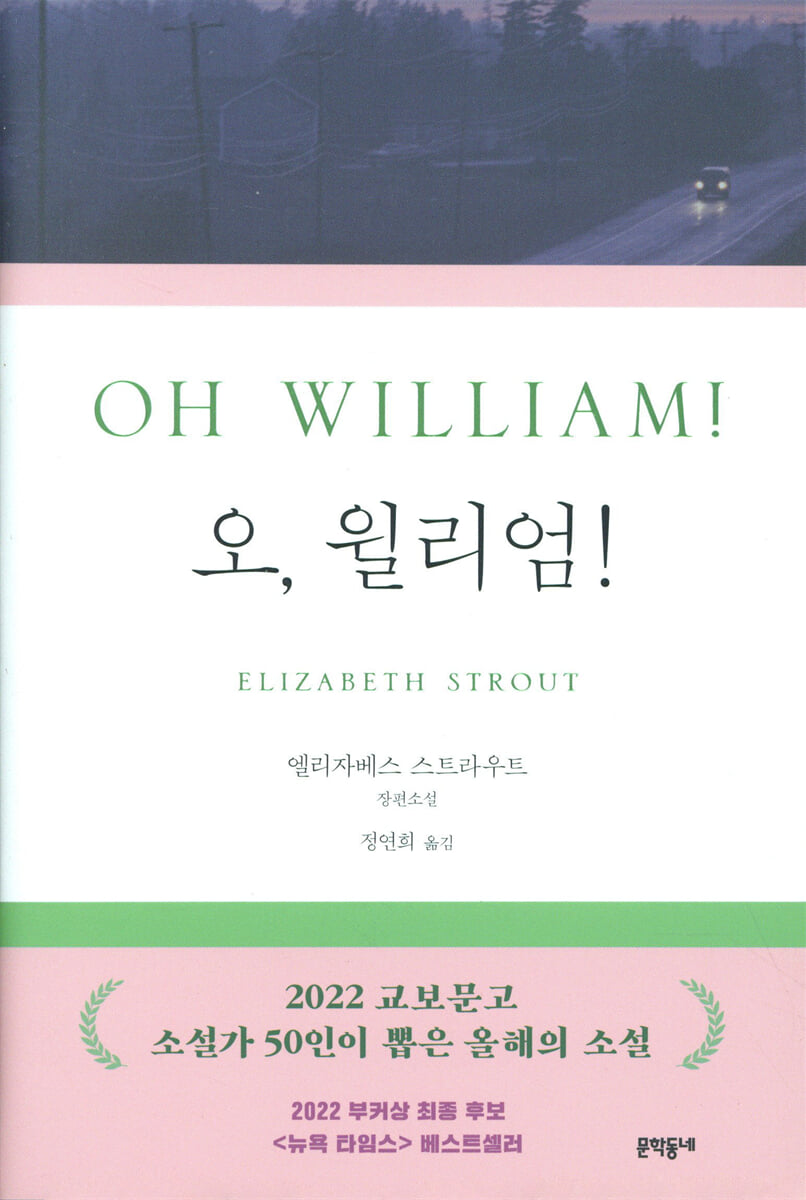
Oh, William!
 |
Description
Book Introduction
No writer writes about the human mind like Strout.
Written with meticulous observation, this work is full of deep psychological insights.
Lucy Barton is an immortal character in literary history.
Easily broken, damaged, disheveled, and hurt, she is, above all, an ordinary person just like us all.
_Reasons for being nominated for the Booker Prize
Elizabeth Strout's 2016 novel, My Name is Lucy Barton, which was shortlisted for the Man Booker Prize, left a strong impression on readers by introducing the character of Lucy Barton, who became a novelist despite her memories of extreme poverty and alienation from her childhood.
Through this short but weighty story of over two hundred pages depicting Lucy's five days in the hospital with her mother, Lucy Barton has established herself as the author's signature character, following in the footsteps of Olive Kitteridge.
"Oh, William!" (2021), the second novel written with Lucy Barton as its narrator, depicts the complex and delicate relationship between Lucy and William, once Lucy's husband and now her longtime friend, with excellent storytelling and calm yet thoughtful language.
The work received rave reviews from readers and critics alike, and was shortlisted for the 2022 Booker Prize, with one commenting, “Lucy Barton is an immortal character in literary history.”
What interests me about people is the ambiguity of the emotions that move us, the inner realms we may not even fully know ourselves.
You may not be Lucy or William, but I hope these characters can touch your heart, and that their stories can lift the ceiling of your closed world—even just a little.
Elizabeth Strout
Since publishing her first novel, Amy and Isabel, in 1998, novelist Elizabeth Strout's world has been constantly expanding.
And for Strout, the world is people, so the expansion of the world is achieved through people.
In all his novels, humanity is an insoluble mystery, a source of endless wonder, and therefore a realm to be constantly explored.
The fact that most of the author's works depict diverse human figures rather than focusing on a single character or narrative, and the fact that people's names frequently appear in the titles of works such as "Olive Kitteridge" and its sequel "Olive Again," as well as "Amy and Isabel," "The Burgess Brothers," and "My Name is Lucy Barton" are not unrelated to this context.
The author's eighth novel, "Oh, William!", explores love and loss, memory and trauma, and family secrets. It is Stroutian in every way, yet it also demonstrates a new level of insight from an already accomplished author, using a more concise and refined language to penetrate the profound realms of human nature and life.
Written with meticulous observation, this work is full of deep psychological insights.
Lucy Barton is an immortal character in literary history.
Easily broken, damaged, disheveled, and hurt, she is, above all, an ordinary person just like us all.
_Reasons for being nominated for the Booker Prize
Elizabeth Strout's 2016 novel, My Name is Lucy Barton, which was shortlisted for the Man Booker Prize, left a strong impression on readers by introducing the character of Lucy Barton, who became a novelist despite her memories of extreme poverty and alienation from her childhood.
Through this short but weighty story of over two hundred pages depicting Lucy's five days in the hospital with her mother, Lucy Barton has established herself as the author's signature character, following in the footsteps of Olive Kitteridge.
"Oh, William!" (2021), the second novel written with Lucy Barton as its narrator, depicts the complex and delicate relationship between Lucy and William, once Lucy's husband and now her longtime friend, with excellent storytelling and calm yet thoughtful language.
The work received rave reviews from readers and critics alike, and was shortlisted for the 2022 Booker Prize, with one commenting, “Lucy Barton is an immortal character in literary history.”
What interests me about people is the ambiguity of the emotions that move us, the inner realms we may not even fully know ourselves.
You may not be Lucy or William, but I hope these characters can touch your heart, and that their stories can lift the ceiling of your closed world—even just a little.
Elizabeth Strout
Since publishing her first novel, Amy and Isabel, in 1998, novelist Elizabeth Strout's world has been constantly expanding.
And for Strout, the world is people, so the expansion of the world is achieved through people.
In all his novels, humanity is an insoluble mystery, a source of endless wonder, and therefore a realm to be constantly explored.
The fact that most of the author's works depict diverse human figures rather than focusing on a single character or narrative, and the fact that people's names frequently appear in the titles of works such as "Olive Kitteridge" and its sequel "Olive Again," as well as "Amy and Isabel," "The Burgess Brothers," and "My Name is Lucy Barton" are not unrelated to this context.
The author's eighth novel, "Oh, William!", explores love and loss, memory and trauma, and family secrets. It is Stroutian in every way, yet it also demonstrates a new level of insight from an already accomplished author, using a more concise and refined language to penetrate the profound realms of human nature and life.
- You can preview some of the book's contents.
Preview
index
Oh, William! · 009
Acknowledgments · 299
Translator's Note: We Don't Know Others' Experiences · 301
Acknowledgments · 299
Translator's Note: We Don't Know Others' Experiences · 301
Into the book
Grief is like sliding down the long outer wall of a very tall glass building and no one is watching you.
--- p.9
I never fully understood the issue of class in America.
That's because I come from the bottom, and when you're born that way, that fact never truly leaves you.
That means I never really got over it, my origins, my poverty, that's what I'm trying to say.
--- p.54
The tulip stem snapped inside me.
I felt that way.
The tulip was left inside me, broken, never to grow again.
After that, I started writing more truthfully.
--- p.98
I tell myself that my mother loved me.
My mother would have loved me in any way she could.
One day, that lovely female psychiatrist said this:
“Hope never dies.”
--- p.108
People are lonely, that's what I'm trying to say.
Many people cannot talk to people who know what they want to say.
--- p.152
You can't be free while living with feelings of things that no one but you knows the meaning of.
It can't be like that forever.
Intimacy has become so tiresome.
--- p.177
“I think people actually choose something—very rarely, at best.
Otherwise, we're just chasing something—even if we don't know what it is, Lucy.
So, no.
I don't think you chose to leave.”
--- pp.194∼195
That's just the way life goes.
There are many things we don't know until it's too late.
--- p.257
The point is that there is a cultural void that never leaves you, but it is not a small dot, but a vast, empty canvas, and that is what makes life so frightening.
--- p.280
But we are all myths, and mysterious.
We are all a mystery, that's what I'm trying to say.
Perhaps this is the only thing I know to be true in this world.
--- p.9
I never fully understood the issue of class in America.
That's because I come from the bottom, and when you're born that way, that fact never truly leaves you.
That means I never really got over it, my origins, my poverty, that's what I'm trying to say.
--- p.54
The tulip stem snapped inside me.
I felt that way.
The tulip was left inside me, broken, never to grow again.
After that, I started writing more truthfully.
--- p.98
I tell myself that my mother loved me.
My mother would have loved me in any way she could.
One day, that lovely female psychiatrist said this:
“Hope never dies.”
--- p.108
People are lonely, that's what I'm trying to say.
Many people cannot talk to people who know what they want to say.
--- p.152
You can't be free while living with feelings of things that no one but you knows the meaning of.
It can't be like that forever.
Intimacy has become so tiresome.
--- p.177
“I think people actually choose something—very rarely, at best.
Otherwise, we're just chasing something—even if we don't know what it is, Lucy.
So, no.
I don't think you chose to leave.”
--- pp.194∼195
That's just the way life goes.
There are many things we don't know until it's too late.
--- p.257
The point is that there is a cultural void that never leaves you, but it is not a small dot, but a vast, empty canvas, and that is what makes life so frightening.
--- p.280
But we are all myths, and mysterious.
We are all a mystery, that's what I'm trying to say.
Perhaps this is the only thing I know to be true in this world.
--- p.298
Publisher's Review
Is this my eternal mystery?
This is a story about my first husband, William, and about him and me.
The novel, which begins with the declaration, “I want to say a few things about my first husband, William,” takes the form of the narrator, Lucy, reminiscing about a series of events that have happened to her ex-husband, William, over the past two years.
At the beginning of the flashback, William is sixty-nine years old, living with his third wife, who is twenty-two years his junior, and is still a man of good health and a confident attitude that “almost nothing can harm me.”
Even after their twenty-year marriage ended and they separated, Lucy and William remained close friends, and although Lucy found comfort and happiness in her marriage to her second husband, David, she still considers the house she built with William the only home she ever had.
Then one day, William confides in Lucy an unexpected worry.
Lately, I've been having trouble sleeping because I've been having nightmare-like thoughts in the middle of the night.
And that nightmare is related to his mother, who passed away a long time ago, and his father, who came to the United States as a German prisoner of war during World War II.
As Lucy listens to William's concerns, she recalls memories of her mother-in-law, Catherine, who had treated her with great affection while she was alive, but who sometimes made strangely hurtful remarks about Lucy's poor background.
And when William discovers shocking truths about his mother's younger years and her life before meeting his father on a website that allows people to trace their family and ancestors, Catherine returns to William and Lucy's lives not as a mere memory but as a distinct entity.
And William decides to go to Maine, his mother's hometown, to find out more about her past and what she left behind long ago, and asks Lucy to accompany him.
On this journey, Lucy reflects on her childhood, her marriage to William, her relationship with her daughters, and the aftermath of her second husband's death, confronting not only the truth about Catherine, but also the truth about William, who has been a perennial mystery to her, and ultimately, the truth about herself.
Left between hesitant sentences
The void of loss and deprivation, and sealed memories
Strictly speaking, "Oh, William!" is the third work in which Lucy appears, as the short story "Little Brother" from the 2017 collection of short stories "Anything Is Possible" deals with the story of Lucy's older brother, Pete Barton, who welcomes his little brother back to his hometown after a long time.
However, considering the central character, point of view, and narrative style that drive the novel, the actual sequel to My Name is Lucy Barton should be considered Oh, William!
In particular, as in My Name is Lucy Barton, the language Strout uses in this work, which unfolds from beginning to end from the first-person point of view of the narrator, Lucy Barton, is particularly full of omissions and gaps.
Whether it's an inner monologue or a conversation with someone, speech is constantly interrupted or disjointed without ever reaching a conclusion.
Or, it is replaced by a single sound, as in a direct negative expression or exclamation, such as “Oh, I can’t say more now.”
The author does not use abstract or esoteric language to express the characters' loss and deficiency, or to express emotions or inner voices that are in a realm that cannot be verbalized or that the speaker himself is unaware of.
Instead, it leaves a gap between the speaker's failure of language and the limits of understanding.
This physical blank space on the page continues the story where language left off.
Additionally, when describing specific facts, he inserts reserved expressions such as “in my opinion,” “in my view,” and “as I remember,” emphasizing that the story is a subjective record that reflects solely the narrator’s perspective.
These hesitant sentences, sentences of questioning and doubt that dominate the entire novel, are directly connected to the theme that 'we cannot ultimately know others', as well as to the issue of free will and choice, which are among the keywords of the novel.
Lucy, who is tormented by memories of the past when she ended her marriage to William and left him, hurting her daughters, William tells her that it is very rare for us to actually 'choose' something, but rather that we simply pursue something without even realizing it.
We simply act in a certain way due to internal systems and tendencies formed through memories, experiences, and the years we have lived.
Lucy, too, has suffered lifelong trauma from the poverty that plagued her childhood and the abusive upbringing of her parents, and feels she “never really got over it, never really got over my origins, never really got over poverty.”
Even Lucy considers herself nonexistent, someone who does not occupy any material space in this world, that is, an invisible person.
And the unexplained fear that still sometimes suddenly comes over her and paralyzes her may stem from the emptiness and lack within her.
I'm amazed that I can love even a little bit? Just like my lovely psychiatrist was amazed.
She said.
“In your situation, Lucy, many people wouldn’t even try.” So what was it within me, what William called joy?
It was a joy.
Who knows why? _Page 274
Through the discontinuous narrative style, the loose narrative structure of Lucy's fragmented memories, and the physical blank spaces on the page, the author successfully visualizes the void within the characters' minds and the essence of human existence formed around that unknown world.
Humans are like confidential documents with important words erased here and there, made up of countless omissions and deletions, sealed memories and silences.
We don't know what we thought we knew, and often we don't even know that we don't know.
In this way, one of the classic devices of literature, the 'unreliable narrator', is extended to a universal human characteristic.
We are all unreliable speakers, both to one another and to ourselves.
Perhaps this is the ultimate limitation and tragedy of humanity that Strout has repeatedly spoken about.
We cannot fully understand those we love most, or even ourselves.
But the fact that we are misunderstood also means that we can come to understand things about ourselves and others we thought we knew so well that we never thought possible.
Just as Lucy, who grew up in a harsh environment devoid of love, was surprised to discover the love and joy that finally took root within herself.
In that sense, we are all texts waiting to be reread with thoughtful eyes.
Between sentences of confusion, disappointment, and sadness, we can sometimes read incredibly splendid joy and comfort.
Just like reading 『Oh, William!』.
This is a story about my first husband, William, and about him and me.
The novel, which begins with the declaration, “I want to say a few things about my first husband, William,” takes the form of the narrator, Lucy, reminiscing about a series of events that have happened to her ex-husband, William, over the past two years.
At the beginning of the flashback, William is sixty-nine years old, living with his third wife, who is twenty-two years his junior, and is still a man of good health and a confident attitude that “almost nothing can harm me.”
Even after their twenty-year marriage ended and they separated, Lucy and William remained close friends, and although Lucy found comfort and happiness in her marriage to her second husband, David, she still considers the house she built with William the only home she ever had.
Then one day, William confides in Lucy an unexpected worry.
Lately, I've been having trouble sleeping because I've been having nightmare-like thoughts in the middle of the night.
And that nightmare is related to his mother, who passed away a long time ago, and his father, who came to the United States as a German prisoner of war during World War II.
As Lucy listens to William's concerns, she recalls memories of her mother-in-law, Catherine, who had treated her with great affection while she was alive, but who sometimes made strangely hurtful remarks about Lucy's poor background.
And when William discovers shocking truths about his mother's younger years and her life before meeting his father on a website that allows people to trace their family and ancestors, Catherine returns to William and Lucy's lives not as a mere memory but as a distinct entity.
And William decides to go to Maine, his mother's hometown, to find out more about her past and what she left behind long ago, and asks Lucy to accompany him.
On this journey, Lucy reflects on her childhood, her marriage to William, her relationship with her daughters, and the aftermath of her second husband's death, confronting not only the truth about Catherine, but also the truth about William, who has been a perennial mystery to her, and ultimately, the truth about herself.
Left between hesitant sentences
The void of loss and deprivation, and sealed memories
Strictly speaking, "Oh, William!" is the third work in which Lucy appears, as the short story "Little Brother" from the 2017 collection of short stories "Anything Is Possible" deals with the story of Lucy's older brother, Pete Barton, who welcomes his little brother back to his hometown after a long time.
However, considering the central character, point of view, and narrative style that drive the novel, the actual sequel to My Name is Lucy Barton should be considered Oh, William!
In particular, as in My Name is Lucy Barton, the language Strout uses in this work, which unfolds from beginning to end from the first-person point of view of the narrator, Lucy Barton, is particularly full of omissions and gaps.
Whether it's an inner monologue or a conversation with someone, speech is constantly interrupted or disjointed without ever reaching a conclusion.
Or, it is replaced by a single sound, as in a direct negative expression or exclamation, such as “Oh, I can’t say more now.”
The author does not use abstract or esoteric language to express the characters' loss and deficiency, or to express emotions or inner voices that are in a realm that cannot be verbalized or that the speaker himself is unaware of.
Instead, it leaves a gap between the speaker's failure of language and the limits of understanding.
This physical blank space on the page continues the story where language left off.
Additionally, when describing specific facts, he inserts reserved expressions such as “in my opinion,” “in my view,” and “as I remember,” emphasizing that the story is a subjective record that reflects solely the narrator’s perspective.
These hesitant sentences, sentences of questioning and doubt that dominate the entire novel, are directly connected to the theme that 'we cannot ultimately know others', as well as to the issue of free will and choice, which are among the keywords of the novel.
Lucy, who is tormented by memories of the past when she ended her marriage to William and left him, hurting her daughters, William tells her that it is very rare for us to actually 'choose' something, but rather that we simply pursue something without even realizing it.
We simply act in a certain way due to internal systems and tendencies formed through memories, experiences, and the years we have lived.
Lucy, too, has suffered lifelong trauma from the poverty that plagued her childhood and the abusive upbringing of her parents, and feels she “never really got over it, never really got over my origins, never really got over poverty.”
Even Lucy considers herself nonexistent, someone who does not occupy any material space in this world, that is, an invisible person.
And the unexplained fear that still sometimes suddenly comes over her and paralyzes her may stem from the emptiness and lack within her.
I'm amazed that I can love even a little bit? Just like my lovely psychiatrist was amazed.
She said.
“In your situation, Lucy, many people wouldn’t even try.” So what was it within me, what William called joy?
It was a joy.
Who knows why? _Page 274
Through the discontinuous narrative style, the loose narrative structure of Lucy's fragmented memories, and the physical blank spaces on the page, the author successfully visualizes the void within the characters' minds and the essence of human existence formed around that unknown world.
Humans are like confidential documents with important words erased here and there, made up of countless omissions and deletions, sealed memories and silences.
We don't know what we thought we knew, and often we don't even know that we don't know.
In this way, one of the classic devices of literature, the 'unreliable narrator', is extended to a universal human characteristic.
We are all unreliable speakers, both to one another and to ourselves.
Perhaps this is the ultimate limitation and tragedy of humanity that Strout has repeatedly spoken about.
We cannot fully understand those we love most, or even ourselves.
But the fact that we are misunderstood also means that we can come to understand things about ourselves and others we thought we knew so well that we never thought possible.
Just as Lucy, who grew up in a harsh environment devoid of love, was surprised to discover the love and joy that finally took root within herself.
In that sense, we are all texts waiting to be reread with thoughtful eyes.
Between sentences of confusion, disappointment, and sadness, we can sometimes read incredibly splendid joy and comfort.
Just like reading 『Oh, William!』.
GOODS SPECIFICS
- Publication date: October 31, 2022
- Format: Hardcover book binding method guide
- Page count, weight, size: 312 pages | 416g | 128*188*21mm
- ISBN13: 9788954689106
- ISBN10: 8954689108
You may also like
카테고리
korean


korean

![GQ KOREA Mark (Monthly): December [2025]](http://librairie.coreenne.fr/cdn/shop/files/8ef265dbbfbf186523ed75ba7319009d.jpg?v=1765340328&width=3840)


