

Modern and Contemporary History in One Page 1
 |
Description
Book Introduction
The person who recommended this book: Seonyeong Jo (ssct@yes24.com)
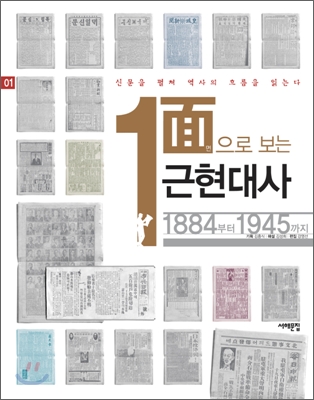
Although the influence of newspapers is said to have declined compared to the past, the feeling of hearing news from home and abroad delivered to your doorstep at dawn still feels special.
Since the publication of the first modern newspaper, 'Hansung Sunbo' in 1883, newspapers have become a major source of information for understanding social phenomena at the time and have also created history in their own right.
So, what did the newspapers our ancestors received on March 1st, the day of liberation, when they shouted “Manse”?
This book allows readers to read history through articles related to major modern historical events, selected from 21 Korean newspapers published domestically and internationally from 1884 to 1945, starting with the first modern newspaper, 'Hansung Sunbo'.
It contains 141 articles, ranging from the 'Crime of the Chinese Soldiers' that led to the first incident of the Korean War, to the Russo-Japanese Treaty, the Manchurian Incident, the Eulsa Treaty, the death of Emperor Gojong, the March 1st Movement, the dropping of the atomic bomb on Hiroshima, and the 'Signing Ceremony of the Pacific War Ending Agreement'.
The book includes reprints of newspaper articles from the time, along with explanations and commentary on the original text, so that today's readers can easily read newspapers from the past.
Additionally, when there are different perspectives on a single incident, multiple newspapers are included together, and the background, development process, and influence of each incident are separately explained.
This book, which stands out for its novel planning, is said to be scheduled to be published in five volumes.
Since the publication of the first modern newspaper, 'Hansung Sunbo' in 1883, newspapers have become a major source of information for understanding social phenomena at the time and have also created history in their own right.
So, what did the newspapers our ancestors received on March 1st, the day of liberation, when they shouted “Manse”?
This book allows readers to read history through articles related to major modern historical events, selected from 21 Korean newspapers published domestically and internationally from 1884 to 1945, starting with the first modern newspaper, 'Hansung Sunbo'.
It contains 141 articles, ranging from the 'Crime of the Chinese Soldiers' that led to the first incident of the Korean War, to the Russo-Japanese Treaty, the Manchurian Incident, the Eulsa Treaty, the death of Emperor Gojong, the March 1st Movement, the dropping of the atomic bomb on Hiroshima, and the 'Signing Ceremony of the Pacific War Ending Agreement'.
The book includes reprints of newspaper articles from the time, along with explanations and commentary on the original text, so that today's readers can easily read newspapers from the past.
Additionally, when there are different perspectives on a single incident, multiple newspapers are included together, and the background, development process, and influence of each incident are separately explained.
This book, which stands out for its novel planning, is said to be scheduled to be published in five volumes.
- You can preview some of the book's contents.
Preview
index
From 1884 to 1910
Hwabyeong crime
The founding of the Independent Newspaper
Emperor Gojong returns to the palace, 1st year of the Russian Legation
Proclamation of the Korean Empire
The People's Assembly opens
Anglo-Japanese Alliance
Russo-Japanese Treaty
Eulsa Treaty_Shijiyabangseongdaegok / Min Yeong-hwan and Jo Byeong-se commit suicide / Emperor Gojong's apology
Establishment of the Residency-General
Launching a national debt redemption movement
The Hague Secret Envoy Incident
Sunjong inherits the throne
New Korea-Japan Agreement
Disband the army
The activities of the volunteer army
Establishment of the Oriental Development Company
An Jung-geun assassinates Ito
Lee Wan-yong's Assassination / Lee Wan-yong's Assassination Plot
Implementation of the military police system
From 1910 to 1930
Japan-Korea Annexation
105-person case verdict
Emperor Gojong's death / Emperor Gojong's poisoning theory
March 1st Movement / March 1st Movement Public Prosecution
Formation of the Provisional Government of the Republic of Korea
The strange bomb dud incident
Armed Forces on the Border / Battle of Bongodong
Yeontongje trial
Rice production increase plan / land improvement project
Uiyoldan and the "Joseon Revolutionary Declaration" / Kim Sang-ok throws a bomb at Jongno Police Station / Na Seok-ju throws a bomb at Dongcheok
Great Kanto Earthquake / Korean Riot Theory
Amtaedo Tenancy Dispute Incident
The great flood of the year of Eulchuk
Shinto shrine visit
The death of Emperor Sunjong and the June 10th Independence Movement
Military funding
The death of Daejeong, the first year of the reign of King Sohwa
Founding of the New Publication Society
Wonsan general strike
Anarchist arrests
Gwangju Student Anti-Japanese Movement / Spread of the Gwangju Student Anti-Japanese Movement
Pyongyang Rubber Factory Strike
From 1931 to 1945
Manchurian Incident
Lee Bong-chang throws a bomb at the emperor
Yun Bong-gil's Hongkou Park Uprising / The Impact of the Hongkou Park Uprising
An Chang-ho's trial / Suyangdan incident
Promoting the compilation of a Korean dictionary
Promulgation of the Joseon Agricultural Land Ordinance
Communist Lee Jae-yu's activities in the National Revolutionary Party
Son Kee-chung wins the Berlin Marathon / Japanese flag erasure incident
Battle of Pochonbo
Sino-Japanese War
Forced relocation of compatriots in Primorsky Krai
The 3rd Joseon Education Ordinance
The first volunteer warrior
National conscription order issued
Change of name
Closure of the Chosun Ilbo and Dong-A Ilbo
Implementation of rice rationing system
Provisional government approval theory
The Pacific War begins
Preparing for conscription / Implementing conscription
Promulgation of the Women's Comfort Women's Service Corps Ordinance
Potsdam Declaration and Soviet Entry into the War
Atomic bomb dropped on Hiroshima
Japan surrenders
Armistice Agreement Signing / From the Beginning to the End of the War / Armistice Agreement Signing Ceremony
Hwabyeong crime
The founding of the Independent Newspaper
Emperor Gojong returns to the palace, 1st year of the Russian Legation
Proclamation of the Korean Empire
The People's Assembly opens
Anglo-Japanese Alliance
Russo-Japanese Treaty
Eulsa Treaty_Shijiyabangseongdaegok / Min Yeong-hwan and Jo Byeong-se commit suicide / Emperor Gojong's apology
Establishment of the Residency-General
Launching a national debt redemption movement
The Hague Secret Envoy Incident
Sunjong inherits the throne
New Korea-Japan Agreement
Disband the army
The activities of the volunteer army
Establishment of the Oriental Development Company
An Jung-geun assassinates Ito
Lee Wan-yong's Assassination / Lee Wan-yong's Assassination Plot
Implementation of the military police system
From 1910 to 1930
Japan-Korea Annexation
105-person case verdict
Emperor Gojong's death / Emperor Gojong's poisoning theory
March 1st Movement / March 1st Movement Public Prosecution
Formation of the Provisional Government of the Republic of Korea
The strange bomb dud incident
Armed Forces on the Border / Battle of Bongodong
Yeontongje trial
Rice production increase plan / land improvement project
Uiyoldan and the "Joseon Revolutionary Declaration" / Kim Sang-ok throws a bomb at Jongno Police Station / Na Seok-ju throws a bomb at Dongcheok
Great Kanto Earthquake / Korean Riot Theory
Amtaedo Tenancy Dispute Incident
The great flood of the year of Eulchuk
Shinto shrine visit
The death of Emperor Sunjong and the June 10th Independence Movement
Military funding
The death of Daejeong, the first year of the reign of King Sohwa
Founding of the New Publication Society
Wonsan general strike
Anarchist arrests
Gwangju Student Anti-Japanese Movement / Spread of the Gwangju Student Anti-Japanese Movement
Pyongyang Rubber Factory Strike
From 1931 to 1945
Manchurian Incident
Lee Bong-chang throws a bomb at the emperor
Yun Bong-gil's Hongkou Park Uprising / The Impact of the Hongkou Park Uprising
An Chang-ho's trial / Suyangdan incident
Promoting the compilation of a Korean dictionary
Promulgation of the Joseon Agricultural Land Ordinance
Communist Lee Jae-yu's activities in the National Revolutionary Party
Son Kee-chung wins the Berlin Marathon / Japanese flag erasure incident
Battle of Pochonbo
Sino-Japanese War
Forced relocation of compatriots in Primorsky Krai
The 3rd Joseon Education Ordinance
The first volunteer warrior
National conscription order issued
Change of name
Closure of the Chosun Ilbo and Dong-A Ilbo
Implementation of rice rationing system
Provisional government approval theory
The Pacific War begins
Preparing for conscription / Implementing conscription
Promulgation of the Women's Comfort Women's Service Corps Ordinance
Potsdam Declaration and Soviet Entry into the War
Atomic bomb dropped on Hiroshima
Japan surrenders
Armistice Agreement Signing / From the Beginning to the End of the War / Armistice Agreement Signing Ceremony
Detailed image
Publisher's Review
How will the newspapers record that day?
The day the first People's Assembly was held, the day Yun Bong-gil threw a lunchbox bomb, the day people cheered for March 1st, the day the conscription system was implemented, the day Japan surrendered...
The first book to weave together the flow of history using only newspaper articles!
This book traces the major events in our modern history through newspaper articles.
There are many books that analyze modern history from various perspectives and methods, but this is the first to weave together the flow of history using only newspaper articles.
This is an example of how our modern and contemporary history was organized, edited, and commented on so that it comes alive as a living, breathing event today.
This book is…
● From the first modern newspaper, 「Hansung Sunbo」, to 1945, newspaper articles related to major historical events were selected from 21 Korean newspapers published domestically and internationally. - Independent Newspaper, Maeil Newspaper, Imperial Newspaper, Hwangseong Newspaper, Daehan Maeil Newspaper, Gongnip Newspaper, Kyunghyang Newspaper, Gwonup Newspaper, Shinhan Minbo, Maeil Newspaper, Gyeongseong Ilbo, Dong-a Ilbo, Chosun Ilbo, Sidae Ilbo, Jungoe Ilbo, Joongang Ilbo, Chosun Joongang Ilbo, Kookminbo, and even Independent Newspaper, the organ of the Provisional Government, and the Chinese newspaper Daegongbo
● It covers all the major historical events that have shaped our modern era, from the ‘Crime of the Chinese Soldiers’ on January 30, 1884, which led to the first incident of the Korean War, to the ‘Signing Ceremony of the Pacific War End Agreement’ on September 11, 1945.
● In addition to domestic events, we also covered international situations that became the catalyst for changing the course of our modern history at every critical juncture.
_Anglo-Japanese Alliance, Russo-Japanese Treaty, Manchurian Incident, Second Sino-Japanese War, Pacific War, Hiroshima atomic bombing, etc.
● A total of 141 articles were classified into 67 major items and 17 minor items.
This goes beyond simply showing the chronological flow of historical events to bringing together related articles regardless of period or newspaper type.
Additionally, when two newspapers had different opinions on the same incident, they published them together.
_The Eulsa Treaty, the assassination of Yi Wan-yong, the death of Emperor Gojong, the March 1st Movement, the Uiyeoldan, the implementation of the conscription system, the theory of approval of the Provisional Government, the dropping of the atomic bomb on Hiroshima, etc.
● We also discovered and included in the flow events that were buried in history but should not be forgotten, meaningful activities that were overshadowed by important events but were never overshadowed, events that were not covered for a long time for political reasons, and events that cannot be found in most history books.
_The Seosanghan bomb misfire incident, the Battle of Bongodong, the Battle of Pochonbo, etc.
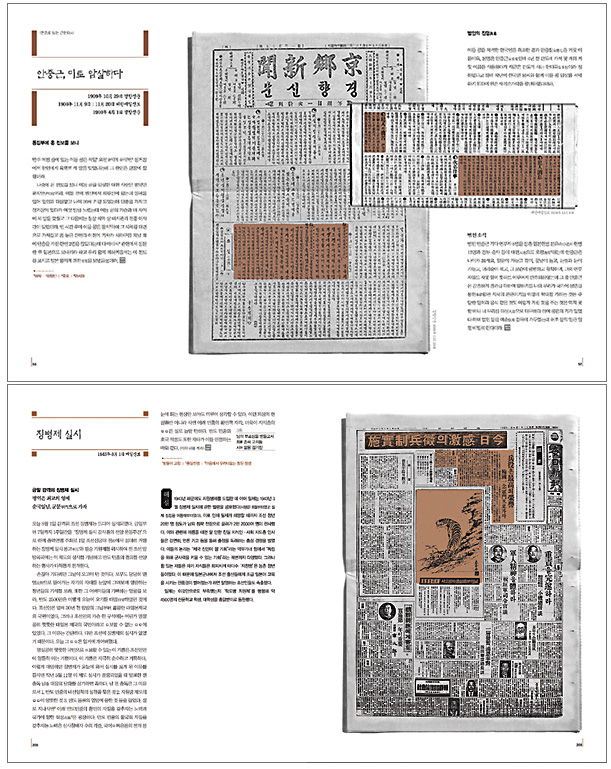
● 141 newspaper articles were published separately along with the original text of the newspaper.
The pure Korean font mixed with archaic characters, the mixed Korean and Chinese characters, and the pure Chinese characters were all translated by specialists.
Additionally, we tried to write this as close to the original text as possible, but added editor's notes for words or sentences that require explanation.
It shows newspapers from around the time of historical events and writes down the articles as they were, allowing today's readers to read newspapers from the past.
Therefore, not only is it valuable as a resource, but the original text of the article also provides a glimpse into the social trends and perceptions of the time.
● The background, development process, results, and influence of each historical event are included in separate commentary.
There are a total of 72 cases covered in the text.
I have explained the circumstances surrounding this major incident from as neutral a standpoint as possible.
A commentary that stands out with a sharp commentary amidst balanced guidance!
Newspapers are history!
After the first modern newspaper, Hanseong Sunbo, was published in 1883, newspapers became a major source of information for understanding social phenomena at the time.
This book, which contains records of that day and that event, allows us to grasp the flow of our modern history at a glance, and will confirm how the past is connected to the present and future.
Following the first volume, which covers the period from 1884 to September 1945, a series of volumes covering historical events after liberation will be published in the future.
The day the first People's Assembly was held, the day Yun Bong-gil threw a lunchbox bomb, the day people cheered for March 1st, the day the conscription system was implemented, the day Japan surrendered...
The first book to weave together the flow of history using only newspaper articles!
This book traces the major events in our modern history through newspaper articles.
There are many books that analyze modern history from various perspectives and methods, but this is the first to weave together the flow of history using only newspaper articles.
This is an example of how our modern and contemporary history was organized, edited, and commented on so that it comes alive as a living, breathing event today.
This book is…
● From the first modern newspaper, 「Hansung Sunbo」, to 1945, newspaper articles related to major historical events were selected from 21 Korean newspapers published domestically and internationally. - Independent Newspaper, Maeil Newspaper, Imperial Newspaper, Hwangseong Newspaper, Daehan Maeil Newspaper, Gongnip Newspaper, Kyunghyang Newspaper, Gwonup Newspaper, Shinhan Minbo, Maeil Newspaper, Gyeongseong Ilbo, Dong-a Ilbo, Chosun Ilbo, Sidae Ilbo, Jungoe Ilbo, Joongang Ilbo, Chosun Joongang Ilbo, Kookminbo, and even Independent Newspaper, the organ of the Provisional Government, and the Chinese newspaper Daegongbo
● It covers all the major historical events that have shaped our modern era, from the ‘Crime of the Chinese Soldiers’ on January 30, 1884, which led to the first incident of the Korean War, to the ‘Signing Ceremony of the Pacific War End Agreement’ on September 11, 1945.
● In addition to domestic events, we also covered international situations that became the catalyst for changing the course of our modern history at every critical juncture.
_Anglo-Japanese Alliance, Russo-Japanese Treaty, Manchurian Incident, Second Sino-Japanese War, Pacific War, Hiroshima atomic bombing, etc.
● A total of 141 articles were classified into 67 major items and 17 minor items.
This goes beyond simply showing the chronological flow of historical events to bringing together related articles regardless of period or newspaper type.
Additionally, when two newspapers had different opinions on the same incident, they published them together.
_The Eulsa Treaty, the assassination of Yi Wan-yong, the death of Emperor Gojong, the March 1st Movement, the Uiyeoldan, the implementation of the conscription system, the theory of approval of the Provisional Government, the dropping of the atomic bomb on Hiroshima, etc.
● We also discovered and included in the flow events that were buried in history but should not be forgotten, meaningful activities that were overshadowed by important events but were never overshadowed, events that were not covered for a long time for political reasons, and events that cannot be found in most history books.
_The Seosanghan bomb misfire incident, the Battle of Bongodong, the Battle of Pochonbo, etc.
● 141 newspaper articles were published separately along with the original text of the newspaper.
The pure Korean font mixed with archaic characters, the mixed Korean and Chinese characters, and the pure Chinese characters were all translated by specialists.
Additionally, we tried to write this as close to the original text as possible, but added editor's notes for words or sentences that require explanation.
It shows newspapers from around the time of historical events and writes down the articles as they were, allowing today's readers to read newspapers from the past.
Therefore, not only is it valuable as a resource, but the original text of the article also provides a glimpse into the social trends and perceptions of the time.
● The background, development process, results, and influence of each historical event are included in separate commentary.
There are a total of 72 cases covered in the text.
I have explained the circumstances surrounding this major incident from as neutral a standpoint as possible.
A commentary that stands out with a sharp commentary amidst balanced guidance!
Newspapers are history!
After the first modern newspaper, Hanseong Sunbo, was published in 1883, newspapers became a major source of information for understanding social phenomena at the time.
This book, which contains records of that day and that event, allows us to grasp the flow of our modern history at a glance, and will confirm how the past is connected to the present and future.
Following the first volume, which covers the period from 1884 to September 1945, a series of volumes covering historical events after liberation will be published in the future.
GOODS SPECIFICS
- Date of issue: January 15, 2009
- Page count, weight, size: 240 pages | 795g | 220*280*20mm
- ISBN13: 9788974833932
- ISBN10: 897483393X
You may also like
카테고리
korean


korean

![GQ KOREA Mark (Monthly): December [2025]](http://librairie.coreenne.fr/cdn/shop/files/8ef265dbbfbf186523ed75ba7319009d.jpg?v=1765340328&width=3840)


