

The era of the maid
 |
Description
Book Introduction
“The era of the maid has begun.” The name of the daughters who take responsibility for the livelihood and turn the world upside down. 『Daily Dew』 Dew's first full-length novel I'm completely in love. The beginning of the second act of author Lee Seul-ah, who enters the world of 'him' from 'me'. Kim Cho-yeop (novelist) The Maid Rise! It's as grand as a hero movie. _Geum Jeong-yeon (book reviewer) I'm reading this to become a beautiful man. _Jang Ki-ha (musician) Writer Lee Seul-ah, who established herself as a representative essayist of our time by communicating directly with readers without any approval from the system or any literary process through 『Daily Dewdrop』, which sends one article to readers via email every day, has published her first full-length novel. The title is 'The Age of the Maid'. While this novel was being serialized in 『Daily Isul-a』, the word 'Ganye-jang', created by author Isul-a, was circulated on social media and in newspaper columns, creating a buzz. This novel is a story about a matriarch, not a patriarch or matriarch. A girl born into a household ruled by her grandfather grows up to rule the household. In this era where it is difficult to rise from a rags to riches and difficult to become self-made, the daughter who has managed to build a family through writing takes control of the family's finances and sovereignty. A beautiful and refreshing revolution that would never happen in a patriarch's house continues, and the matriarch also repeats the mistakes made by the patriarch. As the matriarch takes control of the household, the original patriarch, who has become a member of the family, gives up his authority and shows off his presence as a beautiful and interesting middle-aged man. This patriarch has a mop tattooed on one arm and a vacuum cleaner tattooed on the other, and diligently cleans the house to support his wife and daughter. Nevertheless, this novel is not a story filled only with propaganda or satire of patriarchy, calling for the overthrow of patriarchy. The head of the household constantly reflects, thinking about the patriarchs who raised and helped her survive, her mother who lived under their rule, and the labor of those who lived by using their bodies rather than writing. Seola aspires to be a more rational and admirable matriarch than any other. But will the era of matriarchs be better for Seola's mother, Bokhee? Will Seola's matriarchal revolution truly bring happiness to everyone? Isul-ah's novel, about a daughter clenching her fists to change the fate of herself, her family, and the world, reflects the current era in which young women are active in all walks of life, creating innovations and narratives that were previously unimaginable. In the novel, Isul-ah proudly declares: “There is no patriarch or matriarch in their house. “The era of the maid has begun.” This is a family drama like none I've ever seen before. I hoped that a new era would come, after the era of mothers who provided care and housework for free, after the era of fathers who couldn't distinguish between love and violence, after the era of daughters who had never held authority. When we write "female" in the place of "father" or "father's father," interesting orders arose. I wondered what the dashing young lady, the beautiful old man, and the wonderful old woman would learn from each other. I hoped that through mistakes and recovery, we would be reborn as a good team. I wrote this thinking that I would like to see this kind of story on TV. A small book cannot be an alternative to patriarchy. I hope this will be just one example of countless resistances. I would like to continue writing about characters who cheerfully defy the long and deep-rooted flow of history. I dream of stories about family relationships that connect in new ways, as well as stories about freedom from family. The study of love, power, labor, equality, and everyday life seems endless. _From the author's note |
- You can preview some of the book's contents.
Preview
index
In the beginning there was a patriarch 7
I think the daughter is the owner of this house. 12
Successful people are different after all 17
Let's watch TV 24
If you don't want to be kicked out, stay still 31
Don't Enjoy Fuxi for Free 37
The Beauty of the Old Man 42
The eldest daughter, 48, not the general
Aura of the Outward Gentleman 54
Undiligent Love 62
Enough Date 69
Fuxi style error 79
Sorry for the disappointing answer 85
Bokhee is on a business trip to Doenjang 93
The reading session begins during kimchi-making 100
Rose Era 110
The Boss's Boss 118
There's someone I want to win against 131
My Daughter's Artist Friends 143
Mirani Makes an Unexpected Visit 149
If you can revert back to before printing, 158
Love and Fear of Books 165
Literature with Reason 174
Bokhee Thinks 183
Carrots 192
Patriarch's Morning 201
The Royal Road to Mopping 207
Employee welfare is 210 with yoga
Does Glory Flow Through the Kitchen? 219
Don't mind other people's dicks 237
The Confused Patriarch 247
Confusing Table Etiquette 257
Who plays the female role? 266
One Afternoon Daughter 274
In Search of Our God 282
Clouds Pass Over the Publisher's Roof 298
Author's Note 310
I think the daughter is the owner of this house. 12
Successful people are different after all 17
Let's watch TV 24
If you don't want to be kicked out, stay still 31
Don't Enjoy Fuxi for Free 37
The Beauty of the Old Man 42
The eldest daughter, 48, not the general
Aura of the Outward Gentleman 54
Undiligent Love 62
Enough Date 69
Fuxi style error 79
Sorry for the disappointing answer 85
Bokhee is on a business trip to Doenjang 93
The reading session begins during kimchi-making 100
Rose Era 110
The Boss's Boss 118
There's someone I want to win against 131
My Daughter's Artist Friends 143
Mirani Makes an Unexpected Visit 149
If you can revert back to before printing, 158
Love and Fear of Books 165
Literature with Reason 174
Bokhee Thinks 183
Carrots 192
Patriarch's Morning 201
The Royal Road to Mopping 207
Employee welfare is 210 with yoga
Does Glory Flow Through the Kitchen? 219
Don't mind other people's dicks 237
The Confused Patriarch 247
Confusing Table Etiquette 257
Who plays the female role? 266
One Afternoon Daughter 274
In Search of Our God 282
Clouds Pass Over the Publisher's Roof 298
Author's Note 310
Detailed image
.jpg)
Into the book
father's body mother's body
The father of the mother country
Sla followed along carefully.
He was a child who read a lot of books.
Grandfather explained, pointing at the paper.
“My father gave birth to me and my mother nurtured me.”
Long ago, my grandfather's father also taught me this.
My grandfather's grandfather would have been like that too.
Sla listened silently and then asked.
“My mother gave birth to me.”
Grandfather answered.
“If it weren’t for your father, you wouldn’t have been born.”
“But I gave birth to you myself, Mom…”
He explained calmly to his young granddaughter.
“Think about it.
If you just have land, will crops grow there? You have to plant seeds for them to grow.
“Without seeds, nothing happens on the ground.”
“But even seeds without soil……”
--- pp.8-9 From "In the Beginning There Was a Patriarch"
The day before Bok-hee, his wife, and their children packed all their belongings and left, the eldest man in the family, his father-in-law, drank six bottles of beer by himself.
My heart ached at the thought of not being able to see my rabbit-like grandchildren every day.
He sat his granddaughter down and gave her a word.
“Gijibae, don’t forget me……”
Nine-year-old Sla stared blankly at her grandfather.
--- p.38 From “Don’t Enjoy Bokhee for Free”
When twenty-two-year-old Sla debuted as a writer, she received a call from her grandfather.
He was delighted that a writer had come from a merchant family.
“You’ve become a female writer.”
To my grandfather, a writer was basically a man.
Sla answered calmly.
“This is just the beginning.”
Sla's dream was to become a dragon born from a stream.
--- p.39 From “Don’t Enjoy Bokhee for Free”
“I think I should get a tattoo.”
The maid answers.
“If you want to do it, do it.”
He is still worried.
“I don’t know what shape to carve.”
Sla thinks for a moment and then speaks.
“Tattoos that are meant to be seen as strong actually look weaker.
It's not easy to become a handsome man.
“For a middle-aged man like my father, it’s a wise choice to pursue a humble cuteness.”
A few days later, Woong goes to the tattoo shop with the design that Seol-ah drew for him.
A few hours later, Woong returns home with a vacuum cleaner in his right arm and a mop in his left.
When Woong-i stretches out both arms with a happy face, Bok-hee is startled.
“Honey! It’s so…”
Bokhee ponders and chooses what to say.
“You look so…… sincere!”
The maid comes down from the study.
He finds Woongi and says something.
“You’re sexy.”
--- pp.46-47 From "The Beauty of the Old Man"
Even though she writes like an ant, she doesn't know how to make soybean paste.
Bokhee knows how to write, but he would rather make soybean paste than do that.
Bokhee's mother, Venerable Zi, was skilled at making soybean paste, but she could not read or write.
People who are vulnerable to different things live dependent on each other.
What if Bokhee dies? That's Seol-ah's long-standing question.
Bokhee will not live forever, so who will make the soybean paste when Bokhee dies?
Will middle-aged Seol-ah receive soybean paste from the elderly Bok-hee?
Or will you miss your mother and grandmother while eating soybean paste sold at the supermarket?
Then, will my throat get choked up and I will wipe away my tears?
It's something unknown.
Sla, in her thirties, is writing without a drop of water on her hands.
--- pp.98-99 From "Bokhee is on a business trip to make soybean paste"
Fuxi closed the book.
It's a story we all know, but it made me laugh and cry.
The five people gathered here were those who had gone through those times together.
“This happened before Seol-ah was even born.”
Yunhee said and Younghee nodded.
It was fascinating that someone who had not experienced it firsthand wrote about those times in such detail.
The Venerable One listened to his story as if he were watching his favorite drama.
The text my daughter told me was a sentence written by my daughter's daughter.
The past, which the Venerable One used to lament alone, has returned to the form of Sla after three generations.
It was both the story of the Venerable One and not.
It was an edited version where Seola's memories were mixed with those of Bokhee, Yeonghee, Yunhee, and Byeongchan.
The Venerable One learned that there were multiple owners of the story.
The life of the Venerable One could not be the story of the Venerable One alone.
When I heard the long story about myself, my long-standing sorrow felt a little like someone else's story.
Time flew by beautifully with Sla's commentary.
To become a story is to become distant.
The Venerable One sat there and dimly realized.
A freedom like a breeze settled in the heart of the Venerable One.
It was a freedom that could only be gained by moving away.
The fixed memories swayed gently.
Several truths about the Venerable One were laid out one by one in the living room of the country house.
In the yard, cabbages were being pickled.
--- p.109 From “The reading session begins during kimchi-making”
Bokhee goes back to doing kitchen work peacefully.
Something more than hormones seemed to flow through Bokhee's body.
Despite possessing such power, he somehow doesn't dream of becoming a matriarch.
I wish anyone could be the patriarch or the matriarch.
As long as I get paid well, it doesn't matter how much the head of the household shows off.
Bokhee knows that he has a joy and freedom that cannot be damaged by others.
--- p.142 From "There's Someone I Want to Win"
Let's imagine this.
What if I could write two articles a day and show them to just three people?
Three readers sit around a table and read.
They may giggle, their eyes may get wet, or there may be no reaction at all.
When the reading is finished, the reader leaves the table.
The writer is left alone to write.
How long will the sentences placed on the table be remembered? If the next sentence must be prepared immediately afterward, and such labor is repeated twice a day without fail.
Even then, would Seol-ah have been able to continue as a writer? Would she have been able to endure the futility and keep repeating? Would she have found the strength to write a new story each time, even when faced with documents as cleanly emptied as a sink after washing the dishes? Could she truly do so for just three or four people? We don't know.
What is certain is that the work that Bokhee has been doing for forty years is similar to that.
--- p.228 From “Does Glory Flow in the Kitchen”
Please let me write a good story.
Please keep loving this work.
Please believe that there are readers out there somewhere.
Please help me not to lose courage.
The verse continues on.
108 times becomes a ritual that Sla repeats every time before writing.
(…) The night deepens.
They wander around the neighborhood of religion, unaware that they are each other's guardian deity.
The father of the mother country
Sla followed along carefully.
He was a child who read a lot of books.
Grandfather explained, pointing at the paper.
“My father gave birth to me and my mother nurtured me.”
Long ago, my grandfather's father also taught me this.
My grandfather's grandfather would have been like that too.
Sla listened silently and then asked.
“My mother gave birth to me.”
Grandfather answered.
“If it weren’t for your father, you wouldn’t have been born.”
“But I gave birth to you myself, Mom…”
He explained calmly to his young granddaughter.
“Think about it.
If you just have land, will crops grow there? You have to plant seeds for them to grow.
“Without seeds, nothing happens on the ground.”
“But even seeds without soil……”
--- pp.8-9 From "In the Beginning There Was a Patriarch"
The day before Bok-hee, his wife, and their children packed all their belongings and left, the eldest man in the family, his father-in-law, drank six bottles of beer by himself.
My heart ached at the thought of not being able to see my rabbit-like grandchildren every day.
He sat his granddaughter down and gave her a word.
“Gijibae, don’t forget me……”
Nine-year-old Sla stared blankly at her grandfather.
--- p.38 From “Don’t Enjoy Bokhee for Free”
When twenty-two-year-old Sla debuted as a writer, she received a call from her grandfather.
He was delighted that a writer had come from a merchant family.
“You’ve become a female writer.”
To my grandfather, a writer was basically a man.
Sla answered calmly.
“This is just the beginning.”
Sla's dream was to become a dragon born from a stream.
--- p.39 From “Don’t Enjoy Bokhee for Free”
“I think I should get a tattoo.”
The maid answers.
“If you want to do it, do it.”
He is still worried.
“I don’t know what shape to carve.”
Sla thinks for a moment and then speaks.
“Tattoos that are meant to be seen as strong actually look weaker.
It's not easy to become a handsome man.
“For a middle-aged man like my father, it’s a wise choice to pursue a humble cuteness.”
A few days later, Woong goes to the tattoo shop with the design that Seol-ah drew for him.
A few hours later, Woong returns home with a vacuum cleaner in his right arm and a mop in his left.
When Woong-i stretches out both arms with a happy face, Bok-hee is startled.
“Honey! It’s so…”
Bokhee ponders and chooses what to say.
“You look so…… sincere!”
The maid comes down from the study.
He finds Woongi and says something.
“You’re sexy.”
--- pp.46-47 From "The Beauty of the Old Man"
Even though she writes like an ant, she doesn't know how to make soybean paste.
Bokhee knows how to write, but he would rather make soybean paste than do that.
Bokhee's mother, Venerable Zi, was skilled at making soybean paste, but she could not read or write.
People who are vulnerable to different things live dependent on each other.
What if Bokhee dies? That's Seol-ah's long-standing question.
Bokhee will not live forever, so who will make the soybean paste when Bokhee dies?
Will middle-aged Seol-ah receive soybean paste from the elderly Bok-hee?
Or will you miss your mother and grandmother while eating soybean paste sold at the supermarket?
Then, will my throat get choked up and I will wipe away my tears?
It's something unknown.
Sla, in her thirties, is writing without a drop of water on her hands.
--- pp.98-99 From "Bokhee is on a business trip to make soybean paste"
Fuxi closed the book.
It's a story we all know, but it made me laugh and cry.
The five people gathered here were those who had gone through those times together.
“This happened before Seol-ah was even born.”
Yunhee said and Younghee nodded.
It was fascinating that someone who had not experienced it firsthand wrote about those times in such detail.
The Venerable One listened to his story as if he were watching his favorite drama.
The text my daughter told me was a sentence written by my daughter's daughter.
The past, which the Venerable One used to lament alone, has returned to the form of Sla after three generations.
It was both the story of the Venerable One and not.
It was an edited version where Seola's memories were mixed with those of Bokhee, Yeonghee, Yunhee, and Byeongchan.
The Venerable One learned that there were multiple owners of the story.
The life of the Venerable One could not be the story of the Venerable One alone.
When I heard the long story about myself, my long-standing sorrow felt a little like someone else's story.
Time flew by beautifully with Sla's commentary.
To become a story is to become distant.
The Venerable One sat there and dimly realized.
A freedom like a breeze settled in the heart of the Venerable One.
It was a freedom that could only be gained by moving away.
The fixed memories swayed gently.
Several truths about the Venerable One were laid out one by one in the living room of the country house.
In the yard, cabbages were being pickled.
--- p.109 From “The reading session begins during kimchi-making”
Bokhee goes back to doing kitchen work peacefully.
Something more than hormones seemed to flow through Bokhee's body.
Despite possessing such power, he somehow doesn't dream of becoming a matriarch.
I wish anyone could be the patriarch or the matriarch.
As long as I get paid well, it doesn't matter how much the head of the household shows off.
Bokhee knows that he has a joy and freedom that cannot be damaged by others.
--- p.142 From "There's Someone I Want to Win"
Let's imagine this.
What if I could write two articles a day and show them to just three people?
Three readers sit around a table and read.
They may giggle, their eyes may get wet, or there may be no reaction at all.
When the reading is finished, the reader leaves the table.
The writer is left alone to write.
How long will the sentences placed on the table be remembered? If the next sentence must be prepared immediately afterward, and such labor is repeated twice a day without fail.
Even then, would Seol-ah have been able to continue as a writer? Would she have been able to endure the futility and keep repeating? Would she have found the strength to write a new story each time, even when faced with documents as cleanly emptied as a sink after washing the dishes? Could she truly do so for just three or four people? We don't know.
What is certain is that the work that Bokhee has been doing for forty years is similar to that.
--- p.228 From “Does Glory Flow in the Kitchen”
Please let me write a good story.
Please keep loving this work.
Please believe that there are readers out there somewhere.
Please help me not to lose courage.
The verse continues on.
108 times becomes a ritual that Sla repeats every time before writing.
(…) The night deepens.
They wander around the neighborhood of religion, unaware that they are each other's guardian deity.
--- p.297 From "In Search of Our God"
Publisher's Review
[Daily Isul-ah] Isul-ah's New Challenge: A Dazzling Beginning for "Novelist Isul-ah"
A brave and loving daughter holds economic power and sovereignty
A story that changes the fate of yourself, your family, and the world.
Born into a merchant family, young Seol-ah grows up watching her maternal grandfather become independent from his patriarch and jump into the front lines of making a living.
On the day she became independent from her grandfather's rule and freed from the housework of 11 people, her mother, Bok-hee, had a dream of flying through the sky on a pot lid.
But reality is never easy.
The mother and two siblings, who had been living on the land that the patriarch had built, now had to do everything they could to secure a home and food.
And “the world works in such a way that those who are not born rich have no choice but to go into debt.”
Woongi was a man who would jump into the sea to make a living.
Bokhee was also a person who could climb a mountain of garbage to make a living.
Sla grew up watching her mother's arduous history of labor.
Adults were those who did the work.
Some adults work hard but earn little.
Like Bokhee and Ungyi.
The desire to create a new family stirred within Sla's heart.
(Don't Enjoy Fuxi for Free, p. 39)
Since he started making money through writing, he started a company called 'Nap Publishing' and hired his mother, who had been forced to do hard physical labor until then, as an employee of Nap Publishing.
To her mother, her daughter, Seol-ah, is not only the head of the household but also the boss and CEO at work.
And daughter Seul-ah introduces a new wage and bonus system that was not found in existing patriarchal systems or companies.
Under patriarchy, it was perfectly natural for mothers to prepare meals and seasonal foods, but Sla thoroughly compensates them by providing bonuses such as soybean paste and kimchi, and by setting wages appropriate for mothers' housework and meal preparation.
Sla's mother also respects Sla, who is responsible for the family's livelihood, and speaks politely to her during work hours and assists her in writing, publishing, and daily life so that she does not experience any inconvenience.
The head of the household takes pride in being the one who pays her mother's irreplaceable housework and hires herself to ensure that her father's labor is not treated cheaply, but in this household, cooking, washing dishes, and cleaning are sometimes treated as trivial tasks compared to writing and books.
Just like in a patriarchal household.
For example, when it's time for a deadline, Sla finds the meal her mother, Bokhee, has prepared with great care annoying.
As we wait for Sla, the food gets cold as we wait for the family, who are burying their heads in their phones, to pick up their spoons.
The maid gets irritated when Bok-hee tells her to eat and do it.
“Why are you rushing me so much?
“What if the soup cools down a bit?”
Mom Bok-hee drinks a half-shot of whiskey with her mixed coffee in the kitchen alone with a red face.
Even though she was a woman, didn't she often neglect Bokhee's kitchen and food?
Like countless grandfathers.
Like fathers.
My grandfather always failed at this.
I've always failed to value the kitchen staff.
Even though I was treated to meals prepared by Bokhee every day, it was like that.
Sla feels that she has repeated the patriarch's failures.
("Does Glory Flow Through the Kitchen?", pp. 233-234)
The maid innovates large systems, takes responsibility for her livelihood without wavering, and buys a house, but she keeps failing in small, close-knit tasks.
Not only the maid, but also Sla's mothers are the same.
Bok-hee asks a lesbian couple visiting the Nap Publishing Company an impolite question, and Woong-i gets annoyed at an unknown restaurant owner for being unfriendly.
These first matriarchal household members are by no means perfect.
They make mistakes, fall down, and hurt each other from time to time.
Everyone makes mistakes in the fatigue and careless habits of daily life, but they eventually recover, correct, and make amends, creating a better community.
“‘Debut literature’ is just a branch of literature,
“All kinds of literary works are being created outside the system.”
The maid just wants to be a good writer, but she often fights battles outside the home.
When people persistently ask her why she doesn't 'debut' or why she doesn't want to try 'literature', the girl retorts.
'Debut literature' is just one genre of all writing.
And there are no levels or boundaries in literature, and he is already doing 'literature'.
The days when institutional approval was valued more highly than reader reaction may be long gone, like the patriarchal era.
This refreshing rebuke reminds us of the extraordinary path taken by author Lee Seul-ah, while also prompting us to look at the many interesting and intriguing narratives emerging from outside the "debut literature" genre.
Meanwhile, Ga-nyeo-jang also appears as a regular panelist on a TV show, but when the staff asks Sla, who is not wearing a bra, to wear a bra right before filming, she does something.
In this way, the path that the maid takes is filled with ups and downs.
“I think it’s up to me to decide whether to wear a bra or not. What do you think, PD?”
The PD scratches his head and answers.
"you're right.
But this isn't something I can decide on...
“Then who gets to decide that?”
“I guess… the higher-ups won’t confirm it.”
Sla laughs out loud, finding it hilarious that her nipples are the ones that need to be confirmed.
When Sla laughs, everyone looks at her.
(Don't Mind Other People's Pussies, p. 241)
The name of the novel's main character is 'Sla'.
This may be because the author got hints for the story from his own experiences running 'Swimming Publishing', working with his family, and supporting a mother-daughter business.
However, in this novel, the author goes beyond the episodes of the essays she has written so far to create a new image of the head of the household, and constantly poses questions to women of her time and adults of a bygone era, as well as to men and women who feel that their thoughts are too different from each other.
The era of patriarchy, what comes next?
In what era should we meet, talk, and live together?
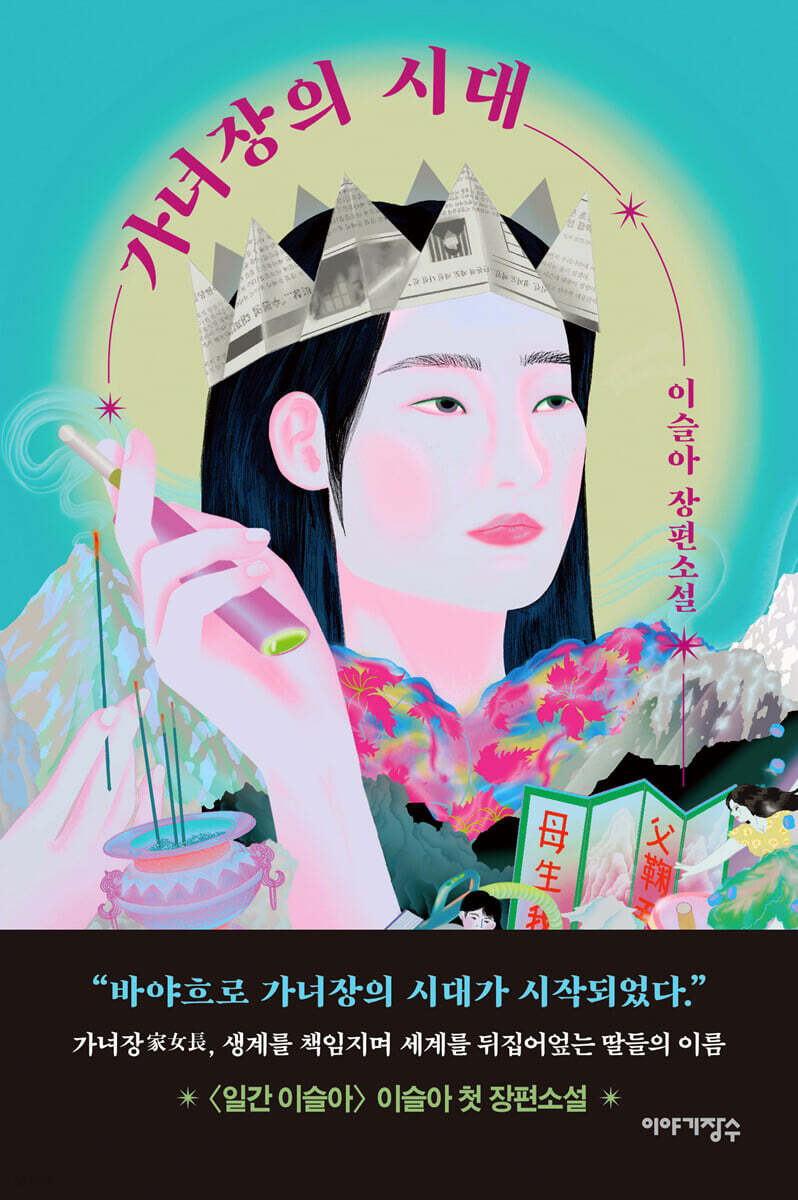
On the cover of 『The Age of the Matriarch』, the matriarch is seen wearing the newspaper that fathers pick up first thing in the morning, folded lightly into a crown, and looking into the distance while wearing a mountain range like a muffler.
Waving her e-cigarette like a magic wand, the maid, symbolizing the writing and print media that have elevated her to the position of both matriarch and employer, proudly wearing the newspaper as a crown, seems to be declaring that she will become the subject of news before anyone chooses her as news.
The daughters of this era no longer have anything to rely on.
There is no one to lean on.
Thus, the matriarchs of this era do not seek the approval of old traditions, but forge new paths for themselves.
This novel is a story of courageous and heartbreaking daughters who struggle to change the fate of themselves, their families, and the world.
The 'era of the maid' has finally arrived.
A brave and loving daughter holds economic power and sovereignty
A story that changes the fate of yourself, your family, and the world.
Born into a merchant family, young Seol-ah grows up watching her maternal grandfather become independent from his patriarch and jump into the front lines of making a living.
On the day she became independent from her grandfather's rule and freed from the housework of 11 people, her mother, Bok-hee, had a dream of flying through the sky on a pot lid.
But reality is never easy.
The mother and two siblings, who had been living on the land that the patriarch had built, now had to do everything they could to secure a home and food.
And “the world works in such a way that those who are not born rich have no choice but to go into debt.”
Woongi was a man who would jump into the sea to make a living.
Bokhee was also a person who could climb a mountain of garbage to make a living.
Sla grew up watching her mother's arduous history of labor.
Adults were those who did the work.
Some adults work hard but earn little.
Like Bokhee and Ungyi.
The desire to create a new family stirred within Sla's heart.
(Don't Enjoy Fuxi for Free, p. 39)
Since he started making money through writing, he started a company called 'Nap Publishing' and hired his mother, who had been forced to do hard physical labor until then, as an employee of Nap Publishing.
To her mother, her daughter, Seol-ah, is not only the head of the household but also the boss and CEO at work.
And daughter Seul-ah introduces a new wage and bonus system that was not found in existing patriarchal systems or companies.
Under patriarchy, it was perfectly natural for mothers to prepare meals and seasonal foods, but Sla thoroughly compensates them by providing bonuses such as soybean paste and kimchi, and by setting wages appropriate for mothers' housework and meal preparation.
Sla's mother also respects Sla, who is responsible for the family's livelihood, and speaks politely to her during work hours and assists her in writing, publishing, and daily life so that she does not experience any inconvenience.
The head of the household takes pride in being the one who pays her mother's irreplaceable housework and hires herself to ensure that her father's labor is not treated cheaply, but in this household, cooking, washing dishes, and cleaning are sometimes treated as trivial tasks compared to writing and books.
Just like in a patriarchal household.
For example, when it's time for a deadline, Sla finds the meal her mother, Bokhee, has prepared with great care annoying.
As we wait for Sla, the food gets cold as we wait for the family, who are burying their heads in their phones, to pick up their spoons.
The maid gets irritated when Bok-hee tells her to eat and do it.
“Why are you rushing me so much?
“What if the soup cools down a bit?”
Mom Bok-hee drinks a half-shot of whiskey with her mixed coffee in the kitchen alone with a red face.
Even though she was a woman, didn't she often neglect Bokhee's kitchen and food?
Like countless grandfathers.
Like fathers.
My grandfather always failed at this.
I've always failed to value the kitchen staff.
Even though I was treated to meals prepared by Bokhee every day, it was like that.
Sla feels that she has repeated the patriarch's failures.
("Does Glory Flow Through the Kitchen?", pp. 233-234)
The maid innovates large systems, takes responsibility for her livelihood without wavering, and buys a house, but she keeps failing in small, close-knit tasks.
Not only the maid, but also Sla's mothers are the same.
Bok-hee asks a lesbian couple visiting the Nap Publishing Company an impolite question, and Woong-i gets annoyed at an unknown restaurant owner for being unfriendly.
These first matriarchal household members are by no means perfect.
They make mistakes, fall down, and hurt each other from time to time.
Everyone makes mistakes in the fatigue and careless habits of daily life, but they eventually recover, correct, and make amends, creating a better community.
“‘Debut literature’ is just a branch of literature,
“All kinds of literary works are being created outside the system.”
The maid just wants to be a good writer, but she often fights battles outside the home.
When people persistently ask her why she doesn't 'debut' or why she doesn't want to try 'literature', the girl retorts.
'Debut literature' is just one genre of all writing.
And there are no levels or boundaries in literature, and he is already doing 'literature'.
The days when institutional approval was valued more highly than reader reaction may be long gone, like the patriarchal era.
This refreshing rebuke reminds us of the extraordinary path taken by author Lee Seul-ah, while also prompting us to look at the many interesting and intriguing narratives emerging from outside the "debut literature" genre.
Meanwhile, Ga-nyeo-jang also appears as a regular panelist on a TV show, but when the staff asks Sla, who is not wearing a bra, to wear a bra right before filming, she does something.
In this way, the path that the maid takes is filled with ups and downs.
“I think it’s up to me to decide whether to wear a bra or not. What do you think, PD?”
The PD scratches his head and answers.
"you're right.
But this isn't something I can decide on...
“Then who gets to decide that?”
“I guess… the higher-ups won’t confirm it.”
Sla laughs out loud, finding it hilarious that her nipples are the ones that need to be confirmed.
When Sla laughs, everyone looks at her.
(Don't Mind Other People's Pussies, p. 241)
The name of the novel's main character is 'Sla'.
This may be because the author got hints for the story from his own experiences running 'Swimming Publishing', working with his family, and supporting a mother-daughter business.
However, in this novel, the author goes beyond the episodes of the essays she has written so far to create a new image of the head of the household, and constantly poses questions to women of her time and adults of a bygone era, as well as to men and women who feel that their thoughts are too different from each other.
The era of patriarchy, what comes next?
In what era should we meet, talk, and live together?
On the cover of 『The Age of the Matriarch』, the matriarch is seen wearing the newspaper that fathers pick up first thing in the morning, folded lightly into a crown, and looking into the distance while wearing a mountain range like a muffler.
Waving her e-cigarette like a magic wand, the maid, symbolizing the writing and print media that have elevated her to the position of both matriarch and employer, proudly wearing the newspaper as a crown, seems to be declaring that she will become the subject of news before anyone chooses her as news.
The daughters of this era no longer have anything to rely on.
There is no one to lean on.
Thus, the matriarchs of this era do not seek the approval of old traditions, but forge new paths for themselves.
This novel is a story of courageous and heartbreaking daughters who struggle to change the fate of themselves, their families, and the world.
The 'era of the maid' has finally arrived.
GOODS SPECIFICS
- Publication date: October 7, 2022
- Page count, weight, size: 316 pages | 376g | 133*200*30mm
- ISBN13: 9791198744456
- ISBN10: 1198744456
You may also like
카테고리
korean


korean

![GQ KOREA Mark (Monthly): December [2025]](http://librairie.coreenne.fr/cdn/shop/files/8ef265dbbfbf186523ed75ba7319009d.jpg?v=1765340328&width=3840)


