

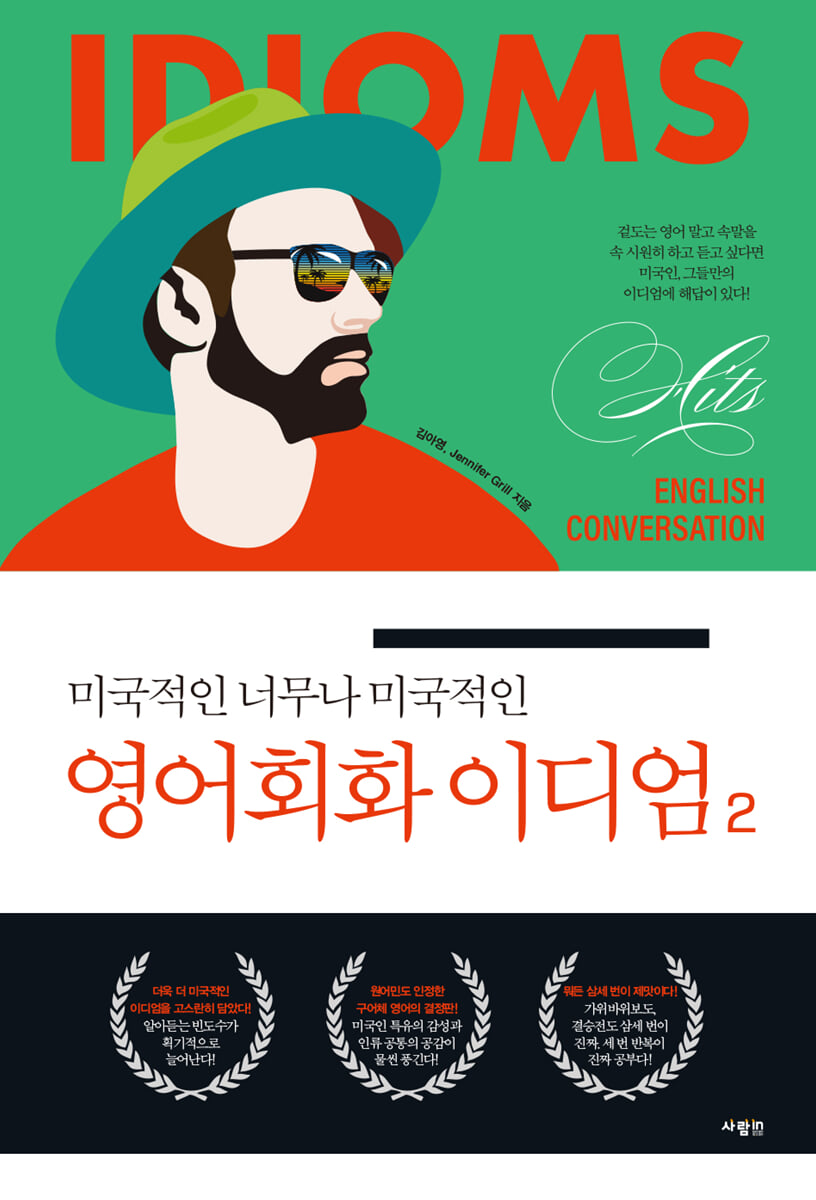
American, Too American English Conversation Idioms 2
 |
Description
Book Introduction
An English conversation book that is more faithful, more relatable, and more American in flavor.
"American, All-American English Conversation Idioms," which has been acclaimed for setting a new standard in idiom books by elevating idioms ingrained in American daily life into a dense conversational volume, has been published in two volumes, offering even more useful, American, and powerful ways to speak.
The conversation, which is useful and has a distinctly American flavor, is based on basic, more relatable material, and the content, which is balanced and unbiased enough to be able to be spoken to by any American, presents the best of conversation that cannot be found anywhere else.
I highly recommend this to those who clearly know the combination of words but couldn't understand what they were saying, or to those who were disappointed that there wasn't a single word that fit the exact situation.
If you ask me to come in second, I'd be sad. When I say it like that, even the idioms are different.
"American, All-American English Conversation Idioms," which has been acclaimed for setting a new standard in idiom books by elevating idioms ingrained in American daily life into a dense conversational volume, has been published in two volumes, offering even more useful, American, and powerful ways to speak.
The conversation, which is useful and has a distinctly American flavor, is based on basic, more relatable material, and the content, which is balanced and unbiased enough to be able to be spoken to by any American, presents the best of conversation that cannot be found anywhere else.
I highly recommend this to those who clearly know the combination of words but couldn't understand what they were saying, or to those who were disappointed that there wasn't a single word that fit the exact situation.
If you ask me to come in second, I'd be sad. When I say it like that, even the idioms are different.
- You can preview some of the book's contents.
Preview
index
preface
Features of this book
How to use this book
Lesson 1
It may not seem like much, but it can make a big difference.
Lesson 2
I can solve the problem.
Lesson 3
You can express your plans.
Lesson 4
You can help people who need help.
Lesson 5
You can express that you need to go out and not just stay at home.
Lesson 6
You can say something sharp to someone who is not in their right mind.
Lesson 7
You can talk about sudden changes in circumstances.
Lesson 8
I can say that to make you sound like a frugal person.
Lesson 9
It can express something that has been upgraded to the next level.
Lesson 10
You can use a fancy expression for 'if the sun rises in the west'.
Lesson 11
You can get a glimpse into the lives of people in the American South.
Lesson 12
I can tell you a situation where you have to choose between this and that.
Lesson 13
It can indicate preparing something for someone.
Lesson 14
It can express whether or not someone is trustworthy or not.
Lesson 15
You can express the difficulties of boring meetings and preparing complicated documents.
Lesson 16
We can discuss how to cope with difficult situations.
Lesson 17
You can talk about difficult situations and receive comfort.
Lesson 18
You can feel free to ask for help from experts.
Lesson 19
It can describe leaving your parents as an adult.
Lesson 20
You'll learn how to deal with the stories everyone hates to tell.
Lesson 21
There are many ways to express that you are thoroughly prepared.
Lesson 22
You can explain other people's harsh language to them in a dignified way.
Lesson 23
You can get a glimpse into the language and daily life unique to the Northeastern region of the United States.
Lesson 24
It may indicate a desire to return to one's roots.
Lesson 25
We can talk while acknowledging that we have different opinions.
English keyword index
Korean keyword index
Features of this book
How to use this book
Lesson 1
It may not seem like much, but it can make a big difference.
Lesson 2
I can solve the problem.
Lesson 3
You can express your plans.
Lesson 4
You can help people who need help.
Lesson 5
You can express that you need to go out and not just stay at home.
Lesson 6
You can say something sharp to someone who is not in their right mind.
Lesson 7
You can talk about sudden changes in circumstances.
Lesson 8
I can say that to make you sound like a frugal person.
Lesson 9
It can express something that has been upgraded to the next level.
Lesson 10
You can use a fancy expression for 'if the sun rises in the west'.
Lesson 11
You can get a glimpse into the lives of people in the American South.
Lesson 12
I can tell you a situation where you have to choose between this and that.
Lesson 13
It can indicate preparing something for someone.
Lesson 14
It can express whether or not someone is trustworthy or not.
Lesson 15
You can express the difficulties of boring meetings and preparing complicated documents.
Lesson 16
We can discuss how to cope with difficult situations.
Lesson 17
You can talk about difficult situations and receive comfort.
Lesson 18
You can feel free to ask for help from experts.
Lesson 19
It can describe leaving your parents as an adult.
Lesson 20
You'll learn how to deal with the stories everyone hates to tell.
Lesson 21
There are many ways to express that you are thoroughly prepared.
Lesson 22
You can explain other people's harsh language to them in a dignified way.
Lesson 23
You can get a glimpse into the language and daily life unique to the Northeastern region of the United States.
Lesson 24
It may indicate a desire to return to one's roots.
Lesson 25
We can talk while acknowledging that we have different opinions.
English keyword index
Korean keyword index
Detailed image

Publisher's Review
The Most American Colloquial English Idioms
Forget the boring and dull feeling of the idiom-example 1:1 correspondence structure that comes to mind when thinking of idiom books.
We are approaching you with a novel structure and content that you have never seen before.
If you want to speak and understand not just words, but also what you say, then English Conversation with Idioms is for you.
-One of the many criteria that distinguish native speakers from non-native speakers is the use of idioms.
So, not being able to use idioms means you can only speak them and not get into the conversations of native speakers.
Haven't we been confining such important idioms to the category of "idioms" and boringly focusing on one-to-one, meaning-example correspondences? And haven't we been making the absurd claim that we don't understand why we should bother with something we don't even use? Even if we want to deny it, conversational idioms are essential for a higher level of conversation with native speakers.
Idioms must absolutely be learned through conversation!
-Idioms contain the culture of the people and society that use them.
Learning and forcing yourself to memorize idioms and examples one-on-one without this understanding is a study method that is sure to fail.
To truly understand idioms, you need to use them in real-life conversational situations that reflect the vivid daily lives and culture of Americans.
The essence of colloquial conversation, recognized even by native speakers, will ignite your desire to study!
Say goodbye to forced, extracted sentences for idiom learning! These authentic, colloquial conversations, recognized even by native speakers, breathe life into a uniquely American sensibility and universal empathy.
Idioms used in sentences like this are the ones that really hit home.
Three repetitions is real studying!
- In rock-paper-scissors and the finals, the third round is the real thing.
I also applied the three-fold truth to English conversation idioms.
We encounter three different conversational passages with the same idiom.
You've seen it three times, so it's probably familiar.
It doesn't stop there.
In addition to the conversational text, we have provided three other examples, so that the learning structure is designed to ensure that the learner sees the text at least six times, no matter how poorly.
It's time to experience the thrill of idioms coming out of your mouth without having to write them down on paper.
Forget the boring and dull feeling of the idiom-example 1:1 correspondence structure that comes to mind when thinking of idiom books.
We are approaching you with a novel structure and content that you have never seen before.
If you want to speak and understand not just words, but also what you say, then English Conversation with Idioms is for you.
-One of the many criteria that distinguish native speakers from non-native speakers is the use of idioms.
So, not being able to use idioms means you can only speak them and not get into the conversations of native speakers.
Haven't we been confining such important idioms to the category of "idioms" and boringly focusing on one-to-one, meaning-example correspondences? And haven't we been making the absurd claim that we don't understand why we should bother with something we don't even use? Even if we want to deny it, conversational idioms are essential for a higher level of conversation with native speakers.
Idioms must absolutely be learned through conversation!
-Idioms contain the culture of the people and society that use them.
Learning and forcing yourself to memorize idioms and examples one-on-one without this understanding is a study method that is sure to fail.
To truly understand idioms, you need to use them in real-life conversational situations that reflect the vivid daily lives and culture of Americans.
The essence of colloquial conversation, recognized even by native speakers, will ignite your desire to study!
Say goodbye to forced, extracted sentences for idiom learning! These authentic, colloquial conversations, recognized even by native speakers, breathe life into a uniquely American sensibility and universal empathy.
Idioms used in sentences like this are the ones that really hit home.
Three repetitions is real studying!
- In rock-paper-scissors and the finals, the third round is the real thing.
I also applied the three-fold truth to English conversation idioms.
We encounter three different conversational passages with the same idiom.
You've seen it three times, so it's probably familiar.
It doesn't stop there.
In addition to the conversational text, we have provided three other examples, so that the learning structure is designed to ensure that the learner sees the text at least six times, no matter how poorly.
It's time to experience the thrill of idioms coming out of your mouth without having to write them down on paper.
GOODS SPECIFICS
- Date of issue: May 3, 2021
- Page count, weight, size: 336 pages | 772g | 170*250*20mm
- ISBN13: 9788960498952
- ISBN10: 8960498955
You may also like
카테고리
korean


korean

![GQ KOREA Mark (Monthly): December [2025]](http://librairie.coreenne.fr/cdn/shop/files/8ef265dbbfbf186523ed75ba7319009d.jpg?v=1765340328&width=3840)


