

Rediscovering Korean History
 |
Description
Book Introduction
Park Soo-ho (psh4039@yes24.com)
Were the original inhabitants of Gaya the very same Huns who even Qin Shi Huang trembled in fear? Who turned the brilliant Ondal into a fool? Why did Choi Chi-won, once considered the greatest writer of the Unified Silla period, struggle with unemployment? Is it true that Balhae, which claimed to be the successor to Goguryeo, was forgotten because of Goguryeo?
This book selects 59 questions that have been truly curious about our history and attempts to provide clear answers to them.
In this process, the author challenges existing, outdated common sense and stereotypical ideas about our history.
At the same time, it avoids assuming that 'this is the right answer' and continuously raises new questions about Korean history, thereby arousing readers' curiosity.
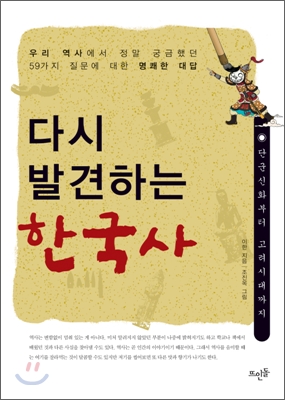
The lively illustrations, which cannot be found in existing history books, catch the eye.
The book also features witty metaphors and parodies hidden throughout, such as describing Seo Hee of Goryeo, famous for her diplomatic negotiations, as “10th level of eloquence,” adding to the enjoyment of reading.
It is a book that the whole family, from middle school students to adults, can read without any burden and enjoyably.
This book selects 59 questions that have been truly curious about our history and attempts to provide clear answers to them.
In this process, the author challenges existing, outdated common sense and stereotypical ideas about our history.
At the same time, it avoids assuming that 'this is the right answer' and continuously raises new questions about Korean history, thereby arousing readers' curiosity.
The lively illustrations, which cannot be found in existing history books, catch the eye.
The book also features witty metaphors and parodies hidden throughout, such as describing Seo Hee of Goryeo, famous for her diplomatic negotiations, as “10th level of eloquence,” adding to the enjoyment of reading.
It is a book that the whole family, from middle school students to adults, can read without any burden and enjoyably.
- You can preview some of the book's contents.
Preview
index
Author's Preface | Not a history that is imposed, but a history that is thoughtful, explored, and discovered anew.
Illustrator's Preface | "History is this interesting?"
1_ History opens with myths: Ancient times
▶Why did ancient people wear bronze mirrors around their necks? ▶It is said that the first year of the Dangi period, 2333 BC, was derived from Chinese mythology. Is this true? ▶How did they move a 300-ton stone in an era without cranes or backhoes? ▶History is said to be a product of the mind of a person who 'cuts' tofu? ▶Before the Three Kingdoms began in earnest, there were 78 countries in the central and southern part of the Korean Peninsula...? ▶Why did the reporter go east? ▶Why is Nakrang more well-known worldwide than Goguryeo, Baekje, and Silla? ▶It is said that in Buyeo, when there was a severe drought, the king's head was cut off. Was this really the case?
2_ You have to go all the way to find out who is truly strong in the Three Kingdoms period.
▶Was King Dongmyeongseong really the first king of Goguryeo? ▶King Yuri, who composed the heartbreaking love poem "Hwangjoga," was a tyrant who buried his subjects alive...? ▶Is it true that King Taejo ruled for 93 years? ▶Prince Hodong thoroughly manipulated Princess Nakrang for political gain and then had her killed? ▶Were the indigenous people of Gaya the Huns, who even Qin Shi Huang trembled with fear? ▶Was Queen Woo, the wife of King Gogukcheon of Goguryeo, really the most lecherous woman in Korean history? ▶Why is Goguryeo history considered Korean history? ▶Why were Goguryeo artifacts discovered in Baekje's Pungnap earthen fortress? ▶King Geunchogo is said to have considered Baekje the center of the world...? ▶The wooden tablets of the Three Kingdoms period hold the key to unlocking the mysteries of ancient history? ▶Why are historical records of King Gwanggaeto the Great solely about territorial demarcation? ▶Could the Goguryeo mural exhibition have been a side effect, triggering China's "Northeast Project"? ▶ Was the content of the Gwanggaeto Stele really fabricated? ▶ Hundreds of years later, Goguryeo's downfall was blamed on King Jangsu? ▶ Did King Gaero really ruin his country with baduk? ▶ Was Ichadon a sacrificial offering to strengthen King Beopheung's royal authority? ▶ Why is King Muryeong more famous in Japan than in Korea? ▶ Did the privileged nobles and historians who held vested interests make a fool of Ondal, a brilliant talent? ▶ Many Hwarang members were homosexuals. Were they really murdered? ▶ The protagonist of the legendary romance, Seodong, was actually the Buddhist monk Wonhyo? ▶ Was Goguryeo actually a nation boasting a naval force as powerful as its army? ▶ Was Yeon Gaemun truly a hero representing Goguryeo, or a dictator who brought about its downfall? ▶ Why was Silla, once the weakest nation, able to play a leading role in the unification of the Three Kingdoms?
3_ The pattern is unification, but the reality is division. The era of North and South Korea.
▶Balhae, which claimed to be the successor to Goguryeo, was forgotten because of Goguryeo? ▶Did Wonhyo actually drink the water from the skull? ▶Is the manuscript of the Hwarang Segi genuine or fake? ▶Why do the Japanese wooden Bodhisattva statue and our gilt-bronze Bodhisattva Pensive Bodhisattva statue look so similar? ▶Did King Gyeongsun Kim Bu plan the Later Baekje army led by Gyeon Hwon to attack Poseokjeong? ▶Why did the Japanese monk Ennin pretend to be a Silla person in Tang? ▶Even Choi Chi-won, the greatest writer of the Unified Silla period, was once unemployed and struggling to find a job? ▶The snake that King Gyeongmun is said to have slept with symbolizes the 'Six Heads', a reformist force? ▶Why did Gung Ye, who claimed to be a prince of Silla, declare himself the successor to Goguryeo? ▶Is Gyeon Hwon, the founder of Later Baekje, the son of an earthworm?
4_ The common people defended the country established by the powerful clans during the Goryeo Dynasty
▶Was the Hunyo Sipjo, which recorded Wang Geon's will, forged by someone? ▶How was King Hyejong of Goryeo, known for his frailty, able to defeat an assassin with his bare hands? ▶People in the Goryeo Dynasty also struggled to become civil servants? ▶How was Seo Hui able to defeat 800,000 Khitan troops with just his three-inch tongue? ▶Su Dongpo, who had a fan club among Goryeo literati, was actually anti-Goryeo? ▶Was the second Khitan invasion a lost war? ▶Why did the family of Lee Ja-gyeom, who started a rebellion, maintain power until the end of the Goryeo Dynasty? ▶Is it true that Kim Bu-sik was assassinated by Jeong Ji-sang's ghost? ▶The military coup is said to have occurred as a result of Myo Cheong's movement to move the capital to the west...? ▶Why was the politics of King Uijong, who was ousted by a military regime, bound to fail? ▶Lee Gyu-bo, the author of Dongguk Isang Gukjip, is said to have been a government-sponsored intellectual who would be second to none...? ▶Why didn't the military officials who seized power make themselves kings? ▶They say an army of commoners defeated the world's strongest Mongol army...? ▶Why were the kings of Goryeo so anxious not to marry Mongol princesses? ▶Isn't it true that Mun Ik-jeom hid cotton seeds in a brush case from the Yuan Dynasty and spread them? ▶Was Empress Ki really a wicked woman? ▶Is it true that King Gongmin lost his mind due to the shock of Princess Noguk's death?
People Index
Korean History Chronology
Illustrator's Preface | "History is this interesting?"
1_ History opens with myths: Ancient times
▶Why did ancient people wear bronze mirrors around their necks? ▶It is said that the first year of the Dangi period, 2333 BC, was derived from Chinese mythology. Is this true? ▶How did they move a 300-ton stone in an era without cranes or backhoes? ▶History is said to be a product of the mind of a person who 'cuts' tofu? ▶Before the Three Kingdoms began in earnest, there were 78 countries in the central and southern part of the Korean Peninsula...? ▶Why did the reporter go east? ▶Why is Nakrang more well-known worldwide than Goguryeo, Baekje, and Silla? ▶It is said that in Buyeo, when there was a severe drought, the king's head was cut off. Was this really the case?
2_ You have to go all the way to find out who is truly strong in the Three Kingdoms period.
▶Was King Dongmyeongseong really the first king of Goguryeo? ▶King Yuri, who composed the heartbreaking love poem "Hwangjoga," was a tyrant who buried his subjects alive...? ▶Is it true that King Taejo ruled for 93 years? ▶Prince Hodong thoroughly manipulated Princess Nakrang for political gain and then had her killed? ▶Were the indigenous people of Gaya the Huns, who even Qin Shi Huang trembled with fear? ▶Was Queen Woo, the wife of King Gogukcheon of Goguryeo, really the most lecherous woman in Korean history? ▶Why is Goguryeo history considered Korean history? ▶Why were Goguryeo artifacts discovered in Baekje's Pungnap earthen fortress? ▶King Geunchogo is said to have considered Baekje the center of the world...? ▶The wooden tablets of the Three Kingdoms period hold the key to unlocking the mysteries of ancient history? ▶Why are historical records of King Gwanggaeto the Great solely about territorial demarcation? ▶Could the Goguryeo mural exhibition have been a side effect, triggering China's "Northeast Project"? ▶ Was the content of the Gwanggaeto Stele really fabricated? ▶ Hundreds of years later, Goguryeo's downfall was blamed on King Jangsu? ▶ Did King Gaero really ruin his country with baduk? ▶ Was Ichadon a sacrificial offering to strengthen King Beopheung's royal authority? ▶ Why is King Muryeong more famous in Japan than in Korea? ▶ Did the privileged nobles and historians who held vested interests make a fool of Ondal, a brilliant talent? ▶ Many Hwarang members were homosexuals. Were they really murdered? ▶ The protagonist of the legendary romance, Seodong, was actually the Buddhist monk Wonhyo? ▶ Was Goguryeo actually a nation boasting a naval force as powerful as its army? ▶ Was Yeon Gaemun truly a hero representing Goguryeo, or a dictator who brought about its downfall? ▶ Why was Silla, once the weakest nation, able to play a leading role in the unification of the Three Kingdoms?
3_ The pattern is unification, but the reality is division. The era of North and South Korea.
▶Balhae, which claimed to be the successor to Goguryeo, was forgotten because of Goguryeo? ▶Did Wonhyo actually drink the water from the skull? ▶Is the manuscript of the Hwarang Segi genuine or fake? ▶Why do the Japanese wooden Bodhisattva statue and our gilt-bronze Bodhisattva Pensive Bodhisattva statue look so similar? ▶Did King Gyeongsun Kim Bu plan the Later Baekje army led by Gyeon Hwon to attack Poseokjeong? ▶Why did the Japanese monk Ennin pretend to be a Silla person in Tang? ▶Even Choi Chi-won, the greatest writer of the Unified Silla period, was once unemployed and struggling to find a job? ▶The snake that King Gyeongmun is said to have slept with symbolizes the 'Six Heads', a reformist force? ▶Why did Gung Ye, who claimed to be a prince of Silla, declare himself the successor to Goguryeo? ▶Is Gyeon Hwon, the founder of Later Baekje, the son of an earthworm?
4_ The common people defended the country established by the powerful clans during the Goryeo Dynasty
▶Was the Hunyo Sipjo, which recorded Wang Geon's will, forged by someone? ▶How was King Hyejong of Goryeo, known for his frailty, able to defeat an assassin with his bare hands? ▶People in the Goryeo Dynasty also struggled to become civil servants? ▶How was Seo Hui able to defeat 800,000 Khitan troops with just his three-inch tongue? ▶Su Dongpo, who had a fan club among Goryeo literati, was actually anti-Goryeo? ▶Was the second Khitan invasion a lost war? ▶Why did the family of Lee Ja-gyeom, who started a rebellion, maintain power until the end of the Goryeo Dynasty? ▶Is it true that Kim Bu-sik was assassinated by Jeong Ji-sang's ghost? ▶The military coup is said to have occurred as a result of Myo Cheong's movement to move the capital to the west...? ▶Why was the politics of King Uijong, who was ousted by a military regime, bound to fail? ▶Lee Gyu-bo, the author of Dongguk Isang Gukjip, is said to have been a government-sponsored intellectual who would be second to none...? ▶Why didn't the military officials who seized power make themselves kings? ▶They say an army of commoners defeated the world's strongest Mongol army...? ▶Why were the kings of Goryeo so anxious not to marry Mongol princesses? ▶Isn't it true that Mun Ik-jeom hid cotton seeds in a brush case from the Yuan Dynasty and spread them? ▶Was Empress Ki really a wicked woman? ▶Is it true that King Gongmin lost his mind due to the shock of Princess Noguk's death?
People Index
Korean History Chronology
Detailed image

Into the book
So, did Ondal actually exist? Regardless of the existence of the character himself, it's clear that there was a historical context in which Ondal was active.
Achasanseong Fortress, where Ondal died fighting to reclaim Goguryeo territory lost to Silla, is located in the Han River basin, which can be said to be the most geographically and economically important location on the Korean Peninsula.
Considering that Goguryeo had been striving to reclaim the Han River basin, it is difficult to view Ondal's story as entirely fiction.
Some claim that Ondal was a low-ranking nobleman who achieved great success and became the king's son-in-law.
However, other nobles who were displeased with Ondal's sudden rise to power disparaged him as a fool.
In the end, the story is that Ondal was not really a fool, but a talented person who was teased as a fool.
On the other hand, there is also a theory that Ondal's model was a man named Go Seung who attacked Silla in the 14th year of King Yeongyang's reign.
In the end, even if Ondal's story is fiction and Princess Pyeonggang did not exist in this world, it is not that there is no historical fact in it.
Above all, the story of Ondal is not part of Goguryeo history, but rather of modern history, and there are many variations depending on who tells it and how.
Depending on who reads and interprets it, Ondal and Princess Pyeonggang are either revolutionary warriors who transcend social status (in North Korea) or feminists who fight against patriarchal authority.
He also becomes the protagonist of a romance that overcomes social discrimination and barriers with only the power of love.
--- From the text
When Choi Chi-won's father, Gyeon-il, sent twelve-year-old Choi Chi-won to study abroad in Tang China, he told him that if he did not pass the state examination within ten years, he would not be his son.
Although this is a cruel statement, it was also the bitter resentment of the six ranks who had encountered the limitations of the bone rank system.
Choi Chi-won did not disobey his father's wishes, and while others did it, he did it himself. In the end, in 874, he passed the civil service examination for foreigners (Bingong-gwa, 賓貢科).
The official position he obtained two years later was that of Yulsu County Commander in Seonju.
If I say it like this, it sounds like something great, but in reality, it was a position of authority in a village called Yulshui County in the Anhui Province, so to put it a bit exaggeratedly, it was a position equivalent to a village office worker.
You may wonder why Choi Chi-won was only able to hold that level of government position, but at the time, there was a limit to the number of government positions available to those from the lower ranks.
Even now, they don't try to appoint foreigners to important government posts, so how much worse must it have been back then? Choi Chi-won resigned from his position after just one year and prepared for the higher civil service examination, the Gwangsa exam, but ultimately failed.
After that, Choi Chi-won suffered from extreme poverty and barely made ends meet by working part-time as a writer for others.
Then, he finally got a chance when Gao Bian, the military governor of Huainan, hired him.
Gobyeon's ancestors were from Balhae and were one of the Tang Dynasty military commanders.
The resume and self-introduction that Choi Chi-won sent to Go Byeon at the time remains in the 『Dongmunseon (東文選)』, and anyone who has struggled to find a job will deeply sympathize with the desperate content.
The main point is that he wants to write about himself, and he even mentions that he is very thin and still young.
Fortunately, Gobyun hired Choi Chi-won as his personal secretary.
The “Tohwangso Geukmun (討黃巢檄文)” that immediately comes to mind when thinking of Choi Chi-won was written at this time.
Achasanseong Fortress, where Ondal died fighting to reclaim Goguryeo territory lost to Silla, is located in the Han River basin, which can be said to be the most geographically and economically important location on the Korean Peninsula.
Considering that Goguryeo had been striving to reclaim the Han River basin, it is difficult to view Ondal's story as entirely fiction.
Some claim that Ondal was a low-ranking nobleman who achieved great success and became the king's son-in-law.
However, other nobles who were displeased with Ondal's sudden rise to power disparaged him as a fool.
In the end, the story is that Ondal was not really a fool, but a talented person who was teased as a fool.
On the other hand, there is also a theory that Ondal's model was a man named Go Seung who attacked Silla in the 14th year of King Yeongyang's reign.
In the end, even if Ondal's story is fiction and Princess Pyeonggang did not exist in this world, it is not that there is no historical fact in it.
Above all, the story of Ondal is not part of Goguryeo history, but rather of modern history, and there are many variations depending on who tells it and how.
Depending on who reads and interprets it, Ondal and Princess Pyeonggang are either revolutionary warriors who transcend social status (in North Korea) or feminists who fight against patriarchal authority.
He also becomes the protagonist of a romance that overcomes social discrimination and barriers with only the power of love.
--- From the text
When Choi Chi-won's father, Gyeon-il, sent twelve-year-old Choi Chi-won to study abroad in Tang China, he told him that if he did not pass the state examination within ten years, he would not be his son.
Although this is a cruel statement, it was also the bitter resentment of the six ranks who had encountered the limitations of the bone rank system.
Choi Chi-won did not disobey his father's wishes, and while others did it, he did it himself. In the end, in 874, he passed the civil service examination for foreigners (Bingong-gwa, 賓貢科).
The official position he obtained two years later was that of Yulsu County Commander in Seonju.
If I say it like this, it sounds like something great, but in reality, it was a position of authority in a village called Yulshui County in the Anhui Province, so to put it a bit exaggeratedly, it was a position equivalent to a village office worker.
You may wonder why Choi Chi-won was only able to hold that level of government position, but at the time, there was a limit to the number of government positions available to those from the lower ranks.
Even now, they don't try to appoint foreigners to important government posts, so how much worse must it have been back then? Choi Chi-won resigned from his position after just one year and prepared for the higher civil service examination, the Gwangsa exam, but ultimately failed.
After that, Choi Chi-won suffered from extreme poverty and barely made ends meet by working part-time as a writer for others.
Then, he finally got a chance when Gao Bian, the military governor of Huainan, hired him.
Gobyeon's ancestors were from Balhae and were one of the Tang Dynasty military commanders.
The resume and self-introduction that Choi Chi-won sent to Go Byeon at the time remains in the 『Dongmunseon (東文選)』, and anyone who has struggled to find a job will deeply sympathize with the desperate content.
The main point is that he wants to write about himself, and he even mentions that he is very thin and still young.
Fortunately, Gobyun hired Choi Chi-won as his personal secretary.
The “Tohwangso Geukmun (討黃巢檄文)” that immediately comes to mind when thinking of Choi Chi-won was written at this time.
--- From the text
Publisher's Review
A unique history textbook that cultivates a keen eye and insight into the forest of Korean history!
Basically, I have a lot of interest in history, so I never miss watching historical dramas like “The Great King Sejong” or “Yi San.”
However, I feel like watching only historical dramas with a lot of fiction is somehow lacking, so I try not to miss out on history-related documentaries like "History Special" and "Korean Dictionary" as much as possible.
But even so, it is frustrating because I can't grasp the clear flow and context of history.
Suddenly, I thought that nothing beats a book to grasp the flow and get the gist of anything, so I decided to go to the bookstore this weekend.
I've been circling the history section for over two hours, searching with my eyes wide open for the perfect Korean history book, but I can't find one that seems just right.
In other words, it is a book that is faithful to its unique format, is very readable, and is armed with fresh arguments and perspectives that cannot be found in existing Korean history books.
Why are all the history books on the market so boring, stiff, and formulaic?
If you are a reader who has thought this way, I recommend reading 『Rediscovering Korean History』.
The author of this book, Lee Han, has presented a new perspective on history through books such as “Joseon Anecdotes” and “I am Joseon.”
He has also strived to increase public interest in Korean history by continuously introducing fascinating, hidden stories from history that are difficult to find in other books.
This book was published in this vein to help readers discover new facts hidden in Korean history that they were previously unaware of and gain insight into history.
From the Dangun myth to the Goryeo Dynasty (*『Rediscovering Korean History 1』: From the Dangun myth to the Goryeo Dynasty / 『Rediscovering Korean History 2』: From the Joseon Dynasty to modern times), the author carefully unfolds the story by selecting 59 themes that are very exciting and important keys to understanding the flow and pulse of Korean history in our long history of nearly 4,000 years.
"Rediscovering Korean History" is a must-read not only for adults who want to develop the keen eye and insight to see the vast forest of our history, but also for middle and high school students who are tired of studying Korean history from beginning to end, and for curious teenagers.
We are completely changing our old common sense and stereotyped thinking about our history!
This book is full of fascinating stories that challenge our old common sense and stereotypes.
For example, let's look at the ancient kingdom of Buyeo, which we learned about in our history classes in school and which became more widely known to the public through the MBC historical drama "Jumong."
Buyeo is a country better known in China than in our country.
The history of Buyeo, Goguryeo, Baekje, and other countries is recorded in more detail in the Chinese appendix, 『Biographies』, than in our history books.
However, Buyeo is ahead of Goguryeo and Baekje in the order of biographies and is also evaluated more favorably.
According to this, the people of Buyeo enjoyed wearing white clothes, were polite, and were gentle.
The people of Goguryeo are described as relatively fierce and barbaric, which is probably due to their constant war with China.
When you think of a 'gentle country that enjoys wearing white clothes', it's easy to think of a peaceful image at first glance, but in fact, Buyeo was said to have been a very brutal country.
He made those who stole money pay back twelve times the amount, and if a woman got jealous, he would kill her and throw her body in Namsan Mountain.
What is even more surprising is that when a severe drought occurred, Buyeo beheaded or expelled the king, blaming him for his political mismanagement.
The author argues that the king was probably killed when a drought struck the country and he felt his life force had run out.
The content about Balhae is also quite interesting.
The author argues that the main reason why Balhae's history has been gradually marginalized and even almost forgotten is, paradoxically, 'Balhae's will to succeed Goguryeo.'
Both Balhae and Goryeo declared their intention to succeed Goguryeo, but it is said that because of this, after Balhae fell and a large number of Balhae refugees, including the royal family, defected to Goryeo, the Goryeo government deliberately ignored Balhae's history.
Let's look at the following:
How wonderful it would have been if Wang Geon had compiled the history of Balhae into a book, based on the countless refugees he accepted at the time of founding the kingdom. But unfortunately, that wasn't the case.
In addition, even the Samguk Sagi ignored the history of Balhae.
As a result, most of Balhae's history was lost, and later, Joseon Dynasty historian Yu Deuk-gong criticized this very point when he compiled the "Balhaego (渤海考)".
And when he organized the history of Balhae that he had collected into a book, he named it ‘Balhae History’, saying that it was not an official history but only a draft.
When Goryeo was founded, Balhae had just fallen, so there would have been people who remembered Balhae's history and there would have been documents and books.
If Goryeo had collected these historical materials and compiled the history of Balhae, more abundant and accurate information about Balhae would have been known.
Records are really important.
And it is even more important to organize it and pass it on to future generations.
Chapter 2.
An interesting perspective is also found in the question, “Did Prince Hodong use Princess Nakrang politically and then kill her?” from the Three Kingdoms period.
In this article, the author speculates that the mysterious drums and trumpets of Nakrang, which sounded on their own to signal danger when an enemy invaded, as seen in the well-known story of Prince Hodong and Princess Nakrang, were a "highly developed command system and information transmission system."
"Then what do the terms 'self-evident' and 'self-evident' mean? It seems unlikely that automatic machines existed at that time.
Drums and trumpets have been used as a means of transmitting signals to soldiers since the Spring and Autumn Period and the Warring States Period.
The drum was used as a signal to advance, and the trumpet was used as a signal to retreat.
According to the "Goguryeo Annals," Goguryeo's efforts to conquer the Nakrang Kingdom repeatedly ended in failure because the Nakrang Kingdom had foreseen these instruments and had thoroughly prepared for them.
The Goguryeo army launched surprise attacks several times, but each time the enemy was already prepared.
This means that the transmission of information from Nakrang was that fast, and this may be because Nakrang, which was part of the Nakrang Commandery and adopted advanced Chinese civilization and systems, had systems such as beacon fires and signal fires.
Could it be that the Goguryeo people, ignorant of the English language, believed that the Nakrang Kingdom possessed mysterious drums and trumpets?
In addition, this book not only shatters our common sense and outdated ideas in a refreshing way but also helps us discover history in a new way through topics such as, “They say Ondal, a brilliant talent, was made into a fool by the privileged nobles and historians…?”, “Seodong, the protagonist of the legendary romance, was actually Monk Wonhyo?”, “Even Choi Chi-won, the greatest writer of the Unified Silla period, was once an unemployed man struggling with unemployment?”, and “Lee Gyu-bo, the author of Dongguk Yi Sang Guk Jip, was a government-sponsored intellectual who would be sad to be second to none…?”.
Basically, I have a lot of interest in history, so I never miss watching historical dramas like “The Great King Sejong” or “Yi San.”
However, I feel like watching only historical dramas with a lot of fiction is somehow lacking, so I try not to miss out on history-related documentaries like "History Special" and "Korean Dictionary" as much as possible.
But even so, it is frustrating because I can't grasp the clear flow and context of history.
Suddenly, I thought that nothing beats a book to grasp the flow and get the gist of anything, so I decided to go to the bookstore this weekend.
I've been circling the history section for over two hours, searching with my eyes wide open for the perfect Korean history book, but I can't find one that seems just right.
In other words, it is a book that is faithful to its unique format, is very readable, and is armed with fresh arguments and perspectives that cannot be found in existing Korean history books.
Why are all the history books on the market so boring, stiff, and formulaic?
If you are a reader who has thought this way, I recommend reading 『Rediscovering Korean History』.
The author of this book, Lee Han, has presented a new perspective on history through books such as “Joseon Anecdotes” and “I am Joseon.”
He has also strived to increase public interest in Korean history by continuously introducing fascinating, hidden stories from history that are difficult to find in other books.
This book was published in this vein to help readers discover new facts hidden in Korean history that they were previously unaware of and gain insight into history.
From the Dangun myth to the Goryeo Dynasty (*『Rediscovering Korean History 1』: From the Dangun myth to the Goryeo Dynasty / 『Rediscovering Korean History 2』: From the Joseon Dynasty to modern times), the author carefully unfolds the story by selecting 59 themes that are very exciting and important keys to understanding the flow and pulse of Korean history in our long history of nearly 4,000 years.
"Rediscovering Korean History" is a must-read not only for adults who want to develop the keen eye and insight to see the vast forest of our history, but also for middle and high school students who are tired of studying Korean history from beginning to end, and for curious teenagers.
We are completely changing our old common sense and stereotyped thinking about our history!
This book is full of fascinating stories that challenge our old common sense and stereotypes.
For example, let's look at the ancient kingdom of Buyeo, which we learned about in our history classes in school and which became more widely known to the public through the MBC historical drama "Jumong."
Buyeo is a country better known in China than in our country.
The history of Buyeo, Goguryeo, Baekje, and other countries is recorded in more detail in the Chinese appendix, 『Biographies』, than in our history books.
However, Buyeo is ahead of Goguryeo and Baekje in the order of biographies and is also evaluated more favorably.
According to this, the people of Buyeo enjoyed wearing white clothes, were polite, and were gentle.
The people of Goguryeo are described as relatively fierce and barbaric, which is probably due to their constant war with China.
When you think of a 'gentle country that enjoys wearing white clothes', it's easy to think of a peaceful image at first glance, but in fact, Buyeo was said to have been a very brutal country.
He made those who stole money pay back twelve times the amount, and if a woman got jealous, he would kill her and throw her body in Namsan Mountain.
What is even more surprising is that when a severe drought occurred, Buyeo beheaded or expelled the king, blaming him for his political mismanagement.
The author argues that the king was probably killed when a drought struck the country and he felt his life force had run out.
The content about Balhae is also quite interesting.
The author argues that the main reason why Balhae's history has been gradually marginalized and even almost forgotten is, paradoxically, 'Balhae's will to succeed Goguryeo.'
Both Balhae and Goryeo declared their intention to succeed Goguryeo, but it is said that because of this, after Balhae fell and a large number of Balhae refugees, including the royal family, defected to Goryeo, the Goryeo government deliberately ignored Balhae's history.
Let's look at the following:
How wonderful it would have been if Wang Geon had compiled the history of Balhae into a book, based on the countless refugees he accepted at the time of founding the kingdom. But unfortunately, that wasn't the case.
In addition, even the Samguk Sagi ignored the history of Balhae.
As a result, most of Balhae's history was lost, and later, Joseon Dynasty historian Yu Deuk-gong criticized this very point when he compiled the "Balhaego (渤海考)".
And when he organized the history of Balhae that he had collected into a book, he named it ‘Balhae History’, saying that it was not an official history but only a draft.
When Goryeo was founded, Balhae had just fallen, so there would have been people who remembered Balhae's history and there would have been documents and books.
If Goryeo had collected these historical materials and compiled the history of Balhae, more abundant and accurate information about Balhae would have been known.
Records are really important.
And it is even more important to organize it and pass it on to future generations.
Chapter 2.
An interesting perspective is also found in the question, “Did Prince Hodong use Princess Nakrang politically and then kill her?” from the Three Kingdoms period.
In this article, the author speculates that the mysterious drums and trumpets of Nakrang, which sounded on their own to signal danger when an enemy invaded, as seen in the well-known story of Prince Hodong and Princess Nakrang, were a "highly developed command system and information transmission system."
"Then what do the terms 'self-evident' and 'self-evident' mean? It seems unlikely that automatic machines existed at that time.
Drums and trumpets have been used as a means of transmitting signals to soldiers since the Spring and Autumn Period and the Warring States Period.
The drum was used as a signal to advance, and the trumpet was used as a signal to retreat.
According to the "Goguryeo Annals," Goguryeo's efforts to conquer the Nakrang Kingdom repeatedly ended in failure because the Nakrang Kingdom had foreseen these instruments and had thoroughly prepared for them.
The Goguryeo army launched surprise attacks several times, but each time the enemy was already prepared.
This means that the transmission of information from Nakrang was that fast, and this may be because Nakrang, which was part of the Nakrang Commandery and adopted advanced Chinese civilization and systems, had systems such as beacon fires and signal fires.
Could it be that the Goguryeo people, ignorant of the English language, believed that the Nakrang Kingdom possessed mysterious drums and trumpets?
In addition, this book not only shatters our common sense and outdated ideas in a refreshing way but also helps us discover history in a new way through topics such as, “They say Ondal, a brilliant talent, was made into a fool by the privileged nobles and historians…?”, “Seodong, the protagonist of the legendary romance, was actually Monk Wonhyo?”, “Even Choi Chi-won, the greatest writer of the Unified Silla period, was once an unemployed man struggling with unemployment?”, and “Lee Gyu-bo, the author of Dongguk Yi Sang Guk Jip, was a government-sponsored intellectual who would be sad to be second to none…?”.
GOODS SPECIFICS
- Date of issue: June 25, 2008
- Page count, weight, size: 384 pages | 585g | 148*210*30mm
- ISBN13: 9788958072317
- ISBN10: 8958072318
You may also like
카테고리
korean


korean

![GQ KOREA Mark (Monthly): December [2025]](http://librairie.coreenne.fr/cdn/shop/files/8ef265dbbfbf186523ed75ba7319009d.jpg?v=1765340328&width=3840)


