

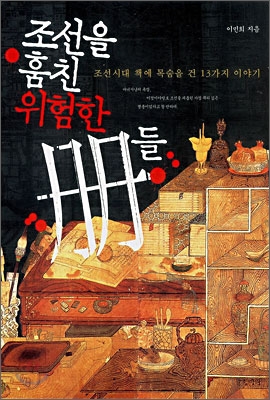
The Dangerous Books That Stole Joseon
 |
Description
Book Introduction
This book seeks to interpret the Joseon Dynasty by uncovering traces of various thoughts that we were unaware of or simply overlooked.
To this end, the author reconstructs the social history of the Joseon Dynasty through the material of ‘forbidden books.’
The history of books and authors who were labeled as schismatics clearly shows the thinking that was not incorporated into Neo-Confucianism.
Furthermore, by bringing in traces of confrontation with realistic life that remain even in books that conclude with Neo-Confucianism, it shows the 'splendid thoughts' of an era not as a single blank sheet of paper, but as a thick layer piled up one after another.
Just as we always see the internal characteristics of something fully revealed when we look at what is 'externalized,' we will be able to better understand the Joseon Dynasty through the 'external aspect of the era' that this book considers.
To this end, the author reconstructs the social history of the Joseon Dynasty through the material of ‘forbidden books.’
The history of books and authors who were labeled as schismatics clearly shows the thinking that was not incorporated into Neo-Confucianism.
Furthermore, by bringing in traces of confrontation with realistic life that remain even in books that conclude with Neo-Confucianism, it shows the 'splendid thoughts' of an era not as a single blank sheet of paper, but as a thick layer piled up one after another.
Just as we always see the internal characteristics of something fully revealed when we look at what is 'externalized,' we will be able to better understand the Joseon Dynasty through the 'external aspect of the era' that this book considers.
- You can preview some of the book's contents.
Preview
index
preface
Story One_ The Hunt for the Hun-gu Faction in the Sarim: The Incident of the Copying of the 『Seol Gong-chan-jeon』
Story 2: Why did Joseon block the sale of books?: The controversy over the establishment of a narrative in the mid-Joseon period and the Eodeukgang
Joseon's Book Story: "Spending Time on Meals and Napping Is a Pain": The Emergence of Bookstores and the Dawn of the Age of Public Reading
Story 3: Failed Snipers, Fueling Controversy: 『Gonjigi』, 『Lee Dan-byeonjeong』, 『Hakbu Tongbyeon』
A Story of Books in Joseon: What Would Recommended Books Have Looked Like in the Joseon Dynasty? - A Comparison of Hong Seok-ju and Yi Yulgok's Theories of Recommended Books
Story 4: Why did Confucian scholars study 'ghosts'? Jeong Yak-yong's "Lessons on the Doctrine of the Mean" deconstructed the Neo-Confucianist discussion of ghosts.
Story 5: The Books of Military Strategy Born from the Fear of the Samurai: From "Yeonbyeongjinam" to "Muyejebo"
A Story of Books in Joseon: Where Did Heo Gyun's Beloved Books Disappear?: The Trend of the Samchi Theory and Joseon's Book Culture
Story Six: The Book That Led a Brilliant Prince to His Death: The Simyangjanggye, a Record of Dangerous Changes
Story Seven: Why Did the Books of the East, Treasures, Fail to Save the People? From Donguibogam to Magwahoetong
Joseon's Book Story: Luring the Scholar Shin Jong-ho to Become a Gisaeng: The Monsters of Reading Created by the Saga Dokseoje
Story Eight_A Criticism to the Yangban Idealists: Seogye Park Se-dang's "Saebyeonrok" and "Saekgyeong"
Story Nine: The Scapegoats of Confucian Society, Burned Novels: Joseon Women, Reading Novels in Silence, Like Secret Societies
The Story of Joseon's Books: What the Ming Dynasty Didn't Have, Joseon Has - Officials Fascinated by Novels and Rare Books
Story Heat_ King Yeongjo's anger that stirred up a storm in the court: The "Myeonggijipyak" incident that killed the seeds of the bookworms
The Story of Books in Joseon: People Who Turn into Dogs When They Cross the River: The Importation of Books and Interpreters of the Ming and Qing Dynasties
Story 11_ The book most hated by Joseon's most intelligent king: The import of the Yangming Leftists of the Noron Cheongryu, including 『Wonjungrangjip』, and its frustration
Story Twelve: The Age of Encyclopedias in the 18th Century: The Encyclopedia Frenzy Among the Well-Learned Scholars
Book Stories from Joseon: Burying a Thousand Books in My Father's Grave: Book-Crazy People
Story 13_ The book that heralded the end of Joseon: The adventure surrounding "Joseon Strategy"
Note
Story One_ The Hunt for the Hun-gu Faction in the Sarim: The Incident of the Copying of the 『Seol Gong-chan-jeon』
Story 2: Why did Joseon block the sale of books?: The controversy over the establishment of a narrative in the mid-Joseon period and the Eodeukgang
Joseon's Book Story: "Spending Time on Meals and Napping Is a Pain": The Emergence of Bookstores and the Dawn of the Age of Public Reading
Story 3: Failed Snipers, Fueling Controversy: 『Gonjigi』, 『Lee Dan-byeonjeong』, 『Hakbu Tongbyeon』
A Story of Books in Joseon: What Would Recommended Books Have Looked Like in the Joseon Dynasty? - A Comparison of Hong Seok-ju and Yi Yulgok's Theories of Recommended Books
Story 4: Why did Confucian scholars study 'ghosts'? Jeong Yak-yong's "Lessons on the Doctrine of the Mean" deconstructed the Neo-Confucianist discussion of ghosts.
Story 5: The Books of Military Strategy Born from the Fear of the Samurai: From "Yeonbyeongjinam" to "Muyejebo"
A Story of Books in Joseon: Where Did Heo Gyun's Beloved Books Disappear?: The Trend of the Samchi Theory and Joseon's Book Culture
Story Six: The Book That Led a Brilliant Prince to His Death: The Simyangjanggye, a Record of Dangerous Changes
Story Seven: Why Did the Books of the East, Treasures, Fail to Save the People? From Donguibogam to Magwahoetong
Joseon's Book Story: Luring the Scholar Shin Jong-ho to Become a Gisaeng: The Monsters of Reading Created by the Saga Dokseoje
Story Eight_A Criticism to the Yangban Idealists: Seogye Park Se-dang's "Saebyeonrok" and "Saekgyeong"
Story Nine: The Scapegoats of Confucian Society, Burned Novels: Joseon Women, Reading Novels in Silence, Like Secret Societies
The Story of Joseon's Books: What the Ming Dynasty Didn't Have, Joseon Has - Officials Fascinated by Novels and Rare Books
Story Heat_ King Yeongjo's anger that stirred up a storm in the court: The "Myeonggijipyak" incident that killed the seeds of the bookworms
The Story of Books in Joseon: People Who Turn into Dogs When They Cross the River: The Importation of Books and Interpreters of the Ming and Qing Dynasties
Story 11_ The book most hated by Joseon's most intelligent king: The import of the Yangming Leftists of the Noron Cheongryu, including 『Wonjungrangjip』, and its frustration
Story Twelve: The Age of Encyclopedias in the 18th Century: The Encyclopedia Frenzy Among the Well-Learned Scholars
Book Stories from Joseon: Burying a Thousand Books in My Father's Grave: Book-Crazy People
Story 13_ The book that heralded the end of Joseon: The adventure surrounding "Joseon Strategy"
Note
Publisher's Review
The Joseon Dynasty as seen through books
Joseon is a country of Neo-Confucianism.
Neo-Confucianism was the only ideology that represented Joseon society.
Just as the Christian-dominated Middle Ages in the West are often described as a dark age, the 500-year history of Joseon is often defined as a controlled society where imagination was suppressed.
The Neo-Confucian order had many of the characteristics of a monotheistic society.
It acquired the characteristics of the same by excluding the other.
Just as medieval monks were enthusiastic about witch-hunting, Joseon Confucian scholars also used their pens and swords to eradicate dissident ideas.
The order of the Three Bonds and Five Relationships was the institutionalization of such political practices.
If we follow the practice of studying the history of thought, which is built around doctrines and debates, we can see at a glance the process by which Joseon was transformed into an ideological machine.
The process of introducing Neo-Confucianism at the end of the Goryeo Dynasty, completing the framework of Gyeongguk Daejeon during the reign of King Seongjong, and then going through the Yesong and Igi debates to reach the conclusion of Silhak is a story that is very familiar to us.
However, by developing arguments centered on the classics of Confucianism and then expanding upon them with opposing or minority theories, thereby creating a dynamic of thought, the structure of the argument can only ultimately produce a picture that rationalizes the winners.
Furthermore, while the exact counterpart of the ceasefire may receive some degree of re-examination, there is also a risk that the numerous reasons for existing alone as independent forces will be left behind in the past without being able to be included in the flow of ideological history.
If that were the case, how much of a tautology would the history of our thinking be?
"The Dangerous Books That Stole Joseon" is a fundamental attempt to move beyond the history of thought through monologue to depict a history of thought through dialogue and struggle.
I wanted to find traces of various thoughts from the Joseon Dynasty that we were not aware of or that we simply passed over, and interpret that era through his eyes and mouth.
In that way, the book took the form of a kind of social history of banned books.
The history of books and authors who were labeled as schismatics best illustrates the thinking that was not incorporated into Neo-Confucianism.
However, the subversive reasons of Joseon cannot be fully depicted with just 'witches'.
If we look more closely and search through them, we often find that the secrets of the times are depicted even in colorless, transparent, and ordinary books.
Even in books that ultimately lead to Neo-Confucianism, we can see traces of a subconscious confrontation with the realities of life at the time, but ultimately a confession of compromise that followed the logic of power.
In this book, I actively included their existence to overcome the uniformity and boredom that can easily lead to the history of forbidden books.
Main contents of each chapter
1.
The Sarim's Hunt for the Hungu Faction: The Incident of the Copying of the "Seol Gongchanjeon"
This is the story of Chae Su (1449-1515), who was dismissed from office during the reign of King Jungjong for writing a novel called “Seol Gong Chan Jeon.”
The first novel written in Korean, 『Seol Gong Chan Jeon』, was confiscated and burned because it contained criticism of the Buddhist idea of reincarnation and the king, and Chae Su was dismissed from office, which ended the incident. However, this incident resulted in Joseon novels becoming uniform and conformed to Confucian ideology.
The author delves into the question of why 『Seol Gong Chan Jeon』 was created.
It is found in the genius of the character Chae-su, the experiential truth of experiencing ghost phenomena as a child, and his political career.
Through this process, the author highlights that 『Seol Gong-chan-jeon』 is the first signal of ideological hunting by the Sarim faction.
2.
Why did Joseon block the sale of books?: The controversy over the establishment of a bookstore in the mid-Joseon period and the Eodeukgang
This is a story that serves as the introduction to this book.
By the mid-Joseon Dynasty, the social desire for knowledge had reached a boiling point, and the need for full-scale distribution of books through bookstores had grown beyond simply obtaining books one by one.
However, vested interest scholars of Neo-Confucianism continued to ignore repeated demands for the establishment of a narrative.
The reasons they put forward for their opposition were that it was inappropriate to commercially buy and sell books inherited from ancestors and that it was a custom that had never been passed down before, but in reality, they were concerned that the expansion of the literate clan would shake the foundation of Neo-Confucian rule.
The author focuses on reconstructing the process by which Eo Deuk-gang (1470-1550), who was also Toegye's teacher, persistently advocated for the establishment of a narrative for several decades starting from his youth, and how this was rejected, while also revealing the double standards of the yangban class at the time.
3.
Failed Snipers Fuel Controversy: "Gonjigi," "Idanbyeonjeong," and "Hakbu Tongbyeon"
This chapter deals with the criticism of Yangmingism in Neo-Confucianism.
When Joseon's history had just passed its halfway point, the national framework gradually became complete and the national ideology began to solidify.
However, the framework of Confucian politics was broken and many Neo-Confucian books were lost due to the ideological suppression of the Yeonsangun army and the great fire of the Jungjong era.
The hardened Confucian scholars were solely focused on rebuilding the Neo-Confucian order, which resulted in the formation of factions and the emergence of movements to reject heresy.
Books criticizing Yangmingism, such as Cheomneung's "Idanbyeonjeong," Na Heumsun's "Gonjigi," and Jin Geon's "Hakbu Tongbyeon," were imported and began to control the intellectual world.
The author makes an interesting point in this process.
Although these books were critical of Yangmingism, they had the effect of introducing valuable Chinese ideological books that were previously unknown in Joseon, and this further amplified the desire for knowledge, which in turn further strengthened the non-establishment forces studying Yangmingism.
Let's go through the process.
4.
Why did Confucian scholars study 'ghosts'? Jeong Yak-yong's "Lessons on the Doctrine of the Mean" deconstructed the Neo-Confucianist discussion of ghosts.
The arguments of Neo-Confucian scholars who attempted to clarify the relationship between the body and the phenomenon became increasingly abstract and ambiguous in the late Joseon Dynasty.
This was especially true of discussions about ghosts.
Because Joseon was a country that practiced ancestral rites, it was necessary to investigate what ghosts were and what kind of relationship they had with living people.
The author examines the theory of ghosts in Neo-Confucianism, which began in Nam Hyo-on (1454-1492)'s 『Chu-gang-jip』, and continues through Seo Gyeong-deok, Yi Hwang, and Im Seong-ju.
But what we are looking at here is a logical dilemma where we can either acknowledge or reject ghosts.
Because ghosts belonged to energy, and what Neo-Confucianism followed was principle.
The person who broke this framework was Jeong Yak-yong.
Jeong Yak-yong developed the theory of Emperor Shang in his 『Doctrine of the Mean』, which brought the issue of ghosts out of the philosophical system that was completely blocked by principles and principles and moved it into the religious realm for discussion.
Jeong Yak-yong, who had been baptized into Catholicism at an early age, superficially concealed his influence, but he transformed the structure of absolute God and temporary human beings and accepted it within the Neo-Confucian system.
5.
The Fear of the Samurai Gave Birth to the Books of Military Strategy: From "Yeonbyeongjinam" to "Muyejebo"
We are examining the life and writings of Han Gyo (1556-1627), a Neo-Confucian scholar and military strategist during the reign of King Seonjo.
When the Imjin War broke out, Hankyo was at the center of rebuilding and rebuilding the Joseon military system that had been ruthlessly destroyed.
He translated a series of military strategy books (such as 『Gihyo Shinseo』) written by Qi Jiguang of the Ming Dynasty into Korean and wrote 『Muye Jebo』 and 『Yeonbyeong Jinam』, which contained optimized knowledge for subduing real-life enemies such as the Japanese pirates and Jurchen.
However, the Joseon government would call in Han Gyo when necessary and urge him to write military books and train the military, but when the enemy retreated, they forgot the urgent situation and impeached Han Gyo using political logic.
Hangyo was eventually removed, and if you look closely at the reason for his impeachment, it was because he was an expert who knew Joseon's military reality very intimately.
6.
The Book That Led a Brilliant Prince to His Death: The Simyangjanggye, a Record of Dangerous Changes
『Simyang Janggye』 is a book that contains the reports to the Joseon court of the events that occurred during the eight years that Crown Prince Sohyeon and his party, who were taken to the Qing Dynasty after the humiliation of the Three Jeondo Wars, stayed in Shenyang, Qing Dynasty.
The Crown Prince's party discussed the Qing Dynasty's request for troops and the repatriation of prisoners of war on behalf of King Injo, who was afraid of the Qing Dynasty, and served as a diplomatic channel for the normalization of diplomatic relations.
In the process, there were conflicts and arguments at first, but gradually the crown prince's outstanding diplomatic skills captivated the Qing king and high-ranking officials.
In addition, as Prince Sohyeon accepted the international order of East Asia, which was being reorganized around the Qing Dynasty at the time, and the Western natural science knowledge that was being transmitted by Western missionaries who landed in Beijing, he was shown to have received very realistic and international lessons from a king in an enemy country.
The 『Simyang Janggye』, which contained all of these contents, made King Injo uneasy, and he ended up fearing that the Qing royal family would overthrow him and place the crown prince on the throne.
Prince Sohyeon dies after returning to his country.
We examine the main contents of the book, "Simyangjanggye," which contains great but dangerous changes, and its tragic historical significance.
7.
Why Didn't the Treasures of the East Save the People? From the Donguibogam to the Magwahoetong
After the Imjin War, Joseon's medical institutions were paralyzed.
When an epidemic broke out, medicine was unavailable, treatment was difficult, and isolation and death were the order of the day.
『Donguibogam』 was a national medical book compilation project to deal with this situation.
This book, which compiled the latest Chinese medical knowledge and Joseon's experience, was exported to China and Japan and gained widespread fame.
However, the author points out that because Donguibogam is a medical book based on personal health techniques, it is inadequate in effectively dealing with infectious diseases.
Measles and smallpox were not infectious diseases that could be cured through personal health practices.
To effectively deal with this, appropriate social action was needed.
There had to be clean isolation facilities, timely arrival of supplies and medicines, and an emergency medical system to coordinate them.
But in Joseon, there was nothing like this.
The author uses the unrealistic and enormous medical system called Donguibogam as an allegory to show how the upper class of Joseon was blind to the reality of the common people.
On the other hand, works such as 『Magwahoetong』 and 『Uiryeong』 written by Jeong Yak-yong are considered to be products of practical knowledge that can be considered from the opposite perspective.
This is because Jeong Yak-yong was a father who lost six children to smallpox and infectious diseases.
8.
A Criticism of Yangban Idealists: Seogye Park Se-dang's "Saebyeonrok" and "Saekgyeong"
The life and writing activities of Seogye Park Se-dang were highlighted.
There was a time when the policy tasks of intellectuals were focused on rebuilding a country devastated both internally and externally after the Byeongja Horan.
Seogye Park Se-dang held important positions during this period and advocated for reform of the caste and land systems, distinction between the roles of the king and his subjects, and a pragmatic reinterpretation of the classics, but was ultimately suppressed for his sectarianism.
What 『Sibyeonrok』 rejected was the system of the Four Books and Three Classics completed by Zhu Xi during the Southern Song Dynasty.
Park Se-dang respected the original intentions of Confucius and Mencius.
Park Se-dang believed that Zhu Xi of the Song Dynasty had interpreted the meaning of the scriptures arbitrarily.
Although Ju Hee said, “Nature is principle,” Park Se-dang rejected this most fundamental proposition of Zhu Xi’s teachings.
Park Se-dang argued that the objective nature of things and the moral subject of humans should be separated, and that things should be viewed separately from morality.
『Saekgyeong』, which explored farming methods, was the first book in Joseon to give the name of Gyeong to labor practices.
Park Se-dang proposed reforms that required the yangban class to participate in production activities and that the tax system should be reformed to eliminate inequality among social classes.
Although 『Saekgyeong』 is a book that deals with agricultural techniques, it was written under this ideological perspective.
9.
Scapegoats of Confucian Society, Burned Novels: Joseon Women, Reading Novels in Silence, Like Secret Societies
Why did the aristocrats and male writers have to deny the very existence of women's novel reading?
The author solves the problem here.
The practical reason was that they were squandering their family fortune and neglecting their household duties, but more fundamentally, there was an unconscious fear that women would grow up to be literate members of the masses, that is, members of the clan.
Because most novels contain content that deviates even slightly from the existing social order, if such deviant thinking becomes established as common sense, the void left behind after the deviation can become permanent.
Girard said that if the conflict between the pairs is not controlled, they fall into a vicious cycle of perpetual mutual violence.
Joseon's literary style and factional strife are very similar to that.
Whether it was Song Si-yeol or Yi Hwang who brought Neo-Confucianism to fruition, Lee Deok-mu who advocated for freedom of writing, or Jeong Yak-yong who valued the practice of statecraft, they were all Confucian scholars.
Just as Confucianism is called a religion for this world, their common goal was to perfect their worldly lives ethically and institutionally.
But writing drew women in a completely different direction.
It was a new desire for a life defined by obscenity and speculation, and reading as play and consolation.
It was the birth of a thought that embraces and compromises, rather than a thought that serves as an ethical whip.
Just as Christian society relied on scapegoats to end community conflicts and crises, when the two tendencies of Joseon Confucianism ran into a vicious cycle of incompatibility and the intellectualization of mutual attacks, women's novel reading was chosen and denounced as a scapegoat to mask the barrenness of the conflict.
10.
King Yeongjo's fury that stirred up a storm in the court: The "Myeonggijipyak" incident that killed the seeds of the bookworms.
It deals with the Myeonggi Jipryak incident that occurred during the reign of King Yeongjo.
This incident, in which countless noblemen and scholars were executed, was due to the 『Mingji Zhiyue』 written by Zhu Lin of China.
It contained content that slandered the royal family, such as claiming that King Taejo of Joseon was the son of a traitor.
One day, King Yeongjo was informed that this book was being distributed, and he was so angry that he arrested those involved. Lee Hee-cheon, a close friend of Park Ji-won of Yeonam, was captured and killed.
The book dealers who distributed these books were also wiped out, so much so that it was impossible to find a book dealer in the city.
However, the author reveals that King Yeongjo enjoyed reading history books written by people with disabilities, executed people who did not even know how to read and interpret, and did not raise any issues with royal relatives, thus revealing that the law was not applied appropriately.
Furthermore, it is emphasized that although the 『Myeonggijipyak』 incident was a tragedy, it provides insight into how books were distributed in Joseon.
11.
The book most hated by Joseon's most intelligent king: The import and subsequent frustration of the Yangming Leftists of the Noron Cheongryu, including "Wonjungrangjip"
Through the Munchebanjeong, King Jeongjo criticized the writing of intellectuals who were "worried, trembling, impatient, and eccentric."
In particular, he attacked Yuan Hongdu, a member of the Chinese Gongan faction, as the culprit in his collection of writings, Yuan Zhonglangji.
The Chinese Gong'an faction communicated with intellectuals from the non-mainstream Noron and Namin factions in Joseon, and this was a meeting of the leftists of both countries.
Joseon intellectuals were fascinated by the 『Wonjungrangjip』, which broke away from the rigid system of classical literature and freely expressed individual thoughts.
But I didn't follow it unconditionally.
By introducing the Qing Dynasty's realistic Silhak and textual criticism, represented by Go Yeom-mu's 『Iljirok』, he reexamined the history of Joseon and also actively promoted realistic scholarship.
However, the author points out that King Jeongjo's literary reforms crushed this movement before it could even mature, thereby blocking the opportunity for Joseon intellectuals to deepen their own debates.
12.
The 18th Century ushered in the age of encyclopedias: The craze for encyclopedias among learned scholars.
The 18th and 19th centuries in Joseon were a time of great enthusiasm for accumulating knowledge, like the Tower of Babel.
The author describes not only well-known Joseon encyclopedias such as 『Imwon Gyeongjeji』 and 『Ojuyeonmunjangjeonsango』, but also numerous intellectual adventures planned but not yet written during this period, intertwined with the transformative period of the 18th century.
The author illuminates that while encyclopedias, a product of the Western Enlightenment, were armed with scientism and embedded with the economic motivation of colonial development, the encyclopedias of Joseon, a tranquil Eastern country, were like a gathering place for intellectual guerrillas who, by mixing contemporary political columns and essays on daily life with vast historical knowledge, counter-currently destroyed existing authority and unnecessary institutions.
In any case, from the perspective of the urgent times, intellectual labor like encyclopedias can seem like idle pursuit of empty dreams.
In that sense, it is true that the craze for compiling encyclopedias in the 18th and 19th centuries could be seen as a feast of vague and fat books that had lost their realistic referents, crushed by greed and the desire for pedantry.
However, the author's view is that it might not have been another expression of literature that only that era dreamed of.
Just as the painful journey of humans in search of a perfect world that has disappeared in the Lukacsian sense, and the romantic irony of ultimately painfully realizing that they will never reach their hometown, are beautiful narratives, shouldn't their frustrated dreams also be accepted in the same way?
13.
The book that heralded the end of Joseon: The adventure surrounding "Joseon Strategy"
Kim Hong-jip, who went to Japan during the reign of King Gojong, brought back a book.
It is 『Joseon Strategy』 written by Qing Dynasty diplomat Huang Zunxian.
This book contained arguments for checking Russia and uniting with Qing, Japan, and the United States. King Gojong selectively accepted these contents, and this served as an opportunity for the Yeongnam Confucian scholars to submit a petition and stir up the political situation.
Through "Joseon Strategy," the author illuminates the gap in perception between the royal family and the intellectual class, demonstrating that the Joseon royal family's policy of suppressing and controlling thought further isolated Joseon by blocking the distribution of diverse information and the formation and development of political discourse.
It is also pointed out that it was a watershed moment that brought together conservative forces across the country and called for the expulsion of Japanese imperialism with one voice, dividing the political situation of the country's opening into a confrontation between those advocating for the opening of ports and those advocating for the expulsion of Japanese imperialism.
In addition, it is analyzed that 『Joseon Strategy』 formed the origin of the positive image of the United States that later spread throughout Korean society.
Joseon is a country of Neo-Confucianism.
Neo-Confucianism was the only ideology that represented Joseon society.
Just as the Christian-dominated Middle Ages in the West are often described as a dark age, the 500-year history of Joseon is often defined as a controlled society where imagination was suppressed.
The Neo-Confucian order had many of the characteristics of a monotheistic society.
It acquired the characteristics of the same by excluding the other.
Just as medieval monks were enthusiastic about witch-hunting, Joseon Confucian scholars also used their pens and swords to eradicate dissident ideas.
The order of the Three Bonds and Five Relationships was the institutionalization of such political practices.
If we follow the practice of studying the history of thought, which is built around doctrines and debates, we can see at a glance the process by which Joseon was transformed into an ideological machine.
The process of introducing Neo-Confucianism at the end of the Goryeo Dynasty, completing the framework of Gyeongguk Daejeon during the reign of King Seongjong, and then going through the Yesong and Igi debates to reach the conclusion of Silhak is a story that is very familiar to us.
However, by developing arguments centered on the classics of Confucianism and then expanding upon them with opposing or minority theories, thereby creating a dynamic of thought, the structure of the argument can only ultimately produce a picture that rationalizes the winners.
Furthermore, while the exact counterpart of the ceasefire may receive some degree of re-examination, there is also a risk that the numerous reasons for existing alone as independent forces will be left behind in the past without being able to be included in the flow of ideological history.
If that were the case, how much of a tautology would the history of our thinking be?
"The Dangerous Books That Stole Joseon" is a fundamental attempt to move beyond the history of thought through monologue to depict a history of thought through dialogue and struggle.
I wanted to find traces of various thoughts from the Joseon Dynasty that we were not aware of or that we simply passed over, and interpret that era through his eyes and mouth.
In that way, the book took the form of a kind of social history of banned books.
The history of books and authors who were labeled as schismatics best illustrates the thinking that was not incorporated into Neo-Confucianism.
However, the subversive reasons of Joseon cannot be fully depicted with just 'witches'.
If we look more closely and search through them, we often find that the secrets of the times are depicted even in colorless, transparent, and ordinary books.
Even in books that ultimately lead to Neo-Confucianism, we can see traces of a subconscious confrontation with the realities of life at the time, but ultimately a confession of compromise that followed the logic of power.
In this book, I actively included their existence to overcome the uniformity and boredom that can easily lead to the history of forbidden books.
Main contents of each chapter
1.
The Sarim's Hunt for the Hungu Faction: The Incident of the Copying of the "Seol Gongchanjeon"
This is the story of Chae Su (1449-1515), who was dismissed from office during the reign of King Jungjong for writing a novel called “Seol Gong Chan Jeon.”
The first novel written in Korean, 『Seol Gong Chan Jeon』, was confiscated and burned because it contained criticism of the Buddhist idea of reincarnation and the king, and Chae Su was dismissed from office, which ended the incident. However, this incident resulted in Joseon novels becoming uniform and conformed to Confucian ideology.
The author delves into the question of why 『Seol Gong Chan Jeon』 was created.
It is found in the genius of the character Chae-su, the experiential truth of experiencing ghost phenomena as a child, and his political career.
Through this process, the author highlights that 『Seol Gong-chan-jeon』 is the first signal of ideological hunting by the Sarim faction.
2.
Why did Joseon block the sale of books?: The controversy over the establishment of a bookstore in the mid-Joseon period and the Eodeukgang
This is a story that serves as the introduction to this book.
By the mid-Joseon Dynasty, the social desire for knowledge had reached a boiling point, and the need for full-scale distribution of books through bookstores had grown beyond simply obtaining books one by one.
However, vested interest scholars of Neo-Confucianism continued to ignore repeated demands for the establishment of a narrative.
The reasons they put forward for their opposition were that it was inappropriate to commercially buy and sell books inherited from ancestors and that it was a custom that had never been passed down before, but in reality, they were concerned that the expansion of the literate clan would shake the foundation of Neo-Confucian rule.
The author focuses on reconstructing the process by which Eo Deuk-gang (1470-1550), who was also Toegye's teacher, persistently advocated for the establishment of a narrative for several decades starting from his youth, and how this was rejected, while also revealing the double standards of the yangban class at the time.
3.
Failed Snipers Fuel Controversy: "Gonjigi," "Idanbyeonjeong," and "Hakbu Tongbyeon"
This chapter deals with the criticism of Yangmingism in Neo-Confucianism.
When Joseon's history had just passed its halfway point, the national framework gradually became complete and the national ideology began to solidify.
However, the framework of Confucian politics was broken and many Neo-Confucian books were lost due to the ideological suppression of the Yeonsangun army and the great fire of the Jungjong era.
The hardened Confucian scholars were solely focused on rebuilding the Neo-Confucian order, which resulted in the formation of factions and the emergence of movements to reject heresy.
Books criticizing Yangmingism, such as Cheomneung's "Idanbyeonjeong," Na Heumsun's "Gonjigi," and Jin Geon's "Hakbu Tongbyeon," were imported and began to control the intellectual world.
The author makes an interesting point in this process.
Although these books were critical of Yangmingism, they had the effect of introducing valuable Chinese ideological books that were previously unknown in Joseon, and this further amplified the desire for knowledge, which in turn further strengthened the non-establishment forces studying Yangmingism.
Let's go through the process.
4.
Why did Confucian scholars study 'ghosts'? Jeong Yak-yong's "Lessons on the Doctrine of the Mean" deconstructed the Neo-Confucianist discussion of ghosts.
The arguments of Neo-Confucian scholars who attempted to clarify the relationship between the body and the phenomenon became increasingly abstract and ambiguous in the late Joseon Dynasty.
This was especially true of discussions about ghosts.
Because Joseon was a country that practiced ancestral rites, it was necessary to investigate what ghosts were and what kind of relationship they had with living people.
The author examines the theory of ghosts in Neo-Confucianism, which began in Nam Hyo-on (1454-1492)'s 『Chu-gang-jip』, and continues through Seo Gyeong-deok, Yi Hwang, and Im Seong-ju.
But what we are looking at here is a logical dilemma where we can either acknowledge or reject ghosts.
Because ghosts belonged to energy, and what Neo-Confucianism followed was principle.
The person who broke this framework was Jeong Yak-yong.
Jeong Yak-yong developed the theory of Emperor Shang in his 『Doctrine of the Mean』, which brought the issue of ghosts out of the philosophical system that was completely blocked by principles and principles and moved it into the religious realm for discussion.
Jeong Yak-yong, who had been baptized into Catholicism at an early age, superficially concealed his influence, but he transformed the structure of absolute God and temporary human beings and accepted it within the Neo-Confucian system.
5.
The Fear of the Samurai Gave Birth to the Books of Military Strategy: From "Yeonbyeongjinam" to "Muyejebo"
We are examining the life and writings of Han Gyo (1556-1627), a Neo-Confucian scholar and military strategist during the reign of King Seonjo.
When the Imjin War broke out, Hankyo was at the center of rebuilding and rebuilding the Joseon military system that had been ruthlessly destroyed.
He translated a series of military strategy books (such as 『Gihyo Shinseo』) written by Qi Jiguang of the Ming Dynasty into Korean and wrote 『Muye Jebo』 and 『Yeonbyeong Jinam』, which contained optimized knowledge for subduing real-life enemies such as the Japanese pirates and Jurchen.
However, the Joseon government would call in Han Gyo when necessary and urge him to write military books and train the military, but when the enemy retreated, they forgot the urgent situation and impeached Han Gyo using political logic.
Hangyo was eventually removed, and if you look closely at the reason for his impeachment, it was because he was an expert who knew Joseon's military reality very intimately.
6.
The Book That Led a Brilliant Prince to His Death: The Simyangjanggye, a Record of Dangerous Changes
『Simyang Janggye』 is a book that contains the reports to the Joseon court of the events that occurred during the eight years that Crown Prince Sohyeon and his party, who were taken to the Qing Dynasty after the humiliation of the Three Jeondo Wars, stayed in Shenyang, Qing Dynasty.
The Crown Prince's party discussed the Qing Dynasty's request for troops and the repatriation of prisoners of war on behalf of King Injo, who was afraid of the Qing Dynasty, and served as a diplomatic channel for the normalization of diplomatic relations.
In the process, there were conflicts and arguments at first, but gradually the crown prince's outstanding diplomatic skills captivated the Qing king and high-ranking officials.
In addition, as Prince Sohyeon accepted the international order of East Asia, which was being reorganized around the Qing Dynasty at the time, and the Western natural science knowledge that was being transmitted by Western missionaries who landed in Beijing, he was shown to have received very realistic and international lessons from a king in an enemy country.
The 『Simyang Janggye』, which contained all of these contents, made King Injo uneasy, and he ended up fearing that the Qing royal family would overthrow him and place the crown prince on the throne.
Prince Sohyeon dies after returning to his country.
We examine the main contents of the book, "Simyangjanggye," which contains great but dangerous changes, and its tragic historical significance.
7.
Why Didn't the Treasures of the East Save the People? From the Donguibogam to the Magwahoetong
After the Imjin War, Joseon's medical institutions were paralyzed.
When an epidemic broke out, medicine was unavailable, treatment was difficult, and isolation and death were the order of the day.
『Donguibogam』 was a national medical book compilation project to deal with this situation.
This book, which compiled the latest Chinese medical knowledge and Joseon's experience, was exported to China and Japan and gained widespread fame.
However, the author points out that because Donguibogam is a medical book based on personal health techniques, it is inadequate in effectively dealing with infectious diseases.
Measles and smallpox were not infectious diseases that could be cured through personal health practices.
To effectively deal with this, appropriate social action was needed.
There had to be clean isolation facilities, timely arrival of supplies and medicines, and an emergency medical system to coordinate them.
But in Joseon, there was nothing like this.
The author uses the unrealistic and enormous medical system called Donguibogam as an allegory to show how the upper class of Joseon was blind to the reality of the common people.
On the other hand, works such as 『Magwahoetong』 and 『Uiryeong』 written by Jeong Yak-yong are considered to be products of practical knowledge that can be considered from the opposite perspective.
This is because Jeong Yak-yong was a father who lost six children to smallpox and infectious diseases.
8.
A Criticism of Yangban Idealists: Seogye Park Se-dang's "Saebyeonrok" and "Saekgyeong"
The life and writing activities of Seogye Park Se-dang were highlighted.
There was a time when the policy tasks of intellectuals were focused on rebuilding a country devastated both internally and externally after the Byeongja Horan.
Seogye Park Se-dang held important positions during this period and advocated for reform of the caste and land systems, distinction between the roles of the king and his subjects, and a pragmatic reinterpretation of the classics, but was ultimately suppressed for his sectarianism.
What 『Sibyeonrok』 rejected was the system of the Four Books and Three Classics completed by Zhu Xi during the Southern Song Dynasty.
Park Se-dang respected the original intentions of Confucius and Mencius.
Park Se-dang believed that Zhu Xi of the Song Dynasty had interpreted the meaning of the scriptures arbitrarily.
Although Ju Hee said, “Nature is principle,” Park Se-dang rejected this most fundamental proposition of Zhu Xi’s teachings.
Park Se-dang argued that the objective nature of things and the moral subject of humans should be separated, and that things should be viewed separately from morality.
『Saekgyeong』, which explored farming methods, was the first book in Joseon to give the name of Gyeong to labor practices.
Park Se-dang proposed reforms that required the yangban class to participate in production activities and that the tax system should be reformed to eliminate inequality among social classes.
Although 『Saekgyeong』 is a book that deals with agricultural techniques, it was written under this ideological perspective.
9.
Scapegoats of Confucian Society, Burned Novels: Joseon Women, Reading Novels in Silence, Like Secret Societies
Why did the aristocrats and male writers have to deny the very existence of women's novel reading?
The author solves the problem here.
The practical reason was that they were squandering their family fortune and neglecting their household duties, but more fundamentally, there was an unconscious fear that women would grow up to be literate members of the masses, that is, members of the clan.
Because most novels contain content that deviates even slightly from the existing social order, if such deviant thinking becomes established as common sense, the void left behind after the deviation can become permanent.
Girard said that if the conflict between the pairs is not controlled, they fall into a vicious cycle of perpetual mutual violence.
Joseon's literary style and factional strife are very similar to that.
Whether it was Song Si-yeol or Yi Hwang who brought Neo-Confucianism to fruition, Lee Deok-mu who advocated for freedom of writing, or Jeong Yak-yong who valued the practice of statecraft, they were all Confucian scholars.
Just as Confucianism is called a religion for this world, their common goal was to perfect their worldly lives ethically and institutionally.
But writing drew women in a completely different direction.
It was a new desire for a life defined by obscenity and speculation, and reading as play and consolation.
It was the birth of a thought that embraces and compromises, rather than a thought that serves as an ethical whip.
Just as Christian society relied on scapegoats to end community conflicts and crises, when the two tendencies of Joseon Confucianism ran into a vicious cycle of incompatibility and the intellectualization of mutual attacks, women's novel reading was chosen and denounced as a scapegoat to mask the barrenness of the conflict.
10.
King Yeongjo's fury that stirred up a storm in the court: The "Myeonggijipyak" incident that killed the seeds of the bookworms.
It deals with the Myeonggi Jipryak incident that occurred during the reign of King Yeongjo.
This incident, in which countless noblemen and scholars were executed, was due to the 『Mingji Zhiyue』 written by Zhu Lin of China.
It contained content that slandered the royal family, such as claiming that King Taejo of Joseon was the son of a traitor.
One day, King Yeongjo was informed that this book was being distributed, and he was so angry that he arrested those involved. Lee Hee-cheon, a close friend of Park Ji-won of Yeonam, was captured and killed.
The book dealers who distributed these books were also wiped out, so much so that it was impossible to find a book dealer in the city.
However, the author reveals that King Yeongjo enjoyed reading history books written by people with disabilities, executed people who did not even know how to read and interpret, and did not raise any issues with royal relatives, thus revealing that the law was not applied appropriately.
Furthermore, it is emphasized that although the 『Myeonggijipyak』 incident was a tragedy, it provides insight into how books were distributed in Joseon.
11.
The book most hated by Joseon's most intelligent king: The import and subsequent frustration of the Yangming Leftists of the Noron Cheongryu, including "Wonjungrangjip"
Through the Munchebanjeong, King Jeongjo criticized the writing of intellectuals who were "worried, trembling, impatient, and eccentric."
In particular, he attacked Yuan Hongdu, a member of the Chinese Gongan faction, as the culprit in his collection of writings, Yuan Zhonglangji.
The Chinese Gong'an faction communicated with intellectuals from the non-mainstream Noron and Namin factions in Joseon, and this was a meeting of the leftists of both countries.
Joseon intellectuals were fascinated by the 『Wonjungrangjip』, which broke away from the rigid system of classical literature and freely expressed individual thoughts.
But I didn't follow it unconditionally.
By introducing the Qing Dynasty's realistic Silhak and textual criticism, represented by Go Yeom-mu's 『Iljirok』, he reexamined the history of Joseon and also actively promoted realistic scholarship.
However, the author points out that King Jeongjo's literary reforms crushed this movement before it could even mature, thereby blocking the opportunity for Joseon intellectuals to deepen their own debates.
12.
The 18th Century ushered in the age of encyclopedias: The craze for encyclopedias among learned scholars.
The 18th and 19th centuries in Joseon were a time of great enthusiasm for accumulating knowledge, like the Tower of Babel.
The author describes not only well-known Joseon encyclopedias such as 『Imwon Gyeongjeji』 and 『Ojuyeonmunjangjeonsango』, but also numerous intellectual adventures planned but not yet written during this period, intertwined with the transformative period of the 18th century.
The author illuminates that while encyclopedias, a product of the Western Enlightenment, were armed with scientism and embedded with the economic motivation of colonial development, the encyclopedias of Joseon, a tranquil Eastern country, were like a gathering place for intellectual guerrillas who, by mixing contemporary political columns and essays on daily life with vast historical knowledge, counter-currently destroyed existing authority and unnecessary institutions.
In any case, from the perspective of the urgent times, intellectual labor like encyclopedias can seem like idle pursuit of empty dreams.
In that sense, it is true that the craze for compiling encyclopedias in the 18th and 19th centuries could be seen as a feast of vague and fat books that had lost their realistic referents, crushed by greed and the desire for pedantry.
However, the author's view is that it might not have been another expression of literature that only that era dreamed of.
Just as the painful journey of humans in search of a perfect world that has disappeared in the Lukacsian sense, and the romantic irony of ultimately painfully realizing that they will never reach their hometown, are beautiful narratives, shouldn't their frustrated dreams also be accepted in the same way?
13.
The book that heralded the end of Joseon: The adventure surrounding "Joseon Strategy"
Kim Hong-jip, who went to Japan during the reign of King Gojong, brought back a book.
It is 『Joseon Strategy』 written by Qing Dynasty diplomat Huang Zunxian.
This book contained arguments for checking Russia and uniting with Qing, Japan, and the United States. King Gojong selectively accepted these contents, and this served as an opportunity for the Yeongnam Confucian scholars to submit a petition and stir up the political situation.
Through "Joseon Strategy," the author illuminates the gap in perception between the royal family and the intellectual class, demonstrating that the Joseon royal family's policy of suppressing and controlling thought further isolated Joseon by blocking the distribution of diverse information and the formation and development of political discourse.
It is also pointed out that it was a watershed moment that brought together conservative forces across the country and called for the expulsion of Japanese imperialism with one voice, dividing the political situation of the country's opening into a confrontation between those advocating for the opening of ports and those advocating for the expulsion of Japanese imperialism.
In addition, it is analyzed that 『Joseon Strategy』 formed the origin of the positive image of the United States that later spread throughout Korean society.
GOODS SPECIFICS
- Date of issue: June 23, 2008
- Page count, weight, size: 383 pages | 658g | 153*224*30mm
- ISBN13: 9788954605922
- ISBN10: 8954605923
You may also like
카테고리
korean


korean

![ELLE 엘르 스페셜 에디션 A형 : 12월 [2025]](http://librairie.coreenne.fr/cdn/shop/files/b8e27a3de6c9538896439686c6b0e8fb.jpg?v=1766436872&width=3840)


