

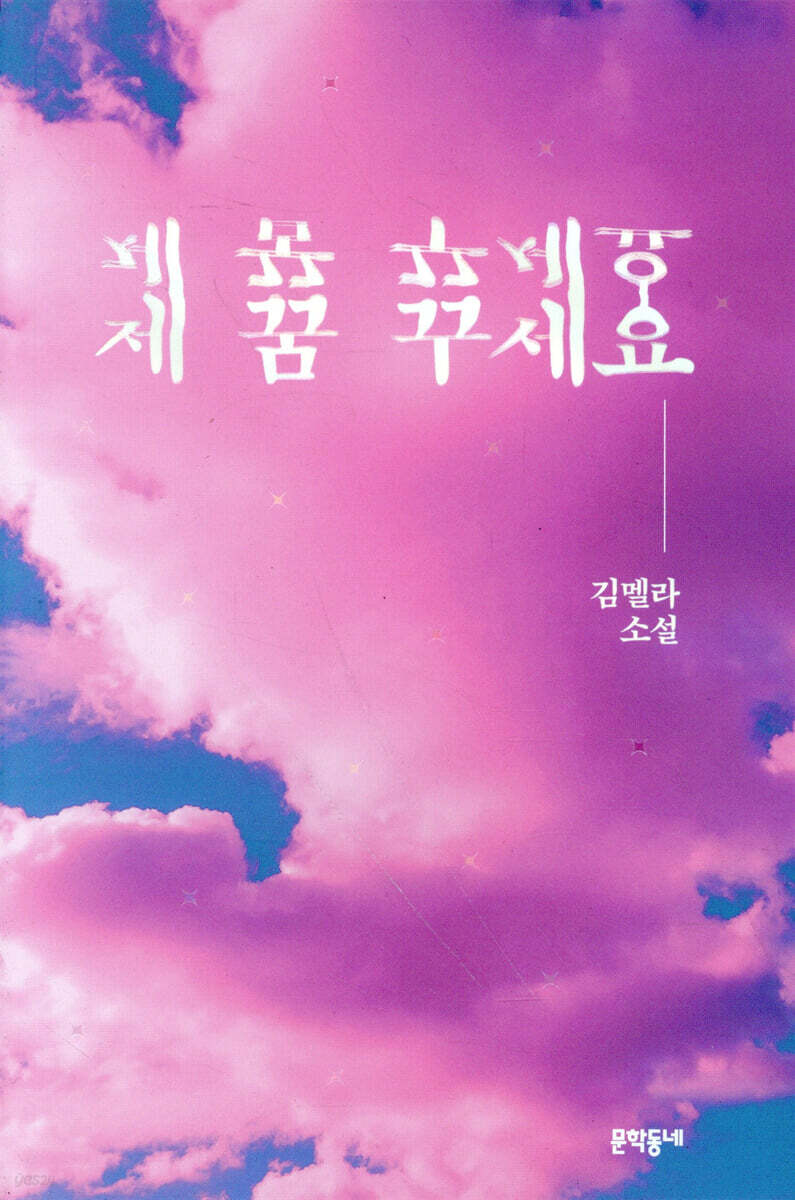
Dream of me
 |
Description
Book Introduction
“It naturally incites love, so I can’t help but join in with a pounding heart. “There has never been such bold and cheerful lyricism.” _Pyeon Hye-young (novelist) 2022 Young Writer Award Winner “Evening Glow” Includes the 2021 Munji Literary Award and Young Writer Award winner, "The Leaves Are Drying" Like a dream world that powerfully immerses us with its lovely and mysterious power, Kim Mela's second short story collection, "Dream of Me," which transparently illuminates our present through lively questions that stimulate the imagination, has been published by Munhakdongne. Kim Mela is one of the most actively promoted novelists among various writers and critics in recent years, and has achieved extraordinary success by releasing works with a wide spectrum of genres each season. “I was overwhelmed by the character of ‘Che,’ who speaks with all her might, laughs with all her might, and walks at her own pace” (novelist Lee Seung-woo), “Kim Mela shows amazing strength in pushing forward her own unique sense of problem while expanding it without hesitation” (literary critic Kim Bo-kyung), and “The Leaves Are Drying,” which won the 12th Young Writer’s Award and the 11th Munji Literary Award in succession; “Evening Glow,” which won the 13th Young Writer’s Award and became a hot topic for its unique setting of “a dildo’s observation of a dissatisfied lesbian couple,” and “Dream of Me,” which received the comment “A work that approaches cleanly and beautifully as clear minds meet” (novelist Oh Jeong-hee) and was selected as the grand prize winner of the 23rd Lee Hyo-seok Literary Award. This collection of short stories will fill our hearts, which have been hoping for the emergence of a unique writer with a new voice, with provocative and lively imagination. |
- You can preview some of the book's contents.
Preview
index
Ringo Ring · 007
The leaves are dry · 055
Sunset · 093
Sugar, Double Double · 137
Logic · 173
Water Duck · 207
Elephant Nose · 229
Dream of Me · 261
Commentary | Oh Hye-jin (literary critic)
Making someone laugh by leaving empty parentheses · 297
Author's Note · 339
The leaves are dry · 055
Sunset · 093
Sugar, Double Double · 137
Logic · 173
Water Duck · 207
Elephant Nose · 229
Dream of Me · 261
Commentary | Oh Hye-jin (literary critic)
Making someone laugh by leaving empty parentheses · 297
Author's Note · 339
Into the book
“When I write novels, I think I am unfolding the dreams I have, imagining the world I want to see, and putting it into words.
Now that I've put it all together, I understand.
After all, all that writing was an effort to achieve your dream.
The novels included here are my excited hopes that they will appear in your dreams.
If there is a wind, please smile when you wake up.”
---From the author's note
Che said everything and laughed everything.
Her being was completely absorbed into every sound and syllable she uttered.
Once upon a time, Angel wished that everyone in the world could talk and laugh like her.
---From "The Leaves Are Drying"
She never stopped reaching out to people and giving them her heart.
He gave first, and even though he did not receive as much in return as he had given, he gave back what was his.
In the end, he said it was good for him too.
If you look at it from afar, from a big picture, yes.
---From "The Leaves Are Drying"
However, it was accepted that just as no favor can be explained by causal validity, no rejection can be justified.
---From "The Leaves Are Drying"
As the two women walked through the city's rooms, they realized that nothing they could do, not eating, not seeing, not earning, not spending, could bring them greater joy than touching each other's bodies, and that of all human activities, touching, rubbing, and caressing was the highest form of satisfaction.
---From "Evening Glow"
The point was that he hated himself for falling and hurting more than others.
I was scared of people who told me to overcome it and that life was like that.
---From "Evening Glow"
Thank you for your concern.
I realized this after receiving your letter.
Do you know when people cry? They cry when they feel sorry for themselves.
I cried when I received your letter.
---From "Sugar, Double Double"
I don't know who you love, but that love is a comfort to me.
---From "Sugar, Double Double"
We couldn't be lovers because we shared too many secrets.
---From "Sugar, Double Double"
Don't be surprised.
Let's not shout.
No matter who Elsa meets or falls in love with in the next installment, don't be angry or scared.
---From "Logic"
Why do we always end up writing the names of people we miss on the sand?
---From "Logic"
“Dad, when my friend prays and says ‘God the Father,’ he hates the word ‘Father’ and can’t say it out loud.
But I don't.
I'm doing well.
“Thank you, Dad.”
---From "Water Duck"
Are you saying that those who commit such sins won't let you go to heaven even after death? I've never seen anyone like that, so how can you say something like that?
People must be allowed to live in order to live.
---From "Water Duck"
Because I was young and had to go to work, I endured it, thinking that other people had to live with this level of pain too.
She was often more hurt by the criticisms of others than by the pain in her body, so she suppressed the screams that were welling up from within.
---From "Elephant Nose"
Because she had a gentle and soft personality and had difficulty refusing other people's requests, it took special courage for her to even say she was sick when she was sick.
---From "Elephant Nose"
When night falls and I lie down under a natural wood quilt, I feel like it would be okay to just fall asleep and end my life like this.
For the first time, she imagined her end as a good one.
---From "Elephant Nose"
Day and night, I live with the goal of dying well.
So, for now, I'm still alive.
Be happy with the time given each day.
And that's not something anyone can do, 202 answered to himself.
---From "Elephant Nose"
I wanted to leave the existence of the country in empty parentheses.
Now I didn't want them to find me dead.
I didn't want to complete the story of my death and my life without any misunderstandings.
Instead, I wanted to go into the dreams of the people connected to me and make them happy.
Now that I've put it all together, I understand.
After all, all that writing was an effort to achieve your dream.
The novels included here are my excited hopes that they will appear in your dreams.
If there is a wind, please smile when you wake up.”
---From the author's note
Che said everything and laughed everything.
Her being was completely absorbed into every sound and syllable she uttered.
Once upon a time, Angel wished that everyone in the world could talk and laugh like her.
---From "The Leaves Are Drying"
She never stopped reaching out to people and giving them her heart.
He gave first, and even though he did not receive as much in return as he had given, he gave back what was his.
In the end, he said it was good for him too.
If you look at it from afar, from a big picture, yes.
---From "The Leaves Are Drying"
However, it was accepted that just as no favor can be explained by causal validity, no rejection can be justified.
---From "The Leaves Are Drying"
As the two women walked through the city's rooms, they realized that nothing they could do, not eating, not seeing, not earning, not spending, could bring them greater joy than touching each other's bodies, and that of all human activities, touching, rubbing, and caressing was the highest form of satisfaction.
---From "Evening Glow"
The point was that he hated himself for falling and hurting more than others.
I was scared of people who told me to overcome it and that life was like that.
---From "Evening Glow"
Thank you for your concern.
I realized this after receiving your letter.
Do you know when people cry? They cry when they feel sorry for themselves.
I cried when I received your letter.
---From "Sugar, Double Double"
I don't know who you love, but that love is a comfort to me.
---From "Sugar, Double Double"
We couldn't be lovers because we shared too many secrets.
---From "Sugar, Double Double"
Don't be surprised.
Let's not shout.
No matter who Elsa meets or falls in love with in the next installment, don't be angry or scared.
---From "Logic"
Why do we always end up writing the names of people we miss on the sand?
---From "Logic"
“Dad, when my friend prays and says ‘God the Father,’ he hates the word ‘Father’ and can’t say it out loud.
But I don't.
I'm doing well.
“Thank you, Dad.”
---From "Water Duck"
Are you saying that those who commit such sins won't let you go to heaven even after death? I've never seen anyone like that, so how can you say something like that?
People must be allowed to live in order to live.
---From "Water Duck"
Because I was young and had to go to work, I endured it, thinking that other people had to live with this level of pain too.
She was often more hurt by the criticisms of others than by the pain in her body, so she suppressed the screams that were welling up from within.
---From "Elephant Nose"
Because she had a gentle and soft personality and had difficulty refusing other people's requests, it took special courage for her to even say she was sick when she was sick.
---From "Elephant Nose"
When night falls and I lie down under a natural wood quilt, I feel like it would be okay to just fall asleep and end my life like this.
For the first time, she imagined her end as a good one.
---From "Elephant Nose"
Day and night, I live with the goal of dying well.
So, for now, I'm still alive.
Be happy with the time given each day.
And that's not something anyone can do, 202 answered to himself.
---From "Elephant Nose"
I wanted to leave the existence of the country in empty parentheses.
Now I didn't want them to find me dead.
I didn't want to complete the story of my death and my life without any misunderstandings.
Instead, I wanted to go into the dreams of the people connected to me and make them happy.
---From "Dream of Me"
Publisher's Review
“It’s scary as it is good, but it’s even better.”
A story that begins when a soft and mysterious wind blows
Moving towards someone's dream, towards the future of a loved one
The 8 unique happy endings we've been waiting for
"The Leaves Are Drying," the starting point of the enthusiasm for Kim Mela's novel world, begins with a scene where 'Che', a senior from college, contacts 'Angel' after a long time.
The force that draws us closer to the novel at this time is the appearance of Che stopping to swallow saliva from time to time because he “cannot pronounce the Korean consonants perfectly” (p. 58).
Che speaks to Angel in an unclear pronunciation.
Her grandmother hasn't eaten for days, and the whole family is worried, and she wants to see Angel.
Could you spare a moment for your grandmother?
What kind of person was Che to Angel?
Che, with his short hair and limbs as thin as winter tree branches, was a man who “evoked a sense of pity and a faint sense of relief in those who saw him” (p. 65).
And on the other hand, he was also a person who knew how to clearly ask for what he needed, and who gave back what he had even if he did not receive as much in return, a person with “a great and lofty aspect that cannot be measured” (p. 75).
He was also a man who wanted to share love with women and was not ashamed of that desire.
Once, he proposed to Angel, saying, "Let's live together."
To meet such a body, Angel decides to head to the princess.
"Ringo Ring" focuses on the narrator, a young man who does not identify as queer, and meticulously captures the confusion and excited impulses he feels.
I, who was once beaten up by a group of friends after reacting to my friend's comment that he was seeing a girl of the same sex with "Ugh, that's so weird" (p. 14), set a rule in high school that I "shouldn't get close to anyone" (p. 17).
But when the teacher calls roll and says, “Number 7, Kim Young-joo!” (page 18), ‘I’ forget the rules and look at him.
A child with the same name as you.
A child who smiles at you when you look back.
'I' become friends with him and 'as if by fate', we go on a trip to Yeongju together.
Yeongju is where my maternal grandparents' house was, and I often went to Yeongju with my mother, and once I met my mother's friend, Aunt Ringo.
From that day on, 'I' often walked around Yeongju with my mother and Aunt Ringo, and I felt a strange feeling whenever I saw the two of them.
'I' think about the two people that day while traveling with Yeongju.
“Youngju, I’m glad to be with you.
(…) It’s scary as much as it’s good, but it’s even better than that.
Maybe my mom was like that too.
“I wonder if Mom did the same thing with Aunt Ringo.” (p. 46)
Having read "The Leaves Are Drying" and "Ringo Ring," which portray the most pressing issues in our society, queer and disability issues, in a lyrical and mystical style, "Sunset" speaks to us in a completely different style.
The lesbian couple Ji-hyeon and Min-yeong decide to use the nicknames “Nunjeom” and “Meokjeom” for each other because “in a world where it is not easy for two women to express affection by calling each other by their names” (p. 98).
Thanks to their nicknames, the two people are able to freely express their affection, and “they turn the constraints of language surrounding them into play and gradually increase their secret language” (p. 99).
For example, the 'ugly word' 'motel' becomes 'library', 'condom' becomes 'book', and 'sex' becomes 'reading'.
The two, who were enjoying complete pleasure while focusing on each other's bodies, bought a dildo - a 'bookmark' in the secret language of the two women - to celebrate their fifth anniversary.
That is the background of how 'Na-Momo', a dildo and a bookmark, came to the two women's homes.
But the two women seen through Momo's eyes are utterly frustrating and pitiful.
Not only does he keep himself in a drawer and never use it properly, but he also takes great care of a leopard doll that is incomparable to his sacred and intelligent self, and he even gives a useless leopard doll the nickname "Pyo-Pyo" and cherishes it.
Momo, who was losing her place in her already small house as she had to grow green onions, is faced with another great ordeal.
The point is that the eye and food spots are clearing out unnecessary items to make space.
After expired food and unread books end up in trash bags, even Momo ends up in the bag.
How could you possibly think of abandoning me, someone so noble and great? Momo couldn't believe what had happened to her.
As literary critic Oh Hye-jin mentioned in her commentary, “The sight of Pyo-pyo, Papaya, and Momo together, the ‘sunset’ cast over the flexible bodies that have attempted self-transformation along with changes in purpose, is the most peaceful and idyllic landscape that Kim Mela has drawn in the era of the sex war” (p. 332), one of the greatest virtues of the imagination displayed in “Sunset” is that the dildo’s attempt to distinguish between the eye dot and the food dot is resolved in an absurd and cute way, allowing us to accept the final scene of the three characters together without any fear or anxiety.
The title piece, “Dream of Me,” can also be viewed as an extension of this imagination.
The speaker, 'I', is now walking on air.
Below, he sees himself dead, his face blue.
So, it was as if he was “squeezing paint out of a tube” (p. 268) and he was squeezing out of his dead body.
The cause of death was airway obstruction and respiratory distress.
Yes, that's right.
I was eating an Almond Crunch Cranberry Chocolate Bar and ended up dying from choking.
But then, a person named 'Chamba' appears in front of the dead 'me'.
Could this be the angel I've only heard of? Chambha introduces himself as a guide and says that "I," now a "traveler," must leave immediately.
Where to? Into someone else's dream.
According to Chambha, a traveler can enter another person's dream within his imagination.
Entering that dream and causing another person to find themselves dead.
That's what 'I' have to do now.
It is a matter of giving causality to one's own life and completing it, but it is also a matter of choosing someone who "will not suffer from an indelible trauma even if they discover my body" (p. 274).
Can she truly accomplish this task smoothly and without causing any harm? Facing this question, Kimmel transforms her journey into someone else's dream from a journey to find someone to discover her body into a dream that "makes you smile when you wake up" (p. 291).
“For the first time, she imagined her end as having a good ending.”
Kim Mela's novel, with its powerful and lively imagination, places us in a different position from the beginning by separating the introduction and the conclusion far apart.
In "Sugar, Double Double," the "I" who applied to be a staff member at a media art exhibition held at Seoul Station with the hope of meeting my first love, unexpectedly encounters a grandmother who desperately wants to see if there is "sugar" beyond the walls of Seoul Station.
A long time ago, my grandmother worked as a maid, preparing meals for workers at Seoul Station.
Although she was a 'small and unattractive maid', she became close to the Japanese stationmaster, Teruo, by chance, and one day he said this.
“I said I had saved up some sugar, so let’s go live together somewhere far away.” (Page 164) Considering the situation at the time when sugar was very rare, this statement was tantamount to a marriage proposal.
But with liberation, Teruo disappeared without a word.
From then on, the grandmother had endured, remembering the sugar that Teruo had collected and hidden somewhere in Seoul Station.
And now Grandma wants to know.
Is there really sugar, or is Teruo lying to himself?
"Sugar, Double Double," which begins with intense curiosity and longing for first love, adds tension to the narrative by introducing unexpected characters and makes us reflect on the nature of our own love.
"Water Duck" deals with bathhouses during a pandemic, delivering a refreshing blow to our perceptions with a humorous twist.
The owner of the bathhouse, Deokjin, stands on a chair in the bathhouse he runs, ties a tie to the pipe of the massage machine, and hangs himself on the hook.
Not long ago, there was a problem with the shikhye that his daughter, Eulju, gave to bathhouse customers, and there were a series of confirmed cases of COVID-19. Eulju, who was suffering from guilt, attempted suicide but barely survived.
Deok-jin's appearance of choosing death because he can no longer bear to see his daughter like that is actually a kind of play to try to bring his daughter back to her senses.
This novel, which cutely and innocently turns the situation upside down like the duckling doll that Deok-jin accidentally discovers in the water after the play, seems to go so far as to break down the stereotypes of our time toward religion, represented by the church pastor who condemned Eul-ju's suicide attempt, and the middle-aged man named Deok-jin.
An impressive twist also appears in "Logic."
"Logic," which unfolds from the perspective of a mother who is seriously injured in a car accident, movingly depicts the process by which a mother, who had been unable to accept her lesbian daughter's sexual orientation, finally realizes what she must do when she learns the secret surrounding the accident.
Thanks to such an ending, we might not feel completely uneasy as we look at "Room 202" in "Elephant Nose," which has moved into "Room 202 on the second floor of a commercial building that sticks out like a wart in the Forsythia Mansion" (p. 239), "with the feeling of searching for a grave."
Born in a family with only three older brothers, 202, who had endured life without being able to do anything for herself, moves into “a seventeen-pyeong space without walls” (p. 240) with her father’s inheritance.
Dying well there was originally the goal of Room 202, but this goal is changed in a completely different direction when a man running a chicken restaurant on the first floor of a commercial building casually uses the women's restroom.
So, not towards death, but towards life.
Protecting the women's restroom is a declaration that Room 202 will not just sit back and do nothing like before.
The will to live is fiercely revealed in the space of death.
With him, No. 202 “imagines his own end with a good ending” (p. 244) and affirms that “he likes living there” (p. 260).
The true power of Kim Mela's novels, which explore various styles in each work and create a unique world of works, is precisely in making us believe in such a happy ending.
A story that begins when a soft and mysterious wind blows
Moving towards someone's dream, towards the future of a loved one
The 8 unique happy endings we've been waiting for
"The Leaves Are Drying," the starting point of the enthusiasm for Kim Mela's novel world, begins with a scene where 'Che', a senior from college, contacts 'Angel' after a long time.
The force that draws us closer to the novel at this time is the appearance of Che stopping to swallow saliva from time to time because he “cannot pronounce the Korean consonants perfectly” (p. 58).
Che speaks to Angel in an unclear pronunciation.
Her grandmother hasn't eaten for days, and the whole family is worried, and she wants to see Angel.
Could you spare a moment for your grandmother?
What kind of person was Che to Angel?
Che, with his short hair and limbs as thin as winter tree branches, was a man who “evoked a sense of pity and a faint sense of relief in those who saw him” (p. 65).
And on the other hand, he was also a person who knew how to clearly ask for what he needed, and who gave back what he had even if he did not receive as much in return, a person with “a great and lofty aspect that cannot be measured” (p. 75).
He was also a man who wanted to share love with women and was not ashamed of that desire.
Once, he proposed to Angel, saying, "Let's live together."
To meet such a body, Angel decides to head to the princess.
"Ringo Ring" focuses on the narrator, a young man who does not identify as queer, and meticulously captures the confusion and excited impulses he feels.
I, who was once beaten up by a group of friends after reacting to my friend's comment that he was seeing a girl of the same sex with "Ugh, that's so weird" (p. 14), set a rule in high school that I "shouldn't get close to anyone" (p. 17).
But when the teacher calls roll and says, “Number 7, Kim Young-joo!” (page 18), ‘I’ forget the rules and look at him.
A child with the same name as you.
A child who smiles at you when you look back.
'I' become friends with him and 'as if by fate', we go on a trip to Yeongju together.
Yeongju is where my maternal grandparents' house was, and I often went to Yeongju with my mother, and once I met my mother's friend, Aunt Ringo.
From that day on, 'I' often walked around Yeongju with my mother and Aunt Ringo, and I felt a strange feeling whenever I saw the two of them.
'I' think about the two people that day while traveling with Yeongju.
“Youngju, I’m glad to be with you.
(…) It’s scary as much as it’s good, but it’s even better than that.
Maybe my mom was like that too.
“I wonder if Mom did the same thing with Aunt Ringo.” (p. 46)
Having read "The Leaves Are Drying" and "Ringo Ring," which portray the most pressing issues in our society, queer and disability issues, in a lyrical and mystical style, "Sunset" speaks to us in a completely different style.
The lesbian couple Ji-hyeon and Min-yeong decide to use the nicknames “Nunjeom” and “Meokjeom” for each other because “in a world where it is not easy for two women to express affection by calling each other by their names” (p. 98).
Thanks to their nicknames, the two people are able to freely express their affection, and “they turn the constraints of language surrounding them into play and gradually increase their secret language” (p. 99).
For example, the 'ugly word' 'motel' becomes 'library', 'condom' becomes 'book', and 'sex' becomes 'reading'.
The two, who were enjoying complete pleasure while focusing on each other's bodies, bought a dildo - a 'bookmark' in the secret language of the two women - to celebrate their fifth anniversary.
That is the background of how 'Na-Momo', a dildo and a bookmark, came to the two women's homes.
But the two women seen through Momo's eyes are utterly frustrating and pitiful.
Not only does he keep himself in a drawer and never use it properly, but he also takes great care of a leopard doll that is incomparable to his sacred and intelligent self, and he even gives a useless leopard doll the nickname "Pyo-Pyo" and cherishes it.
Momo, who was losing her place in her already small house as she had to grow green onions, is faced with another great ordeal.
The point is that the eye and food spots are clearing out unnecessary items to make space.
After expired food and unread books end up in trash bags, even Momo ends up in the bag.
How could you possibly think of abandoning me, someone so noble and great? Momo couldn't believe what had happened to her.
As literary critic Oh Hye-jin mentioned in her commentary, “The sight of Pyo-pyo, Papaya, and Momo together, the ‘sunset’ cast over the flexible bodies that have attempted self-transformation along with changes in purpose, is the most peaceful and idyllic landscape that Kim Mela has drawn in the era of the sex war” (p. 332), one of the greatest virtues of the imagination displayed in “Sunset” is that the dildo’s attempt to distinguish between the eye dot and the food dot is resolved in an absurd and cute way, allowing us to accept the final scene of the three characters together without any fear or anxiety.
The title piece, “Dream of Me,” can also be viewed as an extension of this imagination.
The speaker, 'I', is now walking on air.
Below, he sees himself dead, his face blue.
So, it was as if he was “squeezing paint out of a tube” (p. 268) and he was squeezing out of his dead body.
The cause of death was airway obstruction and respiratory distress.
Yes, that's right.
I was eating an Almond Crunch Cranberry Chocolate Bar and ended up dying from choking.
But then, a person named 'Chamba' appears in front of the dead 'me'.
Could this be the angel I've only heard of? Chambha introduces himself as a guide and says that "I," now a "traveler," must leave immediately.
Where to? Into someone else's dream.
According to Chambha, a traveler can enter another person's dream within his imagination.
Entering that dream and causing another person to find themselves dead.
That's what 'I' have to do now.
It is a matter of giving causality to one's own life and completing it, but it is also a matter of choosing someone who "will not suffer from an indelible trauma even if they discover my body" (p. 274).
Can she truly accomplish this task smoothly and without causing any harm? Facing this question, Kimmel transforms her journey into someone else's dream from a journey to find someone to discover her body into a dream that "makes you smile when you wake up" (p. 291).
“For the first time, she imagined her end as having a good ending.”
Kim Mela's novel, with its powerful and lively imagination, places us in a different position from the beginning by separating the introduction and the conclusion far apart.
In "Sugar, Double Double," the "I" who applied to be a staff member at a media art exhibition held at Seoul Station with the hope of meeting my first love, unexpectedly encounters a grandmother who desperately wants to see if there is "sugar" beyond the walls of Seoul Station.
A long time ago, my grandmother worked as a maid, preparing meals for workers at Seoul Station.
Although she was a 'small and unattractive maid', she became close to the Japanese stationmaster, Teruo, by chance, and one day he said this.
“I said I had saved up some sugar, so let’s go live together somewhere far away.” (Page 164) Considering the situation at the time when sugar was very rare, this statement was tantamount to a marriage proposal.
But with liberation, Teruo disappeared without a word.
From then on, the grandmother had endured, remembering the sugar that Teruo had collected and hidden somewhere in Seoul Station.
And now Grandma wants to know.
Is there really sugar, or is Teruo lying to himself?
"Sugar, Double Double," which begins with intense curiosity and longing for first love, adds tension to the narrative by introducing unexpected characters and makes us reflect on the nature of our own love.
"Water Duck" deals with bathhouses during a pandemic, delivering a refreshing blow to our perceptions with a humorous twist.
The owner of the bathhouse, Deokjin, stands on a chair in the bathhouse he runs, ties a tie to the pipe of the massage machine, and hangs himself on the hook.
Not long ago, there was a problem with the shikhye that his daughter, Eulju, gave to bathhouse customers, and there were a series of confirmed cases of COVID-19. Eulju, who was suffering from guilt, attempted suicide but barely survived.
Deok-jin's appearance of choosing death because he can no longer bear to see his daughter like that is actually a kind of play to try to bring his daughter back to her senses.
This novel, which cutely and innocently turns the situation upside down like the duckling doll that Deok-jin accidentally discovers in the water after the play, seems to go so far as to break down the stereotypes of our time toward religion, represented by the church pastor who condemned Eul-ju's suicide attempt, and the middle-aged man named Deok-jin.
An impressive twist also appears in "Logic."
"Logic," which unfolds from the perspective of a mother who is seriously injured in a car accident, movingly depicts the process by which a mother, who had been unable to accept her lesbian daughter's sexual orientation, finally realizes what she must do when she learns the secret surrounding the accident.
Thanks to such an ending, we might not feel completely uneasy as we look at "Room 202" in "Elephant Nose," which has moved into "Room 202 on the second floor of a commercial building that sticks out like a wart in the Forsythia Mansion" (p. 239), "with the feeling of searching for a grave."
Born in a family with only three older brothers, 202, who had endured life without being able to do anything for herself, moves into “a seventeen-pyeong space without walls” (p. 240) with her father’s inheritance.
Dying well there was originally the goal of Room 202, but this goal is changed in a completely different direction when a man running a chicken restaurant on the first floor of a commercial building casually uses the women's restroom.
So, not towards death, but towards life.
Protecting the women's restroom is a declaration that Room 202 will not just sit back and do nothing like before.
The will to live is fiercely revealed in the space of death.
With him, No. 202 “imagines his own end with a good ending” (p. 244) and affirms that “he likes living there” (p. 260).
The true power of Kim Mela's novels, which explore various styles in each work and create a unique world of works, is precisely in making us believe in such a happy ending.
GOODS SPECIFICS
- Publication date: August 20, 2022
- Page count, weight, size: 344 pages | 424g | 133*200*30mm
- ISBN13: 9788954677707
- ISBN10: 8954677703
You may also like
카테고리
korean


korean

![GQ KOREA Mark (Monthly): December [2025]](http://librairie.coreenne.fr/cdn/shop/files/8ef265dbbfbf186523ed75ba7319009d.jpg?v=1765340328&width=3840)


