

Malmoi, a rewritten Korean dictionary
 |
Description
Book Introduction
100 Years of Malmoi: Rewriting the Korean Dictionary
In December 2020, the first Korean dictionary manuscript in Korea, the 'Malmoi Manuscript', was designated as National Treasure No. 2085.
It is a meaningful event that once again reminds us of the spirit of the 'Malmoi Movement', which worked together to protect the Korean language even under Japanese oppression, and the value of the 'Korean Dictionary' as a cultural heritage.
And a month before this, in November, another manuscript of the Korean language collection of 21st century Korean speakers was opened online.
This is the 『Malmoi, Rewriting Our Language Dictionary』, hosted and sponsored by the Ministry of Culture, Sports and Tourism, the National Institute of the Korean Language, the Korean Language Society, Naver, Hangeul and Computer, and the Chosun Ilbo, and collected directly by citizens from all over the country.
In December 2020, the first Korean dictionary manuscript in Korea, the 'Malmoi Manuscript', was designated as National Treasure No. 2085.
It is a meaningful event that once again reminds us of the spirit of the 'Malmoi Movement', which worked together to protect the Korean language even under Japanese oppression, and the value of the 'Korean Dictionary' as a cultural heritage.
And a month before this, in November, another manuscript of the Korean language collection of 21st century Korean speakers was opened online.
This is the 『Malmoi, Rewriting Our Language Dictionary』, hosted and sponsored by the Ministry of Culture, Sports and Tourism, the National Institute of the Korean Language, the Korean Language Society, Naver, Hangeul and Computer, and the Chosun Ilbo, and collected directly by citizens from all over the country.
- You can preview some of the book's contents.
Preview
Detailed image

Publisher's Review
21st Century Korean Words, Reborn as a Dictionary
This dictionary, which inherits the spirit of 'Malmoi' from 100 years ago, was planned with the aim of gathering old words, colloquialisms, and regional expressions from across the country that have already disappeared or are gradually disappearing amidst the flood of foreign words, loanwords, and unidentified slang, through the hands of the people.
From October 7, 2019 to August 6, 2020, for 10 months, Malmoi Nurijip (https://malmoi100.chosun.
com) and the Malmoi Office (Sangmyung University Korean Language and Culture Center) received applications online and offline, and 22,683 words were received online and approximately 70,000 words were received offline.
From the elderly who sent a handwritten letter saying, “When I die, these words and the lives we live in them will disappear with me,” to scholars who sent research materials and publications they had dedicated their lives to, to the younger generation who posted stories containing fond memories of their parents or grandparents (contrary to expectations that there would be a small number of young people participating due to the nature of the “regional language,” 2,100 words were submitted online in just four days after the website opened), the staff were surprised by the variety and enthusiasm of the reports.
The collected words were reviewed by 71 regional representatives, and then refined and reviewed by 60 researchers from the National Institute of the Korean Language and Culture and regional language experts. The online dictionary was first released in November 2020.
And now, the result of all their efforts is presented in a paper book.
A new Korean dictionary filled with the unique dialects and cultures of each region, from Jeju to North Korea.
[Malmoi, Rewriting Our Language Dictionary] includes not only regional dialects and spoken language that the existing standard language-centered Korean dictionary cannot record, but also cultures that have been born and died together with language users.
The titles were selected from among the vocabulary reported by the public, including old and regional words that were not standard words. In North Korea, all words, including regional words, cultural words, and new words (including slang) were included without distinction.
In line with the purpose of enriching the Korean language and passing down our linguistic heritage to future generations, we have given priority to selecting words that are not introduced in the [Standard Korean Dictionary] or the National Institute of the Korean Language website [Our Language Well], and have included examples of usage that include not only representative forms but also various variant forms.
These examples, gathered through citizen reports, are written down in detail, down to the city or county level, and written as they are spoken so that the feeling and detailed meaning of the field in which they are used can be conveyed.
Additionally, we added relevant cultural information and provided standard language interpretations to help readers understand.
Limited first edition special supplement [The Korean Language I Love]
In celebration of the publication of the completed paper book [Malmoi, Rewriting the Korean Dictionary], a limited first edition of [The Korean Language I Loved], a collection of essays praising the Korean language sent directly by celebrities from all walks of life, including former Minister of Culture Lee Eo-ryeong, novelist Kim Hoon, actor Ahn Sung-ki, trot singer Lee Chan-won, and violinist Jo Jin-ju, as well as Malmoi informants, is being presented.
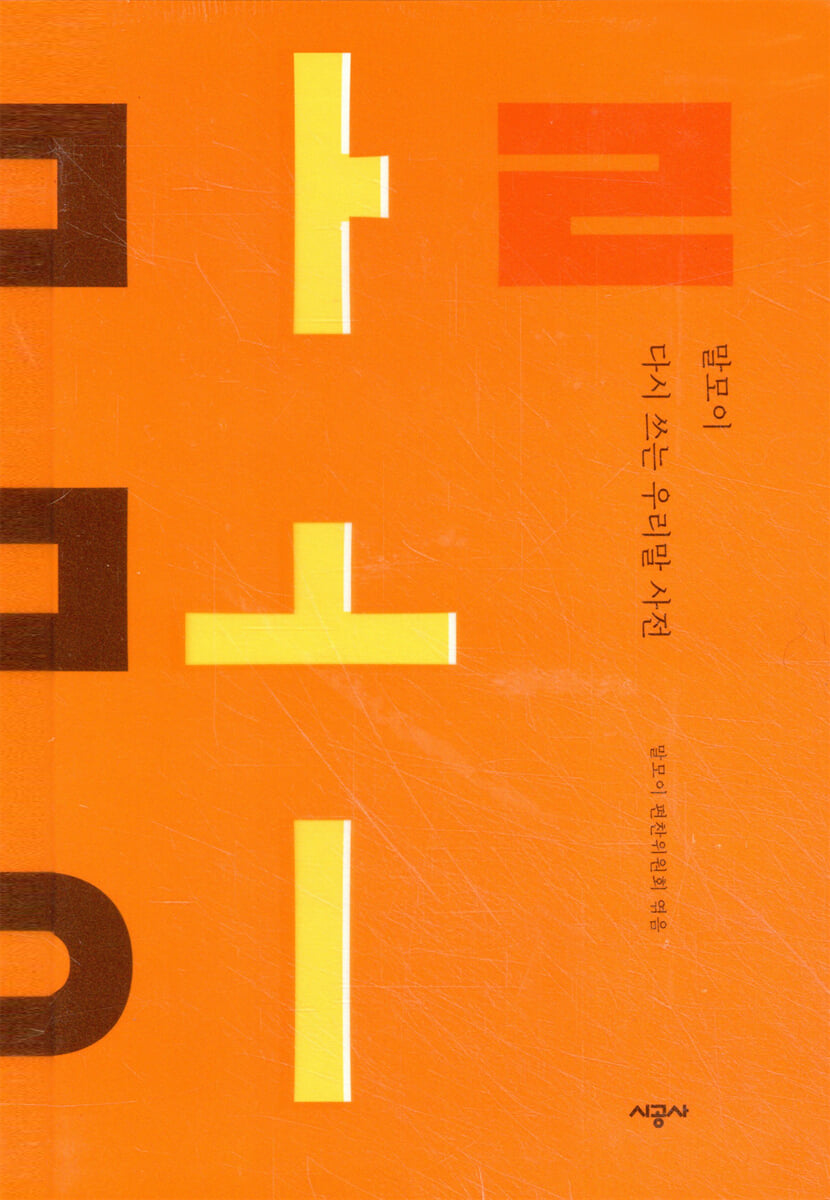
Additionally, the cover and case, which are broken down and reconstructed from the word ‘Malmoi’, will add to the specialness.
This dictionary, which inherits the spirit of 'Malmoi' from 100 years ago, was planned with the aim of gathering old words, colloquialisms, and regional expressions from across the country that have already disappeared or are gradually disappearing amidst the flood of foreign words, loanwords, and unidentified slang, through the hands of the people.
From October 7, 2019 to August 6, 2020, for 10 months, Malmoi Nurijip (https://malmoi100.chosun.
com) and the Malmoi Office (Sangmyung University Korean Language and Culture Center) received applications online and offline, and 22,683 words were received online and approximately 70,000 words were received offline.
From the elderly who sent a handwritten letter saying, “When I die, these words and the lives we live in them will disappear with me,” to scholars who sent research materials and publications they had dedicated their lives to, to the younger generation who posted stories containing fond memories of their parents or grandparents (contrary to expectations that there would be a small number of young people participating due to the nature of the “regional language,” 2,100 words were submitted online in just four days after the website opened), the staff were surprised by the variety and enthusiasm of the reports.
The collected words were reviewed by 71 regional representatives, and then refined and reviewed by 60 researchers from the National Institute of the Korean Language and Culture and regional language experts. The online dictionary was first released in November 2020.
And now, the result of all their efforts is presented in a paper book.
A new Korean dictionary filled with the unique dialects and cultures of each region, from Jeju to North Korea.
[Malmoi, Rewriting Our Language Dictionary] includes not only regional dialects and spoken language that the existing standard language-centered Korean dictionary cannot record, but also cultures that have been born and died together with language users.
The titles were selected from among the vocabulary reported by the public, including old and regional words that were not standard words. In North Korea, all words, including regional words, cultural words, and new words (including slang) were included without distinction.
In line with the purpose of enriching the Korean language and passing down our linguistic heritage to future generations, we have given priority to selecting words that are not introduced in the [Standard Korean Dictionary] or the National Institute of the Korean Language website [Our Language Well], and have included examples of usage that include not only representative forms but also various variant forms.
These examples, gathered through citizen reports, are written down in detail, down to the city or county level, and written as they are spoken so that the feeling and detailed meaning of the field in which they are used can be conveyed.
Additionally, we added relevant cultural information and provided standard language interpretations to help readers understand.
Limited first edition special supplement [The Korean Language I Love]
In celebration of the publication of the completed paper book [Malmoi, Rewriting the Korean Dictionary], a limited first edition of [The Korean Language I Loved], a collection of essays praising the Korean language sent directly by celebrities from all walks of life, including former Minister of Culture Lee Eo-ryeong, novelist Kim Hoon, actor Ahn Sung-ki, trot singer Lee Chan-won, and violinist Jo Jin-ju, as well as Malmoi informants, is being presented.
Additionally, the cover and case, which are broken down and reconstructed from the word ‘Malmoi’, will add to the specialness.
GOODS SPECIFICS
- Publication date: February 11, 2021
- Format: Hardcover book binding method guide
- Page count, weight, size: 656 pages | 1,072g | 145*210*43mm
- ISBN13: 9791165794231
- ISBN10: 1165794233
You may also like
카테고리
korean


korean

![GQ KOREA Mark (Monthly): December [2025]](http://librairie.coreenne.fr/cdn/shop/files/8ef265dbbfbf186523ed75ba7319009d.jpg?v=1765340328&width=3840)


