

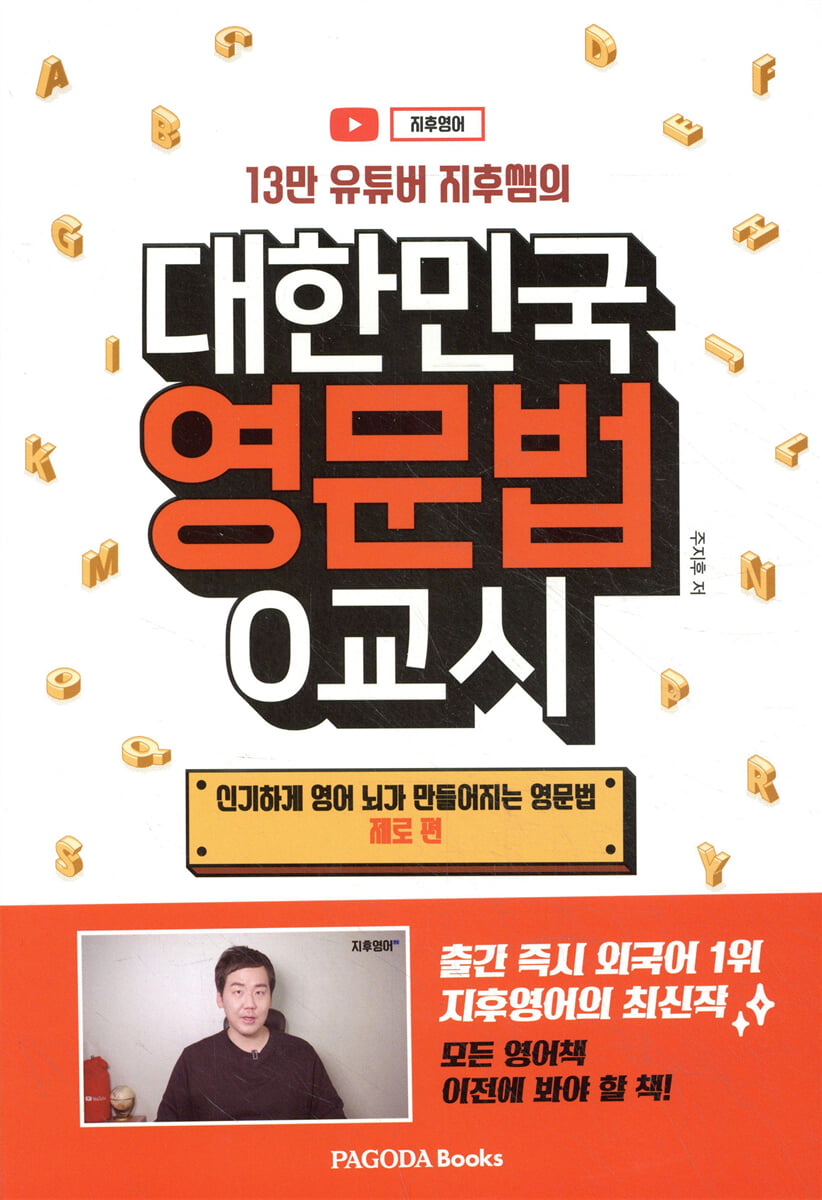
Korean English Grammar 0th Period
 |
Description
Book Introduction
English, no matter how much I study it, it’s still difficult…?
Yes, I wrote it for those people.
The English teacher Joo Ji-hoo's book of salvation for English learners, which has 130,000 people excited
Teacher Ju Ji-hoo, a YouTuber with 130,000 subscribers, has presented a new direction for English learning with "English Grammar That Amazingly Builds Your English Brain."
He's back with a beginner's English book for beginners!
We explain why English can be difficult for Koreans and suggest learning methods to overcome this difficulty. We also help you become accustomed to English by learning the minimum grammar necessary to speak and write in English.
Also, to avoid giving up on English because of terminology, we pursue understanding rather than memorization, and acquiring essential principles rather than accumulating superficial knowledge.
To all the spirits of this land! Don't give up.
We'll fill you in on the fundamental knowledge that no one taught you before class 1 and boost your English confidence.
Yes, I wrote it for those people.
The English teacher Joo Ji-hoo's book of salvation for English learners, which has 130,000 people excited
Teacher Ju Ji-hoo, a YouTuber with 130,000 subscribers, has presented a new direction for English learning with "English Grammar That Amazingly Builds Your English Brain."
He's back with a beginner's English book for beginners!
We explain why English can be difficult for Koreans and suggest learning methods to overcome this difficulty. We also help you become accustomed to English by learning the minimum grammar necessary to speak and write in English.
Also, to avoid giving up on English because of terminology, we pursue understanding rather than memorization, and acquiring essential principles rather than accumulating superficial knowledge.
To all the spirits of this land! Don't give up.
We'll fill you in on the fundamental knowledge that no one taught you before class 1 and boost your English confidence.
- You can preview some of the book's contents.
Preview
index
How to read this book
Prologue
The enthusiastic response from Jihoo English TV subscribers!
Chapter 0 Before Starting Class
1.
Why is English difficult?
2.
What will people say?
Chapter 1 People
3.
who + is + where
4.
who + is + what/which
5.
Who + does + what
Chapter 2 Things
6.
What + is + where
7.
What + is + what/what property/state
8.
What + does + what
Chapter 3 Thoughts/Concepts
9.
~doing + is + what/which
10.
~doing + doing + what
Chapter 4 Expansion
11.
We'll help you - auxiliary verb
12.
Tense - Yesterday, Today, and Tomorrow
Epilogue
Reference
Prologue
The enthusiastic response from Jihoo English TV subscribers!
Chapter 0 Before Starting Class
1.
Why is English difficult?
2.
What will people say?
Chapter 1 People
3.
who + is + where
4.
who + is + what/which
5.
Who + does + what
Chapter 2 Things
6.
What + is + where
7.
What + is + what/what property/state
8.
What + does + what
Chapter 3 Thoughts/Concepts
9.
~doing + is + what/which
10.
~doing + doing + what
Chapter 4 Expansion
11.
We'll help you - auxiliary verb
12.
Tense - Yesterday, Today, and Tomorrow
Epilogue
Reference
Detailed image

Publisher's Review
I recommend this to these people!
1.
I'm a complete beginner who's afraid to even try because English is so difficult.
2.
A person who is illiterate and loses his mind just by hearing English grammar terms
3.
Beginner-intermediate learners who are not complete beginners but feel they lack the basics
4.
A restarter who has been studying English for a long time and wants to start again.
5.
A mother who wants to improve her child's English skills with her own English class
6.
Elementary and middle school students who want to build a solid foundation before entering the English entrance exam.
1.
The answer to the question of where Koreans' fear of English comes from.
It seems that speaking English is often more than just painful; it's terrifying.
I used to be like that too, and I still don't feel completely comfortable.
Why is this happening? The causes of this problem are complex.
If I had to pick two main factors, I would say that the first is that the English language itself is difficult for Koreans, and the second is the sick perception of this society that overly sacredizes English.
I will talk about the second one throughout this book.
First of all, since you and I met to study, let's get this straight from the beginning.
- #1.
Why is English difficult?
2.
Correcting the flawed English learning methods that have created a mass of English learners.
The most important thing when learning English is to first arrange the words appropriately in the unique order of the English language.
Second, refine it so that it looks and sounds natural to a native speaker.
Third, repeat this process infinitely.
Exactly these three.
The problem is that we've been doing it backwards so far.
I was determined to memorize the grammar 'perfectly' and then speak English according to it exactly.
And we have fostered a strange culture where people are laughed at and scolded for making even the slightest grammar mistake.
So, of course, Koreans are scared when they see English.
I'm so scared and nervous that I might make a mistake, and I try to formulate the 'perfect sentence' in my head before I speak, but time passes by before I know it.
And the way we looked at each other as if we were a little pitiful at seeing me like that.
All of this has made us into idiots.
- #1.
Why is English difficult?
3.
The zero-period class before all the English classes in the world
From now on, what I will do is describe all people and all things together with you.
It is about describing everything that can be called a thought or concept.
Especially after you've completed the last exercise, describing 'thoughts and concepts,' you might hear people say, 'Your English is quite sophisticated.'
The part where the expression method differs greatly from our language is the description of thoughts and concepts.
By the time you finish the last chapter of this book, no matter what English class you take or how you study English, your skills will improve ten times faster than before.
Because this course you will study with me from now on is the zeroth period for all English classes in the world.
- #2.
What do people say?
4.
Learning to understand rather than memorize so that you don't give up on English because of the terminology.
I think it's much more important to understand the principles than the terms themselves.
Words should always be viewed within the flow.
Unless we're going to become English scholars or study linguistics, it's much better to learn the principles naturally, as we do now, rather than forcing ourselves to memorize difficult terms.
Words came into existence and then grammar came into existence, not grammar came into existence and then words came into existence.
Even if you don't quite understand the terminology, it doesn't really hinder you from learning the principles.
Don't worry.
And don't blame yourself.
- #7.
What is + is + what/which property/state
5.
Get used to English expressions that are unfamiliar to Koreans
As you study English, you will often feel that not only are Korean and English different in grammar and vocabulary, but their 'ways of expression' are also very different.
'This map shows the location of the hotel.
(This map shows the location of the hotel.)' What do you think when you see this sentence? If you think, "That sounds a bit awkward. It almost feels like it was translated by a machine," that's perfectly normal.
In fact, we usually say things like, 'If you look at this map, it shows you where the hotel is,' or 'You can tell where the hotel is by looking at this map.'
So sometimes when I meet foreigners on the street and say this in English, I often end up saying things like, 'The hotel's location is you see this map...'
Of course.
We are Korean, so we think in Korean, but when we try to translate it into English, we end up throwing out a bunch of words.
The expression “what + do + what” is something that will be good for you for the rest of your life once you learn it.
If you learn well, you will be able to express your thoughts more easily.
- #8.
What + do + what among
1.
I'm a complete beginner who's afraid to even try because English is so difficult.
2.
A person who is illiterate and loses his mind just by hearing English grammar terms
3.
Beginner-intermediate learners who are not complete beginners but feel they lack the basics
4.
A restarter who has been studying English for a long time and wants to start again.
5.
A mother who wants to improve her child's English skills with her own English class
6.
Elementary and middle school students who want to build a solid foundation before entering the English entrance exam.
1.
The answer to the question of where Koreans' fear of English comes from.
It seems that speaking English is often more than just painful; it's terrifying.
I used to be like that too, and I still don't feel completely comfortable.
Why is this happening? The causes of this problem are complex.
If I had to pick two main factors, I would say that the first is that the English language itself is difficult for Koreans, and the second is the sick perception of this society that overly sacredizes English.
I will talk about the second one throughout this book.
First of all, since you and I met to study, let's get this straight from the beginning.
- #1.
Why is English difficult?
2.
Correcting the flawed English learning methods that have created a mass of English learners.
The most important thing when learning English is to first arrange the words appropriately in the unique order of the English language.
Second, refine it so that it looks and sounds natural to a native speaker.
Third, repeat this process infinitely.
Exactly these three.
The problem is that we've been doing it backwards so far.
I was determined to memorize the grammar 'perfectly' and then speak English according to it exactly.
And we have fostered a strange culture where people are laughed at and scolded for making even the slightest grammar mistake.
So, of course, Koreans are scared when they see English.
I'm so scared and nervous that I might make a mistake, and I try to formulate the 'perfect sentence' in my head before I speak, but time passes by before I know it.
And the way we looked at each other as if we were a little pitiful at seeing me like that.
All of this has made us into idiots.
- #1.
Why is English difficult?
3.
The zero-period class before all the English classes in the world
From now on, what I will do is describe all people and all things together with you.
It is about describing everything that can be called a thought or concept.
Especially after you've completed the last exercise, describing 'thoughts and concepts,' you might hear people say, 'Your English is quite sophisticated.'
The part where the expression method differs greatly from our language is the description of thoughts and concepts.
By the time you finish the last chapter of this book, no matter what English class you take or how you study English, your skills will improve ten times faster than before.
Because this course you will study with me from now on is the zeroth period for all English classes in the world.
- #2.
What do people say?
4.
Learning to understand rather than memorize so that you don't give up on English because of the terminology.
I think it's much more important to understand the principles than the terms themselves.
Words should always be viewed within the flow.
Unless we're going to become English scholars or study linguistics, it's much better to learn the principles naturally, as we do now, rather than forcing ourselves to memorize difficult terms.
Words came into existence and then grammar came into existence, not grammar came into existence and then words came into existence.
Even if you don't quite understand the terminology, it doesn't really hinder you from learning the principles.
Don't worry.
And don't blame yourself.
- #7.
What is + is + what/which property/state
5.
Get used to English expressions that are unfamiliar to Koreans
As you study English, you will often feel that not only are Korean and English different in grammar and vocabulary, but their 'ways of expression' are also very different.
'This map shows the location of the hotel.
(This map shows the location of the hotel.)' What do you think when you see this sentence? If you think, "That sounds a bit awkward. It almost feels like it was translated by a machine," that's perfectly normal.
In fact, we usually say things like, 'If you look at this map, it shows you where the hotel is,' or 'You can tell where the hotel is by looking at this map.'
So sometimes when I meet foreigners on the street and say this in English, I often end up saying things like, 'The hotel's location is you see this map...'
Of course.
We are Korean, so we think in Korean, but when we try to translate it into English, we end up throwing out a bunch of words.
The expression “what + do + what” is something that will be good for you for the rest of your life once you learn it.
If you learn well, you will be able to express your thoughts more easily.
- #8.
What + do + what among
GOODS SPECIFICS
- Date of issue: January 4, 2021
- Page count, weight, size: 436 pages | 774g | 170*251*20mm
- ISBN13: 9788962818642
- ISBN10: 8962818647
You may also like
카테고리
korean


korean

![GQ KOREA Mark (Monthly): December [2025]](http://librairie.coreenne.fr/cdn/shop/files/8ef265dbbfbf186523ed75ba7319009d.jpg?v=1765340328&width=3840)


