

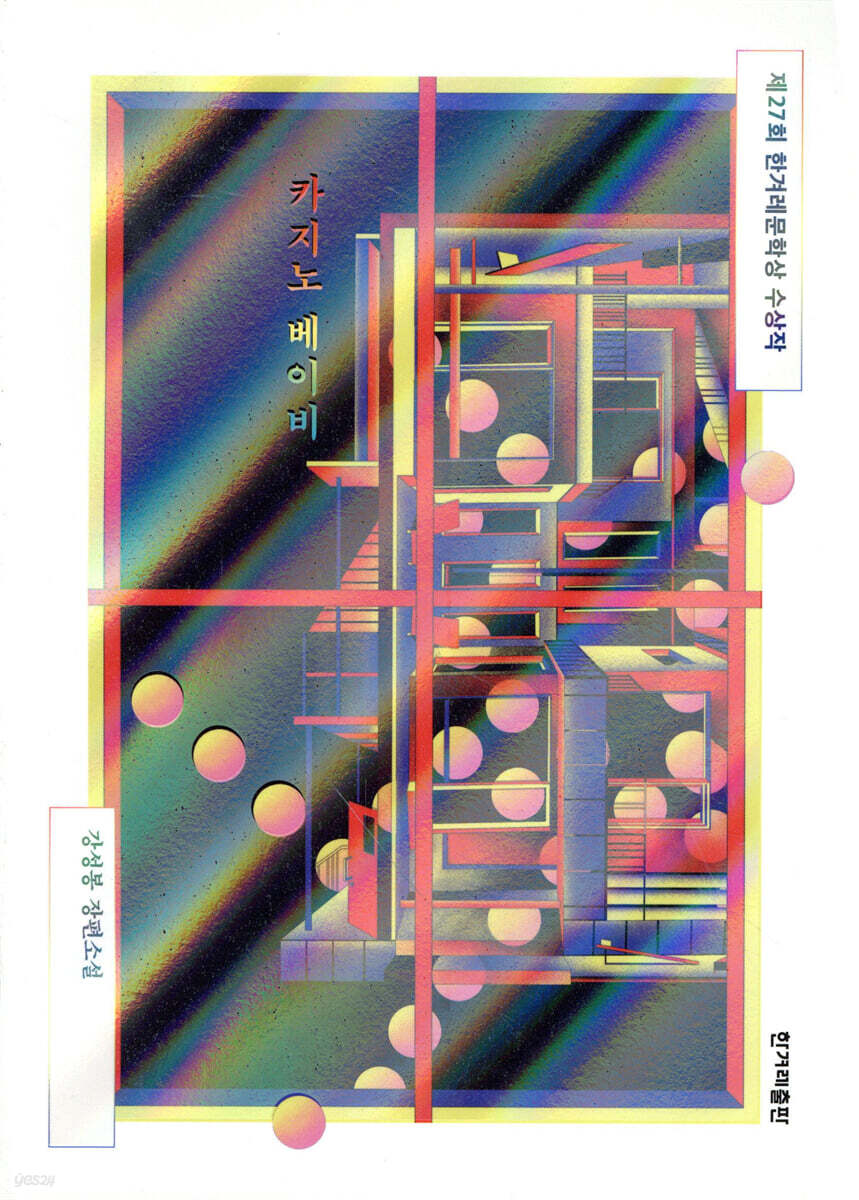
Casino Baby
 |
Description
Book Introduction
Winners of the 27th Hankyoreh Literary Award in 2022 “My father pawned me and borrowed money.” Seen through the eyes of a child born in a casino and abandoned in a casino The joys and sorrows of adults and the rise and fall of cities The Hankyoreh Literary Award, established in 1996 and beloved by readers for a long time, is publishing its twenty-seventh award-winning work, “Casino Baby.” The eight judges selected Kang Seong-bong's "Casino Baby" as this year's winner out of 171 entries, praising its "stable narrative structure, compelling characters, and the author's broad and deep thinking that delicately embraces the history of people and places." "Casino Baby" is a coming-of-age novel about a "pawn shop kid" who was born and raised in a casino special zone. Set in the city of Ji-eum, which was a coal mining town and then a casino town, the film explores the joys and sorrows of the people living there and the rise and fall of the city through the eyes of a child. The 'Ji-eum' in the novel is a space created by combining the author's memories of the village near the coal mine where he lived as a child and his experience working part-time near a casino after his military service. Award-winning author Kang Seong-bong, who is also a current publishing editor, vividly and vividly portrayed the fictional city of Ji-eum, which encapsulates the concerns of the precarious state of Korean society, based on his solid writing skills. |
- You can preview some of the book's contents.
Preview
index
Part 1: The Pawn Shop Family
Market and Library · Shadow Child · Buddha Jesus · Grandmother's Pawn Shop · Dorongi Pond
Part 2 Casino Baby
Speed Pawn Shop · Mom's Romance · The Pastor and the Broker · Memorial Day · Jjokbak Park · Blackjack · Land
Part 3 Grandmother's Legacy
Medical Center · June Snow · Story · Fire Keeper · Children's Land
Author's Note
Recommendation
Market and Library · Shadow Child · Buddha Jesus · Grandmother's Pawn Shop · Dorongi Pond
Part 2 Casino Baby
Speed Pawn Shop · Mom's Romance · The Pastor and the Broker · Memorial Day · Jjokbak Park · Blackjack · Land
Part 3 Grandmother's Legacy
Medical Center · June Snow · Story · Fire Keeper · Children's Land
Author's Note
Recommendation
Into the book
My father pawned me and borrowed money.
I don't know how much money he borrowed, but I'm sure he didn't pay it back.
Even after I was ten, I was still in the pawn shop.
The father who left his child at a pawn shop instead of a daycare center, or the pawn shop that suddenly took the child in, well, I won't say much.
Because the more you do it, the more you imagine.
But just know this.
It doesn't start off so gloomily as a story about an abandoned child.
--- p.11
I know.
What do they call a child with so many secrets like me in the world?
It's the shadow child.
It means that you live in this world but do not exist.
I really don't have a single picture of myself as a child.
What I'm saying is that I'm the only one looking at my face in the mirror, and no one is looking closely at my face.
--- p.27
“You too.
You already know who you are.
“Just because other people say you are a certain kind of person doesn’t mean you really are.” Beyond Grandfather Park Soo, who was tearing open the bundle, the brown trees of Beombawi Valley swayed slowly.
Grandpa Park's voice came to me on the wind.
“These days, the monks only cut my hair well, and the shamans also save people quite well.
Whether you become a corpse or a meal, you must find your own destiny.
Above all, you already firmly believe that you can do it.
Didn't I say you're a slob?
So now, put that mischievous smile aside and take a good look at what's inside you.
“Well, no one else can do that.”
--- pp.43~44
I go to church not because I believe in God, but because I'm worried my mom will be sad.
It's somewhere between faith, hope, and love.
It's fun to secretly open my eyes and watch the congregation praying and singing along to the hymns next to my mom.
--- p.61
“No matter how precious time is, I can’t entrust it to the authorities, not even to Rolex.” Contrary to what my grandmother said, my time was entrusted to a pawn shop.
A street where the snow that has fallen once does not melt until it turns black and sticky.
The light falls below the knees, making the streets cool even in summer.
A street in India where dust sparkles above the densely packed cars.
From that corner of the pawnshop street, I looked out at the world.
--- p.65
As the men's story got longer, President Yong said something.
“If you come to play cards and just rip off the idiots, when will you get your money back?
Whether it's the chairman, the cult leader, the Chinese, or the Korean, money is everything.
The point is that whether you're good or bad, you're all equal in the game.
“Once we sit down at the table, we’re all the same people.”
--- pp.108~109
A child born in a casino and living in a casino.
All the hotel staff were calling him Casino Baby, but I didn't know.
So, that was already the third time you left them in my care! Guess what happened? Two of them, no, three of them, including the baby, ended up getting kicked out of the land.
And I got kicked out too.
I got into trouble because I was taking money from customers and taking care of their children.
--- p.125
When I woke up, my grandmother was asleep in the bed across from me.
He was fine until he was taken to the hospital in an ambulance, but he fainted as soon as he entered the emergency room.
He had spent all his remaining strength searching for me, without eating or sleeping for three days.
I looked down at my sleeping grandmother and thought to myself dozens of times that if I hadn't gone to Land, she would have been fine.
I cried while hugging my mother, saying that I was scared of being awake alone while my grandmother was asleep.
“Yeah, it’s hard to keep,” my mom said, patting my back.
“It’s hard to protect.” My mother’s voice was quiet, and I couldn’t understand what she meant.
--- p.220
Under the eaves of the noodle shop, where the hot tears had fallen, white snow was melting in spots.
And at some point, the tears froze again and turned into icicles, growing little by little from the ground.
It has been said that the last tear someone sheds has the power to change everything in their life, no matter who they are or what kind of life they have lived.
The small-framed grandmother clearly remembered the power of those tears.
The tears she shed under the eaves of the noodle shop that day were the last tears she shed in her life.
--- p.244
At the end of the long story, my grandmother said that death is either full or empty.
When I asked what it was, my grandmother said it was just that.
Back then, my grandfather was either full or empty in his work.
It was at that time that my grandmother made up her mind that she had to survive without even shedding a tear.
--- p.253
My grandmother didn't tell me everything, so some of the stories I'll never know, but I didn't ask any more questions.
Because my grandmother told me.
Children are the hope and future of adults, something that cannot be bought even with a billion dollars.
Children have no choice but to live in the world created by adults, so adults should take good care of children and let them create their own world, and then just give it back to the world.
--- pp.262~263
Death is something that neither you nor I know, so there's no need to be sad, right?
--- pp.265~266
Adults set fire to the ground.
Dig and cut the ground.
Land is bought, sold, taken, or taken away.
Build something on the ground, tear it down, build it again, and tear it down again.
Why? For what reason? The questions and answers are always different and arbitrary.
(…) The questions and answers given to me, my mother, my uncle, and my grandmother will be different for each person, but whatever it is, those who can just ask can just ask, and those who can easily answer can just answer easily.
But those who do not do so must ask and answer with all their heart.
Living tenaciously, regardless of whether the land you stand on is wide or narrow, flat or steep, sound or broken.
I don't know how much money he borrowed, but I'm sure he didn't pay it back.
Even after I was ten, I was still in the pawn shop.
The father who left his child at a pawn shop instead of a daycare center, or the pawn shop that suddenly took the child in, well, I won't say much.
Because the more you do it, the more you imagine.
But just know this.
It doesn't start off so gloomily as a story about an abandoned child.
--- p.11
I know.
What do they call a child with so many secrets like me in the world?
It's the shadow child.
It means that you live in this world but do not exist.
I really don't have a single picture of myself as a child.
What I'm saying is that I'm the only one looking at my face in the mirror, and no one is looking closely at my face.
--- p.27
“You too.
You already know who you are.
“Just because other people say you are a certain kind of person doesn’t mean you really are.” Beyond Grandfather Park Soo, who was tearing open the bundle, the brown trees of Beombawi Valley swayed slowly.
Grandpa Park's voice came to me on the wind.
“These days, the monks only cut my hair well, and the shamans also save people quite well.
Whether you become a corpse or a meal, you must find your own destiny.
Above all, you already firmly believe that you can do it.
Didn't I say you're a slob?
So now, put that mischievous smile aside and take a good look at what's inside you.
“Well, no one else can do that.”
--- pp.43~44
I go to church not because I believe in God, but because I'm worried my mom will be sad.
It's somewhere between faith, hope, and love.
It's fun to secretly open my eyes and watch the congregation praying and singing along to the hymns next to my mom.
--- p.61
“No matter how precious time is, I can’t entrust it to the authorities, not even to Rolex.” Contrary to what my grandmother said, my time was entrusted to a pawn shop.
A street where the snow that has fallen once does not melt until it turns black and sticky.
The light falls below the knees, making the streets cool even in summer.
A street in India where dust sparkles above the densely packed cars.
From that corner of the pawnshop street, I looked out at the world.
--- p.65
As the men's story got longer, President Yong said something.
“If you come to play cards and just rip off the idiots, when will you get your money back?
Whether it's the chairman, the cult leader, the Chinese, or the Korean, money is everything.
The point is that whether you're good or bad, you're all equal in the game.
“Once we sit down at the table, we’re all the same people.”
--- pp.108~109
A child born in a casino and living in a casino.
All the hotel staff were calling him Casino Baby, but I didn't know.
So, that was already the third time you left them in my care! Guess what happened? Two of them, no, three of them, including the baby, ended up getting kicked out of the land.
And I got kicked out too.
I got into trouble because I was taking money from customers and taking care of their children.
--- p.125
When I woke up, my grandmother was asleep in the bed across from me.
He was fine until he was taken to the hospital in an ambulance, but he fainted as soon as he entered the emergency room.
He had spent all his remaining strength searching for me, without eating or sleeping for three days.
I looked down at my sleeping grandmother and thought to myself dozens of times that if I hadn't gone to Land, she would have been fine.
I cried while hugging my mother, saying that I was scared of being awake alone while my grandmother was asleep.
“Yeah, it’s hard to keep,” my mom said, patting my back.
“It’s hard to protect.” My mother’s voice was quiet, and I couldn’t understand what she meant.
--- p.220
Under the eaves of the noodle shop, where the hot tears had fallen, white snow was melting in spots.
And at some point, the tears froze again and turned into icicles, growing little by little from the ground.
It has been said that the last tear someone sheds has the power to change everything in their life, no matter who they are or what kind of life they have lived.
The small-framed grandmother clearly remembered the power of those tears.
The tears she shed under the eaves of the noodle shop that day were the last tears she shed in her life.
--- p.244
At the end of the long story, my grandmother said that death is either full or empty.
When I asked what it was, my grandmother said it was just that.
Back then, my grandfather was either full or empty in his work.
It was at that time that my grandmother made up her mind that she had to survive without even shedding a tear.
--- p.253
My grandmother didn't tell me everything, so some of the stories I'll never know, but I didn't ask any more questions.
Because my grandmother told me.
Children are the hope and future of adults, something that cannot be bought even with a billion dollars.
Children have no choice but to live in the world created by adults, so adults should take good care of children and let them create their own world, and then just give it back to the world.
--- pp.262~263
Death is something that neither you nor I know, so there's no need to be sad, right?
--- pp.265~266
Adults set fire to the ground.
Dig and cut the ground.
Land is bought, sold, taken, or taken away.
Build something on the ground, tear it down, build it again, and tear it down again.
Why? For what reason? The questions and answers are always different and arbitrary.
(…) The questions and answers given to me, my mother, my uncle, and my grandmother will be different for each person, but whatever it is, those who can just ask can just ask, and those who can easily answer can just answer easily.
But those who do not do so must ask and answer with all their heart.
Living tenaciously, regardless of whether the land you stand on is wide or narrow, flat or steep, sound or broken.
--- pp.295~296
Publisher's Review
Winners of the 27th Hankyoreh Literary Award in 2022
“My father pawned me and borrowed money.”
Seen through the eyes of a child born in a casino and abandoned in a casino
The joys and sorrows of adults and the rise and fall of cities
The Hankyoreh Literary Award, which was established in 1996 and has been loved by readers for a long time, has published its 27th award-winning work, Casino Baby, including Shim Yun-kyung's "My Beautiful Garden," Park Min-gyu's "The Last Fan Club of Sammi Superstars," Yoon Go-eun's "Zero Gravity Syndrome," Choi Jin-young's "The Name of the Girl Who Passed You By," Jang Kang-myeong's "Bleach," Kang Hwa-gil's "Another Person," Park Seo-ryeon's "The Air Girl Kang Ju-ryong," Seo Su-jin's "Korean Teacher," and Kim Yu-won's "Bullpen Time."
The eight judges selected Kang Seong-bong's "Casino Baby" as this year's winner out of 171 entries, praising its "stable narrative structure, compelling characters, and the author's broad and deep thinking that delicately embraces the history of people and places."
"Casino Baby" is a coming-of-age novel about a "pawn shop kid" who was born and raised in a casino special zone.
Set in the city of Ji-eum, which was a coal mining town and then a casino town, the film explores the joys and sorrows of the people living there and the rise and fall of the city through the eyes of a child.
Literary critic Seo Young-in, who was in charge of the judging, said, “I focused on the tension between the two secrets: the child trying to find out the secret of his birth, and the grandmother who is stubbornly silent about the time she lived through so much.” Literary critic So Young-hyun said that the novel “evokes the rise and fall of the Sabuk region, which was the largest mining site in the East,” and that it is “a report on the layers of time when casinos were run in the name of the public under the guise of regional development and tourism promotion, and the local economy and community were destroyed by the logic of money.”
Novelist Jo Hae-jin said that in this novel, he was able to discover “the tenacious vitality of those who remain, those who are alive and must live,” and that the author demonstrated “amazing immersion” by “humorously and vividly portraying the individual stories of the characters in the novel.”
Literary critic Yang Kyung-eon emphasized that “Casino Baby” focuses on those who try not to be swept away in the midst of a world that is hopelessly collapsing toward its predicted end,” and that it is a novel that makes us look back on “what we have become, intoxicated by development and greed,” and asks readers what they must do “to move on to the next stage, to live differently from before.”
The 'Ji-eum' in the novel is a space created by combining the author's memories of the village near the coal mine where he lived as a child and his experience working part-time near a casino after his military service.
Award-winning author Kang Seong-bong, who is also a current publishing editor, vividly and vividly portrayed the fictional city of Ji-eum, which encapsulates the concerns of the precarious state of Korean society, based on his solid writing skills.
This novel was written between 2019 and 2021, during the COVID-19 pandemic and the subsequent stock, real estate, and Bitcoin investment craze.
The building is a space created to reflect and evoke the bizarre structure of the gambling industry on top of a coal mine, the speculation and entertainment industry that built on the foundational industries of the industrial era, the social atmosphere during the pandemic that was brimming with investment even in a stagnant environment, and the precariousness of an upward trend that could collapse at any moment.
Rather than criticizing it, I wanted to focus on its vitality in persistently pursuing its own path despite such circumstances.
The main characters of this novel are the child named Haneul and the land named Ji-eum. _From the author's note
“It’s hard to protect.”
Casino Baby, Standing Out in the World
"Casino Baby" is a story about the ups and downs of Ji-eum, a former coal mining town that has been transformed into a casino and resort complex, as seen through the eyes of a "child left in a pawn shop."
Jieum is a place where past and present, natives and outsiders mix. The foot of Jijangsan Mountain, where Land is located, is called West Buddha, and the town centering around Jieum Church is called East Jesus.
In between, there is Sleep City, a town of motels and pawn shops.
'I (Dong Ha-neul)' is a child of about ten years old who was left in the pawn shop of Sleep City since he was a baby.
I grew up thinking of the pawnshop owner as my grandmother, and her daughter and son as my mother and uncle.
'I' discovers the secrets of my birth one by one by chance, and finds my identity as to who I am and how I became a 'casino baby'.
The novel, composed of three parts, tells the story of the author and the people who wrote it through the memories, recollections, and imagination of 'I'.
Part 1, "The Pawn Shop Family," is the story of my family and the city they live in, "Jieum."
I, who am over ten years old, am a ‘shadow child’ who has not been registered at birth and does not attend school.
I live like family, calling the pawnshop owner my grandmother, and her daughter and son my mother and uncle.
The uncle who goes around shouting “The land is falling apart!”, the mother who suffers from anxiety, and the grandmother who tenaciously survives in the city are the only ones who keep this family together.
“No matter how much time is money, you can’t leave it up to the authorities, not even Rolex,” says Mrs. Dong Young-jin, teaching me that a gambler should think like a gambler and a pawnshop owner should do the work of a pawnshop owner.
'I' wonders why I was left in the pawnshop, but there is no adult around to tell me why.
To such a ‘me’, Grandpa Park Soo of Beombawigol simply tells me to look inside myself first.
Meanwhile, 'I' repeatedly dream of being submerged in water or see scenes of unknown meaning.
In fact, a hole appears in the road on Pawnshop Street and water begins to overflow into the street.
A casino was built on the hillside of Jijangsan Mountain where the mine was located.
They carved out mountains to create golf courses and sprinkled artificial snow to create ski resorts.
The children enjoyed their games at the resort, while the adults enjoyed their games at the casino.
Tens of thousands of people flocked to the land each day, overflowing the hotels and resorts, and outsiders who had bought land to avoid missing out on the opportunity built apartments, motels, and cheap resorts along the roads leading to the land.
The miners' quarters and food stalls turned into Sleep City and Pawn Shop Street, and those who mortgaged their dreams there began calling their town East Jesus and Jijangsan Mountain West Buddha.
The name of the land thus created was slowly erased, leaving only the cry, “The land is shaking! The land is collapsing!”_Pages 87-88
Part 2, "Casino Baby," is the story of 'I' discovering the secret of my birth.
It was triggered by overhearing a phone conversation between Mr. Yong, the owner of Speed Pawn Shop, and his mother.
'I' am confused as to whether all those stories are true.
'I' wanted to see the casino view that I kept seeing in my dreams, so I asked President Yong to show me around the casino.
But on the day he visits the casino, a large earthquake strikes the land and the building collapses.
'I' finally realize what the scenes I saw in my dream mean.
I was surprised three times when I heard the story that night.
First, because it might be my story.
Second, Pastor Yeom’s name came up out of nowhere.
Does everyone else know this but me? My grandmother used to call Pastor Yeom "not a pastor, but a publisher." Could that be related? When I asked what a publisher was, she said, "They're people who go wherever money calls, do whatever money tells them to do, and then say it's not for money, but for some other reason." (Page 127)
Part 3, “Grandmother’s Legacy,” is a story about family and creation that ‘I’ heard through my grandmother.
Grandma struggles to find herself in the chaos that followed the earthquake.
Then, he collapses as soon as he finds himself in a collapsed casino building.
'I' stay by my grandmother's side in the hospital room and learn about her family history, as well as the history of the pawn shop and the writing.
The scenery of a road once used for mining coal but now used for gambling, and the dark side of history from the end of the 'New Village Movement' to the 'Olympic Movement' and the 'World Cup Era', is revealed in detail by the grandmother.
This fills in the gaps in what we knew, imagined, and remembered.
After my grandmother passes away, 'I', my mother, and my uncle set out together to find the legacy she left behind.
Now, as I was about to start talking about this and that, I heard my grandmother's voice from somewhere.
“You talk as if you’ve seen things you haven’t.” That’s not a compliment, an admiration, a sneer, or a scolding.
That's just how it is.
Grandma urged.
If you become someone who doesn't get angry or feel sorry for yourself after learning what happened to you, tell the world your story.
Someday, when that time really comes, I'll have to tell the story that started on this road.
When you just start walking alone, your grandmother said to keep walking until the end of the road._Page 295
The power of problematic imagination, exciting characters, and a broad and deep narrative
A story of healing and growth after a time of disaster.
Starting with a child left in a pawn shop for money, "Casino Baby" concludes as a narrative that confronts the contradictions of the modern age through the story of a child's growth while ultimately preserving hope.
“As can be seen from the transformation of the grandmother’s workplace from an ‘Olympic’ teahouse to a ‘World Cup’ pawnshop, the history of this region fully reflects capitalism, which has transformed from development capital to speculative capital.” (Seo Young-in, literary critic) The novel vividly unfolds the process of a golden tower of human desire rising to its ultimate collapse.
The different reactions of the various characters as they face disaster are also exciting and thrilling.
The complex and interesting stories of adults depicted through the eyes of a child are captivating in their own right.
Furthermore, the love for life shown by the characters in the novel gives readers a strong sense of vitality.
Casino Land eventually trembles and collapses, but even after the city collapses, they do not despair.
What matters to them is not the fact that the foundation of their lives has collapsed, but the life they will have to live after the collapse.
“Whether the land I stand on is wide or narrow, flat or steep, sound or broken, while living tenaciously, regardless of the land.” (p. 296) It was precisely thanks to this courage toward life that ‘I’ was able to “run toward creation” in the end.
“We all know too well what kind of times we live in now.
And about what we have become now, intoxicated by development and greed.
“What should we prioritize now?” (Literary critic Yang Kyung-eon) When we have to ask what comes next, this scene of optimism that “Casino Baby” has solely convinced us of is all the more beautiful.
We look forward to seeing what author Kang Sung-bong will do next after "Casino Baby," a broad and deep narrative that connects the past, present, and future, a harmonious blend of delicate sentences and problematic imagination.
Author's Note
The space called Ji-eum is inspired by the area where I briefly lived as a child and where I often stayed as an adult.
I visited there several times for reporting purposes, and was there when I finished the manuscript.
But when I finished the novel and stepped out of the motel room, the place was completely different from the real thing.
Naturally, the work is a virtual space recreated by mixing memory, imagination, and real elements.
This novel was written between 2019 and 2021, during the COVID-19 pandemic and the subsequent stock, real estate, and Bitcoin investment craze.
The building is a space created to reflect and evoke the bizarre structure of the gambling industry on top of a coal mine, the speculation and entertainment industry that built on the foundational industries of the industrial era, the social atmosphere during the pandemic that was brimming with investment even in a stagnant environment, and the precariousness of an upward trend that could collapse at any moment.
Rather than criticizing it, I wanted to focus on its vitality that persists in finding its own path despite such circumstances.
The main characters of this novel are the child named Haneul and the land named Ji-eum.
A single story deeply connects people.
This book is for those who believe that everyone has their own story, who discover that story, love it, and live it without giving up until the end.
“My father pawned me and borrowed money.”
Seen through the eyes of a child born in a casino and abandoned in a casino
The joys and sorrows of adults and the rise and fall of cities
The Hankyoreh Literary Award, which was established in 1996 and has been loved by readers for a long time, has published its 27th award-winning work, Casino Baby, including Shim Yun-kyung's "My Beautiful Garden," Park Min-gyu's "The Last Fan Club of Sammi Superstars," Yoon Go-eun's "Zero Gravity Syndrome," Choi Jin-young's "The Name of the Girl Who Passed You By," Jang Kang-myeong's "Bleach," Kang Hwa-gil's "Another Person," Park Seo-ryeon's "The Air Girl Kang Ju-ryong," Seo Su-jin's "Korean Teacher," and Kim Yu-won's "Bullpen Time."
The eight judges selected Kang Seong-bong's "Casino Baby" as this year's winner out of 171 entries, praising its "stable narrative structure, compelling characters, and the author's broad and deep thinking that delicately embraces the history of people and places."
"Casino Baby" is a coming-of-age novel about a "pawn shop kid" who was born and raised in a casino special zone.
Set in the city of Ji-eum, which was a coal mining town and then a casino town, the film explores the joys and sorrows of the people living there and the rise and fall of the city through the eyes of a child.
Literary critic Seo Young-in, who was in charge of the judging, said, “I focused on the tension between the two secrets: the child trying to find out the secret of his birth, and the grandmother who is stubbornly silent about the time she lived through so much.” Literary critic So Young-hyun said that the novel “evokes the rise and fall of the Sabuk region, which was the largest mining site in the East,” and that it is “a report on the layers of time when casinos were run in the name of the public under the guise of regional development and tourism promotion, and the local economy and community were destroyed by the logic of money.”
Novelist Jo Hae-jin said that in this novel, he was able to discover “the tenacious vitality of those who remain, those who are alive and must live,” and that the author demonstrated “amazing immersion” by “humorously and vividly portraying the individual stories of the characters in the novel.”
Literary critic Yang Kyung-eon emphasized that “Casino Baby” focuses on those who try not to be swept away in the midst of a world that is hopelessly collapsing toward its predicted end,” and that it is a novel that makes us look back on “what we have become, intoxicated by development and greed,” and asks readers what they must do “to move on to the next stage, to live differently from before.”
The 'Ji-eum' in the novel is a space created by combining the author's memories of the village near the coal mine where he lived as a child and his experience working part-time near a casino after his military service.
Award-winning author Kang Seong-bong, who is also a current publishing editor, vividly and vividly portrayed the fictional city of Ji-eum, which encapsulates the concerns of the precarious state of Korean society, based on his solid writing skills.
This novel was written between 2019 and 2021, during the COVID-19 pandemic and the subsequent stock, real estate, and Bitcoin investment craze.
The building is a space created to reflect and evoke the bizarre structure of the gambling industry on top of a coal mine, the speculation and entertainment industry that built on the foundational industries of the industrial era, the social atmosphere during the pandemic that was brimming with investment even in a stagnant environment, and the precariousness of an upward trend that could collapse at any moment.
Rather than criticizing it, I wanted to focus on its vitality in persistently pursuing its own path despite such circumstances.
The main characters of this novel are the child named Haneul and the land named Ji-eum. _From the author's note
“It’s hard to protect.”
Casino Baby, Standing Out in the World
"Casino Baby" is a story about the ups and downs of Ji-eum, a former coal mining town that has been transformed into a casino and resort complex, as seen through the eyes of a "child left in a pawn shop."
Jieum is a place where past and present, natives and outsiders mix. The foot of Jijangsan Mountain, where Land is located, is called West Buddha, and the town centering around Jieum Church is called East Jesus.
In between, there is Sleep City, a town of motels and pawn shops.
'I (Dong Ha-neul)' is a child of about ten years old who was left in the pawn shop of Sleep City since he was a baby.
I grew up thinking of the pawnshop owner as my grandmother, and her daughter and son as my mother and uncle.
'I' discovers the secrets of my birth one by one by chance, and finds my identity as to who I am and how I became a 'casino baby'.
The novel, composed of three parts, tells the story of the author and the people who wrote it through the memories, recollections, and imagination of 'I'.
Part 1, "The Pawn Shop Family," is the story of my family and the city they live in, "Jieum."
I, who am over ten years old, am a ‘shadow child’ who has not been registered at birth and does not attend school.
I live like family, calling the pawnshop owner my grandmother, and her daughter and son my mother and uncle.
The uncle who goes around shouting “The land is falling apart!”, the mother who suffers from anxiety, and the grandmother who tenaciously survives in the city are the only ones who keep this family together.
“No matter how much time is money, you can’t leave it up to the authorities, not even Rolex,” says Mrs. Dong Young-jin, teaching me that a gambler should think like a gambler and a pawnshop owner should do the work of a pawnshop owner.
'I' wonders why I was left in the pawnshop, but there is no adult around to tell me why.
To such a ‘me’, Grandpa Park Soo of Beombawigol simply tells me to look inside myself first.
Meanwhile, 'I' repeatedly dream of being submerged in water or see scenes of unknown meaning.
In fact, a hole appears in the road on Pawnshop Street and water begins to overflow into the street.
A casino was built on the hillside of Jijangsan Mountain where the mine was located.
They carved out mountains to create golf courses and sprinkled artificial snow to create ski resorts.
The children enjoyed their games at the resort, while the adults enjoyed their games at the casino.
Tens of thousands of people flocked to the land each day, overflowing the hotels and resorts, and outsiders who had bought land to avoid missing out on the opportunity built apartments, motels, and cheap resorts along the roads leading to the land.
The miners' quarters and food stalls turned into Sleep City and Pawn Shop Street, and those who mortgaged their dreams there began calling their town East Jesus and Jijangsan Mountain West Buddha.
The name of the land thus created was slowly erased, leaving only the cry, “The land is shaking! The land is collapsing!”_Pages 87-88
Part 2, "Casino Baby," is the story of 'I' discovering the secret of my birth.
It was triggered by overhearing a phone conversation between Mr. Yong, the owner of Speed Pawn Shop, and his mother.
'I' am confused as to whether all those stories are true.
'I' wanted to see the casino view that I kept seeing in my dreams, so I asked President Yong to show me around the casino.
But on the day he visits the casino, a large earthquake strikes the land and the building collapses.
'I' finally realize what the scenes I saw in my dream mean.
I was surprised three times when I heard the story that night.
First, because it might be my story.
Second, Pastor Yeom’s name came up out of nowhere.
Does everyone else know this but me? My grandmother used to call Pastor Yeom "not a pastor, but a publisher." Could that be related? When I asked what a publisher was, she said, "They're people who go wherever money calls, do whatever money tells them to do, and then say it's not for money, but for some other reason." (Page 127)
Part 3, “Grandmother’s Legacy,” is a story about family and creation that ‘I’ heard through my grandmother.
Grandma struggles to find herself in the chaos that followed the earthquake.
Then, he collapses as soon as he finds himself in a collapsed casino building.
'I' stay by my grandmother's side in the hospital room and learn about her family history, as well as the history of the pawn shop and the writing.
The scenery of a road once used for mining coal but now used for gambling, and the dark side of history from the end of the 'New Village Movement' to the 'Olympic Movement' and the 'World Cup Era', is revealed in detail by the grandmother.
This fills in the gaps in what we knew, imagined, and remembered.
After my grandmother passes away, 'I', my mother, and my uncle set out together to find the legacy she left behind.
Now, as I was about to start talking about this and that, I heard my grandmother's voice from somewhere.
“You talk as if you’ve seen things you haven’t.” That’s not a compliment, an admiration, a sneer, or a scolding.
That's just how it is.
Grandma urged.
If you become someone who doesn't get angry or feel sorry for yourself after learning what happened to you, tell the world your story.
Someday, when that time really comes, I'll have to tell the story that started on this road.
When you just start walking alone, your grandmother said to keep walking until the end of the road._Page 295
The power of problematic imagination, exciting characters, and a broad and deep narrative
A story of healing and growth after a time of disaster.
Starting with a child left in a pawn shop for money, "Casino Baby" concludes as a narrative that confronts the contradictions of the modern age through the story of a child's growth while ultimately preserving hope.
“As can be seen from the transformation of the grandmother’s workplace from an ‘Olympic’ teahouse to a ‘World Cup’ pawnshop, the history of this region fully reflects capitalism, which has transformed from development capital to speculative capital.” (Seo Young-in, literary critic) The novel vividly unfolds the process of a golden tower of human desire rising to its ultimate collapse.
The different reactions of the various characters as they face disaster are also exciting and thrilling.
The complex and interesting stories of adults depicted through the eyes of a child are captivating in their own right.
Furthermore, the love for life shown by the characters in the novel gives readers a strong sense of vitality.
Casino Land eventually trembles and collapses, but even after the city collapses, they do not despair.
What matters to them is not the fact that the foundation of their lives has collapsed, but the life they will have to live after the collapse.
“Whether the land I stand on is wide or narrow, flat or steep, sound or broken, while living tenaciously, regardless of the land.” (p. 296) It was precisely thanks to this courage toward life that ‘I’ was able to “run toward creation” in the end.
“We all know too well what kind of times we live in now.
And about what we have become now, intoxicated by development and greed.
“What should we prioritize now?” (Literary critic Yang Kyung-eon) When we have to ask what comes next, this scene of optimism that “Casino Baby” has solely convinced us of is all the more beautiful.
We look forward to seeing what author Kang Sung-bong will do next after "Casino Baby," a broad and deep narrative that connects the past, present, and future, a harmonious blend of delicate sentences and problematic imagination.
Author's Note
The space called Ji-eum is inspired by the area where I briefly lived as a child and where I often stayed as an adult.
I visited there several times for reporting purposes, and was there when I finished the manuscript.
But when I finished the novel and stepped out of the motel room, the place was completely different from the real thing.
Naturally, the work is a virtual space recreated by mixing memory, imagination, and real elements.
This novel was written between 2019 and 2021, during the COVID-19 pandemic and the subsequent stock, real estate, and Bitcoin investment craze.
The building is a space created to reflect and evoke the bizarre structure of the gambling industry on top of a coal mine, the speculation and entertainment industry that built on the foundational industries of the industrial era, the social atmosphere during the pandemic that was brimming with investment even in a stagnant environment, and the precariousness of an upward trend that could collapse at any moment.
Rather than criticizing it, I wanted to focus on its vitality that persists in finding its own path despite such circumstances.
The main characters of this novel are the child named Haneul and the land named Ji-eum.
A single story deeply connects people.
This book is for those who believe that everyone has their own story, who discover that story, love it, and live it without giving up until the end.
GOODS SPECIFICS
- Publication date: July 22, 2022
- Page count, weight, size: 312 pages | 426g | 150*210*30mm
- ISBN13: 9791160408423
- ISBN10: 1160408424
You may also like
카테고리
korean


korean

![GQ KOREA Mark (Monthly): December [2025]](http://librairie.coreenne.fr/cdn/shop/files/8ef265dbbfbf186523ed75ba7319009d.jpg?v=1765340328&width=3840)


