

Lincoln Highway
 |
Description
Book Introduction
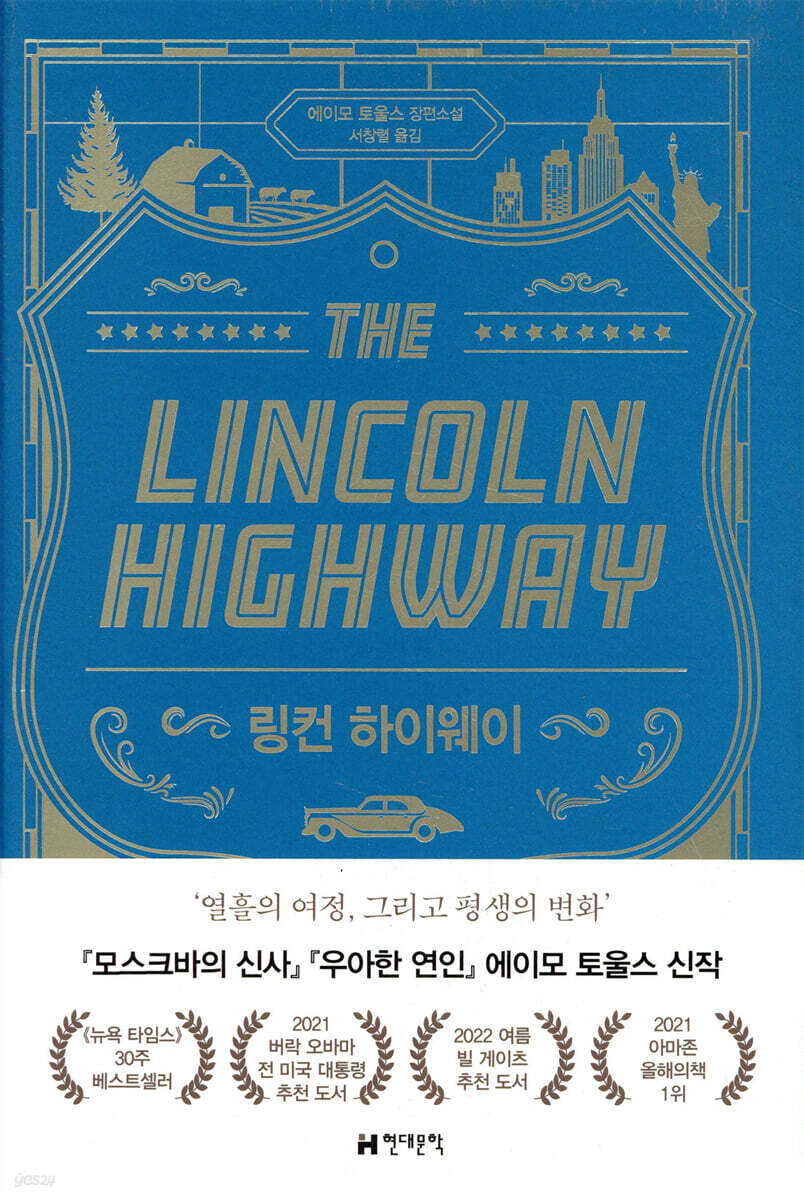
A ten-day journey, and a lifetime of change “The new road will lead us to a very pleasant place, Sometimes you wish you had gone in the direction you were already going instead of in a new direction.” Amor Towles, who rose to the ranks of world-renowned authors with just two books, 『Elegant Lover』 (2011) and 『A Gentleman in Moscow』 (2016), has published his third full-length novel, 『Lincoln Highway』 (2021), translated by Hyundae Munhak. Towles, who has always excelled at storytelling the human condition under extraordinary circumstances, places an eighteen-year-old boy on the brink of a dramatic life change under his characteristically authorial microscope, transporting the reader back to ten days in June 1954. On June 12, 1954, Emmett Watson, who was serving a sentence in a juvenile detention center for manslaughter, had just returned home to central Nebraska after his father's death. His mother left home eight years ago, his father's farm was seized, and he didn't know when the wrath of the family of the manslaughter victim would spill over onto him. Emmett was eighteen years old, and his only remaining family member was his precocious eight-year-old brother, Billy. Now his only possession was a pale blue Studebaker Land Cruiser, but he was determined to take Billy with him and start a new life in South Texas. But then an unexpected visitor appears before the brothers. The trunk of the car that drove Emmett home contained the sly and fiery Duchess and the serious and quirky Woolie, both of whom he had dated in juvenile detention. Emmett, who was troubled by Billy's fervent insistence that he go to California to find his mother with his AWOL friends, eventually decides to head to the westernmost part of the continent, relying on the postmark on a postcard his mother sent him eight years ago. Not knowing that his friends had completely different views on his brother's journey… … . "Lincoln Highway," which unfolds the events of ten days with one chapter per day, is a multi-layered work that unfolds from multiple perspectives, with characters in various roles appearing throughout, with each chapter title counting down from 10 to 1. Amo Towles's sophisticated depiction of the period allows readers to enjoy the history and culture of the time, while his relatable characters bring realism to his fictional stories. |
- You can preview some of the book's contents.
Preview
index
10
9
8
7
6
5
4
3
2
1
Translator's Note
9
8
7
6
5
4
3
2
1
Translator's Note
Into the book
At that moment, Emmett's words were sincere.
Because most of what the director said was agreed with.
He knew full well that his life was ahead of him, and that he had to take care of his younger brother.
He also knew that he was the agent of misfortune rather than its creator.
However, he did not agree that all the debts had been paid.
No matter how many coincidences were at play, having ended his time on this earth, which had been given to another by his own hand, he would have to dedicate the rest of his life to proving to the Almighty that he was worthy of His mercy.
---From "10. Emmett"
misfortune…….
Mr. Overmeyer said it was bad luck.
A misfortune so great that it cannot be overcome.
To some extent, the banker was right.
Speaking of bad luck, Emmett's father was always full of bad luck.
But Emmett knew it wasn't just bad luck.
Because when it comes to bad judgment, his father, Charlie Watson, had plenty of them too.
Emmet's father, who came to Nebraska from Boston in 1933 with his new wife, had dreams of farming the land.
For the next 20 years, my father tried to grow wheat, corn, soybeans, and even alfalfa, but was always frustrated.
When my father chose a crop that needed a lot of water to grow for a year, there was a drought for two years.
When my father changed the crops to those that needed a lot of sunlight, the western sky would often become thick with thunderstorm-inducing clouds.
One could say that nature is inherently merciless.
Nature is said to be inherently indifferent and unpredictable.
But a farmer who changes his crops every two or three years? Even at a young age, Emmett knew his father's attitude was the hallmark of someone who didn't know what he was doing.
---From "10. Emmett"
Billy picked up the last postcard with the classic building and fountain.
Then I turned the postcard over and read what my mother had written, running my finger along the lines.
“This is the Legion of Honor Museum in Lincoln Park, San Francisco.
“Every year on July 4th, the largest fireworks display in all of California takes place here!”
Billy looked at his brother.
“Brother, Mom will be there.
“I’m talking about the fireworks display at the Legion of Honor Museum on July 4th.”
“Billy...” Emmett began.
But Billy, already sensing the skepticism in his brother's voice, began to shake his head vigorously.
Then he looked back down at the map on the table and traced the path his mother had taken with his finger.
“From Ogallala to Cheyenne, from Cheyenne to Rollins, from Rollins to Rock Springs, from Rock Springs to Salt Lake City, from Salt Lake City to Illinois, from Illinois to Reno, from Reno to Sacramento, and from Sacramento to San Francisco.
“This is the path we must take.”
---From "10. Emmett"
At the time, I didn't understand what she was saying.
We failed to understand that our actions could be hindered by some bad deeds.
Because in my experience, the people who tend to do bad things are always the first ones to walk out the door.
I never understood why we had to bear the burden for someone who did something wrong to us.
And I never really understood what it meant to live peacefully, step by step.
But as Sister Agnes often said, the Lord gives us through the gift of experience all the wisdom He did not deem fit to give us from birth.
As expected, as I grew older, experience allowed me to understand Sister Agnes's sermons.
---From "9. The Duchess"
A funny thing about one story, I thought, was that Emmett was in town, Duchess was out for a walk, and Billy was reading his big red book out loud.
The funny thing about a story is that it can be made to take on all sorts of lengths.
---From "9ㆍUli"
“Billy, you know what’s really cool? You know what’s freaking cool?”
Billy marked the part he was reading, then looked up from the book.
“What is it, Wooly? What is that freaking awesome thing?”
“Every day is a special day.”
---From "9ㆍUli"
I am a good Christian.
I believe in God the Father Almighty, Creator of heaven and earth.
I believe that Jesus Christ, the only Son of God, was born of the Virgin Mary, suffered under Pontius Pilate, was crucified, died, was buried, and rose again on the third day.
We believe that He ascended into heaven and will come again to judge the living and the dead.
I believe that Noah built an ark before the great flood, when it rained for 40 days and 40 nights, and he put all kinds of animals on the ark, two by two.
I am even willing to believe that a burning bush spoke to Moses.
But I don't want to believe that our Savior Jesus Christ—the One who instantly heals lepers and restores sight to the blind—would turn His back on a woman who diligently does housework.
But I do not blame Jesus Christ.
The people I blame are Matthew, Mark, Luke, John, and all the others who have served as priests or preachers since then.
From a man's perspective, the first thing that's needed is for you to sit at his feet and listen to what he has to say.
No matter how long he talks or how often he has said it before.
He thinks you have plenty of time to sit down and listen.
Because food is something that is made by itself.
It falls from the sky and can turn water into wine with just a snap of your fingers.
Any woman who has ever gone to the trouble of baking an apple pie can tell you that's exactly how men see the world.
To bake an apple pie, you must first make the dough.
Cut the butter into pieces, add it to the flour, mix it with a beaten egg and a few spoons of ice water to make a dough, and let it sit overnight.
The next day, peel and core the apples, then cut them into wedges and sprinkle them with cinnamon sugar.
You have to roll out the dough and combine the ingredients to make a pie shape.
Then bake it at 425 degrees Fahrenheit for 15 minutes, then at 350 degrees Fahrenheit for another 45 minutes.
Finally, when dinner is over, you carefully place a piece on a plate and place it on the table.
Then, while talking, the man picks up half of it with a fork, puts it in his mouth, and swallows it without chewing it properly.
That way, you can get right back to what you were saying without being interrupted and continue talking.
---From "9ㆍSally"
What else is kindness but performing unnecessary, non-obligatory acts that benefit others? You can't be kind when you pay your bills.
You can't be kind when you wake up at dawn to feed the pigs, milk the cows, or take eggs out of the chicken coop.
Also, you can't be kind when you're cleaning the kitchen after preparing dinner or when your father goes upstairs without saying goodbye.
You can't be kind when you lock the door, turn off the lights, or pick up clothes from the bathroom floor and put them in a clothes basket.
I can't be kind when my only sister wisely gets married and moves to Pensacola, leaving me to take on all the housework.
“Yeah, that’s right,” I muttered as I climbed into bed and turned off the light.
In all these cases, you can't be kind.
Because kindness begins where need ends.
---From "9ㆍSally"
“Do you consider yourself a Christian, Emmett?”
“I’m not the type of person who goes to church.”
“But you think you’re a Christian?”
“I was raised and educated to be a Christian.”
“Then you know the story of the Good Samaritan.”
“Yes, Sister, I know that story.
And I also know that a good Christian helps people in need.”
“That’s right, Emmett.
A good Christian shows compassion to those in need.
That's an important part of the meaning of the story.
But equally important is what Jesus taught us: we don't always get to choose who we show mercy to.”
---From "8ㆍEmmett"
The child continued reading the book.
King Ulysses continued to move from one land to another, from one ordeal to another, and Ulysses listened quietly to the story.
Tears flowed shamelessly from his eyes.
He listened intently as his namesake faced the magic of Circe, who transformed people into animals, the merciless temptations of the Sirens, and then the imminent danger of having to confront Scylla and Charybdis.
But as the boy read about how Ulysses's starving sailors ignored the prophet Tiresias' warning and slaughtered the sacred bulls of the sun god Helios, and how Zeus, enraged by this, once again tormented the hero with thunder and raging waves, Ulysses laid his hand on that page of the boy's book.
“That’s enough,” he said.
The child raised his head with a surprised expression.
“Don’t you want to hear the end?”
Ulysses was silent for a moment.
“There is no end, Billy.
“There is no end to the suffering of those who anger the Almighty God.”
---From "7. Ulysses"
Backing up to the 20-yard line, Woolley watched, first in shock, then in amazement, as the flames spread to the center post of the goal, then to both crossbars simultaneously, and then up both goal posts.
Finally, the entire goal was engulfed in flames.
Suddenly it didn't look like a goal at all.
It looked like a fire spirit standing proudly with its arms outstretched towards the sky.
And it was very, very beautiful.
When the school disciplinary committee summoned Woolley, Woolley tried to explain that all he wanted was to free himself from the tyranny of synonyms so that he could do better on the exams.
However, the Dean of Students presiding over the hearing said before giving Woolley a chance to speak that he was there to explain his actions in setting fire to the football stadium.
After a while, the faculty representative, Mr. Harrington, called it a firestorm.
Then student body president Donkey Dunkle (who was also captain of the football team) called it a fire.
He knew at that very moment, right then and there, that no matter what he said, they would all side with the synonym.
---From "5ㆍUli"
Shortly after arriving in New York, in his golden years of his late twenties, Abacus made three wonderful friends.
There were two men and a woman, the strongest of comrades and companions in their pursuit of adventure of heart and soul.
They sailed the seas of life together, maintaining reasonable diligence and appropriate composure.
But in the past five years, my first friend has lost his eyesight, my second friend has developed emphysema, and my third friend has developed dementia.
Some might be tempted to describe their various fates as 'loss of vision, loss of lung capacity, loss of cognitive ability.'
But in fact, those three diseases correspond to the same sentence:
The narrowness of life at the extreme end of a diamond shape.
The sphere of activity of these friends gradually shrinks from the world itself to their own country, then to their own county, then to their own house, and finally to their own room, where they are destined to end their lives in blind, breathless, and memoryless bodies.
Abacus had no significant illness yet, but his world was also shrinking.
He, too, watched his own life shrink from the vast world to the island of Manhattan, and from there to an office full of books, where he awaited his end with philosophical resignation.
But then this… … .
---From "2. Abacus"
As I watched Emmet walk out the door and get into his bright yellow car, I thought to myself, America really has a lot of great things.
The Empire State Building and the Statue of Liberty are tall.
The Mississippi River and the Grand Canyon are large.
The sky above the prairie is large.
But nothing is greater than human self-overestimation.
Because most of what the director said was agreed with.
He knew full well that his life was ahead of him, and that he had to take care of his younger brother.
He also knew that he was the agent of misfortune rather than its creator.
However, he did not agree that all the debts had been paid.
No matter how many coincidences were at play, having ended his time on this earth, which had been given to another by his own hand, he would have to dedicate the rest of his life to proving to the Almighty that he was worthy of His mercy.
---From "10. Emmett"
misfortune…….
Mr. Overmeyer said it was bad luck.
A misfortune so great that it cannot be overcome.
To some extent, the banker was right.
Speaking of bad luck, Emmett's father was always full of bad luck.
But Emmett knew it wasn't just bad luck.
Because when it comes to bad judgment, his father, Charlie Watson, had plenty of them too.
Emmet's father, who came to Nebraska from Boston in 1933 with his new wife, had dreams of farming the land.
For the next 20 years, my father tried to grow wheat, corn, soybeans, and even alfalfa, but was always frustrated.
When my father chose a crop that needed a lot of water to grow for a year, there was a drought for two years.
When my father changed the crops to those that needed a lot of sunlight, the western sky would often become thick with thunderstorm-inducing clouds.
One could say that nature is inherently merciless.
Nature is said to be inherently indifferent and unpredictable.
But a farmer who changes his crops every two or three years? Even at a young age, Emmett knew his father's attitude was the hallmark of someone who didn't know what he was doing.
---From "10. Emmett"
Billy picked up the last postcard with the classic building and fountain.
Then I turned the postcard over and read what my mother had written, running my finger along the lines.
“This is the Legion of Honor Museum in Lincoln Park, San Francisco.
“Every year on July 4th, the largest fireworks display in all of California takes place here!”
Billy looked at his brother.
“Brother, Mom will be there.
“I’m talking about the fireworks display at the Legion of Honor Museum on July 4th.”
“Billy...” Emmett began.
But Billy, already sensing the skepticism in his brother's voice, began to shake his head vigorously.
Then he looked back down at the map on the table and traced the path his mother had taken with his finger.
“From Ogallala to Cheyenne, from Cheyenne to Rollins, from Rollins to Rock Springs, from Rock Springs to Salt Lake City, from Salt Lake City to Illinois, from Illinois to Reno, from Reno to Sacramento, and from Sacramento to San Francisco.
“This is the path we must take.”
---From "10. Emmett"
At the time, I didn't understand what she was saying.
We failed to understand that our actions could be hindered by some bad deeds.
Because in my experience, the people who tend to do bad things are always the first ones to walk out the door.
I never understood why we had to bear the burden for someone who did something wrong to us.
And I never really understood what it meant to live peacefully, step by step.
But as Sister Agnes often said, the Lord gives us through the gift of experience all the wisdom He did not deem fit to give us from birth.
As expected, as I grew older, experience allowed me to understand Sister Agnes's sermons.
---From "9. The Duchess"
A funny thing about one story, I thought, was that Emmett was in town, Duchess was out for a walk, and Billy was reading his big red book out loud.
The funny thing about a story is that it can be made to take on all sorts of lengths.
---From "9ㆍUli"
“Billy, you know what’s really cool? You know what’s freaking cool?”
Billy marked the part he was reading, then looked up from the book.
“What is it, Wooly? What is that freaking awesome thing?”
“Every day is a special day.”
---From "9ㆍUli"
I am a good Christian.
I believe in God the Father Almighty, Creator of heaven and earth.
I believe that Jesus Christ, the only Son of God, was born of the Virgin Mary, suffered under Pontius Pilate, was crucified, died, was buried, and rose again on the third day.
We believe that He ascended into heaven and will come again to judge the living and the dead.
I believe that Noah built an ark before the great flood, when it rained for 40 days and 40 nights, and he put all kinds of animals on the ark, two by two.
I am even willing to believe that a burning bush spoke to Moses.
But I don't want to believe that our Savior Jesus Christ—the One who instantly heals lepers and restores sight to the blind—would turn His back on a woman who diligently does housework.
But I do not blame Jesus Christ.
The people I blame are Matthew, Mark, Luke, John, and all the others who have served as priests or preachers since then.
From a man's perspective, the first thing that's needed is for you to sit at his feet and listen to what he has to say.
No matter how long he talks or how often he has said it before.
He thinks you have plenty of time to sit down and listen.
Because food is something that is made by itself.
It falls from the sky and can turn water into wine with just a snap of your fingers.
Any woman who has ever gone to the trouble of baking an apple pie can tell you that's exactly how men see the world.
To bake an apple pie, you must first make the dough.
Cut the butter into pieces, add it to the flour, mix it with a beaten egg and a few spoons of ice water to make a dough, and let it sit overnight.
The next day, peel and core the apples, then cut them into wedges and sprinkle them with cinnamon sugar.
You have to roll out the dough and combine the ingredients to make a pie shape.
Then bake it at 425 degrees Fahrenheit for 15 minutes, then at 350 degrees Fahrenheit for another 45 minutes.
Finally, when dinner is over, you carefully place a piece on a plate and place it on the table.
Then, while talking, the man picks up half of it with a fork, puts it in his mouth, and swallows it without chewing it properly.
That way, you can get right back to what you were saying without being interrupted and continue talking.
---From "9ㆍSally"
What else is kindness but performing unnecessary, non-obligatory acts that benefit others? You can't be kind when you pay your bills.
You can't be kind when you wake up at dawn to feed the pigs, milk the cows, or take eggs out of the chicken coop.
Also, you can't be kind when you're cleaning the kitchen after preparing dinner or when your father goes upstairs without saying goodbye.
You can't be kind when you lock the door, turn off the lights, or pick up clothes from the bathroom floor and put them in a clothes basket.
I can't be kind when my only sister wisely gets married and moves to Pensacola, leaving me to take on all the housework.
“Yeah, that’s right,” I muttered as I climbed into bed and turned off the light.
In all these cases, you can't be kind.
Because kindness begins where need ends.
---From "9ㆍSally"
“Do you consider yourself a Christian, Emmett?”
“I’m not the type of person who goes to church.”
“But you think you’re a Christian?”
“I was raised and educated to be a Christian.”
“Then you know the story of the Good Samaritan.”
“Yes, Sister, I know that story.
And I also know that a good Christian helps people in need.”
“That’s right, Emmett.
A good Christian shows compassion to those in need.
That's an important part of the meaning of the story.
But equally important is what Jesus taught us: we don't always get to choose who we show mercy to.”
---From "8ㆍEmmett"
The child continued reading the book.
King Ulysses continued to move from one land to another, from one ordeal to another, and Ulysses listened quietly to the story.
Tears flowed shamelessly from his eyes.
He listened intently as his namesake faced the magic of Circe, who transformed people into animals, the merciless temptations of the Sirens, and then the imminent danger of having to confront Scylla and Charybdis.
But as the boy read about how Ulysses's starving sailors ignored the prophet Tiresias' warning and slaughtered the sacred bulls of the sun god Helios, and how Zeus, enraged by this, once again tormented the hero with thunder and raging waves, Ulysses laid his hand on that page of the boy's book.
“That’s enough,” he said.
The child raised his head with a surprised expression.
“Don’t you want to hear the end?”
Ulysses was silent for a moment.
“There is no end, Billy.
“There is no end to the suffering of those who anger the Almighty God.”
---From "7. Ulysses"
Backing up to the 20-yard line, Woolley watched, first in shock, then in amazement, as the flames spread to the center post of the goal, then to both crossbars simultaneously, and then up both goal posts.
Finally, the entire goal was engulfed in flames.
Suddenly it didn't look like a goal at all.
It looked like a fire spirit standing proudly with its arms outstretched towards the sky.
And it was very, very beautiful.
When the school disciplinary committee summoned Woolley, Woolley tried to explain that all he wanted was to free himself from the tyranny of synonyms so that he could do better on the exams.
However, the Dean of Students presiding over the hearing said before giving Woolley a chance to speak that he was there to explain his actions in setting fire to the football stadium.
After a while, the faculty representative, Mr. Harrington, called it a firestorm.
Then student body president Donkey Dunkle (who was also captain of the football team) called it a fire.
He knew at that very moment, right then and there, that no matter what he said, they would all side with the synonym.
---From "5ㆍUli"
Shortly after arriving in New York, in his golden years of his late twenties, Abacus made three wonderful friends.
There were two men and a woman, the strongest of comrades and companions in their pursuit of adventure of heart and soul.
They sailed the seas of life together, maintaining reasonable diligence and appropriate composure.
But in the past five years, my first friend has lost his eyesight, my second friend has developed emphysema, and my third friend has developed dementia.
Some might be tempted to describe their various fates as 'loss of vision, loss of lung capacity, loss of cognitive ability.'
But in fact, those three diseases correspond to the same sentence:
The narrowness of life at the extreme end of a diamond shape.
The sphere of activity of these friends gradually shrinks from the world itself to their own country, then to their own county, then to their own house, and finally to their own room, where they are destined to end their lives in blind, breathless, and memoryless bodies.
Abacus had no significant illness yet, but his world was also shrinking.
He, too, watched his own life shrink from the vast world to the island of Manhattan, and from there to an office full of books, where he awaited his end with philosophical resignation.
But then this… … .
---From "2. Abacus"
As I watched Emmet walk out the door and get into his bright yellow car, I thought to myself, America really has a lot of great things.
The Empire State Building and the Statue of Liberty are tall.
The Mississippi River and the Grand Canyon are large.
The sky above the prairie is large.
But nothing is greater than human self-overestimation.
---From "1ㆍSally"
Publisher's Review
Amor Towles' new works, "A Gentleman in Moscow" and "The Elegant Lover"
* Cumulative sales in the U.S. exceeded 1,000,000 copies
* NBC Today's Jenna Book Club Selection
* 2021 [New York Times] Notable Books
* 2021 [Washington Post] Notable Novels
* 2021 [TIME] Must-Read Books
* 2021 Oprah Daley and National Public Radio Book of the Year
* 2021 Barnes & Noble Novel of the Year, Waterstones Book of the Year Novel, Indigo Book of the Year
* 2021 Kirkus Historical Novel of the Year
· With exquisitely drawn characters, beautiful prose, and a true sense of moral integrity, "Lincoln Highway" is already an American classic for those just coming of age, standing shoulder to shoulder with "The Catcher in the Rye" and "To Kill a Mockingbird."
[Red]
· A mischievous, wise, and wildly funny novel.
Amor Towles is preoccupied with the rich, illustrated narratives found in mythology and the Homeric epics.
Each of the faces he subtly reveals is the central figure in a unique yet universal adventure currently underway.
A wonderfully bouncy work, brimming with light, wit and youth.
Towles slices existence into tiny, random chunks—ten days, for example—and through his lens, we see that these tiny slivers are filled with stories as grand as legend.
[New York Times Book Review]
· Towles' third novel is even more exciting than the acclaimed A Gentleman in Moscow.
A remarkable blend of sweetness and tragic fate, "Lincoln Highway" fully reveals American mythology, the art of storytelling, and the ruthless influence history has on individuals.
A thrilling journey through Americana! [Kirkus Reviews]
· Full of drama.
Readers of Towles will be richly rewarded with the very pleasures they have come to expect from him.
A variety of stories told at a leisurely pace, a cast of lovable yet occasionally mad characters, and a perfect composition that always surprises.
Towles has created another captivating novel destined to leave satisfied readers turning the pages, sometimes in tatters.
[Book Page]
· A dazzlingly elaborate work.
Towles binds his novel with compassion and meticulous detail.
He draws a line between the social ills of his time and the present, connecting the aspirations of his characters to our own volatile times.
He does this with elegant and sophisticated storytelling.
This novel skillfully embraces the characters' contradictions, leading the reader forward with a "floating feeling, like being carried along a wide river on a not-too-hot summer day."
[Washington Post]
· The American openness to the vagaries of fate and the endlessly fractalizing concept of free will are the tensions that fuel Towles's exciting and thrilling picaresque novel.
The author seems to be saying that if we are willing to accept the power of stories, stories can help us find ourselves again.
Anyone who follows the Lincoln Highway will enjoy the journey, whether by choice or not, keeping in mind that there are roads not taken.
[Los Angeles Times]
· A thrilling and exhilarating drive.
If you hitchhike to this delightful masterpiece, you'll find yourself helplessly dragged along by the creative richness of Towles's storytelling.
The Lincoln Highway is so elegantly constructed that it's hard to take your eyes off it.
It's also full of action.
This well-crafted novel, filled with fantastical characters, is full of side stories, magical feats, heartbreaking tales of retribution, and intricately woven deals to balance the purse strings.
National Public Radio
· As the pandemic drags on, "Lincoln Highway" is an uplifting, heroic adventure for readers weary of staying home and digital life.
Towles handles elements of the picaresque, the coming-of-age novel, and the epic expedition with elegance and sophistication.
The unforgettable and unexpected final scene perfectly encapsulates the theme of inheritance and the choices the characters make with what they are given to determine their own fate.
[Seattle Times]
· Fascinating.
Lincoln Highway has suspense, humor, philosophy, and a solid sense of time and space, and moves quickly and steadily toward a satisfying conclusion.
Like its namesake, the Lincoln Highway is full of long and fascinating detours.
The works of a master of language like Towles are certainly worth traveling with.
[St. Louis Post-Dispatch]
· A captivating odyssey.
[People]
· The fact that I enjoyed Lincoln Highway so captivatingly is a testament to Towles's near-magical gift for storytelling—his ability to simultaneously create characters who are both lovable and compelling, yet somehow somehow flawed.
Towles gives us what all great journey novels give us.
For example, the panorama of prairies and hills, the adventure that seems to leap out of that landscape, the propulsive rhythm of the road.
The novel is told from multiple perspectives, each compelling and complete.
Perhaps because of the limited palette of the previous work, the film seems to welcome a more vibrant expansiveness here—not just the vast expanses of American landscape, but also the narrative that stretches far and wide along straight lines, leaping briskly and relentlessly from one point to the next.
This novel is a story about travel itself and a literary history of the American road.
Truly one of the best in the field, he ranks alongside Jack Kerouac, John Steinbeck, and Thomas Wolfe.
[Observer]
· If you love history and adventure, there's no book like The Lincoln Highway.
Even though it is thick, it doesn't feel excessive.
The fast-paced plot and concise sentences make it a smooth read whether you're in bed or in a noisy coffee shop.
Associated Press
· The amazingly versatile author of "The Elegant Lover" and "A Gentleman in Moscow" returns with an American picaresque novel destined for classic success.
It's full of adventures and memorable characters.
Using multiple perspectives and shifting from comedy to tragedy and back again, Amor Towles captivates.
[O, Oprah Magazine]
· Towles's mythic allusions and epic parallels create a depth and flow that counters the story's premise.
Although set in 1950s America, the novel is inherently timeless.
It also raises big questions about judgment and retribution, the fundamental wounds of abandonment by parents and spouses, the crucial role of the storyteller, and the extent of responsibility towards others.
The complexity of the characters adds to the pace and excitement.
Towles readily embraces the ambiguous mystery that fuses light and dark in human nature.
In a sad age of maddening alternate realities and shameless selfishness, Lincoln Highway is a timely refresher, thanks to its focus on responsibility and enduring truth.
South China Morning Post
* Cumulative sales in the U.S. exceeded 1,000,000 copies
* NBC Today's Jenna Book Club Selection
* 2021 [New York Times] Notable Books
* 2021 [Washington Post] Notable Novels
* 2021 [TIME] Must-Read Books
* 2021 Oprah Daley and National Public Radio Book of the Year
* 2021 Barnes & Noble Novel of the Year, Waterstones Book of the Year Novel, Indigo Book of the Year
* 2021 Kirkus Historical Novel of the Year
· With exquisitely drawn characters, beautiful prose, and a true sense of moral integrity, "Lincoln Highway" is already an American classic for those just coming of age, standing shoulder to shoulder with "The Catcher in the Rye" and "To Kill a Mockingbird."
[Red]
· A mischievous, wise, and wildly funny novel.
Amor Towles is preoccupied with the rich, illustrated narratives found in mythology and the Homeric epics.
Each of the faces he subtly reveals is the central figure in a unique yet universal adventure currently underway.
A wonderfully bouncy work, brimming with light, wit and youth.
Towles slices existence into tiny, random chunks—ten days, for example—and through his lens, we see that these tiny slivers are filled with stories as grand as legend.
[New York Times Book Review]
· Towles' third novel is even more exciting than the acclaimed A Gentleman in Moscow.
A remarkable blend of sweetness and tragic fate, "Lincoln Highway" fully reveals American mythology, the art of storytelling, and the ruthless influence history has on individuals.
A thrilling journey through Americana! [Kirkus Reviews]
· Full of drama.
Readers of Towles will be richly rewarded with the very pleasures they have come to expect from him.
A variety of stories told at a leisurely pace, a cast of lovable yet occasionally mad characters, and a perfect composition that always surprises.
Towles has created another captivating novel destined to leave satisfied readers turning the pages, sometimes in tatters.
[Book Page]
· A dazzlingly elaborate work.
Towles binds his novel with compassion and meticulous detail.
He draws a line between the social ills of his time and the present, connecting the aspirations of his characters to our own volatile times.
He does this with elegant and sophisticated storytelling.
This novel skillfully embraces the characters' contradictions, leading the reader forward with a "floating feeling, like being carried along a wide river on a not-too-hot summer day."
[Washington Post]
· The American openness to the vagaries of fate and the endlessly fractalizing concept of free will are the tensions that fuel Towles's exciting and thrilling picaresque novel.
The author seems to be saying that if we are willing to accept the power of stories, stories can help us find ourselves again.
Anyone who follows the Lincoln Highway will enjoy the journey, whether by choice or not, keeping in mind that there are roads not taken.
[Los Angeles Times]
· A thrilling and exhilarating drive.
If you hitchhike to this delightful masterpiece, you'll find yourself helplessly dragged along by the creative richness of Towles's storytelling.
The Lincoln Highway is so elegantly constructed that it's hard to take your eyes off it.
It's also full of action.
This well-crafted novel, filled with fantastical characters, is full of side stories, magical feats, heartbreaking tales of retribution, and intricately woven deals to balance the purse strings.
National Public Radio
· As the pandemic drags on, "Lincoln Highway" is an uplifting, heroic adventure for readers weary of staying home and digital life.
Towles handles elements of the picaresque, the coming-of-age novel, and the epic expedition with elegance and sophistication.
The unforgettable and unexpected final scene perfectly encapsulates the theme of inheritance and the choices the characters make with what they are given to determine their own fate.
[Seattle Times]
· Fascinating.
Lincoln Highway has suspense, humor, philosophy, and a solid sense of time and space, and moves quickly and steadily toward a satisfying conclusion.
Like its namesake, the Lincoln Highway is full of long and fascinating detours.
The works of a master of language like Towles are certainly worth traveling with.
[St. Louis Post-Dispatch]
· A captivating odyssey.
[People]
· The fact that I enjoyed Lincoln Highway so captivatingly is a testament to Towles's near-magical gift for storytelling—his ability to simultaneously create characters who are both lovable and compelling, yet somehow somehow flawed.
Towles gives us what all great journey novels give us.
For example, the panorama of prairies and hills, the adventure that seems to leap out of that landscape, the propulsive rhythm of the road.
The novel is told from multiple perspectives, each compelling and complete.
Perhaps because of the limited palette of the previous work, the film seems to welcome a more vibrant expansiveness here—not just the vast expanses of American landscape, but also the narrative that stretches far and wide along straight lines, leaping briskly and relentlessly from one point to the next.
This novel is a story about travel itself and a literary history of the American road.
Truly one of the best in the field, he ranks alongside Jack Kerouac, John Steinbeck, and Thomas Wolfe.
[Observer]
· If you love history and adventure, there's no book like The Lincoln Highway.
Even though it is thick, it doesn't feel excessive.
The fast-paced plot and concise sentences make it a smooth read whether you're in bed or in a noisy coffee shop.
Associated Press
· The amazingly versatile author of "The Elegant Lover" and "A Gentleman in Moscow" returns with an American picaresque novel destined for classic success.
It's full of adventures and memorable characters.
Using multiple perspectives and shifting from comedy to tragedy and back again, Amor Towles captivates.
[O, Oprah Magazine]
· Towles's mythic allusions and epic parallels create a depth and flow that counters the story's premise.
Although set in 1950s America, the novel is inherently timeless.
It also raises big questions about judgment and retribution, the fundamental wounds of abandonment by parents and spouses, the crucial role of the storyteller, and the extent of responsibility towards others.
The complexity of the characters adds to the pace and excitement.
Towles readily embraces the ambiguous mystery that fuses light and dark in human nature.
In a sad age of maddening alternate realities and shameless selfishness, Lincoln Highway is a timely refresher, thanks to its focus on responsibility and enduring truth.
South China Morning Post
GOODS SPECIFICS
- Date of issue: July 4, 2022
- Format: Hardcover book binding method guide
- Page count, weight, size: 820 pages | 922g | 138*205*40mm
- ISBN13: 9791167901118
- ISBN10: 1167901118
You may also like
카테고리
korean


korean

![GQ KOREA Mark (Monthly): December [2025]](http://librairie.coreenne.fr/cdn/shop/files/8ef265dbbfbf186523ed75ba7319009d.jpg?v=1765340328&width=3840)


