

Correcting Common Sense about Korean History
 |
Description
Book Introduction
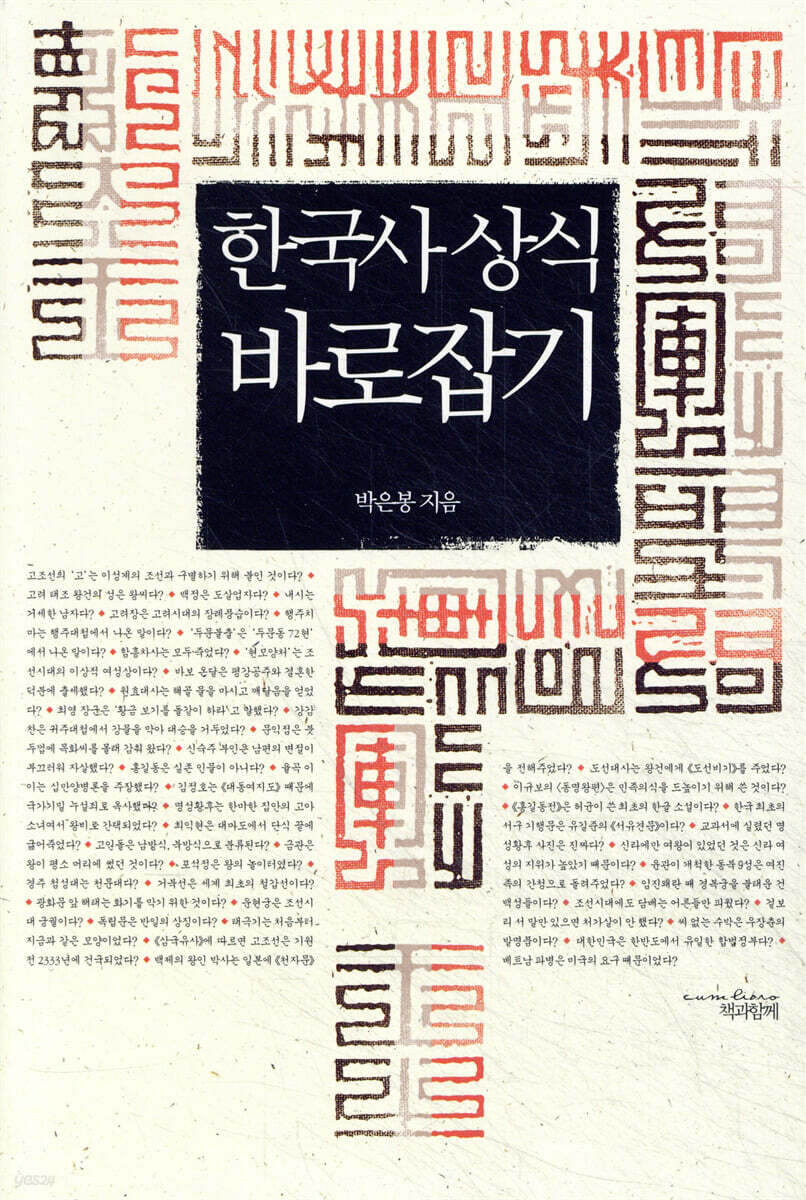
『Correcting Common Sense about Korean History』 is a book by Eunbong Park, the best-selling author of 『100 Scenes from World History』 and 『100 Scenes from Korean History』, which traces the causes of why the general public believes incorrect information about Korean history as 'fact' and reveals the reasons, thereby providing correct common sense about Korean history and a view of Korean history.
As discussed in 'Is Goryeojang a funeral custom of the Goryeo Dynasty?' (p. 47) and 'Is Haengjuchima a word derived from the Battle of Haengju?' (p. 55), the descriptions of 'Haengjuchima' and 'Goryeojang' are full of errors in current elementary school textbooks, and even the alternative textbook 'Living Korean History Textbook', which was written by the National History Teachers Association, a group of current history teachers, and became a hot topic, lists the founding year of Gojoseon in 'Samguk Yusa' as BC
The author points out common misconceptions, such as the one that describes it as 2333 (page 285).
This book, consisting of 5 parts and 44 chapters, presents a progressive perspective on history by deeply and clearly solving problems across Korean history from Gojoseon to the dispatch of troops to Vietnam.
As discussed in 'Is Goryeojang a funeral custom of the Goryeo Dynasty?' (p. 47) and 'Is Haengjuchima a word derived from the Battle of Haengju?' (p. 55), the descriptions of 'Haengjuchima' and 'Goryeojang' are full of errors in current elementary school textbooks, and even the alternative textbook 'Living Korean History Textbook', which was written by the National History Teachers Association, a group of current history teachers, and became a hot topic, lists the founding year of Gojoseon in 'Samguk Yusa' as BC
The author points out common misconceptions, such as the one that describes it as 2333 (page 285).
This book, consisting of 5 parts and 44 chapters, presents a progressive perspective on history by deeply and clearly solving problems across Korean history from Gojoseon to the dispatch of troops to Vietnam.
- You can preview some of the book's contents.
Preview
index
Author's Note
1.
Misconceptions about etymology
Was the 'Go' in Gojoseon added to distinguish it from Joseon, which was founded by Yi Seong-gye?
Is the surname of King Taejo of Goryeo, Wang Geon, 'Wang'?
Does Baekjeong refer to a butcher?
Does eunuch refer to a castrated man?
Is Goryeojang a common custom of the Goryeo Dynasty?
Did the term Haengju Chima come from the Battle of Haengju during the Imjin War?
Is the term “staying at home” derived from the 72 loyal subjects of Dumun-dong in the late Goryeo Dynasty?
Did all the people who went to Hamheung die?
Is a good wife and wise mother the ideal type of woman in the Joseon Dynasty?
2.
Misconceptions about people
Fool Ondal became successful because of Princess Pyeonggang?
Did Wonhyo attain enlightenment by drinking water from a skull?
General Choi Young said to treat gold like a stone?
Gang Gam-chan achieved a great victory in the Battle of Gwiju by blocking the river with ox hide?
Did Mun Ik-jeom secretly hide cotton seeds in the brush case?
Did Mrs. Shin Suk-ju commit suicide because she was ashamed of her husband's betrayal?
Hong Gil-dong is not a real person?
Did Yulgok Yi I advocate the theory of raising 100,000 troops?
Kim Jeong-ho was imprisoned and killed by the isolationist Heungseon Daewongun for leaking state secrets?
Was Empress Myeongseong chosen as queen because she came from a humble family?
Choi Ik-hyeon died from hunger strike on Daema Island?
3.
Misconceptions about relics and historical sites
Are dolmens classified into southern and northern styles?
Is the gold crown something the king usually wears?
Is Poseokjeong the king's playground?
Is Gyeongju Cheomseongdae an astronomical observatory?
The turtle ship was the world's first ironclad ship?
Was the Haetae in front of Gwanghwamun erected to ward off evil spirits?
Unhyeongung Palace is one of the palaces of the Joseon Dynasty?
Is the Independence Gate a symbol of anti-Japanese sentiment?
Has the Taegeukgi been the same since the beginning?
4.
Misconceptions about books, literature, and photographs
According to "Samguk Yusa", Gojoseon was founded in 2333 BC?
Did King Bak of Baekje transmit the "Thousand Character Classic" to Japan?
Did the great geomancer Doseon give Wang Geon the "Doseon Bigi"?
Was Lee Gyu-bo's poem "Dongmyeongwangpyeon" written to raise national consciousness?
Is "The Story of Hong Gildong" the first novel written in Korean?
Is Korea's first Western travelogue "Seoyu Gyeonmun"?
Is the photo of Empress Myeongseong in the textbook real?
5.
Misconceptions about politics, society, and life
Was the reason that only Silla had a queen because the status of Silla women was high?
Were the nine northeastern castles that Yun Gwan had pioneered returned at the request of the Jurchen?
Were the angry people the ones who burned down Gyeongbokgung Palace during the Imjin War?
Even in the Joseon Dynasty, only adults smoked cigarettes?
If you only had the barley, you wouldn't have lived with your in-laws?
Is the seedless watermelon Woo Jang-chun's invention?
Is the Republic of Korea the only legitimate government on the Korean Peninsula recognized by the UN?
Was the dispatch of troops to Vietnam due to American demands?
References
1.
Misconceptions about etymology
Was the 'Go' in Gojoseon added to distinguish it from Joseon, which was founded by Yi Seong-gye?
Is the surname of King Taejo of Goryeo, Wang Geon, 'Wang'?
Does Baekjeong refer to a butcher?
Does eunuch refer to a castrated man?
Is Goryeojang a common custom of the Goryeo Dynasty?
Did the term Haengju Chima come from the Battle of Haengju during the Imjin War?
Is the term “staying at home” derived from the 72 loyal subjects of Dumun-dong in the late Goryeo Dynasty?
Did all the people who went to Hamheung die?
Is a good wife and wise mother the ideal type of woman in the Joseon Dynasty?
2.
Misconceptions about people
Fool Ondal became successful because of Princess Pyeonggang?
Did Wonhyo attain enlightenment by drinking water from a skull?
General Choi Young said to treat gold like a stone?
Gang Gam-chan achieved a great victory in the Battle of Gwiju by blocking the river with ox hide?
Did Mun Ik-jeom secretly hide cotton seeds in the brush case?
Did Mrs. Shin Suk-ju commit suicide because she was ashamed of her husband's betrayal?
Hong Gil-dong is not a real person?
Did Yulgok Yi I advocate the theory of raising 100,000 troops?
Kim Jeong-ho was imprisoned and killed by the isolationist Heungseon Daewongun for leaking state secrets?
Was Empress Myeongseong chosen as queen because she came from a humble family?
Choi Ik-hyeon died from hunger strike on Daema Island?
3.
Misconceptions about relics and historical sites
Are dolmens classified into southern and northern styles?
Is the gold crown something the king usually wears?
Is Poseokjeong the king's playground?
Is Gyeongju Cheomseongdae an astronomical observatory?
The turtle ship was the world's first ironclad ship?
Was the Haetae in front of Gwanghwamun erected to ward off evil spirits?
Unhyeongung Palace is one of the palaces of the Joseon Dynasty?
Is the Independence Gate a symbol of anti-Japanese sentiment?
Has the Taegeukgi been the same since the beginning?
4.
Misconceptions about books, literature, and photographs
According to "Samguk Yusa", Gojoseon was founded in 2333 BC?
Did King Bak of Baekje transmit the "Thousand Character Classic" to Japan?
Did the great geomancer Doseon give Wang Geon the "Doseon Bigi"?
Was Lee Gyu-bo's poem "Dongmyeongwangpyeon" written to raise national consciousness?
Is "The Story of Hong Gildong" the first novel written in Korean?
Is Korea's first Western travelogue "Seoyu Gyeonmun"?
Is the photo of Empress Myeongseong in the textbook real?
5.
Misconceptions about politics, society, and life
Was the reason that only Silla had a queen because the status of Silla women was high?
Were the nine northeastern castles that Yun Gwan had pioneered returned at the request of the Jurchen?
Were the angry people the ones who burned down Gyeongbokgung Palace during the Imjin War?
Even in the Joseon Dynasty, only adults smoked cigarettes?
If you only had the barley, you wouldn't have lived with your in-laws?
Is the seedless watermelon Woo Jang-chun's invention?
Is the Republic of Korea the only legitimate government on the Korean Peninsula recognized by the UN?
Was the dispatch of troops to Vietnam due to American demands?
References
Into the book
If you look up 'good wife and wise mother' in the Korean dictionary, it comes up like this.
“A good mother to her children, a good wife to her husband.” In English, it is written as ‘a good wife and wise mother’, and in Chinese characters, it is written as ‘賢母良妻’.
When people think of a good wife and wise mother, they always think of Shin Saimdang and nod their heads, saying that she was the ideal woman of the Joseon Dynasty, but in fact, the good wife and wise mother is a new image of women that came from abroad during the Enlightenment Period about 100 years ago.
… … The ideal woman in the Joseon Dynasty was not a good wife and wise mother, but a ‘virtuous woman’ and a ‘filial daughter.’
… … The fact that the national award given to a woman who sacrificed her life to live up to the ideals demanded by the times was called the ‘Yeolnyeomun’ rather than the ‘Hyunmomyeongmun’ is clear evidence.
… … Even if we look at the ‘Seonbi 先? Haengjang’ written by Yulgok Yi I, the son of Shin Saimdang, who was known as the epitome of a good wife and wise mother, in mourning for his mother’s death, we can see that.
---Part 1, Chapter 9: "Wise Wife and Good Mother": The Ideal Woman of the Joseon Dynasty?, pp. 79-81
As time goes by, not only the content of the theory of raising ten thousand soldiers becomes more specific, but also the time period in which it was spoken.
He simply said, “earlier in the competition,” without revealing a specific date.
However, the Annals of King Seonjo included the theory of raising 100,000 troops in the September 1, 1582, and the Annals of Yulgok included the theory of raising 100,000 troops in the April 1583, respectively.
The Imjin War broke out in April 1592, so was the Yulgok Yeonbo conscious of the date '10 years ago'?
In that sense, the content of the theory of raising ten thousand troops became more specific and the dates became clearer as time passed.
It first appeared in the book written by Kim Jang-saeng, and was slightly revised in the book about 15 years later, and the theory of 100,000 military forces that we know was completed in the book Yulgok Yeonbo about 65 years later.
The theory of raising 100,000 troops, completed in this way, is included in the ‘Appendix’ of the ‘Yulgok Complete Works’ and is handed down to this day.
---Part 2, Chapter 17: Did Yulgok Yi I advocate the theory of raising 100,000 troops?, pp. 160-161
So where did the story come from that Kim Jeong-ho traveled the country three times, climbed Mount Baekdu eight times, and presented the Daedongyeojido to Heungseon Daewongun before being imprisoned? Until now, the prevailing view was that these stories were fabricated by Japan during the colonial period.
This is because such a story was included in the elementary school textbook “Korean Language Reader” published by the Government-General of Korea in 1934.
… … But in fact, there was someone who spoke of the Oksa theory and the Jeon Guk Dop Sa theory before the 《Joseon Eo Dok Bon》.
This is Yukdang Choi Namseon.
---Part 2, Chapter 18: Did Kim Jeong-ho die in prison for leaking state secrets because of the Daedongyeojido?, pp. 174-175
It was about 60 years ago, in 1949, after the establishment of the Republic of Korea government, that the Taegeukgi, which had been so diverse, was unified into its current form.
… … But before this, the Shanghai Provisional Government had established a unified Taegeukgi.
… …Why was this provisional government Taegeukgi not adopted as the national flag of the Republic of Korea? Furthermore, the provisional government Taegeukgi wasn't even included as a candidate for the national unification plan.
---Part 3 Chapter 29 Was the Taegeukgi the same shape as it is now from the beginning?
p.277~278
Those who attended high school in the 1970s and 1980s will remember Yu Gil-jun's "Journey to the West" which was included in the Korean language textbook.
With the test answer sheet titled 'Our country's first Western travelogue'.
However, there is a Western travelogue written before Seoyugyeonmun.
This is the “Misokseupyu” by Park Jeong-yang, the first Korean ambassador to the United States.
《Misokseupyu》 is a record of what Park Jeong-yang, the first Minister Plenipotentiary to the United States, heard and experienced while working in Washington, D.C., the capital of the United States, for approximately 11 months from January to November 1888.
《Seo Yu Gyeon Mun》 was completed in 1889 by Yu Gil-jun, who had returned from a trip to Europe and was under house arrest at Min Yeong-ik's villa, Chwiunjeong, on charges of involvement in the Gapsin Coup. This makes it several months at the shortest and a year at the longest, later than 《Misoksup Yu》.
“A good mother to her children, a good wife to her husband.” In English, it is written as ‘a good wife and wise mother’, and in Chinese characters, it is written as ‘賢母良妻’.
When people think of a good wife and wise mother, they always think of Shin Saimdang and nod their heads, saying that she was the ideal woman of the Joseon Dynasty, but in fact, the good wife and wise mother is a new image of women that came from abroad during the Enlightenment Period about 100 years ago.
… … The ideal woman in the Joseon Dynasty was not a good wife and wise mother, but a ‘virtuous woman’ and a ‘filial daughter.’
… … The fact that the national award given to a woman who sacrificed her life to live up to the ideals demanded by the times was called the ‘Yeolnyeomun’ rather than the ‘Hyunmomyeongmun’ is clear evidence.
… … Even if we look at the ‘Seonbi 先? Haengjang’ written by Yulgok Yi I, the son of Shin Saimdang, who was known as the epitome of a good wife and wise mother, in mourning for his mother’s death, we can see that.
---Part 1, Chapter 9: "Wise Wife and Good Mother": The Ideal Woman of the Joseon Dynasty?, pp. 79-81
As time goes by, not only the content of the theory of raising ten thousand soldiers becomes more specific, but also the time period in which it was spoken.
He simply said, “earlier in the competition,” without revealing a specific date.
However, the Annals of King Seonjo included the theory of raising 100,000 troops in the September 1, 1582, and the Annals of Yulgok included the theory of raising 100,000 troops in the April 1583, respectively.
The Imjin War broke out in April 1592, so was the Yulgok Yeonbo conscious of the date '10 years ago'?
In that sense, the content of the theory of raising ten thousand troops became more specific and the dates became clearer as time passed.
It first appeared in the book written by Kim Jang-saeng, and was slightly revised in the book about 15 years later, and the theory of 100,000 military forces that we know was completed in the book Yulgok Yeonbo about 65 years later.
The theory of raising 100,000 troops, completed in this way, is included in the ‘Appendix’ of the ‘Yulgok Complete Works’ and is handed down to this day.
---Part 2, Chapter 17: Did Yulgok Yi I advocate the theory of raising 100,000 troops?, pp. 160-161
So where did the story come from that Kim Jeong-ho traveled the country three times, climbed Mount Baekdu eight times, and presented the Daedongyeojido to Heungseon Daewongun before being imprisoned? Until now, the prevailing view was that these stories were fabricated by Japan during the colonial period.
This is because such a story was included in the elementary school textbook “Korean Language Reader” published by the Government-General of Korea in 1934.
… … But in fact, there was someone who spoke of the Oksa theory and the Jeon Guk Dop Sa theory before the 《Joseon Eo Dok Bon》.
This is Yukdang Choi Namseon.
---Part 2, Chapter 18: Did Kim Jeong-ho die in prison for leaking state secrets because of the Daedongyeojido?, pp. 174-175
It was about 60 years ago, in 1949, after the establishment of the Republic of Korea government, that the Taegeukgi, which had been so diverse, was unified into its current form.
… … But before this, the Shanghai Provisional Government had established a unified Taegeukgi.
… …Why was this provisional government Taegeukgi not adopted as the national flag of the Republic of Korea? Furthermore, the provisional government Taegeukgi wasn't even included as a candidate for the national unification plan.
---Part 3 Chapter 29 Was the Taegeukgi the same shape as it is now from the beginning?
p.277~278
Those who attended high school in the 1970s and 1980s will remember Yu Gil-jun's "Journey to the West" which was included in the Korean language textbook.
With the test answer sheet titled 'Our country's first Western travelogue'.
However, there is a Western travelogue written before Seoyugyeonmun.
This is the “Misokseupyu” by Park Jeong-yang, the first Korean ambassador to the United States.
《Misokseupyu》 is a record of what Park Jeong-yang, the first Minister Plenipotentiary to the United States, heard and experienced while working in Washington, D.C., the capital of the United States, for approximately 11 months from January to November 1888.
《Seo Yu Gyeon Mun》 was completed in 1889 by Yu Gil-jun, who had returned from a trip to Europe and was under house arrest at Min Yeong-ik's villa, Chwiunjeong, on charges of involvement in the Gapsin Coup. This makes it several months at the shortest and a year at the longest, later than 《Misoksup Yu》.
---Part 4, Chapter 35, Is Korea's First Western Travelogue Yu Gil-jun's "Seo Yu Gyeon Mun"?, p. 324
Publisher's Review
(1) Why and how was this book written?
Since the 1990s, the hot topic in the liberal arts history book market has been ‘popularizing history.’
The boom in liberal arts history books that began in this way has achieved quantitative growth that can be called explosive up to the present day in 2007.
However, it is true that qualitative growth has not been achieved, as incorrect content is being reproduced and expanded amidst the flood of popular history books.
Thus, the academic world has reacted cynically to popular history books and has criticized the authors of popular history books for being populist.
(2) Creating a new chapter in liberal arts history!
Recently, many popular history books have been pursuing various formats and adding factions to make them more entertaining, in an effort to free readers from the rigidity and compulsion to memorize history.
This phenomenon extends not only to adult books but also to children's books.
However, this approach can be dangerous because it often does not accurately convey the facts.
Starting from a reflection on and questioning of the qualitative achievements of the liberal arts history book market, "Correcting Common Sense About Korean History" goes beyond simply satisfying interest and curiosity to present a perspective on Korean history and, through meticulous analysis of historical materials, provides readers with knowledge, information, and the enjoyment of reading that is a level different from existing liberal arts history books.
Eunbong Park, the author of this book, spent three years writing it, tracing the reasons why the general public believes such incorrect information to be fact, and thereby opening up new horizons in understanding Korean history.
In addition, we reviewed numerous sources and reflected recent research findings to present objective evidence, and boldly adopted topics of heated debate in academia.
Through these efforts, new achievements were made that even the academic world had not been able to uncover, such as ‘the authenticity of the photo of Empress Myeongseong’ (‘Is the photo of Empress Myeongseong in the textbook real?’, p. 333) and ‘errors regarding the Daedongyeojido and their causes’ (Did Kim Jeong-ho die in prison for leaking state secrets because of the Daedongyeojido?, p. 174).
In this respect, this book can serve as a foundation for the advancement of liberal arts history books and is a very timely book.
(3) Valuable results obtained through long-term communication with readers!
《Correcting Common Sense about Korean History》 is composed of 5 parts and 44 topics.
These are a selection of questions the author has received from communicating and interacting with readers over the past 15 years while writing general history books.
This kind of feedback is also a strength of Park Eun-bong, the bestselling author of cultural history books with a wide readership regardless of age or gender, and it is also Park Eun-bong's charm that appeals to the younger generation of today who are accustomed to participating in content through UCC and other means.
These 44 carefully selected passages offer a progressive perspective on history by deeply and clearly addressing issues across Korean history, from Gojoseon to the dispatch of troops to Vietnam.
Part 1, 'Misconceptions about Etymology', covers nine topics, including 'Was the 'Go' in Gojoseon added to distinguish it from Yi Seong-gye's Joseon?' and 'Are all the Hamheung envoys dead?'. Part 2, 'Misconceptions about People', covers eleven people, including 'Was the fool Ondal promoted thanks to marrying Princess Pyeonggang?' and 'Did Yulgok Yi I advocate the theory of raising a hundred thousand troops?'
Also, Part 3, 'Misconceptions about Relics and Historical Sites', delved into nine misconceptions and their origins, such as 'Is the gold crown something the king usually wore on his head?' and 'Is the Independence Gate a symbol of anti-Japanese sentiment?', and Part 4, 'Misconceptions about Books and Photos', discussed seven sources of information errors, such as 'Is Lee Gyu-bo's silver written to raise national consciousness?' and 'Is 《The Story of Hong Gildong》 the first Korean novel written by Heo Gyun?'
Lastly, in Part 5, "Misconceptions about Politics, Society, and Life," which covers topics such as "Is the Seedless Watermelon a Woo Jang-chun Invention?" and "Was the Deployment of Troops to Vietnam Due to the Request of the United States?", eight topics were selected to correct historical misconceptions.
Since the 1990s, the hot topic in the liberal arts history book market has been ‘popularizing history.’
The boom in liberal arts history books that began in this way has achieved quantitative growth that can be called explosive up to the present day in 2007.
However, it is true that qualitative growth has not been achieved, as incorrect content is being reproduced and expanded amidst the flood of popular history books.
Thus, the academic world has reacted cynically to popular history books and has criticized the authors of popular history books for being populist.
(2) Creating a new chapter in liberal arts history!
Recently, many popular history books have been pursuing various formats and adding factions to make them more entertaining, in an effort to free readers from the rigidity and compulsion to memorize history.
This phenomenon extends not only to adult books but also to children's books.
However, this approach can be dangerous because it often does not accurately convey the facts.
Starting from a reflection on and questioning of the qualitative achievements of the liberal arts history book market, "Correcting Common Sense About Korean History" goes beyond simply satisfying interest and curiosity to present a perspective on Korean history and, through meticulous analysis of historical materials, provides readers with knowledge, information, and the enjoyment of reading that is a level different from existing liberal arts history books.
Eunbong Park, the author of this book, spent three years writing it, tracing the reasons why the general public believes such incorrect information to be fact, and thereby opening up new horizons in understanding Korean history.
In addition, we reviewed numerous sources and reflected recent research findings to present objective evidence, and boldly adopted topics of heated debate in academia.
Through these efforts, new achievements were made that even the academic world had not been able to uncover, such as ‘the authenticity of the photo of Empress Myeongseong’ (‘Is the photo of Empress Myeongseong in the textbook real?’, p. 333) and ‘errors regarding the Daedongyeojido and their causes’ (Did Kim Jeong-ho die in prison for leaking state secrets because of the Daedongyeojido?, p. 174).
In this respect, this book can serve as a foundation for the advancement of liberal arts history books and is a very timely book.
(3) Valuable results obtained through long-term communication with readers!
《Correcting Common Sense about Korean History》 is composed of 5 parts and 44 topics.
These are a selection of questions the author has received from communicating and interacting with readers over the past 15 years while writing general history books.
This kind of feedback is also a strength of Park Eun-bong, the bestselling author of cultural history books with a wide readership regardless of age or gender, and it is also Park Eun-bong's charm that appeals to the younger generation of today who are accustomed to participating in content through UCC and other means.
These 44 carefully selected passages offer a progressive perspective on history by deeply and clearly addressing issues across Korean history, from Gojoseon to the dispatch of troops to Vietnam.
Part 1, 'Misconceptions about Etymology', covers nine topics, including 'Was the 'Go' in Gojoseon added to distinguish it from Yi Seong-gye's Joseon?' and 'Are all the Hamheung envoys dead?'. Part 2, 'Misconceptions about People', covers eleven people, including 'Was the fool Ondal promoted thanks to marrying Princess Pyeonggang?' and 'Did Yulgok Yi I advocate the theory of raising a hundred thousand troops?'
Also, Part 3, 'Misconceptions about Relics and Historical Sites', delved into nine misconceptions and their origins, such as 'Is the gold crown something the king usually wore on his head?' and 'Is the Independence Gate a symbol of anti-Japanese sentiment?', and Part 4, 'Misconceptions about Books and Photos', discussed seven sources of information errors, such as 'Is Lee Gyu-bo's silver written to raise national consciousness?' and 'Is 《The Story of Hong Gildong》 the first Korean novel written by Heo Gyun?'
Lastly, in Part 5, "Misconceptions about Politics, Society, and Life," which covers topics such as "Is the Seedless Watermelon a Woo Jang-chun Invention?" and "Was the Deployment of Troops to Vietnam Due to the Request of the United States?", eight topics were selected to correct historical misconceptions.
GOODS SPECIFICS
- Date of issue: November 19, 2007
- Page count, weight, size: 460 pages | 746g | 152*223*30mm
- ISBN13: 9788991221314
- ISBN10: 8991221319
You may also like
카테고리
korean


korean

![GQ KOREA Mark (Monthly): December [2025]](http://librairie.coreenne.fr/cdn/shop/files/8ef265dbbfbf186523ed75ba7319009d.jpg?v=1765340328&width=3840)


