

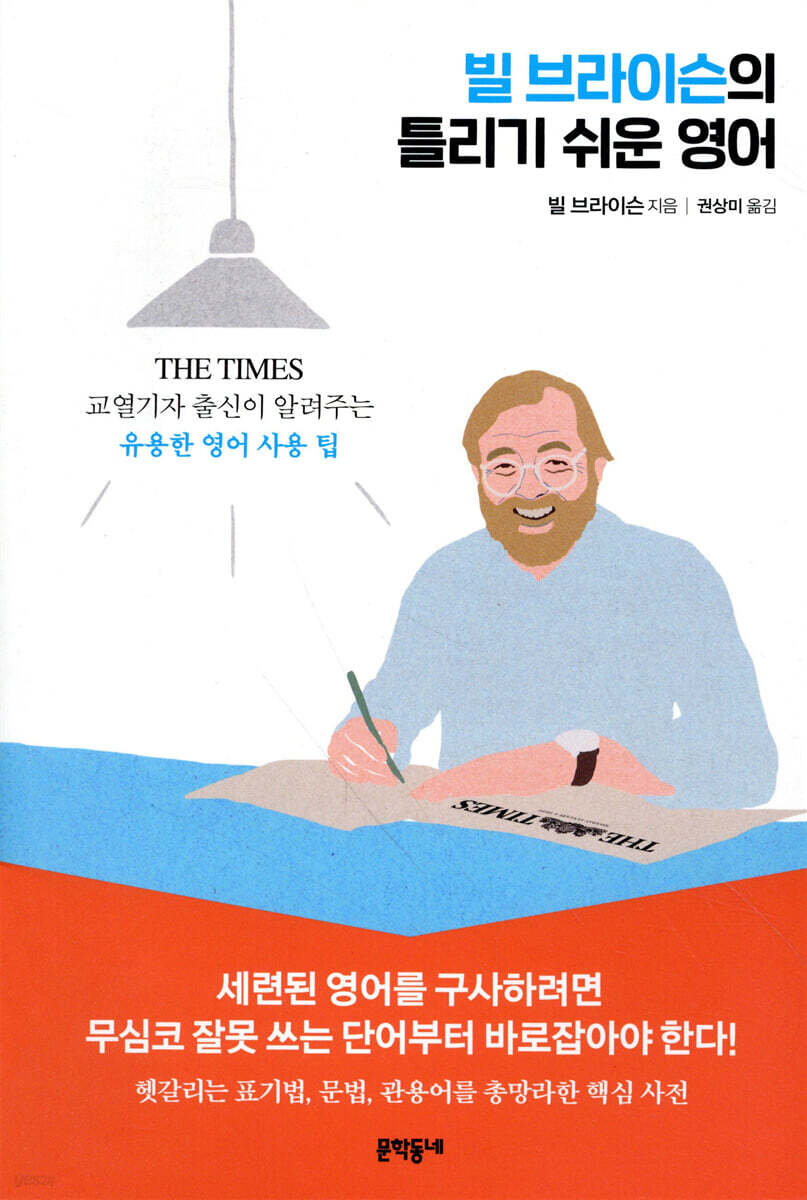
Bill Bryson's Easy English Mistakes
 |
Description
Book Introduction
- A word from MD
- Bill Bryson, better known to us as a travel writer, was a copy editor for The Times.
He explains how and why even native English speakers often make mistakes and get confused when using English words incorrectly.
An English dictionary that helps you use English correctly and accurately, not just English that you learn after the test.
- Park Sook-kyung, MD of Korean Language and Foreign Languages
From beginner to advanced English speaker
A dictionary to read and refer to over and over again
Learn everything from basic grammar to advanced English vocabulary all at once!
Q: Contagious and infectious both mean 'contagious', but are they strictly different?
A: Contagious is used for diseases that spread through contact, and infectious is used for diseases that spread through air or water.
Q: What is the correct English spelling for the summer shoe 'sandals'?
A: sandal.
It's not sandle.
Q: What is the difference between occur and take place?
A: When describing a coincidence, use occur, and when describing a scheduled event, use take place.
The verb that should be included in the sentence 'The accident occurred in driving rain' is occur, so it is written as 'The accident occurred in driving rain'.
Q: When talking about 'rent that is not too expensive from the tenant's perspective', which adjective is appropriate: economic or economical?
A: economical rent.
From the landlord's perspective, a not-so-low monthly rent is economic rent.
Bill Bryson, a former copy editor for The Times, reveals detailed English vocabulary usage! This essential dictionary covers confusing spelling, grammar, and idioms. Bryson clearly explains English vocabulary with his witty banter and keen insight.
Even journalists and authors from major English-speaking publications, as well as English experts, share examples of mistakes they make and how to communicate more concisely and clearly.
You don't need to have advanced English skills to speak sophisticated English.
Misspelling or pronouncing frequently used words, or missing even the most basic grammar rules, can all lead to incorrect meanings, regardless of your English proficiency.
Bill Bryson points out common mistakes in vocabulary, grammar, and writing, and guides you to use English effectively in real-life situations.
A dictionary to read and refer to over and over again
Learn everything from basic grammar to advanced English vocabulary all at once!
Q: Contagious and infectious both mean 'contagious', but are they strictly different?
A: Contagious is used for diseases that spread through contact, and infectious is used for diseases that spread through air or water.
Q: What is the correct English spelling for the summer shoe 'sandals'?
A: sandal.
It's not sandle.
Q: What is the difference between occur and take place?
A: When describing a coincidence, use occur, and when describing a scheduled event, use take place.
The verb that should be included in the sentence 'The accident occurred in driving rain' is occur, so it is written as 'The accident occurred in driving rain'.
Q: When talking about 'rent that is not too expensive from the tenant's perspective', which adjective is appropriate: economic or economical?
A: economical rent.
From the landlord's perspective, a not-so-low monthly rent is economic rent.
Bill Bryson, a former copy editor for The Times, reveals detailed English vocabulary usage! This essential dictionary covers confusing spelling, grammar, and idioms. Bryson clearly explains English vocabulary with his witty banter and keen insight.
Even journalists and authors from major English-speaking publications, as well as English experts, share examples of mistakes they make and how to communicate more concisely and clearly.
You don't need to have advanced English skills to speak sophisticated English.
Misspelling or pronouncing frequently used words, or missing even the most basic grammar rules, can all lead to incorrect meanings, regardless of your English proficiency.
Bill Bryson points out common mistakes in vocabulary, grammar, and writing, and guides you to use English effectively in real-life situations.
- You can preview some of the book's contents.
Preview
index
Preface _005
Note _016
A _019 / B _042 / C _054 / D _075 / E _092 / F _103 / G _116 / H _123 / I _134 / J _146 / K _148
/ L _152 / M _164 / N _177 / O _190 / P _198 / Q _219 / R _222 / S _230 / T _250 / U _263 / V _268 / W _271 / Y _281 / Z _283
Punctuation _284
Terminology _297
References _303
Note _016
A _019 / B _042 / C _054 / D _075 / E _092 / F _103 / G _116 / H _123 / I _134 / J _146 / K _148
/ L _152 / M _164 / N _177 / O _190 / P _198 / Q _219 / R _222 / S _230 / T _250 / U _263 / V _268 / W _271 / Y _281 / Z _283
Punctuation _284
Terminology _297
References _303
Publisher's Review
English Vocabulary: Let's learn and use familiar words correctly.
Just because you are familiar with an English word doesn't mean you know and use it correctly.
The more such a word is, the more likely it is that it has been used incorrectly for a long time without any doubt.
Bill Bryson explains how and why people misuse English words.
We list examples of awkward or even difficult sentences that resulted from not choosing the right words, and introduce content that gets to the heart of the words so that you don't repeat the same mistakes in the future.
If necessary, explain the etymology of the word or other related words, and if you are afraid of using it incorrectly, recommend replacing it with another, easier word.
For example, literally, which means 'literally', was misspelled in 'Our eyes were literally pinned to the curtains'.
This means 'in reality', not 'figuratively'.
This word is only acceptable when it is intended to show that an expression, usually used figuratively, should be taken at face value, as in 'He literally died laughing'.
Meanwhile, minuscule means 'small', but is often misspelled as miniscule.
Let's think minus, not mini.
Bill Bryson teaches you how to choose the right word for the right context, taking into account the subtle nuances of each word.
"Avenge" and "revenge" both mean "taking revenge." Which word should we use when referring to a large-scale act of revenge for personal satisfaction? Also, which word, "country" or "nation," is more appropriate when referring to a wealthy nation? "Revenge" is used when referring to revenge for personal satisfaction, while "rich nation" is used to refer to a wealthy nation.
Even English words that we know in simple terms are sometimes used with more specific meanings.
For example, react is best used only for spontaneous reactions, not to express decisions made after much deliberation.
Grammar: Use every single punctuation mark correctly.
Even though you've studied English grammar from beginning to end, there are probably people who are still 2% short of being able to construct a perfect English sentence.
Also, people who learned English grammar as a basic skill for solving multiple-choice questions may sometimes get confused about the basics of grammar when actually using English.
When solving grammar problems, you only need to consider one or two grammatical elements, but when expressing thoughts in English, you need to consider multiple grammatical elements in a complex manner.
What parts do English speakers easily miss in such situations? Bill Bryson cites examples of such unfortunate errors and reconstructs the sentences to show how to correct them.
Grammar terms and punctuation marks that I had skipped over because I thought I only needed to roughly understand the concepts.
But these can also be a hindrance to English speakers.
For those unfamiliar with grammar terms, we've compiled them all in the appendix, so let's start by solidifying our understanding of the concepts.
Also, even if it is the same punctuation mark, it is often used differently in Korean and English, so you should not use just any one.
To properly interpret English text and demonstrate excellent writing skills, you must pay attention to even seemingly trivial punctuation that clarifies meaning.
English Composition: One word is enough when writing three.
If your sentences are long, it may be because you haven't organized your thoughts well, but it may also be because you're confused and using English incorrectly.
It's a good idea to check that you're not adding unnecessary details by using another similar word when the word itself already contains the meaning you want to say, or that you're not using commas in places where it's unnecessary for semantics or convention.
And you have to decide whether you are using ambiguous sentences to make people laugh out loud or whether you are using unnecessary double negatives to annoy the reader.
If you try to explain something kindly to the other person, you may end up repeating yourself and emphasizing it in a clichéd way.
Idioms and idioms can make your sentences shine if used properly, but if used incorrectly, they can be worse than not using them at all, so be careful.
Studying English: Where should I start and where should I end?
Is studying English simply about getting good grades? You never know when, where, or how you might need English throughout your life.
Unless you're someone who will never use English in your life, you should own a copy of this book and look up confusing English words and review the content whenever you need to.
You can prepare for everything from studying English test grammar and vocabulary to writing an English resume, and learn how to use English in a sophisticated manner, from everyday English to business English.
Now that we've started studying English, let's do it properly and consistently!
Just because you are familiar with an English word doesn't mean you know and use it correctly.
The more such a word is, the more likely it is that it has been used incorrectly for a long time without any doubt.
Bill Bryson explains how and why people misuse English words.
We list examples of awkward or even difficult sentences that resulted from not choosing the right words, and introduce content that gets to the heart of the words so that you don't repeat the same mistakes in the future.
If necessary, explain the etymology of the word or other related words, and if you are afraid of using it incorrectly, recommend replacing it with another, easier word.
For example, literally, which means 'literally', was misspelled in 'Our eyes were literally pinned to the curtains'.
This means 'in reality', not 'figuratively'.
This word is only acceptable when it is intended to show that an expression, usually used figuratively, should be taken at face value, as in 'He literally died laughing'.
Meanwhile, minuscule means 'small', but is often misspelled as miniscule.
Let's think minus, not mini.
Bill Bryson teaches you how to choose the right word for the right context, taking into account the subtle nuances of each word.
"Avenge" and "revenge" both mean "taking revenge." Which word should we use when referring to a large-scale act of revenge for personal satisfaction? Also, which word, "country" or "nation," is more appropriate when referring to a wealthy nation? "Revenge" is used when referring to revenge for personal satisfaction, while "rich nation" is used to refer to a wealthy nation.
Even English words that we know in simple terms are sometimes used with more specific meanings.
For example, react is best used only for spontaneous reactions, not to express decisions made after much deliberation.
Grammar: Use every single punctuation mark correctly.
Even though you've studied English grammar from beginning to end, there are probably people who are still 2% short of being able to construct a perfect English sentence.
Also, people who learned English grammar as a basic skill for solving multiple-choice questions may sometimes get confused about the basics of grammar when actually using English.
When solving grammar problems, you only need to consider one or two grammatical elements, but when expressing thoughts in English, you need to consider multiple grammatical elements in a complex manner.
What parts do English speakers easily miss in such situations? Bill Bryson cites examples of such unfortunate errors and reconstructs the sentences to show how to correct them.
Grammar terms and punctuation marks that I had skipped over because I thought I only needed to roughly understand the concepts.
But these can also be a hindrance to English speakers.
For those unfamiliar with grammar terms, we've compiled them all in the appendix, so let's start by solidifying our understanding of the concepts.
Also, even if it is the same punctuation mark, it is often used differently in Korean and English, so you should not use just any one.
To properly interpret English text and demonstrate excellent writing skills, you must pay attention to even seemingly trivial punctuation that clarifies meaning.
English Composition: One word is enough when writing three.
If your sentences are long, it may be because you haven't organized your thoughts well, but it may also be because you're confused and using English incorrectly.
It's a good idea to check that you're not adding unnecessary details by using another similar word when the word itself already contains the meaning you want to say, or that you're not using commas in places where it's unnecessary for semantics or convention.
And you have to decide whether you are using ambiguous sentences to make people laugh out loud or whether you are using unnecessary double negatives to annoy the reader.
If you try to explain something kindly to the other person, you may end up repeating yourself and emphasizing it in a clichéd way.
Idioms and idioms can make your sentences shine if used properly, but if used incorrectly, they can be worse than not using them at all, so be careful.
Studying English: Where should I start and where should I end?
Is studying English simply about getting good grades? You never know when, where, or how you might need English throughout your life.
Unless you're someone who will never use English in your life, you should own a copy of this book and look up confusing English words and review the content whenever you need to.
You can prepare for everything from studying English test grammar and vocabulary to writing an English resume, and learn how to use English in a sophisticated manner, from everyday English to business English.
Now that we've started studying English, let's do it properly and consistently!
GOODS SPECIFICS
- Date of issue: June 10, 2020
- Page count, weight, size: 308 pages | 550g | 153*224*20mm
- ISBN13: 9788954670753
- ISBN10: 895467075X
You may also like
카테고리
korean


korean

![GQ KOREA Mark (Monthly): December [2025]](http://librairie.coreenne.fr/cdn/shop/files/8ef265dbbfbf186523ed75ba7319009d.jpg?v=1765340328&width=3840)


