

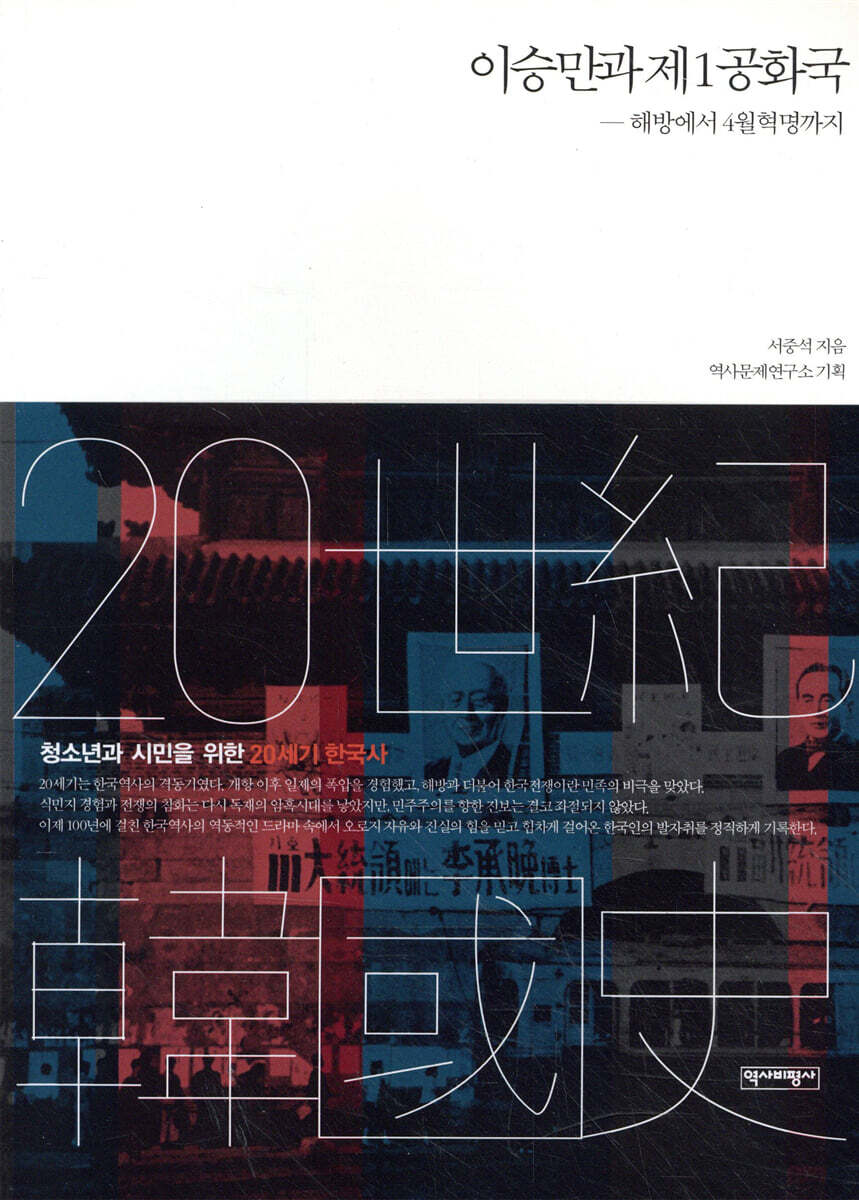
Syngman Rhee and the First Republic
 |
Description
Book Introduction
A history textbook for the general public, not just history majors.
The 20th century was the most turbulent period in Korean history.
After the opening of the country, we experienced Japanese oppression, and after liberation, we faced the national tragedy of the Korean War.
The colonial experience and the devastation of war again gave rise to a dark age of dictatorship, but the progress toward democracy was never thwarted.
Now, in the dynamic drama of Korean history spanning 100 years, we honestly record the footsteps of Koreans who have walked boldly, believing only in the power of freedom and truth.
The 20th century was the most turbulent period in Korean history.
After the opening of the country, we experienced Japanese oppression, and after liberation, we faced the national tragedy of the Korean War.
The colonial experience and the devastation of war again gave rise to a dark age of dictatorship, but the progress toward democracy was never thwarted.
Now, in the dynamic drama of Korean history spanning 100 years, we honestly record the footsteps of Koreans who have walked boldly, believing only in the power of freedom and truth.
- You can preview some of the book's contents.
Preview
index
Preface - Revisiting the Syngman Rhee era
Chapter 1: The Syngman Rhee government faced trials upon its launch.
Inter-Korean negotiations and the May 10th election / The making of the Republic of Korea government / Anti-communist laws and land reform laws during the heyday of the small-scale faction / The island of peace turned bloody / The dawn of the era of the National Security Act / Ilminism and the "chieftain state"
Chapter 2: The Syngman Rhee Regime's June Offensive and the May 30th Election
June 1949: First offensive / The National Assembly spy incident, controversial over whether it was fabricated / Kim Gu's murder / Prisons overflowing with "communists" / The first election winds of May 30th election
Chapter 3: Constitutional Amendment, Another Constitutional Amendment, Towards Permanent Power
The first ruling party to use a false name, the Liberal Party / The Busan political turmoil: The presidential race amidst gunfire / The vice president-elect unknown to voters / Eliminate the Jokcheong faction! / The establishment of the late Syngman Rhee regime / The secret to Syngman Rhee's consolidation of power / 〈Special Theme〉 The mass birth of the Hangul generation that brought about the "Miracle on the Han River"
Chapter 4: The May 15, 1956 Presidential Election
The Birth of a New Opposition Party? The Democratic Party and the Progressive Party Promotion Committee / "We Can't Live This Alive, Let's Change It!" / Winning the Election, Losing the Vote Count / A Wounded President / "The Killing of Vice President Jang Myun" / Cho Bong-am Passes Away Like the Dew on the Execution Ground / The Liberal Party Goes All Out for the May 2nd General Election / Towards the 1960 Presidential Election / Women Take the Lead in the Economy / 〈Special Theme〉 Changes in Sexual Morality and "Freedom Madams"
Chapter 5: Ah! The April Revolution: The Overthrow of the White Dictatorship
Choi In-gyu plans a rigged election / Students take to the streets to protest / The Second Masan Uprising leaves an irreversible situation / April 19, "Bloody Tuesday" / University professors' protests reignite student and citizen protests / "Victory Tuesday"
Conclusion: Why Did Syngman Rhee's Power Collapse So Easily?
"My heart is already out on the streets" / Similarities and differences between Syngman Rhee's and Park Chung-hee's regimes / Why did Syngman Rhee's regime collapse so easily?
Appendix: Major Events Log / References / Sources of Photos Used in This Book / Index
Chapter 1: The Syngman Rhee government faced trials upon its launch.
Inter-Korean negotiations and the May 10th election / The making of the Republic of Korea government / Anti-communist laws and land reform laws during the heyday of the small-scale faction / The island of peace turned bloody / The dawn of the era of the National Security Act / Ilminism and the "chieftain state"
Chapter 2: The Syngman Rhee Regime's June Offensive and the May 30th Election
June 1949: First offensive / The National Assembly spy incident, controversial over whether it was fabricated / Kim Gu's murder / Prisons overflowing with "communists" / The first election winds of May 30th election
Chapter 3: Constitutional Amendment, Another Constitutional Amendment, Towards Permanent Power
The first ruling party to use a false name, the Liberal Party / The Busan political turmoil: The presidential race amidst gunfire / The vice president-elect unknown to voters / Eliminate the Jokcheong faction! / The establishment of the late Syngman Rhee regime / The secret to Syngman Rhee's consolidation of power / 〈Special Theme〉 The mass birth of the Hangul generation that brought about the "Miracle on the Han River"
Chapter 4: The May 15, 1956 Presidential Election
The Birth of a New Opposition Party? The Democratic Party and the Progressive Party Promotion Committee / "We Can't Live This Alive, Let's Change It!" / Winning the Election, Losing the Vote Count / A Wounded President / "The Killing of Vice President Jang Myun" / Cho Bong-am Passes Away Like the Dew on the Execution Ground / The Liberal Party Goes All Out for the May 2nd General Election / Towards the 1960 Presidential Election / Women Take the Lead in the Economy / 〈Special Theme〉 Changes in Sexual Morality and "Freedom Madams"
Chapter 5: Ah! The April Revolution: The Overthrow of the White Dictatorship
Choi In-gyu plans a rigged election / Students take to the streets to protest / The Second Masan Uprising leaves an irreversible situation / April 19, "Bloody Tuesday" / University professors' protests reignite student and citizen protests / "Victory Tuesday"
Conclusion: Why Did Syngman Rhee's Power Collapse So Easily?
"My heart is already out on the streets" / Similarities and differences between Syngman Rhee's and Park Chung-hee's regimes / Why did Syngman Rhee's regime collapse so easily?
Appendix: Major Events Log / References / Sources of Photos Used in This Book / Index
Into the book
People usually think of Seoul when they think of April 19, but April 19 was not only Seoul's April 19, but also Gwangju's April 19 and Busan's April 19.
In Busan, at around 11:15 AM on April 19, about 600 students from Gyeongnam Technical High School ran out and marched to the Busanjin Police Station.
After a while, the Teresa High School girls joined in.
Armed police beat students indiscriminately, resulting in many injuries.
Some students from Gyeongnam Technical High School headed downtown, followed by many citizens and students.
About 100 armed police officers set up a barricade in front of the magnetic pole.
It rained from the afternoon.
Protesters overturned a fire truck and a police jeep and set them on fire.
At around 3 o'clock, the police opened fire from the front.
Seven or eight young people fell.
The protesters became even more angry.
Shoe shiners, gum sellers, and the unemployed joined in.
The students fought, singing 'Over and over the corpses of their comrades'.
Machine guns opened fire as the crowd surged toward the Dongbu Busan Police Station.
At 5 p.m., an announcement came over the loudspeaker that martial law had been declared.
According to the tally as of the 22nd, the number of people killed in the protests in Busan that day was 13 (including those who died from injuries) and about 60 were injured.
At 10:40 AM on the 19th in Gwangju, Gwangju High School students ran out of the school gate, chanting slogans such as “Let’s have another rigged election.”
About 80 of them were the first to knock down the wooden doors of the Do-ok building and take to the streets, and in response, Gwangju Girls' High School students also took to the streets.
About 500 students from Gwangju Technical High School, Chonnam National University High School, and Gwangju Commercial High School also joined.
Students engaged in a fierce scuffle with police in the Geumnam-ro area.
Meanwhile, students destroyed a police car.
Geumnam-ro was packed with students from Joseon University High School and Sungil High School.
Citizens carried water and cheered on the protesters, who numbered around 5,000.
… … In Daegu, at around 3:00 PM on the 19th, about 2,000 students from Kyungpook National University formed a scrum and arrived in front of the Gyeongbuk Provincial Office to stage a sit-in protest.
A little after 5 o'clock the governor announced that martial law had been declared.
About 1,500 students from the night shift at Cheonggu University joined the protest around 7:10 p.m. and clashed with police.
As the 9 o'clock curfew arrived, the police dispersed the citizens following them, and the students dispersed from the school grounds after 11 o'clock.
On the 19th, about 500 students from Cheongju Agricultural High School and 300 students from Incheon Technical High School also protested, carrying farm equipment.
Bloody Tuesday, April 19th, was a very long day.
In Busan, at around 11:15 AM on April 19, about 600 students from Gyeongnam Technical High School ran out and marched to the Busanjin Police Station.
After a while, the Teresa High School girls joined in.
Armed police beat students indiscriminately, resulting in many injuries.
Some students from Gyeongnam Technical High School headed downtown, followed by many citizens and students.
About 100 armed police officers set up a barricade in front of the magnetic pole.
It rained from the afternoon.
Protesters overturned a fire truck and a police jeep and set them on fire.
At around 3 o'clock, the police opened fire from the front.
Seven or eight young people fell.
The protesters became even more angry.
Shoe shiners, gum sellers, and the unemployed joined in.
The students fought, singing 'Over and over the corpses of their comrades'.
Machine guns opened fire as the crowd surged toward the Dongbu Busan Police Station.
At 5 p.m., an announcement came over the loudspeaker that martial law had been declared.
According to the tally as of the 22nd, the number of people killed in the protests in Busan that day was 13 (including those who died from injuries) and about 60 were injured.
At 10:40 AM on the 19th in Gwangju, Gwangju High School students ran out of the school gate, chanting slogans such as “Let’s have another rigged election.”
About 80 of them were the first to knock down the wooden doors of the Do-ok building and take to the streets, and in response, Gwangju Girls' High School students also took to the streets.
About 500 students from Gwangju Technical High School, Chonnam National University High School, and Gwangju Commercial High School also joined.
Students engaged in a fierce scuffle with police in the Geumnam-ro area.
Meanwhile, students destroyed a police car.
Geumnam-ro was packed with students from Joseon University High School and Sungil High School.
Citizens carried water and cheered on the protesters, who numbered around 5,000.
… … In Daegu, at around 3:00 PM on the 19th, about 2,000 students from Kyungpook National University formed a scrum and arrived in front of the Gyeongbuk Provincial Office to stage a sit-in protest.
A little after 5 o'clock the governor announced that martial law had been declared.
About 1,500 students from the night shift at Cheonggu University joined the protest around 7:10 p.m. and clashed with police.
As the 9 o'clock curfew arrived, the police dispersed the citizens following them, and the students dispersed from the school grounds after 11 o'clock.
On the 19th, about 500 students from Cheongju Agricultural High School and 300 students from Incheon Technical High School also protested, carrying farm equipment.
Bloody Tuesday, April 19th, was a very long day.
--- p.238~246
GOODS SPECIFICS
- Date of issue: August 10, 2007
- Page count, weight, size: 312 pages | 544g | 150*210*30mm
- ISBN13: 9788976963215
- ISBN10: 8976963210
You may also like
카테고리
korean


korean

![GQ KOREA Mark (Monthly): December [2025]](http://librairie.coreenne.fr/cdn/shop/files/8ef265dbbfbf186523ed75ba7319009d.jpg?v=1765340328&width=3840)


