

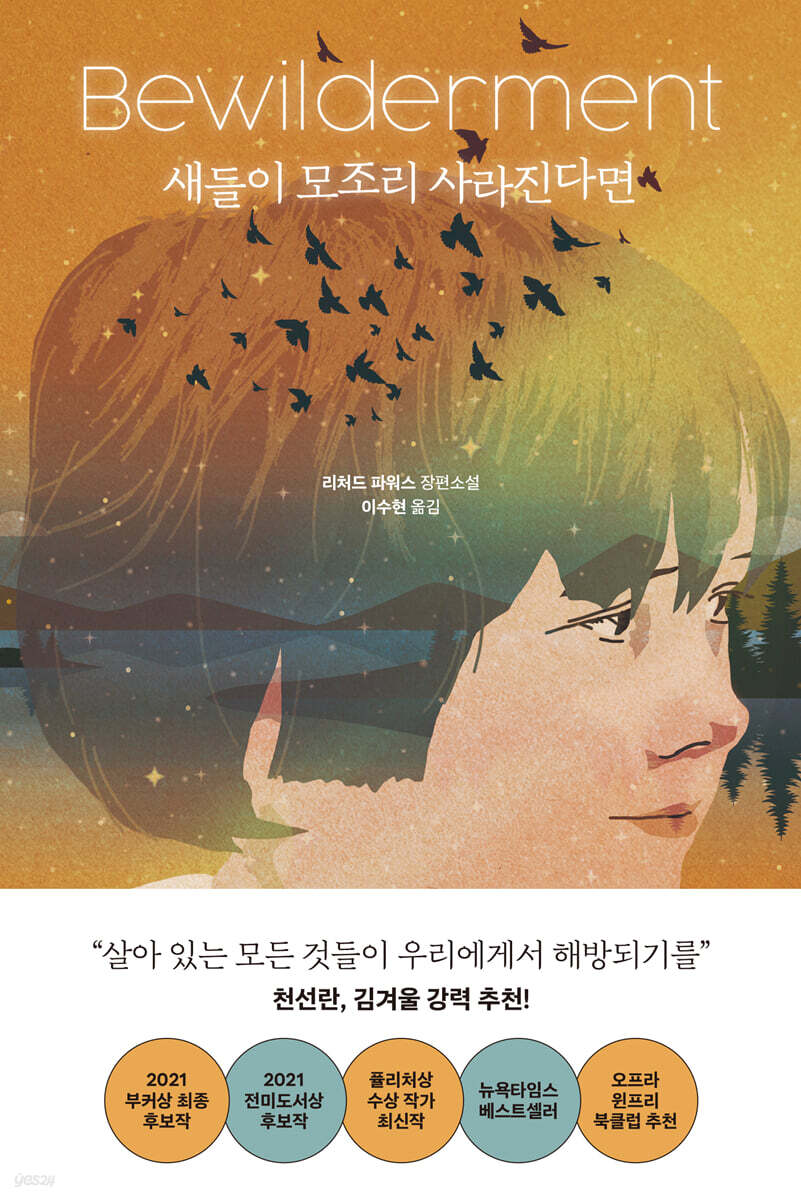
If all the birds disappeared
 |
Description
Book Introduction
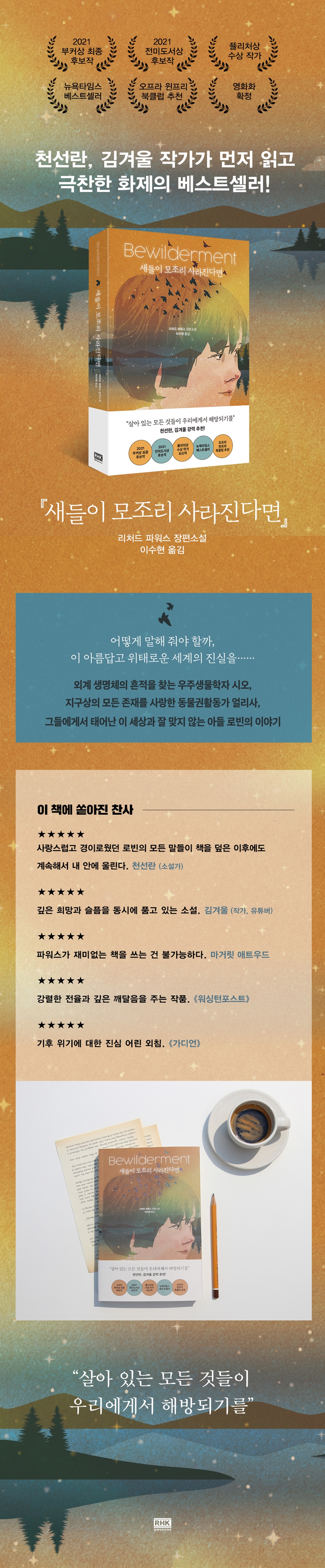
“May all living things be free from us.” Margaret Atwood, Oprah Winfrey, A hotly-anticipated novel that has been praised by both authors Cheon Seon-ran and Kim Gyul-wool! "If All the Birds Were Vanished," which was nominated for both the 2021 Booker Prize and the National Book Award and received critical acclaim as one of the most talked-about works in English-speaking literature, has finally been published in Korea. This is the latest novel by Richard Powers, a giant in American literature who has consistently published works that infuse insight into the relationship between humans and non-human beings with his unique poetic style and even won the 2019 Pulitzer Prize for his previous work, "Overstory." Set in the near future, facing a climate crisis, this novel depicts the anxieties of a family and future generations living on a planet being destroyed at an uncontrollable rate. Immediately after its publication, it received significant attention from major media outlets, with reviews calling it “a work that gives intense thrills and deep insight.” It is also receiving a flood of moving reviews from readers around the world, leading to the book being made into a film in the near future. "If All the Birds Disappeared" follows the fascinating story of Theo, an astrobiologist searching for traces of extraterrestrial life, Alisa, an animal rights activist who loves all living things on Earth, and their "sad, special, nine-year-old son, Robin," who is not very well-suited to this world. The journey of harmless love and pure resistance, unfolded in the unique language of a vulnerable boy wounded by the world, deeply resonates with readers living in an age of hatred that has made them insensitive to the suffering of others. This work, which broadly covers astronomy, brain science, and global environmental issues, and contains reflections on life and death, will be remembered as another masterpiece by Richard Powers. |
- You can preview some of the book's contents.
Preview
index
If all the birds disappeared
Translator's Note
Translator's Note
Detailed image
Into the book
Such a wonderful darkness was rare.
When so much darkness gathers in one place, the sky actually lights up brightly.
We put our telescopes through the gaps in the trees that stretched out here and there on top of the rented cabin.
Robin took his eyes off the eyepiece.
My sad, special, nine-year-old son who doesn't quite fit into this world.
--- p.11
Robin's second pediatrician was eager to place Robin on the autism 'spectrum'.
I wanted to tell the man that everyone alive on this random little planet falls into some spectrum.
That's what a spectrum is.
I wanted to tell the man that life itself is a chaos of spectrums, and that we all vibrate at specific frequencies within a continuous rainbow.
--- p.17
No one is perfect.
But we are all imperfect in such beautiful ways.
--- p.18
Be merciful to all living things.
Be calm and unwavering.
May you be happy with whatever you are, wherever you are.
And remember, whatever pain you have, it is also my pain.
--- p.45
Astronomy and childhood have a lot in common.
Both are voyages across enormous distances.
Both seek to discover facts beyond their own understanding.
Both create outlandish theories and allow possibilities to proliferate infinitely.
Both get shabby every few weeks.
They move because they both don't know.
Both are confused by the time.
Both are always the starting point.
--- p.99
Because the world is fundamentally a mess, the greater the capacity for empathy, the deeper the suffering.
--- p.203
I told the story of a planet called Chromat.
It was a planet with nine satellites and two suns, a small red sun and a large blue sun.
Thanks to this, there are three different lengths of day, four different sunsets and sunrises, twenty different solar and lunar eclipses, and countless different twilights and nights.
When dust settles in the atmosphere, two types of sunlight turn into swirling watercolors.
In the languages of that world, there are 200 words for sadness and 300 words for joy, depending on latitude and hemisphere.
--- p.234
There were two kinds of people on Earth.
A person who can do math and follow science, and who is more satisfied with his own truth.
But no matter what school we attended, in our daily education we all lived as if tomorrow would be exactly like today.
--- p.236
We just looked up at the stars for a long time.
All the stars you can see, and half of the stars you can't see.
'dad.
I feel like I'm waking up.
I feel like I'm inside everything.
Look where we are! That tree.
This grass!'
--- p.258
'Do you remember how much Mommy loved this tree?' My son, who had been asking me for the past two years what Alisa loved, was now reminding me of it.
'This tree was called a boarding house.
He said that no one has ever counted all the creatures that live in this tree.'
I looked back at the child's mother to ask if that was really true, but Alisa was gone.
About a meter away, the last fireflies of the year lit up, and Robin took a deep breath.
We lay still and watched the fireflies blink.
The sight of fireflies drifting slowly through the summer night in a line was like the lights of interstellar spaceships from every planet we'd ever visited, invading our backyard.
--- p.259
Let us heal what we have harmed.
--- p.302
“I knew it!” Somewhere in the billion-strong world of social media, a girl in her late teens must have seen a post about a strange young boy making strange bird sounds.
Now the girl was circling around this impromptu gathering, flicking her finger on her phone, following the trail of the "Oba Nova" video cast.
“That’s Jay! The boy connected to my dead mother!”
--- p.316
Birds flew over our heads.
Robin watched quietly until the cranes disappeared into the distance.
He looked frightened and small, as if he didn't know how he had ended up here, at the edge of the forest, water, and sky.
After a long time, the strength in my son's fingers that had been holding my wrist relaxed.
"How can we know about aliens? Even birds can't know about them."
--- p.328
Robin had found all the wildflowers I had assigned for homework before we had even walked 800 meters along the ridge.
The child looked back at the sun-drenched, wet rock wall, tightly packed with experimental material.
No matter what happens, spring keeps coming back.
Right, Dad?'
--- p.366
There was one planet where no one could figure out where it was.
The planet died from loneliness.
This has happened billions of times in our galaxy alone.
--- p.386
We soar high into the orbit of the planet we visited together.
Robin and I both have the same thoughts.
'Can you believe where we were just now?'
When so much darkness gathers in one place, the sky actually lights up brightly.
We put our telescopes through the gaps in the trees that stretched out here and there on top of the rented cabin.
Robin took his eyes off the eyepiece.
My sad, special, nine-year-old son who doesn't quite fit into this world.
--- p.11
Robin's second pediatrician was eager to place Robin on the autism 'spectrum'.
I wanted to tell the man that everyone alive on this random little planet falls into some spectrum.
That's what a spectrum is.
I wanted to tell the man that life itself is a chaos of spectrums, and that we all vibrate at specific frequencies within a continuous rainbow.
--- p.17
No one is perfect.
But we are all imperfect in such beautiful ways.
--- p.18
Be merciful to all living things.
Be calm and unwavering.
May you be happy with whatever you are, wherever you are.
And remember, whatever pain you have, it is also my pain.
--- p.45
Astronomy and childhood have a lot in common.
Both are voyages across enormous distances.
Both seek to discover facts beyond their own understanding.
Both create outlandish theories and allow possibilities to proliferate infinitely.
Both get shabby every few weeks.
They move because they both don't know.
Both are confused by the time.
Both are always the starting point.
--- p.99
Because the world is fundamentally a mess, the greater the capacity for empathy, the deeper the suffering.
--- p.203
I told the story of a planet called Chromat.
It was a planet with nine satellites and two suns, a small red sun and a large blue sun.
Thanks to this, there are three different lengths of day, four different sunsets and sunrises, twenty different solar and lunar eclipses, and countless different twilights and nights.
When dust settles in the atmosphere, two types of sunlight turn into swirling watercolors.
In the languages of that world, there are 200 words for sadness and 300 words for joy, depending on latitude and hemisphere.
--- p.234
There were two kinds of people on Earth.
A person who can do math and follow science, and who is more satisfied with his own truth.
But no matter what school we attended, in our daily education we all lived as if tomorrow would be exactly like today.
--- p.236
We just looked up at the stars for a long time.
All the stars you can see, and half of the stars you can't see.
'dad.
I feel like I'm waking up.
I feel like I'm inside everything.
Look where we are! That tree.
This grass!'
--- p.258
'Do you remember how much Mommy loved this tree?' My son, who had been asking me for the past two years what Alisa loved, was now reminding me of it.
'This tree was called a boarding house.
He said that no one has ever counted all the creatures that live in this tree.'
I looked back at the child's mother to ask if that was really true, but Alisa was gone.
About a meter away, the last fireflies of the year lit up, and Robin took a deep breath.
We lay still and watched the fireflies blink.
The sight of fireflies drifting slowly through the summer night in a line was like the lights of interstellar spaceships from every planet we'd ever visited, invading our backyard.
--- p.259
Let us heal what we have harmed.
--- p.302
“I knew it!” Somewhere in the billion-strong world of social media, a girl in her late teens must have seen a post about a strange young boy making strange bird sounds.
Now the girl was circling around this impromptu gathering, flicking her finger on her phone, following the trail of the "Oba Nova" video cast.
“That’s Jay! The boy connected to my dead mother!”
--- p.316
Birds flew over our heads.
Robin watched quietly until the cranes disappeared into the distance.
He looked frightened and small, as if he didn't know how he had ended up here, at the edge of the forest, water, and sky.
After a long time, the strength in my son's fingers that had been holding my wrist relaxed.
"How can we know about aliens? Even birds can't know about them."
--- p.328
Robin had found all the wildflowers I had assigned for homework before we had even walked 800 meters along the ridge.
The child looked back at the sun-drenched, wet rock wall, tightly packed with experimental material.
No matter what happens, spring keeps coming back.
Right, Dad?'
--- p.366
There was one planet where no one could figure out where it was.
The planet died from loneliness.
This has happened billions of times in our galaxy alone.
--- p.386
We soar high into the orbit of the planet we visited together.
Robin and I both have the same thoughts.
'Can you believe where we were just now?'
--- p.390
Publisher's Review
“May all living things be free from us.”
Margaret Atwood, Oprah Winfrey,
A hotly-anticipated novel that has been praised by both authors Cheon Seon-ran and Kim Gyul-wool!
★The latest work by Pulitzer Prize-winning author Richard Powers
★Booker Prize finalist, National Book Award nominee, New York Times bestseller
★A Best Book of 2021 by Amazon, Oprah Winfrey Book Club, NPR, Newsweek, and The Boston Globe
How should I say it,
The truth about this beautiful and dangerous world…
“My son is the hope that I can count
“It was a pocket universe that could not be contained.”
― Theo, an astrobiologist searching for traces of extraterrestrial life
“No one is perfect.
“We are all flawed in such beautiful ways.”
―Elisabeth, an animal rights activist who loved all beings on Earth
“That’s why they all become extinct.
Because everyone wants to solve it later.”
― The story of Robin, the son born to them who does not fit in well with the world.
Sio, an astrobiologist searching for extraterrestrial life, is a single father who is raising his nine-year-old son alone after the sudden death of his wife, Alisa.
Robin, a son with attention deficit hyperactivity disorder, experienced worsening symptoms after losing his beloved mother and then his dog.
Shortly after returning from a family camping trip to the Smoky Mountains, Robin is suspended from school for hitting a friend in the face with a thermos.
I was outraged by my friend's suggestion that my mother's death might not have been a simple accident.
Sio explains to his son that the accident occurred while he was trying to avoid a possum that had jumped onto the road, but he hides the fact that his wife was pregnant with Robin's younger sister at the time.
Then one day, Robin, who dreams of becoming an ornithologist, starts drawing pictures to sell at the farmer's market to help her mother, an animal rights activist, do what she wanted to do while she was alive.
Extinct creatures from around the world startle people by magically coming back to life at the child's fingertips, and Robin becomes increasingly absorbed in drawing and loses interest in his studies.
At school, Robin is advised to take antipsychotic medication, but Sio refuses.
Because I'm afraid of what drugs might do to a nine-year-old, and I don't think it's the solution, and I love my son for who he is, just the way he is.
Sio seeks advice from his wife's friend, neuroscientist Martin Currier, who recommends Robin undergo experimental "decoded neurofeedback" therapy. While this technology, which trains AI to perceive the emotional fingerprints of others, is real, the novel takes it a step further, extending it into the realm of imagination.
What if this technology could free people from suffering?
Through this training, Robin learns to align herself with her mother's brain activity patterns while she was alive, and gradually becomes free from pain and happy.
“Everyone is inside everyone else.”
A journey of harmless love and pure resistance toward living beings.
“Where I saw nothing but a mass of gray and black in the frog photo, Robin saw a violent swirl that took up half of a beautiful rainbow-colored crater.” (p. 120)
“Robin hates zoos.
“Because a sentient being cannot stand being imprisoned.” (p. 56)
“Species are dying, Dad.
Thousands will die, that's all!' (p. 183)
If the novel "The Overstory," which won the Pulitzer Prize for its author, Richard Powers, was an epic that explored human nature and the world of nature by unfolding the lives of nine people who gathered to save the remaining primeval forest from root to branch, "If All the Birds Gone" is "a story that expands to the vastness of space through a powerless individual" (p. 398).
The story unfolds along the journey of a father and son, making it easy for readers to empathize with it, further enhancing the author's message about the Earth's ecosystem and the future of humanity.
Meanwhile, “a huge chunk of ice broke off in Antarctica.
The heads of state tested the extent to which the public could be deceived.
“Small wars broke out everywhere.” (p. 41), “In Shanghai, two million people lost their homes.
There is no water in Phoenix.
News such as “Mad cow disease spread from cows to humans” (p. 387) shows that a world where the strong prospered at the expense of the weak is ultimately headed toward destruction.
“All the lovely and wonderful words of Robin
“It continues to resonate within me even after I close the book.”
― Recommended by author Cheon Seon-ran of 『Nine』 and 『A Thousand Blues』!
“Let Us Heal What We’ve Harmed” (p. 302)
Let's turn our gaze to the future that Robin, a nine-year-old boy who stood before a collapsing world holding a banner he drew himself, must have dreamed of.
A world that does not ignore destroyed forests and lost birds, a world of those who understand and care for the hearts of fragile beings, a world where all living beings are freed from unnecessary suffering… … .
Readers who are completely absorbed in the story will experience a special emotion they have never experienced before when they close the last page of this book, which awaits a whirlwind conclusion.
“It is up to the reader whether to read this ending with despair or hope.
I still want to hang on to hope.
Because the state of liberation, where all living things are freed from suffering, is precisely the state of mind that Robin's mother radiated from moment to moment, the state of mind that Robin reached for a moment, and the state that Robin's father seeks.
A place we might be able to go too.
Unlike in the novel, the James Webb Space Telescope has safely ascended into space and begun taking pictures, and a new type of mad cow disease has not yet swept the world.
Hopefully, there is still time.” (From the translator’s note on page 397)
Margaret Atwood, Oprah Winfrey,
A hotly-anticipated novel that has been praised by both authors Cheon Seon-ran and Kim Gyul-wool!
★The latest work by Pulitzer Prize-winning author Richard Powers
★Booker Prize finalist, National Book Award nominee, New York Times bestseller
★A Best Book of 2021 by Amazon, Oprah Winfrey Book Club, NPR, Newsweek, and The Boston Globe
How should I say it,
The truth about this beautiful and dangerous world…
“My son is the hope that I can count
“It was a pocket universe that could not be contained.”
― Theo, an astrobiologist searching for traces of extraterrestrial life
“No one is perfect.
“We are all flawed in such beautiful ways.”
―Elisabeth, an animal rights activist who loved all beings on Earth
“That’s why they all become extinct.
Because everyone wants to solve it later.”
― The story of Robin, the son born to them who does not fit in well with the world.
Sio, an astrobiologist searching for extraterrestrial life, is a single father who is raising his nine-year-old son alone after the sudden death of his wife, Alisa.
Robin, a son with attention deficit hyperactivity disorder, experienced worsening symptoms after losing his beloved mother and then his dog.
Shortly after returning from a family camping trip to the Smoky Mountains, Robin is suspended from school for hitting a friend in the face with a thermos.
I was outraged by my friend's suggestion that my mother's death might not have been a simple accident.
Sio explains to his son that the accident occurred while he was trying to avoid a possum that had jumped onto the road, but he hides the fact that his wife was pregnant with Robin's younger sister at the time.
Then one day, Robin, who dreams of becoming an ornithologist, starts drawing pictures to sell at the farmer's market to help her mother, an animal rights activist, do what she wanted to do while she was alive.
Extinct creatures from around the world startle people by magically coming back to life at the child's fingertips, and Robin becomes increasingly absorbed in drawing and loses interest in his studies.
At school, Robin is advised to take antipsychotic medication, but Sio refuses.
Because I'm afraid of what drugs might do to a nine-year-old, and I don't think it's the solution, and I love my son for who he is, just the way he is.
Sio seeks advice from his wife's friend, neuroscientist Martin Currier, who recommends Robin undergo experimental "decoded neurofeedback" therapy. While this technology, which trains AI to perceive the emotional fingerprints of others, is real, the novel takes it a step further, extending it into the realm of imagination.
What if this technology could free people from suffering?
Through this training, Robin learns to align herself with her mother's brain activity patterns while she was alive, and gradually becomes free from pain and happy.
“Everyone is inside everyone else.”
A journey of harmless love and pure resistance toward living beings.
“Where I saw nothing but a mass of gray and black in the frog photo, Robin saw a violent swirl that took up half of a beautiful rainbow-colored crater.” (p. 120)
“Robin hates zoos.
“Because a sentient being cannot stand being imprisoned.” (p. 56)
“Species are dying, Dad.
Thousands will die, that's all!' (p. 183)
If the novel "The Overstory," which won the Pulitzer Prize for its author, Richard Powers, was an epic that explored human nature and the world of nature by unfolding the lives of nine people who gathered to save the remaining primeval forest from root to branch, "If All the Birds Gone" is "a story that expands to the vastness of space through a powerless individual" (p. 398).
The story unfolds along the journey of a father and son, making it easy for readers to empathize with it, further enhancing the author's message about the Earth's ecosystem and the future of humanity.
Meanwhile, “a huge chunk of ice broke off in Antarctica.
The heads of state tested the extent to which the public could be deceived.
“Small wars broke out everywhere.” (p. 41), “In Shanghai, two million people lost their homes.
There is no water in Phoenix.
News such as “Mad cow disease spread from cows to humans” (p. 387) shows that a world where the strong prospered at the expense of the weak is ultimately headed toward destruction.
“All the lovely and wonderful words of Robin
“It continues to resonate within me even after I close the book.”
― Recommended by author Cheon Seon-ran of 『Nine』 and 『A Thousand Blues』!
“Let Us Heal What We’ve Harmed” (p. 302)
Let's turn our gaze to the future that Robin, a nine-year-old boy who stood before a collapsing world holding a banner he drew himself, must have dreamed of.
A world that does not ignore destroyed forests and lost birds, a world of those who understand and care for the hearts of fragile beings, a world where all living beings are freed from unnecessary suffering… … .
Readers who are completely absorbed in the story will experience a special emotion they have never experienced before when they close the last page of this book, which awaits a whirlwind conclusion.
“It is up to the reader whether to read this ending with despair or hope.
I still want to hang on to hope.
Because the state of liberation, where all living things are freed from suffering, is precisely the state of mind that Robin's mother radiated from moment to moment, the state of mind that Robin reached for a moment, and the state that Robin's father seeks.
A place we might be able to go too.
Unlike in the novel, the James Webb Space Telescope has safely ascended into space and begun taking pictures, and a new type of mad cow disease has not yet swept the world.
Hopefully, there is still time.” (From the translator’s note on page 397)
GOODS SPECIFICS
- Publication date: May 30, 2022
- Page count, weight, size: 400 pages | 532g | 141*209*30mm
- ISBN13: 9788925578422
- ISBN10: 8925578425
You may also like
카테고리
korean


korean

![GQ KOREA Mark (Monthly): December [2025]](http://librairie.coreenne.fr/cdn/shop/files/8ef265dbbfbf186523ed75ba7319009d.jpg?v=1765340328&width=3840)


