

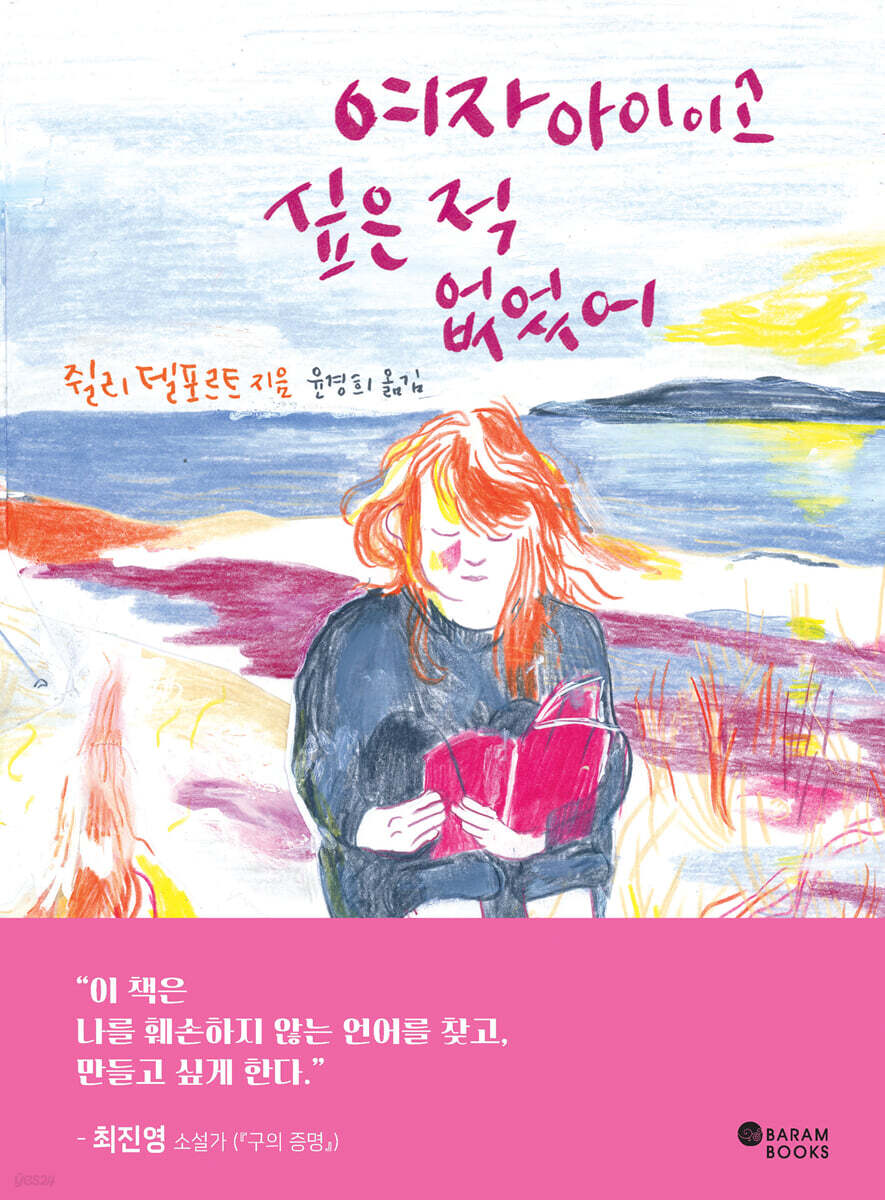
I never wanted to be a girl
 |
Description
Book Introduction
The Globe and Mail's Best Books of 2019!
"I want to describe the world with my adjectives."
“Julie Delport finds strength to continue living and working from the existence of women who use painting, film, writing, and song as tools to create a world that is beautiful in itself while simultaneously creating a gap in the solid reality.” - Recommended by Yoon Kyung-hee (literary critic)
“It feels like a lie that I’m a girl.”
Living as a strange and unfamiliar woman in this world
The default in the world we live in is male.
It goes without saying that human history has been built in the names of a few men, and women are always included in parentheses as an exception, as when indicating the gender of a person in a newspaper article.
Even things like clothing, furniture, and piano keys are designed to fit the standard male physique, so women always have to endure minor inconveniences and awkwardness.
It's so strange to always live as an extra.
For women, or anyone who isn't a typical male, the strange, unfamiliar feeling of not fitting into the world is, ironically, quite familiar.
The graphic novel "I Never Wanted to Be a Girl" is a deeply personal reflection on women's lives.
The desire to have children extends beyond love and sexual pleasure for a male partner to reflecting on a woman's life.
It was men who imagined women as being somehow lacking and deficient.
How can one possibly think that a woman would desire a man's life and want a son to fill her void?
What the writer wants is a girl, not a boy.
“What can I do with a son?” But for a woman, having a child is not about filling a void and becoming fulfilled, but rather about destroying one side of her life.
Men would leave women to look after the children alone, and the babies would interfere with women's work of drawing or writing books.
A man can be a father without having or caring for a child, but a woman cannot.
The author asks:
“At what age did I start to feel like being a girl was a trick?” From a very young age, girls are haunted by strange and unfamiliar feelings.
Is it because women are inherently lacking in some way? Not at all.
When you encounter absurd situations one after another, you naturally acquire a sense of absurdity.
As a woman born and raised in a male-centered world, there are always many unfair and unfair things to experience.
Feelings of strangeness, unfamiliarity, resentment, and sadness are the default in a woman's life.
Therefore, it is difficult to advance the female narrative in an orderly and logical manner.
This is why the story of "I Never Wanted to Be a Girl" unfolds in fragments and without any order.
The writer asks questions endlessly, travels from place to place, and thinks over and over again.
And then, as if sewing, I connect those pieces together to create a story.
"I want to describe the world with my adjectives."
“Julie Delport finds strength to continue living and working from the existence of women who use painting, film, writing, and song as tools to create a world that is beautiful in itself while simultaneously creating a gap in the solid reality.” - Recommended by Yoon Kyung-hee (literary critic)
“It feels like a lie that I’m a girl.”
Living as a strange and unfamiliar woman in this world
The default in the world we live in is male.
It goes without saying that human history has been built in the names of a few men, and women are always included in parentheses as an exception, as when indicating the gender of a person in a newspaper article.
Even things like clothing, furniture, and piano keys are designed to fit the standard male physique, so women always have to endure minor inconveniences and awkwardness.
It's so strange to always live as an extra.
For women, or anyone who isn't a typical male, the strange, unfamiliar feeling of not fitting into the world is, ironically, quite familiar.
The graphic novel "I Never Wanted to Be a Girl" is a deeply personal reflection on women's lives.
The desire to have children extends beyond love and sexual pleasure for a male partner to reflecting on a woman's life.
It was men who imagined women as being somehow lacking and deficient.
How can one possibly think that a woman would desire a man's life and want a son to fill her void?
What the writer wants is a girl, not a boy.
“What can I do with a son?” But for a woman, having a child is not about filling a void and becoming fulfilled, but rather about destroying one side of her life.
Men would leave women to look after the children alone, and the babies would interfere with women's work of drawing or writing books.
A man can be a father without having or caring for a child, but a woman cannot.
The author asks:
“At what age did I start to feel like being a girl was a trick?” From a very young age, girls are haunted by strange and unfamiliar feelings.
Is it because women are inherently lacking in some way? Not at all.
When you encounter absurd situations one after another, you naturally acquire a sense of absurdity.
As a woman born and raised in a male-centered world, there are always many unfair and unfair things to experience.
Feelings of strangeness, unfamiliarity, resentment, and sadness are the default in a woman's life.
Therefore, it is difficult to advance the female narrative in an orderly and logical manner.
This is why the story of "I Never Wanted to Be a Girl" unfolds in fragments and without any order.
The writer asks questions endlessly, travels from place to place, and thinks over and over again.
And then, as if sewing, I connect those pieces together to create a story.
- You can preview some of the book's contents.
Preview
Detailed image

Into the book
A heartwarming, sensitive, feminine book about what women do.
---p.6
I want a daughter, what can I do with a son?
---p.9
I wanted him to say things like, "I'll take care of the baby. You can draw. I'll change your diapers. I'll feed you formula." But we didn't say a word, and while he enjoyed himself, I felt betrayed.
---pp.18-21
When my sister was young, she said she wanted to have children but not a husband.
I said that if I had a child, I would want to be a father, not a mother.
Which of us was more feminist?
---pp.31-33
How old was I when I started feeling like being a girl was a lie?
---p.37
A book that says it wants to describe the world with its own adjectives.
---p.55
Yesterday, I told myself.
Unicorn whale, gentle feminist.
That's me.
By the way, did you know that female monodonts don't have horns?
---pp.65-67
I'm sick of being scared when I'm alone.
It's time to stop now.
---p.135
What I want is for people to feel that time is passing within them.
So instead of me stealing two hours from people, they're living that time themselves.
---p.183
I'm afraid I won't be able to find a lover anymore...
What man would tolerate a feminist?
What kind of man can I stand?
---p.202
Doing nothing, watching time pass by, this seems to be the only way to push death back.
---p.212
I'm sitting alone on Jerome's bed, and he's sleeping below.
We had an argument.
And now I'm scared to death that I might be pregnant.
---p.6
I want a daughter, what can I do with a son?
---p.9
I wanted him to say things like, "I'll take care of the baby. You can draw. I'll change your diapers. I'll feed you formula." But we didn't say a word, and while he enjoyed himself, I felt betrayed.
---pp.18-21
When my sister was young, she said she wanted to have children but not a husband.
I said that if I had a child, I would want to be a father, not a mother.
Which of us was more feminist?
---pp.31-33
How old was I when I started feeling like being a girl was a lie?
---p.37
A book that says it wants to describe the world with its own adjectives.
---p.55
Yesterday, I told myself.
Unicorn whale, gentle feminist.
That's me.
By the way, did you know that female monodonts don't have horns?
---pp.65-67
I'm sick of being scared when I'm alone.
It's time to stop now.
---p.135
What I want is for people to feel that time is passing within them.
So instead of me stealing two hours from people, they're living that time themselves.
---p.183
I'm afraid I won't be able to find a lover anymore...
What man would tolerate a feminist?
What kind of man can I stand?
---p.202
Doing nothing, watching time pass by, this seems to be the only way to push death back.
---p.212
I'm sitting alone on Jerome's bed, and he's sleeping below.
We had an argument.
And now I'm scared to death that I might be pregnant.
---p.253
Publisher's Review
“What images are we prisoners of?”
On how to exist without being marginalized in a male-dominated society.
Living as a woman in a male-dominated society can be so confusing, so the question that arises within this world is how free can we truly be from the male-dominated order?
If there is anyone who has lived fully as a woman in a world geared towards the standardized male lifestyle, it might be helpful.
So Tove Jansson of the Moomin series comes to mind.
The author goes to Finland to follow in the footsteps of Tove Jansson, travels through the forests, and experiences a heightened sense of well-being.
The Moomins who welcomed the comet must have been really foolishly peaceful.
Meanwhile, the reason Tove Jansson was able to enjoy life with a female partner instead of marrying a man at the time was because she had art and stories.
Images and language are the best way to make sense of a confusing world.
So the author lists the names of female artists, dead and still living, and wonders about their lives, asking why female artists suffer more than male artists.
The author presents all kinds of images and confusing questions while tenaciously holding on to women's lives.
The free-spirited colored pencil drawings, instead of demonstrating a flexible and systematic way of thinking, reveal questions that exist everywhere through fragmented and scattered images.
A father who jokes, "It looks like the wife did it," when something doesn't go well, a man who names a child but doesn't promise to take full responsibility for it, sexual abuse suffered from a young age when they knew nothing about it, and secret gossip that always pretends not to see the harm suffered by women.
The author travels to various countries and places, listening to news from other artists and painting, but also constantly asks questions about women's lives.
Therefore, the pictures drawn by the author and the sentences written by the author become ‘women’s work’ in themselves.
Just as all art and language have many layers of meaning and depth, so too do women's lives.
Perhaps asking questions, questioning, and not settling for comfort is the only way to live fully as a woman.
In French, where there are separate masculine and feminine nouns, there is a rule that when modifying a French feminine and masculine noun with one adjective, the masculine adjective modifies both.
This is a grammar that expresses in a concise manner that, like all norms in the world, the default is male.
The original French title of 'I Never Wanted to Be a Girl' is 'Moi aussi, je voulais l'emporter (I also wanted to represent)', which is inspired by this grammar rule.
It contains the meaning of a woman who is always unable to live up to her reputation and desires to live a full life.
Later translated into English, it became 'this woman's work', which defined all the work contained in this graphic novel, including the original title, as 'woman's work'.
Thinking about, creating, and producing for women is deeply personal, yet it also forms part of the larger movement called feminism.
And feminism is not simply limited to women's issues.
Because it serves as a starting point for thinking about all those who cannot be represented—all those who are not heterosexual, not white, not wealthy, older, disabled, and, furthermore, non-human.
So, we all have to draw pictures and tell stories, even if it's awkward.
This book can provide direction to all women who want to quietly look into the chaos within themselves and to all those who feel sad about not being able to represent themselves.
Recommended reviews
"A beautiful sketch, introspective." - The Guardian
"In this world-shaking, impressionistic personal essay, the Montreal cartoonist finds feminist inspiration in the labor of women artists while reflecting on her own knowledge of what it means to be a woman." - The Globe & Mail Best Books of 2019
"Through nonlinear narratives, Delport explores art, gender, and ambition, revealing her own history of trauma and subsequent struggles with her femininity and identity." - BuzzFeed Books
"A leap forward and rich reflection on gender experience...
"There's a conversational ease to the narrative of 'I Never Wanted to Be a Girl' that disarms readers and leaves them vulnerable to common realizations and even new questions." - The LA Review of Books
"This book is a fascinating and wide-ranging look at gender politics, relationships, and the expectations women face." - The Hollywood Reporter
"This woman's work is a wise, reflective, and beautifully written feminist essay.
This book will captivate and inspire you." - Lit Hub
"I Never Wanted to Be a Girl" speaks aloud about Delport's taboo personal conflict.
She fears that motherhood will destroy her artistic practice, wonders whether she can overcome heterosexuality, and often wishes she were not a woman. - The Stranger
"'I Never Wanted to Be a Girl' is a personal and reflective inquiry into femininity and feminism in the Me Too era." - CBC Books
"This colorful and rich book requires some processing.
Read this book, and read it again.
You will still experience its beauty and experience its messages anew." - The Toronto Star
"Impressionistic...
Delport's chosen medium conveys both vulnerability and cautious optimism, and her writing is razor-sharp.” - Montreal Gazette
"An indictment of how female artists have often been erased from Western art history.
It also raises interesting questions about feminism, gender, sexual abuse and rape culture." - Huffington Post India
"The mournful tone, delicate colored pencil drawings, and reflections on the limitations of women come across as subtle." -Hyperallergic
"'I Never Wanted to Be a Girl' reaches a sharp intensity as Delport works through her thoughts on women's art, women's creative lives, and women's vulnerability." -BookRiot
"A powerful, thought-provoking work of art." -The Scotland Herald
"'Women' is an education in oppressed elegance amidst this mournful meditation on art, femininity, and longing." -Publishers Weekly
"Her subjects often deal with complex questions of love and desire, but there is a palpable joy in Delport's expressive prose, which takes on a meditative quality as she reflects on both her personal relationships and her relationship with art." - Winnipeg Free Press
"Delport works with soft, brightly colored pencils and composes by page rather than by panel.
"Every line she writes feels thoughtful and intentional." - Paste Magazine
"Reading the English translation of 'I Never Wanted to Be a Girl' makes me wish I could read it again in the original French.
I want to understand the deeply personal and emotional memoir present in the original (and not because of any imaginative flaws in the translators' fluid prose (Helge Dascher and Alessia Jensen)).
-Pop Matters
On how to exist without being marginalized in a male-dominated society.
Living as a woman in a male-dominated society can be so confusing, so the question that arises within this world is how free can we truly be from the male-dominated order?
If there is anyone who has lived fully as a woman in a world geared towards the standardized male lifestyle, it might be helpful.
So Tove Jansson of the Moomin series comes to mind.
The author goes to Finland to follow in the footsteps of Tove Jansson, travels through the forests, and experiences a heightened sense of well-being.
The Moomins who welcomed the comet must have been really foolishly peaceful.
Meanwhile, the reason Tove Jansson was able to enjoy life with a female partner instead of marrying a man at the time was because she had art and stories.
Images and language are the best way to make sense of a confusing world.
So the author lists the names of female artists, dead and still living, and wonders about their lives, asking why female artists suffer more than male artists.
The author presents all kinds of images and confusing questions while tenaciously holding on to women's lives.
The free-spirited colored pencil drawings, instead of demonstrating a flexible and systematic way of thinking, reveal questions that exist everywhere through fragmented and scattered images.
A father who jokes, "It looks like the wife did it," when something doesn't go well, a man who names a child but doesn't promise to take full responsibility for it, sexual abuse suffered from a young age when they knew nothing about it, and secret gossip that always pretends not to see the harm suffered by women.
The author travels to various countries and places, listening to news from other artists and painting, but also constantly asks questions about women's lives.
Therefore, the pictures drawn by the author and the sentences written by the author become ‘women’s work’ in themselves.
Just as all art and language have many layers of meaning and depth, so too do women's lives.
Perhaps asking questions, questioning, and not settling for comfort is the only way to live fully as a woman.
In French, where there are separate masculine and feminine nouns, there is a rule that when modifying a French feminine and masculine noun with one adjective, the masculine adjective modifies both.
This is a grammar that expresses in a concise manner that, like all norms in the world, the default is male.
The original French title of 'I Never Wanted to Be a Girl' is 'Moi aussi, je voulais l'emporter (I also wanted to represent)', which is inspired by this grammar rule.
It contains the meaning of a woman who is always unable to live up to her reputation and desires to live a full life.
Later translated into English, it became 'this woman's work', which defined all the work contained in this graphic novel, including the original title, as 'woman's work'.
Thinking about, creating, and producing for women is deeply personal, yet it also forms part of the larger movement called feminism.
And feminism is not simply limited to women's issues.
Because it serves as a starting point for thinking about all those who cannot be represented—all those who are not heterosexual, not white, not wealthy, older, disabled, and, furthermore, non-human.
So, we all have to draw pictures and tell stories, even if it's awkward.
This book can provide direction to all women who want to quietly look into the chaos within themselves and to all those who feel sad about not being able to represent themselves.
Recommended reviews
"A beautiful sketch, introspective." - The Guardian
"In this world-shaking, impressionistic personal essay, the Montreal cartoonist finds feminist inspiration in the labor of women artists while reflecting on her own knowledge of what it means to be a woman." - The Globe & Mail Best Books of 2019
"Through nonlinear narratives, Delport explores art, gender, and ambition, revealing her own history of trauma and subsequent struggles with her femininity and identity." - BuzzFeed Books
"A leap forward and rich reflection on gender experience...
"There's a conversational ease to the narrative of 'I Never Wanted to Be a Girl' that disarms readers and leaves them vulnerable to common realizations and even new questions." - The LA Review of Books
"This book is a fascinating and wide-ranging look at gender politics, relationships, and the expectations women face." - The Hollywood Reporter
"This woman's work is a wise, reflective, and beautifully written feminist essay.
This book will captivate and inspire you." - Lit Hub
"I Never Wanted to Be a Girl" speaks aloud about Delport's taboo personal conflict.
She fears that motherhood will destroy her artistic practice, wonders whether she can overcome heterosexuality, and often wishes she were not a woman. - The Stranger
"'I Never Wanted to Be a Girl' is a personal and reflective inquiry into femininity and feminism in the Me Too era." - CBC Books
"This colorful and rich book requires some processing.
Read this book, and read it again.
You will still experience its beauty and experience its messages anew." - The Toronto Star
"Impressionistic...
Delport's chosen medium conveys both vulnerability and cautious optimism, and her writing is razor-sharp.” - Montreal Gazette
"An indictment of how female artists have often been erased from Western art history.
It also raises interesting questions about feminism, gender, sexual abuse and rape culture." - Huffington Post India
"The mournful tone, delicate colored pencil drawings, and reflections on the limitations of women come across as subtle." -Hyperallergic
"'I Never Wanted to Be a Girl' reaches a sharp intensity as Delport works through her thoughts on women's art, women's creative lives, and women's vulnerability." -BookRiot
"A powerful, thought-provoking work of art." -The Scotland Herald
"'Women' is an education in oppressed elegance amidst this mournful meditation on art, femininity, and longing." -Publishers Weekly
"Her subjects often deal with complex questions of love and desire, but there is a palpable joy in Delport's expressive prose, which takes on a meditative quality as she reflects on both her personal relationships and her relationship with art." - Winnipeg Free Press
"Delport works with soft, brightly colored pencils and composes by page rather than by panel.
"Every line she writes feels thoughtful and intentional." - Paste Magazine
"Reading the English translation of 'I Never Wanted to Be a Girl' makes me wish I could read it again in the original French.
I want to understand the deeply personal and emotional memoir present in the original (and not because of any imaginative flaws in the translators' fluid prose (Helge Dascher and Alessia Jensen)).
-Pop Matters
GOODS SPECIFICS
- Date of issue: January 27, 2023
- Page count, weight, size: 252 pages | 478g | 150*190*20mm
- ISBN13: 9791197381751
- ISBN10: 1197381759
You may also like
카테고리
korean


korean

![GQ KOREA Mark (Monthly): December [2025]](http://librairie.coreenne.fr/cdn/shop/files/8ef265dbbfbf186523ed75ba7319009d.jpg?v=1765340328&width=3840)


