

A living textbook of modern and contemporary Korean history
 |
Description
Book Introduction
Reading modern and contemporary Korean history through the eyes of the future
"Couldn't Kim Ok-gyun and Jeon Bong-jun have worked together? Couldn't we hold Emperor Gojong responsible for the nation's downfall? Couldn't we have achieved liberation on our own? Couldn't we have avoided division? What is the meaning of democracy and industrialization?"
Let's go back 140 years and look back at the path our people have taken.
And let's ask questions to the past.
Where we stand now, and what path we have taken to get to this point.
We examine the achievements we have made together, consider whether there were any problems brought about by rapid progress, and whether there was another path other than the one that has led us to our current state.
Thus, with empathy for what those who came before us have achieved and a willingness to work together as the main players in history, we will open a forum for discussion on what kind of future we can create together.
"Couldn't Kim Ok-gyun and Jeon Bong-jun have worked together? Couldn't we hold Emperor Gojong responsible for the nation's downfall? Couldn't we have achieved liberation on our own? Couldn't we have avoided division? What is the meaning of democracy and industrialization?"
Let's go back 140 years and look back at the path our people have taken.
And let's ask questions to the past.
Where we stand now, and what path we have taken to get to this point.
We examine the achievements we have made together, consider whether there were any problems brought about by rapid progress, and whether there was another path other than the one that has led us to our current state.
Thus, with empathy for what those who came before us have achieved and a willingness to work together as the main players in history, we will open a forum for discussion on what kind of future we can create together.
- You can preview some of the book's contents.
Preview
index
Prologue: Asking Questions to the Past
Chapter 1 Joseon at a turning point
Chapter 2 From the Korean Empire to the Republic of Korea
Chapter 3: The National Liberation Movement Ignites
Chapter 4: Split into two independent countries
Chapter 5: Industrialization and Democracy: The Faces of the South and the North
Epilogue: Beyond the 20th Century and into a New Future
Chapter 1 Joseon at a turning point
Chapter 2 From the Korean Empire to the Republic of Korea
Chapter 3: The National Liberation Movement Ignites
Chapter 4: Split into two independent countries
Chapter 5: Industrialization and Democracy: The Faces of the South and the North
Epilogue: Beyond the 20th Century and into a New Future
Detailed image
Into the book
1
“I wish there had been no independence movement.”
This is what a student who was studying the history of the independence movement from a textbook once said.
It is truly heartbreaking that the history of those who sacrificed themselves for independence, crossing countless crossroads between life and death, is being read this way.
Children are busy memorizing the countless characters and groups they belonged to on every page of their history textbooks.
In a series of countless events without any context, children might feel resentful about why so many people took so many different paths in the independence movement.
Couldn't textbooks be treasured history books, always kept close by? Couldn't they be so easy to read that you feel like you're actually there? Is it truly impossible to have a history textbook that doesn't just focus on the past, but helps us explore the future?
2
The future is not something that will suddenly be thrown at us one day.
We who live today are working hard to create the future we desire.
The present we are living in is also the same.
Even the present, which seems to have been given to us just like that, is the result of the sweat and tears shed by countless people.
Studying history is the process of remembering the sweat and tears they shed and reliving the meaning contained in their every step.
That is why modern and contemporary history, which is closely related to me today, is even more important.
Taking stock of what we have accomplished so far, examining the paths we have taken and those not yet taken, is a process of exploring a new future we must create together.
Isn't the past the old future?
3
The reason I named it ‘Living Textbook’ was because I wanted to convey the hope that textbooks should be alive for the readers.
I tried to write in a way that is easy to read, and tried to make the times and life vivid by showing various types of visual materials in a dynamic way.
And by maintaining a consistent perspective from the beginning to the end of the book, from the introduction to the conclusion of each unit, I hoped that reading the book would lead to thinking.
It was not easy to arrange the numerous events, people, and historical facts into a clear thematic consciousness and overarching flow.
As a result, there will be some places where it is unreasonable.
Still, I took courage from the thought that it had to be a textbook that could understand the big picture and feel the breath of people.
The name 'Living Textbook' also contains the hope that history should be alive.
Each topic in this book contains questions for you to ponder.
That is why the very last section of the chapter is tied with the title, ‘Asking Questions to the Past.’
Additionally, each unit examines Korean history within the context of world history and includes content that seeks to view our history from a different perspective.
History must live here today.
Studying history should not simply be about gaining knowledge about the past, but rather a process of creating a new future by engaging in discussion with ourselves and those who share our perspectives.
4
The unit structure of this book is slightly different from existing textbooks or modern and contemporary history books on the market.
The first part is divided into sections based on the March 1st Movement and the formation of the Provisional Government of the Republic of Korea, rather than the year 1910 when the country lost its sovereignty.
And one section was from the liberation in 1945 to around 1960, and another section was from after that to the late 1980s.
The reason for dividing modern and contemporary history into periods like this is because I wanted to understand modern and contemporary times as a consistent flow of democracy.
The first unit explores the process of seeking a new national system and abolishing the caste system, the second unit explores the process of abandoning absolute monarchy and agreeing on a democratic republic, the third unit explores the content of a democratic republic while fighting against Japanese imperialism, the fourth unit explores the institutionalization of democracy and the impact of division on it, and the fifth unit explores the process of achieving industrialization and democratization and its characteristics.
It was intended to confirm that democracy and republicanism are the present of us all, achieved through long-term struggles and therefore irreversible, and to make the question of what a democratic republic is an object of constant reflection.
As a result, there are many stories related to politics and economics, but we also tried to cover social and cultural issues related to everyday life.
I also paid attention to the relationship between science and technology, changes in life, and Korean and world history.
Another characteristic of this book is that it tries to incorporate stories from each field into a larger flow.
5
This year marks my 21st year as a history teacher.
This insufficient article is the product of valuable conversations I have had with children, researched materials whenever I felt something was missing, and shared with teachers who teach history together.
I would like to express my gratitude to the students who have listened to my stories and constantly reminded me of my potential, and to the teachers of the National History Teachers Association who have walked this difficult path with me in the hope that history education will change, even if only a little.
I also express my apologies and gratitude to my family who fought against allergies by filling their home with dusty books.
I am not without fear that I can even dare to use the term 'living textbook'.
But there is also a certain pride in the fact that the hope that textbooks and history should be alive has taken another step forward.
I hope that this book will open a forum for discussion about the future we will create together with those who read it.
- Kim Yuk-hoon, April 2007
“I wish there had been no independence movement.”
This is what a student who was studying the history of the independence movement from a textbook once said.
It is truly heartbreaking that the history of those who sacrificed themselves for independence, crossing countless crossroads between life and death, is being read this way.
Children are busy memorizing the countless characters and groups they belonged to on every page of their history textbooks.
In a series of countless events without any context, children might feel resentful about why so many people took so many different paths in the independence movement.
Couldn't textbooks be treasured history books, always kept close by? Couldn't they be so easy to read that you feel like you're actually there? Is it truly impossible to have a history textbook that doesn't just focus on the past, but helps us explore the future?
2
The future is not something that will suddenly be thrown at us one day.
We who live today are working hard to create the future we desire.
The present we are living in is also the same.
Even the present, which seems to have been given to us just like that, is the result of the sweat and tears shed by countless people.
Studying history is the process of remembering the sweat and tears they shed and reliving the meaning contained in their every step.
That is why modern and contemporary history, which is closely related to me today, is even more important.
Taking stock of what we have accomplished so far, examining the paths we have taken and those not yet taken, is a process of exploring a new future we must create together.
Isn't the past the old future?
3
The reason I named it ‘Living Textbook’ was because I wanted to convey the hope that textbooks should be alive for the readers.
I tried to write in a way that is easy to read, and tried to make the times and life vivid by showing various types of visual materials in a dynamic way.
And by maintaining a consistent perspective from the beginning to the end of the book, from the introduction to the conclusion of each unit, I hoped that reading the book would lead to thinking.
It was not easy to arrange the numerous events, people, and historical facts into a clear thematic consciousness and overarching flow.
As a result, there will be some places where it is unreasonable.
Still, I took courage from the thought that it had to be a textbook that could understand the big picture and feel the breath of people.
The name 'Living Textbook' also contains the hope that history should be alive.
Each topic in this book contains questions for you to ponder.
That is why the very last section of the chapter is tied with the title, ‘Asking Questions to the Past.’
Additionally, each unit examines Korean history within the context of world history and includes content that seeks to view our history from a different perspective.
History must live here today.
Studying history should not simply be about gaining knowledge about the past, but rather a process of creating a new future by engaging in discussion with ourselves and those who share our perspectives.
4
The unit structure of this book is slightly different from existing textbooks or modern and contemporary history books on the market.
The first part is divided into sections based on the March 1st Movement and the formation of the Provisional Government of the Republic of Korea, rather than the year 1910 when the country lost its sovereignty.
And one section was from the liberation in 1945 to around 1960, and another section was from after that to the late 1980s.
The reason for dividing modern and contemporary history into periods like this is because I wanted to understand modern and contemporary times as a consistent flow of democracy.
The first unit explores the process of seeking a new national system and abolishing the caste system, the second unit explores the process of abandoning absolute monarchy and agreeing on a democratic republic, the third unit explores the content of a democratic republic while fighting against Japanese imperialism, the fourth unit explores the institutionalization of democracy and the impact of division on it, and the fifth unit explores the process of achieving industrialization and democratization and its characteristics.
It was intended to confirm that democracy and republicanism are the present of us all, achieved through long-term struggles and therefore irreversible, and to make the question of what a democratic republic is an object of constant reflection.
As a result, there are many stories related to politics and economics, but we also tried to cover social and cultural issues related to everyday life.
I also paid attention to the relationship between science and technology, changes in life, and Korean and world history.
Another characteristic of this book is that it tries to incorporate stories from each field into a larger flow.
5
This year marks my 21st year as a history teacher.
This insufficient article is the product of valuable conversations I have had with children, researched materials whenever I felt something was missing, and shared with teachers who teach history together.
I would like to express my gratitude to the students who have listened to my stories and constantly reminded me of my potential, and to the teachers of the National History Teachers Association who have walked this difficult path with me in the hope that history education will change, even if only a little.
I also express my apologies and gratitude to my family who fought against allergies by filling their home with dusty books.
I am not without fear that I can even dare to use the term 'living textbook'.
But there is also a certain pride in the fact that the hope that textbooks and history should be alive has taken another step forward.
I hope that this book will open a forum for discussion about the future we will create together with those who read it.
- Kim Yuk-hoon, April 2007
-- Preface: From Living Textbook, Living History
Publisher's Review
1.
Reading Modern and Contemporary Korean History Through the Eyes of the Future - Overview
“Dae-han-min-guk!” Just as at the World Cup, we shout “Republic of Korea” everywhere in our lives.
Why does my heart swell with emotion every time I hear this? It's probably because the Republic of Korea is my country, and I feel united under its name.
How was the Republic of Korea created? Were Articles 1 and 2 of the Constitution—that the Republic of Korea is a democratic republic, that sovereignty resides in the people, and that all state authority emanates from the people—just given?
It is nearly impossible to imagine the Republic of Korea today in Korea 60 years ago, when liberation led to the establishment of an independent nation.
What the West took centuries to achieve in industrialization and democratization, Korea and its people achieved in just a few decades.
The 140 years of modern and contemporary Korean history prove that this is the result of the sweat, effort, joy, and tears of those who have lived up to this point.
And now no one can deny that the Republic of Korea is a democratic republic.
《A Living Textbook of Modern and Contemporary Korean History》 clearly states that democracy and republicanism are our present, achieved through long-term struggles and therefore irreversible, and thus it looks at modern and contemporary Korean history from the perspective of the democracy we have realized and the democracy we should strive for.
The purpose is to pinpoint what we have achieved throughout modern and contemporary Korean history and to clearly establish the point from which we can no longer retreat.
The recent debate surrounding the perception of modern and contemporary history still remains stuck within the left-right political framework of the 1980s, which defined the dark and bright sides of South Korea.
In particular, at a time when the historical awareness of modern and contemporary history is shifting to the issue of history textbooks and history education, such as the New Right, Textbook Forum, and the Geumseong edition approval of Korean modern and contemporary history textbooks, "A Living Korean Modern and Contemporary History Textbook" opens a new chapter in the awareness of modern and contemporary history, history education, and history textbooks in the 21st century based on its alternative characteristics.
First, it is a forum for discussion on the recognition of modern and contemporary Korean history.
Starting from the premise that the Republic of Korea is an industrialized and democratic nation, the focus was on creating a forum for open discussion by asking and guiding questions about the past from various angles.
Second, the modern and contemporary periods were understood as a consistent flow of Korean history.
For this purpose, the periodization of modern and contemporary history was changed.
While textbooks and many modern and contemporary history books divide the period into 1910, the year of the loss of national sovereignty, and 1945, this book divides the period based on the March 1st Movement and the formation of the Provisional Government of the Republic of Korea.
The purpose is to convey a clear message about how the Republic of Korea was formed and what kind of nation it aims to become.
Third, it revolutionized the concept of 21st century Korean history textbooks.
Attempts to overcome the cliche of textbook-like formats evolved into “Living Korean History Textbook” in March 2002 and “Living World History Textbook” in October 2005.
This is the result of a seven-year effort to develop an alternative history textbook, which began with the hope that history should be alive under the name of a living textbook.
“The future is not something that will suddenly be thrown in front of us one day.
The future is something we, living today, are creating by sweating to create the future we desire.
The present we live in today is the same.
Even the present, which seems to have been given to us just like that, is filled with the sweat and tears of countless people in the process of getting here.
Studying history is the process of remembering their sweat and tears and reliving the meaning contained in their every step.
That is why modern and contemporary history, which deals with the time we live in, is all the more important.
The process of examining what we have accomplished so far, and of examining the paths we have taken and those we have not taken, is the process of exploring the new future we must create together.
“Isn’t the past the distant future?” - From the preface
2.
Understanding modern and contemporary times as a consistent stream of democracy - Periodization
《Living Textbook of Modern and Contemporary Korean History》 covers the period from the 1860s to 1987.
Instead of describing the history of the North and South equally from the perspective of Korean history, the focus was on the progress of democracy in the Republic of Korea and South Korea.
It is different from the textbooks and many modern and contemporary history books that cover modern and contemporary Korean history in terms of periodization.
While these books usually divide the period into 1910 and 1945, and describe the period thereafter as one, or by decade, or by regime, 《Living Textbook of Modern and Contemporary Korean History》 is unique in that it divides the period not by 1910, when the country lost its sovereignty, but by the March 1st Movement and the formation of the Provisional Government of the Republic of Korea, and by the 1960s in modern history.
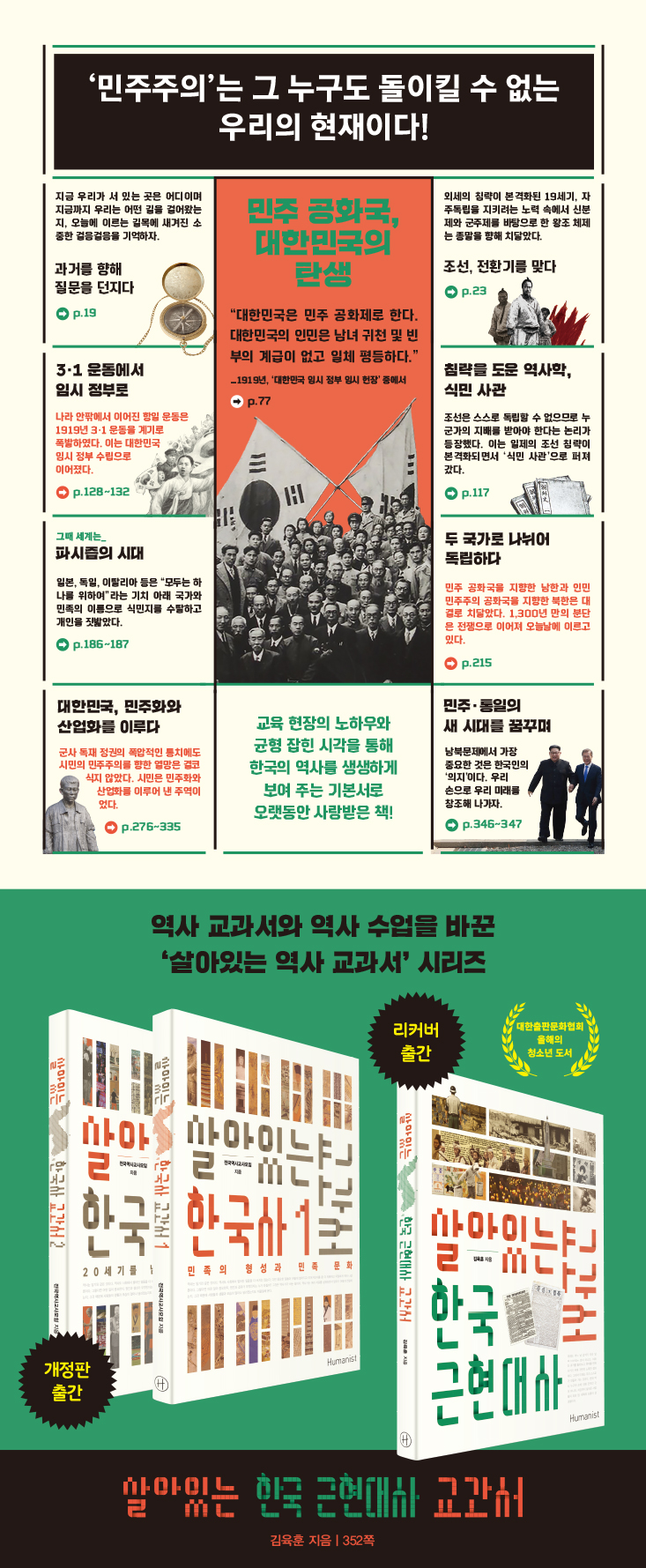
It is divided into five periods: until 1894, the process of seeking a new national system and abolishing the caste system; until 1919, the process of overcoming absolute monarchy and agreeing on a democratic republic; until 1945, the process of exploring the contents of a democratic republic while fighting against Japanese imperialism; until 1960, the process of considering the institutionalization of democracy and the impact of division on it; and after that, the story unfolds with a focus on the process of achieving industrialization and democratization and its characteristics.
The aim is to understand the modern and contemporary eras as a consistent flow of democracy, and to convey a clear message about how the Republic of Korea was formed as a nation-state and what kind of nation it aims to become.
3.
Asking Questions to the Past - Feature 1
"Couldn't Kim Ok-gyun and Jeon Bong-jun have worked together? Is it possible to hold Emperor Gojong responsible for the nation's downfall? Couldn't we have achieved liberation on our own? Couldn't we have avoided division? What do democracy and industrialization mean to our history?" "A Living Textbook of Modern and Contemporary Korean History" features a dedicated section at the end of each unit, beginning with the prologue, and at the end of each section, it again poses questions about the past.
The purpose is to reflect on where we stand now, the path we have taken to get to where we are today, the achievements we have made together, whether there have been any problems brought about by rapid progress, and whether there was another path other than the one that has led us to where we are today.
Studying history goes beyond a hobby to reflect on one's own life and form a perspective on oneself and the world.
‘History and Me’, reading history determines my current actions.
The question of what kind of life I will live overlaps with the question of how I will view history.
In particular, studying modern and contemporary history, which deals with the time we live in, is an act of finding out how I should live.
《A Living Textbook of Modern and Contemporary Korean History》 constantly asks questions about the past.
Through questions, we encounter the concerns and voices of the people who lived at that time.
The idea is to revive the traces of various concerns and debates about how to deal with the situation, to confront the social image that was ultimately sought to be achieved, and to revive the intention in the present even if it was not ultimately realized.
4.
Reflectively Reconstructing Modern and Contemporary Korean History - Feature 2
Rather than describing in detail what happened when, where, and what happened, the Living Textbook of Modern and Contemporary Korean History analyzes historical events from a social science and humanities perspective and reveals the lives and thoughts of the people of the time.
Based on this, we focused on restoring the networks and reflective efforts behind the events of the time.
Therefore, unlike most history books, we avoided describing it by dividing it into politics, economy, society, and culture, and instead chose to melt various fields into a larger flow.
As a result, there is a lot of content related to politics and economics, but it also deals with social and cultural issues related to everyday life.
In particular, the issue of science and technology, which has become increasingly important in modern and contemporary history, was read in connection with our lives through a separate section called 'Science and Technology and Changes in Life.'
The connection between Korean history and world history was also emphasized from the beginning.
In addition to describing the text in a world historical context, it also has separate sections such as “The World Then” which deals with the contemporary background of Korean history, “Korea and the World” which deals with the world and Korea in the world through Koreans who went out into the world and foreigners who came to Korea, and “Korea Seen from a Different Perspective” which deals with foreigners’ perceptions of Korea.
5.
A forum for debate and discussion surrounding the perception of modern and contemporary Korean history - Feature 3
There are various perspectives on modern and contemporary Korean history.
In recent years, the debate surrounding the perception of modern and contemporary Korean history has been so intense that it can be called a "civil war on the past," including the controversy surrounding the composition and activities of the Truth and Reconciliation Commission, the controversy over the approval of modern and contemporary Korean history textbooks, and the New Right and the Textbook Forum.
Ultimately, it is a task to form a historical image of modern and contemporary Korea.
What kind of image do Koreans have of Korea?
Even if you try to picture it in life, where you rush towards your goal without having time to turn back and reflect, it is not very clear.
The recent debate surrounding the perception of modern and contemporary Korean history has aspects that reflect on existing history and seek new historical perspectives, but it has not progressed in an academic or educational manner and has not been able to break free from the existing partisan framework.
This book assumes that present-day Korea is a democratic society and an industrialized country.
That is the starting point of the discussion.
However, there may be differences of opinion on what democracy and industrialization mean, how they were achieved, and what they should aim for.
This book focuses on creating a forum for open discussion by asking questions at multiple levels and guiding people to think from various perspectives.
6.
Living Textbook, Living History - Completed Living History Textbook
Living textbooks, living history! Couldn't textbooks be treasured history books we always keep close by? Couldn't they, while reading them, evoke the feeling of being present at the very scene? Is it truly impossible to read history not as a mere historical event, but as a way to revive the voices that sought to create a better future, and to explore a new future? "Textbooks" symbolize the problems of outdated education.
Humanists have gone beyond the state and certification, beyond the banality of textbook-like formats, and have innovated the content and format of textbooks by devoting all of the values and capabilities that books, as a medium, can embody.
《Living Korean Modern and Contemporary History Textbook》 is the result of a seven-year effort to develop an alternative history textbook, which began with the hope that history should be alive, following 《Living Korean History Textbook 1,2》 in March 2002 and 《Living World History Textbook 1,2》 in October 2005, under the name of a living textbook.
Living Alternative Textbooks have changed the very concept of textbooks and, above all, the landscape of textbooks.
By spreading textbooks from classrooms and school bags to various spaces, including bookstores, textbooks have truly established themselves as textbooks for a healthy civil society.
The ideal of a living alternative textbook is meaningful when it can be used not only in the classroom but also as a general education textbook that embodies social consensus and the achievements of the times.
Furthermore, while clearly targeting youth, we aim to create a textbook that lives and breathes across generations by expanding communication between adults and children through youth.
Reading Modern and Contemporary Korean History Through the Eyes of the Future - Overview
“Dae-han-min-guk!” Just as at the World Cup, we shout “Republic of Korea” everywhere in our lives.
Why does my heart swell with emotion every time I hear this? It's probably because the Republic of Korea is my country, and I feel united under its name.
How was the Republic of Korea created? Were Articles 1 and 2 of the Constitution—that the Republic of Korea is a democratic republic, that sovereignty resides in the people, and that all state authority emanates from the people—just given?
It is nearly impossible to imagine the Republic of Korea today in Korea 60 years ago, when liberation led to the establishment of an independent nation.
What the West took centuries to achieve in industrialization and democratization, Korea and its people achieved in just a few decades.
The 140 years of modern and contemporary Korean history prove that this is the result of the sweat, effort, joy, and tears of those who have lived up to this point.
And now no one can deny that the Republic of Korea is a democratic republic.
《A Living Textbook of Modern and Contemporary Korean History》 clearly states that democracy and republicanism are our present, achieved through long-term struggles and therefore irreversible, and thus it looks at modern and contemporary Korean history from the perspective of the democracy we have realized and the democracy we should strive for.
The purpose is to pinpoint what we have achieved throughout modern and contemporary Korean history and to clearly establish the point from which we can no longer retreat.
The recent debate surrounding the perception of modern and contemporary history still remains stuck within the left-right political framework of the 1980s, which defined the dark and bright sides of South Korea.
In particular, at a time when the historical awareness of modern and contemporary history is shifting to the issue of history textbooks and history education, such as the New Right, Textbook Forum, and the Geumseong edition approval of Korean modern and contemporary history textbooks, "A Living Korean Modern and Contemporary History Textbook" opens a new chapter in the awareness of modern and contemporary history, history education, and history textbooks in the 21st century based on its alternative characteristics.
First, it is a forum for discussion on the recognition of modern and contemporary Korean history.
Starting from the premise that the Republic of Korea is an industrialized and democratic nation, the focus was on creating a forum for open discussion by asking and guiding questions about the past from various angles.
Second, the modern and contemporary periods were understood as a consistent flow of Korean history.
For this purpose, the periodization of modern and contemporary history was changed.
While textbooks and many modern and contemporary history books divide the period into 1910, the year of the loss of national sovereignty, and 1945, this book divides the period based on the March 1st Movement and the formation of the Provisional Government of the Republic of Korea.
The purpose is to convey a clear message about how the Republic of Korea was formed and what kind of nation it aims to become.
Third, it revolutionized the concept of 21st century Korean history textbooks.
Attempts to overcome the cliche of textbook-like formats evolved into “Living Korean History Textbook” in March 2002 and “Living World History Textbook” in October 2005.
This is the result of a seven-year effort to develop an alternative history textbook, which began with the hope that history should be alive under the name of a living textbook.
“The future is not something that will suddenly be thrown in front of us one day.
The future is something we, living today, are creating by sweating to create the future we desire.
The present we live in today is the same.
Even the present, which seems to have been given to us just like that, is filled with the sweat and tears of countless people in the process of getting here.
Studying history is the process of remembering their sweat and tears and reliving the meaning contained in their every step.
That is why modern and contemporary history, which deals with the time we live in, is all the more important.
The process of examining what we have accomplished so far, and of examining the paths we have taken and those we have not taken, is the process of exploring the new future we must create together.
“Isn’t the past the distant future?” - From the preface
2.
Understanding modern and contemporary times as a consistent stream of democracy - Periodization
《Living Textbook of Modern and Contemporary Korean History》 covers the period from the 1860s to 1987.
Instead of describing the history of the North and South equally from the perspective of Korean history, the focus was on the progress of democracy in the Republic of Korea and South Korea.
It is different from the textbooks and many modern and contemporary history books that cover modern and contemporary Korean history in terms of periodization.
While these books usually divide the period into 1910 and 1945, and describe the period thereafter as one, or by decade, or by regime, 《Living Textbook of Modern and Contemporary Korean History》 is unique in that it divides the period not by 1910, when the country lost its sovereignty, but by the March 1st Movement and the formation of the Provisional Government of the Republic of Korea, and by the 1960s in modern history.
It is divided into five periods: until 1894, the process of seeking a new national system and abolishing the caste system; until 1919, the process of overcoming absolute monarchy and agreeing on a democratic republic; until 1945, the process of exploring the contents of a democratic republic while fighting against Japanese imperialism; until 1960, the process of considering the institutionalization of democracy and the impact of division on it; and after that, the story unfolds with a focus on the process of achieving industrialization and democratization and its characteristics.
The aim is to understand the modern and contemporary eras as a consistent flow of democracy, and to convey a clear message about how the Republic of Korea was formed as a nation-state and what kind of nation it aims to become.
3.
Asking Questions to the Past - Feature 1
"Couldn't Kim Ok-gyun and Jeon Bong-jun have worked together? Is it possible to hold Emperor Gojong responsible for the nation's downfall? Couldn't we have achieved liberation on our own? Couldn't we have avoided division? What do democracy and industrialization mean to our history?" "A Living Textbook of Modern and Contemporary Korean History" features a dedicated section at the end of each unit, beginning with the prologue, and at the end of each section, it again poses questions about the past.
The purpose is to reflect on where we stand now, the path we have taken to get to where we are today, the achievements we have made together, whether there have been any problems brought about by rapid progress, and whether there was another path other than the one that has led us to where we are today.
Studying history goes beyond a hobby to reflect on one's own life and form a perspective on oneself and the world.
‘History and Me’, reading history determines my current actions.
The question of what kind of life I will live overlaps with the question of how I will view history.
In particular, studying modern and contemporary history, which deals with the time we live in, is an act of finding out how I should live.
《A Living Textbook of Modern and Contemporary Korean History》 constantly asks questions about the past.
Through questions, we encounter the concerns and voices of the people who lived at that time.
The idea is to revive the traces of various concerns and debates about how to deal with the situation, to confront the social image that was ultimately sought to be achieved, and to revive the intention in the present even if it was not ultimately realized.
4.
Reflectively Reconstructing Modern and Contemporary Korean History - Feature 2
Rather than describing in detail what happened when, where, and what happened, the Living Textbook of Modern and Contemporary Korean History analyzes historical events from a social science and humanities perspective and reveals the lives and thoughts of the people of the time.
Based on this, we focused on restoring the networks and reflective efforts behind the events of the time.
Therefore, unlike most history books, we avoided describing it by dividing it into politics, economy, society, and culture, and instead chose to melt various fields into a larger flow.
As a result, there is a lot of content related to politics and economics, but it also deals with social and cultural issues related to everyday life.
In particular, the issue of science and technology, which has become increasingly important in modern and contemporary history, was read in connection with our lives through a separate section called 'Science and Technology and Changes in Life.'
The connection between Korean history and world history was also emphasized from the beginning.
In addition to describing the text in a world historical context, it also has separate sections such as “The World Then” which deals with the contemporary background of Korean history, “Korea and the World” which deals with the world and Korea in the world through Koreans who went out into the world and foreigners who came to Korea, and “Korea Seen from a Different Perspective” which deals with foreigners’ perceptions of Korea.
5.
A forum for debate and discussion surrounding the perception of modern and contemporary Korean history - Feature 3
There are various perspectives on modern and contemporary Korean history.
In recent years, the debate surrounding the perception of modern and contemporary Korean history has been so intense that it can be called a "civil war on the past," including the controversy surrounding the composition and activities of the Truth and Reconciliation Commission, the controversy over the approval of modern and contemporary Korean history textbooks, and the New Right and the Textbook Forum.
Ultimately, it is a task to form a historical image of modern and contemporary Korea.
What kind of image do Koreans have of Korea?
Even if you try to picture it in life, where you rush towards your goal without having time to turn back and reflect, it is not very clear.
The recent debate surrounding the perception of modern and contemporary Korean history has aspects that reflect on existing history and seek new historical perspectives, but it has not progressed in an academic or educational manner and has not been able to break free from the existing partisan framework.
This book assumes that present-day Korea is a democratic society and an industrialized country.
That is the starting point of the discussion.
However, there may be differences of opinion on what democracy and industrialization mean, how they were achieved, and what they should aim for.
This book focuses on creating a forum for open discussion by asking questions at multiple levels and guiding people to think from various perspectives.
6.
Living Textbook, Living History - Completed Living History Textbook
Living textbooks, living history! Couldn't textbooks be treasured history books we always keep close by? Couldn't they, while reading them, evoke the feeling of being present at the very scene? Is it truly impossible to read history not as a mere historical event, but as a way to revive the voices that sought to create a better future, and to explore a new future? "Textbooks" symbolize the problems of outdated education.
Humanists have gone beyond the state and certification, beyond the banality of textbook-like formats, and have innovated the content and format of textbooks by devoting all of the values and capabilities that books, as a medium, can embody.
《Living Korean Modern and Contemporary History Textbook》 is the result of a seven-year effort to develop an alternative history textbook, which began with the hope that history should be alive, following 《Living Korean History Textbook 1,2》 in March 2002 and 《Living World History Textbook 1,2》 in October 2005, under the name of a living textbook.
Living Alternative Textbooks have changed the very concept of textbooks and, above all, the landscape of textbooks.
By spreading textbooks from classrooms and school bags to various spaces, including bookstores, textbooks have truly established themselves as textbooks for a healthy civil society.
The ideal of a living alternative textbook is meaningful when it can be used not only in the classroom but also as a general education textbook that embodies social consensus and the achievements of the times.
Furthermore, while clearly targeting youth, we aim to create a textbook that lives and breathes across generations by expanding communication between adults and children through youth.
GOODS SPECIFICS
- Date of issue: August 8, 2011
- Page count, weight, size: 340 pages | 856g | 188*254*30mm
- ISBN13: 9788958621768
- ISBN10: 8958621761
You may also like
카테고리
korean


korean

![GQ KOREA Mark (Monthly): December [2025]](http://librairie.coreenne.fr/cdn/shop/files/8ef265dbbfbf186523ed75ba7319009d.jpg?v=1765340328&width=3840)


