

Correct use of historical terms
 |
Description
Book Introduction
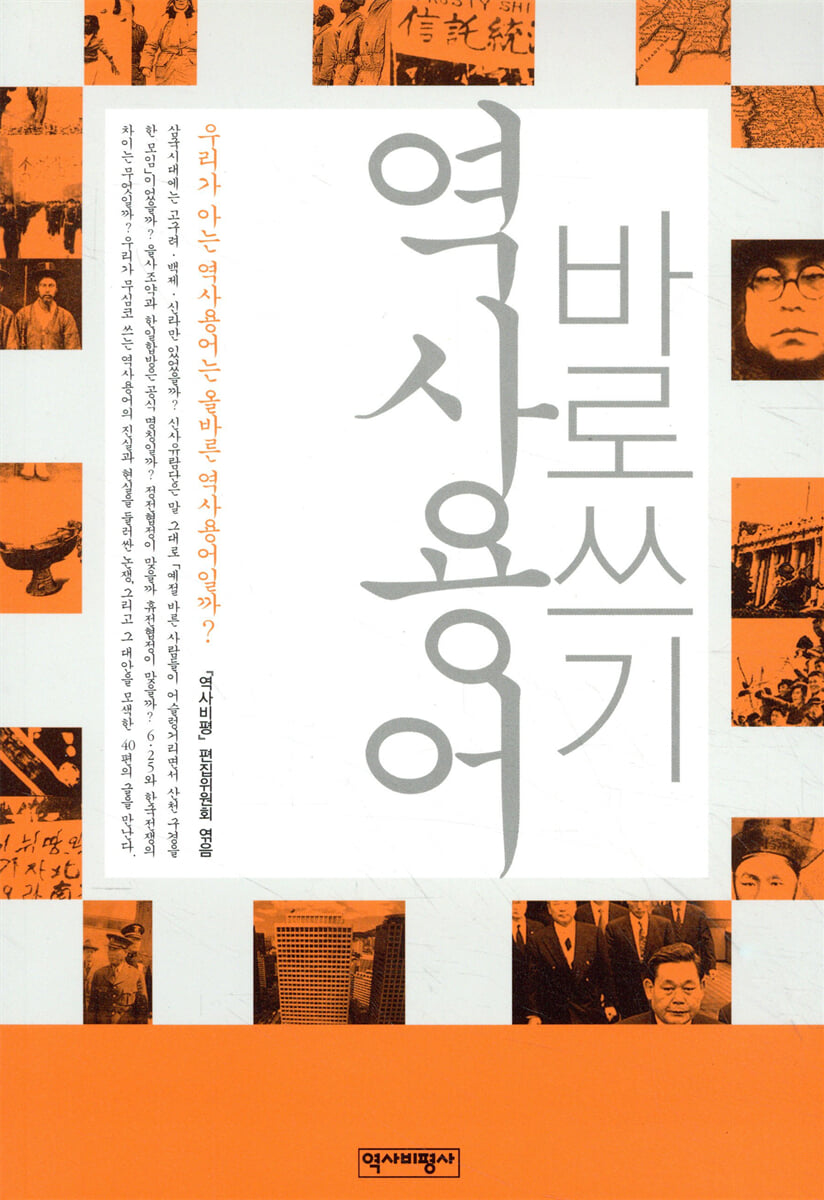
Were Goguryeo, Baekje, and Silla the only states in the Three Kingdoms period? Were the Shinsa Yuramdan literally "a gathering of polite people strolling around and enjoying the mountains and rivers"? Are the "Eulsa Treaty" and the "Japan-Korea Annexation" actually official treaty names? Is it the independence movement or the national liberation movement? Is the situation on the Korean Peninsula a ceasefire or an armistice? Who is the reference point for the Far East? The historical terms we use thoughtlessly often reflect, whether knowingly or unknowingly, the subjects who coined them and their historical perceptions.
But what if there's a clear flaw in the term's origins and the historical understanding it embodies? Should we continue to call it by its incorrect name, even though it's already been created? Or is it not too late to reflect and seek a new name? This book began with this question in mind.
This book reexamines 40 historical terms (or groups of terms) that are often misused or used differently depending on the subject.
Just as inappropriate terms were used during the transition to modern society, or incorrect terms were used in everyday life without academic review and then became established as academic terms, there are many incorrect terms that have been used out of habit, or historical terms that have lost their meaning or are used without proper understanding.
This book carefully selects such historical terms and explains in detail what alternatives there are, what historical terminology concepts we must know, and which terms are under debate.
This book, written by 35 scholars and presented in a popular format for the general public, contains the efforts of scholars to correct the use of historical terminology and the results of their efforts.
This article provides an opportunity to learn about correct history through 40 articles that explore the truth and reality of historical terms we use carelessly, as well as alternatives.
But what if there's a clear flaw in the term's origins and the historical understanding it embodies? Should we continue to call it by its incorrect name, even though it's already been created? Or is it not too late to reflect and seek a new name? This book began with this question in mind.
This book reexamines 40 historical terms (or groups of terms) that are often misused or used differently depending on the subject.
Just as inappropriate terms were used during the transition to modern society, or incorrect terms were used in everyday life without academic review and then became established as academic terms, there are many incorrect terms that have been used out of habit, or historical terms that have lost their meaning or are used without proper understanding.
This book carefully selects such historical terms and explains in detail what alternatives there are, what historical terminology concepts we must know, and which terms are under debate.
This book, written by 35 scholars and presented in a popular format for the general public, contains the efforts of scholars to correct the use of historical terminology and the results of their efforts.
This article provides an opportunity to learn about correct history through 40 articles that explore the truth and reality of historical terms we use carelessly, as well as alternatives.
- You can preview some of the book's contents.
Preview
index
Introduction - Why We Must Use Historical Terminology Correctly / Han Jeong-suk
1.
From the Three Kingdoms to the Four Kingdoms / Kim Tae-sik
2.
From the Unified Silla Period to the North-South States Period / Song Ki-ho
3.
People, commoners, the masses / Jeong Chang-ryeol
4.
The Shinsa Yuramdan was transformed into a Japanese inspection group in 1881 / Lee I-hwa
5.
Criticism of existing reformist terminology / Joo Jin-oh
6.
Controversy surrounding the Gwangmu Reform / King Hyeonjong
7.
What's the Difference Between a Rule and a Treaty? / Kim Min-gyu
8.
It's not the Eulsa Treaty, but the Korea-Japan Diplomatic Entrustment Treaty / Lee Sang-chan
9.
Annexation of Korea or Japan-Korea Annexation Treaty? / Lee Tae-jin
10.
Late Joseon Dynasty, the period of port opening, the period of enlightenment, the period of patriotic enlightenment / Lee Yun-sang
11.
Japanese colonial period, Japanese colonial period, Japanese occupation period / Kim Jeong-in
12.
Comfort women, mental hospitals, brothels, sex slaves / Kang Jeong-sook
13.
Collaboration with Japan / Lee Ki-hoon
14.
Revisiting the Concept of National Capital / Jeon Woo-yong
15.
Independence Movement or National Liberation Movement? / Lee Ki-hoon
16.
Anarchism and Anarchism / Ryu Si-hyeon
17.
Socialism and Communism / Ryu Si-hyeon
18.
Bourgeois nationalism, right-wing nationalism, cultural nationalism / Park Chan-seung
19.
Liberal democracy / rental system
20.
Liberation or Restoration? / Shin Joo-baek
21.
There was opposition, but no support / Park Tae-gyun
22.
Did the Soviet Union Really Exist? / Ki Gwang-seo
23.
Moderate, Moderate, or Collaborative? / Seo Jung-seok
24.
Remembering the Korean War/June 25: Problems with Historical Terminology and System of Thought / Park Myeong-rim
25.
Is it a ceasefire or an armistice agreement? / Park Tae-gyun
26.
War Records of Capture and Plunder: NARA's Collection of North Korean Captured Documents / Jeong Byeong-jun
27.
The August Sect: Sects, Factions, and Intra-Party Rivalry / Baek Jun-gi
28.
Defection to North Korea and Abduction / Lee Shin-cheol
29.
Compatriots and Nation / Min Dong-taek
30.
Doctor and Martyr / Eun Jeong-tae
31.
The various names of modern and contemporary political prisoners / Choi Jeong-gi
32.
Conglomerates and their leaders / Kim Ki-won
33.
Solar and lunar calendars / Shin Dong-won
34.
Oriental Medicine and Oriental Medicine / Shin Dong-won
35.
National literature, national literature, nationalist literature / Ha Jeong-il
36.
The misconception of 'pure literature'
37.
Let's change the spelling of foreign country names / Kim Dong-taek
38.
Gando, Gando Expedition / Bae Seong-jun
39.
Implications of the Far East, East Asia, and Northeast Asia / Kim Hee-kyo
40.
The Reality of Chinese Patriotism: Neo-Cultivism, Sino-Chinese Hegemony, and Nationalism / Kim Hee-kyo
Notes in the text that indicate the source
People who participated in writing this book
1.
From the Three Kingdoms to the Four Kingdoms / Kim Tae-sik
2.
From the Unified Silla Period to the North-South States Period / Song Ki-ho
3.
People, commoners, the masses / Jeong Chang-ryeol
4.
The Shinsa Yuramdan was transformed into a Japanese inspection group in 1881 / Lee I-hwa
5.
Criticism of existing reformist terminology / Joo Jin-oh
6.
Controversy surrounding the Gwangmu Reform / King Hyeonjong
7.
What's the Difference Between a Rule and a Treaty? / Kim Min-gyu
8.
It's not the Eulsa Treaty, but the Korea-Japan Diplomatic Entrustment Treaty / Lee Sang-chan
9.
Annexation of Korea or Japan-Korea Annexation Treaty? / Lee Tae-jin
10.
Late Joseon Dynasty, the period of port opening, the period of enlightenment, the period of patriotic enlightenment / Lee Yun-sang
11.
Japanese colonial period, Japanese colonial period, Japanese occupation period / Kim Jeong-in
12.
Comfort women, mental hospitals, brothels, sex slaves / Kang Jeong-sook
13.
Collaboration with Japan / Lee Ki-hoon
14.
Revisiting the Concept of National Capital / Jeon Woo-yong
15.
Independence Movement or National Liberation Movement? / Lee Ki-hoon
16.
Anarchism and Anarchism / Ryu Si-hyeon
17.
Socialism and Communism / Ryu Si-hyeon
18.
Bourgeois nationalism, right-wing nationalism, cultural nationalism / Park Chan-seung
19.
Liberal democracy / rental system
20.
Liberation or Restoration? / Shin Joo-baek
21.
There was opposition, but no support / Park Tae-gyun
22.
Did the Soviet Union Really Exist? / Ki Gwang-seo
23.
Moderate, Moderate, or Collaborative? / Seo Jung-seok
24.
Remembering the Korean War/June 25: Problems with Historical Terminology and System of Thought / Park Myeong-rim
25.
Is it a ceasefire or an armistice agreement? / Park Tae-gyun
26.
War Records of Capture and Plunder: NARA's Collection of North Korean Captured Documents / Jeong Byeong-jun
27.
The August Sect: Sects, Factions, and Intra-Party Rivalry / Baek Jun-gi
28.
Defection to North Korea and Abduction / Lee Shin-cheol
29.
Compatriots and Nation / Min Dong-taek
30.
Doctor and Martyr / Eun Jeong-tae
31.
The various names of modern and contemporary political prisoners / Choi Jeong-gi
32.
Conglomerates and their leaders / Kim Ki-won
33.
Solar and lunar calendars / Shin Dong-won
34.
Oriental Medicine and Oriental Medicine / Shin Dong-won
35.
National literature, national literature, nationalist literature / Ha Jeong-il
36.
The misconception of 'pure literature'
37.
Let's change the spelling of foreign country names / Kim Dong-taek
38.
Gando, Gando Expedition / Bae Seong-jun
39.
Implications of the Far East, East Asia, and Northeast Asia / Kim Hee-kyo
40.
The Reality of Chinese Patriotism: Neo-Cultivism, Sino-Chinese Hegemony, and Nationalism / Kim Hee-kyo
Notes in the text that indicate the source
People who participated in writing this book
Publisher's Review
Why We Need Correct Historical Terminology - Correct Historical Terminology Creates Correct History
Words bind and restrict consciousness.
This means that history written with incorrect terms leads to incorrect understanding and perception of history.
That is why nothing is more important than writing words correctly, naming things correctly, and naming and pronouncing historical terms correctly.
The task of naming historical terms correctly is linked to the question, 'How can we subjectively internalize historical terms and historical memory?'
This problem is directly linked to the question of 'who manages memory'.
Because the person who names memories dominates the direction of perception of things, and naming one's own memories means possessing the 'ability to perceive history subjectively.'
Historical terminology must also be chosen based on new historical perceptions and values, and universal terms widely used by the general public must be chosen to demonstrate a correct understanding of history.
Therefore, reexamining historical terminology at this time also means critically reflecting on the process of ‘creating a modern society’ in Korean society.
The effort to have a 'correct name' also has the meaning of historical practice.
Because understanding and naming history are not issues of the past but of the present, and they are also issues of evaluating the lives of those involved in an event, as well as issues of collective reason and democracy in a society.
Therefore, the effort to call things by their 'correct names' is a task that must continue as long as history continues, and this book is an extension of that work.
A work by 35 scholars that popularized historical research!!
This book is the result of a collaborative effort by 35 scholars who have been actively pursuing research.
In 2005, to commemorate the 60th anniversary of liberation, the [History Criticism] editorial committee prepared a special feature titled 'Correcting Historical Terminology' to reexamine historical terms that had been used conventionally throughout the colonial period, the liberation period, and the division period, and to find alternatives for terms whose original meanings were invalid, whose meanings had been polluted, damaged, or lost.
And that special feature continued from the winter issue of 2005 to the summer issue of 2006, and scholars from various fields who agreed with the importance of using correct historical terminology willingly participated in the 'Correcting Historical Terminology' project.
Although the content and format may differ slightly depending on the selected topic and author, they share one commonality: the scholars who participated as contributors to this book wrote articles related to their main research areas, the content of these articles reflects the research results to date, and the content is explained in an easy-to-understand manner so that anyone interested in history can understand it.
The fact that the period during which only the three kingdoms of Goguryeo, Baekje, and Silla coexisted was only 98 years, and therefore it should be called the Four Kingdoms Period including Gaya rather than the Three Kingdoms Period (Kim Tae-sik); the argument that the 'Eulsa Treaty' and the 'Japan-Korea Annexation' are not official names and that proper terminology that fits them is needed (Lee Sang-chan, Lee Tae-jin); the article that reminds us of the importance of the 'Collection of Captured North Korean Documents' stored at the 'National Archives and Records Administration (NARA)' in relation to the Korean War (Jeong Byeong-jun) and the article that points out the problems with the way the South and the North remember and commemorate the Korean War (Park Myeong-rim), all of the articles in this book can be said to be 'popularization of academic research results' in that they summarize historical facts that scholars have learned through their research results or the process of research so that the general public, including middle and high school students, can easily understand them.
This book not only provides readers with a chance to learn about historical facts they were not familiar with, but also to encounter fresh arguments and voices from recent academic circles.
The work of introducing and disseminating research results, previously confined to the academic realm, to the public clearly demonstrates the critical awareness among scholars that historical terminology must be used appropriately in both academic and everyday spheres.
Selection criteria and main contents of historical terms included in this book
- Five classifications based on the nature of the text
The 40 historical terms (groups) included in this book were selected based on the following criteria: ① those based on incorrect historical facts, including those that misuse the right to name historical terms; ② those from an uninitiated or non-initiated perspective; ③ those from a Cold War perspective; ④ those centered on specific individuals or groups; and ⑤ those with significant disagreement and controversy.
In terms of historical periodization, this category includes ancient times with a focus on modern and contemporary times, and in terms of academic fields, it goes beyond political history to encompass socio-economic history, daily life history, literary history, cultural history, and even East Asia, including China, beyond Korea.
Each piece contains not only diversity in content and form, but also the author's diverse historical perspectives.
This is because it shows the process of exploration that is still ongoing in the Korean historical academia.
It may be undesirable to try to define a phenomenon that can be given various names depending on different perspectives using just one historical term.
However, I believe that this book's attempt to use correct terminology and seek sound alternatives will serve as a catalyst for various discussions and debates surrounding historical terminology.
Based on the nature and content of the text, it can be classified as follows:
① In cases where existing terms (historical) that have been commonly used are criticized and new terms (historical) are proposed or alternatives are proposed for review.
"From the Three Kingdoms Period to the Four Kingdoms Period" (Kim Tae-sik), which argues that the Three Kingdoms Period was actually the Four Kingdoms Period including Gaya and should be named that way; "From the Unified Silla Period to the North-South States Period" (Song Gi-ho), which argues that Balhae should be restored to our history and called the North-South States Period rather than the Unified Silla Period; "From the Shinsa Yuramdan to the 1881 Japanese Inspection Group" (Lee I-hwa), which argues that the name of the Shinsa Yuramdan was incorrectly given and that it should be renamed based on its main activities; "What is the difference between a treaty and a treaty?" (Kim Min-gyu), which explains the difference between the "regulations" and "treaties" that Korea made with Japan, China, and Western powers during the Enlightenment Period and argues that they should be used correctly; "It is not the Eulsa Treaty, but the Korea-Japan Diplomatic Entrustment Treaty Draft" (Lee Sang-chan), which argues that the "Eulsa Treaty" of 1905 that we know is not the official name and that a proper alternative should be sought; and "The Korea-Japan Annexation Treaty" of 1910 is a wrong name. Some examples include “Is it the Korea Annexation Treaty or the Korea-Japan Annexation Treaty?” (Lee Tae-jin), “Did the Soviet Military Government Really Exist?” (Ki Gwang-seo), which examines whether the US military government in South Korea after the liberation on August 15th and the Soviet military government in North Korea were truly true, “The August Faction: Factions, Sects, and Intra-Party Competition” (Baek Jun-gi), which examines North Korea’s party issues through the “August Faction” incident, known as the largest power struggle in North Korea since the Korean War, and “Let’s Change the Notation of Foreign Country Names” (Kim Dong-taek), which argues for notation of foreign country names in our own way.
② Introducing terms that are being used interchangeably and suggesting a preferred term as an alternative.
"Comfort Women, Men's Corps, Public Prostitution, Sexual Slavery" (Kang Jeong-suk), which examines the differences between "comfort women" and "mental corps," their differences from Japanese brothels, and the appropriateness of the term "sex slavery," examines the appropriateness of the term "comfort women," "mental corps," "public prostitution," and "sex slavery." Is the term "independence movement" appropriate? Is the term "national liberation movement" appropriate? "Is it an independence movement or a national liberation movement?" (Lee Ki-hoon) which presents the answer; "Anarchism and Anarchism" (Ryu Si-hyeon) which examines the correlation between anarchism and anarchism translated from Japan; "Is it a moderate, a centrist, or a cooperative group?" (Seo Jung-seok) which examines the terms moderate, centrist, and cooperative group and views the Yeo Un-hyeong and Kim Kyu-sik lines as a centrist line rather than a gray line; "Is it an armistice agreement or an armistice agreement?" (Park Tae-gyun) which contains the answer to the question of whether it is an armistice agreement or a truce agreement; "Defection and Abduction to North Korea" (Lee Shin-cheol) which introduces in detail the meaning of defection to North Korea and abduction and the concept of diaspora; "Various Names for Modern and Contemporary Political Prisoners" (Choi Jeong-gi) which examines the history of political prisoners and the terms used to refer to them; There is no Far West, but there is a Far East? This includes “The Implications of the Far East, East Asia, and Northeast Asia” (Kim Hee-kyo), which provides an in-depth examination of the region called the Far East and the place names East Asia and Northeast Asia.
③ Introducing different terms that are being used interchangeably and comparing and analyzing the context of discourse in which these terms are used (no single alternative is presented)
There are “Criticism of Existing Enlightenment Terminology” (Joo Jin-oh), which critically examines the existing Enlightenment terminology that divides it into radical reform, moderate reform, and Shimu Yangmu; “Late Joseon Dynasty, Port Opening Period, Enlightenment Period, Patriotic Enlightenment Period” (Lee Yun-sang), which points out the usage and problems of various terms referring to the period from 1876 to 1910 and 1910 to 1945; “Japanese Colonial Period, Japanese Colonial Period, Japanese Occupation Period” (Kim Jeong-in); “Pro-Japanese and Cooperation” (Lee Ki-hoon), which examines the historical perception of “pro-Japanese” and “collaboration” during the Japanese colonial period; “Liberation or Liberation” (Shin Ju-baek), which reexamines the difference between “liberation” and “restored”; and “The Reality of Chinese Patriotism: Neo-Chineseism, Sino-Chinese Hegemonism, Nationalism” (Kim Hee-kyo), which discusses the true nature of Chinese patriotism from a current perspective.
④ In case the meaning of an existing term is described in detail, including the history of change in meaning.
"People, Commoners, and Minjung" (Jeong Chang-ryeol), which examines the nature of the people in Korean history using three terms; "The Debate Surrounding the Gwangmu Reform" (Wang Hyeon-jong), which examines whether Emperor Gojong's reform projects during the Gwangmu period of the Korean Empire can be called the "Gwangmu Reform"; "Revisiting the Concept of National Capital" (Jeon Woo-yong), which is good to read when wondering what national capital is; "Socialism and Communism" (Ryu Si-hyeon), which examines the various names for socialism, communism, and nationalism, and the concept of liberal democracy, a Korean coinage; "Bourgeois Nationalism, Right-Wing Nationalism, Cultural Nationalism" (Park Chan-seung), "Liberal Democracy" (Lim Dae-sik); "Chaebol Corporations and Chaebol Heads" (Kim Ki-won), which examines the meaning of highly topical terms such as chaebol and corporations in our society; "Compatriots and the Nation" (Kim Dong-taek), "Doctors and Martyrs" (Eun Jeong-tae), and "Solar and Lunar Calendars" (Shin Dong-won), which explain the historical nature and differences of each term; His writings include “Oriental Medicine and Korean Medicine” (Shin Dong-won), “National Literature, People’s Literature, Nationalist Literature” (Ha Jeong-il), and “The Misunderstanding of ‘Pure Literature’” (Han Su-yeong).
⑤ In case of complex personality
This includes writings such as “There Was Anti-Trusteeship, But No Pro-Trustship” (Park Tae-gyun), which reveals the true facts (historical facts) of anti- and pro-trusteeship that we have been mistaken about; “The Way We Remember the Korean War and the Korean War” (Park Myeong-rim), which correctly informs us of the meaning of the Korean War by raising the issue of how the South and the North remember and commemorate the historical event known as the Korean War or the Korean War; “Records of the War of Capture and Capture, NARA’s Collection of North Korean Captive Documents” (Jeong Byeong-jun), which raises awareness of the reality and importance of the “Collection of North Korean Captive Documents” stored in the “National Archives and Records Administration (NARA)” that the United States seized during the Korean War; and “Gando, Gando Expedition” (Bae Seong-jun), which examines the place name Gando, the contents of the Gando Agreement signed between Japan and China regarding this region, and the meaning of the term Gando Expedition.
Words bind and restrict consciousness.
This means that history written with incorrect terms leads to incorrect understanding and perception of history.
That is why nothing is more important than writing words correctly, naming things correctly, and naming and pronouncing historical terms correctly.
The task of naming historical terms correctly is linked to the question, 'How can we subjectively internalize historical terms and historical memory?'
This problem is directly linked to the question of 'who manages memory'.
Because the person who names memories dominates the direction of perception of things, and naming one's own memories means possessing the 'ability to perceive history subjectively.'
Historical terminology must also be chosen based on new historical perceptions and values, and universal terms widely used by the general public must be chosen to demonstrate a correct understanding of history.
Therefore, reexamining historical terminology at this time also means critically reflecting on the process of ‘creating a modern society’ in Korean society.
The effort to have a 'correct name' also has the meaning of historical practice.
Because understanding and naming history are not issues of the past but of the present, and they are also issues of evaluating the lives of those involved in an event, as well as issues of collective reason and democracy in a society.
Therefore, the effort to call things by their 'correct names' is a task that must continue as long as history continues, and this book is an extension of that work.
A work by 35 scholars that popularized historical research!!
This book is the result of a collaborative effort by 35 scholars who have been actively pursuing research.
In 2005, to commemorate the 60th anniversary of liberation, the [History Criticism] editorial committee prepared a special feature titled 'Correcting Historical Terminology' to reexamine historical terms that had been used conventionally throughout the colonial period, the liberation period, and the division period, and to find alternatives for terms whose original meanings were invalid, whose meanings had been polluted, damaged, or lost.
And that special feature continued from the winter issue of 2005 to the summer issue of 2006, and scholars from various fields who agreed with the importance of using correct historical terminology willingly participated in the 'Correcting Historical Terminology' project.
Although the content and format may differ slightly depending on the selected topic and author, they share one commonality: the scholars who participated as contributors to this book wrote articles related to their main research areas, the content of these articles reflects the research results to date, and the content is explained in an easy-to-understand manner so that anyone interested in history can understand it.
The fact that the period during which only the three kingdoms of Goguryeo, Baekje, and Silla coexisted was only 98 years, and therefore it should be called the Four Kingdoms Period including Gaya rather than the Three Kingdoms Period (Kim Tae-sik); the argument that the 'Eulsa Treaty' and the 'Japan-Korea Annexation' are not official names and that proper terminology that fits them is needed (Lee Sang-chan, Lee Tae-jin); the article that reminds us of the importance of the 'Collection of Captured North Korean Documents' stored at the 'National Archives and Records Administration (NARA)' in relation to the Korean War (Jeong Byeong-jun) and the article that points out the problems with the way the South and the North remember and commemorate the Korean War (Park Myeong-rim), all of the articles in this book can be said to be 'popularization of academic research results' in that they summarize historical facts that scholars have learned through their research results or the process of research so that the general public, including middle and high school students, can easily understand them.
This book not only provides readers with a chance to learn about historical facts they were not familiar with, but also to encounter fresh arguments and voices from recent academic circles.
The work of introducing and disseminating research results, previously confined to the academic realm, to the public clearly demonstrates the critical awareness among scholars that historical terminology must be used appropriately in both academic and everyday spheres.
Selection criteria and main contents of historical terms included in this book
- Five classifications based on the nature of the text
The 40 historical terms (groups) included in this book were selected based on the following criteria: ① those based on incorrect historical facts, including those that misuse the right to name historical terms; ② those from an uninitiated or non-initiated perspective; ③ those from a Cold War perspective; ④ those centered on specific individuals or groups; and ⑤ those with significant disagreement and controversy.
In terms of historical periodization, this category includes ancient times with a focus on modern and contemporary times, and in terms of academic fields, it goes beyond political history to encompass socio-economic history, daily life history, literary history, cultural history, and even East Asia, including China, beyond Korea.
Each piece contains not only diversity in content and form, but also the author's diverse historical perspectives.
This is because it shows the process of exploration that is still ongoing in the Korean historical academia.
It may be undesirable to try to define a phenomenon that can be given various names depending on different perspectives using just one historical term.
However, I believe that this book's attempt to use correct terminology and seek sound alternatives will serve as a catalyst for various discussions and debates surrounding historical terminology.
Based on the nature and content of the text, it can be classified as follows:
① In cases where existing terms (historical) that have been commonly used are criticized and new terms (historical) are proposed or alternatives are proposed for review.
"From the Three Kingdoms Period to the Four Kingdoms Period" (Kim Tae-sik), which argues that the Three Kingdoms Period was actually the Four Kingdoms Period including Gaya and should be named that way; "From the Unified Silla Period to the North-South States Period" (Song Gi-ho), which argues that Balhae should be restored to our history and called the North-South States Period rather than the Unified Silla Period; "From the Shinsa Yuramdan to the 1881 Japanese Inspection Group" (Lee I-hwa), which argues that the name of the Shinsa Yuramdan was incorrectly given and that it should be renamed based on its main activities; "What is the difference between a treaty and a treaty?" (Kim Min-gyu), which explains the difference between the "regulations" and "treaties" that Korea made with Japan, China, and Western powers during the Enlightenment Period and argues that they should be used correctly; "It is not the Eulsa Treaty, but the Korea-Japan Diplomatic Entrustment Treaty Draft" (Lee Sang-chan), which argues that the "Eulsa Treaty" of 1905 that we know is not the official name and that a proper alternative should be sought; and "The Korea-Japan Annexation Treaty" of 1910 is a wrong name. Some examples include “Is it the Korea Annexation Treaty or the Korea-Japan Annexation Treaty?” (Lee Tae-jin), “Did the Soviet Military Government Really Exist?” (Ki Gwang-seo), which examines whether the US military government in South Korea after the liberation on August 15th and the Soviet military government in North Korea were truly true, “The August Faction: Factions, Sects, and Intra-Party Competition” (Baek Jun-gi), which examines North Korea’s party issues through the “August Faction” incident, known as the largest power struggle in North Korea since the Korean War, and “Let’s Change the Notation of Foreign Country Names” (Kim Dong-taek), which argues for notation of foreign country names in our own way.
② Introducing terms that are being used interchangeably and suggesting a preferred term as an alternative.
"Comfort Women, Men's Corps, Public Prostitution, Sexual Slavery" (Kang Jeong-suk), which examines the differences between "comfort women" and "mental corps," their differences from Japanese brothels, and the appropriateness of the term "sex slavery," examines the appropriateness of the term "comfort women," "mental corps," "public prostitution," and "sex slavery." Is the term "independence movement" appropriate? Is the term "national liberation movement" appropriate? "Is it an independence movement or a national liberation movement?" (Lee Ki-hoon) which presents the answer; "Anarchism and Anarchism" (Ryu Si-hyeon) which examines the correlation between anarchism and anarchism translated from Japan; "Is it a moderate, a centrist, or a cooperative group?" (Seo Jung-seok) which examines the terms moderate, centrist, and cooperative group and views the Yeo Un-hyeong and Kim Kyu-sik lines as a centrist line rather than a gray line; "Is it an armistice agreement or an armistice agreement?" (Park Tae-gyun) which contains the answer to the question of whether it is an armistice agreement or a truce agreement; "Defection and Abduction to North Korea" (Lee Shin-cheol) which introduces in detail the meaning of defection to North Korea and abduction and the concept of diaspora; "Various Names for Modern and Contemporary Political Prisoners" (Choi Jeong-gi) which examines the history of political prisoners and the terms used to refer to them; There is no Far West, but there is a Far East? This includes “The Implications of the Far East, East Asia, and Northeast Asia” (Kim Hee-kyo), which provides an in-depth examination of the region called the Far East and the place names East Asia and Northeast Asia.
③ Introducing different terms that are being used interchangeably and comparing and analyzing the context of discourse in which these terms are used (no single alternative is presented)
There are “Criticism of Existing Enlightenment Terminology” (Joo Jin-oh), which critically examines the existing Enlightenment terminology that divides it into radical reform, moderate reform, and Shimu Yangmu; “Late Joseon Dynasty, Port Opening Period, Enlightenment Period, Patriotic Enlightenment Period” (Lee Yun-sang), which points out the usage and problems of various terms referring to the period from 1876 to 1910 and 1910 to 1945; “Japanese Colonial Period, Japanese Colonial Period, Japanese Occupation Period” (Kim Jeong-in); “Pro-Japanese and Cooperation” (Lee Ki-hoon), which examines the historical perception of “pro-Japanese” and “collaboration” during the Japanese colonial period; “Liberation or Liberation” (Shin Ju-baek), which reexamines the difference between “liberation” and “restored”; and “The Reality of Chinese Patriotism: Neo-Chineseism, Sino-Chinese Hegemonism, Nationalism” (Kim Hee-kyo), which discusses the true nature of Chinese patriotism from a current perspective.
④ In case the meaning of an existing term is described in detail, including the history of change in meaning.
"People, Commoners, and Minjung" (Jeong Chang-ryeol), which examines the nature of the people in Korean history using three terms; "The Debate Surrounding the Gwangmu Reform" (Wang Hyeon-jong), which examines whether Emperor Gojong's reform projects during the Gwangmu period of the Korean Empire can be called the "Gwangmu Reform"; "Revisiting the Concept of National Capital" (Jeon Woo-yong), which is good to read when wondering what national capital is; "Socialism and Communism" (Ryu Si-hyeon), which examines the various names for socialism, communism, and nationalism, and the concept of liberal democracy, a Korean coinage; "Bourgeois Nationalism, Right-Wing Nationalism, Cultural Nationalism" (Park Chan-seung), "Liberal Democracy" (Lim Dae-sik); "Chaebol Corporations and Chaebol Heads" (Kim Ki-won), which examines the meaning of highly topical terms such as chaebol and corporations in our society; "Compatriots and the Nation" (Kim Dong-taek), "Doctors and Martyrs" (Eun Jeong-tae), and "Solar and Lunar Calendars" (Shin Dong-won), which explain the historical nature and differences of each term; His writings include “Oriental Medicine and Korean Medicine” (Shin Dong-won), “National Literature, People’s Literature, Nationalist Literature” (Ha Jeong-il), and “The Misunderstanding of ‘Pure Literature’” (Han Su-yeong).
⑤ In case of complex personality
This includes writings such as “There Was Anti-Trusteeship, But No Pro-Trustship” (Park Tae-gyun), which reveals the true facts (historical facts) of anti- and pro-trusteeship that we have been mistaken about; “The Way We Remember the Korean War and the Korean War” (Park Myeong-rim), which correctly informs us of the meaning of the Korean War by raising the issue of how the South and the North remember and commemorate the historical event known as the Korean War or the Korean War; “Records of the War of Capture and Capture, NARA’s Collection of North Korean Captive Documents” (Jeong Byeong-jun), which raises awareness of the reality and importance of the “Collection of North Korean Captive Documents” stored in the “National Archives and Records Administration (NARA)” that the United States seized during the Korean War; and “Gando, Gando Expedition” (Bae Seong-jun), which examines the place name Gando, the contents of the Gando Agreement signed between Japan and China regarding this region, and the meaning of the term Gando Expedition.
GOODS SPECIFICS
- Date of issue: August 21, 2006
- Page count, weight, size: 328 pages | 608g | 153*224*30mm
- ISBN13: 9788976965189
- ISBN10: 8976965183
You may also like
카테고리
korean


korean

![ELLE 엘르 스페셜 에디션 A형 : 12월 [2025]](http://librairie.coreenne.fr/cdn/shop/files/b8e27a3de6c9538896439686c6b0e8fb.jpg?v=1766436872&width=3840)


