

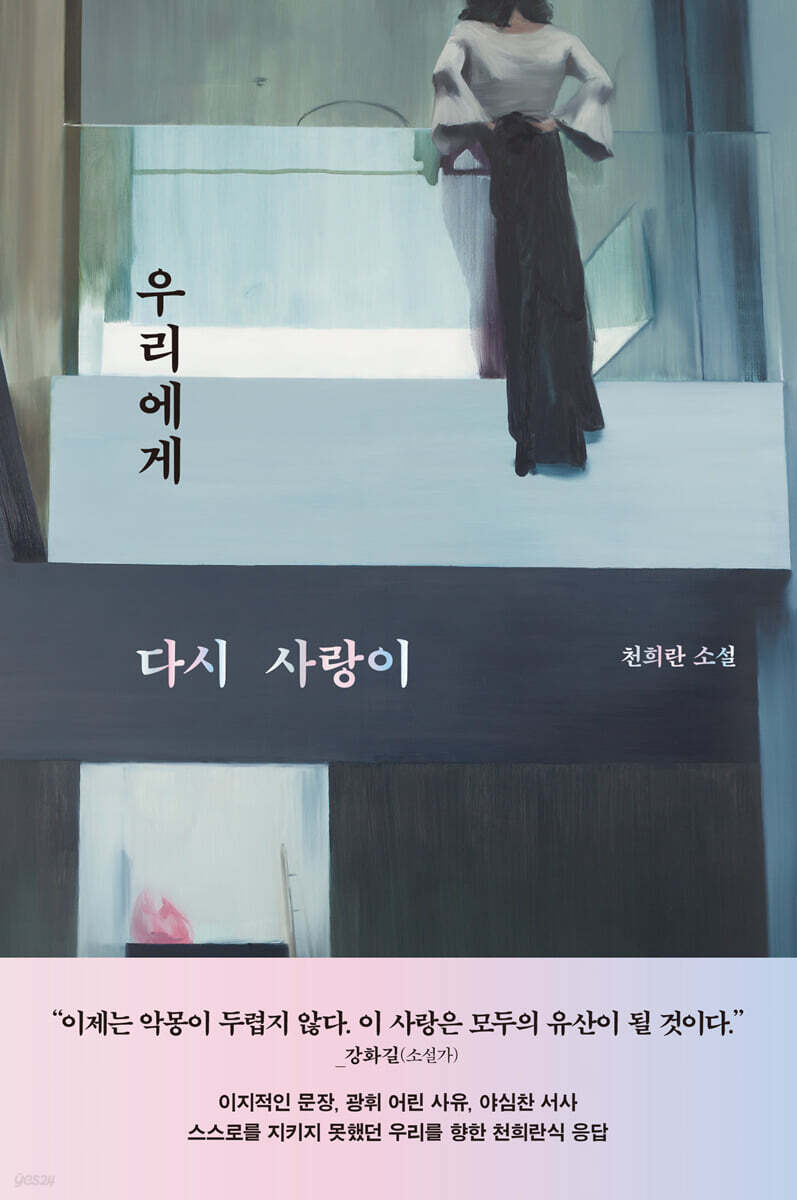
Love us again
 |
Description
Book Introduction
- A word from MD
-
A collection of captivating female narrativesA collection of novels featuring powerful sentences and stories, and diverse female narratives that transcend generations and genres.
Here, those who bear the indelible scars left by love still hold on to love and life with one hand.
At the end, the kernel of love that confronts me as my true self shines brightly.
April 5, 2022. Novel/Poetry PD Park Hyung-wook
Intelligent sentences, brilliant reasoning, ambitious narrative
Cheon Hee-ran's response to us who could not protect ourselves
Cheon Hee-ran's second collection of short stories, "Love Comes to Us Again," which delves deeply into the issues of life, death, and art from a female perspective, has been published.
Cheon Hee-ran, who has consistently published her first collection of short stories, 『The Origin of the Spirit』, and the light novel 『The Automatic Piano』, has distinguished herself by developing irreplaceable sentences and a captivating world of her own. She also demonstrated her potential as an outstanding new writer by winning the 8th Young Writer's Award in 2017 with "Five Preludes and a Fugue."
Cheon Hee-ran has been recognized as a trustworthy and readable writer by consistently publishing works such as “Love Comes to Us Again,” which was selected for Munhak-kwa-Jiseongsa’s “Novels of the Season” (Fall 2019) and “The Legacy of the Camilla Convent,” which was nominated for the 2020 Contemporary Literature Award, while receiving praise for “success in restoring women’s language.”
『Love Comes to Us Again』 is a new collection of short stories by Cheon Hee-ran, published after three years, and her elegant prose and exquisite narrative skills are fully displayed.
Here is Cheon Hee-ran's response to all of us who have suffered not only from the wounds of our relationships with others but also from distrust of ourselves.
Cheon Hee-ran's response to us who could not protect ourselves
Cheon Hee-ran's second collection of short stories, "Love Comes to Us Again," which delves deeply into the issues of life, death, and art from a female perspective, has been published.
Cheon Hee-ran, who has consistently published her first collection of short stories, 『The Origin of the Spirit』, and the light novel 『The Automatic Piano』, has distinguished herself by developing irreplaceable sentences and a captivating world of her own. She also demonstrated her potential as an outstanding new writer by winning the 8th Young Writer's Award in 2017 with "Five Preludes and a Fugue."
Cheon Hee-ran has been recognized as a trustworthy and readable writer by consistently publishing works such as “Love Comes to Us Again,” which was selected for Munhak-kwa-Jiseongsa’s “Novels of the Season” (Fall 2019) and “The Legacy of the Camilla Convent,” which was nominated for the 2020 Contemporary Literature Award, while receiving praise for “success in restoring women’s language.”
『Love Comes to Us Again』 is a new collection of short stories by Cheon Hee-ran, published after three years, and her elegant prose and exquisite narrative skills are fully displayed.
Here is Cheon Hee-ran's response to all of us who have suffered not only from the wounds of our relationships with others but also from distrust of ourselves.
- You can preview some of the book's contents.
Preview
index
The Legacy of the Camilla Convent · 007
The Tilted Heart · 037
Love Comes Back to Us · 079
Piano Room · 111
Murderer's Coffin · 149
Lost Things · 181
Innocent Breakup · 199
Breath · 211
Continuity and Deferral · 243
Commentary | Lee Ji-eun (literary critic)
The Heirs Prologue · 275
Author's Note · 301
The Tilted Heart · 037
Love Comes Back to Us · 079
Piano Room · 111
Murderer's Coffin · 149
Lost Things · 181
Innocent Breakup · 199
Breath · 211
Continuity and Deferral · 243
Commentary | Lee Ji-eun (literary critic)
The Heirs Prologue · 275
Author's Note · 301
Into the book
If this is a story someone made up, then the story so far is just a prologue.
Because the tragedy of Camilla and Laura's family, bound by blood and heart, goes back a very long time.
--- p.34 From “The Legacy of the Camilla Convent”
Seung-eun remembered that she already knew that a tree's blossoming could not be compared to hope, and its shedding could not be compared to loss.
That life, in which we must make irreversible choices and walk toward an unpredictable future, cannot be compared to anything else.
--- p.78 From “The Tilted Heart”
It's about being a person who responds with love to an approaching confession of love, but cannot believe in his own love.
--- p.86 From “Love Comes to Us Again”
I lived two lives like that.
Even after breaking up with him, I continued to remain in a body that was half-conscious and unable to do anything I wanted.
It wasn't a dream.
After that, I had several encounters and breakups with him, but I no longer waited for his contact.
When he called, I went to him, and when he told me to leave, I left him.
I was divided into before and after I met him.
I had become a passive and skeptical person.
After my first and last suicide attempt, I couldn't even trust the pain that was so certain.
I've completely lost hope that I can truly love someone.
Even when happy moments came, I couldn't accept them as they were.
I displayed all the causes of my misfortune that were hurting me, and I was in pain, and I did not believe in that pain.
No one's encouragement or persuasion worked.
There was no way anyone else could understand the loneliness that even I could not understand.
--- p.105 From “Love Comes to Us Again”
I have regained countless things I had lost.
And I thought of countless lost things that I couldn't find.
There was great joy and pain there.
Because they have memories attached to them.
--- p.188 From "What's Lost"
When darkness falls upon your heart, give a voice to the women on television who silently criticize each other, and when you feel your back getting damp from the heat, lower your head and turn on the fan that has stopped, and you will be able to let in at least a sliver of sunlight into your heart.
--- p.235 From "Breath"
The woman then realized that resignation and helplessness alone could not bring her closer to death.
Only those who fight fiercely can bring death and shake hands with death.
--- p.259 From “Continuity and Deferral”
The fragments of broken love poured down on the child.
Since the child was the only object of love for both parents, he had to endure the fact that he was the object of such affection.
It was a love that prepared for deficiency.
Because the tragedy of Camilla and Laura's family, bound by blood and heart, goes back a very long time.
--- p.34 From “The Legacy of the Camilla Convent”
Seung-eun remembered that she already knew that a tree's blossoming could not be compared to hope, and its shedding could not be compared to loss.
That life, in which we must make irreversible choices and walk toward an unpredictable future, cannot be compared to anything else.
--- p.78 From “The Tilted Heart”
It's about being a person who responds with love to an approaching confession of love, but cannot believe in his own love.
--- p.86 From “Love Comes to Us Again”
I lived two lives like that.
Even after breaking up with him, I continued to remain in a body that was half-conscious and unable to do anything I wanted.
It wasn't a dream.
After that, I had several encounters and breakups with him, but I no longer waited for his contact.
When he called, I went to him, and when he told me to leave, I left him.
I was divided into before and after I met him.
I had become a passive and skeptical person.
After my first and last suicide attempt, I couldn't even trust the pain that was so certain.
I've completely lost hope that I can truly love someone.
Even when happy moments came, I couldn't accept them as they were.
I displayed all the causes of my misfortune that were hurting me, and I was in pain, and I did not believe in that pain.
No one's encouragement or persuasion worked.
There was no way anyone else could understand the loneliness that even I could not understand.
--- p.105 From “Love Comes to Us Again”
I have regained countless things I had lost.
And I thought of countless lost things that I couldn't find.
There was great joy and pain there.
Because they have memories attached to them.
--- p.188 From "What's Lost"
When darkness falls upon your heart, give a voice to the women on television who silently criticize each other, and when you feel your back getting damp from the heat, lower your head and turn on the fan that has stopped, and you will be able to let in at least a sliver of sunlight into your heart.
--- p.235 From "Breath"
The woman then realized that resignation and helplessness alone could not bring her closer to death.
Only those who fight fiercely can bring death and shake hands with death.
--- p.259 From “Continuity and Deferral”
The fragments of broken love poured down on the child.
Since the child was the only object of love for both parents, he had to endure the fact that he was the object of such affection.
It was a love that prepared for deficiency.
--- p.264 From “Continuity and Deferral”
Publisher's Review
Through a powerful story that strikes the unexpected
A captivating female narrative that defies convention
"The Legacy of the Camilla Convent," which opens the door to the novel collection, is a retelling of the novel "Carmilla," which depicts the world's first female vampire, "Carmilla," from a contemporary perspective.
Set in the Camilla Convent, a haven for women with nowhere to go, this gothic novel overturns the original work's stale ending, which solidifies patriarchy through the execution of "Carmilla" (a woman, queer, and monster).
This captivating work, which shows in a surprising twist how Laura, a daughter who has been subjected to constant surveillance and exploitation by her mother, escapes from the fate of “a poor wife/mother suffering under the patriarch” (commentary, p. 294), is a female narrative that discovers a new image of womanhood.
The discovery of a female narrative that defies conventional wisdom through such powerful and unexpected stories is a major theme that runs through Cheon Hee-ran's novel collection.
Let's take a look at other women who appear in Cheon Hee-ran's novels.
The protagonist of "The Piano Room" is a woman whose husband is a famous pianist, and the only witness to her husband's brutal murder.
She is in shock and loses her memories of that time due to the trauma, and the case soon becomes a mystery.
However, the tension builds again at the climax of the story, where the unknown wounds of the woman who has been by her husband's side all her life, providing so-called 'support' and 'inspiration' to him, are revealed.
What was the secret about her husband's death that she could not reveal?
If "Piano Room" shows how women's voices have been erased throughout history and society, the title piece, "Love Comes to Us Again," is an ambitious women's narrative that overcomes the past and vividly reveals the voices of the present.
The protagonist, 'I', once loved a man twenty years older than her.
'I' recalls her relationship with the man while completely excluding her emotions, referring to her past self in the third person as 'her'.
This format seems to be the exact opposite of the man's gaslighting style, where he unilaterally initiates meetings and breakups, mentally exploits the woman, and forces her to go through emotional extremes.
'I' do not judge my past self as foolish, nor do I deny the sincerity of my love for that man.
This self-confidence leaves a touching aftertaste, along with “the hope that there is an end to suffering” (Commentary, p. 289).
This hope will give you a firm belief that you will not be left alone when another despair strikes.
So, we can be optimistic that love will come again to 'us' who have become distrustful of themselves and afraid of love.
At this point, we must remember that the source of optimism is not the comfort of "his sincerity," but a confident self-narrative that stems from "my assurance of love." (Commentary, same page)
There was no need to weigh whether my love was genuine or not.
I didn't even wonder if he had ever truly loved me for a moment.
I never questioned whether it was he I loved or the pain he caused me, and it didn't matter whether my love was the result of self-deception or madness.
I didn't suspect anything.
It was love.
I just wanted to acknowledge that love and take back what I said to him.
I now hoped that he would never think of my face at the end of his life.
--- p.109~110
As a woman, as a human being, and as a writer
The Legacy of Love Left Behind by Cheon Hee-ran
If the previous novels showed the struggle and will of a woman discovering herself, "The Murderer's Coffin," which depicts a woman who repeatedly feels threatened by a strange man around a snowy mountain lodge while going back and forth between reality and fantasy, and "The Lost Thing," which experiences the intrusion of another 'self's' voice while doubting the familiar daily life and searching for what has been lost, seem to depict a moment of journey that sets the self and the other on the stage through literary experimentation.
"Innocent Breakup" is the story of an elderly man, 'Na', whose wife asks for a divorce on their 40th wedding anniversary.
Although I appeared to be a pretty good husband on the outside, deep down I had long recognized my sexual identity as female.
My wife seems to know that too.
A secret that has remained unspoken for a long time, and the quiet devastation that results from that secret, give us food for thought about what it means for one person to understand another.
If "Innocent Breakup" shows the "dead end" of a relationship that has ultimately gone astray, "Breath" depicts the friendship and love between two elderly women, "Hae-ok" in her sixties and "Jeong-hee" in her seventies.
This work delicately examines the lives of elderly women, which are difficult to see in reality, and the difficult-to-name relationship between these two people, through the figures of Hae-ok, who is always tied to her family and cannot let go of worrying about her children, and Jeong-hee, a woman who has lived alone her entire life.
In particular, the scene where Hae-ok and Jeong-hee lean on each other and swim in the pool, kicking their feet, can be considered one of the most beautiful scenes in this novel.
Meanwhile, "Tilted Heart" is the story of Seung-eun, who hears the news that Hye-won, the girlfriend of her nephew Ki-ho, whom she raised like her own child, is pregnant before marriage.
Seung-eun is worried about Hye-won, who is only in her early twenties, but is taken aback when Hye-won unexpectedly announces that she will have a child.
The incident reminds Seung of her past, when she chose to have an abortion, and she feels inclined to hope that Hye-won will make the same choice she did a long time ago, and thereby realize that her past self did not make the wrong choice.
This novel, which meticulously traces the differences in perspectives and the knots of their hearts between two women of different generations, shows that female solidarity is not simply a happy ending, resolved through smooth understanding without conflict.
The story leaves a touching aftertaste by respecting both sides' choices by leaving open-ended questions for each other in parentheses.
A suspense thriller, a colorful narrative that moves between allegory and realism, a voice that vividly brings to life various generations from those in their twenties to those in their seventies, and a deep and broad perspective that confronts violent social issues such as gender discrimination, 『Love Comes Back to Us』 is a testament to how seriously and fiercely Cheon Hee-ran has been writing.
“As a woman, as a human being, and as a writer” (novelist Kang Hwa-gil), it is all the more exciting to watch where the legacy of love left by Cheon Hee-ran will reach in this time of year, as we welcome the new spring.
“I think about the irony of my life, where I had to push the existence of unused time into fiction in order to convince myself that I was writing fiction.
Now I can imagine myself living without writing, and I finally realize that the desires I've been fighting against were nothing more than fiction.
“I am no longer afraid of writing.” _From the author’s note
A captivating female narrative that defies convention
"The Legacy of the Camilla Convent," which opens the door to the novel collection, is a retelling of the novel "Carmilla," which depicts the world's first female vampire, "Carmilla," from a contemporary perspective.
Set in the Camilla Convent, a haven for women with nowhere to go, this gothic novel overturns the original work's stale ending, which solidifies patriarchy through the execution of "Carmilla" (a woman, queer, and monster).
This captivating work, which shows in a surprising twist how Laura, a daughter who has been subjected to constant surveillance and exploitation by her mother, escapes from the fate of “a poor wife/mother suffering under the patriarch” (commentary, p. 294), is a female narrative that discovers a new image of womanhood.
The discovery of a female narrative that defies conventional wisdom through such powerful and unexpected stories is a major theme that runs through Cheon Hee-ran's novel collection.
Let's take a look at other women who appear in Cheon Hee-ran's novels.
The protagonist of "The Piano Room" is a woman whose husband is a famous pianist, and the only witness to her husband's brutal murder.
She is in shock and loses her memories of that time due to the trauma, and the case soon becomes a mystery.
However, the tension builds again at the climax of the story, where the unknown wounds of the woman who has been by her husband's side all her life, providing so-called 'support' and 'inspiration' to him, are revealed.
What was the secret about her husband's death that she could not reveal?
If "Piano Room" shows how women's voices have been erased throughout history and society, the title piece, "Love Comes to Us Again," is an ambitious women's narrative that overcomes the past and vividly reveals the voices of the present.
The protagonist, 'I', once loved a man twenty years older than her.
'I' recalls her relationship with the man while completely excluding her emotions, referring to her past self in the third person as 'her'.
This format seems to be the exact opposite of the man's gaslighting style, where he unilaterally initiates meetings and breakups, mentally exploits the woman, and forces her to go through emotional extremes.
'I' do not judge my past self as foolish, nor do I deny the sincerity of my love for that man.
This self-confidence leaves a touching aftertaste, along with “the hope that there is an end to suffering” (Commentary, p. 289).
This hope will give you a firm belief that you will not be left alone when another despair strikes.
So, we can be optimistic that love will come again to 'us' who have become distrustful of themselves and afraid of love.
At this point, we must remember that the source of optimism is not the comfort of "his sincerity," but a confident self-narrative that stems from "my assurance of love." (Commentary, same page)
There was no need to weigh whether my love was genuine or not.
I didn't even wonder if he had ever truly loved me for a moment.
I never questioned whether it was he I loved or the pain he caused me, and it didn't matter whether my love was the result of self-deception or madness.
I didn't suspect anything.
It was love.
I just wanted to acknowledge that love and take back what I said to him.
I now hoped that he would never think of my face at the end of his life.
--- p.109~110
As a woman, as a human being, and as a writer
The Legacy of Love Left Behind by Cheon Hee-ran
If the previous novels showed the struggle and will of a woman discovering herself, "The Murderer's Coffin," which depicts a woman who repeatedly feels threatened by a strange man around a snowy mountain lodge while going back and forth between reality and fantasy, and "The Lost Thing," which experiences the intrusion of another 'self's' voice while doubting the familiar daily life and searching for what has been lost, seem to depict a moment of journey that sets the self and the other on the stage through literary experimentation.
"Innocent Breakup" is the story of an elderly man, 'Na', whose wife asks for a divorce on their 40th wedding anniversary.
Although I appeared to be a pretty good husband on the outside, deep down I had long recognized my sexual identity as female.
My wife seems to know that too.
A secret that has remained unspoken for a long time, and the quiet devastation that results from that secret, give us food for thought about what it means for one person to understand another.
If "Innocent Breakup" shows the "dead end" of a relationship that has ultimately gone astray, "Breath" depicts the friendship and love between two elderly women, "Hae-ok" in her sixties and "Jeong-hee" in her seventies.
This work delicately examines the lives of elderly women, which are difficult to see in reality, and the difficult-to-name relationship between these two people, through the figures of Hae-ok, who is always tied to her family and cannot let go of worrying about her children, and Jeong-hee, a woman who has lived alone her entire life.
In particular, the scene where Hae-ok and Jeong-hee lean on each other and swim in the pool, kicking their feet, can be considered one of the most beautiful scenes in this novel.
Meanwhile, "Tilted Heart" is the story of Seung-eun, who hears the news that Hye-won, the girlfriend of her nephew Ki-ho, whom she raised like her own child, is pregnant before marriage.
Seung-eun is worried about Hye-won, who is only in her early twenties, but is taken aback when Hye-won unexpectedly announces that she will have a child.
The incident reminds Seung of her past, when she chose to have an abortion, and she feels inclined to hope that Hye-won will make the same choice she did a long time ago, and thereby realize that her past self did not make the wrong choice.
This novel, which meticulously traces the differences in perspectives and the knots of their hearts between two women of different generations, shows that female solidarity is not simply a happy ending, resolved through smooth understanding without conflict.
The story leaves a touching aftertaste by respecting both sides' choices by leaving open-ended questions for each other in parentheses.
A suspense thriller, a colorful narrative that moves between allegory and realism, a voice that vividly brings to life various generations from those in their twenties to those in their seventies, and a deep and broad perspective that confronts violent social issues such as gender discrimination, 『Love Comes Back to Us』 is a testament to how seriously and fiercely Cheon Hee-ran has been writing.
“As a woman, as a human being, and as a writer” (novelist Kang Hwa-gil), it is all the more exciting to watch where the legacy of love left by Cheon Hee-ran will reach in this time of year, as we welcome the new spring.
“I think about the irony of my life, where I had to push the existence of unused time into fiction in order to convince myself that I was writing fiction.
Now I can imagine myself living without writing, and I finally realize that the desires I've been fighting against were nothing more than fiction.
“I am no longer afraid of writing.” _From the author’s note
GOODS SPECIFICS
- Publication date: March 24, 2022
- Page count, weight, size: 308 pages | 364g | 131*200*19mm
- ISBN13: 9788954685771
- ISBN10: 8954685773
You may also like
카테고리
korean


korean

![GQ KOREA Mark (Monthly): December [2025]](http://librairie.coreenne.fr/cdn/shop/files/8ef265dbbfbf186523ed75ba7319009d.jpg?v=1765340328&width=3840)


