

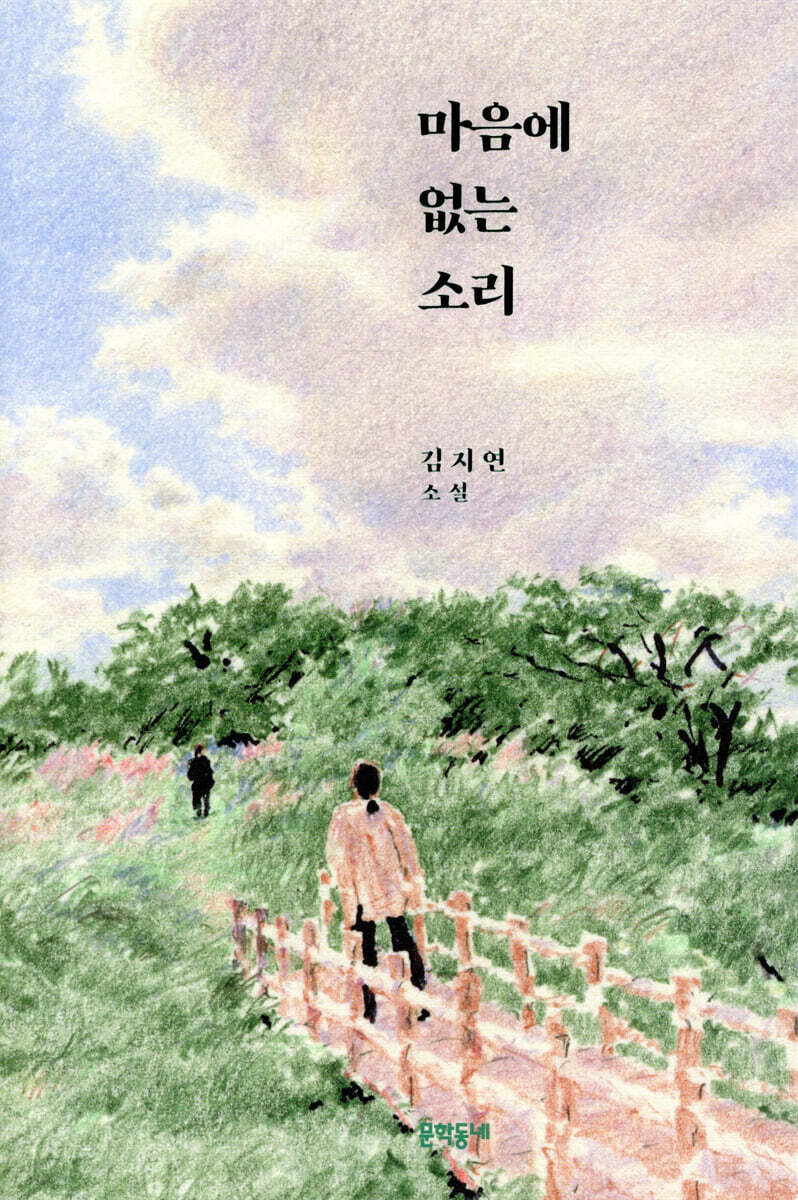
Words that don't make sense
 |
Description
Book Introduction
- A word from MD
-
Still, the story of our loving lifeThe first novel collection by Kim Ji-yeon, winner of the Young Writer's Award.
Kim Ji-yeon's characters in her works are anxious, hesitant, lonely, then suddenly honest, and ultimately lovable.
A story close to our present, where we are constantly disappointed but never lose hope in life, and where the thought, "Life is good," suddenly comes to mind vividly.March 15, 2022. Novel/Poetry PD Park Hyung-wook
The unanimous winner of the Munhakdongne New Writer's Award,
This year's newcomer, Kim Ji-yeon's first novel collection
Includes the 2022 Young Writer's Award winner, "In the Park," and the 2021 Young Writer's Award winner, "Love."
The Munhakdongne New Writer's Award, which selects just one work from among hundreds of entries, is a passionate event where judges with diverse perspectives carefully yet boldly push forward their respective choices.
While opinions fiercely compete each year and it is often difficult to find common ground, the work selected as the winner in 2018 drew praise from all seven judges (novelists Kim Geum-hee, Yoon Yi-hyung, Jeong Yong-jun, and Jo Hae-jin, and literary critics Baek Ji-eun, Shin Hyeong-cheol, and Hwang Jong-yeon) who have different literary standards and tastes, calling it “a well-written novel,” creating an unusual scene that could be called “a special case even in the recent judging of the novel category of the Munhakdongne New Writer’s Award” (from “Judging Details”).
The name of the new writer who began her career amidst expectations is Kim Ji-yeon, and her debut work is “Declaration of Determination.” She received reviews such as, “The structure of the novel raised high expectations for the applicants” (Kim Geum-hee), “She achieved something new without any experimental manipulation” (Baek Ji-eun), and “She knows how to place the necessary sentences in the right place and always succeeds in internalizing the situation with those sentences” (Shin Hyeong-cheol).
The author's first collection of short stories, "Sounds Without a Heart," is a selection of nine stories published in various media over the past four years. Like a multi-layered pastry, it depicts people who hold many hearts within themselves, and meticulously captures the changes that occur while reminiscing about someone or ruminating on the past.
This collection of novels, which allows for a combination of contradictory adjectives—lyrical and tough, humorous and lingering—will turn the expectations poured into the new writer four years ago into firm faith.
This year's newcomer, Kim Ji-yeon's first novel collection
Includes the 2022 Young Writer's Award winner, "In the Park," and the 2021 Young Writer's Award winner, "Love."
The Munhakdongne New Writer's Award, which selects just one work from among hundreds of entries, is a passionate event where judges with diverse perspectives carefully yet boldly push forward their respective choices.
While opinions fiercely compete each year and it is often difficult to find common ground, the work selected as the winner in 2018 drew praise from all seven judges (novelists Kim Geum-hee, Yoon Yi-hyung, Jeong Yong-jun, and Jo Hae-jin, and literary critics Baek Ji-eun, Shin Hyeong-cheol, and Hwang Jong-yeon) who have different literary standards and tastes, calling it “a well-written novel,” creating an unusual scene that could be called “a special case even in the recent judging of the novel category of the Munhakdongne New Writer’s Award” (from “Judging Details”).
The name of the new writer who began her career amidst expectations is Kim Ji-yeon, and her debut work is “Declaration of Determination.” She received reviews such as, “The structure of the novel raised high expectations for the applicants” (Kim Geum-hee), “She achieved something new without any experimental manipulation” (Baek Ji-eun), and “She knows how to place the necessary sentences in the right place and always succeeds in internalizing the situation with those sentences” (Shin Hyeong-cheol).
The author's first collection of short stories, "Sounds Without a Heart," is a selection of nine stories published in various media over the past four years. Like a multi-layered pastry, it depicts people who hold many hearts within themselves, and meticulously captures the changes that occur while reminiscing about someone or ruminating on the past.
This collection of novels, which allows for a combination of contradictory adjectives—lyrical and tough, humorous and lingering—will turn the expectations poured into the new writer four years ago into firm faith.
- You can preview some of the book's contents.
Preview
index
Useless Things We Picked Up on the Beach 007
Oyster Drive 039
Condensation 071
Resolution 097
Such weak words 125
159 Words That Don't Make Sense
195 When I Started to Cry
Love 223
255 in the park
Commentary│Kang Ji-hee (literary critic)
Two Jokes and a Wonderful Future 285
Author's Note 313
Oyster Drive 039
Condensation 071
Resolution 097
Such weak words 125
159 Words That Don't Make Sense
195 When I Started to Cry
Love 223
255 in the park
Commentary│Kang Ji-hee (literary critic)
Two Jokes and a Wonderful Future 285
Author's Note 313
Into the book
I've always been afraid to talk about things that haven't happened.
The moment I spoke, it felt like I would become something else, and I felt like I couldn't handle the change, and I didn't feel confident explaining it to anyone else.
I only had the courage to share with others what I had been through, what I had endured, and what I had endured.
--- p.25 From “Useless Things We Picked Up on the Beach”
It was reassuring to know that I could reach anywhere in the country in about four hours.
No matter how far it is, there is no place you cannot go in half a day.
If you make up your mind in the morning and leave at noon, you can arrive in a different city in the evening and completely forget where you were in the morning.
But the way back is just as close.
No matter how far you go, you can't get very far.
--- p.41~42 From "Oyster Drive"
I never believed in the saying that when you are tired and worn out, you can go back to your hometown and find peace of mind.
How could that be possible?
But this drive gave me something akin to peace.
It reminded me that some aspects of my hometown remain as good memories for me.
--- p.52 From "Oyster Drive"
“I don’t know because the young lady is still young.”
“I’m not young.”
“Really? How old are you?”
“I’m twenty-nine.”
“Oh my, at twenty-nine, you’re a lump of blood, a lump of blood.”
Mr. Gyeongnam laughed.
As if I were a real lump of flesh, as if I were cute.
--- p.87 From "Condensation"
Whenever I want to hide something from someone, I look them straight in the face.
It's a long-standing truism that people who lie can't make proper eye contact, so I'm defending myself by doing that.
I always end up being ambiguous and evasive in front of people who want to pinpoint my exact coordinates.
But maybe, at that moment, I should have made it clear where I stood.
Small names that nullify big things.
--- p.114 From "The Record of Resolution"
I felt that Wonjin, who was no longer by my side, was protecting me.
Of course, it's impossible and it's what I hate most about this world, but I have to endure it, so I can't help it.
I want to wish Wonjin happiness, but that's impossible, so I want to believe that Wonjin is wishing for my happiness, that is, my future.
I am safe in it.
In irrational beliefs.
--- p.123~124 From “The Record of the Decisive”
Jeong-eun liked those weak words from her teacher.
The two exchanged even their dirty feelings for each other.
He cursed at young students and his boss at work.
He would go on and on about how much he hated someone and how he wanted them to be ruined.
Perhaps it was possible because there was no world of intersection between the two.
The two people were close because they were far apart.
--- p.142 From “Such Weak Words”
Maybe dying is just the heart being shattered into pieces.
(…) At first, only the body can function, but then the mind has no place to stay, so it cannot help but fall apart.
Then, anything that can be called you will completely disappear.
Because you are like a collection of many hearts.
--- p.198 From "When I Start to Cry"
After crying, I felt like all my complicated thoughts had dissolved.
It took a tremendous amount of passion and pressure to cry like that.
I felt like I had cried my whole body out and killed all the bad feelings that I thought would never go away.
Sometimes crying is purifying, perhaps because you've succeeded in killing someone.
--- p.213 From "When I Start to Cry"
"thank you."
But I was also really grateful.
It was even more so after I said thank you.
Like a grain of rice that becomes sweeter the more you chew it, that feeling gradually deepened.
Because sincerity sometimes follows formality.
Gratitude came flooding back belatedly.
--- p.235 From “The Work I Love”
Suddenly I realized that I really liked living.
At first it felt like such a random and strange feeling, but it gradually became clearer.
Things didn't always go as planned, but I enjoyed life.
I love it so much that I want to overcome all the humiliations I've experienced by any means necessary.
It's good to live like that.
It's especially nice to pet live, dog-like things.
The moment I spoke, it felt like I would become something else, and I felt like I couldn't handle the change, and I didn't feel confident explaining it to anyone else.
I only had the courage to share with others what I had been through, what I had endured, and what I had endured.
--- p.25 From “Useless Things We Picked Up on the Beach”
It was reassuring to know that I could reach anywhere in the country in about four hours.
No matter how far it is, there is no place you cannot go in half a day.
If you make up your mind in the morning and leave at noon, you can arrive in a different city in the evening and completely forget where you were in the morning.
But the way back is just as close.
No matter how far you go, you can't get very far.
--- p.41~42 From "Oyster Drive"
I never believed in the saying that when you are tired and worn out, you can go back to your hometown and find peace of mind.
How could that be possible?
But this drive gave me something akin to peace.
It reminded me that some aspects of my hometown remain as good memories for me.
--- p.52 From "Oyster Drive"
“I don’t know because the young lady is still young.”
“I’m not young.”
“Really? How old are you?”
“I’m twenty-nine.”
“Oh my, at twenty-nine, you’re a lump of blood, a lump of blood.”
Mr. Gyeongnam laughed.
As if I were a real lump of flesh, as if I were cute.
--- p.87 From "Condensation"
Whenever I want to hide something from someone, I look them straight in the face.
It's a long-standing truism that people who lie can't make proper eye contact, so I'm defending myself by doing that.
I always end up being ambiguous and evasive in front of people who want to pinpoint my exact coordinates.
But maybe, at that moment, I should have made it clear where I stood.
Small names that nullify big things.
--- p.114 From "The Record of Resolution"
I felt that Wonjin, who was no longer by my side, was protecting me.
Of course, it's impossible and it's what I hate most about this world, but I have to endure it, so I can't help it.
I want to wish Wonjin happiness, but that's impossible, so I want to believe that Wonjin is wishing for my happiness, that is, my future.
I am safe in it.
In irrational beliefs.
--- p.123~124 From “The Record of the Decisive”
Jeong-eun liked those weak words from her teacher.
The two exchanged even their dirty feelings for each other.
He cursed at young students and his boss at work.
He would go on and on about how much he hated someone and how he wanted them to be ruined.
Perhaps it was possible because there was no world of intersection between the two.
The two people were close because they were far apart.
--- p.142 From “Such Weak Words”
Maybe dying is just the heart being shattered into pieces.
(…) At first, only the body can function, but then the mind has no place to stay, so it cannot help but fall apart.
Then, anything that can be called you will completely disappear.
Because you are like a collection of many hearts.
--- p.198 From "When I Start to Cry"
After crying, I felt like all my complicated thoughts had dissolved.
It took a tremendous amount of passion and pressure to cry like that.
I felt like I had cried my whole body out and killed all the bad feelings that I thought would never go away.
Sometimes crying is purifying, perhaps because you've succeeded in killing someone.
--- p.213 From "When I Start to Cry"
"thank you."
But I was also really grateful.
It was even more so after I said thank you.
Like a grain of rice that becomes sweeter the more you chew it, that feeling gradually deepened.
Because sincerity sometimes follows formality.
Gratitude came flooding back belatedly.
--- p.235 From “The Work I Love”
Suddenly I realized that I really liked living.
At first it felt like such a random and strange feeling, but it gradually became clearer.
Things didn't always go as planned, but I enjoyed life.
I love it so much that I want to overcome all the humiliations I've experienced by any means necessary.
It's good to live like that.
It's especially nice to pet live, dog-like things.
--- p.281 From "In the Park"
Publisher's Review
Recommended by novelists Yoon Seong-hee and Choi Jin-young!
Kim Ji-yeon, the unanimous winner of the Munhakdongne New Writer's Award and this year's newcomer, presents her first novel collection.
2022 Young Writer Award Winner “In the Park”
Included in the 2021 Young Writer's Award winning work "Love"
The Munhakdongne New Writer's Award, which selects just one work from among hundreds of entries, is a passionate event where judges with diverse perspectives carefully yet boldly push forward their respective choices.
While opinions fiercely compete each year and it is often difficult to find common ground, the work selected as the winner in 2018 drew praise from all seven judges (novelists Kim Geum-hee, Yoon Yi-hyung, Jeong Yong-jun, and Jo Hae-jin, and literary critics Baek Ji-eun, Shin Hyeong-cheol, and Hwang Jong-yeon) who have different literary standards and tastes, calling it “a well-written novel,” creating an unusual scene that could be called “a special case even in the recent judging of the novel category of the Munhakdongne New Writer’s Award” (from “Judging Details”).
The name of the new writer who began her career amidst expectations is Kim Ji-yeon, and her debut work is “Declaration of Determination.” She received reviews such as, “The structure of the novel raised high expectations for the applicants” (Kim Geum-hee), “She achieved something new without any experimental manipulation” (Baek Ji-eun), and “She knows how to place the necessary sentences in the right place and always succeeds in internalizing the situation with those sentences” (Shin Hyeong-cheol).
The author's first collection of short stories, "Sounds Without a Heart," is a selection of nine stories published in various media over the past four years. Like a multi-layered pastry, it depicts people who hold many hearts within themselves, and meticulously captures the changes that occur while reminiscing about someone or ruminating on the past.
This collection of novels, which allows for a combination of contradictory adjectives—lyrical and tough, humorous and lingering—will turn the expectations poured into the new writer four years ago into firm faith.
A small garden filled with people with many hearts
Wavering between love and fear, between attachment and weakness
A beautiful and tough new world opens up
The starting point of Kim Ji-yeon's novel world, "Jakjeonggi," concisely captures the charm of her works.
The image of a character who feels strong emotions toward another person but has difficulty expressing his or her own decisive feelings, and the scene where he or she repeatedly recalls a certain period of time and opens up a new space and time different from before, fill the novel with a poignant yet passionate energy.
"The Decisive Period" begins on the day when Wonjin, a friend, informs us of his divorce, and Wonjin and I impulsively buy plane tickets to Japan.
But when Wonjin's grandfather suddenly passes away, 'I' ends up going on a trip alone.
On the first day of arriving in Japan, 'I' happened to meet a Japanese woman named 'Yuko' and had a conversation with her. Perhaps due to an interpretation issue, he realized that Yuuko understood that he had gone on this trip in place of a dead friend.
But 'I' do not correct the misunderstanding.
Because there was a time when I wished that Wonjin would die.
And soon after, Wonjin suddenly dies, and 'I' is overcome with guilt, wondering if my failure to correct the misunderstanding at the time may have hastened Wonjin's death.
However, this feeling of 'I' takes on a different ripple when I reunite with Yuko, who is visiting Korea on business a few months later.
Yuko, who works at a 'gardening company', took 'I''s words about her friend's death to heart and gave 'I' a model of the garden she had made.
Only then can I shed the tears I had held back for so long and go on my trip to Japan again.
And on that trip, he comes to believe that “Wonjin is wishing for my happiness, that is, my future” (p. 124).
The scene where a person opens up a future with a person they cherish in an unexpected way after parting ways with them can also be seen in "Useless Things We Picked Up on the Beach."
Long ago, one summer, 'I' went on a trip to a small village in Namhae with 'Jinyoung', the girlfriend I was dating at the time.
It's because of my leisurely wish to swim naked.
The night Jinyoung and I arrived in Namhae, we walked cautiously down the dark road to the beach, and felt a sense of freedom there, surrounded only by forest and sky, except for a small boat floating in the distance.
There is no such thing as a gaze watching them.
No one hits them because they kiss.
But contrary to expectations, it was very cold, so they couldn't even take off their outerwear, let alone swim. Instead, the two walked slowly along the two ends of the small beach, picking up things that had been abandoned there.
And during that short trip, the distance between the two people's hearts, which had not been narrowed, gradually begins to reveal itself.
But the novel doesn't stop at confirming the gap between the two people.
The final scene, which begins with a recollection of a day spent with an ex-lover and ends with a scene of reuniting with a person who seems to be that lover in a new time and space, bends time in a strange way, bringing together the present, past, and future.
Literary critic Kang Ji-hee, encompassing this scene and the final line of “Jakjeonggi,” pointed out the special meaning these scenes hold, saying, “The novel opens up the future with faith in unknown time and love, without denying the love of the past” (Commentary, p. 305), and drew a beautiful analysis of the potential space-time that opens up in a new way in Kim Ji-yeon’s novel.
If "Jakjeonggi" and "Useless Things We Picked Up on the Beach" are works that leave a strong lingering impression when read by following the margins as if pointing out the "borders that do not appear on the map," "Oyster Drive" and "Sounds Without a Heart" depict the events and resulting changes that occur as a female character who goes down to the countryside or lives there becomes entangled with the people around her, showing Kim Ji-yeon's perspective on relationships in a plain tone.
'I' in 'Oyster Drive' is currently riding a bus and going down to my hometown.
That's because my uncle contacted me and told me that he had a job that paid 300 won a month and asked me to come down.
Even though I thought there was no way that such a job would be available in my hometown, my contract ended last month, and I headed home with the hope that maybe there would be one.
But the job my uncle was talking about was the exact same one.
To me, who has no intention of doing anything, my uncle suggests that he deliver a box of oysters from his factory for just one day.
I, who had nothing else to do, went to the factory to earn some pocket money and ran into a high school classmate by chance.
Although I shook hands with my classmate who extended his hand to greet me warmly, I was not close to him.
No, rather, I was closer to disliking it.
Because he hated 'me'.
He even chuckled and whispered, “Isn’t he a little weird?” (p. 63).
But then he says something unexpected to me.
He asked if I wanted to have a drink after work.
I am reluctant to meet him because I still remember being hated by him, but somehow I cannot refuse his offer.
This is my hometown, which has never welcomed me, so will it bring me different memories this time?
The circumstances of 'I' in 'The Sound of Nothing in My Heart' are similar to this.
After much thought, I, who had not accomplished anything properly even though I was over 35 years old, decided to take over my grandmother's restaurant and open a kimbap shop.
Although I couldn't cook and had no money, I opened a store in a traditional market with the idea that I could watch YouTube videos and follow the recipes, and get the ingredients from my grandmother's field.
My friend, Min-gu, says that my restaurant is not different from other restaurants and is not good at attracting customers, but he still comes by often to get kimbap to go, and Hwa-young, feeling sorry for not having many customers, calls around to gather customers.
And then there's 'Seungho'.
Seungho was a friend that I liked when I was preparing for the civil service exam, but Seungho refused, saying he wanted to focus on his studies, and I also gave up on him.
And Seung-ho, who became a civil servant, hovers around 'me', giving off countless nuances and atmospheres without anyone knowing whether he has feelings for 'me' or not.
Even though I am exhausted every day from running the restaurant and it is difficult to expect a bright future, I still occasionally spend time with three friends I have been with since childhood, and I have a feeling that some unexpected future is coming, although it is not what I wanted.
“I still had expectations about life.”
How to Move Through Life Without Enduring Insults
Maybe that's why.
Reading Kim Ji-yeon's novels can feel like a process that begins with the sentence, "It was because living was difficult enough" (p. 17) and ends with the sentence, "I still had expectations about life" (p. 221).
"Condensation" is about a woman who went to an unfamiliar neighborhood to buy a gift for her younger sibling who hasn't left his room for quite some time, and who, after a chance conversation with three grandmothers, transforms the time ahead from a time to simply endure and hold on to a time of possibility for trying something new. "Such Weak Words" is about a woman who, confused between the kindness her loved one showed her after their death and the words she heard from another friend that he thought poorly of her, decides not to stop thinking about him without clearly sharing all her feelings for him, "just as one cannot clearly divide a human body into head, chest, and stomach." These works depict, without vague fantasy or leaps of imagination, the characters in Kim Ji-yeon's novels who ultimately turn their attention to life even in the midst of the difficult and sometimes merciless situations that surround them.
The achievements of “Beloved Work” and “In the Park,” which are located at the end of the collection of short stories, seem to be related to this.
When Eun-ho from "Love" came out and said he had a girlfriend, his mother ignored him as if she hadn't heard, his father subtly said that there was no need to spread rumors about his relationship with his girlfriend, and his grandmother, who had loved him when he was young, cursed him and swore at him.
However, Eunho passes through this situation lively and flexibly, declaring that she has “a narrative centered on herself” (p. 249) and that she will cultivate her love.
"In the Park" places the characters in a more complex situation.
I'm often mistaken for a man because I'm tall, have short hair, and don't wear makeup.
At times like that, the emotion I feel is safety rather than discomfort.
The difficulty of living as a woman is vividly revealed through several episodes that 'I' experienced. As a child, I was molested on a bus, but I was confused and didn't understand what had happened to me, and only screamed later.
And not long ago, I went to the park and was indiscriminately assaulted by a man I didn't know.
However, the situation of 'I', who deserves to be protected, puts the reader in a difficult situation when the fact that 'I' is having an affair with a married man is revealed.
Am I a victim deserving of protection? Did this happen because I was morally unsound? What bursts forth, piercing through these questions, is my own scream.
Because in the midst of a series of checks to see if I am a perfect victim, the only thing I can utter is a scream.
The scream shatters those seemingly logical and rational words and forces us to face the unspoken words pouring out of 'me'.
And 'I' goes so far as to give new meaning to 'the park', which was once his favorite place but now reminds him of the trauma of being assaulted.
As I watched people leisurely passing the time, I suddenly thought, “I haven’t had many things go my way, but I’ve enjoyed life.
I love it so much that I want to overcome all the humiliations I've experienced by any means necessary.
It is a realization that “it is good to live like that” (p. 281).
In the park, there are people who suddenly appear and threaten 'me', but there are also children who approach me without any worries and let me feel 'the vitality and warmth of a dog'.
That is why the calm confession of 'I', "I realized that I really like living" (same side), seems to make us stay in a certain emotion as long as the scream of 'I'.
To borrow the expression from the novel, “Even after crying a lot, some things that haven’t completely dissolved slowly settle and become grudge” (When I Start to Cry, pp. 215-216), even after insults, harassment, and violence have passed, a love for life still shines and remains.
This affection, which would be more appropriate to say "preserved" rather than "remained" for Kim Ji-yeon's characters, seems to make us stagger and jolt, yet move forward in surprising ways.
Through the repetition of daily life, “becoming a different person every day and doing something you love every day” (Love, p. 253).
And by doing so, through a new tomorrow that unfolds.
“The novels in this book were written starting in 2015 and were revised and polished until 2022.
Although it is different from the order in which it was published, the first novel I wrote was "When I Start to Cry."
My favorite scenes in this novel are the ones where the characters cry.
They spent more time crying than speaking, and someone listened to their crying.
These days, I think writing is similar to crying.
If I'm going to do this, I want to cry with all my might and not leave anything behind.
So that you can complete the remaining tasks with a light heart.
And I want to look around and see if there is anyone crying alone somewhere.
“I hope no one cries alone.” _From the author’s note
Kim Ji-yeon, the unanimous winner of the Munhakdongne New Writer's Award and this year's newcomer, presents her first novel collection.
2022 Young Writer Award Winner “In the Park”
Included in the 2021 Young Writer's Award winning work "Love"
The Munhakdongne New Writer's Award, which selects just one work from among hundreds of entries, is a passionate event where judges with diverse perspectives carefully yet boldly push forward their respective choices.
While opinions fiercely compete each year and it is often difficult to find common ground, the work selected as the winner in 2018 drew praise from all seven judges (novelists Kim Geum-hee, Yoon Yi-hyung, Jeong Yong-jun, and Jo Hae-jin, and literary critics Baek Ji-eun, Shin Hyeong-cheol, and Hwang Jong-yeon) who have different literary standards and tastes, calling it “a well-written novel,” creating an unusual scene that could be called “a special case even in the recent judging of the novel category of the Munhakdongne New Writer’s Award” (from “Judging Details”).
The name of the new writer who began her career amidst expectations is Kim Ji-yeon, and her debut work is “Declaration of Determination.” She received reviews such as, “The structure of the novel raised high expectations for the applicants” (Kim Geum-hee), “She achieved something new without any experimental manipulation” (Baek Ji-eun), and “She knows how to place the necessary sentences in the right place and always succeeds in internalizing the situation with those sentences” (Shin Hyeong-cheol).
The author's first collection of short stories, "Sounds Without a Heart," is a selection of nine stories published in various media over the past four years. Like a multi-layered pastry, it depicts people who hold many hearts within themselves, and meticulously captures the changes that occur while reminiscing about someone or ruminating on the past.
This collection of novels, which allows for a combination of contradictory adjectives—lyrical and tough, humorous and lingering—will turn the expectations poured into the new writer four years ago into firm faith.
A small garden filled with people with many hearts
Wavering between love and fear, between attachment and weakness
A beautiful and tough new world opens up
The starting point of Kim Ji-yeon's novel world, "Jakjeonggi," concisely captures the charm of her works.
The image of a character who feels strong emotions toward another person but has difficulty expressing his or her own decisive feelings, and the scene where he or she repeatedly recalls a certain period of time and opens up a new space and time different from before, fill the novel with a poignant yet passionate energy.
"The Decisive Period" begins on the day when Wonjin, a friend, informs us of his divorce, and Wonjin and I impulsively buy plane tickets to Japan.
But when Wonjin's grandfather suddenly passes away, 'I' ends up going on a trip alone.
On the first day of arriving in Japan, 'I' happened to meet a Japanese woman named 'Yuko' and had a conversation with her. Perhaps due to an interpretation issue, he realized that Yuuko understood that he had gone on this trip in place of a dead friend.
But 'I' do not correct the misunderstanding.
Because there was a time when I wished that Wonjin would die.
And soon after, Wonjin suddenly dies, and 'I' is overcome with guilt, wondering if my failure to correct the misunderstanding at the time may have hastened Wonjin's death.
However, this feeling of 'I' takes on a different ripple when I reunite with Yuko, who is visiting Korea on business a few months later.
Yuko, who works at a 'gardening company', took 'I''s words about her friend's death to heart and gave 'I' a model of the garden she had made.
Only then can I shed the tears I had held back for so long and go on my trip to Japan again.
And on that trip, he comes to believe that “Wonjin is wishing for my happiness, that is, my future” (p. 124).
The scene where a person opens up a future with a person they cherish in an unexpected way after parting ways with them can also be seen in "Useless Things We Picked Up on the Beach."
Long ago, one summer, 'I' went on a trip to a small village in Namhae with 'Jinyoung', the girlfriend I was dating at the time.
It's because of my leisurely wish to swim naked.
The night Jinyoung and I arrived in Namhae, we walked cautiously down the dark road to the beach, and felt a sense of freedom there, surrounded only by forest and sky, except for a small boat floating in the distance.
There is no such thing as a gaze watching them.
No one hits them because they kiss.
But contrary to expectations, it was very cold, so they couldn't even take off their outerwear, let alone swim. Instead, the two walked slowly along the two ends of the small beach, picking up things that had been abandoned there.
And during that short trip, the distance between the two people's hearts, which had not been narrowed, gradually begins to reveal itself.
But the novel doesn't stop at confirming the gap between the two people.
The final scene, which begins with a recollection of a day spent with an ex-lover and ends with a scene of reuniting with a person who seems to be that lover in a new time and space, bends time in a strange way, bringing together the present, past, and future.
Literary critic Kang Ji-hee, encompassing this scene and the final line of “Jakjeonggi,” pointed out the special meaning these scenes hold, saying, “The novel opens up the future with faith in unknown time and love, without denying the love of the past” (Commentary, p. 305), and drew a beautiful analysis of the potential space-time that opens up in a new way in Kim Ji-yeon’s novel.
If "Jakjeonggi" and "Useless Things We Picked Up on the Beach" are works that leave a strong lingering impression when read by following the margins as if pointing out the "borders that do not appear on the map," "Oyster Drive" and "Sounds Without a Heart" depict the events and resulting changes that occur as a female character who goes down to the countryside or lives there becomes entangled with the people around her, showing Kim Ji-yeon's perspective on relationships in a plain tone.
'I' in 'Oyster Drive' is currently riding a bus and going down to my hometown.
That's because my uncle contacted me and told me that he had a job that paid 300 won a month and asked me to come down.
Even though I thought there was no way that such a job would be available in my hometown, my contract ended last month, and I headed home with the hope that maybe there would be one.
But the job my uncle was talking about was the exact same one.
To me, who has no intention of doing anything, my uncle suggests that he deliver a box of oysters from his factory for just one day.
I, who had nothing else to do, went to the factory to earn some pocket money and ran into a high school classmate by chance.
Although I shook hands with my classmate who extended his hand to greet me warmly, I was not close to him.
No, rather, I was closer to disliking it.
Because he hated 'me'.
He even chuckled and whispered, “Isn’t he a little weird?” (p. 63).
But then he says something unexpected to me.
He asked if I wanted to have a drink after work.
I am reluctant to meet him because I still remember being hated by him, but somehow I cannot refuse his offer.
This is my hometown, which has never welcomed me, so will it bring me different memories this time?
The circumstances of 'I' in 'The Sound of Nothing in My Heart' are similar to this.
After much thought, I, who had not accomplished anything properly even though I was over 35 years old, decided to take over my grandmother's restaurant and open a kimbap shop.
Although I couldn't cook and had no money, I opened a store in a traditional market with the idea that I could watch YouTube videos and follow the recipes, and get the ingredients from my grandmother's field.
My friend, Min-gu, says that my restaurant is not different from other restaurants and is not good at attracting customers, but he still comes by often to get kimbap to go, and Hwa-young, feeling sorry for not having many customers, calls around to gather customers.
And then there's 'Seungho'.
Seungho was a friend that I liked when I was preparing for the civil service exam, but Seungho refused, saying he wanted to focus on his studies, and I also gave up on him.
And Seung-ho, who became a civil servant, hovers around 'me', giving off countless nuances and atmospheres without anyone knowing whether he has feelings for 'me' or not.
Even though I am exhausted every day from running the restaurant and it is difficult to expect a bright future, I still occasionally spend time with three friends I have been with since childhood, and I have a feeling that some unexpected future is coming, although it is not what I wanted.
“I still had expectations about life.”
How to Move Through Life Without Enduring Insults
Maybe that's why.
Reading Kim Ji-yeon's novels can feel like a process that begins with the sentence, "It was because living was difficult enough" (p. 17) and ends with the sentence, "I still had expectations about life" (p. 221).
"Condensation" is about a woman who went to an unfamiliar neighborhood to buy a gift for her younger sibling who hasn't left his room for quite some time, and who, after a chance conversation with three grandmothers, transforms the time ahead from a time to simply endure and hold on to a time of possibility for trying something new. "Such Weak Words" is about a woman who, confused between the kindness her loved one showed her after their death and the words she heard from another friend that he thought poorly of her, decides not to stop thinking about him without clearly sharing all her feelings for him, "just as one cannot clearly divide a human body into head, chest, and stomach." These works depict, without vague fantasy or leaps of imagination, the characters in Kim Ji-yeon's novels who ultimately turn their attention to life even in the midst of the difficult and sometimes merciless situations that surround them.
The achievements of “Beloved Work” and “In the Park,” which are located at the end of the collection of short stories, seem to be related to this.
When Eun-ho from "Love" came out and said he had a girlfriend, his mother ignored him as if she hadn't heard, his father subtly said that there was no need to spread rumors about his relationship with his girlfriend, and his grandmother, who had loved him when he was young, cursed him and swore at him.
However, Eunho passes through this situation lively and flexibly, declaring that she has “a narrative centered on herself” (p. 249) and that she will cultivate her love.
"In the Park" places the characters in a more complex situation.
I'm often mistaken for a man because I'm tall, have short hair, and don't wear makeup.
At times like that, the emotion I feel is safety rather than discomfort.
The difficulty of living as a woman is vividly revealed through several episodes that 'I' experienced. As a child, I was molested on a bus, but I was confused and didn't understand what had happened to me, and only screamed later.
And not long ago, I went to the park and was indiscriminately assaulted by a man I didn't know.
However, the situation of 'I', who deserves to be protected, puts the reader in a difficult situation when the fact that 'I' is having an affair with a married man is revealed.
Am I a victim deserving of protection? Did this happen because I was morally unsound? What bursts forth, piercing through these questions, is my own scream.
Because in the midst of a series of checks to see if I am a perfect victim, the only thing I can utter is a scream.
The scream shatters those seemingly logical and rational words and forces us to face the unspoken words pouring out of 'me'.
And 'I' goes so far as to give new meaning to 'the park', which was once his favorite place but now reminds him of the trauma of being assaulted.
As I watched people leisurely passing the time, I suddenly thought, “I haven’t had many things go my way, but I’ve enjoyed life.
I love it so much that I want to overcome all the humiliations I've experienced by any means necessary.
It is a realization that “it is good to live like that” (p. 281).
In the park, there are people who suddenly appear and threaten 'me', but there are also children who approach me without any worries and let me feel 'the vitality and warmth of a dog'.
That is why the calm confession of 'I', "I realized that I really like living" (same side), seems to make us stay in a certain emotion as long as the scream of 'I'.
To borrow the expression from the novel, “Even after crying a lot, some things that haven’t completely dissolved slowly settle and become grudge” (When I Start to Cry, pp. 215-216), even after insults, harassment, and violence have passed, a love for life still shines and remains.
This affection, which would be more appropriate to say "preserved" rather than "remained" for Kim Ji-yeon's characters, seems to make us stagger and jolt, yet move forward in surprising ways.
Through the repetition of daily life, “becoming a different person every day and doing something you love every day” (Love, p. 253).
And by doing so, through a new tomorrow that unfolds.
“The novels in this book were written starting in 2015 and were revised and polished until 2022.
Although it is different from the order in which it was published, the first novel I wrote was "When I Start to Cry."
My favorite scenes in this novel are the ones where the characters cry.
They spent more time crying than speaking, and someone listened to their crying.
These days, I think writing is similar to crying.
If I'm going to do this, I want to cry with all my might and not leave anything behind.
So that you can complete the remaining tasks with a light heart.
And I want to look around and see if there is anyone crying alone somewhere.
“I hope no one cries alone.” _From the author’s note
GOODS SPECIFICS
- Publication date: March 10, 2022
- Page count, weight, size: 320 pages | 374g | 133*200*18mm
- ISBN13: 9788954685436
- ISBN10: 8954685439
You may also like
카테고리
korean


korean

![GQ KOREA Mark (Monthly): December [2025]](http://librairie.coreenne.fr/cdn/shop/files/8ef265dbbfbf186523ed75ba7319009d.jpg?v=1765340328&width=3840)


