

Night of the Plague
 |
Description
Book Introduction
- A word from MD
-
Orhan Pamuk's pandemic novelA story published by Nobel Prize-winning author Orhan Pamuk after five years of hard work.
"Night of the Plague" begins in 1901, when a plague spreads on the fictional island of Minger under the Ottoman Empire.
A historical fantasy mystery that skillfully weaves together fantasy and reality, past and present, East and West, confronting present-day situations everywhere.March 11, 2022. Novel/Poetry PD Park Hyung-wook
A masterpiece written by the master Orhan Pamuk over a period of five years.
The first pandemic novel since COVID-19
A new novel that transcends 100 years and resonates with our current situation.
Orhan Pamuk, a world-renowned master whose works have been translated into over 60 languages around the world, has published his eleventh new work, "Night of the Plague."
Orhan Pamuk has been steadily publishing novels since winning the Nobel Prize in Literature in 2006, and he continues to surprise the world with his increasingly outstanding works.
He is considered a unique writer who has achieved both literary and commercial success, and this time, he has once again combined historical fiction and mystery to weave a captivating and grand narrative.
Orhan Pamuk has been contemplating a novel about an epidemic for thirty-five years and has devoted the last five years to writing it.
As the manuscript neared completion, the coronavirus pandemic began to spread across the globe.
In one interview, he said, “When I first heard about the coronavirus in Istanbul, I thought it was like a story from my novel.”
He wrote and revised the work, further enhancing its perfection, amidst the simultaneous content of the novel he was writing and the reality of the pandemic unfolding around the world. In this way, the literary achievement of a master who captures the contagion and chaos of today's pandemic for the first time has finally reached readers.
Why does it feel so familiar, like seeing the pandemic unfolding around the world today, despite the fact that there is a gap of over 100 years between the situation in the novel and the situation in the present?
Pamuk's sharp and insightful gaze, which runs through the novel, sends a chill down the spines of readers living in the midst of today's pandemic.
The first pandemic novel since COVID-19
A new novel that transcends 100 years and resonates with our current situation.
Orhan Pamuk, a world-renowned master whose works have been translated into over 60 languages around the world, has published his eleventh new work, "Night of the Plague."
Orhan Pamuk has been steadily publishing novels since winning the Nobel Prize in Literature in 2006, and he continues to surprise the world with his increasingly outstanding works.
He is considered a unique writer who has achieved both literary and commercial success, and this time, he has once again combined historical fiction and mystery to weave a captivating and grand narrative.
Orhan Pamuk has been contemplating a novel about an epidemic for thirty-five years and has devoted the last five years to writing it.
As the manuscript neared completion, the coronavirus pandemic began to spread across the globe.
In one interview, he said, “When I first heard about the coronavirus in Istanbul, I thought it was like a story from my novel.”
He wrote and revised the work, further enhancing its perfection, amidst the simultaneous content of the novel he was writing and the reality of the pandemic unfolding around the world. In this way, the literary achievement of a master who captures the contagion and chaos of today's pandemic for the first time has finally reached readers.
Why does it feel so familiar, like seeing the pandemic unfolding around the world today, despite the fact that there is a gap of over 100 years between the situation in the novel and the situation in the present?
Pamuk's sharp and insightful gaze, which runs through the novel, sends a chill down the spines of readers living in the midst of today's pandemic.
- You can preview some of the book's contents.
Preview
index
Introduction 13
Night of the Plague 18
After many years, 723
Translator's Note 777
Night of the Plague 18
After many years, 723
Translator's Note 777
Into the book
Some captains of delicate souls invited their passengers on deck to admire the Minger landscape when it appeared on the horizon, a magnificent sight that Homer described in the Iliad as “a green diamond of pink stone,” and painters heading to the East passionately depicted this romantic scene on canvas, adding dark, storm-laden clouds.
--- p.18
“Unfortunately, the plague has been discovered on Minger Island,” said Bonkowski Pasha.
“The virulence is also very high.”
“What do you mean?”
...
“The situation is much worse than what the article says,” Bonkowski said authoritatively.
“It is the same germ, the same epidemic that killed tens of millions of people in India and China.
“It’s like coming to Izmir.” --- p.27
Where is the patient? Instead of showing him the patient, people looked at him with accusatory eyes.
Bonkovsky Pasha suddenly felt so anxious that he felt as if he could not breathe.
Then a man with brown hair and green eyes stepped forward and spoke.
"You brought disease and pestilence here again to destroy us! But this time, you won't succeed!" --- p.92
"Pasha, is this man really a murderer? Or is it possible he confessed under brutal interrogation?"
“You know as well as I do, not only from the telegrams he sent you, but also from the edicts he sent me, that our Padishah is very anxious to find the murderer immediately!”
...
“The Padishah does not wish to find Bonkowski’s killer in this way.”
“You speak as if you already know what His Majesty wants and how it will be done.”
“Yes, that’s right.
“His Majesty wishes to investigate the details of the murder, as in a Sherlock Holmes story, and to find the real murderer of Bonkowski Pasha based on evidence, not beatings and torture.”
“Who is Sherlock Holmes?” --- p.223
Among Muslims, hostility toward Christians sometimes turned into anger toward Ottoman officials, governors, and soldiers.
There was a basic feeling shared by almost everyone on the island.
Many felt that after fifty years of reforms, half under pressure from Europe and half sincerely aimed at currying favor with the Europeans, and half under pressure from Europe to ensure equality between Christians and Muslims, the island was now going through a difficult time, and that Europe, instead of helping, had left the island to its own fate.
--- p.368
“No one will listen to us anymore!” said Sami Pasha, revealing himself frankly.
“Quite the opposite, Pasha!” said Kolyas, his famous reply that came to his mind at that moment.
"If we take a step forward now and declare a revolution, the progress-loving Minger people will take not one, but two steps with us." --- p.465
Now Col-Aas reached the balcony railing.
“If we stop waiting for telegrams from Istanbul and start taking control of ourselves, the quarantine will end, the disease will subside, and we will all be safe,” he said, speaking like a true politician.
Then he turned towards the square and shouted with all his might.
"Long live Minger! Long live Minger people! Long live the Minger people!" --- p.467
After so much busy work and running from city to city and battlefield to battlefield in the military, I finally tasted happiness for two and a half months in my life.
Oh my God, it's so short! If my wife got sick, it meant everything was over.
Not only his wife and the child in her womb, but he too will surely die.
Unfortunately, this could also mean the end of the Minger people! --- p.560
“It’s too late now,” said Nuri.
“Besides, you were opposing quarantine until yesterday, weren’t you?”
“It is inappropriate to mention us at this crucial turning point, when the fate of a nation is at stake,” said Prime Minister Nimetullah Effendi.
“We are ashamed of our mistakes.
We leave this place and return to Teke.” --- p.649
The children were eager to speak with the queen, who had come to Arpara village in her Lando and delivered a package of gifts, dried fish, and biscuits, but they could not do so because she did not speak Minger.
Moreover, a woman who was very fond of the Queen, took the blue-eyed baby girl she had brought into her arms, asking her to cherish it, and wept as she told her story of how she had unfortunately not received the compensation she had been promised to pay to her family who had suffered damage when her husband died of the plague, adding that she was alone and could only express her suffering to the Queen.
--- p.285
The female superintendent spoke as she looked at the pictures of the commander and his wife hanging in every classroom at Minger.
And then he turned around and said to me.
“Queen Pakije would be proud of this young Minger!”
--- p.18
“Unfortunately, the plague has been discovered on Minger Island,” said Bonkowski Pasha.
“The virulence is also very high.”
“What do you mean?”
...
“The situation is much worse than what the article says,” Bonkowski said authoritatively.
“It is the same germ, the same epidemic that killed tens of millions of people in India and China.
“It’s like coming to Izmir.” --- p.27
Where is the patient? Instead of showing him the patient, people looked at him with accusatory eyes.
Bonkovsky Pasha suddenly felt so anxious that he felt as if he could not breathe.
Then a man with brown hair and green eyes stepped forward and spoke.
"You brought disease and pestilence here again to destroy us! But this time, you won't succeed!" --- p.92
"Pasha, is this man really a murderer? Or is it possible he confessed under brutal interrogation?"
“You know as well as I do, not only from the telegrams he sent you, but also from the edicts he sent me, that our Padishah is very anxious to find the murderer immediately!”
...
“The Padishah does not wish to find Bonkowski’s killer in this way.”
“You speak as if you already know what His Majesty wants and how it will be done.”
“Yes, that’s right.
“His Majesty wishes to investigate the details of the murder, as in a Sherlock Holmes story, and to find the real murderer of Bonkowski Pasha based on evidence, not beatings and torture.”
“Who is Sherlock Holmes?” --- p.223
Among Muslims, hostility toward Christians sometimes turned into anger toward Ottoman officials, governors, and soldiers.
There was a basic feeling shared by almost everyone on the island.
Many felt that after fifty years of reforms, half under pressure from Europe and half sincerely aimed at currying favor with the Europeans, and half under pressure from Europe to ensure equality between Christians and Muslims, the island was now going through a difficult time, and that Europe, instead of helping, had left the island to its own fate.
--- p.368
“No one will listen to us anymore!” said Sami Pasha, revealing himself frankly.
“Quite the opposite, Pasha!” said Kolyas, his famous reply that came to his mind at that moment.
"If we take a step forward now and declare a revolution, the progress-loving Minger people will take not one, but two steps with us." --- p.465
Now Col-Aas reached the balcony railing.
“If we stop waiting for telegrams from Istanbul and start taking control of ourselves, the quarantine will end, the disease will subside, and we will all be safe,” he said, speaking like a true politician.
Then he turned towards the square and shouted with all his might.
"Long live Minger! Long live Minger people! Long live the Minger people!" --- p.467
After so much busy work and running from city to city and battlefield to battlefield in the military, I finally tasted happiness for two and a half months in my life.
Oh my God, it's so short! If my wife got sick, it meant everything was over.
Not only his wife and the child in her womb, but he too will surely die.
Unfortunately, this could also mean the end of the Minger people! --- p.560
“It’s too late now,” said Nuri.
“Besides, you were opposing quarantine until yesterday, weren’t you?”
“It is inappropriate to mention us at this crucial turning point, when the fate of a nation is at stake,” said Prime Minister Nimetullah Effendi.
“We are ashamed of our mistakes.
We leave this place and return to Teke.” --- p.649
The children were eager to speak with the queen, who had come to Arpara village in her Lando and delivered a package of gifts, dried fish, and biscuits, but they could not do so because she did not speak Minger.
Moreover, a woman who was very fond of the Queen, took the blue-eyed baby girl she had brought into her arms, asking her to cherish it, and wept as she told her story of how she had unfortunately not received the compensation she had been promised to pay to her family who had suffered damage when her husband died of the plague, adding that she was alone and could only express her suffering to the Queen.
--- p.285
The female superintendent spoke as she looked at the pictures of the commander and his wife hanging in every classroom at Minger.
And then he turned around and said to me.
“Queen Pakije would be proud of this young Minger!”
--- p.763
Publisher's Review
“There is absolutely no epidemic in our city!”
Governor Sami Pasha said:
…
“Then who brought it?”
“There is officially no epidemic at this time!”
The global pandemic and chaos predicted by Nobel Prize-winning author Orhan Pamuk today.
The first literary achievement of the pandemic era, written by a world-renowned master!
A masterpiece written by master Orhan Pamuk after five years of dedication, this is the first pandemic novel since COVID-19.
A new novel that transcends 100 years and resonates with our current situation.
Orhan Pamuk, a world-renowned master whose works have been translated into over 60 languages worldwide, has published his eleventh new work by Minumsa.
Orhan Pamuk has been steadily publishing novels since winning the Nobel Prize in Literature in 2006, and he continues to surprise the world with his increasingly outstanding works.
He is considered a unique writer who has achieved both literary and commercial success, and this time, he has once again combined historical fiction and mystery to weave a captivating and grand narrative.
The Korean edition has been published just a year after its publication in Turkey, and the English edition is scheduled to be published in the second half of this year, allowing readers in Turkey to access Pamuk's new book faster than anywhere else in the world.
Orhan Pamuk has been contemplating a novel about an epidemic for thirty-five years and has devoted the last five years to writing it.
As the manuscript neared completion, the coronavirus pandemic began to spread across the globe.
In one interview, he said, “When I first heard about the coronavirus in Istanbul, I thought it was like a story from my novel.”
He wrote and revised the work, further enhancing its perfection, amidst the simultaneous content of the novel he was writing and the reality of the pandemic unfolding around the world. In this way, the literary achievement of a master who captures the contagion and chaos of today's pandemic for the first time has finally met readers.
Why does it feel so familiar, like seeing the pandemic unfolding around the world today, despite the fact that there is a time gap of over 100 years between the novel and the situation?
Pamuk's sharp and insightful gaze, which runs through the novel, sends a chill down the spines of readers living in the midst of today's pandemic.
A competent quarantine expert who successfully carried out quarantine and eradicated the epidemic in Istanbul
He is murdered shortly after arriving on Minger Island.
Who is the culprit who murdered him and what will become of this place?
"Night of the Plague" begins in 1901, when a plague spreads on the fictional island of Minger under the Ottoman Empire.
Amidst the island's increasingly rebellious elements, a contagious disease that could have simply been contained and treated is increasingly engulfed in a whirlpool of religious and political division, an incident occurs where an orthodox Christian and quarantine expert who was dispatched is murdered.
Ominger Island, the setting of the novel, is a small, peaceful island with a magical landscape that has been poetically described in various travel books, with its naturally pink-white stones glowing warmly with an orange glow even from afar.
The island is divided roughly equally between Muslims and Orthodox Christians, so political tensions are constant.
Then one day, the Padishah's (absolute ruler's) cruise ship, the Aziziye, secretly stops by this tranquil and awe-inspiring island and disembarks two people.
It is the famous chemist and pharmacist Bonkovsky Pasha and his assistant.
Bonkowski Pasha was a skilled quarantine expert who ended a plague epidemic in Izmir, a major port in the Ottoman Empire, in just six weeks and was dispatched by Sultan Abdulhamid II of the Ottoman Empire.
However, he, an orthodox Christian, is found covered in blood on the street before any proper quarantine measures can be implemented.
Sultan Abdul Hamid II again dispatched the Muslim physician Nuri.
As a doctor, he enters Minger Island with his wife, Pakije Sultan, with orders to enforce strict quarantine measures and find out who killed the quarantine expert.
However, the quarantine efforts are failing due to the incompetence of the administration and people not following the sanctions.
Soon after, Sultan Abdul Hamid, unable to withstand international pressure from Western powers, instead of sending relief ships, blockaded Minger Island with Ottoman warships.
The island, in a desperate situation, declares to the world, led by Kolaas, that Mingerya is an independent nation.
From now on, the island must find a way to defeat the epidemic on its own… … .
Who are the forces obstructing the quarantine and who are the murderers of Bonkovsky Pasha, and what will become of Mingerya's fate?
For readers who miss long novels that they can get lost in!
A historical fantasy mystery novel that skillfully weaves together fantasy and reality, past and present, East and West.
The work meticulously depicts the different facets of the disease's spread: the government's aggressive approach to quarantine, those who refuse to comply and even refuse to believe in the pandemic, Islam versus orthodox Christianity, the educated versus the uneducated, the rich versus the poor, the upper class versus the working class, and connected versus isolated neighbors.
In this way, Orhan Pamuk shows how people react differently to epidemics depending on where they stand, and how nations respond and evolve within them.
In this way, the novel, strangely timed, becomes a masterpiece that gives us an opportunity to look back on our present-day appearance and diagnose society.
The translator who preserved the beauty of Pamuk's uniquely beautiful and long sentences is Inana, the only Türkiye expert in Korea.
The book details Turkish history from 1890 to 1920 in the first and last 100 pages or so for readers around the world, and the translation was said to be very difficult and tricky because of the strange intertwining of historical facts and fictional fiction.
In the preface, translator Lee Nan-ah did not spare praise for this novel, saying, “In this work, Orhan Pamuk delicately depicts the potentially gloomy atmosphere of the pandemic era with an exciting narrative and unique creative techniques, imprinting on readers Pamuk’s unique authorial spirit of ‘digging a well with a needle.’”
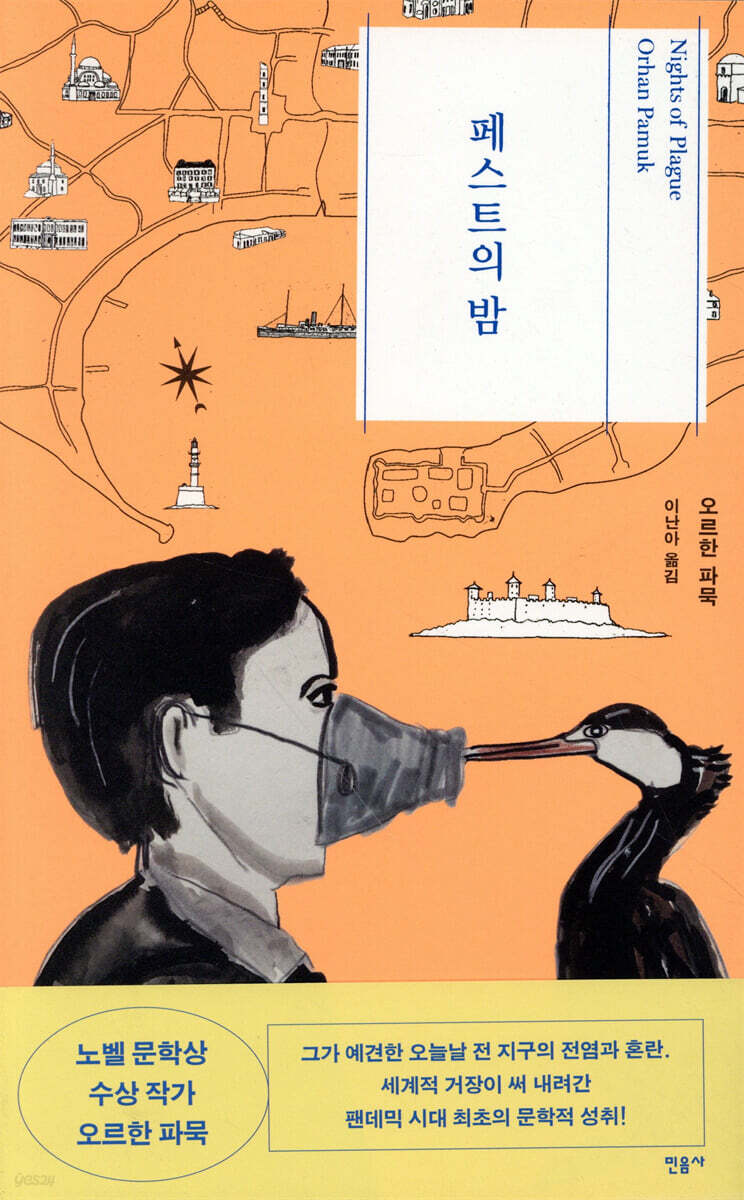
Additionally, the illustration that adorns the cover design is one of several research drawings that Orhan Pamuk himself created while researching the vast amount of history of epidemics, and the background color of the book was designed in a warm, bright orange that represents the colors of Minger Island at the author's direct request.
Readers who have been longing for a full-length novel should take this opportunity to immerse themselves in the intricately woven narrative of a masterful storyteller.
A fantasy fairy tale-like story will instantly draw readers into a turbulent virtual island.
Governor Sami Pasha said:
…
“Then who brought it?”
“There is officially no epidemic at this time!”
The global pandemic and chaos predicted by Nobel Prize-winning author Orhan Pamuk today.
The first literary achievement of the pandemic era, written by a world-renowned master!
A masterpiece written by master Orhan Pamuk after five years of dedication, this is the first pandemic novel since COVID-19.
A new novel that transcends 100 years and resonates with our current situation.
Orhan Pamuk, a world-renowned master whose works have been translated into over 60 languages worldwide, has published his eleventh new work by Minumsa.
Orhan Pamuk has been steadily publishing novels since winning the Nobel Prize in Literature in 2006, and he continues to surprise the world with his increasingly outstanding works.
He is considered a unique writer who has achieved both literary and commercial success, and this time, he has once again combined historical fiction and mystery to weave a captivating and grand narrative.
The Korean edition has been published just a year after its publication in Turkey, and the English edition is scheduled to be published in the second half of this year, allowing readers in Turkey to access Pamuk's new book faster than anywhere else in the world.
Orhan Pamuk has been contemplating a novel about an epidemic for thirty-five years and has devoted the last five years to writing it.
As the manuscript neared completion, the coronavirus pandemic began to spread across the globe.
In one interview, he said, “When I first heard about the coronavirus in Istanbul, I thought it was like a story from my novel.”
He wrote and revised the work, further enhancing its perfection, amidst the simultaneous content of the novel he was writing and the reality of the pandemic unfolding around the world. In this way, the literary achievement of a master who captures the contagion and chaos of today's pandemic for the first time has finally met readers.
Why does it feel so familiar, like seeing the pandemic unfolding around the world today, despite the fact that there is a time gap of over 100 years between the novel and the situation?
Pamuk's sharp and insightful gaze, which runs through the novel, sends a chill down the spines of readers living in the midst of today's pandemic.
A competent quarantine expert who successfully carried out quarantine and eradicated the epidemic in Istanbul
He is murdered shortly after arriving on Minger Island.
Who is the culprit who murdered him and what will become of this place?
"Night of the Plague" begins in 1901, when a plague spreads on the fictional island of Minger under the Ottoman Empire.
Amidst the island's increasingly rebellious elements, a contagious disease that could have simply been contained and treated is increasingly engulfed in a whirlpool of religious and political division, an incident occurs where an orthodox Christian and quarantine expert who was dispatched is murdered.
Ominger Island, the setting of the novel, is a small, peaceful island with a magical landscape that has been poetically described in various travel books, with its naturally pink-white stones glowing warmly with an orange glow even from afar.
The island is divided roughly equally between Muslims and Orthodox Christians, so political tensions are constant.
Then one day, the Padishah's (absolute ruler's) cruise ship, the Aziziye, secretly stops by this tranquil and awe-inspiring island and disembarks two people.
It is the famous chemist and pharmacist Bonkovsky Pasha and his assistant.
Bonkowski Pasha was a skilled quarantine expert who ended a plague epidemic in Izmir, a major port in the Ottoman Empire, in just six weeks and was dispatched by Sultan Abdulhamid II of the Ottoman Empire.
However, he, an orthodox Christian, is found covered in blood on the street before any proper quarantine measures can be implemented.
Sultan Abdul Hamid II again dispatched the Muslim physician Nuri.
As a doctor, he enters Minger Island with his wife, Pakije Sultan, with orders to enforce strict quarantine measures and find out who killed the quarantine expert.
However, the quarantine efforts are failing due to the incompetence of the administration and people not following the sanctions.
Soon after, Sultan Abdul Hamid, unable to withstand international pressure from Western powers, instead of sending relief ships, blockaded Minger Island with Ottoman warships.
The island, in a desperate situation, declares to the world, led by Kolaas, that Mingerya is an independent nation.
From now on, the island must find a way to defeat the epidemic on its own… … .
Who are the forces obstructing the quarantine and who are the murderers of Bonkovsky Pasha, and what will become of Mingerya's fate?
For readers who miss long novels that they can get lost in!
A historical fantasy mystery novel that skillfully weaves together fantasy and reality, past and present, East and West.
The work meticulously depicts the different facets of the disease's spread: the government's aggressive approach to quarantine, those who refuse to comply and even refuse to believe in the pandemic, Islam versus orthodox Christianity, the educated versus the uneducated, the rich versus the poor, the upper class versus the working class, and connected versus isolated neighbors.
In this way, Orhan Pamuk shows how people react differently to epidemics depending on where they stand, and how nations respond and evolve within them.
In this way, the novel, strangely timed, becomes a masterpiece that gives us an opportunity to look back on our present-day appearance and diagnose society.
The translator who preserved the beauty of Pamuk's uniquely beautiful and long sentences is Inana, the only Türkiye expert in Korea.
The book details Turkish history from 1890 to 1920 in the first and last 100 pages or so for readers around the world, and the translation was said to be very difficult and tricky because of the strange intertwining of historical facts and fictional fiction.
In the preface, translator Lee Nan-ah did not spare praise for this novel, saying, “In this work, Orhan Pamuk delicately depicts the potentially gloomy atmosphere of the pandemic era with an exciting narrative and unique creative techniques, imprinting on readers Pamuk’s unique authorial spirit of ‘digging a well with a needle.’”
Additionally, the illustration that adorns the cover design is one of several research drawings that Orhan Pamuk himself created while researching the vast amount of history of epidemics, and the background color of the book was designed in a warm, bright orange that represents the colors of Minger Island at the author's direct request.
Readers who have been longing for a full-length novel should take this opportunity to immerse themselves in the intricately woven narrative of a masterful storyteller.
A fantasy fairy tale-like story will instantly draw readers into a turbulent virtual island.
GOODS SPECIFICS
- Date of issue: March 4, 2022
- Page count, weight, size: 780 pages | 892g | 140*225*37mm
- ISBN13: 9788937442568
- ISBN10: 8937442566
You may also like
카테고리
korean


korean

![GQ KOREA Mark (Monthly): December [2025]](http://librairie.coreenne.fr/cdn/shop/files/8ef265dbbfbf186523ed75ba7319009d.jpg?v=1765340328&width=3840)


