

Possibilityist
 |
Description
Book Introduction
Despite the lips that are caught up in the harsh reality,
A poem that calls forth the dawn from the hazy fog
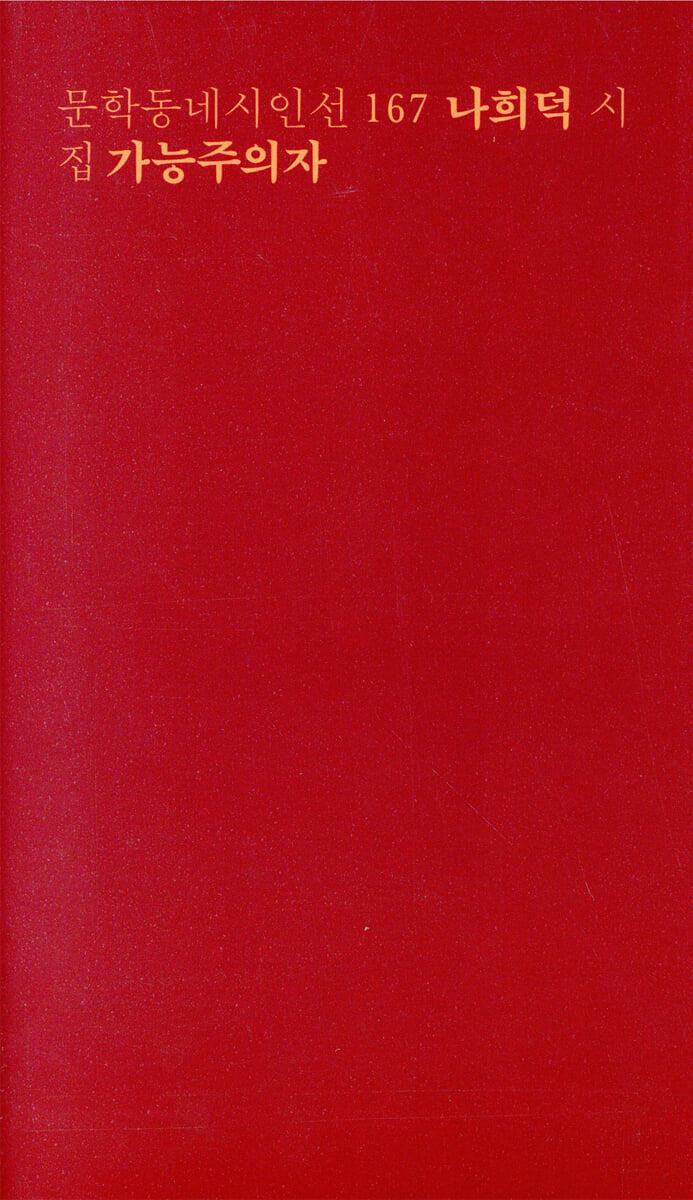
The 167th poetry collection in the Munhakdongne Poetry Collection is the ninth poetry collection by poet Na Hee-deok, titled “Possibilityist.”
This is a collection of poems in which the poet's poetic questions, which have been deepened over the past 30 years since his debut in the JoongAng Ilbo New Year's Literary Contest in 1989, have been refined and refined.
Na Hee-deok re-examines the role of poetry in confronting the darkness of the world, and presents a new frontline language that enables the existence of the hidden.
In this collection of poems, which pinpoints the blind spots of our vision and makes those who have been erased stand out, the poems, as possibilities that stretch out alongside the ghosts who raise their voices, clearly whisper about what the 2020s must open up next.
A poem that calls forth the dawn from the hazy fog
The 167th poetry collection in the Munhakdongne Poetry Collection is the ninth poetry collection by poet Na Hee-deok, titled “Possibilityist.”
This is a collection of poems in which the poet's poetic questions, which have been deepened over the past 30 years since his debut in the JoongAng Ilbo New Year's Literary Contest in 1989, have been refined and refined.
Na Hee-deok re-examines the role of poetry in confronting the darkness of the world, and presents a new frontline language that enables the existence of the hidden.
In this collection of poems, which pinpoints the blind spots of our vision and makes those who have been erased stand out, the poems, as possibilities that stretch out alongside the ghosts who raise their voices, clearly whisper about what the 2020s must open up next.
- You can preview some of the book's contents.
Preview
index
Poet's words
The opposite of a wall is a beach.
Red spider web/ Lips speak/ Since that day/ From the attic/ Pieces/ Tear/ Sew/ The opposite of a wall/ Flow/ The community of compost/ The giant bread/ The world of leaven/ The long, narrow room
Part 2 Stains that Remove Stains
Like ghosts/ Passing by/ Turin's horse/ If you're not hungry/ Pick up/ Heo Sam-gwan's blood seller/ Standing on the line/ Asking/ Lee Deok-gu's mountain village/ People who died too late/ As if no voice could be heard/ Bloody/ That rock someday
Part 3: Only Fear Can Teach Us
Some Easter/ Things that disappear/ The dormitory/ Birds of the plesiosaurus/ Only in the bowels of a bear/ The Arctic pine/ A glacial funeral/ How far away did the rose come/ Cows/ Courtesy to the cicada/ Black leaves/ If those fallen leaves do not return/ Places of refuge
To stop a running locomotive, Part 4
Possibility/ To stop a running locomotive/ Cold, round light/ Hedgehog and fox/ A rooster/ Change faces/ Towards an apple/ When I was holding that pebble in my hand/ Thoughts of fertility in Baekun/ Their garden/ The point of parting/ The journey is over/ Crossing
Commentary | Possibilists, the Poetics of the Impossible Future
Choi Jin-seok (literary critic)
The opposite of a wall is a beach.
Red spider web/ Lips speak/ Since that day/ From the attic/ Pieces/ Tear/ Sew/ The opposite of a wall/ Flow/ The community of compost/ The giant bread/ The world of leaven/ The long, narrow room
Part 2 Stains that Remove Stains
Like ghosts/ Passing by/ Turin's horse/ If you're not hungry/ Pick up/ Heo Sam-gwan's blood seller/ Standing on the line/ Asking/ Lee Deok-gu's mountain village/ People who died too late/ As if no voice could be heard/ Bloody/ That rock someday
Part 3: Only Fear Can Teach Us
Some Easter/ Things that disappear/ The dormitory/ Birds of the plesiosaurus/ Only in the bowels of a bear/ The Arctic pine/ A glacial funeral/ How far away did the rose come/ Cows/ Courtesy to the cicada/ Black leaves/ If those fallen leaves do not return/ Places of refuge
To stop a running locomotive, Part 4
Possibility/ To stop a running locomotive/ Cold, round light/ Hedgehog and fox/ A rooster/ Change faces/ Towards an apple/ When I was holding that pebble in my hand/ Thoughts of fertility in Baekun/ Their garden/ The point of parting/ The journey is over/ Crossing
Commentary | Possibilists, the Poetics of the Impossible Future
Choi Jin-seok (literary critic)
Into the book
The lips speak
About your name, hometown, and loved ones
About despair, anger, sadness and death
What I ate for dinner tonight
About the sunset I saw on my walk
About the climate crisis and the government's real estate policies
About birthdays and funerals, alcohol and music, books and movies, dogs and cats
About the sound of the waves, about the monsoon rain that swept through the village
(……)
About the reason why I can't sleep today too
About why I can't stop talking
About the medications you have been taking
Or bloody words, about other lips
--- From "Lips Speak"
But I like Tolstoy
Not a fox that couldn't become a hedgehog
Rather, I think the author tried to become a fox from a hedgehog.
No, I wanted to be a hedgehog and a fox.
The hand that draws the trivial things of the world
Among the heads obsessed with religious fervor
Between what I believed, what I wanted to believe, and what I had to believe
Between what already exists and what should exist
Between political and spiritual events
Between War and Peace
Between intellectual and moral errors
They say the writer had the head of a hedgehog and the hands of a fox.
Rather, Tolstoy's greatness is
I'm in agony because I can't be either a hedgehog or a fox.
(……)
I just try not to miss the fragmented words and expressions,
I can neither fully believe nor reject it
The fox's worries
I guess you can't say it's inferior to the wisdom of a hedgehog.
What I want to defend is
I don't know if it's me or Tolstoy.
--- From "The Hedgehog and the Fox"
I'm not looking at the stone
When I feel like the stone is staring at me
Picking up a stone
Maybe it's a way to avoid the stone's gaze
That stone is nothing special
Only when he came to me did he become a stone.
I didn't name it or call it anything.
The stone is outside of me, cold and hard
The stone gradually became lukewarm in the pocket.
(……)
Until it becomes just a stone, not my stone
Until you don't look at me anymore
I'll keep it by my side until then
--- From "When I was holding that pebble in my hand"
When I came back from my trip
The misfortunes I had been putting off have all come crashing down on me.
Like clutter pouring out through a closet door
The exceptional days are over
Look at that
This is your share of life that you can't escape from.
It felt like someone was whispering in my ear.
(……)
The trip is over, now
A time to swallow bitter grass and coarse bread
The time it takes to draw water and then draw more
In a perforated poison
Like the Danaids who had to draw water endlessly
--- From "The Journey Is Over"
nevertheless,
To be someone who still says something is possible
What kind of darkness is this possible?
What kind of darkness can blind us to the light?
Oh my goodness, a possibilist, what a ridiculous dream that is.
About your name, hometown, and loved ones
About despair, anger, sadness and death
What I ate for dinner tonight
About the sunset I saw on my walk
About the climate crisis and the government's real estate policies
About birthdays and funerals, alcohol and music, books and movies, dogs and cats
About the sound of the waves, about the monsoon rain that swept through the village
(……)
About the reason why I can't sleep today too
About why I can't stop talking
About the medications you have been taking
Or bloody words, about other lips
--- From "Lips Speak"
But I like Tolstoy
Not a fox that couldn't become a hedgehog
Rather, I think the author tried to become a fox from a hedgehog.
No, I wanted to be a hedgehog and a fox.
The hand that draws the trivial things of the world
Among the heads obsessed with religious fervor
Between what I believed, what I wanted to believe, and what I had to believe
Between what already exists and what should exist
Between political and spiritual events
Between War and Peace
Between intellectual and moral errors
They say the writer had the head of a hedgehog and the hands of a fox.
Rather, Tolstoy's greatness is
I'm in agony because I can't be either a hedgehog or a fox.
(……)
I just try not to miss the fragmented words and expressions,
I can neither fully believe nor reject it
The fox's worries
I guess you can't say it's inferior to the wisdom of a hedgehog.
What I want to defend is
I don't know if it's me or Tolstoy.
--- From "The Hedgehog and the Fox"
I'm not looking at the stone
When I feel like the stone is staring at me
Picking up a stone
Maybe it's a way to avoid the stone's gaze
That stone is nothing special
Only when he came to me did he become a stone.
I didn't name it or call it anything.
The stone is outside of me, cold and hard
The stone gradually became lukewarm in the pocket.
(……)
Until it becomes just a stone, not my stone
Until you don't look at me anymore
I'll keep it by my side until then
--- From "When I was holding that pebble in my hand"
When I came back from my trip
The misfortunes I had been putting off have all come crashing down on me.
Like clutter pouring out through a closet door
The exceptional days are over
Look at that
This is your share of life that you can't escape from.
It felt like someone was whispering in my ear.
(……)
The trip is over, now
A time to swallow bitter grass and coarse bread
The time it takes to draw water and then draw more
In a perforated poison
Like the Danaids who had to draw water endlessly
--- From "The Journey Is Over"
nevertheless,
To be someone who still says something is possible
What kind of darkness is this possible?
What kind of darkness can blind us to the light?
Oh my goodness, a possibilist, what a ridiculous dream that is.
--- From "The Possibilityist"
Publisher's Review
“I try to be a possibilist.
“I try to believe in the possibility of the impossible.”
Despite the lips that are caught up in the harsh reality,
A poem that calls forth the dawn from the hazy fog
Bacteria and viruses
Finally became the most feared god
Because it is invisible
Because of the power that knocks people down wherever it passes by.
Because it shows that humans are like chaff blown by the wind.
There is no evidence that bacteria and viruses have minds.
This oldest and most intelligent being
I once discovered the secret to immortality.
To gain something, you have to give up something.
What we gave up was independence,
Instead, it became possible to inhabit any living thing.
It has become omnipresent in the world
That's how the history of the billions of people began.
_From "A Certain Easter"
As the 2020s began, what came to us were “bacteria and viruses.”
In the face of the pandemic that spread across the web of relationships created by civilization, mocking human arrogance, people were nothing more than “chaff blown by the wind.”
Faced with disasters that “spread so defenselessly” and seem to repeat without end, what we keenly felt was that “humans are not separate from non-humans, and that we ultimately live in a universe that is connected without exception” (critic Jinseok Choi, commentary).
If so, the beings we must look to in order to escape despair and look forward to tomorrow are the 'non-humans'.
In poetry, those who are forgotten and hidden from the visible world finally regain their existence.
People don't see us
I only see the broom
I only see the mop
I only see the bucket
It's becoming more and more transparent
Because they don't see us as people
_From "Like Ghosts"
In this collection of poems, Na Hee-deok suggests that readers actively feel discomfort and discomfort.
Living unaware of the omnipresent alienation and absurdity might be peaceful, but is human life truly that way? Since no one exists in isolation, each person's well-being depends on the well-being of living with others.
However, people only see them for a very short time, “barely” after the beings who have been erased like “ghosts” “leave behind a will and disappear.”
So, for ghosts to truly exist, they need sentences that evoke and linger their presence, and they need language that allows them to be themselves.
The poet appeals that the possible role and meaning of poetry is to bring to light the beings we have forgotten.
In parts 2 and 3 of the collection, specific ghosts are named.
The speaker, who speaks of “the fact that there are so many long-term prisoners imprisoned in this land for over 30 years” (“Line on Line”), recalls Gwangju as “an endless field of death” and “an endless field of unanswerable questions” (“Asking”), and hears “the cries of those who have lost their kin” and “the cries of those who beg for milk” (“Lee Deok-gu’s Birth Story”) of April 3, stands for a long time “among those who died too late / among those who forgot too soon” (“People Who Died Too Late”) in a place where the traces of the Yongsan Tragedy have completely disappeared.
Among the people who live as if “no voice is heard” (“As if no voice is heard”) of the Sewol ferry disaster.
Some seek to erase the homeless “for the most certain visual quarantine” (“The Disappearing”).
We, who have gradually “come from the vanishing iceberg” (“Glacier Funeral”), following the “carbon footprint” (“How Far Have Roses Came”), are not aware that we are next.
The poet, facing refugees in Afghanistan, asks, “Where should those who have lost even their place of refuge go?” (“Places of Refuge”).
Despite this total loss of direction, at the very end of the negation, the poet discovers the will to return to our origins and begin again.
The well has dried up
On days when we run out of firewood and oil
What should I do?
Leaving like a rag in the wind
But I can't find the exit and I come back again
Closing the door to a world that is getting worse
Embracing the darkness of the sixth day
Staring into the darkness until the end
Holding a raw potato
Holding a raw potato
_From "The Turin Horse"
“How can poetry navigate this turbulent and exciting era?” the poet asks in the eulogy.
Na Hee-deok's poetry denounces the barren land and harsh reality of the world we live in.
So that the loss and absence we face become more pronounced.
But those who speak of despair are also those who cannot give up optimism.
His poetry is a determination that hints at possibility, and a willingness to push oneself toward the approaching darkness, seeking the next.
Despite the seemingly impenetrable view, the end of the dead end holds the possibility of a future.
“To be someone who says something is still possible/ Is it possible to rely on some darkness?” (“The Possibilityist”).
Na Hee-deok goes into the darkness where the possibility seems the most unlikely and draws light from it.
Perhaps this is a self-evident truth.
Because the person who goes all the way once will be able to dig up the next one.
Because for those who are less negative, what remains is only negative, not positive.
Only those who are deeply skeptical can find a sliver of hope.
“No possibility will be possible unless we accept the impossibility, the abyss of disconnection.
It is not that there is a lack because there is a fullness, but rather that there is a lack because there is a fullness, so impossibility is a condition of possibility, not the other way around.
So let's be possibilists.
“Let us once again draw the future of the impossible beginning.” (Critic Choi Jin-seok, commentary)
nevertheless,
I try to be a possibilist
I try to believe in the possibility of the impossible.
It doesn't have to be a big light
Blinking like a firefly
About the light and darkness we cannot reach
About that discrepancy
I'm trying to write with drying ink.
_From "The Possibilityist"
■ Poet's Note
A certain blood, hunger, and coldness surround life.
It came from a kind of nakedness.
blood.
sweat.
teardrop.
These three bodily fluids are constantly flowing through humans.
As your heart desires
If you follow the flow of blood, sweat and tears
I was with souls who felt pain, hunger, and cold.
Poetry is forever on the side of such beings.
December 2021
Na Hee-deok
“I try to believe in the possibility of the impossible.”
Despite the lips that are caught up in the harsh reality,
A poem that calls forth the dawn from the hazy fog
Bacteria and viruses
Finally became the most feared god
Because it is invisible
Because of the power that knocks people down wherever it passes by.
Because it shows that humans are like chaff blown by the wind.
There is no evidence that bacteria and viruses have minds.
This oldest and most intelligent being
I once discovered the secret to immortality.
To gain something, you have to give up something.
What we gave up was independence,
Instead, it became possible to inhabit any living thing.
It has become omnipresent in the world
That's how the history of the billions of people began.
_From "A Certain Easter"
As the 2020s began, what came to us were “bacteria and viruses.”
In the face of the pandemic that spread across the web of relationships created by civilization, mocking human arrogance, people were nothing more than “chaff blown by the wind.”
Faced with disasters that “spread so defenselessly” and seem to repeat without end, what we keenly felt was that “humans are not separate from non-humans, and that we ultimately live in a universe that is connected without exception” (critic Jinseok Choi, commentary).
If so, the beings we must look to in order to escape despair and look forward to tomorrow are the 'non-humans'.
In poetry, those who are forgotten and hidden from the visible world finally regain their existence.
People don't see us
I only see the broom
I only see the mop
I only see the bucket
It's becoming more and more transparent
Because they don't see us as people
_From "Like Ghosts"
In this collection of poems, Na Hee-deok suggests that readers actively feel discomfort and discomfort.
Living unaware of the omnipresent alienation and absurdity might be peaceful, but is human life truly that way? Since no one exists in isolation, each person's well-being depends on the well-being of living with others.
However, people only see them for a very short time, “barely” after the beings who have been erased like “ghosts” “leave behind a will and disappear.”
So, for ghosts to truly exist, they need sentences that evoke and linger their presence, and they need language that allows them to be themselves.
The poet appeals that the possible role and meaning of poetry is to bring to light the beings we have forgotten.
In parts 2 and 3 of the collection, specific ghosts are named.
The speaker, who speaks of “the fact that there are so many long-term prisoners imprisoned in this land for over 30 years” (“Line on Line”), recalls Gwangju as “an endless field of death” and “an endless field of unanswerable questions” (“Asking”), and hears “the cries of those who have lost their kin” and “the cries of those who beg for milk” (“Lee Deok-gu’s Birth Story”) of April 3, stands for a long time “among those who died too late / among those who forgot too soon” (“People Who Died Too Late”) in a place where the traces of the Yongsan Tragedy have completely disappeared.
Among the people who live as if “no voice is heard” (“As if no voice is heard”) of the Sewol ferry disaster.
Some seek to erase the homeless “for the most certain visual quarantine” (“The Disappearing”).
We, who have gradually “come from the vanishing iceberg” (“Glacier Funeral”), following the “carbon footprint” (“How Far Have Roses Came”), are not aware that we are next.
The poet, facing refugees in Afghanistan, asks, “Where should those who have lost even their place of refuge go?” (“Places of Refuge”).
Despite this total loss of direction, at the very end of the negation, the poet discovers the will to return to our origins and begin again.
The well has dried up
On days when we run out of firewood and oil
What should I do?
Leaving like a rag in the wind
But I can't find the exit and I come back again
Closing the door to a world that is getting worse
Embracing the darkness of the sixth day
Staring into the darkness until the end
Holding a raw potato
Holding a raw potato
_From "The Turin Horse"
“How can poetry navigate this turbulent and exciting era?” the poet asks in the eulogy.
Na Hee-deok's poetry denounces the barren land and harsh reality of the world we live in.
So that the loss and absence we face become more pronounced.
But those who speak of despair are also those who cannot give up optimism.
His poetry is a determination that hints at possibility, and a willingness to push oneself toward the approaching darkness, seeking the next.
Despite the seemingly impenetrable view, the end of the dead end holds the possibility of a future.
“To be someone who says something is still possible/ Is it possible to rely on some darkness?” (“The Possibilityist”).
Na Hee-deok goes into the darkness where the possibility seems the most unlikely and draws light from it.
Perhaps this is a self-evident truth.
Because the person who goes all the way once will be able to dig up the next one.
Because for those who are less negative, what remains is only negative, not positive.
Only those who are deeply skeptical can find a sliver of hope.
“No possibility will be possible unless we accept the impossibility, the abyss of disconnection.
It is not that there is a lack because there is a fullness, but rather that there is a lack because there is a fullness, so impossibility is a condition of possibility, not the other way around.
So let's be possibilists.
“Let us once again draw the future of the impossible beginning.” (Critic Choi Jin-seok, commentary)
nevertheless,
I try to be a possibilist
I try to believe in the possibility of the impossible.
It doesn't have to be a big light
Blinking like a firefly
About the light and darkness we cannot reach
About that discrepancy
I'm trying to write with drying ink.
_From "The Possibilityist"
■ Poet's Note
A certain blood, hunger, and coldness surround life.
It came from a kind of nakedness.
blood.
sweat.
teardrop.
These three bodily fluids are constantly flowing through humans.
As your heart desires
If you follow the flow of blood, sweat and tears
I was with souls who felt pain, hunger, and cold.
Poetry is forever on the side of such beings.
December 2021
Na Hee-deok
GOODS SPECIFICS
- Publication date: December 6, 2021
- Page count, weight, size: 172 pages | 208g | 130*224*9mm
- ISBN13: 9788954683517
- ISBN10: 8954683517
You may also like
카테고리
korean


korean

![GQ KOREA Mark (Monthly): December [2025]](http://librairie.coreenne.fr/cdn/shop/files/8ef265dbbfbf186523ed75ba7319009d.jpg?v=1765340328&width=3840)


