

Cut it off and say it's nothing
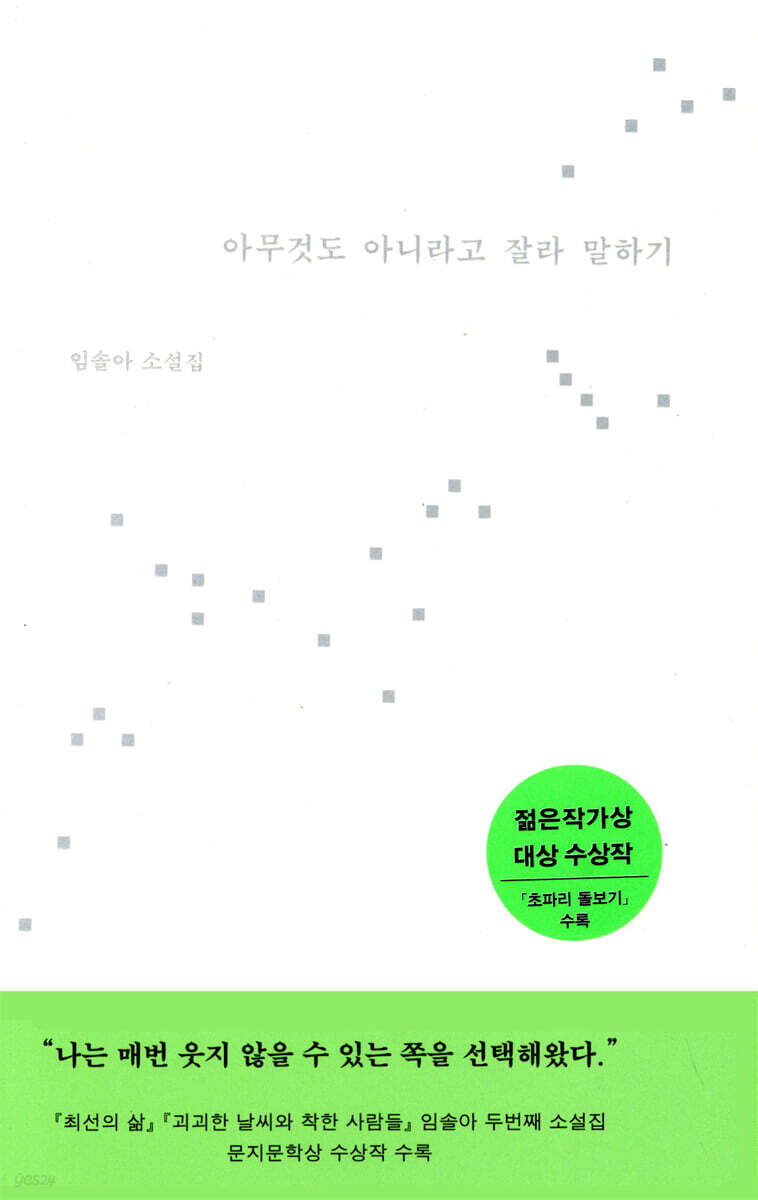 |
Description
Book Introduction
- A word from MD
-
Reading the truth behind the words "nothing"『The Best Life』, 『Strange Weather and Good People』, Im Sol-a's second collection of short stories.
It is a collection of nine novels, including “The White and Round Part,” which won the Munji Literary Award.
The characters and their situations in the novel, which seem to be out of place in some way, evoke empathy at the very point where they seem far from the ideals of the majority, and become our story.
December 10, 2021. Novel/Poetry PD Park Hyung-wook
Im Sol-a's second collection of short stories: "The Best Life" and "Strange Weather and Good People."
Includes works winning the Munji Literary Award
The second collection of short stories by author Im Sol-a, who examines the contradictions in everyday life, has been published.
Lim Sol-ah has written novels and poetry, including the novel “The Best Life,” which won the Munhakdongne University Novel Award in 2015, and her first poetry collection “Strange Weather and Good People,” which won the Shin Dong-yup Literary Award in 2017.
『Saying It's Nothing』 includes "The White, Round Part," the winner of the 10th Munji Literary Award.
The people in Im Sol-ah's novels are aging naturally along with the author.
Following the first collection of short stories, which covered the period from the late teens to the mid-twenties, the second collection covers the period from the mid-twenties to the thirties.
By reading the novels, which are arranged in reverse chronological order, we will be able to encounter each of our yesterdays that made us who we are today.
Includes works winning the Munji Literary Award
The second collection of short stories by author Im Sol-a, who examines the contradictions in everyday life, has been published.
Lim Sol-ah has written novels and poetry, including the novel “The Best Life,” which won the Munhakdongne University Novel Award in 2015, and her first poetry collection “Strange Weather and Good People,” which won the Shin Dong-yup Literary Award in 2017.
『Saying It's Nothing』 includes "The White, Round Part," the winner of the 10th Munji Literary Award.
The people in Im Sol-ah's novels are aging naturally along with the author.
Following the first collection of short stories, which covered the period from the late teens to the mid-twenties, the second collection covers the period from the mid-twenties to the thirties.
By reading the novels, which are arranged in reverse chronological order, we will be able to encounter each of our yesterdays that made us who we are today.
- You can preview some of the book's contents.
Preview
index
People who quit
Fruit fly care
Important factors
white, round part
The brightest world I know
Mafia, please raise your heads and check on each other.
Cut it off and say it's nothing
I reached out my hand
Danyoung
Commentary | Far Away_Hong Seong-hee
Fruit fly care
Important factors
white, round part
The brightest world I know
Mafia, please raise your heads and check on each other.
Cut it off and say it's nothing
I reached out my hand
Danyoung
Commentary | Far Away_Hong Seong-hee
Into the book
The story of a woman who spends all day listening to abuse over her headset in a telemarketing office.
The story of a woman who started to get sick because she never had her own desk in her life.
The story of a family who asks if they should buy a dishwasher but never asks if they need a desk.
The story of a woman who suffered from asthenia because wheat flour did not suit her constitution, but ate noodles for 30 years because her husband liked them.
The story of my daughter who would nag me every time I ate noodles and ask why I was eating them.
And yet, on Sunday evenings, Wonyoung would clap his hands and say, “Wow, noodles!” as he spoke, changing the subject little by little.
It almost became a novel.
Wonyoung was telling someone for the first time about anecdotes that were so trivial that he had rather ignored them.
--- From "Caring for Fruit Flies"
Chion vacated his house.
In images like novels and movies, elements that would have been absolutely necessary were erased one by one.
I erased as many of the life hacks that Somin mentioned as I could.
Chion lay down in the living room and looked up at the ceiling.
Only after erasing the traces of my life did I feel like I was getting closer to something.
It seemed like the house would sell even without consulting.
--- Among the "Important Elements"
The boundary line marked with a dotted line on the map was impossible to witness.
Rohee wanted to translate the physical practice of actually exploring the borderline of the unwitnessable into her work.
When standing on the edge of the city, Rohee said that strangely, she felt like she was standing on the border between people.
He said that there are times when he feels like he is standing on the border between nightmare and reality.
--- From "White and Round Part"
If a fetus is recognized as a child, then the smartest strategy is to have an abortion after the fetus is recognized.
It might not be 500 million per child, but 500 million per abortion.
I can't be the only one doing such simple calculations.
I turned on the portal app on my phone.
I entered the two words ‘subscription’ and ‘abortion’ into the search bar.
Among the winners of the 2019 special supply, 10 percent were found to have applied illegally.
People have sham-married single mothers to become lottery winners, gotten pregnant, had abortions, and adopted children they would otherwise have abandoned.
--- From "The Brightest World I Know"
“I remember how beautiful a person my sister used to think I was.
My sister says I took care of her, but that's not true.
At that time, I wanted to appear as a beautiful person to my older sister.
I thought that was cool.
That's how I got through those times.
I don't have that kind of beauty anymore.
I don't care about anyone anymore.
Just think about me.
I know my sister was very upset with me.
But, I'm a little satisfied now.
I like it now.
It's just been so long since we've talked.
So I called.” --- From “Cutting it Off and Saying It Was Nothing”
He was gathering the petals, holding a sprayer, spraying them, and then tidying them up with a broom.
The pile of cherry blossom petals gradually became the word love.
[…] The anecdote of a security guard confessing his love to students with letters written on cherry blossom leaves was one of the most famous anecdotes among the rumors about the school.
“He did this every day.
Every year during cherry blossom season.
“You are amazing.”
I smiled at the security guard.
“Because the president told me to do it every morning.”
He said, hitting his waist with his fist.
--- From "I reached out my hand"
The first realization that Hyojeong gained after coming to Haeunsa Temple was something that was not written anywhere in the Buddhist scriptures.
The rule that a monk who has left home must live as a being without a name is a prerequisite that everyone knows, but a nun can never survive without a name.
The believers wanted to experience the ideal femininity at Haenamsa.
It was easy for Hyojeong to meet their desires.
When Haensa was able to put on a gentle smile no matter what emotion she was feeling, it became a famous nunnery.
The story of a woman who started to get sick because she never had her own desk in her life.
The story of a family who asks if they should buy a dishwasher but never asks if they need a desk.
The story of a woman who suffered from asthenia because wheat flour did not suit her constitution, but ate noodles for 30 years because her husband liked them.
The story of my daughter who would nag me every time I ate noodles and ask why I was eating them.
And yet, on Sunday evenings, Wonyoung would clap his hands and say, “Wow, noodles!” as he spoke, changing the subject little by little.
It almost became a novel.
Wonyoung was telling someone for the first time about anecdotes that were so trivial that he had rather ignored them.
--- From "Caring for Fruit Flies"
Chion vacated his house.
In images like novels and movies, elements that would have been absolutely necessary were erased one by one.
I erased as many of the life hacks that Somin mentioned as I could.
Chion lay down in the living room and looked up at the ceiling.
Only after erasing the traces of my life did I feel like I was getting closer to something.
It seemed like the house would sell even without consulting.
--- Among the "Important Elements"
The boundary line marked with a dotted line on the map was impossible to witness.
Rohee wanted to translate the physical practice of actually exploring the borderline of the unwitnessable into her work.
When standing on the edge of the city, Rohee said that strangely, she felt like she was standing on the border between people.
He said that there are times when he feels like he is standing on the border between nightmare and reality.
--- From "White and Round Part"
If a fetus is recognized as a child, then the smartest strategy is to have an abortion after the fetus is recognized.
It might not be 500 million per child, but 500 million per abortion.
I can't be the only one doing such simple calculations.
I turned on the portal app on my phone.
I entered the two words ‘subscription’ and ‘abortion’ into the search bar.
Among the winners of the 2019 special supply, 10 percent were found to have applied illegally.
People have sham-married single mothers to become lottery winners, gotten pregnant, had abortions, and adopted children they would otherwise have abandoned.
--- From "The Brightest World I Know"
“I remember how beautiful a person my sister used to think I was.
My sister says I took care of her, but that's not true.
At that time, I wanted to appear as a beautiful person to my older sister.
I thought that was cool.
That's how I got through those times.
I don't have that kind of beauty anymore.
I don't care about anyone anymore.
Just think about me.
I know my sister was very upset with me.
But, I'm a little satisfied now.
I like it now.
It's just been so long since we've talked.
So I called.” --- From “Cutting it Off and Saying It Was Nothing”
He was gathering the petals, holding a sprayer, spraying them, and then tidying them up with a broom.
The pile of cherry blossom petals gradually became the word love.
[…] The anecdote of a security guard confessing his love to students with letters written on cherry blossom leaves was one of the most famous anecdotes among the rumors about the school.
“He did this every day.
Every year during cherry blossom season.
“You are amazing.”
I smiled at the security guard.
“Because the president told me to do it every morning.”
He said, hitting his waist with his fist.
--- From "I reached out my hand"
The first realization that Hyojeong gained after coming to Haeunsa Temple was something that was not written anywhere in the Buddhist scriptures.
The rule that a monk who has left home must live as a being without a name is a prerequisite that everyone knows, but a nun can never survive without a name.
The believers wanted to experience the ideal femininity at Haenamsa.
It was easy for Hyojeong to meet their desires.
When Haensa was able to put on a gentle smile no matter what emotion she was feeling, it became a famous nunnery.
--- From "Danyeong"
Publisher's Review
“I've always chosen not to laugh.”
Im Sol-a's second collection of short stories: "The Best Life" and "Strange Weather and Good People."
Includes works winning the Munji Literary Award
Conspirators who act with sincerity, understanding each other's feelings.
In a world where everything is believed to have been said
Waiting for feelings that have not yet been expressed
The second collection of short stories by author Im Sol-a, known for her deep and refined writing, has been published.
Im Sol-ah has written novels and poetry, including the novel 『The Best Life』, which won the Munhakdongne University Novel Award in 2015, and the poetry collection 『Strange Weather and Good People』, which won the Shin Dong-yup Literary Award in 2017.
This book contains nine novels, including “The White and Round Part,” which won the 10th Munji Literary Award.
In the author's note from his first novel collection, he said, "Will it be possible for me and the characters in my novels to continue to resemble each other in the future as I continue to live?
[…] Just as she had hoped, “I want to be by the side of the novels I write,” the people in Im Sol-ah’s novels have naturally aged and changed along with the author.
In "Saying It's Nothing", the stories are mainly about people in their mid-twenties to thirties.
The author, who had previously tried to carve beings similar to himself, now seems to be moving in the direction of attempting to connect with other faint beings.
In this book, you will find the yesterdays of each of us that made us who we are today, and “sentences that will be passed on to our future selves” (interview with 『Axt』).
In this way, Im Sol-ah's novel allows us to look at those who are like snowflakes that are too faint to be seen, and at the truths that cannot be clearly distinguished.
I am a person who is slow to grasp situations.
I often miss the timing to speak.
I belatedly remember what I should have felt and what I should have said in that situation.
Rather than wanting to restore memories, I have continued to revisit them because I want to understand that time.
But the more I tried to understand, the more the story inevitably became a novel.
Because we cannot know the reality accurately, we often fail to understand it,
As the effort to understand continues, it seems that the effort leaves behind a novel.
―From an interview with Cine21 in September 2021
“Just make it seem plausible for a moment.”
A seemingly perfect world made up of layers of best efforts
Everyone has their own position.
Some people faithfully follow the roles assigned to them by the system and environment or the roles expected of them by others.
Someone else is marginalized or excluded because they do not follow or perform it.
Im Sol-ah's novels are interwoven with people who, in their best efforts to play this role, deceive themselves or inflict harm on one another without malice, and those who strive not to become accomplices in the role-play.
The author does not judge them, but quietly continues their position.
Isn't the ability that society expects from people these days a keen eye?
While demanding something new, they want it to fall within the categories permitted by the system, such as 'safe criticism' or 'familiar difference', and when it doesn't or cannot comply, they are singled out like chaff.
In "The Brightest World I Know," the noticing is embodied as a 'smile'.
The laughter of the class when they see a child fall over after being pranked in the classroom, the laughter of a child who has fallen and bled, the laughter mixed with bowing that a mother only does in front of the teacher… … From a young age, ‘I’ am someone who refused to go along with the sophisticated oppression of the powerful and the powerless colluding to create through laughter.
The novel shows how laughter creeps into the bright, expressionless world of 'I', a ten-year freelancer who lives "with the expressionless face I chose" while building and maintaining his own home.
Because of the high housing prices in Seoul, people move to the countryside, and when they finally move into a villa, a high-rise building is built in front of it, blocking their view. Rainwater leaks into the hastily constructed ceiling, causing mold to grow.
This is the reality that confronted me when I, who had lived honestly, was trying to own a house in my name where I could live comfortably.
When I cleverly exploit a loophole in the insurance system to fix up my house, decorate it like a model house, and sell it to someone else, I feel like I've been scammed, and I chuckle.
This laughter is neither “self-mockery about my choices” nor “a substitute emotion that quickly fills the gap left by erasing the guilt about my choices,” but it still remains true that I ended up agreeing with the conspiracy.
He has experienced crossing the 'line' he drew himself, and next time he will cross it more easily.
It's hard to be cynical about his choices.
Im Sol-a's novels bring us to a reality that we cannot help but empathize with.
Don't work too hard.
[…]
If you work too hard, it's scary.
―Im Sol-a, from “Rigida Pine Tree”
There are also people who are faithful to the roles expected of them.
Won-young, a woman in her fifties who desperately wanted to work, took on a part-time job caring for fruit flies for research ("Raising Fruit Flies").
Wonyoung cherished and cared for the fruit flies as if he were caring for his own family.
When Won-young falls ill after working at the lab, her daughter Ji-yu suspects it may have been an industrial accident, but she cannot attribute the cause to the place where she could not have been a 'woman, wife, and mother', the place where her dreams came true.
The school in "I Reached Out" weaves together the commonality of older age among the students who committed suicide as the number of student suicides increases.
The school classifies all students as at-risk for suicide and mandates regular counseling sessions, threatening disciplinary action if they fail to do so.
Ha-yeon, who is at risk of suicide, reads a eulogy pretending to be the roommate of a student who committed suicide at the school's request.
Ha-yeon's touching lie, which emphasizes how much the dead student loved school and the importance of "holding hands," shows, as literary critic Hong Seong-hee puts it, "how role-playing is approved and expanded within an effectively functioning system."
Hyojeong of "Danyeong" is a faithful chief priest of Haeunsa Temple.
While doing his best to save the temple, he realizes that while monks must live as silent beings, nuns cannot survive as silent beings.
Since then, Hyojeong has actively used the role of ideal femininity and conformed to the fantasies of her followers.
With a “gentle smile” that can be worn in any situation, Hyo-jeong tramples on the flowers she planted every night to maintain the beautiful nature of Ha-eun-sa Temple.
It's a space for women, but they pretend not to know the stories of the women who come to visit.
Lim Sol-ah said in a recent lecture that since writing “Body Expropriation” around 2017, she has tried to understand the context by empathizing with the positions of those who oppose her, in addition to those she can sympathize with and defend.
The results of that attempt are included in 『Cutting It Off and Saying It's Nothing』.
They may have simply done their best, starting with self-deception and excluding others, and ending up identifying themselves with the system.
Regardless of whether it is real or fake, the problem is that Im Sol-ah's novel repeatedly tells us that it is the gaze of others and the system that demands and forces us to act according to a role.
“How can we show what is invisible?”
The warmth of Im Sol-ah that makes the world bearable
The relationship is strained due to differences in position.
Jinyoung of "The White and Round Part" tried his best to respond to Minchae, a student who trusted him as a teacher, but at some point, Jinyoung's sincerity began to feel like "pretend" to Minchae.
Just like Ji-yu preparing a cake for Won-young's birthday when he can't eat flour, and Won-young preparing Chex Choco, which Ji-yu no longer likes, for his daughter whom he hasn't seen in a long time ("Raising Fruit Flies"), they care for each other, but they are also unable to give and receive what they want.
However, the reason Im Sol-ah spent so much time portraying various perspectives in her novel is probably because “the existence of points of disagreement in our communication allows us to talk” (“Mafia, please raise your heads and check on each other”).
In the title, the answer “nothing” has two meanings.
Moon-kyung and Aran from "Cutting It Off and Saying It's Nothing" met at a boarding school 10 years ago.
Moonkyung thought caring was her calling and went to nursing school, but she had to give up her dream.
Moonkyung doesn't want to complain to Aran anymore.
Aran, who knows Moonkyung's dream very well and cheers her on from the side, feels sorry for Moonkyung who is having a hard time.
They draw the line, hiding their true feelings with the words “It’s nothing” while playing the role of friends for each other’s sake (or for themselves).
But one night, while riding on a swing and talking on the phone like 10 years ago, Moon-kyung's new words, "It's nothing," tie the knot in their relationship and allow them to speak their hearts.
“I don’t care about anyone anymore.
Just think about me.
[…] But, I’m a bit satisfied now.
“I like it now.”
The possibility of a new solidarity is also found in "The Quitters."
This novel, which reveals the author's desire to quit literature at the time of writing, is filled with people standing on the borderline, having left or are preparing to leave their original positions.
'I', who became a writer to suppress quitting, finds comfort in the exhibition of artist Jae-yeon, who held her last exhibition before quitting.
My friend Hye-ri, who is studying abroad in Sweden, experiences racial discrimination, but has no one to confide in, so she exchanges emails with 'me'.
They were “people who could not get close to each other, could not intervene, and could only listen”, but they still live far apart, but they share their daily lives and listen to each other’s requests.
Im Sol-ah's people meet in "Mafia, please raise your heads and check on each other."
In this story, which takes one name from each of the seven novels in the collection, the characters may be in a reading club together, or they may have borrowed only the settings while sharing the same names.
Posts on internet communities that appear to be about playing a mafia game are either stating their position or sniping at someone.
I can't be sure if they're telling the truth or if they're actually playing the mafia game, and if so, what the mafia's lies are.
The important thing is to “see the other side of words in what is said or what is believed to have been said, whether it is telling a lie or telling the truth, or cleverly overlapping the two to say something that is both this and that” (Hong Seong-hee).
The reading group, which was “a good relationship because we could be silent,” has become a relationship where “we just try to agree with everyone in silence, and we just try to continue while agreeing,” and “we stay silent to swallow what we have to say.”
Im Sol-ah's people break the silence by tying knots and talking.
By ending firmly and then starting a new conversation, we see the unseen and wait for the unspoken feelings.
I recall a scene that runs through Im Sol-ah's novel.
Like the reenactment in “People Who Quit” where many hands catch the water flowing down from the air little by little, like “those hands are catching all the rain that falls on my head,” can’t small, long-term attempts achieve something?
Im Sol-ah speaks quietly, searching for the boundary line (the “white, round part”) where it is impossible to witness.
“I hope we can keep going together without giving up.”
Water flowed down from the air.
A person cupped both hands together.
I caught the flowing water with both hands.
The water that had been rising transparently in my hand soon flowed down between my fingers.
Another person's two hands caught the water.
And underneath that, there are two concave hands and flowing water.
And the two hands and the water flowing down below… it looked like it was raining.
It seemed like those hands were catching all the rain falling on my head.
People Who Quit
Continuing to do something just before you quit.
In a place where the role of giving or taking away by the system has disappeared, the people of Imsol-a create their own role and protect it.
I'm waiting to meet you in roles that won't be shackles, and I'm hoping that it will be possible.
Hong Seong-hee (literary critic)
Im Sol-a's second collection of short stories: "The Best Life" and "Strange Weather and Good People."
Includes works winning the Munji Literary Award
Conspirators who act with sincerity, understanding each other's feelings.
In a world where everything is believed to have been said
Waiting for feelings that have not yet been expressed
The second collection of short stories by author Im Sol-a, known for her deep and refined writing, has been published.
Im Sol-ah has written novels and poetry, including the novel 『The Best Life』, which won the Munhakdongne University Novel Award in 2015, and the poetry collection 『Strange Weather and Good People』, which won the Shin Dong-yup Literary Award in 2017.
This book contains nine novels, including “The White and Round Part,” which won the 10th Munji Literary Award.
In the author's note from his first novel collection, he said, "Will it be possible for me and the characters in my novels to continue to resemble each other in the future as I continue to live?
[…] Just as she had hoped, “I want to be by the side of the novels I write,” the people in Im Sol-ah’s novels have naturally aged and changed along with the author.
In "Saying It's Nothing", the stories are mainly about people in their mid-twenties to thirties.
The author, who had previously tried to carve beings similar to himself, now seems to be moving in the direction of attempting to connect with other faint beings.
In this book, you will find the yesterdays of each of us that made us who we are today, and “sentences that will be passed on to our future selves” (interview with 『Axt』).
In this way, Im Sol-ah's novel allows us to look at those who are like snowflakes that are too faint to be seen, and at the truths that cannot be clearly distinguished.
I am a person who is slow to grasp situations.
I often miss the timing to speak.
I belatedly remember what I should have felt and what I should have said in that situation.
Rather than wanting to restore memories, I have continued to revisit them because I want to understand that time.
But the more I tried to understand, the more the story inevitably became a novel.
Because we cannot know the reality accurately, we often fail to understand it,
As the effort to understand continues, it seems that the effort leaves behind a novel.
―From an interview with Cine21 in September 2021
“Just make it seem plausible for a moment.”
A seemingly perfect world made up of layers of best efforts
Everyone has their own position.
Some people faithfully follow the roles assigned to them by the system and environment or the roles expected of them by others.
Someone else is marginalized or excluded because they do not follow or perform it.
Im Sol-ah's novels are interwoven with people who, in their best efforts to play this role, deceive themselves or inflict harm on one another without malice, and those who strive not to become accomplices in the role-play.
The author does not judge them, but quietly continues their position.
Isn't the ability that society expects from people these days a keen eye?
While demanding something new, they want it to fall within the categories permitted by the system, such as 'safe criticism' or 'familiar difference', and when it doesn't or cannot comply, they are singled out like chaff.
In "The Brightest World I Know," the noticing is embodied as a 'smile'.
The laughter of the class when they see a child fall over after being pranked in the classroom, the laughter of a child who has fallen and bled, the laughter mixed with bowing that a mother only does in front of the teacher… … From a young age, ‘I’ am someone who refused to go along with the sophisticated oppression of the powerful and the powerless colluding to create through laughter.
The novel shows how laughter creeps into the bright, expressionless world of 'I', a ten-year freelancer who lives "with the expressionless face I chose" while building and maintaining his own home.
Because of the high housing prices in Seoul, people move to the countryside, and when they finally move into a villa, a high-rise building is built in front of it, blocking their view. Rainwater leaks into the hastily constructed ceiling, causing mold to grow.
This is the reality that confronted me when I, who had lived honestly, was trying to own a house in my name where I could live comfortably.
When I cleverly exploit a loophole in the insurance system to fix up my house, decorate it like a model house, and sell it to someone else, I feel like I've been scammed, and I chuckle.
This laughter is neither “self-mockery about my choices” nor “a substitute emotion that quickly fills the gap left by erasing the guilt about my choices,” but it still remains true that I ended up agreeing with the conspiracy.
He has experienced crossing the 'line' he drew himself, and next time he will cross it more easily.
It's hard to be cynical about his choices.
Im Sol-a's novels bring us to a reality that we cannot help but empathize with.
Don't work too hard.
[…]
If you work too hard, it's scary.
―Im Sol-a, from “Rigida Pine Tree”
There are also people who are faithful to the roles expected of them.
Won-young, a woman in her fifties who desperately wanted to work, took on a part-time job caring for fruit flies for research ("Raising Fruit Flies").
Wonyoung cherished and cared for the fruit flies as if he were caring for his own family.
When Won-young falls ill after working at the lab, her daughter Ji-yu suspects it may have been an industrial accident, but she cannot attribute the cause to the place where she could not have been a 'woman, wife, and mother', the place where her dreams came true.
The school in "I Reached Out" weaves together the commonality of older age among the students who committed suicide as the number of student suicides increases.
The school classifies all students as at-risk for suicide and mandates regular counseling sessions, threatening disciplinary action if they fail to do so.
Ha-yeon, who is at risk of suicide, reads a eulogy pretending to be the roommate of a student who committed suicide at the school's request.
Ha-yeon's touching lie, which emphasizes how much the dead student loved school and the importance of "holding hands," shows, as literary critic Hong Seong-hee puts it, "how role-playing is approved and expanded within an effectively functioning system."
Hyojeong of "Danyeong" is a faithful chief priest of Haeunsa Temple.
While doing his best to save the temple, he realizes that while monks must live as silent beings, nuns cannot survive as silent beings.
Since then, Hyojeong has actively used the role of ideal femininity and conformed to the fantasies of her followers.
With a “gentle smile” that can be worn in any situation, Hyo-jeong tramples on the flowers she planted every night to maintain the beautiful nature of Ha-eun-sa Temple.
It's a space for women, but they pretend not to know the stories of the women who come to visit.
Lim Sol-ah said in a recent lecture that since writing “Body Expropriation” around 2017, she has tried to understand the context by empathizing with the positions of those who oppose her, in addition to those she can sympathize with and defend.
The results of that attempt are included in 『Cutting It Off and Saying It's Nothing』.
They may have simply done their best, starting with self-deception and excluding others, and ending up identifying themselves with the system.
Regardless of whether it is real or fake, the problem is that Im Sol-ah's novel repeatedly tells us that it is the gaze of others and the system that demands and forces us to act according to a role.
“How can we show what is invisible?”
The warmth of Im Sol-ah that makes the world bearable
The relationship is strained due to differences in position.
Jinyoung of "The White and Round Part" tried his best to respond to Minchae, a student who trusted him as a teacher, but at some point, Jinyoung's sincerity began to feel like "pretend" to Minchae.
Just like Ji-yu preparing a cake for Won-young's birthday when he can't eat flour, and Won-young preparing Chex Choco, which Ji-yu no longer likes, for his daughter whom he hasn't seen in a long time ("Raising Fruit Flies"), they care for each other, but they are also unable to give and receive what they want.
However, the reason Im Sol-ah spent so much time portraying various perspectives in her novel is probably because “the existence of points of disagreement in our communication allows us to talk” (“Mafia, please raise your heads and check on each other”).
In the title, the answer “nothing” has two meanings.
Moon-kyung and Aran from "Cutting It Off and Saying It's Nothing" met at a boarding school 10 years ago.
Moonkyung thought caring was her calling and went to nursing school, but she had to give up her dream.
Moonkyung doesn't want to complain to Aran anymore.
Aran, who knows Moonkyung's dream very well and cheers her on from the side, feels sorry for Moonkyung who is having a hard time.
They draw the line, hiding their true feelings with the words “It’s nothing” while playing the role of friends for each other’s sake (or for themselves).
But one night, while riding on a swing and talking on the phone like 10 years ago, Moon-kyung's new words, "It's nothing," tie the knot in their relationship and allow them to speak their hearts.
“I don’t care about anyone anymore.
Just think about me.
[…] But, I’m a bit satisfied now.
“I like it now.”
The possibility of a new solidarity is also found in "The Quitters."
This novel, which reveals the author's desire to quit literature at the time of writing, is filled with people standing on the borderline, having left or are preparing to leave their original positions.
'I', who became a writer to suppress quitting, finds comfort in the exhibition of artist Jae-yeon, who held her last exhibition before quitting.
My friend Hye-ri, who is studying abroad in Sweden, experiences racial discrimination, but has no one to confide in, so she exchanges emails with 'me'.
They were “people who could not get close to each other, could not intervene, and could only listen”, but they still live far apart, but they share their daily lives and listen to each other’s requests.
Im Sol-ah's people meet in "Mafia, please raise your heads and check on each other."
In this story, which takes one name from each of the seven novels in the collection, the characters may be in a reading club together, or they may have borrowed only the settings while sharing the same names.
Posts on internet communities that appear to be about playing a mafia game are either stating their position or sniping at someone.
I can't be sure if they're telling the truth or if they're actually playing the mafia game, and if so, what the mafia's lies are.
The important thing is to “see the other side of words in what is said or what is believed to have been said, whether it is telling a lie or telling the truth, or cleverly overlapping the two to say something that is both this and that” (Hong Seong-hee).
The reading group, which was “a good relationship because we could be silent,” has become a relationship where “we just try to agree with everyone in silence, and we just try to continue while agreeing,” and “we stay silent to swallow what we have to say.”
Im Sol-ah's people break the silence by tying knots and talking.
By ending firmly and then starting a new conversation, we see the unseen and wait for the unspoken feelings.
I recall a scene that runs through Im Sol-ah's novel.
Like the reenactment in “People Who Quit” where many hands catch the water flowing down from the air little by little, like “those hands are catching all the rain that falls on my head,” can’t small, long-term attempts achieve something?
Im Sol-ah speaks quietly, searching for the boundary line (the “white, round part”) where it is impossible to witness.
“I hope we can keep going together without giving up.”
Water flowed down from the air.
A person cupped both hands together.
I caught the flowing water with both hands.
The water that had been rising transparently in my hand soon flowed down between my fingers.
Another person's two hands caught the water.
And underneath that, there are two concave hands and flowing water.
And the two hands and the water flowing down below… it looked like it was raining.
It seemed like those hands were catching all the rain falling on my head.
People Who Quit
Continuing to do something just before you quit.
In a place where the role of giving or taking away by the system has disappeared, the people of Imsol-a create their own role and protect it.
I'm waiting to meet you in roles that won't be shackles, and I'm hoping that it will be possible.
Hong Seong-hee (literary critic)
GOODS SPECIFICS
- Date of issue: December 1, 2021
- Page count, weight, size: 284 pages | 280g | 120*188*16mm
- ISBN13: 9788932039237
- ISBN10: 8932039232
You may also like
카테고리
korean


korean

![GQ KOREA Mark (Monthly): December [2025]](http://librairie.coreenne.fr/cdn/shop/files/8ef265dbbfbf186523ed75ba7319009d.jpg?v=1765340328&width=3840)


