

Civil War
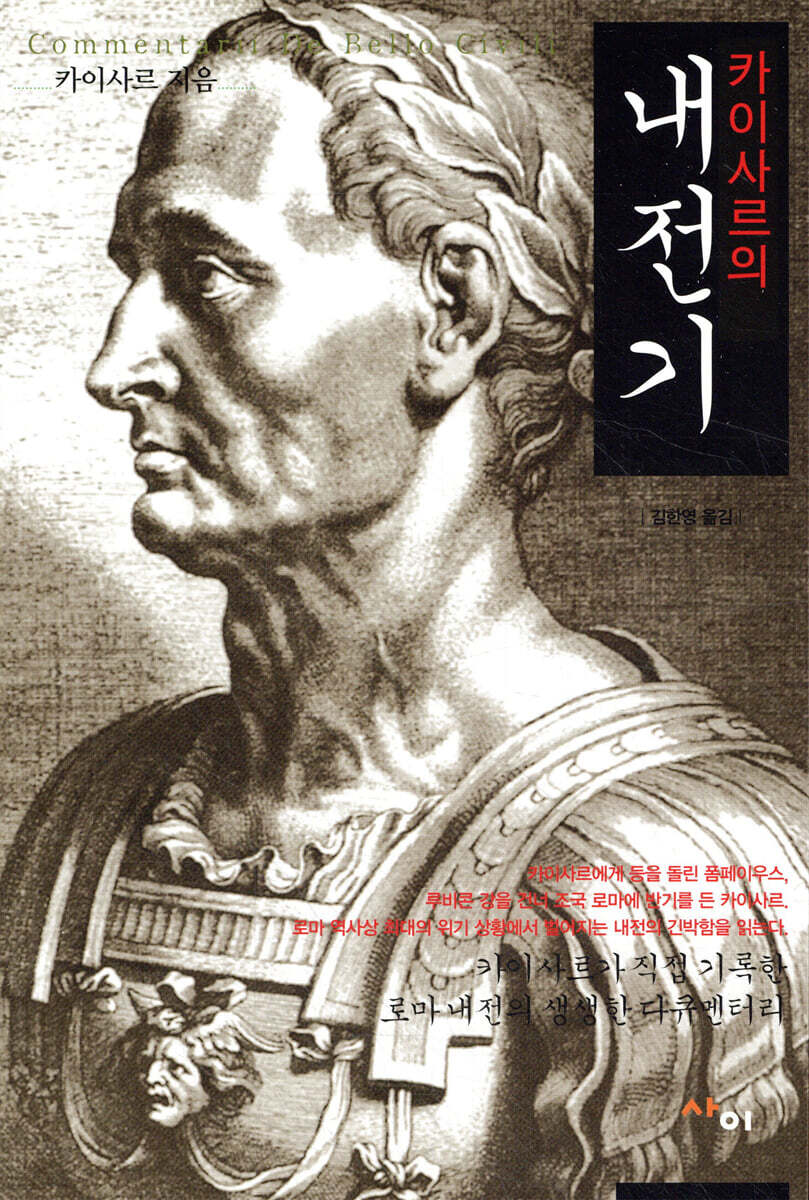 |
Description
Book Introduction
What awaited Caesar, who had led the eight-year Gallic War to victory, was not the glory of victory, but the betrayal of the Senate and Pompey.
Should we disband our army and follow the orders of the Senate, or should we break the law and risk war among our own people?
Caesar decides.
“If I cross this river, the human world will become miserable, and if I don’t cross it, I will be destroyed.
Let us go, where the gods await, the die is cast!”
This is how the greatest crisis in Roman history, the civil war, began.
And Caesar, who knew better than anyone else the importance of public opinion, wrote 『Civil Wars』 following 『The Gallic Wars』.
The Civil Wars, which begins with the conspiracy of the Roman Senate and Pompey, and Caesar's counterattack, does not cover the complete end of the civil war and ends with a description of the civil war in Egypt.
Because Caesar was assassinated by senators just a year after the end of the civil war.
And Rome is engulfed in another civil war.
The first part of this book contains texts that describe the political situation in Rome at the time and Caesar's life, which cannot be understood from the original Civil Wars alone, as well as a picture depicting the scene of Caesar's assassination.
And, as with the previously published 『The Gallic Wars』, it is designed with faithful annotations and illustrations to ensure that readers of stories from 2,000 years ago can fully understand the book's contents.
This book offers readers who have been waiting for another piece of Caesar's writing after reading 『The Gallic Wars』 the joy of meeting Caesar again.
Should we disband our army and follow the orders of the Senate, or should we break the law and risk war among our own people?
Caesar decides.
“If I cross this river, the human world will become miserable, and if I don’t cross it, I will be destroyed.
Let us go, where the gods await, the die is cast!”
This is how the greatest crisis in Roman history, the civil war, began.
And Caesar, who knew better than anyone else the importance of public opinion, wrote 『Civil Wars』 following 『The Gallic Wars』.
The Civil Wars, which begins with the conspiracy of the Roman Senate and Pompey, and Caesar's counterattack, does not cover the complete end of the civil war and ends with a description of the civil war in Egypt.
Because Caesar was assassinated by senators just a year after the end of the civil war.
And Rome is engulfed in another civil war.
The first part of this book contains texts that describe the political situation in Rome at the time and Caesar's life, which cannot be understood from the original Civil Wars alone, as well as a picture depicting the scene of Caesar's assassination.
And, as with the previously published 『The Gallic Wars』, it is designed with faithful annotations and illustrations to ensure that readers of stories from 2,000 years ago can fully understand the book's contents.
This book offers readers who have been waiting for another piece of Caesar's writing after reading 『The Gallic Wars』 the joy of meeting Caesar again.
- You can preview some of the book's contents.
Preview
index
introduction
Rome in Crisis: Who Will It Turn To?
Caesar, now a traitor, declares war.
Caesar, his life and death
Book 1: The Beginning of the Civil War
Conspiracy within Rome
Caesar's Counterattack
Conquest of Corpinium
Pompey escapes Rome
Rome enters without bloodshed
The Clouds of Massilia
Ilerda isolates Caesar
Brutus's naval victory report
Caesar's Victory, Battle of Hispaena
Volume 2 Victory and Defeat
Siege of Massilia
Final conquest of Hispania
Massilia, raise the white flag
Curio's Battle of Africa
Curio's Death, the Beginning of Defeat
Book 3: The Great Clash Between Caesar and Pompey
Pompey prepares for war
Epirus Conference
Caelius's Rebellion
Antony's Trials
Macedonian injustices
Darakium Battle
Caesar's plan fails
Caesar goes to Thessaly
Pompey's pursuit
The Great Battle of Pharsalus
The End of Pompey
Alexandria and Cleopatra
Caesar's Chronology
Rome in Crisis: Who Will It Turn To?
Caesar, now a traitor, declares war.
Caesar, his life and death
Book 1: The Beginning of the Civil War
Conspiracy within Rome
Caesar's Counterattack
Conquest of Corpinium
Pompey escapes Rome
Rome enters without bloodshed
The Clouds of Massilia
Ilerda isolates Caesar
Brutus's naval victory report
Caesar's Victory, Battle of Hispaena
Volume 2 Victory and Defeat
Siege of Massilia
Final conquest of Hispania
Massilia, raise the white flag
Curio's Battle of Africa
Curio's Death, the Beginning of Defeat
Book 3: The Great Clash Between Caesar and Pompey
Pompey prepares for war
Epirus Conference
Caelius's Rebellion
Antony's Trials
Macedonian injustices
Darakium Battle
Caesar's plan fails
Caesar goes to Thessaly
Pompey's pursuit
The Great Battle of Pharsalus
The End of Pompey
Alexandria and Cleopatra
Caesar's Chronology
Into the book
All humans make the mistake of being overconfident and fearful of what they cannot see and what they do not know.
--- p.125~126
In war, small things tend to escalate into something big and lead to strange and serious consequences.
In war, small things tend to escalate into something big and lead to strange and serious consequences.
In war, small things tend to escalate into something big and lead to strange and serious consequences.
--- p.63
Shouldn't a great commander achieve greater victories through tactics than through the swing of his sword? Shouldn't a great commander achieve greater victories through tactics than through the swing of his sword?
--- p.107
People tend to believe what they want to believe and want others to think the same way.
People tend to believe what they want to believe and want others to think the same way.
People tend to believe what they want to believe and want others to think the same way.
--- p.149
If heaven turns its back on us for a moment, we must create our own fortune through our own efforts.
Because the defeat we suffered was no one's fault but our own.
If heaven turns its back on us for a moment, we must create our own fortune through our own efforts.
Because the defeat we suffered was no one's fault but our own.
Because the defeat we suffered was no one's fault but our own.
If heaven turns its back on us for a moment, we must create our own fortune through our own efforts.
Because the defeat we suffered was no one's fault but our own.
--- p.235
Pompey proudly showed off the two cavalry captains who had converted to all his soldiers.
The two men were of noble birth and high status, and were especially favored by Caesar because they had many men and horses, and were also renowned for their bravery.
Moreover, this was a special and unprecedented event.
Up to this time, there had been daily incidents of soldiers from Epirus, Aetolia, and other regions that had recently fallen into Caesar's hands crossing from Pompey's camp to Caesar's, but not a single soldier, either infantry or cavalry, had deserted from Caesar's camp to Pompey's.
Also, the two cavalry captains knew everything.
They knew which parts of Caesar's siege were unfinished, and which divisions of military specialists were lacking.
They also took note of the soldiers' schedules, the distances between outposts, and the differences in the temperament and sincerity of the commanders in charge of each outpost and the resulting differences in their alertness.
And he reported all this to Pompey.
Pompey proudly showed off the two cavalry captains who had converted to all his soldiers.
The two men were of noble birth and high status, and were especially favored by Caesar because they had many men and horses, and were also renowned for their bravery.
Moreover, this was a special and unprecedented event.
Up to this time, there had been daily incidents of soldiers from Epirus, Aetolia, and other regions that had recently fallen into Caesar's hands crossing from Pompey's camp to Caesar's, but not a single soldier, either infantry or cavalry, had deserted from Caesar's camp to Pompey's.
Also, the two cavalry captains knew everything.
They knew which parts of Caesar's siege were unfinished, and which divisions of military specialists were lacking.
They also took note of the soldiers' schedules, the distances between outposts, and the differences in the temperament and sincerity of the commanders in charge of each outpost and the resulting differences in their alertness.
And he reported all this to Pompey.
The two men were of noble birth and high status, and were especially favored by Caesar because they had many men and horses, and were also renowned for their bravery.
Moreover, this was a special and unprecedented event.
Up to this time, there had been daily incidents of soldiers from Epirus, Aetolia, and other regions that had recently fallen into Caesar's hands crossing from Pompey's camp to Caesar's, but not a single soldier, either infantry or cavalry, had deserted from Caesar's camp to Pompey's.
Also, the two cavalry captains knew everything.
They knew which parts of Caesar's siege were unfinished, and which divisions of military specialists were lacking.
They also took note of the soldiers' schedules, the distances between outposts, and the differences in the temperament and sincerity of the commanders in charge of each outpost and the resulting differences in their alertness.
And he reported all this to Pompey.
Pompey proudly showed off the two cavalry captains who had converted to all his soldiers.
The two men were of noble birth and high status, and were especially favored by Caesar because they had many men and horses, and were also renowned for their bravery.
Moreover, this was a special and unprecedented event.
Up to this time, there had been daily incidents of soldiers from Epirus, Aetolia, and other regions that had recently fallen into Caesar's hands crossing from Pompey's camp to Caesar's, but not a single soldier, either infantry or cavalry, had deserted from Caesar's camp to Pompey's.
Also, the two cavalry captains knew everything.
They knew which parts of Caesar's siege were unfinished, and which divisions of military specialists were lacking.
They also took note of the soldiers' schedules, the distances between outposts, and the differences in the temperament and sincerity of the commanders in charge of each outpost and the resulting differences in their alertness.
And he reported all this to Pompey.
--- p.225~226
Just then, Caesar gave the order to advance to the third line of soldiers who were waiting in their positions.
As fresh, unwounded troops took the place of the exhausted ones and another force attacked from the rear, Pompey's army could no longer endure and all turned and began to flee.
As Caesar had declared in his exhortation to his soldiers, victory that day depended on the battalions deployed in the fourth line to block the cavalry.
It was they who repulsed Pompey's cavalry, it was they who swept away the slingers and archers, it was they who surrounded Pompey's left wing and routed the enemy.
Pompey, who witnessed the cavalry fleeing and his most trusted troops panicking, rode straight back to the camp and shouted at the centurions standing guard at the gates so that all the soldiers could hear:
“Beware of the enemy and defend the camp with all your might.” Then he returned to headquarters and, feeling the dark clouds gathering over his battlefield, awaited the outcome.
Just then, Caesar gave the order to advance to the third line of soldiers who were waiting in their positions.
As fresh, unwounded troops took the place of the exhausted ones and another force attacked from the rear, Pompey's army could no longer endure and all turned and began to flee.
As Caesar had declared in his exhortation to his soldiers, victory that day depended on the battalions deployed in the fourth line to block the cavalry.
It was they who repulsed Pompey's cavalry, it was they who swept away the slingers and archers, it was they who surrounded Pompey's left wing and routed the enemy.
Pompey, who witnessed the cavalry fleeing and his most trusted troops panicking, rode straight back to the camp and shouted at the centurions standing guard at the gates so that all the soldiers could hear:
“Beware of the enemy and defend the camp with all your might.” Then he returned to headquarters and, feeling the dark clouds gathering over his battlefield, awaited the outcome.
As fresh, unwounded troops took the place of the exhausted ones and another force attacked from the rear, Pompey's army could no longer endure and all turned and began to flee.
As Caesar had declared in his exhortation to his soldiers, victory that day depended on the battalions deployed in the fourth line to block the cavalry.
It was they who repulsed Pompey's cavalry, it was they who swept away the slingers and archers, it was they who surrounded Pompey's left wing and routed the enemy.
Pompey, who witnessed the cavalry fleeing and his most trusted troops panicking, rode straight back to the camp and shouted at the centurions standing guard at the gates so that all the soldiers could hear:
“Beware of the enemy and defend the camp with all your might.” Then he returned to headquarters and, feeling the dark clouds gathering over his battlefield, awaited the outcome.
Just then, Caesar gave the order to advance to the third line of soldiers who were waiting in their positions.
As fresh, unwounded troops took the place of the exhausted ones and another force attacked from the rear, Pompey's army could no longer endure and all turned and began to flee.
As Caesar had declared in his exhortation to his soldiers, victory that day depended on the battalions deployed in the fourth line to block the cavalry.
It was they who repulsed Pompey's cavalry, it was they who swept away the slingers and archers, it was they who surrounded Pompey's left wing and routed the enemy.
Pompey, who witnessed the cavalry fleeing and his most trusted troops panicking, rode straight back to the camp and shouted at the centurions standing guard at the gates so that all the soldiers could hear:
“Beware of the enemy and defend the camp with all your might.” Then he returned to headquarters and, feeling the dark clouds gathering over his battlefield, awaited the outcome.
--- p.255~256
Publisher's Review
The greatest crisis in Roman history,
Pompey betrayed Caesar, and Caesar crossed the Rubicon River and became a traitor.
A vivid account of the Roman Civil War, written by Caesar himself in the midst of it all.
“If we cross this river, the human world will become miserable,
If I don't cross, I'm ruined.
Let us go forward, to where the gods await.
“The die is cast!” -- Caesar
Caesar, standing before the Rubicon River, writes a book.
The book "Civil Wars," written by Caesar himself about the Roman civil war that began when he crossed the Rubicon River with his horse in 49 BC, has been published by a publisher.
A book containing a variety of visual materials that are difficult to find.
In particular, the recently published 『Civil War』 is rich in rare visual materials, such as a painting that captures the moment and expresses it in four consecutive frames, a scene of Pompey's assassination, and a painting depicting .
In addition, it includes maps showing the battle situation at the time, pictures of Rome before Christ, and Roman army weapons, allowing readers to get a glimpse into the vivid history.
Caesar's masterpiece, never putting down his brush even on the battlefield
This book is a translation of a book written by Caesar himself during the tense civil war and published two thousand years ago, who was not only a warrior but also the greatest writer of his time, and who displayed outstanding writing skills and never stopped writing even on the battlefield.
Caesar wrote many books, but only two have survived to the present: "The Gallic Wars" and "The Civil Wars." "The Gallic Wars" tells the story of Caesar leading the Roman army to conquer Gaul, a region of present-day Western Europe, over a period of eight years, starting in 58 BC. It is considered a classic of world war literature for its objective narrative, cool-headed observation, and restrained prose.
In Korea, it was introduced by a publisher in July of this year and has shown a steady response, selling 5,000 copies in a month and a half.
is over.
But now it is
The end of "The Gallic Wars" and the beginning of "The Civil Wars" are interwoven. "The Gallic Wars" ends with Caesar, having left Rome and waged a grueling war against barbarians, on the verge of victory, when he learns of a plot within Rome to harm him.
The Civil Wars then begins with the conspiracy of the Roman Senate and Pompey, and Caesar's counterattack in response.
Therefore, these two books, written in chronological order, can be considered as a prequel and a sequel rather than as independent, separate books.
In the end, another war awaits Caesar, leaving him no time to catch his breath.
But this time, it is the one that has to be paid.
A great soldier, politician and brilliant writer,
He became a national hero by eradicating pirates and conquering the Orient.
Two heroes on stage, which of them will survive and rule Rome?
Caesar, who became a hero through wars against foreigners, is feared by Rome.
Caesar's victory in the Gallic Wars laid the foundation for Rome to move beyond its city-state status and build a vast empire.
But within Rome they are trying to declare him as such.
At the end of the Gallic Wars, the Roman Senate and Caesar's opponents issued a decree ordering Caesar to disband his army, surrender his military command, and return to Rome alone by a set date, in an attempt to isolate Caesar, who was attempting to overthrow the Senate system.
“Caesar must disband his army before the appointed date.
“If the army is not disbanded, it will be considered treason.” (Page 42)
In other words, they tried to dismiss and recall Caesar, who was supposed to win the war and hold a triumphal procession.
Rome in crisis, to whom will the Senate turn?
Pompey turns his back, betraying Caesar's trust.
At the same time, they approached Pompey, who had formed a triumvirate with Caesar and was married to Caesar's daughter, and tempted him to betray Caesar and join forces with the Senate to drive him out.
The Senate, feeling threatened by Caesar's success, put a sword in Pompey's hand.
Eventually, Pompey, who had both military and political power in his hands, betrayed Caesar.
Caesar becomes aware that a plot to harm him is underway.
◈ Caesar hesitating before the Rubicon River,
Do we really have to go to war with our own people…?
The final recommendations of the Senate are only promulgated in times of national emergency, and failure to comply is considered treason.
When Caesar leads his army across the Rubicon River, he now becomes a .
He stands in front.
And hesitate.
“If we cross this river, the human world will become miserable,
“If I don’t cross, I’m ruined.”
Caesar crossing the river means that there will be a civil war.
But it is not only the tragic reality of war, but also the long aftermath of resentment, hatred, distrust and betrayal that arises from the division of the same people into two.
So, should he avoid crossing the Rubicon to avoid civil war? Or should he risk civil war to protect his own legitimate rights and the legitimate rights of the Roman people, to overthrow the senatorial republican system led by a minority, and to reform the state system? Caesar ultimately decides.
The die has been cast.
“Let us go forward, to where the gods await.
To where the enemy who tarnished our honor awaits.
The die has been cast.”
On January 12, 49 BC, in the middle of winter when Caesar was 50 years old, he finally crossed the Rubicon River.
Historically, this is how it is done.
◈ The civil war begins in earnest, with a series of escapes and pursuits.
Caesar vs. the March on Rome.
Pompey flees Rome
After crossing the Rubicon River, Caesar heads towards Rome.
Rumors of Caesar's advance had already spread within Rome, causing Pompey and most of the high-ranking officials to flee the city.
Caesar then pursues them into present-day Spain and Greece.
On the way, he attacked Spain and North Africa, which were being defended by generals under Pompey.
Caesar, defeated, faces a crisis
Caesar does not boast of a string of victories during the civil war as he did during the Gallic Wars.
He struggles because of his soldiers' numerical inferiority and his immature strategy.
His subordinate generals also die in the civil war.
A comparison of his forces with Pompey's is as follows:
The ages of the commanders-in-chief were similar: Pompey was 58, and Caesar was 52.
However, Pompey's side had the upper hand in land forces, naval power, financial resources, and the ratio of high-ranking officers.
However, Caesar's army had the upper hand due to its soldiers' extensive experience in actual combat.
Caesar started the war with only the enthusiasm and experience of his soldiers.
Battle of Ilerda: A series of reversals
Caesar, who was fighting Pompey's army in Hispania (present-day Spain), was stranded by a sudden torrential downpour.
Upon seeing this, Pompey's camp cheered and sent a hasty report to Rome that they had won.
Upon hearing this news, most of the senators who had not yet decided which side to join joined Pompey.
At this time, Cicero also decided to side with Pompey.
However, Caesar changed the course of the river by building a canal, isolating the enemy.
Eventually, he accepts the surrender of Pompey's army and takes control of the western Mediterranean.
Caesar's deserting officer leaks a large amount of information.
Caesar also arrives in Greece, pursuing Pompey, who leaves Italy for Dyrrachium in Greece.
However, two cavalry captains under Caesar defect and desert, joining Pompey's side.
Through them, a large amount of military information about the siege of Dyrrachium was leaked, and Caesar's army was mercilessly destroyed.
In just one day of fighting, Caesar lost over 1,000 soldiers, 32 officers and centurions, and 33 standard-bearers.
(pages 225-233)
Also, Caesar, an outstanding general who had fought alongside him in the Gallic Wars for 13 years, did not cross the Rubicon River with Caesar.
He was tempted by Pompey's side, betrayed Caesar, joined their side, and became an enemy of Caesar during the civil war, inflicting a fatal defeat on him.
Additionally, Pompey's side ultimately rejected all of Caesar's proposed peace negotiations.
“Let’s not discuss agreement any more.
“There can be no peace before Caesar’s head is brought to you.” (p. 187)
The great clash between Pompey and Caesar,
After being defeated miserably at the Siege of Dyrrachium, Caesar entered Thessaly in Greece and chose a flat plain to meet Pompey there for a decisive battle.
This plain became famous historically as it became the site of the two men's greatest battle.
Despite being outnumbered, Caesar's army launched a preemptive attack, driving Pompey's cavalry into a human fence and incapacitating them, ultimately achieving victory.
(Page 245)
Pompey, who was watching this battle, sensed defeat and quickly fled to Alexandria, Egypt, hiding on a grain ship.
This battle, fought on August 9, 48 BC, ultimately resulted in a complete victory for Caesar and laid the foundation for his victory in the civil war.
Pompey's death, the end of Act I of the civil war
However, Pompey meets his death under unexpected circumstances.
Pompey, sensing dark clouds gathering over the Battle of Pharsalus, hastily fled to Alexandria, Egypt, with only a few of his men.
However, there he is murdered by Egyptian generals, his head cut off on the ship.
(Figure on pages 266-267)
Pompey's severed head is delivered to Caesar, who enters Alexandria in pursuit of Pompey.
Caesar passes it on to Pompey's wife.
When Caesar learned of the death of Pompey, his greatest rival in life, he described his death in just one sentence:
Although he was the greatest static, he did not cheer in the face of his death.
He feels rather sad.
I suppress my grief by recording his death in just one sentence.
Thus, the civil war that began in 49 BC and lasted until 48 BC ends in the first act with the death of Pompey.
Caesar, captivated by Cleopatra's charms, and the Alexandrian War
Upon arriving in Alexandria, Caesar intervenes in the civil war between Cleopatra and her brother over the throne of Egypt.
By supporting Cleopatra, he became involved in the Egyptian civil war, where he fought the Alexandrian War.
According to history, Caesar, who was captivated by Cleopatra's charms, intervened in the Alexandrian War despite the civil war in Rome and helped her ascend to the throne.
It is also said that 『The Civil War』 was written while traveling around Egypt with Cleopatra after the war.
Caesar had a son, Caesarion, with her and after the civil war ended, he called them back to Rome.
◈ End of civil war
The Spartan era ended with Pompey's death, but civil war with the remnants of Pompey's faction scattered in all directions after the Battle of Pharsalus continued until 45 BC.
However, Caesar's 『Civil Wars』 does not record what happened later, such as , , etc.
It is known that his subordinates wrote about the war that followed, but it is not known exactly who they were.
However, it is criticized for being less literary than Caesar's writing and for not providing a clear description.
◈ Caesar's masterpiece, "Civil Wars"
In his own Civil Wars, Caesar only records the civil war from 49 BC to 48 BC.
Strictly speaking, the civil war ended in 45 BC, but Caesar finished writing it after Pompey's death and his own entry into Alexandria.
Perhaps Caesar also intended to record the wars he later fought.
That may be why it ends with .
But history did not permit him to write further.
Because he was assassinated a year after the end of the civil war.
However, this book, along with 『The Gallic Wars』, is considered one of his representative works, and serves to clearly convey the situation at the time of the civil war.
◈ "Brutus, you too!" Caesar's tragic death
Less than a year after the end of the civil war, Caesar met a brutal death on March 15, 44 BC, stabbed 23 times in the Senate chamber beneath a statue of his political rival, Pompey.
Among the assassins were his subordinate officers who had fought alongside him in the Gallic Wars and the Civil War, including Marcus Brutus, Gaius Trebonius, Decius Brutus, and Manucius Basilus.
In the end, his body is destined to be carried away alone by his three slaves.
(Figure on pages 36-37).
Thus ended his 56-year life, and Rome was plunged into another civil war as the republican system collapsed.
Pompey betrayed Caesar, and Caesar crossed the Rubicon River and became a traitor.
A vivid account of the Roman Civil War, written by Caesar himself in the midst of it all.
“If we cross this river, the human world will become miserable,
If I don't cross, I'm ruined.
Let us go forward, to where the gods await.
“The die is cast!” -- Caesar
Caesar, standing before the Rubicon River, writes a book.
The book "Civil Wars," written by Caesar himself about the Roman civil war that began when he crossed the Rubicon River with his horse in 49 BC, has been published by a publisher.
A book containing a variety of visual materials that are difficult to find.
In particular, the recently published 『Civil War』 is rich in rare visual materials, such as a painting that captures the moment and expresses it in four consecutive frames, a scene of Pompey's assassination, and a painting depicting .
In addition, it includes maps showing the battle situation at the time, pictures of Rome before Christ, and Roman army weapons, allowing readers to get a glimpse into the vivid history.
Caesar's masterpiece, never putting down his brush even on the battlefield
This book is a translation of a book written by Caesar himself during the tense civil war and published two thousand years ago, who was not only a warrior but also the greatest writer of his time, and who displayed outstanding writing skills and never stopped writing even on the battlefield.
Caesar wrote many books, but only two have survived to the present: "The Gallic Wars" and "The Civil Wars." "The Gallic Wars" tells the story of Caesar leading the Roman army to conquer Gaul, a region of present-day Western Europe, over a period of eight years, starting in 58 BC. It is considered a classic of world war literature for its objective narrative, cool-headed observation, and restrained prose.
In Korea, it was introduced by a publisher in July of this year and has shown a steady response, selling 5,000 copies in a month and a half.
is over.
But now it is
The end of "The Gallic Wars" and the beginning of "The Civil Wars" are interwoven. "The Gallic Wars" ends with Caesar, having left Rome and waged a grueling war against barbarians, on the verge of victory, when he learns of a plot within Rome to harm him.
The Civil Wars then begins with the conspiracy of the Roman Senate and Pompey, and Caesar's counterattack in response.
Therefore, these two books, written in chronological order, can be considered as a prequel and a sequel rather than as independent, separate books.
In the end, another war awaits Caesar, leaving him no time to catch his breath.
But this time, it is the one that has to be paid.
A great soldier, politician and brilliant writer,
He became a national hero by eradicating pirates and conquering the Orient.
Two heroes on stage, which of them will survive and rule Rome?
Caesar, who became a hero through wars against foreigners, is feared by Rome.
Caesar's victory in the Gallic Wars laid the foundation for Rome to move beyond its city-state status and build a vast empire.
But within Rome they are trying to declare him as such.
At the end of the Gallic Wars, the Roman Senate and Caesar's opponents issued a decree ordering Caesar to disband his army, surrender his military command, and return to Rome alone by a set date, in an attempt to isolate Caesar, who was attempting to overthrow the Senate system.
“Caesar must disband his army before the appointed date.
“If the army is not disbanded, it will be considered treason.” (Page 42)
In other words, they tried to dismiss and recall Caesar, who was supposed to win the war and hold a triumphal procession.
Rome in crisis, to whom will the Senate turn?
Pompey turns his back, betraying Caesar's trust.
At the same time, they approached Pompey, who had formed a triumvirate with Caesar and was married to Caesar's daughter, and tempted him to betray Caesar and join forces with the Senate to drive him out.
The Senate, feeling threatened by Caesar's success, put a sword in Pompey's hand.
Eventually, Pompey, who had both military and political power in his hands, betrayed Caesar.
Caesar becomes aware that a plot to harm him is underway.
◈ Caesar hesitating before the Rubicon River,
Do we really have to go to war with our own people…?
The final recommendations of the Senate are only promulgated in times of national emergency, and failure to comply is considered treason.
When Caesar leads his army across the Rubicon River, he now becomes a .
He stands in front.
And hesitate.
“If we cross this river, the human world will become miserable,
“If I don’t cross, I’m ruined.”
Caesar crossing the river means that there will be a civil war.
But it is not only the tragic reality of war, but also the long aftermath of resentment, hatred, distrust and betrayal that arises from the division of the same people into two.
So, should he avoid crossing the Rubicon to avoid civil war? Or should he risk civil war to protect his own legitimate rights and the legitimate rights of the Roman people, to overthrow the senatorial republican system led by a minority, and to reform the state system? Caesar ultimately decides.
The die has been cast.
“Let us go forward, to where the gods await.
To where the enemy who tarnished our honor awaits.
The die has been cast.”
On January 12, 49 BC, in the middle of winter when Caesar was 50 years old, he finally crossed the Rubicon River.
Historically, this is how it is done.
◈ The civil war begins in earnest, with a series of escapes and pursuits.
Caesar vs. the March on Rome.
Pompey flees Rome
After crossing the Rubicon River, Caesar heads towards Rome.
Rumors of Caesar's advance had already spread within Rome, causing Pompey and most of the high-ranking officials to flee the city.
Caesar then pursues them into present-day Spain and Greece.
On the way, he attacked Spain and North Africa, which were being defended by generals under Pompey.
Caesar, defeated, faces a crisis
Caesar does not boast of a string of victories during the civil war as he did during the Gallic Wars.
He struggles because of his soldiers' numerical inferiority and his immature strategy.
His subordinate generals also die in the civil war.
A comparison of his forces with Pompey's is as follows:
The ages of the commanders-in-chief were similar: Pompey was 58, and Caesar was 52.
However, Pompey's side had the upper hand in land forces, naval power, financial resources, and the ratio of high-ranking officers.
However, Caesar's army had the upper hand due to its soldiers' extensive experience in actual combat.
Caesar started the war with only the enthusiasm and experience of his soldiers.
Battle of Ilerda: A series of reversals
Caesar, who was fighting Pompey's army in Hispania (present-day Spain), was stranded by a sudden torrential downpour.
Upon seeing this, Pompey's camp cheered and sent a hasty report to Rome that they had won.
Upon hearing this news, most of the senators who had not yet decided which side to join joined Pompey.
At this time, Cicero also decided to side with Pompey.
However, Caesar changed the course of the river by building a canal, isolating the enemy.
Eventually, he accepts the surrender of Pompey's army and takes control of the western Mediterranean.
Caesar's deserting officer leaks a large amount of information.
Caesar also arrives in Greece, pursuing Pompey, who leaves Italy for Dyrrachium in Greece.
However, two cavalry captains under Caesar defect and desert, joining Pompey's side.
Through them, a large amount of military information about the siege of Dyrrachium was leaked, and Caesar's army was mercilessly destroyed.
In just one day of fighting, Caesar lost over 1,000 soldiers, 32 officers and centurions, and 33 standard-bearers.
(pages 225-233)
Also, Caesar, an outstanding general who had fought alongside him in the Gallic Wars for 13 years, did not cross the Rubicon River with Caesar.
He was tempted by Pompey's side, betrayed Caesar, joined their side, and became an enemy of Caesar during the civil war, inflicting a fatal defeat on him.
Additionally, Pompey's side ultimately rejected all of Caesar's proposed peace negotiations.
“Let’s not discuss agreement any more.
“There can be no peace before Caesar’s head is brought to you.” (p. 187)
The great clash between Pompey and Caesar,
After being defeated miserably at the Siege of Dyrrachium, Caesar entered Thessaly in Greece and chose a flat plain to meet Pompey there for a decisive battle.
This plain became famous historically as it became the site of the two men's greatest battle.
Despite being outnumbered, Caesar's army launched a preemptive attack, driving Pompey's cavalry into a human fence and incapacitating them, ultimately achieving victory.
(Page 245)
Pompey, who was watching this battle, sensed defeat and quickly fled to Alexandria, Egypt, hiding on a grain ship.
This battle, fought on August 9, 48 BC, ultimately resulted in a complete victory for Caesar and laid the foundation for his victory in the civil war.
Pompey's death, the end of Act I of the civil war
However, Pompey meets his death under unexpected circumstances.
Pompey, sensing dark clouds gathering over the Battle of Pharsalus, hastily fled to Alexandria, Egypt, with only a few of his men.
However, there he is murdered by Egyptian generals, his head cut off on the ship.
(Figure on pages 266-267)
Pompey's severed head is delivered to Caesar, who enters Alexandria in pursuit of Pompey.
Caesar passes it on to Pompey's wife.
When Caesar learned of the death of Pompey, his greatest rival in life, he described his death in just one sentence:
Although he was the greatest static, he did not cheer in the face of his death.
He feels rather sad.
I suppress my grief by recording his death in just one sentence.
Thus, the civil war that began in 49 BC and lasted until 48 BC ends in the first act with the death of Pompey.
Caesar, captivated by Cleopatra's charms, and the Alexandrian War
Upon arriving in Alexandria, Caesar intervenes in the civil war between Cleopatra and her brother over the throne of Egypt.
By supporting Cleopatra, he became involved in the Egyptian civil war, where he fought the Alexandrian War.
According to history, Caesar, who was captivated by Cleopatra's charms, intervened in the Alexandrian War despite the civil war in Rome and helped her ascend to the throne.
It is also said that 『The Civil War』 was written while traveling around Egypt with Cleopatra after the war.
Caesar had a son, Caesarion, with her and after the civil war ended, he called them back to Rome.
◈ End of civil war
The Spartan era ended with Pompey's death, but civil war with the remnants of Pompey's faction scattered in all directions after the Battle of Pharsalus continued until 45 BC.
However, Caesar's 『Civil Wars』 does not record what happened later, such as , , etc.
It is known that his subordinates wrote about the war that followed, but it is not known exactly who they were.
However, it is criticized for being less literary than Caesar's writing and for not providing a clear description.
◈ Caesar's masterpiece, "Civil Wars"
In his own Civil Wars, Caesar only records the civil war from 49 BC to 48 BC.
Strictly speaking, the civil war ended in 45 BC, but Caesar finished writing it after Pompey's death and his own entry into Alexandria.
Perhaps Caesar also intended to record the wars he later fought.
That may be why it ends with .
But history did not permit him to write further.
Because he was assassinated a year after the end of the civil war.
However, this book, along with 『The Gallic Wars』, is considered one of his representative works, and serves to clearly convey the situation at the time of the civil war.
◈ "Brutus, you too!" Caesar's tragic death
Less than a year after the end of the civil war, Caesar met a brutal death on March 15, 44 BC, stabbed 23 times in the Senate chamber beneath a statue of his political rival, Pompey.
Among the assassins were his subordinate officers who had fought alongside him in the Gallic Wars and the Civil War, including Marcus Brutus, Gaius Trebonius, Decius Brutus, and Manucius Basilus.
In the end, his body is destined to be carried away alone by his three slaves.
(Figure on pages 36-37).
Thus ended his 56-year life, and Rome was plunged into another civil war as the republican system collapsed.
GOODS SPECIFICS
- Date of issue: September 7, 2005
- Page count, weight, size: 283 pages | 468g | 153*224*20mm
- ISBN13: 9788995671313
- ISBN10: 8995671319
You may also like
카테고리
korean


korean

![GQ KOREA Mark (Monthly): December [2025]](http://librairie.coreenne.fr/cdn/shop/files/8ef265dbbfbf186523ed75ba7319009d.jpg?v=1765340328&width=3840)


