

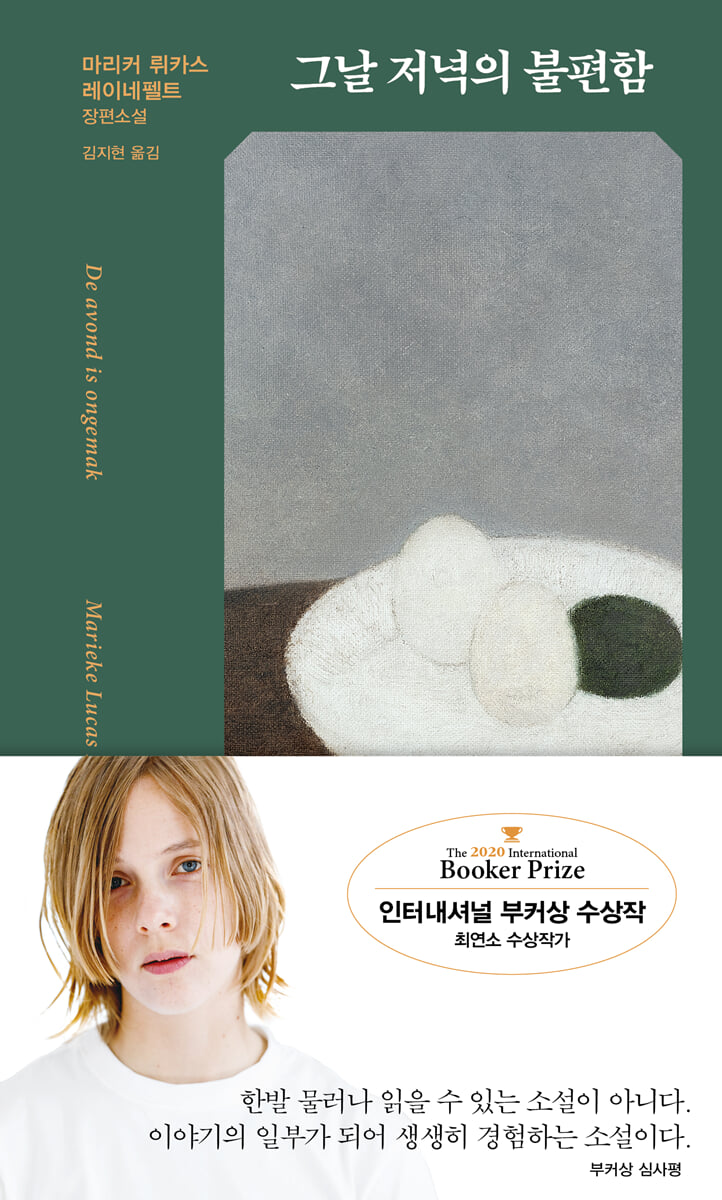
The discomfort of that evening
 |
Description
Book Introduction
2020 International Booker Prize Winner “It’s not a novel you can read by taking a step back. “It is a novel that makes you feel like you are part of the story.” The 2020 Booker International Awards ceremony was held virtually to prevent the spread of the virus. An unfamiliar face was featured on the screen, beating out prominent writers like Daniel Kelman, Yoko Ogawa, and Samantha Schweblin. This is twenty-nine-year-old Dutch writer Marike Lucas Reineveld. "The Discomfort of That Evening" was the author's first novel, and it didn't win many awards. The Netherlands, which produced the youngest ever winner, was swept up in a celebratory mood, and the media was eager to cover the 'surprise winner'. The novel begins in a rural Dutch village on a winter day a few days before Christmas. Ten-year-old farm boy Yas spends his day observing toads and caring for cows as usual. That morning, my older brother, Matthis, went to the reclaimed land skating competition. “I’ll be back before it gets dark!” my brother said, but that was his last goodbye. Because the weather was warm, the ice was thinner and no one saw Matthis, who was in the lead, fall out. The once sparkling Christmas tree was taken out of the house, and Yas's life became dark. The parents are too overwhelmed to care for their children because they are struggling to cope with their own loss, and Yas, gripped by the fear of loss, cannot take off the red coat he was wearing that day even in midsummer. Even holding in stool. Soon after, foot-and-mouth disease spreads throughout the village, and over a hundred cows are culled. Yasu wants to understand somehow. The sadness that was still vivid, the violence that occasionally surged up, the sexual desire that tickled my stomach, the extreme cold and pain that my brother Mathis must have felt that day. The ten-year-old girl Yasu's gaze looks at everything with unfamiliarity, as if 'a newborn were seeing it for the first time,' as the Booker Prize judges put it. The world reflected in those eyes is a ruin. Children are too young to understand death, and Yas's parents can't even take care of themselves. No parent can endure the death of a child, but parents who have maintained a strict ascetic lifestyle, especially those who have followed the words of the Bible, regard the death of their eldest son as a kind of punishment or curse. Even at a scene where all the cows they raised with love and care are being slaughtered, parents do not turn a blind eye to their children. Children who are separated from adult care often harm small animals, sexually harass friends and siblings, and ultimately harm themselves, all without realizing the consequences of their actions. As the title, “The Discomfort of That Evening,” suggests, the novel leads the reader into the midst of the ruins without a moment’s hesitation. |
- You can preview some of the book's contents.
Preview
Detailed image

Into the book
“I want to go to the other side too.”
I whispered.
“I’ll take you when you grow up.”
My brother wore a fur hat and smiled.
A zigzag blue rubber band was revealed on the braces.
“I’ll come before it gets dark.”
My brother shouted at my mother.
Then he turned back to the doorway, looked at me, and waved.
From now on, I will keep recalling this memory over and over again.
To the point where I couldn't lift my brother's arm in my memory, or rather, to the point where I doubted whether we had even said goodbye in the first place.
--- p.16
Later, I often thought that this was when the emptiness began.
It wasn't because of the death of my brother, Mathis, but because of the two days of Christmas that had passed away, left in a pot and an empty Russian salad tin.
--- p.34
My mom never touches me while she's serving me an omelet.
Our bodies don't even touch by chance.
I take one step back, then another.
Grief creeps up one's spine.
Mom's back is getting more and more bent.
--- p.80
The sadness that flowed from my father resembled the thin dung and blood that came from dead cows.
The feces and blood flow between the tiles and reach the drain, where they mix with the milk coming from the cooling tank.
--- p.236
It is said that ants can carry weights 5,000 times heavier than their own body weight.
Human abilities are insignificant compared to that.
People can barely lift something their own weight, and they can't even bear the weight of their own sorrow.
--- p.261
It's quiet all around.
At one point, I could hear my father patting my mother's back as if he was shaking off a carpet.
As if trying to shake off all the grayness, the dust of daily life, and the sadness that had settled down all day, my mother had inhaled.
--- p.322
Only the violence within me makes noise.
The noise is getting louder.
Just like sadness.
As Beller says, only sorrow needs space.
Violence, on the other hand, just takes up space.
I take the dead moth from my hand and let it fall into the snow.
And the boots push the snow over it with their feet.
It is a cold tomb.
I whispered.
“I’ll take you when you grow up.”
My brother wore a fur hat and smiled.
A zigzag blue rubber band was revealed on the braces.
“I’ll come before it gets dark.”
My brother shouted at my mother.
Then he turned back to the doorway, looked at me, and waved.
From now on, I will keep recalling this memory over and over again.
To the point where I couldn't lift my brother's arm in my memory, or rather, to the point where I doubted whether we had even said goodbye in the first place.
--- p.16
Later, I often thought that this was when the emptiness began.
It wasn't because of the death of my brother, Mathis, but because of the two days of Christmas that had passed away, left in a pot and an empty Russian salad tin.
--- p.34
My mom never touches me while she's serving me an omelet.
Our bodies don't even touch by chance.
I take one step back, then another.
Grief creeps up one's spine.
Mom's back is getting more and more bent.
--- p.80
The sadness that flowed from my father resembled the thin dung and blood that came from dead cows.
The feces and blood flow between the tiles and reach the drain, where they mix with the milk coming from the cooling tank.
--- p.236
It is said that ants can carry weights 5,000 times heavier than their own body weight.
Human abilities are insignificant compared to that.
People can barely lift something their own weight, and they can't even bear the weight of their own sorrow.
--- p.261
It's quiet all around.
At one point, I could hear my father patting my mother's back as if he was shaking off a carpet.
As if trying to shake off all the grayness, the dust of daily life, and the sadness that had settled down all day, my mother had inhaled.
--- p.322
Only the violence within me makes noise.
The noise is getting louder.
Just like sadness.
As Beller says, only sorrow needs space.
Violence, on the other hand, just takes up space.
I take the dead moth from my hand and let it fall into the snow.
And the boots push the snow over it with their feet.
It is a cold tomb.
--- p.326
Publisher's Review
2020 International Booker Prize Winner ★ Youngest Winner
This is not a novel you can read by taking a step back.
It is a novel that makes you feel like you are part of the story.
_Booker Prize Judges' Comments
The Booker International Awards Ceremony, held virtually on August 26, 2020, to prevent the spread of the virus.
An unfamiliar face was featured on the screen, beating out prominent writers like Daniel Kelman, Yoko Ogawa, and Samantha Schweblin.
This is twenty-nine-year-old Dutch writer Marike Lucas Reineveld.
As seen in the cases of Korean author Han Kang, who won the prize in 2016, Israeli literary giant David Grossman, who won the prize in 2017, and Olga Tokarczuk, who also won the Nobel Prize in Literature in 2018, the International Booker Prize has been awarded primarily to writers with a strong foundation in their home countries.
However, "The Discomfort of That Evening" was the author's first novel and did not win many awards.
The Netherlands, which produced the youngest ever winner, was swept up in a celebratory mood, and the media was eager to cover the 'surprise winner'.
“I am ten years old.
Since that day, I haven't been able to take my coat off.
The novel begins in a rural Dutch village on a winter day a few days before Christmas.
Ten-year-old farm boy Yas spends his day observing toads and caring for cows as usual.
That morning, my older brother, Matthis, went to the reclaimed land skating competition.
“I’ll be back before it gets dark!” my brother said, but that was his last goodbye.
Because the weather was warm, the ice was thinner and no one saw Matthis, who was in the lead, fall out.
The once sparkling Christmas tree was taken out of the house, and Yas's life became dark.
The parents are too overwhelmed to care for their children because they are struggling to cope with their own loss, and Yas, gripped by the fear of loss, cannot take off the red coat he was wearing that day even in midsummer.
Even holding in stool.
Soon after, foot-and-mouth disease spreads throughout the village, and over a hundred cows are culled.
Yasu wants to understand somehow.
The sadness that was still vivid, the violence that occasionally surged up, the sexual desire that tickled my stomach, the extreme cold and pain that my brother Mathis must have felt that day.
Grief creeps up one's spine.
Mom's back is getting more and more bent.
_Page 80
The sadness that flowed from my father resembled the thin dung and blood that came from dead cows.
_Page 236
Can we confront suffering by understanding it?
How much sorrow must there be before death seems safer than life?
Part 1, where ordinary days are shattered by the death of an older brother; Part 2, where culling and death run rampant after foot-and-mouth disease sweeps the village; and Part 3, where all of these things are swept up and engulfed in chaos.
The ten-year-old girl Yasu's gaze looks at everything with unfamiliarity, as if 'a newborn were seeing it for the first time,' as the Booker Prize judges put it.
The world reflected in those eyes is a ruin.
Children are too young to understand death, and Yas's parents can't even take care of themselves.
No parent can endure the death of a child, but parents who have maintained a strict ascetic lifestyle, especially those who have followed the words of the Bible, regard the death of their eldest son as a kind of punishment or curse.
Even at a scene where all the cows they raised with love and care are being slaughtered, parents do not turn a blind eye to their children.
Children who are separated from adult care often harm small animals, sexually harass friends and siblings, and ultimately harm themselves, all without realizing the consequences of their actions.
As the title, “The Discomfort of That Evening,” suggests, the novel leads the reader into the midst of the ruins without a moment’s hesitation.
A novel that delves into the wounds without looking at the scars.
A new and clear voice suggesting the future of literature
The Discomfort of That Evening is Marike Lucas Reinefeldt's first novel, published when she was twenty-seven.
Although he won the International Booker Prize, one of the world's top three literary awards, for this work, his family is still not happy about this fact.
“Even when I was nominated for the Booker Prize and the whole town was talking about my book, my family was too scared to read it,” Reinefeldt said. “It’s actually a family misfortune when a writer is born.”
Like Yas's family in the novel, the author's family also farmed, raised livestock, and strictly observed the words of the Bible.
And the author also lost her older brother when she was three years old.
The novel, “The Discomfort of That Evening,” was written over a period of six years based on the experience of that loss.
It wasn't just his novels that his family couldn't accept.
Reinefeldt identifies as genderqueer and "nonbinary," meaning outside the binary of male and female.
His middle name, 'Lucas', was also given to him by himself.
This also took a long time to be accepted by the family.
The changes that began with writing helped the writer grow and become more disciplined.
“To write is to play with oneself.
“I only become stronger when I am in front of my laptop.” This is how a new voice that has captured the world’s attention was born.
Look at this little world consumed by pain.
It may be hard to face it, but it will be even harder to pretend not to see it.
Kirkus Review
A completely new voice emerged, uninhibited, bold, and irreverent.
The New York Times
A childhood epic filled with overwhelming sadness, madness, death, incest, cruelty and despair.
But the explosive power of this novel lies not in its shock, but in the author's straightforward and elegant writing style.
The Wall Street Journal
A must-read and must-memorize book.
The sadness of this story has a unique power.
The Economist
Realistic desolation and surreal darkness, poetic and refined language.
The Guardian
It conveys Grand Guignol-like grotesqueness with a restrained narrative.
The Times
This is not a novel you can read by taking a step back.
It is a novel that makes you feel like you are part of the story.
_Booker Prize Judges' Comments
The Booker International Awards Ceremony, held virtually on August 26, 2020, to prevent the spread of the virus.
An unfamiliar face was featured on the screen, beating out prominent writers like Daniel Kelman, Yoko Ogawa, and Samantha Schweblin.
This is twenty-nine-year-old Dutch writer Marike Lucas Reineveld.
As seen in the cases of Korean author Han Kang, who won the prize in 2016, Israeli literary giant David Grossman, who won the prize in 2017, and Olga Tokarczuk, who also won the Nobel Prize in Literature in 2018, the International Booker Prize has been awarded primarily to writers with a strong foundation in their home countries.
However, "The Discomfort of That Evening" was the author's first novel and did not win many awards.
The Netherlands, which produced the youngest ever winner, was swept up in a celebratory mood, and the media was eager to cover the 'surprise winner'.
“I am ten years old.
Since that day, I haven't been able to take my coat off.
The novel begins in a rural Dutch village on a winter day a few days before Christmas.
Ten-year-old farm boy Yas spends his day observing toads and caring for cows as usual.
That morning, my older brother, Matthis, went to the reclaimed land skating competition.
“I’ll be back before it gets dark!” my brother said, but that was his last goodbye.
Because the weather was warm, the ice was thinner and no one saw Matthis, who was in the lead, fall out.
The once sparkling Christmas tree was taken out of the house, and Yas's life became dark.
The parents are too overwhelmed to care for their children because they are struggling to cope with their own loss, and Yas, gripped by the fear of loss, cannot take off the red coat he was wearing that day even in midsummer.
Even holding in stool.
Soon after, foot-and-mouth disease spreads throughout the village, and over a hundred cows are culled.
Yasu wants to understand somehow.
The sadness that was still vivid, the violence that occasionally surged up, the sexual desire that tickled my stomach, the extreme cold and pain that my brother Mathis must have felt that day.
Grief creeps up one's spine.
Mom's back is getting more and more bent.
_Page 80
The sadness that flowed from my father resembled the thin dung and blood that came from dead cows.
_Page 236
Can we confront suffering by understanding it?
How much sorrow must there be before death seems safer than life?
Part 1, where ordinary days are shattered by the death of an older brother; Part 2, where culling and death run rampant after foot-and-mouth disease sweeps the village; and Part 3, where all of these things are swept up and engulfed in chaos.
The ten-year-old girl Yasu's gaze looks at everything with unfamiliarity, as if 'a newborn were seeing it for the first time,' as the Booker Prize judges put it.
The world reflected in those eyes is a ruin.
Children are too young to understand death, and Yas's parents can't even take care of themselves.
No parent can endure the death of a child, but parents who have maintained a strict ascetic lifestyle, especially those who have followed the words of the Bible, regard the death of their eldest son as a kind of punishment or curse.
Even at a scene where all the cows they raised with love and care are being slaughtered, parents do not turn a blind eye to their children.
Children who are separated from adult care often harm small animals, sexually harass friends and siblings, and ultimately harm themselves, all without realizing the consequences of their actions.
As the title, “The Discomfort of That Evening,” suggests, the novel leads the reader into the midst of the ruins without a moment’s hesitation.
A novel that delves into the wounds without looking at the scars.
A new and clear voice suggesting the future of literature
The Discomfort of That Evening is Marike Lucas Reinefeldt's first novel, published when she was twenty-seven.
Although he won the International Booker Prize, one of the world's top three literary awards, for this work, his family is still not happy about this fact.
“Even when I was nominated for the Booker Prize and the whole town was talking about my book, my family was too scared to read it,” Reinefeldt said. “It’s actually a family misfortune when a writer is born.”
Like Yas's family in the novel, the author's family also farmed, raised livestock, and strictly observed the words of the Bible.
And the author also lost her older brother when she was three years old.
The novel, “The Discomfort of That Evening,” was written over a period of six years based on the experience of that loss.
It wasn't just his novels that his family couldn't accept.
Reinefeldt identifies as genderqueer and "nonbinary," meaning outside the binary of male and female.
His middle name, 'Lucas', was also given to him by himself.
This also took a long time to be accepted by the family.
The changes that began with writing helped the writer grow and become more disciplined.
“To write is to play with oneself.
“I only become stronger when I am in front of my laptop.” This is how a new voice that has captured the world’s attention was born.
Look at this little world consumed by pain.
It may be hard to face it, but it will be even harder to pretend not to see it.
Kirkus Review
A completely new voice emerged, uninhibited, bold, and irreverent.
The New York Times
A childhood epic filled with overwhelming sadness, madness, death, incest, cruelty and despair.
But the explosive power of this novel lies not in its shock, but in the author's straightforward and elegant writing style.
The Wall Street Journal
A must-read and must-memorize book.
The sadness of this story has a unique power.
The Economist
Realistic desolation and surreal darkness, poetic and refined language.
The Guardian
It conveys Grand Guignol-like grotesqueness with a restrained narrative.
The Times
GOODS SPECIFICS
- Publication date: November 22, 2021
- Format: Hardcover book binding method guide
- Page count, weight, size: 340 pages | 408g | 131*216*20mm
- ISBN13: 9788934979999
- ISBN10: 8934979992
You may also like
카테고리
korean


korean

![GQ KOREA Mark (Monthly): December [2025]](http://librairie.coreenne.fr/cdn/shop/files/8ef265dbbfbf186523ed75ba7319009d.jpg?v=1765340328&width=3840)


