

The Ghost of the Grand Buddha Hotel
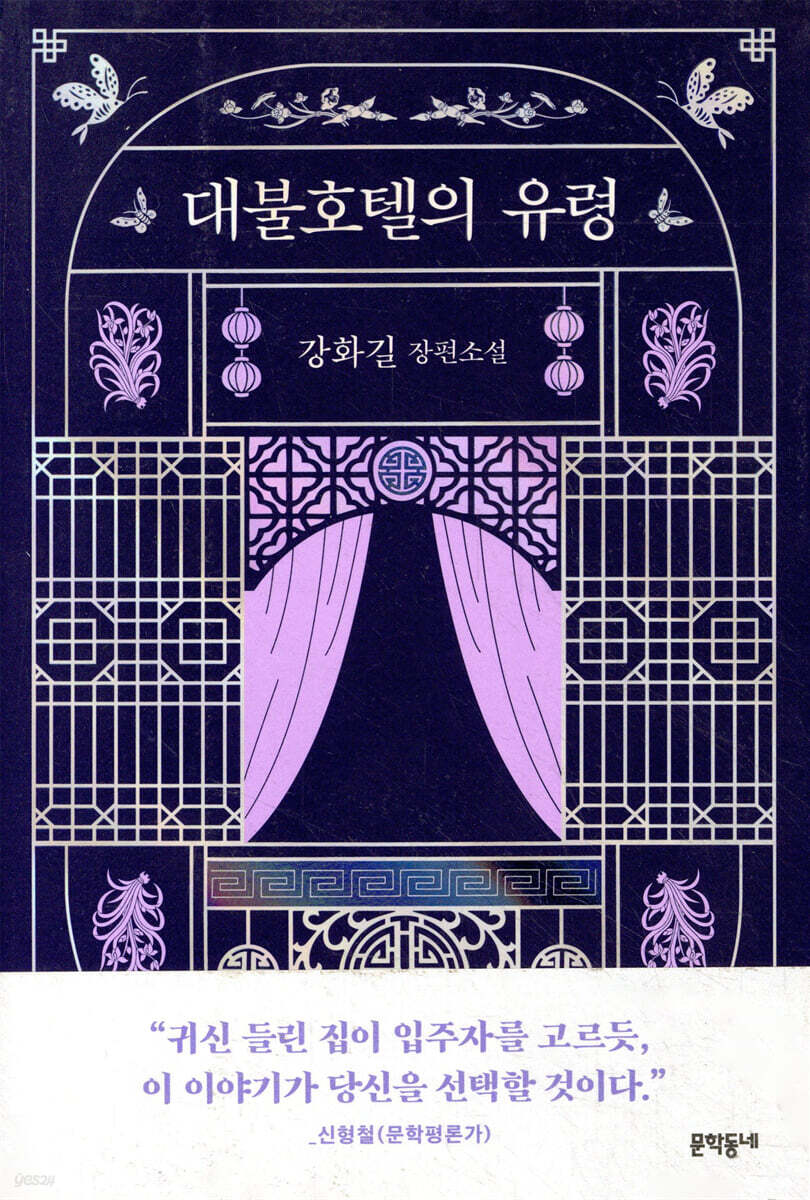 |
Description
Book Introduction
- A word from MD
-
A well-made gothic horror film by Kang Hwa-gilThe novel begins with the confession of a novelist who is cursed by an evil spirit, and continues with the story of those who are drawn to the haunted 'Daebul Hotel'.
Readers invited into this chilling space, where malice, resentment, and hatred are intertwined, will experience a tension that cannot be easily escaped, and will even experience walking out of it on their own.
August 10, 2021. Novel/Poetry PD Park Hyung-wook
The evolution of Kang Hwa-gil's novel world, winner of the 2020 Young Writer's Award!
Kang Hwa-gil, who won the grand prize at the 2020 Young Writer's Award for her short story "Eumbok (飮福)" and became a representative Korean female thriller novelist, has published her second full-length novel, "The Ghost of the Daebul Hotel."
Through her first collection of short stories, "A Good Person," and her first full-length novel, "Another Person," the author shed light on the social problem of violence that is closely tied to women's daily lives. In her second collection of short stories, "White Horse," she highlighted the enormous, invisible structure that has oppressed and limited women's lives.
Kang Hwa-gil's novel effectively conveys this thematic awareness by allowing readers to sense the characters' anxiety and fear within the thriller narrative.
Starting from the phenomenon of hatred and continuing his journey to uncover its essence, Kang Hwa-gil successfully novelizes the emotion of "resentment" that lies at the bottom of Korean society in "The Ghost of the Grand Hotel."
This story, which depicts the terrifying experiences of four people who are drawn to the haunted building, the Daebul Hotel, in the 1950s, when the scars of the Korean War still dominate the nation, is a gothic horror novel in the style of Kang Hwa-gil that overlaps the dark feelings each character had to harbor in order to survive with psychic phenomena.
While reading this novel, the reader experiences the deep-rooted emotions that have been passed down within him being touched.
The chilling realization that one might also be caught in that eternal curse that causes people to harm each other because they cannot trust each other washes away the midsummer heat.
Kang Hwa-gil, who won the grand prize at the 2020 Young Writer's Award for her short story "Eumbok (飮福)" and became a representative Korean female thriller novelist, has published her second full-length novel, "The Ghost of the Daebul Hotel."
Through her first collection of short stories, "A Good Person," and her first full-length novel, "Another Person," the author shed light on the social problem of violence that is closely tied to women's daily lives. In her second collection of short stories, "White Horse," she highlighted the enormous, invisible structure that has oppressed and limited women's lives.
Kang Hwa-gil's novel effectively conveys this thematic awareness by allowing readers to sense the characters' anxiety and fear within the thriller narrative.
Starting from the phenomenon of hatred and continuing his journey to uncover its essence, Kang Hwa-gil successfully novelizes the emotion of "resentment" that lies at the bottom of Korean society in "The Ghost of the Grand Hotel."
This story, which depicts the terrifying experiences of four people who are drawn to the haunted building, the Daebul Hotel, in the 1950s, when the scars of the Korean War still dominate the nation, is a gothic horror novel in the style of Kang Hwa-gil that overlaps the dark feelings each character had to harbor in order to survive with psychic phenomena.
While reading this novel, the reader experiences the deep-rooted emotions that have been passed down within him being touched.
The chilling realization that one might also be caught in that eternal curse that causes people to harm each other because they cannot trust each other washes away the midsummer heat.
- You can preview some of the book's contents.
Preview
index
Prologue | 009
Part 1 | 013
Part 2 | 081
Part 3 | 243
Epilogue | 300
Author's Note | 307
Part 1 | 013
Part 2 | 081
Part 3 | 243
Epilogue | 300
Author's Note | 307
Detailed image
.jpg)
Into the book
idiot.
How dare you come in here without permission.
You're always like that.
It will be like that in the future too.
(…) Listen carefully.
From now on, you will live like this.
Forever as long as I am here.
Everything you have achieved, everything you will achieve, will all fall apart anyway.
That's not yours.
You will lose everything.
It looks good.
It's so pretty.
So you shouldn't have made that mistake.
I shouldn't have been hated.
It's all your fault.
Honey, it's really your fault.
I warned you so.
It looks good.
It's so pretty.
Oh, okay.
I love it! ...
This fucking bitch.
You are nothing.
You won't be able to write anything.
--- p.53-54
I muttered in my head.
What matters is my resentment.
It's about giving this back.
If that's possible, anything is possible.
I'll try.
Let's give it a try.
--- p.65
I found this story creepy.
Why? Because this is a story about killing and killing and killing people until their grudge is satisfied.
That's what resentment is.
A heart that won't be broken until it's broken.
Last night, I felt that resentment.
(…) I knew.
That all the nightmares up until now were not dreams.
I was left among the things left behind.
I was thrown there.
I felt it when I realized it.
This building harbors deep malice! It will never stop until it gets what it wants.
--- p.142-143
The Daebul Hotel makes people fall apart.
Let's tear them apart, one by one.
It's telling you the reality.
It reveals what we fear most.
Being left alone.
Telling my story only to myself.
--- p.207-208
You don't want to hold a grudge?
You don't want to live like that?
That's not something you can choose.
Anyway, the resentment will come to me.
They choose me.
--- p.234
I hated the fact that they wanted to kick me out.
Why? Why me of all people? I felt a surge of anger welling up in me.
What did I do wrong? Was it wrong for me to be me? Was it wrong for me to live as myself? The world had changed, but I remained the same.
Why is that a problem?
I thought I knew what it meant to be filled with resentment.
--- p.237
The beginning is always beautiful.
Everything is like that.
But anything can go wrong at any time.
We live under such threats all the time.
How dare you come in here without permission.
You're always like that.
It will be like that in the future too.
(…) Listen carefully.
From now on, you will live like this.
Forever as long as I am here.
Everything you have achieved, everything you will achieve, will all fall apart anyway.
That's not yours.
You will lose everything.
It looks good.
It's so pretty.
So you shouldn't have made that mistake.
I shouldn't have been hated.
It's all your fault.
Honey, it's really your fault.
I warned you so.
It looks good.
It's so pretty.
Oh, okay.
I love it! ...
This fucking bitch.
You are nothing.
You won't be able to write anything.
--- p.53-54
I muttered in my head.
What matters is my resentment.
It's about giving this back.
If that's possible, anything is possible.
I'll try.
Let's give it a try.
--- p.65
I found this story creepy.
Why? Because this is a story about killing and killing and killing people until their grudge is satisfied.
That's what resentment is.
A heart that won't be broken until it's broken.
Last night, I felt that resentment.
(…) I knew.
That all the nightmares up until now were not dreams.
I was left among the things left behind.
I was thrown there.
I felt it when I realized it.
This building harbors deep malice! It will never stop until it gets what it wants.
--- p.142-143
The Daebul Hotel makes people fall apart.
Let's tear them apart, one by one.
It's telling you the reality.
It reveals what we fear most.
Being left alone.
Telling my story only to myself.
--- p.207-208
You don't want to hold a grudge?
You don't want to live like that?
That's not something you can choose.
Anyway, the resentment will come to me.
They choose me.
--- p.234
I hated the fact that they wanted to kick me out.
Why? Why me of all people? I felt a surge of anger welling up in me.
What did I do wrong? Was it wrong for me to be me? Was it wrong for me to live as myself? The world had changed, but I remained the same.
Why is that a problem?
I thought I knew what it meant to be filled with resentment.
--- p.237
The beginning is always beautiful.
Everything is like that.
But anything can go wrong at any time.
We live under such threats all the time.
--- p.277
Publisher's Review
“This is almost everything Kang Hwa-gil can do now,
“Perhaps it is something that only Kang Hwa-gil can do.”
Shin Hyeong-cheol (literary critic)
The evolution of Kang Hwa-gil's novel world, winner of the 2020 Young Writer's Award!
Kang Hwa-gil, who won the grand prize at the 2020 Young Writer's Award for her short story "Eumbok (飮福)" and became a representative Korean female thriller novelist, has published her second full-length novel, "The Ghost of the Daebul Hotel."
Through her first collection of short stories, "A Good Person," and her first full-length novel, "Another Person," the author shed light on the social problem of violence that is closely tied to women's daily lives. In her second collection of short stories, "White Horse," she highlighted the enormous, invisible structure that has oppressed and limited women's lives.
Kang Hwa-gil's novel effectively conveys this thematic awareness by allowing readers to sense the characters' anxiety and fear within the thriller narrative.
Starting from the phenomenon of hatred and continuing his journey to uncover its essence, Kang Hwa-gil successfully novelizes the emotion of "resentment" that lies at the bottom of Korean society in "The Ghost of the Grand Hotel."
This story, which depicts the terrifying experiences of four people who are drawn to the haunted building, the Daebul Hotel, in the 1950s, when the scars of the Korean War still dominate the nation, is a gothic horror novel in the style of Kang Hwa-gil that overlaps the dark feelings each character had to harbor in order to survive with psychic phenomena.
While reading this novel, the reader experiences the deep-rooted emotions that have been passed down within him being touched.
The chilling realization that one might also be caught in that eternal curse that causes people to harm each other because they cannot trust each other washes away the midsummer heat.
A novel written by a novelist possessed by a demon
Can you avoid being infected by this curse?
The story begins with the confession of the novelist narrator, 'I'.
'I', who is reminiscent of the real writer Kang Hwa-gil, reveals a shocking experience.
The truth is that he was once possessed by an evil spirit, and because of that, he was interrupted by malicious voices whenever he tried to write a novel called "Nicola's Kindergarten."
That voice cursed me every time I tried to accomplish something, every time I tried to move forward in a relationship with someone precious to me.
'I', who was suffering from a life that was becoming increasingly more depressing, gradually became infected with malice and decided to write a novel filled with even deeper malice to crush the curse.
What can't I do?
Isn't that right? I gritted my teeth as I looked at the rising sun.
okay.
I will hold a grudge too.
To you guys.
Right to you.
I'll give you that disgusting voice back.
I will write a novel somehow.
I will definitely use it.
I'm going to write it very eccentrically.
I will write a story full of cruel and evil emotions. (Page 57)
Then, at that moment, my friend Jin brings up an interesting story.
The atmosphere of the Nicola Kindergarten that 'I' am talking about is similar to the scenery of the Daebul Hotel site in Incheon.
The building, which was Korea's first Western-style hotel, was later taken over by Chinese immigrants and turned into a Chinese restaurant, but ultimately remained in ruins for a long time.
'I', who visited the site of the Daebul Hotel with Jin, saw a vision of a strange woman there, and Jin told her that the woman's appearance was similar to that of a woman who died at the Daebul Hotel in the past.
'I', who decided to investigate the death that occurred at the Daebul Hotel, asked Jin's maternal grandmother 'Park Ji-woon', who knew about the incident, to tell the story, and brought the ghost that was wandering around the Daebul Hotel into his novel.
“The three of them stood together over there, as if comforting each other.
And I was standing here.”
The old story that unfolds is set in the Daebul Hotel in Incheon in 1955.
In the novel written by 'I', the Daebul Hotel reopens on a small scale on the third floor of a Chinese restaurant building, and the person in charge of its operation is a young woman named 'Go Yeon-ju'.
Rumor has it that anyone who tries to harm her will fall down the haunted stairs of the Daebul Hotel and break their necks or suffer serious injuries.
People gossip about Ko Yeon-ju, but secretly they are afraid of her.
However, Ji Young-hyun, who is temporarily employed by Go Yeon-ju to work as a solicitor, admires Go Yeon-ju.
Ji Young-hyun's hometown, Wolmido, became a place of death and destruction due to extreme left-right conflict during the war, and Ji Young-hyun, who lived with her parents who were involved in left-wing activities, had to secretly escape from there.
In Ji Young-hyun's eyes, Go Yeon-ju is a person who has regained peace of mind by protecting her place of existence, and is a being protected by a ghost.
People said.
They say Yeonju is possessed by a ghost.
They say you have a strong fate.
But Yeonju survived in the end.
The ghost that possessed her broke the necks of those who tried to harm her.
I pushed him down the stairs.
No one could kick her out, and no one chased her.
Couldn't harass him.
And she came back, grabbing the scruff of her neck instead.
okay.
Yeonju was the real owner of this building.
Whoever is protected by these solid and magnificent walls! Oh, if only I could be like that.
If only ghosts would eat me 'equally'. (Page 104)
Then one day, an American comes to stay long-term at the Daebul Hotel, and Ji Young-hyun starts living with Go Yeon-ju at the Daebul Hotel and starts to take full charge of the hotel business.
The American's name is 'Shirley Jackson', a novelist who visited a haunted house to write a story about a haunted house.
But as Shirley opens up about her bizarre experiences at the Grand Hotel, the narrative begins to tighten with tension.
Not only Shirley, but also Go Yeon-ju, and even the Chinese man 'Lou Yi-han' who works at a Chinese restaurant and lives in the kitchen, all those staying at the Daebul Hotel suffer from hallucinations that can only be attributed to ghosts, and feel a fear that they will be trapped in the building forever.
But nothing happens to Ji Young-hyun, who wants to settle down in the Daebul Hotel more than anyone else.
Why do you appear like that? Are you angry? Are you lonely? Why do you want to tie them down? Why do you only do this to them? What grudge do you hold? Do you intend to keep it from being resolved? Only to them? Only to them? (p. 171)
Ji Young-hyun, feeling isolated and alone, becomes increasingly emotionally twisted, and eventually begins to vent her resentment on those she spends time with.
Along with it, countless ills erupt, fueled by the madness of time: hatred between the left and the right, Koreans' hatred of overseas Chinese, and the world's hostility toward young women trying to carve out a path for themselves.
In this world, can Ko Yeon-ju, Shirley Jackson, and Roy Han break the curse of the Daebul Hotel?
Will Ji Young-hyun be able to remain in the comfortable Daebul Hotel and find peace of mind forever?
And after the story surrounding the Daebul Hotel is concluded, the novelist 'I' hears the story behind the incident from a third party that he had not heard from Park Ji-woon.
The novel takes a completely new turn when it is revealed that a surprising secret was hidden in the scenes erased or left blank in Park Ji-woon's oral history.
“You wouldn’t have to judge anything without me,
“I can write anything without you.”
As can be sensed from the title and main setting, this novel is also an homage to Shirley Jackson's novel The Haunting of Hill House.
Considering that 『The Phantom of the Grand Hotel』 is a metanovel that features the author himself as the narrator, and that Kang Hwa-gil is currently actively writing Gothic novels, it is possible to infer that while writing this novel, he overlapped Shirley Jackson's life with his own life as a novelist.
When read in this way, the movement of the novelist 'I', who, like Shirley Jackson, tries to continue writing her own novels while overcoming the burdens thrown at her from the outside and the oppressive voice resonating within herself, becomes even more precious.
What is most important is that Kang Hwa-gil's novel goes beyond depicting hatred and begins to speak of a greater emotion: "love that embraces hatred."
"The Ghost of the Grand Buddha Hotel" is a story about walking into a haunted house, but it is also a story about ultimately escaping from it.
If Kang Hwa-gil's novels thus far have heightened psychological tension to the climax and concluded at that point, this work continues the narrative until that tension is resolved and transformed into emotion.
By guiding readers into the story after they are released from the novel rather than confining them forever, Kang Hwa-gil's novels are now moving into a new phase of their own.
“Perhaps it is something that only Kang Hwa-gil can do.”
Shin Hyeong-cheol (literary critic)
The evolution of Kang Hwa-gil's novel world, winner of the 2020 Young Writer's Award!
Kang Hwa-gil, who won the grand prize at the 2020 Young Writer's Award for her short story "Eumbok (飮福)" and became a representative Korean female thriller novelist, has published her second full-length novel, "The Ghost of the Daebul Hotel."
Through her first collection of short stories, "A Good Person," and her first full-length novel, "Another Person," the author shed light on the social problem of violence that is closely tied to women's daily lives. In her second collection of short stories, "White Horse," she highlighted the enormous, invisible structure that has oppressed and limited women's lives.
Kang Hwa-gil's novel effectively conveys this thematic awareness by allowing readers to sense the characters' anxiety and fear within the thriller narrative.
Starting from the phenomenon of hatred and continuing his journey to uncover its essence, Kang Hwa-gil successfully novelizes the emotion of "resentment" that lies at the bottom of Korean society in "The Ghost of the Grand Hotel."
This story, which depicts the terrifying experiences of four people who are drawn to the haunted building, the Daebul Hotel, in the 1950s, when the scars of the Korean War still dominate the nation, is a gothic horror novel in the style of Kang Hwa-gil that overlaps the dark feelings each character had to harbor in order to survive with psychic phenomena.
While reading this novel, the reader experiences the deep-rooted emotions that have been passed down within him being touched.
The chilling realization that one might also be caught in that eternal curse that causes people to harm each other because they cannot trust each other washes away the midsummer heat.
A novel written by a novelist possessed by a demon
Can you avoid being infected by this curse?
The story begins with the confession of the novelist narrator, 'I'.
'I', who is reminiscent of the real writer Kang Hwa-gil, reveals a shocking experience.
The truth is that he was once possessed by an evil spirit, and because of that, he was interrupted by malicious voices whenever he tried to write a novel called "Nicola's Kindergarten."
That voice cursed me every time I tried to accomplish something, every time I tried to move forward in a relationship with someone precious to me.
'I', who was suffering from a life that was becoming increasingly more depressing, gradually became infected with malice and decided to write a novel filled with even deeper malice to crush the curse.
What can't I do?
Isn't that right? I gritted my teeth as I looked at the rising sun.
okay.
I will hold a grudge too.
To you guys.
Right to you.
I'll give you that disgusting voice back.
I will write a novel somehow.
I will definitely use it.
I'm going to write it very eccentrically.
I will write a story full of cruel and evil emotions. (Page 57)
Then, at that moment, my friend Jin brings up an interesting story.
The atmosphere of the Nicola Kindergarten that 'I' am talking about is similar to the scenery of the Daebul Hotel site in Incheon.
The building, which was Korea's first Western-style hotel, was later taken over by Chinese immigrants and turned into a Chinese restaurant, but ultimately remained in ruins for a long time.
'I', who visited the site of the Daebul Hotel with Jin, saw a vision of a strange woman there, and Jin told her that the woman's appearance was similar to that of a woman who died at the Daebul Hotel in the past.
'I', who decided to investigate the death that occurred at the Daebul Hotel, asked Jin's maternal grandmother 'Park Ji-woon', who knew about the incident, to tell the story, and brought the ghost that was wandering around the Daebul Hotel into his novel.
“The three of them stood together over there, as if comforting each other.
And I was standing here.”
The old story that unfolds is set in the Daebul Hotel in Incheon in 1955.
In the novel written by 'I', the Daebul Hotel reopens on a small scale on the third floor of a Chinese restaurant building, and the person in charge of its operation is a young woman named 'Go Yeon-ju'.
Rumor has it that anyone who tries to harm her will fall down the haunted stairs of the Daebul Hotel and break their necks or suffer serious injuries.
People gossip about Ko Yeon-ju, but secretly they are afraid of her.
However, Ji Young-hyun, who is temporarily employed by Go Yeon-ju to work as a solicitor, admires Go Yeon-ju.
Ji Young-hyun's hometown, Wolmido, became a place of death and destruction due to extreme left-right conflict during the war, and Ji Young-hyun, who lived with her parents who were involved in left-wing activities, had to secretly escape from there.
In Ji Young-hyun's eyes, Go Yeon-ju is a person who has regained peace of mind by protecting her place of existence, and is a being protected by a ghost.
People said.
They say Yeonju is possessed by a ghost.
They say you have a strong fate.
But Yeonju survived in the end.
The ghost that possessed her broke the necks of those who tried to harm her.
I pushed him down the stairs.
No one could kick her out, and no one chased her.
Couldn't harass him.
And she came back, grabbing the scruff of her neck instead.
okay.
Yeonju was the real owner of this building.
Whoever is protected by these solid and magnificent walls! Oh, if only I could be like that.
If only ghosts would eat me 'equally'. (Page 104)
Then one day, an American comes to stay long-term at the Daebul Hotel, and Ji Young-hyun starts living with Go Yeon-ju at the Daebul Hotel and starts to take full charge of the hotel business.
The American's name is 'Shirley Jackson', a novelist who visited a haunted house to write a story about a haunted house.
But as Shirley opens up about her bizarre experiences at the Grand Hotel, the narrative begins to tighten with tension.
Not only Shirley, but also Go Yeon-ju, and even the Chinese man 'Lou Yi-han' who works at a Chinese restaurant and lives in the kitchen, all those staying at the Daebul Hotel suffer from hallucinations that can only be attributed to ghosts, and feel a fear that they will be trapped in the building forever.
But nothing happens to Ji Young-hyun, who wants to settle down in the Daebul Hotel more than anyone else.
Why do you appear like that? Are you angry? Are you lonely? Why do you want to tie them down? Why do you only do this to them? What grudge do you hold? Do you intend to keep it from being resolved? Only to them? Only to them? (p. 171)
Ji Young-hyun, feeling isolated and alone, becomes increasingly emotionally twisted, and eventually begins to vent her resentment on those she spends time with.
Along with it, countless ills erupt, fueled by the madness of time: hatred between the left and the right, Koreans' hatred of overseas Chinese, and the world's hostility toward young women trying to carve out a path for themselves.
In this world, can Ko Yeon-ju, Shirley Jackson, and Roy Han break the curse of the Daebul Hotel?
Will Ji Young-hyun be able to remain in the comfortable Daebul Hotel and find peace of mind forever?
And after the story surrounding the Daebul Hotel is concluded, the novelist 'I' hears the story behind the incident from a third party that he had not heard from Park Ji-woon.
The novel takes a completely new turn when it is revealed that a surprising secret was hidden in the scenes erased or left blank in Park Ji-woon's oral history.
“You wouldn’t have to judge anything without me,
“I can write anything without you.”
As can be sensed from the title and main setting, this novel is also an homage to Shirley Jackson's novel The Haunting of Hill House.
Considering that 『The Phantom of the Grand Hotel』 is a metanovel that features the author himself as the narrator, and that Kang Hwa-gil is currently actively writing Gothic novels, it is possible to infer that while writing this novel, he overlapped Shirley Jackson's life with his own life as a novelist.
When read in this way, the movement of the novelist 'I', who, like Shirley Jackson, tries to continue writing her own novels while overcoming the burdens thrown at her from the outside and the oppressive voice resonating within herself, becomes even more precious.
What is most important is that Kang Hwa-gil's novel goes beyond depicting hatred and begins to speak of a greater emotion: "love that embraces hatred."
"The Ghost of the Grand Buddha Hotel" is a story about walking into a haunted house, but it is also a story about ultimately escaping from it.
If Kang Hwa-gil's novels thus far have heightened psychological tension to the climax and concluded at that point, this work continues the narrative until that tension is resolved and transformed into emotion.
By guiding readers into the story after they are released from the novel rather than confining them forever, Kang Hwa-gil's novels are now moving into a new phase of their own.
GOODS SPECIFICS
- Publication date: August 13, 2021
- Page count, weight, size: 312 pages | 372g | 133*200*18mm
- ISBN13: 9788954681575
- ISBN10: 8954681573
You may also like
카테고리
korean


korean

![GQ KOREA Mark (Monthly): December [2025]](http://librairie.coreenne.fr/cdn/shop/files/8ef265dbbfbf186523ed75ba7319009d.jpg?v=1765340328&width=3840)


