

What we wrote
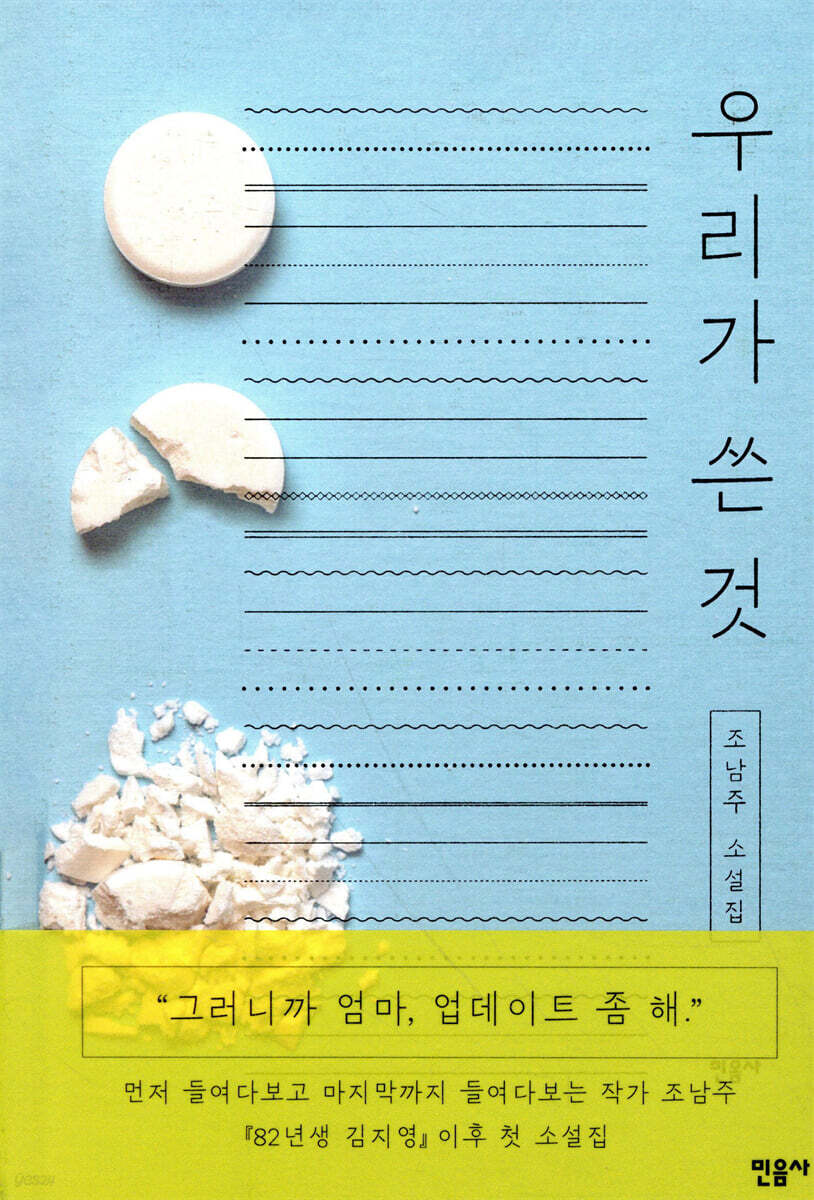 |
Description
Book Introduction
- A word from MD
-
Again, the lives of women today are told differently.Author Nam-Joo Cho's first novel collection.
Having presented a female narrative centered around 'Born in 1982', he now tells the story of the lives of women of a wider range of ages.
The novel addresses ongoing issues such as illegal filming, care work, and the lives of elderly women, and asks what we should ask and how we should share more today.
June 22, 2021. Novel/Poetry PD Park Hyung-wook
The first novel collection by Jo Nam-joo, author of "Kim Ji-young, Born 1982"
The lives of various women from youth to old age
Retelling to see things anew, telling stories differently
Author Nam-ju Cho's first short story collection, "What We Wrote," has been published.
If the million-seller "Kim Ji-young, Born 1982," which has been translated into 25 languages in 27 countries to date, was a women's narrative centered around those born in 1982, "What We Wrote" is an expanded women's narrative that rereads and reinterprets the life experiences of women of various ages, from eighty-year-olds to thirteen-year-old elementary school students.
This is why the first name of this book, in which the 'Kim Ji-youngs' belonging to various time periods are connected and exist, can be said to be an expanded and updated version of 'Kim Ji-young, Born 1982'.
"What We Wrote" is a collection of eight short stories, including "The Girl Grows Up," "Runaway," and "To Brother Hyunnam."
Each work touches on issues that have been major topics in discussions of women's lives, such as gaslighting, illegal filming, care work, patriarchy, the lives of older women, and generational conflict within feminism.
As a site of sharp and current conflict, this collection of short stories is also a record of the limitations that gender sensitivity in Korean society has overcome, or failed to overcome, since Kim Ji-young, Born 1982.
How far have we come and what more can we ask?
A map for setting the coordinates we need now.
This would be the second name of this book.
The lives of various women from youth to old age
Retelling to see things anew, telling stories differently
Author Nam-ju Cho's first short story collection, "What We Wrote," has been published.
If the million-seller "Kim Ji-young, Born 1982," which has been translated into 25 languages in 27 countries to date, was a women's narrative centered around those born in 1982, "What We Wrote" is an expanded women's narrative that rereads and reinterprets the life experiences of women of various ages, from eighty-year-olds to thirteen-year-old elementary school students.
This is why the first name of this book, in which the 'Kim Ji-youngs' belonging to various time periods are connected and exist, can be said to be an expanded and updated version of 'Kim Ji-young, Born 1982'.
"What We Wrote" is a collection of eight short stories, including "The Girl Grows Up," "Runaway," and "To Brother Hyunnam."
Each work touches on issues that have been major topics in discussions of women's lives, such as gaslighting, illegal filming, care work, patriarchy, the lives of older women, and generational conflict within feminism.
As a site of sharp and current conflict, this collection of short stories is also a record of the limitations that gender sensitivity in Korean society has overcome, or failed to overcome, since Kim Ji-young, Born 1982.
How far have we come and what more can we ask?
A map for setting the coordinates we need now.
This would be the second name of this book.
- You can preview some of the book's contents.
Preview
index
Under the Plum Tree 7
Ogi 47
Runaway 81
Miss Kim Knows 117
153 to Hyunnam Oppa
Aurora Night 191
The girl grew up to be 261
First Love 2020 301
Author's Note
Commentary on the work
Sewing Time, Proliferating Herstory_Kim Mi-hyeon (Literary Critic, Professor of Korean Literature, Ewha Womans University)
Ogi 47
Runaway 81
Miss Kim Knows 117
153 to Hyunnam Oppa
Aurora Night 191
The girl grew up to be 261
First Love 2020 301
Author's Note
Commentary on the work
Sewing Time, Proliferating Herstory_Kim Mi-hyeon (Literary Critic, Professor of Korean Literature, Ewha Womans University)
Into the book
“A person who took care of her younger siblings in place of her poor parents when she was young, and after getting married, she worked diligently to support her incompetent husband, and fed and educated all five children.
Actually, it's such a cliché story.
When I think of my sister, the first thing that comes to mind is the obvious word, “tough.”
--- p.13
“When the adults weren’t around, my older sister would call me Dongju in a low voice, and she also told me that I could change my name when I became an adult.
But even after becoming an adult, I lived as a woman for 40 years.
I became Kim Dong-ju long after I turned 60, and as soon as I got my new resident registration card, I ran to my older sister.
My sister said this with a face even more overwhelmed than mine, her eyes reddening.
Dongju is Dongjuji, then.”
--- p.21
“The person who has been in front of me since the moment I was born into this world and who looks like me.
When I was young, we fought every day.
Then, I went to school holding my sister's hand, and on the day I left home for my first day at work at the address my father had written down, I held my sister's hand.
Even as I got married and raised my children, I felt like I was following in the footsteps of my older sister, who got married exactly two years before me and had her first child two years before me.
“After my sister died, I realized that I could die too.”
--- p.26
“Even Mom can express her opinion with such concise sentences and precise pronunciation.”
--- p.96
“Miss Kim was swearing at me, saying, ‘What kind of crazy person would apply for a job that isn’t even a full-time position, where the job is unclear, and the salary is unknown?’ But the resumes kept coming in.
And the one crazy person chosen is me.”
--- p.136
“From the outside, our family might look like a family of chaste women from a historical drama.
A family consisting of a widowed mother-in-law and a widowed daughter-in-law.
But I have no intention of being filial to my mother.
My roommate, my housemate, my last companion in life.
I'm glad that my mother is the only family I have left now that I no longer have the capacity to accommodate, understand, and compromise with others' lifestyles, attitudes, tastes, and personalities.
Sometimes I wonder what it would have been like if Jihye and her father had been together.
Could it ever be as comfortable as it is now?
“Would it be possible to age like water, without expending much energy on living, without being physically and mentally exhausted by housework, without begging for recognition and understanding?”
--- p.232
“We endured the cold of a foreign country, something we had never experienced before, in our own way.”
--- pp.234~235
“Still, what we can do is wait, prepare, not give up completely, acknowledge and be grateful when a sliver of luck comes along, and not try to make it all seem like it was all our own effort.
“The tears stopped.”
--- p.250
“My mom keeps saying that I’m pretty no matter what I do, and that I’m pretty no matter what I do, so I think I should at least be pretty.
“Can’t you tell me it doesn’t have to be pretty?”
Actually, it's such a cliché story.
When I think of my sister, the first thing that comes to mind is the obvious word, “tough.”
--- p.13
“When the adults weren’t around, my older sister would call me Dongju in a low voice, and she also told me that I could change my name when I became an adult.
But even after becoming an adult, I lived as a woman for 40 years.
I became Kim Dong-ju long after I turned 60, and as soon as I got my new resident registration card, I ran to my older sister.
My sister said this with a face even more overwhelmed than mine, her eyes reddening.
Dongju is Dongjuji, then.”
--- p.21
“The person who has been in front of me since the moment I was born into this world and who looks like me.
When I was young, we fought every day.
Then, I went to school holding my sister's hand, and on the day I left home for my first day at work at the address my father had written down, I held my sister's hand.
Even as I got married and raised my children, I felt like I was following in the footsteps of my older sister, who got married exactly two years before me and had her first child two years before me.
“After my sister died, I realized that I could die too.”
--- p.26
“Even Mom can express her opinion with such concise sentences and precise pronunciation.”
--- p.96
“Miss Kim was swearing at me, saying, ‘What kind of crazy person would apply for a job that isn’t even a full-time position, where the job is unclear, and the salary is unknown?’ But the resumes kept coming in.
And the one crazy person chosen is me.”
--- p.136
“From the outside, our family might look like a family of chaste women from a historical drama.
A family consisting of a widowed mother-in-law and a widowed daughter-in-law.
But I have no intention of being filial to my mother.
My roommate, my housemate, my last companion in life.
I'm glad that my mother is the only family I have left now that I no longer have the capacity to accommodate, understand, and compromise with others' lifestyles, attitudes, tastes, and personalities.
Sometimes I wonder what it would have been like if Jihye and her father had been together.
Could it ever be as comfortable as it is now?
“Would it be possible to age like water, without expending much energy on living, without being physically and mentally exhausted by housework, without begging for recognition and understanding?”
--- p.232
“We endured the cold of a foreign country, something we had never experienced before, in our own way.”
--- pp.234~235
“Still, what we can do is wait, prepare, not give up completely, acknowledge and be grateful when a sliver of luck comes along, and not try to make it all seem like it was all our own effort.
“The tears stopped.”
--- p.250
“My mom keeps saying that I’m pretty no matter what I do, and that I’m pretty no matter what I do, so I think I should at least be pretty.
“Can’t you tell me it doesn’t have to be pretty?”
--- p.290
Publisher's Review
“So, Mom, please update.”
There is a gap of up to 10 years between the writing of the short story "Miss Kim Knows" published in 2012 and "First Love 2020" published this year.
This is a passage that shows that one can gauge the changes in thoughts and senses experienced by author Namjoo Cho over the past 10 years through this book.
However, the process of exploration of a writer does not stop at the history of an individual, but also signifies the spiritual path that an era has traversed.
This is because the writer and society are inextricably linked, interpenetrating and transforming each other.
When we read the eight stories included here as written by and through Jo Nam-joo, as the author's voice and as the voice of society expressed through the author, the third name of this book would be as follows.
What we wrote.
And what I didn't write.
Under the readers' aspiration for feminism, female narratives in Korean literature are making great strides.
Its scale is even more significant because it is not limited to the domestic market.
Readers from Asia and around the world are sharing their own stories as they read the diverse and profound women's narratives that originated in Korea.
This is also a point where the history of feminist literature since the mid-2010s differs from that of the previous period.
At the beginning of change is writer Namjoo Cho.
However, the Jo Nam-ju that readers meet through this collection of short stories is not the Jo Nam-ju writer they know, but the Jo Nam-ju writer they thought they knew.
This is because it shows that Jo Nam-joo, the writer who anticipated the coming of feminism earlier than anyone else, is not only the first writer to write, but also the last writer to write.
The writer Nam-ju Cho, who first looks into the world and then looks into the very last moment, is the Scheherazade of our time, who tells a different story by retelling it and tells it again by telling it differently.
Reading Jo Nam-joo now.
It is an act of taking part in naming vague boundaries by looking at them for a long time.
Just as the proper noun 'Kim Ji-young' has become a kind of pronoun, many names are still waiting to be called.
Whatever it is, discovery will begin with 'what we wrote'.
■ The constellation of sisterhood
“Under the Plum Tree” and “Night of the Northern Lights” are novels that show a touching sisterly love.
Both works feature elderly women as the main characters.
"Under the Plum Tree" is literally the story of three sisters.
As the youngest, I miss my second older sister who has passed away, and at the same time, I look on with pity at my older sister who has dementia and is spending the rest of her life in a nursing home. It is only after experiencing the deaths of my older sisters that I finally realize my own mortality.
Because my sister is “a person who has been in front of me since the moment I was born, looking just like me.”
"Aurora Night" illuminates the daily life of a daughter-in-law who lives with her mother-in-law after her husband's death.
The two of them go on a trip together to see the aurora and live a satisfying life.
What could have prevented their relationship from being the perfect partner for each other?
When the vertical relationship, which is a symbol of discord to the point that there is a saying called "conflict between mother-in-law and daughter-in-law," is redefined as a horizontal relationship, sisterhood is also at the center.
Like a constellation formed by the connection of bright stars, sisterhood connects women who exist alone.
A new story is born again from that connection.
■ Among the ways to combat violence
"To Hyunnam Oppa" and "When the Girl Grows Up" are novels that contain violence that is difficult to visualize or detect, such as gaslighting and illegal filming, as well as our society's perception of such violence.
"To Hyunnam Oppa" is a letter of accusation and a notice of breakup written by a woman who rejects a marriage proposal from her long-term boyfriend.
This work, which shows the reality and operation of gaslighting in a covert and persistent manner, is particularly interesting for the striking change in style that occurs as the story unfolds.
The ending, which dramatically depicts the process of recognizing and confronting violence, was also a scene that became a hot topic at the time of the work's release.
"The Girl Grows Up" is a story about three generations of feminists.
This novel, which comprehensively addresses the issue of illegal filming in high schools and the generational gap between mother and daughter in their responses to the issue, is like a conversation between the past, present, and future of feminism.
The process by which people who feel they do not understand each other experience the same pain provides important clues to the possibility of solidarity.
■ Misrepresentation and arrogance
"Ogi," which has an autobiographical nature, is a work that delicately expresses the suffering experienced by a novelist who came to the center of public attention after writing a feminist novel.
In the play, the novelist struggles with his relationship with a 'reader' who pours out extremely malicious comments toward him and a 'reader' who protests whether he has the right to write and speak about women's suffering.
However, the existence of malicious commenters is not a big reason why writers, as writers, spend their days in pain without being able to write anything.
The person who causes the writer to be perplexed is not the 'reader' who refuses to read and intentionally misreads, but the 'reader' who questions the writer's right to speak and write and doubts the writer's sincerity.
This novel, which also contains the author's pride in protecting the work from various errors, reflects the state of Korean society when faced with "Kim Ji-young, Born 1982," and shows the unhealed wounds that women of this era still carry through the fact that no one is free from talking about their violent experiences as a woman, including the author.
"Ogi," a novel that is also a sequel to "Kim Ji-young, Born 1982," makes us look back on the history of things we have written in the past.
When I look back, the space between the lines is filled with a list of things that were not written and could not be written.
You could call it a list of things we're going to write.
■ Author's Note
“Ten years have passed between “Runaway” and “First Love 2020.”
I didn't start it with the thought that it would all be bound into one volume, and I just wrote the stories from that time without any plan.
By rereading and writing, I was able to look back on what I had seen, what I had thought, and how I had acted.
“It was a slightly awkward and very precious experience.”
There is a gap of up to 10 years between the writing of the short story "Miss Kim Knows" published in 2012 and "First Love 2020" published this year.
This is a passage that shows that one can gauge the changes in thoughts and senses experienced by author Namjoo Cho over the past 10 years through this book.
However, the process of exploration of a writer does not stop at the history of an individual, but also signifies the spiritual path that an era has traversed.
This is because the writer and society are inextricably linked, interpenetrating and transforming each other.
When we read the eight stories included here as written by and through Jo Nam-joo, as the author's voice and as the voice of society expressed through the author, the third name of this book would be as follows.
What we wrote.
And what I didn't write.
Under the readers' aspiration for feminism, female narratives in Korean literature are making great strides.
Its scale is even more significant because it is not limited to the domestic market.
Readers from Asia and around the world are sharing their own stories as they read the diverse and profound women's narratives that originated in Korea.
This is also a point where the history of feminist literature since the mid-2010s differs from that of the previous period.
At the beginning of change is writer Namjoo Cho.
However, the Jo Nam-ju that readers meet through this collection of short stories is not the Jo Nam-ju writer they know, but the Jo Nam-ju writer they thought they knew.
This is because it shows that Jo Nam-joo, the writer who anticipated the coming of feminism earlier than anyone else, is not only the first writer to write, but also the last writer to write.
The writer Nam-ju Cho, who first looks into the world and then looks into the very last moment, is the Scheherazade of our time, who tells a different story by retelling it and tells it again by telling it differently.
Reading Jo Nam-joo now.
It is an act of taking part in naming vague boundaries by looking at them for a long time.
Just as the proper noun 'Kim Ji-young' has become a kind of pronoun, many names are still waiting to be called.
Whatever it is, discovery will begin with 'what we wrote'.
■ The constellation of sisterhood
“Under the Plum Tree” and “Night of the Northern Lights” are novels that show a touching sisterly love.
Both works feature elderly women as the main characters.
"Under the Plum Tree" is literally the story of three sisters.
As the youngest, I miss my second older sister who has passed away, and at the same time, I look on with pity at my older sister who has dementia and is spending the rest of her life in a nursing home. It is only after experiencing the deaths of my older sisters that I finally realize my own mortality.
Because my sister is “a person who has been in front of me since the moment I was born, looking just like me.”
"Aurora Night" illuminates the daily life of a daughter-in-law who lives with her mother-in-law after her husband's death.
The two of them go on a trip together to see the aurora and live a satisfying life.
What could have prevented their relationship from being the perfect partner for each other?
When the vertical relationship, which is a symbol of discord to the point that there is a saying called "conflict between mother-in-law and daughter-in-law," is redefined as a horizontal relationship, sisterhood is also at the center.
Like a constellation formed by the connection of bright stars, sisterhood connects women who exist alone.
A new story is born again from that connection.
■ Among the ways to combat violence
"To Hyunnam Oppa" and "When the Girl Grows Up" are novels that contain violence that is difficult to visualize or detect, such as gaslighting and illegal filming, as well as our society's perception of such violence.
"To Hyunnam Oppa" is a letter of accusation and a notice of breakup written by a woman who rejects a marriage proposal from her long-term boyfriend.
This work, which shows the reality and operation of gaslighting in a covert and persistent manner, is particularly interesting for the striking change in style that occurs as the story unfolds.
The ending, which dramatically depicts the process of recognizing and confronting violence, was also a scene that became a hot topic at the time of the work's release.
"The Girl Grows Up" is a story about three generations of feminists.
This novel, which comprehensively addresses the issue of illegal filming in high schools and the generational gap between mother and daughter in their responses to the issue, is like a conversation between the past, present, and future of feminism.
The process by which people who feel they do not understand each other experience the same pain provides important clues to the possibility of solidarity.
■ Misrepresentation and arrogance
"Ogi," which has an autobiographical nature, is a work that delicately expresses the suffering experienced by a novelist who came to the center of public attention after writing a feminist novel.
In the play, the novelist struggles with his relationship with a 'reader' who pours out extremely malicious comments toward him and a 'reader' who protests whether he has the right to write and speak about women's suffering.
However, the existence of malicious commenters is not a big reason why writers, as writers, spend their days in pain without being able to write anything.
The person who causes the writer to be perplexed is not the 'reader' who refuses to read and intentionally misreads, but the 'reader' who questions the writer's right to speak and write and doubts the writer's sincerity.
This novel, which also contains the author's pride in protecting the work from various errors, reflects the state of Korean society when faced with "Kim Ji-young, Born 1982," and shows the unhealed wounds that women of this era still carry through the fact that no one is free from talking about their violent experiences as a woman, including the author.
"Ogi," a novel that is also a sequel to "Kim Ji-young, Born 1982," makes us look back on the history of things we have written in the past.
When I look back, the space between the lines is filled with a list of things that were not written and could not be written.
You could call it a list of things we're going to write.
■ Author's Note
“Ten years have passed between “Runaway” and “First Love 2020.”
I didn't start it with the thought that it would all be bound into one volume, and I just wrote the stories from that time without any plan.
By rereading and writing, I was able to look back on what I had seen, what I had thought, and how I had acted.
“It was a slightly awkward and very precious experience.”
GOODS SPECIFICS
- Publication date: June 18, 2021
- Format: Hardcover book binding method guide
- Page count, weight, size: 368 pages | 400g | 135*194*22mm
- ISBN13: 9788937472060
- ISBN10: 8937472066
You may also like
카테고리
korean


korean

![GQ KOREA Mark (Monthly): December [2025]](http://librairie.coreenne.fr/cdn/shop/files/8ef265dbbfbf186523ed75ba7319009d.jpg?v=1765340328&width=3840)


