

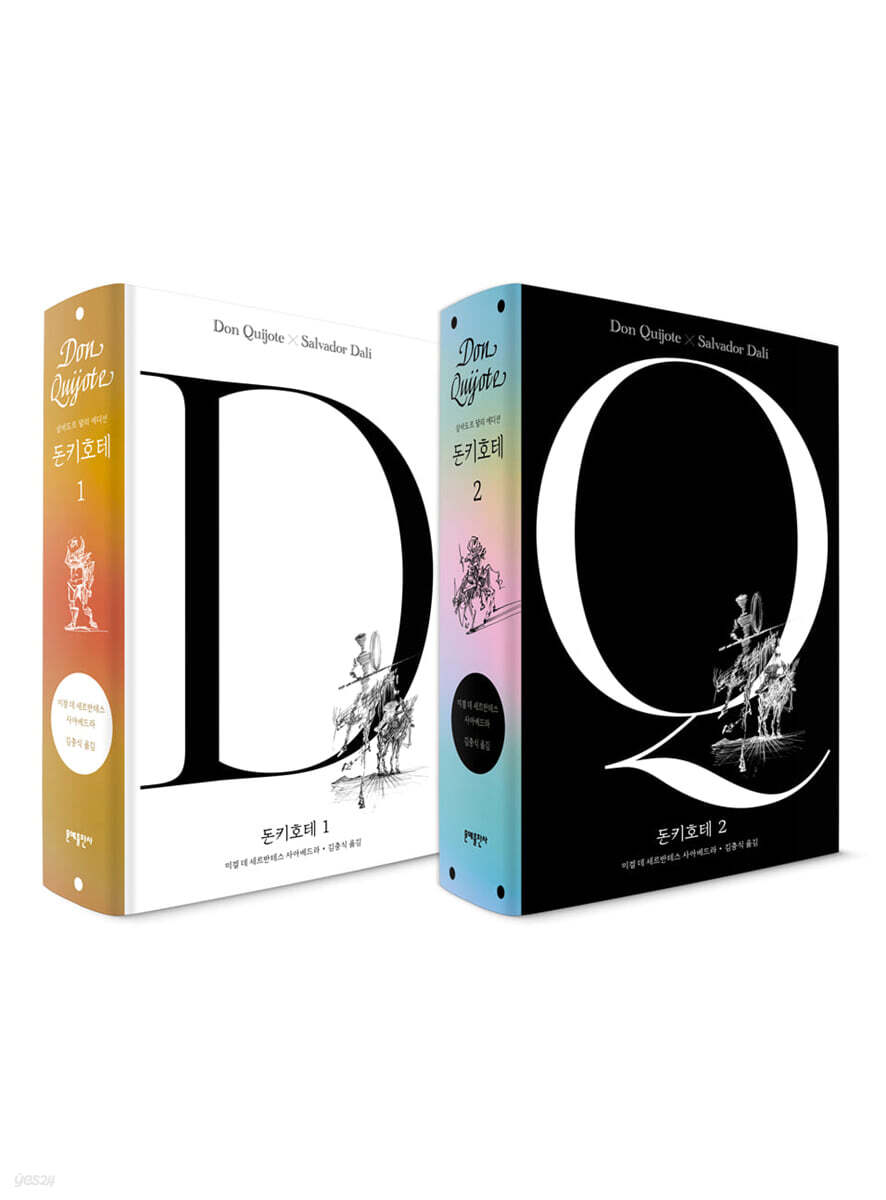
Don Quixote Set 1,2
 |
Description
Book Introduction
This product is a product made by YES24. (Individual returns are not possible.) [Book] Don Quixote 1: Salvador Dali Edition [Book] Don Quixote 2: Salvador Dali Edition Korea's first Salvador Dali edition of "Don Quixote" published Includes 54 color and black-and-white illustrations by Salvador Dali. The Salvador Dali Edition of Don Quixote is a collaboration between Don Quixote, the first modern novel and the greatest work in world literature, and Salvador Dali, the master of 20th-century surrealist art. The illustrations in 『Don Quixote 1』 are works that were included in 『The Life and Works of the Renowned Don Quixote of La Mancha, Part 1』, published by Random House in the United States in 1946, and include 10 color watercolors and 32 drawings. The illustrations in 『Don Quixote 2』 are 12 lithographs created by Dali himself, and were included in 『Don Quixote in La Mancha』, published by Joseph Faure, an art publisher in Paris, France, in 1957. Don Quixote, the most bizarre and unique character in world literature, and Salvador Dali, who built his own artistic world with the motto, “The only difference between me and a madman is that I am not mad,” come together to create a world of maximized fantasy and unique images. The Salvador Dali Edition of Don Quixote, reinterpreted by Salvador Dali, a modern-day Don Quixote who garnered public attention for his groundbreaking works and eccentric travels, will be the most special and most 'Don Quixote-like' edition of Don Quixote published worldwide. |
- You can preview some of the book's contents.
Preview
Detailed image
.jpg)
Publisher's Review
Don Quixote, a knight of noble heart and extraordinary madness,
Who wouldn't love this madman?
Don Quixote I was first published in Spain in 1605 under the title Don Quixote of La Mancha, the Witty Country Gentleman.
In 1615, ten years after the publication of Volume 1, “Don Quixote of La Mancha,” the equivalent of “Don Quixote 2,” was published.
The most translated literary work in the world,
A masterpiece of world literature loved across time
"Don Quixote" centers around the adventures of the main characters Don Quixote and Sancho Panza, and features over 650 characters, telling the colorful and rich stories of their lives.
It is called the 'original novel' because it contains the joys and sorrows of human life that anyone can relate to, from beautiful and heartbreaking love to sad love that cannot be achieved, true friendship and tragic betrayal, and even exhilarating revenge.
Among classic works, there are many that are recognized only after a long time, but in the case of Don Quixote, its exciting stories gained explosive popularity from the time of its publication.
“Nari’s story is so clear and distinct that it doesn’t seem difficult at all.
So children fiddle with it, young people read it, adults understand it, and old people praise it.
(…) It is said that there is no room in a nobleman’s house without a copy of Don Quixote.
If someone leaves the book behind, someone else will take it, and someone else will rush in and snatch it away, and someone else will beg to borrow it.”
This is a scene from Volume 2, published 10 years after Volume 1, where Cervantes shows how popular Volume 1 was through the mouth of a new character, Sanson Carrasco.
It is said that when Don Quixote was very popular, King Philip III of Spain saw a man reading a book on the street and laughing his head off and said, “That man must be crazy or reading Don Quixote.”
Don Quixote, a satire of the times with unique wit and humor, continues to be loved even after 400 years for its warm and humane emotions that flow throughout the work.
French literary critic Albert Thibaudet praised it as “the book of humanity” and it has been cited by Fyodor Dostoevsky, Thomas Mann, Gustave Flaubert, Milan Kundera, and T.
It inspired numerous writers, including S. Eliot and Anton Chekhov.
It is considered one of the greatest novels in the history of world literature, and has been translated into the most diverse languages around the world. It is constantly being reinterpreted in various genres, including literature, plays, musicals, ballet, paintings, and films.
A translator who has dedicated his life to spreading Spanish language and culture
A meticulous and thorough translation
Kim Chung-sik, the translator of the Salvador Dali edition of Don Quixote, has been working to spread the Spanish language and culture in Korea for over 40 years by writing Spanish dictionaries and textbooks and through research and lectures.
After visiting the Cervantes Museum in Spain a long time ago, I decided to translate Don Quixote, and after about ten years of effort, I finally translated Volumes 1 and 2 of Don Quixote.
As a writer of a Spanish dictionary, I have utilized a rich vocabulary to the fullest extent possible to preserve the original work's characteristics and style, which includes many proverbs and figures of speech, and have also strived to capture the spirit of the times and unique culture that are embedded in the work.
Based on the edition of Martin de Riquer, known as the most accurate translation of Don Quixote, this book includes detailed translator's notes that explain the sources and hidden meanings of medieval chivalric novels and European classics cited in the text, helping readers understand the text.
The meticulous and careful translation, which reflects the translator's extraordinary affection for Don Quixote, enhances the immersion into the story.
Cervantes and Salvador Dali,
A meeting between two genius artists representing Spain
“Don Quixote is a work that will allow you to demonstrate your extraordinary abilities.”
―From a letter sent to Dali by his father
The illustrations in "Don Quixote 1" are drawings and watercolors included in "The Life and Deeds of the Renowned Don Quixote of La Mancha, Part 1," published by Random House in the United States in 1946.
Salvador Dali, who was recognized for his unique artistic world while working not only as a painter but also as a writer, film director, and stage designer, was also an illustrator of many literary works, including Macbeth, Essays de Montaigne, and Alice in Wonderland.
Dali's artistic inspiration shines even brighter when he touches on themes related to his native Spain.
There is no doubt that Dalí was deeply fascinated by the character of Don Quixote, especially in the works of Cervantes.
Dali, who had as his motto “The only difference between me and a madman is that I am not mad,” clearly had Don Quixote in his heart.
Cervantes' genius drew on Dali's, creating original images full of fantasy and magic.
The painting (second picture in the color pictorial) that depicts the most famous windmill battle scene in Don Quixote as imagined by Don Quixote is especially worth noting.
Also, the fact that he included the Emporda region, which he loved, and the port of Rigat, where he built a house and lived with his wife, in the La Mancha landscape in his work shows his affection for this work.
“Whether I like it or not, that lithograph of Don Quixote will become the lithograph of the century.”
―From a letter Dali sent to his publisher Faure
The illustrations in "Don Quixote 2" are lithographs included in "Don Quixote in La Mancha," published by Joseph Fauré, an art publisher in Paris, France, in 1957.
Ten years after the publication of the Random House edition of Don Quixote, Fauré proposed to Dalí a new series of lithographs to be included in Don Quixote, and Dalí, persuaded by Fauré, accepted the work and explored and experimented with new techniques that had never been used in lithography.
The most famous technique involved firing a matchlock gun with a bullet soaked in ink, creating a unique swirling effect, a technique Dali called "bulletism."
This technique can be found in the painting Don Quixote, which starts with a swarm of small soldiers like ants and creates the figure of Don Quixote in armor.
The technique of placing ink-soaked bread on a slab and crushing it with a rhinoceros horn creates dynamic lines similar to the techniques of action painters such as Jackson Pollock.
Using this technique, he depicted the scene where Don Quixote attacks the illusion of the windmill giant, drawing the windmill in the simplest and clearest way (title of the work, “Attack on the Windmill”).
Although the illustrations in Volume 2 do not directly evoke the narrative of Don Quixote, the explosive colors and images evoke a consistent sense of urgency that runs through the work.
He captured his world, a blend of myth, imagination, and reality, in his illustrations for Don Quixote, one of the greatest works of Western literature.
★ Selected as 'the greatest novel in history' by the Nobel Institute
★ 100 World Classic Novels Preferred by Korean Writers
★ Peter Boxall's "1001 Books You Must Read Before You Die"
Whether I like it or not, this illustration of Don Quixote will become the work of the century.
Salvador Dali
Don Quixote is the most complete embodiment of beauty.
ㆍFyodor Dostoevsky
How creative, how ingenious, how free, how human!
Thomas Mann
Don Quixote is a world-wide bestseller, comparable to the Bible.
Gustave Flaubert
Has there ever been a character more vividly alive in our memories than Don Quixote?
Milan Kundera
Cervantes broke away from the old, technical idealism and created a new idealism that was suited to reality.
Heinrich Heine
Cervantes's works provide answers to the question of what Spain is.
Jose Ortega y Gasset
Who wouldn't love this madman?
Don Quixote I was first published in Spain in 1605 under the title Don Quixote of La Mancha, the Witty Country Gentleman.
In 1615, ten years after the publication of Volume 1, “Don Quixote of La Mancha,” the equivalent of “Don Quixote 2,” was published.
The most translated literary work in the world,
A masterpiece of world literature loved across time
"Don Quixote" centers around the adventures of the main characters Don Quixote and Sancho Panza, and features over 650 characters, telling the colorful and rich stories of their lives.
It is called the 'original novel' because it contains the joys and sorrows of human life that anyone can relate to, from beautiful and heartbreaking love to sad love that cannot be achieved, true friendship and tragic betrayal, and even exhilarating revenge.
Among classic works, there are many that are recognized only after a long time, but in the case of Don Quixote, its exciting stories gained explosive popularity from the time of its publication.
“Nari’s story is so clear and distinct that it doesn’t seem difficult at all.
So children fiddle with it, young people read it, adults understand it, and old people praise it.
(…) It is said that there is no room in a nobleman’s house without a copy of Don Quixote.
If someone leaves the book behind, someone else will take it, and someone else will rush in and snatch it away, and someone else will beg to borrow it.”
This is a scene from Volume 2, published 10 years after Volume 1, where Cervantes shows how popular Volume 1 was through the mouth of a new character, Sanson Carrasco.
It is said that when Don Quixote was very popular, King Philip III of Spain saw a man reading a book on the street and laughing his head off and said, “That man must be crazy or reading Don Quixote.”
Don Quixote, a satire of the times with unique wit and humor, continues to be loved even after 400 years for its warm and humane emotions that flow throughout the work.
French literary critic Albert Thibaudet praised it as “the book of humanity” and it has been cited by Fyodor Dostoevsky, Thomas Mann, Gustave Flaubert, Milan Kundera, and T.
It inspired numerous writers, including S. Eliot and Anton Chekhov.
It is considered one of the greatest novels in the history of world literature, and has been translated into the most diverse languages around the world. It is constantly being reinterpreted in various genres, including literature, plays, musicals, ballet, paintings, and films.
A translator who has dedicated his life to spreading Spanish language and culture
A meticulous and thorough translation
Kim Chung-sik, the translator of the Salvador Dali edition of Don Quixote, has been working to spread the Spanish language and culture in Korea for over 40 years by writing Spanish dictionaries and textbooks and through research and lectures.
After visiting the Cervantes Museum in Spain a long time ago, I decided to translate Don Quixote, and after about ten years of effort, I finally translated Volumes 1 and 2 of Don Quixote.
As a writer of a Spanish dictionary, I have utilized a rich vocabulary to the fullest extent possible to preserve the original work's characteristics and style, which includes many proverbs and figures of speech, and have also strived to capture the spirit of the times and unique culture that are embedded in the work.
Based on the edition of Martin de Riquer, known as the most accurate translation of Don Quixote, this book includes detailed translator's notes that explain the sources and hidden meanings of medieval chivalric novels and European classics cited in the text, helping readers understand the text.
The meticulous and careful translation, which reflects the translator's extraordinary affection for Don Quixote, enhances the immersion into the story.
Cervantes and Salvador Dali,
A meeting between two genius artists representing Spain
“Don Quixote is a work that will allow you to demonstrate your extraordinary abilities.”
―From a letter sent to Dali by his father
The illustrations in "Don Quixote 1" are drawings and watercolors included in "The Life and Deeds of the Renowned Don Quixote of La Mancha, Part 1," published by Random House in the United States in 1946.
Salvador Dali, who was recognized for his unique artistic world while working not only as a painter but also as a writer, film director, and stage designer, was also an illustrator of many literary works, including Macbeth, Essays de Montaigne, and Alice in Wonderland.
Dali's artistic inspiration shines even brighter when he touches on themes related to his native Spain.
There is no doubt that Dalí was deeply fascinated by the character of Don Quixote, especially in the works of Cervantes.
Dali, who had as his motto “The only difference between me and a madman is that I am not mad,” clearly had Don Quixote in his heart.
Cervantes' genius drew on Dali's, creating original images full of fantasy and magic.
The painting (second picture in the color pictorial) that depicts the most famous windmill battle scene in Don Quixote as imagined by Don Quixote is especially worth noting.
Also, the fact that he included the Emporda region, which he loved, and the port of Rigat, where he built a house and lived with his wife, in the La Mancha landscape in his work shows his affection for this work.
“Whether I like it or not, that lithograph of Don Quixote will become the lithograph of the century.”
―From a letter Dali sent to his publisher Faure
The illustrations in "Don Quixote 2" are lithographs included in "Don Quixote in La Mancha," published by Joseph Fauré, an art publisher in Paris, France, in 1957.
Ten years after the publication of the Random House edition of Don Quixote, Fauré proposed to Dalí a new series of lithographs to be included in Don Quixote, and Dalí, persuaded by Fauré, accepted the work and explored and experimented with new techniques that had never been used in lithography.
The most famous technique involved firing a matchlock gun with a bullet soaked in ink, creating a unique swirling effect, a technique Dali called "bulletism."
This technique can be found in the painting Don Quixote, which starts with a swarm of small soldiers like ants and creates the figure of Don Quixote in armor.
The technique of placing ink-soaked bread on a slab and crushing it with a rhinoceros horn creates dynamic lines similar to the techniques of action painters such as Jackson Pollock.
Using this technique, he depicted the scene where Don Quixote attacks the illusion of the windmill giant, drawing the windmill in the simplest and clearest way (title of the work, “Attack on the Windmill”).
Although the illustrations in Volume 2 do not directly evoke the narrative of Don Quixote, the explosive colors and images evoke a consistent sense of urgency that runs through the work.
He captured his world, a blend of myth, imagination, and reality, in his illustrations for Don Quixote, one of the greatest works of Western literature.
★ Selected as 'the greatest novel in history' by the Nobel Institute
★ 100 World Classic Novels Preferred by Korean Writers
★ Peter Boxall's "1001 Books You Must Read Before You Die"
Whether I like it or not, this illustration of Don Quixote will become the work of the century.
Salvador Dali
Don Quixote is the most complete embodiment of beauty.
ㆍFyodor Dostoevsky
How creative, how ingenious, how free, how human!
Thomas Mann
Don Quixote is a world-wide bestseller, comparable to the Bible.
Gustave Flaubert
Has there ever been a character more vividly alive in our memories than Don Quixote?
Milan Kundera
Cervantes broke away from the old, technical idealism and created a new idealism that was suited to reality.
Heinrich Heine
Cervantes's works provide answers to the question of what Spain is.
Jose Ortega y Gasset
GOODS SPECIFICS
- Date of issue: May 14, 2021
- Format: Hardcover book binding method guide
- Page count, weight, size: 1,820 pages | 2,434g | 140*210*80mm
You may also like
카테고리
korean


korean

![GQ KOREA Mark (Monthly): December [2025]](http://librairie.coreenne.fr/cdn/shop/files/8ef265dbbfbf186523ed75ba7319009d.jpg?v=1765340328&width=3840)


