

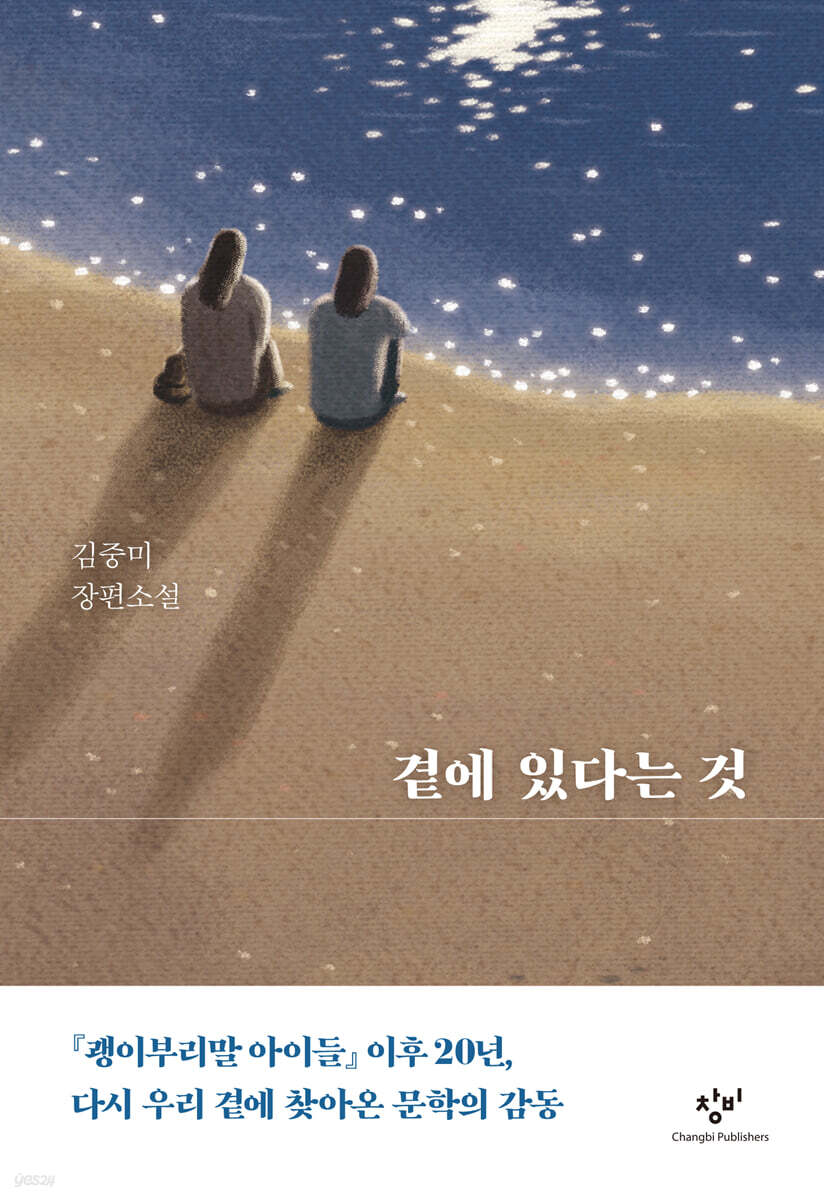
Being by your side
 |
Description
Book Introduction
- A word from MD
-
The Children of the Magpie's Beak, a novel by Kim Jung-miThe book is set in Eun-gang, the setting of "The Little Ball Shot by the Dwarf."
The author illuminates aspects of society and the faces of neighbors that remain unchanged despite the changing landscape, conveying a voice of hope that life flows even in places you haven't yet discovered, and that only when we talk about and share all of it together can a different tomorrow emerge.
April 6, 2021. Novel/Poetry PD Park Hyung-wook
20 years after the children of the magpie beak,
The true emotion of literature returns to us.
The new novel, "Being by Your Side," by author Kim Jung-mi, who has long been listening to the quiet voices of the weak, has been published.
Twenty years after "The Children of the Magpie," which opened the year 2000 with a deeply moving story, this work will become a new milestone in our time, telling a story of strong hope through solidarity.
Centered around teenage girls Ji-woo, Kang-i, and Yeo-ul, the film depicts the lives of grandmother, mother, and daughter, passing through generations, paying homage to the lives of ordinary neighbors who have lived through the major twists and turns of modern and contemporary Korean history.
This will be another masterpiece that confronts the current problems of Korean society head-on, such as the widening gap between the rich and the poor and the risky working conditions of young irregular workers, and calls for social attention to solidarity and care.
The true emotion of literature returns to us.
The new novel, "Being by Your Side," by author Kim Jung-mi, who has long been listening to the quiet voices of the weak, has been published.
Twenty years after "The Children of the Magpie," which opened the year 2000 with a deeply moving story, this work will become a new milestone in our time, telling a story of strong hope through solidarity.
Centered around teenage girls Ji-woo, Kang-i, and Yeo-ul, the film depicts the lives of grandmother, mother, and daughter, passing through generations, paying homage to the lives of ordinary neighbors who have lived through the major twists and turns of modern and contemporary Korean history.
This will be another masterpiece that confronts the current problems of Korean society head-on, such as the widening gap between the rich and the poor and the risky working conditions of young irregular workers, and calls for social attention to solidarity and care.
- You can preview some of the book's contents.
Preview
index
Part 1: Jiwoo's Story 007
Part 2: The River's Story 107
Part 3: The Story of Yeoul 187
Part 4 Our Story 273
Epilogue 362
Author's Note 375
Source 381
Reference 382
Part 2: The River's Story 107
Part 3: The Story of Yeoul 187
Part 4 Our Story 273
Epilogue 362
Author's Note 375
Source 381
Reference 382
Detailed image
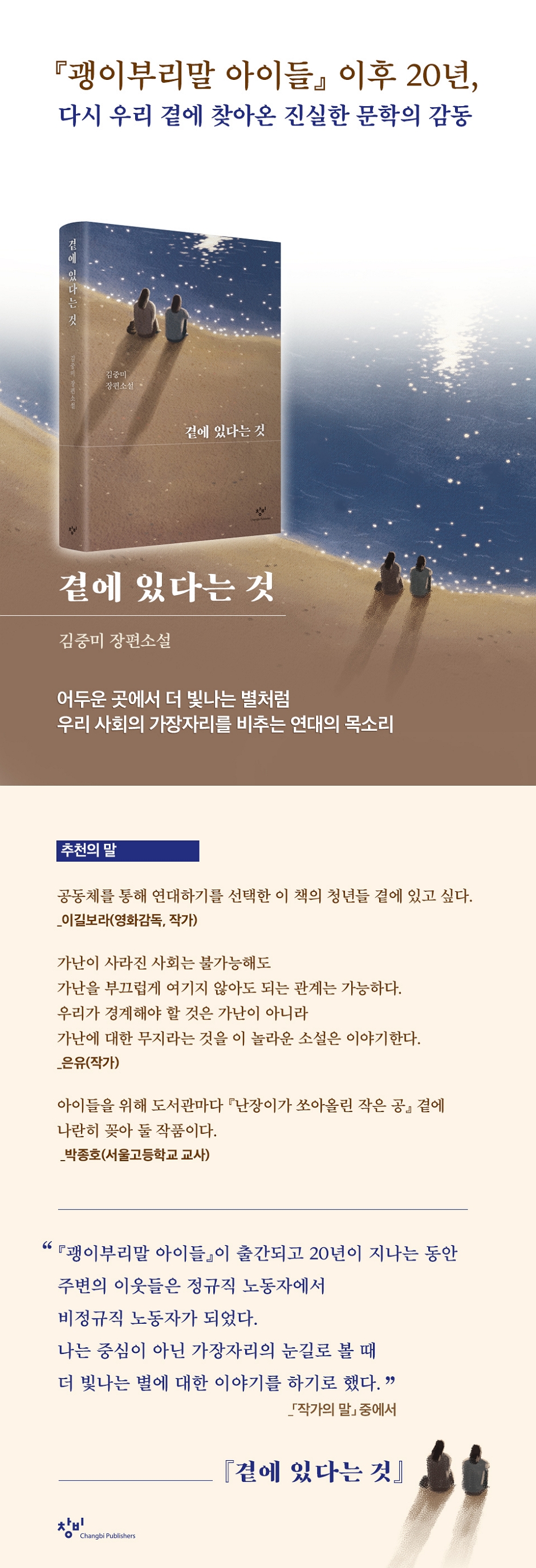
Into the book
“Kim Yeo-ul, you know what? Stars shine brighter when you look at them from the corner of your eye than when you look at them straight on.
Pick a star like this, look straight at it, and then glance sideways.
Then the stars appear to twinkle more brightly than when viewed straight on.
“Just give it a try.”
"it's okay.
I don't care about stars.
“I don’t know anything about space or astronomy.”
“They say to look at the stars, but why space, astronomy? Just look at the stars.
I discovered this by chance during a school trip in the second grade. If you look out of the corner of your eye, the stars twinkle even brighter.
It was really amazing.
We think that we can see things better if we look at them straight on, head-on.
But sometimes, there are things that look better when you look at them from the edge like this.
“Isn’t it amazing?”
“What are you trying to say?”
“People think that the periphery is not very important.
But that's not the case.
“Just as you can see that the edges of the eyes shine more, those of us on the edges can see better and shine more.”
Instead of answering Jiwoo's question, I looked up at the sky and picked a star.
And I glanced at the star.
The stars really did shine brighter.
--- p.241
Kang-i knew that these candles were not all pointing in the same direction.
I also know that no matter how many candles I light, I can't light up all the dark corners.
Those who are truly in desperate need of light cannot hold candles here.
If luck hadn't been on my side today, Kang wouldn't be here.
But I didn't want to be cynical and say that holding candles wouldn't make a difference.
When the donation box arrived in front of him, Kang-i generously put in the 30,000 won he had brought from home.
--- pp.365~366
Eun Kang-dong survived not by comparing himself to others, but by standing shoulder to shoulder with others.
Eun-gang-dong is a place where one can only survive by sharing things, whether it be sadness, joy, labor, or space.
Those who do not know poverty came up with absurd ideas like a one-room experience center.
Poverty is not a commodity that can be displayed on a shelf.
--- pp.371~372
In the 20 years since the publication of "The Children of the Magpie Beak," my neighbors have changed from regular workers to contract and irregular workers.
(…) I decided to tell the stories of the poor they desperately try to ignore, the stories of those struggling to survive on the margins, the stories of stars that shine brighter when seen from the margins rather than the center.
(…) No era in history has ever been on the side of the poor.
But if we resign ourselves to the fact that the future will not be on the side of the poor, then there is no hope for us.
We must choose hope.
Pick a star like this, look straight at it, and then glance sideways.
Then the stars appear to twinkle more brightly than when viewed straight on.
“Just give it a try.”
"it's okay.
I don't care about stars.
“I don’t know anything about space or astronomy.”
“They say to look at the stars, but why space, astronomy? Just look at the stars.
I discovered this by chance during a school trip in the second grade. If you look out of the corner of your eye, the stars twinkle even brighter.
It was really amazing.
We think that we can see things better if we look at them straight on, head-on.
But sometimes, there are things that look better when you look at them from the edge like this.
“Isn’t it amazing?”
“What are you trying to say?”
“People think that the periphery is not very important.
But that's not the case.
“Just as you can see that the edges of the eyes shine more, those of us on the edges can see better and shine more.”
Instead of answering Jiwoo's question, I looked up at the sky and picked a star.
And I glanced at the star.
The stars really did shine brighter.
--- p.241
Kang-i knew that these candles were not all pointing in the same direction.
I also know that no matter how many candles I light, I can't light up all the dark corners.
Those who are truly in desperate need of light cannot hold candles here.
If luck hadn't been on my side today, Kang wouldn't be here.
But I didn't want to be cynical and say that holding candles wouldn't make a difference.
When the donation box arrived in front of him, Kang-i generously put in the 30,000 won he had brought from home.
--- pp.365~366
Eun Kang-dong survived not by comparing himself to others, but by standing shoulder to shoulder with others.
Eun-gang-dong is a place where one can only survive by sharing things, whether it be sadness, joy, labor, or space.
Those who do not know poverty came up with absurd ideas like a one-room experience center.
Poverty is not a commodity that can be displayed on a shelf.
--- pp.371~372
In the 20 years since the publication of "The Children of the Magpie Beak," my neighbors have changed from regular workers to contract and irregular workers.
(…) I decided to tell the stories of the poor they desperately try to ignore, the stories of those struggling to survive on the margins, the stories of stars that shine brighter when seen from the margins rather than the center.
(…) No era in history has ever been on the side of the poor.
But if we resign ourselves to the fact that the future will not be on the side of the poor, then there is no hope for us.
We must choose hope.
--- From the author's note on pp.377~379
Publisher's Review
Like a star that shines brighter in the dark
A voice of solidarity illuminating the margins of our society
Jiwoo, Kang-i, and Yeo-ul, all nineteen years old, are friends who were born and raised in the same village in Eun-gang-gu, Incheon.
Eun-gang, the setting of "The Little Ball Shot by a Dwarf," is now a place where apartments have replaced shantytowns, unlike the 1970s landscape depicted in the novel, but it has been pushed further away from the city center.
Those who pursued success left Eun-gang and moved to the new city, and even today, poor workers who are no different from the 'dwarf family' still live in Eun-gang.
Jiwoo, a high school senior, has a dream of writing a novel about the life of his great-aunt, a laid-off worker who led the Eun-gang Textile struggle.
After his mother, who worked at Eun-gang Textiles, passes away at a young age, Kang-i lives with his maternal grandmother. He works part-time at a chicken restaurant and dreams of becoming a nurse.
Yeoul is obsessed with preparing for the entrance exam to a teacher's college in order to escape poverty from Eun-gang.
Although each of them has different family backgrounds and dreams, the three friends unknowingly become strong supports for each other.
Then one day, the district office promotes a 'room experience center' that infringes on the residents' living space under the pretext of 'developing Eungang-gu as a tourist attraction.'
In the face of the logic of capital, even poverty is commodified and the idea of putting the foundation of life on display is met with opposition from Jiwoo, Kang-i, and Yeo-ul, along with their friends.
In the process, the children gain a deeper understanding of the history of Eun-gang, which has been passed down since their grandmother's time, and come to realize the reality as they face the society surrounding them.
The three friends, who have grown up a little, celebrate their twenties with a heavy heart on December 31, 2016, the last day of their teenage years, holding candles at Gwanghwamun Square.
“Kim Yeo-ul, you know what? Stars shine brighter when you look at them from the corner of your eye than when you look at them straight on.
Pick a star like this, look straight at it, and then glance sideways.
Then the stars appear to twinkle more brightly than when viewed straight on.
“Just give it a try.”
(…)
“People think that the periphery is not that important.
But that's not the case.
As you can see, the edges of the eyes shine brighter, so those of us on the edges can see better and shine brighter.” - Main text, page 241
Whether it's sadness or joy, we have to share everything to survive.
Our neighborhood, our neighbors' stories
As in ‘The Children of the Magpie’, the author’s gaze is still directed towards ‘people’.
The people his gaze lingers on are like constellations in the night sky, who may not stand out on their own, but shine brightly together.
The fight of Okja, the grandmother of Jiwoo, a laid-off worker at Eungang Textile, has not ended even after decades.
Because I have not yet received an apology from the company for the unfair oppression.
In this work, author Kim Jung-mi calls upon the female factory workers of the 1970s not as forgotten figures in the events that transpired, but as protagonists who constantly voice their own opinions.
Okja's fight is not only a testament to her own life and that of her colleagues, but also a message of encouragement to young workers who are fighting the same fight.
When they are by each other's side, they are no longer separated by generational divisions such as old and young, but are united under the name of 'comrade'.
Jiwoo's mother, Gyeongsun, met Jiwoo's father, who was working in the local area, and they started a family.
Unlike my father, who continued his civic activism, I feel sorry for my mother, who devoted herself to raising children and making a living after getting married.
However, Kyung-soon believes that the importance of work to make a living and the efforts to protect that work are equally important as civil movements.
Jiwoo also learns the valuable meaning of 'life' through his mother's appearance, even if it doesn't shine.
On the other hand, Jiwoo's older sister Yeonwoo, who changed her career path from dreaming of becoming a film director to preparing for the civil service exam, Yeoul, who desires stability rather than great success, and Yeoul's mother Eunhye, who considers a prestigious university and an apartment as the only standards for happiness, help to create tension and balance between the characters and give the work a three-dimensional feel.
Eun Kang-dong survived not by comparing himself to others, but by standing shoulder to shoulder with others.
Eun-gang-dong is a place where one can only survive by sharing things, whether it be sadness, joy, labor, or space.
Those who do not know poverty came up with absurd ideas like a one-room experience center.
Poverty is not a commodity that can be displayed on a shelf.
―Pages 371-372
Writer Kim Jung-mi, who has been by our side like a watchman,
Talking about hope again
"Being By Your Side" delivers a profoundly moving account of vivid historical events, from the struggles of female factory workers in the 1970s, to urban regeneration projects that reveal the true face of Korean society's treatment of the poor, to the Sewol Ferry disaster and candlelight vigils seen through the eyes of youth, transcribed in Kim Jung-mi's characteristically trustworthy voice.
This novel raises an urgent question by depicting the problem of poverty, which has remained unchanged for over 20 years since the publication of "The Children of the Magpie," and the changing nature of poverty.
Youngmin, a young man who lives next door to Jiwoo and has just finished receiving protection, is forced to explain how poor he is and how lonely he has lived in order to receive government support.
After his father, who had been holding a tent protest, passes away, Suchan, who lives alone working part-time as a deliveryman, feels distant from his peers who speak out boldly at rallies, and is hesitant to expect a bright future.
But at the same time, Kang-i becomes closer to Lan-i from Vietnam and realizes that they can communicate despite differences in language and culture, and Ji-woo also shares his feelings, remembering Suchan and Yeong-min, who were unable to hold candlelight vigils together.
"Being by Your Side" is a work that once again speaks of poverty, but also of a stronger hope.
As long as we don't give up, we still have a chance to choose hope.
Now it is the readers' turn to give this brave hope a helping hand.
“Why didn’t Mom leave?”
“I couldn’t give up.”
"what?"
“The poor have a voice.” —Page 281
A voice of solidarity illuminating the margins of our society
Jiwoo, Kang-i, and Yeo-ul, all nineteen years old, are friends who were born and raised in the same village in Eun-gang-gu, Incheon.
Eun-gang, the setting of "The Little Ball Shot by a Dwarf," is now a place where apartments have replaced shantytowns, unlike the 1970s landscape depicted in the novel, but it has been pushed further away from the city center.
Those who pursued success left Eun-gang and moved to the new city, and even today, poor workers who are no different from the 'dwarf family' still live in Eun-gang.
Jiwoo, a high school senior, has a dream of writing a novel about the life of his great-aunt, a laid-off worker who led the Eun-gang Textile struggle.
After his mother, who worked at Eun-gang Textiles, passes away at a young age, Kang-i lives with his maternal grandmother. He works part-time at a chicken restaurant and dreams of becoming a nurse.
Yeoul is obsessed with preparing for the entrance exam to a teacher's college in order to escape poverty from Eun-gang.
Although each of them has different family backgrounds and dreams, the three friends unknowingly become strong supports for each other.
Then one day, the district office promotes a 'room experience center' that infringes on the residents' living space under the pretext of 'developing Eungang-gu as a tourist attraction.'
In the face of the logic of capital, even poverty is commodified and the idea of putting the foundation of life on display is met with opposition from Jiwoo, Kang-i, and Yeo-ul, along with their friends.
In the process, the children gain a deeper understanding of the history of Eun-gang, which has been passed down since their grandmother's time, and come to realize the reality as they face the society surrounding them.
The three friends, who have grown up a little, celebrate their twenties with a heavy heart on December 31, 2016, the last day of their teenage years, holding candles at Gwanghwamun Square.
“Kim Yeo-ul, you know what? Stars shine brighter when you look at them from the corner of your eye than when you look at them straight on.
Pick a star like this, look straight at it, and then glance sideways.
Then the stars appear to twinkle more brightly than when viewed straight on.
“Just give it a try.”
(…)
“People think that the periphery is not that important.
But that's not the case.
As you can see, the edges of the eyes shine brighter, so those of us on the edges can see better and shine brighter.” - Main text, page 241
Whether it's sadness or joy, we have to share everything to survive.
Our neighborhood, our neighbors' stories
As in ‘The Children of the Magpie’, the author’s gaze is still directed towards ‘people’.
The people his gaze lingers on are like constellations in the night sky, who may not stand out on their own, but shine brightly together.
The fight of Okja, the grandmother of Jiwoo, a laid-off worker at Eungang Textile, has not ended even after decades.
Because I have not yet received an apology from the company for the unfair oppression.
In this work, author Kim Jung-mi calls upon the female factory workers of the 1970s not as forgotten figures in the events that transpired, but as protagonists who constantly voice their own opinions.
Okja's fight is not only a testament to her own life and that of her colleagues, but also a message of encouragement to young workers who are fighting the same fight.
When they are by each other's side, they are no longer separated by generational divisions such as old and young, but are united under the name of 'comrade'.
Jiwoo's mother, Gyeongsun, met Jiwoo's father, who was working in the local area, and they started a family.
Unlike my father, who continued his civic activism, I feel sorry for my mother, who devoted herself to raising children and making a living after getting married.
However, Kyung-soon believes that the importance of work to make a living and the efforts to protect that work are equally important as civil movements.
Jiwoo also learns the valuable meaning of 'life' through his mother's appearance, even if it doesn't shine.
On the other hand, Jiwoo's older sister Yeonwoo, who changed her career path from dreaming of becoming a film director to preparing for the civil service exam, Yeoul, who desires stability rather than great success, and Yeoul's mother Eunhye, who considers a prestigious university and an apartment as the only standards for happiness, help to create tension and balance between the characters and give the work a three-dimensional feel.
Eun Kang-dong survived not by comparing himself to others, but by standing shoulder to shoulder with others.
Eun-gang-dong is a place where one can only survive by sharing things, whether it be sadness, joy, labor, or space.
Those who do not know poverty came up with absurd ideas like a one-room experience center.
Poverty is not a commodity that can be displayed on a shelf.
―Pages 371-372
Writer Kim Jung-mi, who has been by our side like a watchman,
Talking about hope again
"Being By Your Side" delivers a profoundly moving account of vivid historical events, from the struggles of female factory workers in the 1970s, to urban regeneration projects that reveal the true face of Korean society's treatment of the poor, to the Sewol Ferry disaster and candlelight vigils seen through the eyes of youth, transcribed in Kim Jung-mi's characteristically trustworthy voice.
This novel raises an urgent question by depicting the problem of poverty, which has remained unchanged for over 20 years since the publication of "The Children of the Magpie," and the changing nature of poverty.
Youngmin, a young man who lives next door to Jiwoo and has just finished receiving protection, is forced to explain how poor he is and how lonely he has lived in order to receive government support.
After his father, who had been holding a tent protest, passes away, Suchan, who lives alone working part-time as a deliveryman, feels distant from his peers who speak out boldly at rallies, and is hesitant to expect a bright future.
But at the same time, Kang-i becomes closer to Lan-i from Vietnam and realizes that they can communicate despite differences in language and culture, and Ji-woo also shares his feelings, remembering Suchan and Yeong-min, who were unable to hold candlelight vigils together.
"Being by Your Side" is a work that once again speaks of poverty, but also of a stronger hope.
As long as we don't give up, we still have a chance to choose hope.
Now it is the readers' turn to give this brave hope a helping hand.
“Why didn’t Mom leave?”
“I couldn’t give up.”
"what?"
“The poor have a voice.” —Page 281
GOODS SPECIFICS
- Publication date: March 26, 2021
- Format: Hardcover book binding method guide
- Page count, weight, size: 384 pages | 468g | 134*195*24mm
- ISBN13: 9788936434472
- ISBN10: 8936434470
You may also like
카테고리
korean


korean

![GQ KOREA Mark (Monthly): December [2025]](http://librairie.coreenne.fr/cdn/shop/files/8ef265dbbfbf186523ed75ba7319009d.jpg?v=1765340328&width=3840)


