

Maybe twenty times
 |
Description
Book Introduction
- A word from MD
-
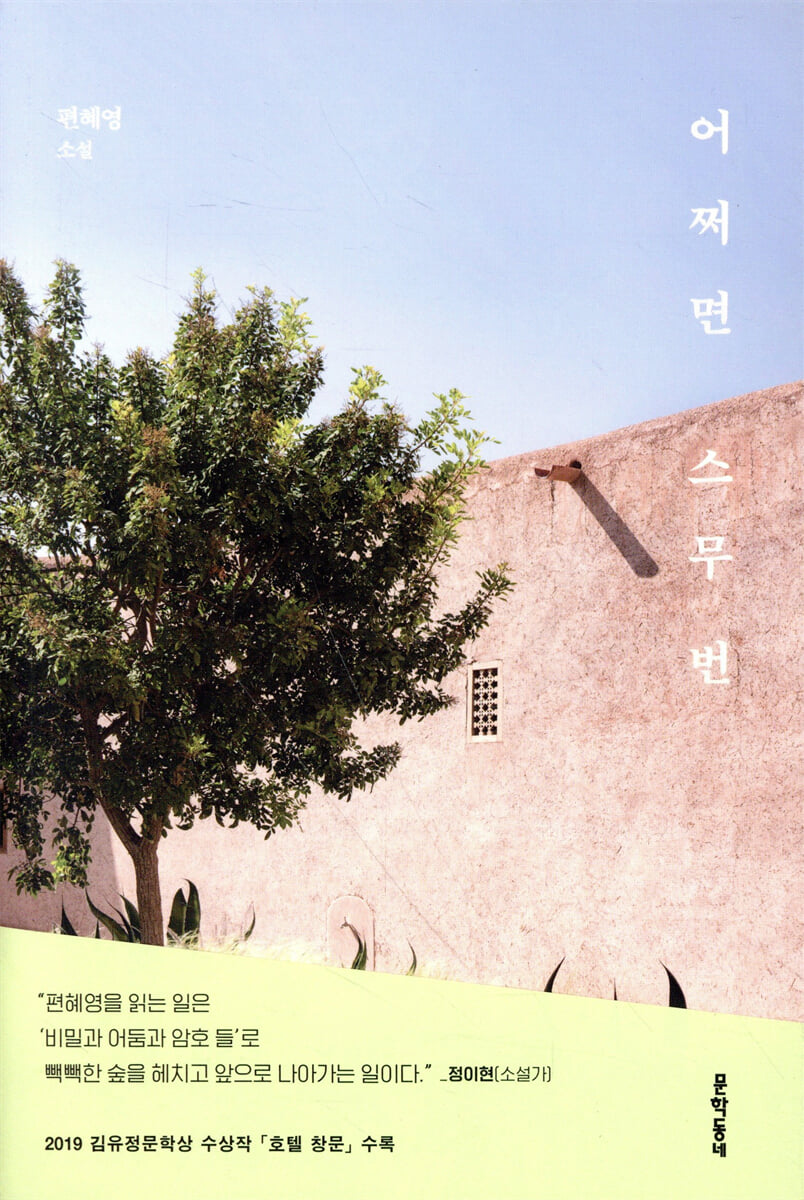
『Boyhood』 Pyeon Hye-young's short story collectionA collection of short stories by Pyeon Hye-young that allows you to sense the other side of life.
The daily life that gradually cracks can suddenly shake uncontrollably, and the collapsed world is unlikely to recover.
A story full of twists and suspense that gives new meaning to familiar scenes, with unexpected characters and situations intruding into a seemingly peaceful setting, constantly adding tension.March 16, 2021. Novel/Poetry PD Park Hyung-wook
“Reading Pyeon Hye-young is like reading ‘Secrets, Darkness, and Codes’
“It’s about moving forward through the dense forest.” _Jeong I-hyeon (novelist)
The present of Pyeon Hye-young's novels, renewed once again
Included in the 2019 Kim Yu-jeong Literary Award winning work "Hotel Window"
Author Pyeon Hye-young's sixth short story collection, "Maybe Twenty Times," has been published, allowing us to perceive the hidden aspects of life that are not apparent by densely compressing the daily life that surrounds us.
As author Son Bo-mi said in a special interview ahead of the publication of her short story collection, “It is rare for a novel published in a magazine to be published as a book,” Pyeon Hye-young selected eight short stories with similar characters from among those written between 2015 and 2020, and then carefully considered and refined the work.
This collection of short stories, compiled through such intense and meticulous revision, still maintains the vivid suspense created by concise sentences, while showing the poignant sadness of life that is inseparable from it in a way different from previous works.
This is the pinnacle of the world of Pyeon Hye-young, now in her 22nd year since her debut, allowing us to experience an exceptional time in Korean literature by revisiting familiar places and relationships.
The works included in this collection are characterized by the fact that they all begin with the characters moving from their current location to another place.
The new places they move to are usually small cities or rural areas with few people.
At first glance, it appears peaceful and idyllic, but at the same time it is isolated, closed, and exclusive to outsiders.
The works included in “Maybe Twenty Times” highlight the latter of these dualistic images of the countryside, creating a subtle tension in which the surrounding space suddenly becomes unfamiliar.
Meanwhile, their movements stem from their relationships with their families or with themselves, having made minor mistakes in the past. Because of this, some unresolved issues suddenly become a huge threat, threatening them in a different place than before.
“It’s about moving forward through the dense forest.” _Jeong I-hyeon (novelist)
The present of Pyeon Hye-young's novels, renewed once again
Included in the 2019 Kim Yu-jeong Literary Award winning work "Hotel Window"
Author Pyeon Hye-young's sixth short story collection, "Maybe Twenty Times," has been published, allowing us to perceive the hidden aspects of life that are not apparent by densely compressing the daily life that surrounds us.
As author Son Bo-mi said in a special interview ahead of the publication of her short story collection, “It is rare for a novel published in a magazine to be published as a book,” Pyeon Hye-young selected eight short stories with similar characters from among those written between 2015 and 2020, and then carefully considered and refined the work.
This collection of short stories, compiled through such intense and meticulous revision, still maintains the vivid suspense created by concise sentences, while showing the poignant sadness of life that is inseparable from it in a way different from previous works.
This is the pinnacle of the world of Pyeon Hye-young, now in her 22nd year since her debut, allowing us to experience an exceptional time in Korean literature by revisiting familiar places and relationships.
The works included in this collection are characterized by the fact that they all begin with the characters moving from their current location to another place.
The new places they move to are usually small cities or rural areas with few people.
At first glance, it appears peaceful and idyllic, but at the same time it is isolated, closed, and exclusive to outsiders.
The works included in “Maybe Twenty Times” highlight the latter of these dualistic images of the countryside, creating a subtle tension in which the surrounding space suddenly becomes unfamiliar.
Meanwhile, their movements stem from their relationships with their families or with themselves, having made minor mistakes in the past. Because of this, some unresolved issues suddenly become a huge threat, threatening them in a different place than before.
- You can preview some of the book's contents.
Preview
index
Maybe twenty times
hotel window
Holiday home
recorder
Please call me
guardianship
It's a good day
The End of the Future
Author's Note
hotel window
Holiday home
recorder
Please call me
guardianship
It's a good day
The End of the Future
Author's Note
Into the book
My wife and I both thought it was better to be a talkative person than a question-asking person.
When I answer, I inevitably end up lying, but if I just listen, that doesn't happen.
Sometimes a nod was enough.
--- p.10~11, from “Maybe Twenty Times”
Once you get it right, it's easy the next time.
The more evil you use, the more peaceful and gentle the world becomes, so there is no way to tolerate it.
I knew that feeling right before you scream.
It feels like a long string is tied to my chest.
It feels like if I just wiggle it a little, I can pull the string out.
Once the sound started, it was okay.
Because the string is coming off.
If that happens repeatedly, screaming becomes as easy as tying and untying your shoelaces.
--- p.22, from “Maybe Twenty Times”
Just as he wasn't excited by the mere fact of being alive, he wasn't particularly moved by the thought that he might have died a long time ago.
--- p.51, from “Hotel Window”
“There are all kinds of people in the photo.
There are people who hit me and there are people I did wrong.
“It makes me feel strange because there are even dead people.” --- p.83, from “Holiday Home”
After that, Suo and Muyeong became, in a sense, their only friends.
If there were two of them, there would be no need to feel sorry for at least existing alive.
There were things we didn't have to say to each other.
It's like saying that you're scared of dying, but it's even scarier because you don't die.
When I heard that everything passes, I didn't have to tell them why I was angry or why I had to sleep with the lights on at night.
I wasn't impressed that we survived together, but at least it was a relief.
--- p.106, from "Recorder"
Alcohol made Mijo sleep all day long or cry quietly.
Instead, it helped me sleep and cry to my heart's content.
The only thing that did that to Mijo was alcohol.
Above all, drinking alcohol allowed me to reminisce about the past in a leisurely and nostalgic way.
--- p.121, from "Please Call Me"
People were growing old in place like the village's guardian trees, growing thicker and thicker without being noticed.
Because there were few incoming foreigners and outgoing locals, I lived with the same people as my neighbors my entire life.
There will be many times when you will misunderstand and feel sorry for someone rather than understand them well.
--- p.151, from "Guardianship"
Jeong So-myeong has long learned how to escape people's attention.
All you had to do was be consistent.
I always kept my grades, clothes, hairstyle, bag and shoes, school commute times, greeting attitude, and speech habits the same.
If you were even slightly different or different from others, you were bound to be questioned.
Adults felt relieved and praised him as a model student because he showed a typical and uniform attitude.
--- p.152, from "Guardianship"
Like me, my mother must have believed that she would soon make up for her mistake and put everything back to normal.
I wouldn't have known how it would end, as I did.
--- p.185, from “It’s a Good Day”
I laughed along with my mother with a funny expression.
My mother hugged me and said that everything that flows is good, that all good things flow.
--- p.196, from “It’s a Good Day”
The woman didn't ask any other questions.
For example, what are your close friends' names, what do you do with your friends, and whether you study well at school.
He seemed to know that I didn't have much to say in response to such a question.
The lady saved me in a way that didn't hurt my pride.
--- p.213, from “The End of the Future”
When trials come, no one can find you.
It's not that I don't need help, it's that I don't have time for it.
When I answer, I inevitably end up lying, but if I just listen, that doesn't happen.
Sometimes a nod was enough.
--- p.10~11, from “Maybe Twenty Times”
Once you get it right, it's easy the next time.
The more evil you use, the more peaceful and gentle the world becomes, so there is no way to tolerate it.
I knew that feeling right before you scream.
It feels like a long string is tied to my chest.
It feels like if I just wiggle it a little, I can pull the string out.
Once the sound started, it was okay.
Because the string is coming off.
If that happens repeatedly, screaming becomes as easy as tying and untying your shoelaces.
--- p.22, from “Maybe Twenty Times”
Just as he wasn't excited by the mere fact of being alive, he wasn't particularly moved by the thought that he might have died a long time ago.
--- p.51, from “Hotel Window”
“There are all kinds of people in the photo.
There are people who hit me and there are people I did wrong.
“It makes me feel strange because there are even dead people.” --- p.83, from “Holiday Home”
After that, Suo and Muyeong became, in a sense, their only friends.
If there were two of them, there would be no need to feel sorry for at least existing alive.
There were things we didn't have to say to each other.
It's like saying that you're scared of dying, but it's even scarier because you don't die.
When I heard that everything passes, I didn't have to tell them why I was angry or why I had to sleep with the lights on at night.
I wasn't impressed that we survived together, but at least it was a relief.
--- p.106, from "Recorder"
Alcohol made Mijo sleep all day long or cry quietly.
Instead, it helped me sleep and cry to my heart's content.
The only thing that did that to Mijo was alcohol.
Above all, drinking alcohol allowed me to reminisce about the past in a leisurely and nostalgic way.
--- p.121, from "Please Call Me"
People were growing old in place like the village's guardian trees, growing thicker and thicker without being noticed.
Because there were few incoming foreigners and outgoing locals, I lived with the same people as my neighbors my entire life.
There will be many times when you will misunderstand and feel sorry for someone rather than understand them well.
--- p.151, from "Guardianship"
Jeong So-myeong has long learned how to escape people's attention.
All you had to do was be consistent.
I always kept my grades, clothes, hairstyle, bag and shoes, school commute times, greeting attitude, and speech habits the same.
If you were even slightly different or different from others, you were bound to be questioned.
Adults felt relieved and praised him as a model student because he showed a typical and uniform attitude.
--- p.152, from "Guardianship"
Like me, my mother must have believed that she would soon make up for her mistake and put everything back to normal.
I wouldn't have known how it would end, as I did.
--- p.185, from “It’s a Good Day”
I laughed along with my mother with a funny expression.
My mother hugged me and said that everything that flows is good, that all good things flow.
--- p.196, from “It’s a Good Day”
The woman didn't ask any other questions.
For example, what are your close friends' names, what do you do with your friends, and whether you study well at school.
He seemed to know that I didn't have much to say in response to such a question.
The lady saved me in a way that didn't hurt my pride.
--- p.213, from “The End of the Future”
When trials come, no one can find you.
It's not that I don't need help, it's that I don't have time for it.
--- p.224, from “The End of the Future”
Publisher's Review
When a peaceful and idyllic countryside suddenly turns into a closed space,
When the one who strikes us is none other than our family,
When something that was only for a moment lasts a lifetime
Like a building that is either being demolished or being rebuilt.
In the chain of double conditions and ironic situations that surround us,
Hye-young Pyeon's revealing, watery, rural-family blueprint
The protagonist of the title story, "Maybe Twenty Times," which is located at the beginning of the collection of short stories, "I," has moved to a mountain village with his wife to care for his father-in-law who suffers from dementia.
One day, as I was adjusting to life in the countryside, surrounded by cornfields and sparsely populated by people, with the nearest neighbor more than three hundred meters away, a security guard came to my house.
My wife and I felt a strange sense of fear as they subtly pressured us to sign a contract with their company, emphasizing the difficult situation of seeking help even when exposed to danger.
The irony of those who say they will protect my 'property and life' but who make my wife and 'me' anxious more than anything else makes me look at the situation of those surrounding my father-in-law whose dementia is getting worse from a different perspective.
As we read the following novels, “Hotel Window,” “Holiday Home,” and “Recorder,” we can see that Pyeon Hye-young’s perspective on life has become deeper and more detailed.
It is related to emotions such as ‘guilt’ and ‘shame’ more than anything else.
'Un-oh' from 'Hotel Window' almost drowned in the river 19 years ago and was rescued by his cousin, who did not escape death.
Since then, his uncle and aunt have reminded Un-oh of the fact whenever they have the chance, hoping that he will act accordingly, but Un-oh always feels puzzled when he thinks that his brother, who was always scary and fearful, saved him, and he doesn't know what emotions he should feel.
"Holiday Home" also reveals the complexities of characters' relationships and emotions.
Jin-soo Lee, a career soldier who met and married Major Jang through a blind date, is discharged without being promoted further than Major.
He was accused of being involved in inflating the unit price of goods, and when this became known, he was identified as the person responsible.
After that, Lee Jin-su opened a restaurant and seemed to have settled down, but after he was caught selling beef as Korean beef, the number of customers decreased and he was eventually forced to sell his apartment and even his country house.
One day, when the rain was pouring down heavily, two men came to see their house.
They try to interrogate him as if they know something about another incident that Lee Jin-soo committed in the past, but the interrogation seems to be directed not only at Lee Jin-soo but also at Jang So-ryeong, who watched everything happen while remaining silent.
If "Hotel Window" and "Holiday Home" are stories about people who are unable to feel certain emotions or who deliberately pretend not to, then "Recorder" can be said to be the story of a person who cannot shake off certain emotions.
Muyeong, who has accumulated debt beyond his means, ends up living with Suo, a former classmate from high school. However, soon after, Suo disappears as if he has evaporated.
The police suspect Muyeong and question him, but there is something they do not know.
The fact that Muyeong and Suo experienced the collapse of the training center during their high school years, and that while the two were fortunately rescued, another friend in their class did not survive.
Muyeong suspects that Suo's disappearance might be somehow related to that incident.
And as Muyeong recalls the 'last words' spoken by Suo, a feeling of sadness and longing that is not often seen in Pyeon Hye-young's novels, which rarely express emotions and are written in a dry manner, is felt.
This change is not limited to the "recorder".
"Please Call Me" is the story of Mijo, who has become increasingly dependent on alcohol due to her husband's disappearance after his business failed and he developed dementia, and visits her daughter's home who lives abroad; "It's Been a Good Day" is the story of "I" who returns to his hometown after hearing that his mother, whom he assumed would live a quiet life, has injured someone, and begins to reflect on the past; "The End of the Future" depicts a mother's efforts to live a straight life, such as taking out insurance to send her daughter to college despite her modest circumstances, but all of these works do not leave us feeling pessimistic, despite depicting characters in situations so desperate that they cannot foresee the future.
It must be because there were definitely warm and soft moments for them.
Even after life rapidly deteriorates, when Mijo and her daughter look at each other with longing ("Please Call Me"), when 'I' look at my hospitalized mother and recall my childhood when she would smile brightly ("It's Been a Good Day"), when 'the Dongbang Life Lady' takes the hand of 'I' who is left alone and leads me out of the house ("The End of the Future"), we feel a brightness that does not disappear even in the darkness that cannot be helped.
Like debt, which starts out small but grows uncontrollably over time, we never know when our lives become irreversibly distorted.
I don't know which part of the knot I need to untie to get it back to normal.
No, perhaps life was entangled and twisted from the beginning, and it was placed before us in a state where we could not tell what was right or wrong.
So, the 'twist' and 'secret' in Pyeon Hye-young's novel are not solutions that allow us to clearly understand the situation surrounding the character who fell for the trick.
The twists and secrets are hard to unravel, and even after they are, we have to move forward while groping for more twists and secrets.
Perhaps Pyeon Hye-young shows us, in such a refined and elegant way, that our lives are like a giant mystery novel.
★
Pyeon Hye-young's novels resemble elaborately and delicately crafted keys.
Only after reaching the very end of a narrative composed of essential short sentences does the reader blink and then sigh.
There is no lock that fits this beautiful key.
The world remains closed, expressionless.
For Michel Tournier, a person with a key that doesn't lock is someone who "cannot keep his feet tied and still."
He also said of the keyless lock, "It is a secret to be revealed, a darkness to be revealed, a code to be deciphered."
Reading Pyeon Hye-young is like moving forward through a dense forest of 'secrets, darkness, and codes.'
Holding the question mark key tightly in his hand.
_Jeong I-hyeon (novelist)
★
“For me, a novel always ends at a point that is slightly different from the story I initially intended to write, or at a completely different point.
Now I think I know that it is not the place from which I leap, but the place where I land that becomes the novel.
I think I know that the difference makes me a little better at writing novels, but I also know that life doesn't continue to be that way.
“I want to remember this failure and this setback well.” _From the author’s note
When the one who strikes us is none other than our family,
When something that was only for a moment lasts a lifetime
Like a building that is either being demolished or being rebuilt.
In the chain of double conditions and ironic situations that surround us,
Hye-young Pyeon's revealing, watery, rural-family blueprint
The protagonist of the title story, "Maybe Twenty Times," which is located at the beginning of the collection of short stories, "I," has moved to a mountain village with his wife to care for his father-in-law who suffers from dementia.
One day, as I was adjusting to life in the countryside, surrounded by cornfields and sparsely populated by people, with the nearest neighbor more than three hundred meters away, a security guard came to my house.
My wife and I felt a strange sense of fear as they subtly pressured us to sign a contract with their company, emphasizing the difficult situation of seeking help even when exposed to danger.
The irony of those who say they will protect my 'property and life' but who make my wife and 'me' anxious more than anything else makes me look at the situation of those surrounding my father-in-law whose dementia is getting worse from a different perspective.
As we read the following novels, “Hotel Window,” “Holiday Home,” and “Recorder,” we can see that Pyeon Hye-young’s perspective on life has become deeper and more detailed.
It is related to emotions such as ‘guilt’ and ‘shame’ more than anything else.
'Un-oh' from 'Hotel Window' almost drowned in the river 19 years ago and was rescued by his cousin, who did not escape death.
Since then, his uncle and aunt have reminded Un-oh of the fact whenever they have the chance, hoping that he will act accordingly, but Un-oh always feels puzzled when he thinks that his brother, who was always scary and fearful, saved him, and he doesn't know what emotions he should feel.
"Holiday Home" also reveals the complexities of characters' relationships and emotions.
Jin-soo Lee, a career soldier who met and married Major Jang through a blind date, is discharged without being promoted further than Major.
He was accused of being involved in inflating the unit price of goods, and when this became known, he was identified as the person responsible.
After that, Lee Jin-su opened a restaurant and seemed to have settled down, but after he was caught selling beef as Korean beef, the number of customers decreased and he was eventually forced to sell his apartment and even his country house.
One day, when the rain was pouring down heavily, two men came to see their house.
They try to interrogate him as if they know something about another incident that Lee Jin-soo committed in the past, but the interrogation seems to be directed not only at Lee Jin-soo but also at Jang So-ryeong, who watched everything happen while remaining silent.
If "Hotel Window" and "Holiday Home" are stories about people who are unable to feel certain emotions or who deliberately pretend not to, then "Recorder" can be said to be the story of a person who cannot shake off certain emotions.
Muyeong, who has accumulated debt beyond his means, ends up living with Suo, a former classmate from high school. However, soon after, Suo disappears as if he has evaporated.
The police suspect Muyeong and question him, but there is something they do not know.
The fact that Muyeong and Suo experienced the collapse of the training center during their high school years, and that while the two were fortunately rescued, another friend in their class did not survive.
Muyeong suspects that Suo's disappearance might be somehow related to that incident.
And as Muyeong recalls the 'last words' spoken by Suo, a feeling of sadness and longing that is not often seen in Pyeon Hye-young's novels, which rarely express emotions and are written in a dry manner, is felt.
This change is not limited to the "recorder".
"Please Call Me" is the story of Mijo, who has become increasingly dependent on alcohol due to her husband's disappearance after his business failed and he developed dementia, and visits her daughter's home who lives abroad; "It's Been a Good Day" is the story of "I" who returns to his hometown after hearing that his mother, whom he assumed would live a quiet life, has injured someone, and begins to reflect on the past; "The End of the Future" depicts a mother's efforts to live a straight life, such as taking out insurance to send her daughter to college despite her modest circumstances, but all of these works do not leave us feeling pessimistic, despite depicting characters in situations so desperate that they cannot foresee the future.
It must be because there were definitely warm and soft moments for them.
Even after life rapidly deteriorates, when Mijo and her daughter look at each other with longing ("Please Call Me"), when 'I' look at my hospitalized mother and recall my childhood when she would smile brightly ("It's Been a Good Day"), when 'the Dongbang Life Lady' takes the hand of 'I' who is left alone and leads me out of the house ("The End of the Future"), we feel a brightness that does not disappear even in the darkness that cannot be helped.
Like debt, which starts out small but grows uncontrollably over time, we never know when our lives become irreversibly distorted.
I don't know which part of the knot I need to untie to get it back to normal.
No, perhaps life was entangled and twisted from the beginning, and it was placed before us in a state where we could not tell what was right or wrong.
So, the 'twist' and 'secret' in Pyeon Hye-young's novel are not solutions that allow us to clearly understand the situation surrounding the character who fell for the trick.
The twists and secrets are hard to unravel, and even after they are, we have to move forward while groping for more twists and secrets.
Perhaps Pyeon Hye-young shows us, in such a refined and elegant way, that our lives are like a giant mystery novel.
★
Pyeon Hye-young's novels resemble elaborately and delicately crafted keys.
Only after reaching the very end of a narrative composed of essential short sentences does the reader blink and then sigh.
There is no lock that fits this beautiful key.
The world remains closed, expressionless.
For Michel Tournier, a person with a key that doesn't lock is someone who "cannot keep his feet tied and still."
He also said of the keyless lock, "It is a secret to be revealed, a darkness to be revealed, a code to be deciphered."
Reading Pyeon Hye-young is like moving forward through a dense forest of 'secrets, darkness, and codes.'
Holding the question mark key tightly in his hand.
_Jeong I-hyeon (novelist)
★
“For me, a novel always ends at a point that is slightly different from the story I initially intended to write, or at a completely different point.
Now I think I know that it is not the place from which I leap, but the place where I land that becomes the novel.
I think I know that the difference makes me a little better at writing novels, but I also know that life doesn't continue to be that way.
“I want to remember this failure and this setback well.” _From the author’s note
GOODS SPECIFICS
- Publication date: March 17, 2021
- Page count, weight, size: 232 pages | 298g | 133*200*16mm
- ISBN13: 9788954677608
- ISBN10: 8954677606
You may also like
카테고리
korean


korean

![GQ KOREA Mark (Monthly): December [2025]](http://librairie.coreenne.fr/cdn/shop/files/8ef265dbbfbf186523ed75ba7319009d.jpg?v=1765340328&width=3840)


