

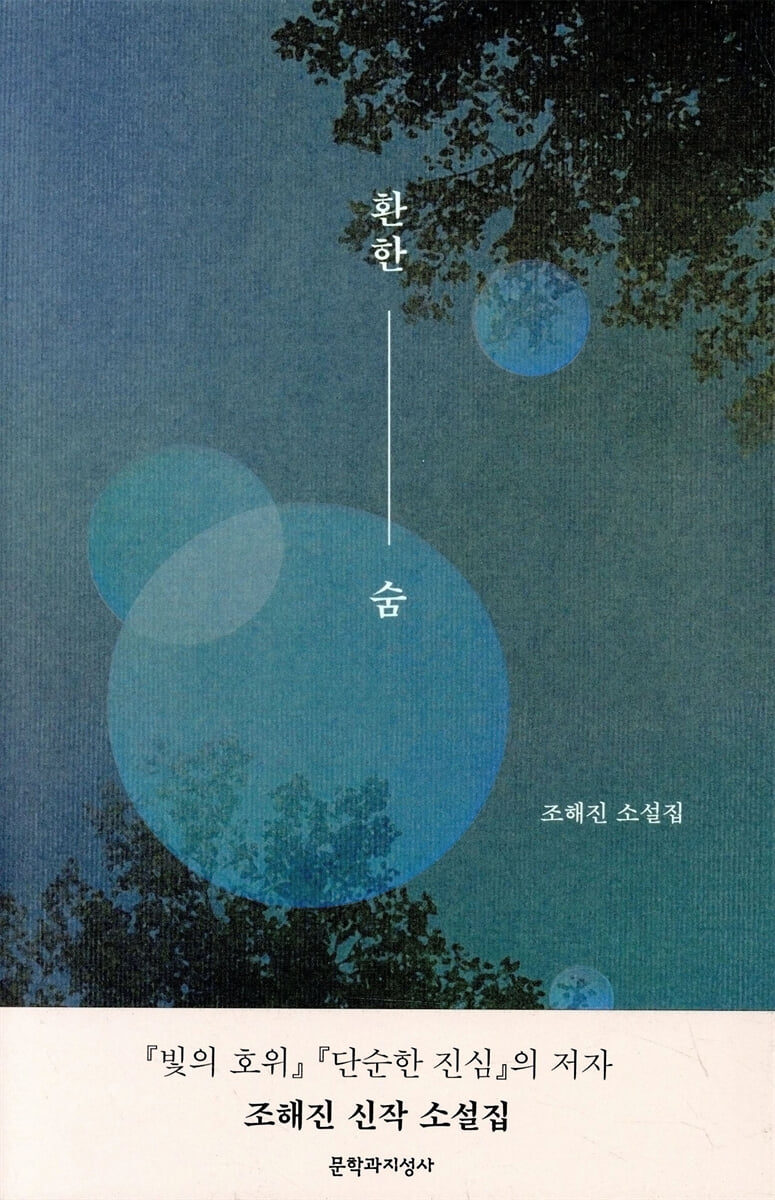
Bright breath
 |
Description
Book Introduction
- A word from MD
-
The moment when breath meets breath『Escort of Light』, 『Simple Sincerity』, a collection of short stories by Jo Hae-jin.
The book tells the story of people who live without knowing each other, yet are inevitably connected to each other.
In it, we capture moments when life and life, breath and breath, meet and shine warmly, and that light and warmth soon reach the deepest darkness of our hearts.
March 12, 2021. Novel/Poetry PD Park Hyung-wook
A new collection of short stories by Jo Hae-jin, author of "The Escort of Light" and "Simple Sincerity."
Warm stories that come back to life when my breath flows into you
A collection of short stories by Jo Hae-jin that comforts the marginalized with warm language.
This is the first book by the author, who has established his influence by sweeping major literary awards in the literary world, such as the Shin Dong-yup Literary Award, the Young Writer Award, and the Lee Hyo-seok Literary Award, after winning the Daesan Literary Award for “Simple Sincerity” in 2019.
This is the first book after winning the Daesan Literary Award for the novel 『Simple Sincerity』, and it contains a total of 9 short stories.
Jo Hae-jin's works demonstrate that each person can have their own story within the larger framework of society, while simultaneously providing readers with the experience of discovering each other's uniqueness.
Regarding this experience, critic Kim Mi-jeong says, “Rather than a simple ‘connection,’ this is closer to events that are deeply ‘involved’ in a certain world or event.”
That is, those who are located in markedly different positions, “here and there, this being and that being, past and present,” permeate each other while maintaining their own uniqueness.
Subjects who cannot be simply reduced and aligned within a group ask how they can reach each other's hearts, even if they cannot fully understand each other, and where their stories can begin again.
“The world becomes immeasurably deeper and wider in front of Jo Hae-jin’s novels, which willingly invite us to engage with these difficult questions” (Kim Mi-jeong).
Warm stories that come back to life when my breath flows into you
A collection of short stories by Jo Hae-jin that comforts the marginalized with warm language.
This is the first book by the author, who has established his influence by sweeping major literary awards in the literary world, such as the Shin Dong-yup Literary Award, the Young Writer Award, and the Lee Hyo-seok Literary Award, after winning the Daesan Literary Award for “Simple Sincerity” in 2019.
This is the first book after winning the Daesan Literary Award for the novel 『Simple Sincerity』, and it contains a total of 9 short stories.
Jo Hae-jin's works demonstrate that each person can have their own story within the larger framework of society, while simultaneously providing readers with the experience of discovering each other's uniqueness.
Regarding this experience, critic Kim Mi-jeong says, “Rather than a simple ‘connection,’ this is closer to events that are deeply ‘involved’ in a certain world or event.”
That is, those who are located in markedly different positions, “here and there, this being and that being, past and present,” permeate each other while maintaining their own uniqueness.
Subjects who cannot be simply reduced and aligned within a group ask how they can reach each other's hearts, even if they cannot fully understand each other, and where their stories can begin again.
“The world becomes immeasurably deeper and wider in front of Jo Hae-jin’s novels, which willingly invite us to engage with these difficult questions” (Kim Mi-jeong).
- You can preview some of the book's contents.
Preview
index
Bright treetops
Dispersing clouds
One breath
Between the borders
Sowing night
Man in the Snow
High and slow forgiveness
Hotter than breath
Moonrae
Commentary/Involvement and Secrets · Kim Mi-jeong
Author's Note
Dispersing clouds
One breath
Between the borders
Sowing night
Man in the Snow
High and slow forgiveness
Hotter than breath
Moonrae
Commentary/Involvement and Secrets · Kim Mi-jeong
Author's Note
Into the book
I don't think it's bad.
It's not bad, because there's nothing real here anyway, because right now I'm dreaming a very long dream that may never end.
Sometimes I miss the people I left behind outside my dream, living in a city that's like a mirror reflecting on the car window, but I believe that even if I wake up, that place will still be a dream, that it's just a dream outside of a dream.
But the desire to see a happy face may not be a dream.
One continues to think like that.
So, just to protect that face, for that one moment when they feel that happiness is not fake, they barely manage to puff up their hearts that are about to go out from the bottom, and one more time… …
Take one breath.
--- From "One Breath"
Just imagining the days when my films would not be selected, would be subject to harsh criticism and condemnation, and would be shunned was painful enough for me.
Remaining at zero so as not to get hurt, that was how I lived.
Like a reserve fighter standing alone in an empty ring with loose gloves on, with his opponent's seat and the audience in the stands empty...
--- From "Scattered Clouds"
Whether it is possible to absolutely sympathize with the individual suffering that unfolds within that wish.
She didn't think so.
No matter how much I thought about it, that couldn't be possible.
When viewed from the perspective of the whole and eternity, a person's wish is nothing more than an average part and a universal desire, like a piece of a quilt.
Now that I think about it, I had similar thoughts when I left the temple.
--- From "Bright Treetops"
Is it different?
If they and I are different, then what is the difference?
Whenever I saw senior journalists who, with their strong convictions in both hands, dropped everything and joined the protests, I began to have such questions, and as I became aware of, enumerated, and analyzed that other thing, a sense of moral inferiority followed.
At times, a void would overtake her, her passion and convictions evaporating, and at such times, Yeonjin would feel as if her entire life was decaying.
My insides, blood, and bones felt like they were being contaminated, and the simple laughter that had escaped me when I heard someone's joke quickly degenerated into self-directed ridicule.
--- From "Between the Borderlines"
If it's a story of something she's clearly witnessed and experienced, but then she's buried in the snow as if nothing happened from the beginning, then it's hers too.
It seemed like that was all the seven years had taught me about her.
If, in a moment, I were to return to a world of numbers and scales, the snow I had imagined would melt, and I would have to turn the corner.
But I wanted to stand here and watch her a little longer, until she moved to find her own way through the snow that had piled up so carelessly.
--- From "The Man in the Snow"
Hyojin took out a trash bag and threw the pot, rice bowl, and plates into it.
By what right do you dare come now and demand, pretend to be pitiful, force pity on me, how can you, even me, do that, huh, huh! I found myself muttering this to myself as I nervously washed the dishes, and at that very moment a detergent-stained mug slipped from my hands.
As I sat on the floor picking up the broken pieces of pottery, blood quickly formed on my right index finger.
It's not bad, because there's nothing real here anyway, because right now I'm dreaming a very long dream that may never end.
Sometimes I miss the people I left behind outside my dream, living in a city that's like a mirror reflecting on the car window, but I believe that even if I wake up, that place will still be a dream, that it's just a dream outside of a dream.
But the desire to see a happy face may not be a dream.
One continues to think like that.
So, just to protect that face, for that one moment when they feel that happiness is not fake, they barely manage to puff up their hearts that are about to go out from the bottom, and one more time… …
Take one breath.
--- From "One Breath"
Just imagining the days when my films would not be selected, would be subject to harsh criticism and condemnation, and would be shunned was painful enough for me.
Remaining at zero so as not to get hurt, that was how I lived.
Like a reserve fighter standing alone in an empty ring with loose gloves on, with his opponent's seat and the audience in the stands empty...
--- From "Scattered Clouds"
Whether it is possible to absolutely sympathize with the individual suffering that unfolds within that wish.
She didn't think so.
No matter how much I thought about it, that couldn't be possible.
When viewed from the perspective of the whole and eternity, a person's wish is nothing more than an average part and a universal desire, like a piece of a quilt.
Now that I think about it, I had similar thoughts when I left the temple.
--- From "Bright Treetops"
Is it different?
If they and I are different, then what is the difference?
Whenever I saw senior journalists who, with their strong convictions in both hands, dropped everything and joined the protests, I began to have such questions, and as I became aware of, enumerated, and analyzed that other thing, a sense of moral inferiority followed.
At times, a void would overtake her, her passion and convictions evaporating, and at such times, Yeonjin would feel as if her entire life was decaying.
My insides, blood, and bones felt like they were being contaminated, and the simple laughter that had escaped me when I heard someone's joke quickly degenerated into self-directed ridicule.
--- From "Between the Borderlines"
If it's a story of something she's clearly witnessed and experienced, but then she's buried in the snow as if nothing happened from the beginning, then it's hers too.
It seemed like that was all the seven years had taught me about her.
If, in a moment, I were to return to a world of numbers and scales, the snow I had imagined would melt, and I would have to turn the corner.
But I wanted to stand here and watch her a little longer, until she moved to find her own way through the snow that had piled up so carelessly.
--- From "The Man in the Snow"
Hyojin took out a trash bag and threw the pot, rice bowl, and plates into it.
By what right do you dare come now and demand, pretend to be pitiful, force pity on me, how can you, even me, do that, huh, huh! I found myself muttering this to myself as I nervously washed the dishes, and at that very moment a detergent-stained mug slipped from my hands.
As I sat on the floor picking up the broken pieces of pottery, blood quickly formed on my right index finger.
--- From "High and Slow Forgiveness"
Publisher's Review
A new collection of short stories by Jo Hae-jin, author of "The Escort of Light" and "Simple Sincerity."
This book contains a total of nine novels, including the autobiographical novel “Munrae” and “The Bright Tree Top,” which won the 2019 Kim Seung-ok Literary Award for Excellence.
In particular, "The Bright Treetop" is a work that allows us to glimpse the author's unique strengths, as the judges commented, "a novel written with delicate sentences that seem to grope for light in the darkness," and breathe bright life into emotions that are difficult to express in words while soothing the twists and turns of life.
Over the years, Jo Hae-jin has been working to add color to the lives of those who remain in the darkest corners of society, including immigrants, adoptees, and the working poor.
This book also focuses on the lives of those who are hidden and neglected, such as a middle-aged woman battling cancer with no one to turn to, child laborers forced to work without even knowing what mercury poisoning was, and men and women who have wasted their youth without achieving any significant results and become exhausted.
The author adds warmth to the individual stories of “unperceived but existing” individuals with a “desperate heart” that their lives do not end here.
"Reading a novel is like staring at your cold eyes with your bare hands for a while.
Faced with a dilemma we cannot ignore, we may feel dizzy and lonely many times, like a child alone on a merry-go-round, but such isolation does not end there.
This is because we have the beautiful and delicate 'language of prayer' of Jo Hae-jin, who melts the pain of others with his own warmth and hopes that it will lead to salvation on a higher level.
- Recommendation by Kim Geum-hee (novelist)
The hidden truths that follow 'but'
The starting point of life that rises again from where it ended
The future with Hojae was just canceled.
The thought that my life would now be a repeating chain of visits to this coffee shop actually made me feel more at ease.
The countless coffee shops, connected like train cars, where I sit hunched over and drink coffee alone, become a new stage in my life, free from the lonely ring.
however……
But I didn't know that this might be the last thing I wanted to say.
_「Scattered Clouds」
If we can call a party a climax moment that is given equally to everyone, then all parties eventually end.
Even the daily life filled with “pure passion,” the moments filled with the joy of life, and sometimes the times when it was so difficult that I couldn’t escape from “pessimistic emptiness.”
However, as if this is not the real end, author Jo Hae-jin continues the story by leaning on the words he “wanted to say for the last time” after the climax.
After spending 12 years together, Hojae and I decided to break up, and apart from my expectations that a “new stage in my life” awaited me after a long relationship, the novel focuses on my true feelings that follow the “but.”
The sincerity is a true confession about how a life with Hojae was possible, and how the words Hojae said in the documentary he participated in as an assistant director helped me live.
Events such as the end of a love affair are sometimes transformed into variations such as the death of a classmate ("Bright Treetop"), a minor who loses consciousness in an unfortunate factory accident ("One Breath"), and a father who disappears in an unfortunate incident and a sister left behind ("High and Slow Forgiveness"). The author catches the tail of the story that is nearing its end and breathes life into the individual stories crouching behind the "but."
Even though our relationship is sometimes disrupted by death, separation, or a vast gap in time and space, isn't it the truth of life that I still have stories to tell you, stories I haven't told you, that keeps us alive?
The author focuses on the true feelings of each individual who remains in the stories of scattered and wounded individuals, and suggests that we cautiously begin again with the belief that the tragic ending is “not the complete end” (literary critic Kim Mi-jeong).
Brilliant moments created by a sincere heart
The 'I-you' involved when discovering each other
“Not long ago, someone who worked for a civic group came to the hospital and said that this society made it that way.
Is that so, sir?”
“……”
“But, I’m saying this because I don’t really know.
It's because I'm bad that one of them ended up like that.
“I’m a high school dropout, a single mother, I guess I’m kind of a loser.”
_「One Breath」
The conjunction 'but' mentioned earlier also exerts its power in Jo Hae-jin's main narrative, which focuses on the lives of individuals swept up in the violence of history and society.
One day, as I was working as a non-regular teacher at a specialized high school, I heard the news that my student, Hana, had lost consciousness after a serious accident at the factory where she had gone for training.
The story of the boys who died from mercury poisoning in "The Night of Sowing," another novel included in this book, and the internal conflict of a new reporter who takes the place of an unfairly dismissed reporter but is not recognized by anyone in "Between the Lines" are recurring but still unresolved incidents.
However, behind the short summary that “society made one that way,” there is a ‘one’ who wants to believe that there is true happiness, and there is a person who hopes that ‘one’ will dream of happiness even in their subconscious.
The inner wills that emerge when the individual worlds and dreams behind the cross-section of society, and the bright hearts that are kept fairly, sparkle, create points that can never be reduced to a system, carving out the shining scenes of a novel.
For example, in "The Man in the Snow," 'I' and Yeo-jin participate in a publishing company's oral history project and meet Choi Gil-nam, a scout who participated in the massacre of North Korean soldiers by the US military during the Korean War.
Choi Gil-nam, who lives in shame for having killed so many people just to save his own life, secretly reveals the one moment that made him truly feel his heart.
That handful of brilliant moments, which made him throw his body away to save “a fragile life with short limbs and a thin torso” while trembling in fear amidst a hail of gunfire, brings out another side of Choi Gil-nam that was hidden beneath the easily hurled criticism.
In this way, Jo Hae-jin's works show that each person can have their own story within the large framework of society, while at the same time providing readers with the experience of discovering each other's uniqueness.
Regarding this experience, critic Kim Mi-jeong says, "Rather than a simple 'connection,' this is closer to events that are deeply 'involved' in a certain world or event."
That is, those who are located in markedly different positions, “here and there, this being and that being, past and present,” permeate each other while maintaining their own uniqueness.
Subjects who cannot be simply reduced and aligned within a group ask how they can reach each other's hearts, even if they cannot fully understand each other, and where their stories can begin again.
“The world becomes immeasurably deeper and wider in front of Jo Hae-jin’s novels, which willingly invite us to engage with these difficult questions” (Kim Mi-jeong).
This book contains a total of nine novels, including the autobiographical novel “Munrae” and “The Bright Tree Top,” which won the 2019 Kim Seung-ok Literary Award for Excellence.
In particular, "The Bright Treetop" is a work that allows us to glimpse the author's unique strengths, as the judges commented, "a novel written with delicate sentences that seem to grope for light in the darkness," and breathe bright life into emotions that are difficult to express in words while soothing the twists and turns of life.
Over the years, Jo Hae-jin has been working to add color to the lives of those who remain in the darkest corners of society, including immigrants, adoptees, and the working poor.
This book also focuses on the lives of those who are hidden and neglected, such as a middle-aged woman battling cancer with no one to turn to, child laborers forced to work without even knowing what mercury poisoning was, and men and women who have wasted their youth without achieving any significant results and become exhausted.
The author adds warmth to the individual stories of “unperceived but existing” individuals with a “desperate heart” that their lives do not end here.
"Reading a novel is like staring at your cold eyes with your bare hands for a while.
Faced with a dilemma we cannot ignore, we may feel dizzy and lonely many times, like a child alone on a merry-go-round, but such isolation does not end there.
This is because we have the beautiful and delicate 'language of prayer' of Jo Hae-jin, who melts the pain of others with his own warmth and hopes that it will lead to salvation on a higher level.
- Recommendation by Kim Geum-hee (novelist)
The hidden truths that follow 'but'
The starting point of life that rises again from where it ended
The future with Hojae was just canceled.
The thought that my life would now be a repeating chain of visits to this coffee shop actually made me feel more at ease.
The countless coffee shops, connected like train cars, where I sit hunched over and drink coffee alone, become a new stage in my life, free from the lonely ring.
however……
But I didn't know that this might be the last thing I wanted to say.
_「Scattered Clouds」
If we can call a party a climax moment that is given equally to everyone, then all parties eventually end.
Even the daily life filled with “pure passion,” the moments filled with the joy of life, and sometimes the times when it was so difficult that I couldn’t escape from “pessimistic emptiness.”
However, as if this is not the real end, author Jo Hae-jin continues the story by leaning on the words he “wanted to say for the last time” after the climax.
After spending 12 years together, Hojae and I decided to break up, and apart from my expectations that a “new stage in my life” awaited me after a long relationship, the novel focuses on my true feelings that follow the “but.”
The sincerity is a true confession about how a life with Hojae was possible, and how the words Hojae said in the documentary he participated in as an assistant director helped me live.
Events such as the end of a love affair are sometimes transformed into variations such as the death of a classmate ("Bright Treetop"), a minor who loses consciousness in an unfortunate factory accident ("One Breath"), and a father who disappears in an unfortunate incident and a sister left behind ("High and Slow Forgiveness"). The author catches the tail of the story that is nearing its end and breathes life into the individual stories crouching behind the "but."
Even though our relationship is sometimes disrupted by death, separation, or a vast gap in time and space, isn't it the truth of life that I still have stories to tell you, stories I haven't told you, that keeps us alive?
The author focuses on the true feelings of each individual who remains in the stories of scattered and wounded individuals, and suggests that we cautiously begin again with the belief that the tragic ending is “not the complete end” (literary critic Kim Mi-jeong).
Brilliant moments created by a sincere heart
The 'I-you' involved when discovering each other
“Not long ago, someone who worked for a civic group came to the hospital and said that this society made it that way.
Is that so, sir?”
“……”
“But, I’m saying this because I don’t really know.
It's because I'm bad that one of them ended up like that.
“I’m a high school dropout, a single mother, I guess I’m kind of a loser.”
_「One Breath」
The conjunction 'but' mentioned earlier also exerts its power in Jo Hae-jin's main narrative, which focuses on the lives of individuals swept up in the violence of history and society.
One day, as I was working as a non-regular teacher at a specialized high school, I heard the news that my student, Hana, had lost consciousness after a serious accident at the factory where she had gone for training.
The story of the boys who died from mercury poisoning in "The Night of Sowing," another novel included in this book, and the internal conflict of a new reporter who takes the place of an unfairly dismissed reporter but is not recognized by anyone in "Between the Lines" are recurring but still unresolved incidents.
However, behind the short summary that “society made one that way,” there is a ‘one’ who wants to believe that there is true happiness, and there is a person who hopes that ‘one’ will dream of happiness even in their subconscious.
The inner wills that emerge when the individual worlds and dreams behind the cross-section of society, and the bright hearts that are kept fairly, sparkle, create points that can never be reduced to a system, carving out the shining scenes of a novel.
For example, in "The Man in the Snow," 'I' and Yeo-jin participate in a publishing company's oral history project and meet Choi Gil-nam, a scout who participated in the massacre of North Korean soldiers by the US military during the Korean War.
Choi Gil-nam, who lives in shame for having killed so many people just to save his own life, secretly reveals the one moment that made him truly feel his heart.
That handful of brilliant moments, which made him throw his body away to save “a fragile life with short limbs and a thin torso” while trembling in fear amidst a hail of gunfire, brings out another side of Choi Gil-nam that was hidden beneath the easily hurled criticism.
In this way, Jo Hae-jin's works show that each person can have their own story within the large framework of society, while at the same time providing readers with the experience of discovering each other's uniqueness.
Regarding this experience, critic Kim Mi-jeong says, "Rather than a simple 'connection,' this is closer to events that are deeply 'involved' in a certain world or event."
That is, those who are located in markedly different positions, “here and there, this being and that being, past and present,” permeate each other while maintaining their own uniqueness.
Subjects who cannot be simply reduced and aligned within a group ask how they can reach each other's hearts, even if they cannot fully understand each other, and where their stories can begin again.
“The world becomes immeasurably deeper and wider in front of Jo Hae-jin’s novels, which willingly invite us to engage with these difficult questions” (Kim Mi-jeong).
GOODS SPECIFICS
- Publication date: March 9, 2021
- Page count, weight, size: 316 pages | 316g | 120*188*18mm
- ISBN13: 9788932038230
- ISBN10: 8932038236
You may also like
카테고리
korean


korean

![GQ KOREA Mark (Monthly): December [2025]](http://librairie.coreenne.fr/cdn/shop/files/8ef265dbbfbf186523ed75ba7319009d.jpg?v=1765340328&width=3840)


