

Snowball Drive
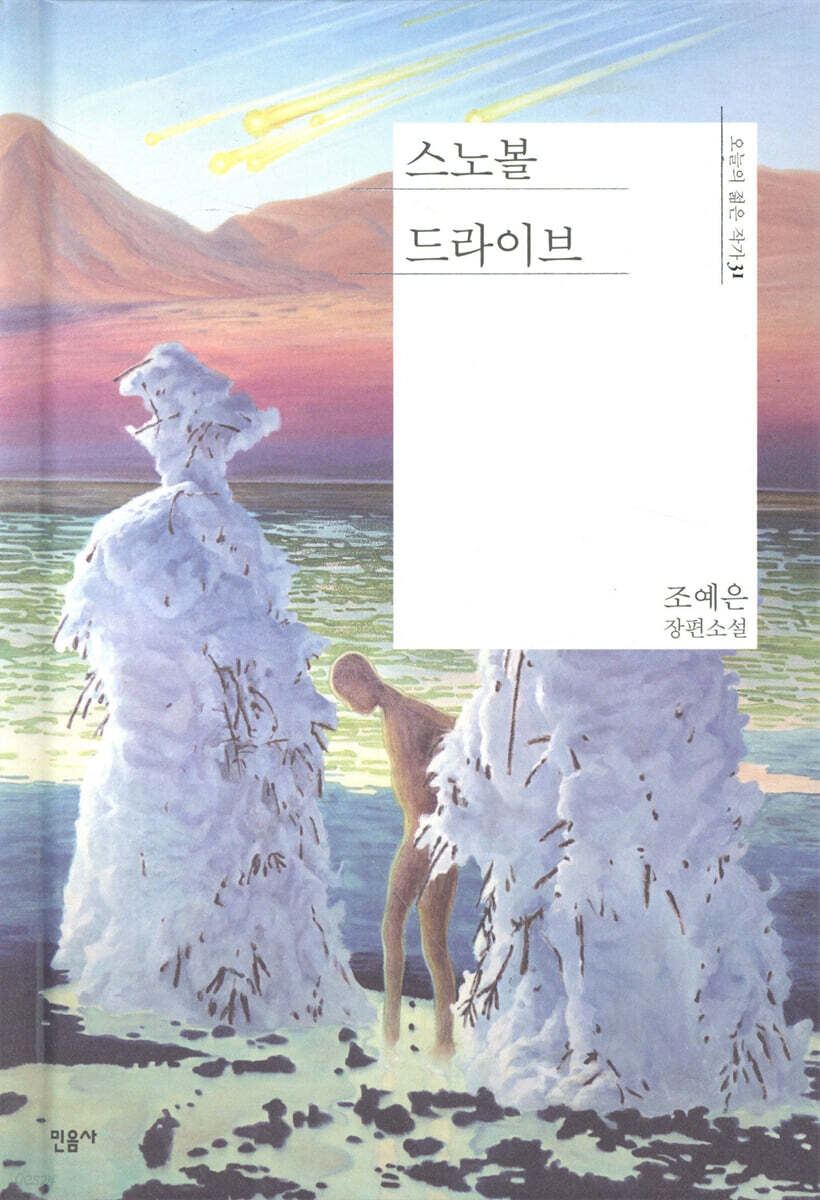 |
Description
Book Introduction
- A word from MD
-
One summer, snow began to fall without melting.In a world where unmeltable "preservative snow" falls, "Snowball Drive" tells the story of people who have become adults while being stuffed under the snow for a time.
An unexpected disaster destroys everyday life, but rather than crumbling under it, the faces of those who choose to laugh, spread warmth, and run through it shine.March 2, 2021. Novel/Poetry PD Park Hyung-wook
One summer day when I just wanted the world to end
Snow began to fall without melting.
Adults who haven't grown up
Snowball Dystopia
“Even if snow piles up on top again, only the heat of the person running
“I think I now understand that this world is melting away little by little.”
―Kim Cho-yeop (novelist)┃From the recommendation
Jo Ye-eun's new novel, "Snowball Drive," has been published by Minumsa as part of the "Today's Young Writers Series."
"Snowball Drive" is a dystopian novel by Jo Ye-eun that depicts the time of two people who have become adults while half of their teenage years are buried under the snow, set in a time of disaster when "preservative snow" falls that causes rashes as soon as it touches the skin and does not melt unless burned. It is a poignant and lighthearted novel.
Novelist Jo Ye-eun has consistently depicted the small signs of the apocalypse that infiltrate our daily lives through her previous works, “The New Seoul Park Jelly Vendor Massacre” and “Cocktail, Love, Zombie.”
This novel expands the setting to the entire world, showing even more intensely the irony of the long and bleak life of daily life after disaster.
The irony of a life where one habitually mutters that everything will be ruined, and a life where one struggles to survive until the end after the world has collapsed as one wishes.
Now, when global catastrophes are no longer unfamiliar, is perhaps the most opportune time to follow Moru and Yiwol's journey right alongside them.
Snow began to fall without melting.
Adults who haven't grown up
Snowball Dystopia
“Even if snow piles up on top again, only the heat of the person running
“I think I now understand that this world is melting away little by little.”
―Kim Cho-yeop (novelist)┃From the recommendation
Jo Ye-eun's new novel, "Snowball Drive," has been published by Minumsa as part of the "Today's Young Writers Series."
"Snowball Drive" is a dystopian novel by Jo Ye-eun that depicts the time of two people who have become adults while half of their teenage years are buried under the snow, set in a time of disaster when "preservative snow" falls that causes rashes as soon as it touches the skin and does not melt unless burned. It is a poignant and lighthearted novel.
Novelist Jo Ye-eun has consistently depicted the small signs of the apocalypse that infiltrate our daily lives through her previous works, “The New Seoul Park Jelly Vendor Massacre” and “Cocktail, Love, Zombie.”
This novel expands the setting to the entire world, showing even more intensely the irony of the long and bleak life of daily life after disaster.
The irony of a life where one habitually mutters that everything will be ruined, and a life where one struggles to survive until the end after the world has collapsed as one wishes.
Now, when global catastrophes are no longer unfamiliar, is perhaps the most opportune time to follow Moru and Yiwol's journey right alongside them.
- You can preview some of the book's contents.
Preview
index
Snowball Drive 7
Author's Note 227
Recommendation 229
Author's Note 227
Recommendation 229
Into the book
Average daily snowfall: 20 centimeters.
Total 150 centimeters.
What makes it different from regular snow is that it doesn't melt away.
The fake snow piled up to the chest of an adult man.
All the trash on the street—takeout cups, broken glass, cigarette butts, dead rats, and poorly cleaned disposable containers—was buried under the snow.
The street looked peaceful at first glance, as the snowflakes hid all the dirt.
Snow crystals, which never melt unless burned, sparkled like water scales in the direction the sunlight struck them.
--- p.34
The damage was slowly repaired.
In the meantime, more things fell apart beyond repair.
People starving to death, people dying of loneliness, people ruined, people dying of ruin, people who couldn't stand the frustration and jumped into the snow and had a seizure, people who thought nothing of it and went out and never came back, people who searched for those who couldn't come back and never came back.
--- p.35
The work was simple but hard, and I was so exhausted that I couldn't do anything after work.
There was a reason there was an age limit for doing dirty work at the center.
Children are timid, easily fooled, and have good physical strength but don't know anything.
Because it moves well as you tell it to.
--- p.93
Greed, greed.
For a moment, I wondered if I was in a position to be greedy, but then I thought that I should want it even more.
There were so many things I had missed out on, so I wanted to grab onto anything I could from now on.
I needed something I could hold firmly, not a snowflake that would melt away the moment I held it in my hand.
I didn't want to repeat things like reminiscing about a world in photographs that would never return, or chasing after my aunt after losing her.
No, I won't repeat it.
--- p.152~153
If a faint grape scent wafts through the strong smells, the child is somewhere nearby.
Even though I was working wearing a gas mask, the grape scent was strangely clear.
It's a strange thing.
Even though they were all wearing the same overalls and gas masks, I could still recognize him.
Total 150 centimeters.
What makes it different from regular snow is that it doesn't melt away.
The fake snow piled up to the chest of an adult man.
All the trash on the street—takeout cups, broken glass, cigarette butts, dead rats, and poorly cleaned disposable containers—was buried under the snow.
The street looked peaceful at first glance, as the snowflakes hid all the dirt.
Snow crystals, which never melt unless burned, sparkled like water scales in the direction the sunlight struck them.
--- p.34
The damage was slowly repaired.
In the meantime, more things fell apart beyond repair.
People starving to death, people dying of loneliness, people ruined, people dying of ruin, people who couldn't stand the frustration and jumped into the snow and had a seizure, people who thought nothing of it and went out and never came back, people who searched for those who couldn't come back and never came back.
--- p.35
The work was simple but hard, and I was so exhausted that I couldn't do anything after work.
There was a reason there was an age limit for doing dirty work at the center.
Children are timid, easily fooled, and have good physical strength but don't know anything.
Because it moves well as you tell it to.
--- p.93
Greed, greed.
For a moment, I wondered if I was in a position to be greedy, but then I thought that I should want it even more.
There were so many things I had missed out on, so I wanted to grab onto anything I could from now on.
I needed something I could hold firmly, not a snowflake that would melt away the moment I held it in my hand.
I didn't want to repeat things like reminiscing about a world in photographs that would never return, or chasing after my aunt after losing her.
No, I won't repeat it.
--- p.152~153
If a faint grape scent wafts through the strong smells, the child is somewhere nearby.
Even though I was working wearing a gas mask, the grape scent was strangely clear.
It's a strange thing.
Even though they were all wearing the same overalls and gas masks, I could still recognize him.
--- p.170
Publisher's Review
fucking beauty
"Snowball Drive" shows how far oppression and despair can reach when disaster becomes the norm.
The preservative snow falls more and more, covering up all the filth in the world.
The city, covered entirely in white snow, is sadly beautiful, but no one talks about its beauty because “I don’t think it should be considered pretty.”
At the 'Center', a workshop where eyes are incinerated, employees in their early 20s, like the two main characters Moru and Iwol, who have had half of their teenage years erased, live in a dormitory.
They sleep together, eat together, and ride the same commuter bus to and from the center, feeling as if they are going back to school, but somehow they feel like they shouldn't be having fun, so they don't smile as often as the other students.
Even as I'm laughing, in one corner of the center, employees are missing in an avalanche, and rescue teams aren't dispatched for small things like employee disappearances.
Because one day, while working, you might come across the face of a colleague who has died buried in the snow.
To be unable to say that something beautiful is beautiful even when it is right before your eyes is the most miserable result when disaster has penetrated deep into your life.
A different color from white snow
The protagonist, Moru, leaves behind an unexpected clue called Snowball and decides to leave it at the center to find traces of his missing aunt.
Hard work, dry skin, and the corpses we face every day in the snow.
Still, Moru cannot leave the center where all kinds of trash gather, fearing that his aunt will show up with other corpses.
Then one day, Lee Wol, who went to the same middle school as Moru, gets a job at the center.
There are new memories blooming from the past.
Things like the boring school days, the ordinary days of watching TV while eating grapes, and the graduation ceremony scenes filled with excitement.
In a world covered in white snow, in a colorless present where everyone must wear the same protective gear covering their entire body, only Yiwol illuminates the past when everyone had their own color.
Can the forgotten colors of the past color the black and white present and the uncertain future?
Will a world of a different color from the white snow ever come?
As critic Ina Young recommends, "Snowball Drive" is a novel about "the courage to hold each other's hands and become stronger in a world where there is no escape."
The steps Moru and Iwol will take together will be a strong encouragement to us who are hesitating in the face of uncertainty.
"Snowball Drive" shows how far oppression and despair can reach when disaster becomes the norm.
The preservative snow falls more and more, covering up all the filth in the world.
The city, covered entirely in white snow, is sadly beautiful, but no one talks about its beauty because “I don’t think it should be considered pretty.”
At the 'Center', a workshop where eyes are incinerated, employees in their early 20s, like the two main characters Moru and Iwol, who have had half of their teenage years erased, live in a dormitory.
They sleep together, eat together, and ride the same commuter bus to and from the center, feeling as if they are going back to school, but somehow they feel like they shouldn't be having fun, so they don't smile as often as the other students.
Even as I'm laughing, in one corner of the center, employees are missing in an avalanche, and rescue teams aren't dispatched for small things like employee disappearances.
Because one day, while working, you might come across the face of a colleague who has died buried in the snow.
To be unable to say that something beautiful is beautiful even when it is right before your eyes is the most miserable result when disaster has penetrated deep into your life.
A different color from white snow
The protagonist, Moru, leaves behind an unexpected clue called Snowball and decides to leave it at the center to find traces of his missing aunt.
Hard work, dry skin, and the corpses we face every day in the snow.
Still, Moru cannot leave the center where all kinds of trash gather, fearing that his aunt will show up with other corpses.
Then one day, Lee Wol, who went to the same middle school as Moru, gets a job at the center.
There are new memories blooming from the past.
Things like the boring school days, the ordinary days of watching TV while eating grapes, and the graduation ceremony scenes filled with excitement.
In a world covered in white snow, in a colorless present where everyone must wear the same protective gear covering their entire body, only Yiwol illuminates the past when everyone had their own color.
Can the forgotten colors of the past color the black and white present and the uncertain future?
Will a world of a different color from the white snow ever come?
As critic Ina Young recommends, "Snowball Drive" is a novel about "the courage to hold each other's hands and become stronger in a world where there is no escape."
The steps Moru and Iwol will take together will be a strong encouragement to us who are hesitating in the face of uncertainty.
GOODS SPECIFICS
- Publication date: February 15, 2021
- Format: Hardcover book binding method guide
- Page count, weight, size: 236 pages | 328g | 135*194*17mm
- ISBN13: 9788937473319
- ISBN10: 8937473313
You may also like
카테고리
korean


korean

![GQ KOREA Mark (Monthly): December [2025]](http://librairie.coreenne.fr/cdn/shop/files/8ef265dbbfbf186523ed75ba7319009d.jpg?v=1765340328&width=3840)


