

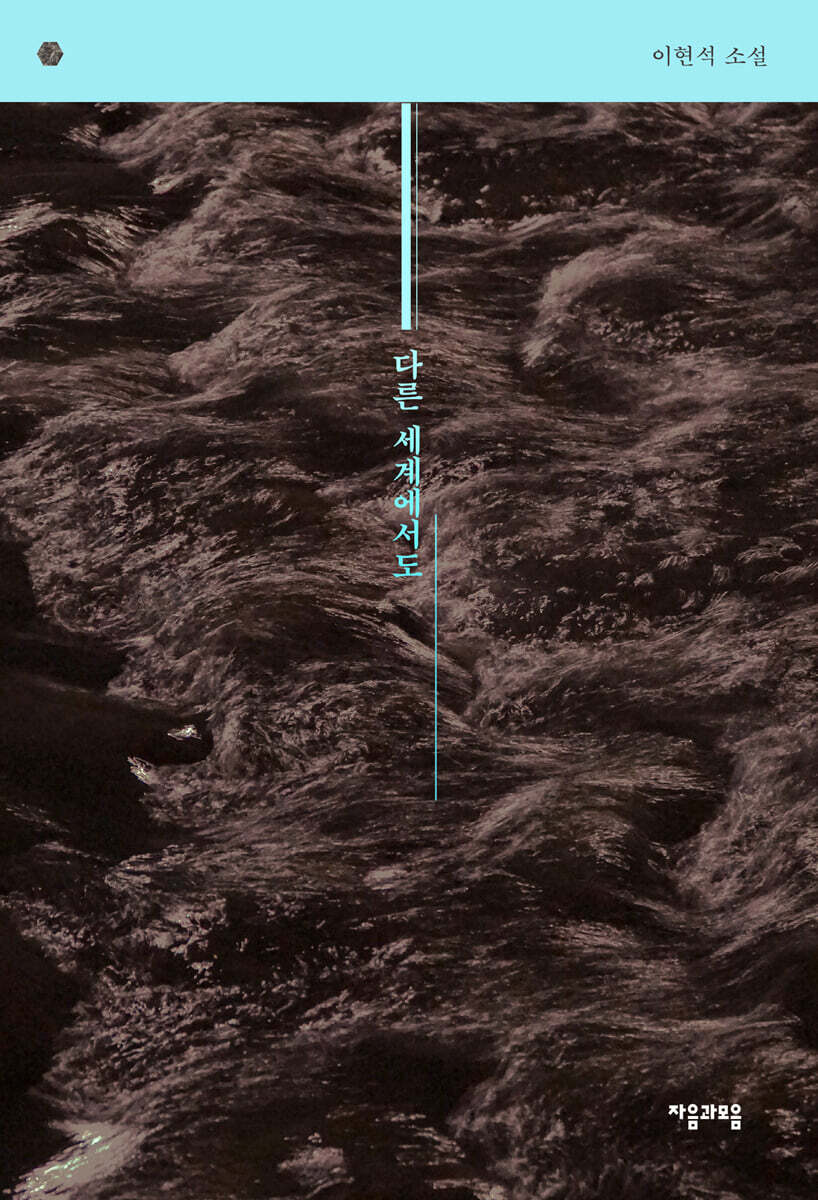
In another world too
 |
Description
Book Introduction
- A word from MD
-
Literature of life, tightly woven with a keen senseThe first novel collection by Lee Hyeon-seok, winner of the 11th Young Writer's Award in 2020.
Each piece in the book gives us a glimpse into the persistent questions he must have had about the world and its people.
A book that will allow you to perceive reality with a keen sense of awareness while also deeply experiencing the pleasure of reading literature.February 19, 2021. Novel/Poetry PD Park Hyung-wook
Winner of the 11th Young Writer Award in 2020
Lee Hyun-seok's first novel collection
“I am sure that my love for you will remain strong even in that other world.
“I hope the day will come when you understand”
The first collection of short stories, 『In Another World』, by Lee Hyeon-seok, currently the most notable novelist in the Korean literary world, has been published by Jaum and Moeum.
The author began her career in 2017 when her novel “Cham (站)” won the JoongAng New Writer’s Award, and in 2020, she won the 11th Young Writer’s Award, receiving praise for her “power to read the complex inner world of humans” (novelist Oh Jeong-hee), “fighting not to be swayed by either side in the conflict between ideas and reality” (novelist Kwon Yeo-seon), and “delicate and rigorous perspective and sensibility” (novelist Jeon Seong-tae).
As can be seen in "In Another World," the title work of a collection of short stories set against the backdrop of the Constitutional Court's ruling that the abortion law is unconstitutional and the winner of the Young Writer's Award, the author is a realist who poses sophisticated and meticulous questions while unraveling contemporary ethical and social issues through novels.
By constructing a narrative through the intersecting and diverse voices and perspectives of various characters, it allows us to perceive the details of real-world issues that require deep consideration and even the contradictions inherent in human nature.
Lee Hyeon-seok's novels are a literature of life that critically and fiercely remembers and records the present world, thereby preventing forgetting and welcoming a better world afterward.
Lee Hyun-seok's first novel collection
“I am sure that my love for you will remain strong even in that other world.
“I hope the day will come when you understand”
The first collection of short stories, 『In Another World』, by Lee Hyeon-seok, currently the most notable novelist in the Korean literary world, has been published by Jaum and Moeum.
The author began her career in 2017 when her novel “Cham (站)” won the JoongAng New Writer’s Award, and in 2020, she won the 11th Young Writer’s Award, receiving praise for her “power to read the complex inner world of humans” (novelist Oh Jeong-hee), “fighting not to be swayed by either side in the conflict between ideas and reality” (novelist Kwon Yeo-seon), and “delicate and rigorous perspective and sensibility” (novelist Jeon Seong-tae).
As can be seen in "In Another World," the title work of a collection of short stories set against the backdrop of the Constitutional Court's ruling that the abortion law is unconstitutional and the winner of the Young Writer's Award, the author is a realist who poses sophisticated and meticulous questions while unraveling contemporary ethical and social issues through novels.
By constructing a narrative through the intersecting and diverse voices and perspectives of various characters, it allows us to perceive the details of real-world issues that require deep consideration and even the contradictions inherent in human nature.
Lee Hyeon-seok's novels are a literature of life that critically and fiercely remembers and records the present world, thereby preventing forgetting and welcoming a better world afterward.
- You can preview some of the book's contents.
Preview
index
I left them in the garden
In another world too
LiFi
Butaebok
Confrontation
There is no look in your eyes
If I follow you
Station
References and some additions
Preface: Our Possibilities_Han Jeong-hyeon
In another world too
LiFi
Butaebok
Confrontation
There is no look in your eyes
If I follow you
Station
References and some additions
Preface: Our Possibilities_Han Jeong-hyeon
Into the book
It's a story about two people meeting, and I've been trying to write it several times for about ten months now.
I changed the character's age, sex, and gender, and I also changed the background, situation, and details, and I even changed the nationality and era.
---From "I Left Them in the Garden"
Perhaps the reason I hypnotized myself into thinking it wasn't Suyeon when I found out she had read the piece was because I knew it couldn't have been her.
---From "I Left Them in the Garden"
Haven't we seen many married mothers who couldn't hide their confusion and depression when they heard the news of their pregnancy, and conversely, those who couldn't hide their relief or comfort after an unexpected miscarriage?
---From "In Another World"
Shouldn't it be now, not later?
Shouldn't it be right now, not some unspecified time?
---From "In Another World"
The life force is growing within the father.
As soon as he thought about this, Youngwoo looked around anxiously.
---From "Life"
Just one roundhouse kick.
That was the first time Youngwoo saw Raifai appearing at the end of a long darkness.
---From "Life"
“It’s like coronavirus, isn’t it?” Butaebok pointed out that coronavirus infection is typically accompanied by abdominal symptoms such as diarrhea.
---From "Bu Tae-bok"
When Butaebok, feeling proud, said that he had crossed the Imjin River, the pleasant atmosphere at the table suddenly cooled down.
People glared at him, and a young woman sitting next to him asked in a sharp voice if he was a defector.
---From "Bu Tae-bok"
In particular, 〈Confrontation 1〉 had the illusion that it became clearer the further away I got, so I kept walking away from it.
---From "Confrontation"
I chuckled, "You're a bit weird."
"Not you?" Hanseo said, as if incredulous, and touched my cheek with both hands.
---From "Confrontation"
The sound had been echoing through the wall and covering the table for a long time, and Jun-mo, who had been listening to his crying for a long time, muttered.
“Since that day, I haven’t seen that guy’s eyes.
I wasn't in my right mind.
“Wouldn’t it be just that friend?”
---From "No Eyes"
For example, was that person really servicing the cut saw at that time?
Was he really looking down at the flowers blooming on the ground when he was staring straight down below the railing?
---From "No Eyes"
Did that older sister go to Frankfurt?
If you go there, they give you a house and clothes?
---From "If I Follow You"
The afternoon of May 22, 1980.
Jeong-hye silently watched the blood slowly rise inside the transparent pack.
One door must close for the other door to open.
The entrance to the prison looks like this.
---From "Cham (站)"
“So this is what they call a ‘true’ place.” “Yes.
I don't know if that's true, but that's what the inmates who worked as beauticians in society said.
When you say 'step', you mean 'step'.
“Somehow, we ended up calling it that too.”
I changed the character's age, sex, and gender, and I also changed the background, situation, and details, and I even changed the nationality and era.
---From "I Left Them in the Garden"
Perhaps the reason I hypnotized myself into thinking it wasn't Suyeon when I found out she had read the piece was because I knew it couldn't have been her.
---From "I Left Them in the Garden"
Haven't we seen many married mothers who couldn't hide their confusion and depression when they heard the news of their pregnancy, and conversely, those who couldn't hide their relief or comfort after an unexpected miscarriage?
---From "In Another World"
Shouldn't it be now, not later?
Shouldn't it be right now, not some unspecified time?
---From "In Another World"
The life force is growing within the father.
As soon as he thought about this, Youngwoo looked around anxiously.
---From "Life"
Just one roundhouse kick.
That was the first time Youngwoo saw Raifai appearing at the end of a long darkness.
---From "Life"
“It’s like coronavirus, isn’t it?” Butaebok pointed out that coronavirus infection is typically accompanied by abdominal symptoms such as diarrhea.
---From "Bu Tae-bok"
When Butaebok, feeling proud, said that he had crossed the Imjin River, the pleasant atmosphere at the table suddenly cooled down.
People glared at him, and a young woman sitting next to him asked in a sharp voice if he was a defector.
---From "Bu Tae-bok"
In particular, 〈Confrontation 1〉 had the illusion that it became clearer the further away I got, so I kept walking away from it.
---From "Confrontation"
I chuckled, "You're a bit weird."
"Not you?" Hanseo said, as if incredulous, and touched my cheek with both hands.
---From "Confrontation"
The sound had been echoing through the wall and covering the table for a long time, and Jun-mo, who had been listening to his crying for a long time, muttered.
“Since that day, I haven’t seen that guy’s eyes.
I wasn't in my right mind.
“Wouldn’t it be just that friend?”
---From "No Eyes"
For example, was that person really servicing the cut saw at that time?
Was he really looking down at the flowers blooming on the ground when he was staring straight down below the railing?
---From "No Eyes"
Did that older sister go to Frankfurt?
If you go there, they give you a house and clothes?
---From "If I Follow You"
The afternoon of May 22, 1980.
Jeong-hye silently watched the blood slowly rise inside the transparent pack.
One door must close for the other door to open.
The entrance to the prison looks like this.
---From "Cham (站)"
“So this is what they call a ‘true’ place.” “Yes.
I don't know if that's true, but that's what the inmates who worked as beauticians in society said.
When you say 'step', you mean 'step'.
“Somehow, we ended up calling it that too.”
---From "Cham (站)"
Publisher's Review
Questions that roam and construct the most contemporary ethics
In "I Left Them in the Garden," which opens the first novel collection, the doctor, "I," is also a novelist.
Lee Si-jin is a patient in a vegetative state that I am in charge of. He had left his wife and daughter in the past when he came out to the public.
His same-sex lover of over 10 years came to the hospital, but their relationship was not acknowledged in any way and he was kicked out by Lee Si-jin's family.
Meanwhile, my college classmate, Suyeon, tries to bring about public discussion on the enactment of the Life Partner Act by writing about the situation in text, but in the process, she exaggerates and embellishes the facts.
I called Suyeon and criticized her, saying that the article was not fiction and that she should have at least asked for permission before writing it, but Suyeon hit back.
“Did you ask?” (……) My face flushed as I recalled the short story I had published in a small, now defunct literary magazine two years ago, right after my debut.
This work was written in a hurry at the sudden request and then forgotten. The main character in it was inspired by Suyeon. (Page 17)
'I' think of the novel and internally protest that I have sufficiently fabricated the character, but I am still gripped by an uneasy feeling.
In this way, the novel addresses sharp social issues and raises difficult questions about representation and objectification that require reflection.
In the title work, “In Another World,” the story also presents a multi-layered and multifaceted perspective on abortion and reproductive rights.
The novel unfolds in the form of a message sent by 'I' (Jisoo), an obstetrician/gynecologist concerned about her younger sister's sudden pregnancy, to her unborn niece (her younger sister Haesoo's fetus). The perspective on the issue becomes sharper in a columnist meeting of obstetricians/gynecologists that 'I' is a member of.
Although all the contributors agree on the abolition of the abortion law, the language they use to reach that conclusion differs.
Senior Heejin says, “What is considered right and what needs to be said cannot always be the same” (p. 57), and in order to achieve realistic goals, she aims to express herself in a way that avoids public backlash as much as possible.
On the other hand, Jisoo advocates abortion as a woman's right to decide her own life.
Lee Hyun-seok's novels delicately and thoughtfully examine the subtle layers of gender, class, and family.
What is noteworthy about the collection of short stories is that many of them are set in hospitals, and their realism stands out. This is likely due to the background of the author, Lee Hyeon-seok, who is also a specialist in occupational and environmental medicine.
The broad and deep fascination of intelligent and vibrant stories
Lee Hyun-seok's novels captivate us by depicting vibrant and vibrant moments of this world in a largely intellectual manner.
Additionally, the story is richly and skillfully told using a variety of materials, methods, and compositions.
"Life" is a novel that brings the science fiction comic of the same name, which was serialized for 10 years starting in 1959, into the novel.
'Raipai' is Korea's first native hero.
Wearing a black blindfold and a white hood wrapped around his forehead, Raifai, dressed in a lime green tights uniform, subdues his enemies with a single roundhouse kick.
'Na' (Young-woo)'s father, Jo Han-heum, was crazy about it during his youth, and now that he is old, Life-Pai continues to appear in his hallucinations.
And Jo Han-Heum's behavior is a bit strange.
"Confrontation," which could be called a truly outstanding urban romance, is now dominated by its poignant psychological portrayal of a somewhat simplistic professional woman narrator in love.
The novel reflects on the moment when 'I' begin to feel romantic feelings again and bring someone into an exceptional relationship, and the relationship that becomes stronger but eventually crumbles. It strangely intersects with the background of Gerhard Richter's painting "Confrontation" and makes us ponder the secrets of life.
Even though I knew that as I recalled memories filled with yellow tones and warm textures, I would eventually arrive at scenes where our seemingly strong relationship had crumbled without a trace.
It came, for example, at the end of an ordinary conversation, like the summer night when Gudrun Ensslin and Andreas Baader discovered, belatedly, that they were lovers. (p. 171)
In "No Eyes," which reveals that it borrowed the structure of Sebald's novel, we can see another side of Lee Hyeon-seok's novel.
This novel, which will delight readers of Sebald, describes the life of Woojae, a naturally talented power plant technician, the horrific events he experienced while working, and the people who disappeared there, all in a dry and calm tone.
The setting of “Follow You” is Gwangju in 1980.
The novel explores the entire life of Jeong-hye, a nurse working in Gwangju at the time, and powerfully evokes the time and space of Gwangju that day through the lens of female gender.
“My blood is dirty, is it dirty?” (page 251) Even in situations where a blood transfusion is urgent, we see people making discriminatory remarks about the blood of the deceased.
At the end of the novels, the author provides a 'Notes and Slight Additions' instead of an 'Author's Note', detailing the background and sources of the work.
This may reflect the writer's tendency to pursue a certain sense of responsibility or clarity. Novelist Lee Hyeon-seok once described his writing as "a work that seeks to reduce political prose to literary screams" (『Munhakdongne』, Summer 2020 issue).
The writer is conscious of his writing, faces reality without reservation, and carefully considers how to remember the moments that must be remembered.
『In Another World』 is the first faithful result of that work.
And as novelist Park Min-jeong recommends, this collection will spark a new lineage of realism.
Author's Note
The working title for "Left Them in the Garden" during the planning stage was "Agreement and Adaptation."
In the spring of 2018, when I began to think about the gap between my two professions, especially the conflict that arose in the dimension of "representation," I had a meeting with three colleagues who shared a common concern about the issues surrounding "medical writing." We read and discussed the papers published in the July 2011 issue of the AMA Journal of Ethics, "Physician-Authors," special issue.
In "I Left Them in the Garden," which opens the first novel collection, the doctor, "I," is also a novelist.
Lee Si-jin is a patient in a vegetative state that I am in charge of. He had left his wife and daughter in the past when he came out to the public.
His same-sex lover of over 10 years came to the hospital, but their relationship was not acknowledged in any way and he was kicked out by Lee Si-jin's family.
Meanwhile, my college classmate, Suyeon, tries to bring about public discussion on the enactment of the Life Partner Act by writing about the situation in text, but in the process, she exaggerates and embellishes the facts.
I called Suyeon and criticized her, saying that the article was not fiction and that she should have at least asked for permission before writing it, but Suyeon hit back.
“Did you ask?” (……) My face flushed as I recalled the short story I had published in a small, now defunct literary magazine two years ago, right after my debut.
This work was written in a hurry at the sudden request and then forgotten. The main character in it was inspired by Suyeon. (Page 17)
'I' think of the novel and internally protest that I have sufficiently fabricated the character, but I am still gripped by an uneasy feeling.
In this way, the novel addresses sharp social issues and raises difficult questions about representation and objectification that require reflection.
In the title work, “In Another World,” the story also presents a multi-layered and multifaceted perspective on abortion and reproductive rights.
The novel unfolds in the form of a message sent by 'I' (Jisoo), an obstetrician/gynecologist concerned about her younger sister's sudden pregnancy, to her unborn niece (her younger sister Haesoo's fetus). The perspective on the issue becomes sharper in a columnist meeting of obstetricians/gynecologists that 'I' is a member of.
Although all the contributors agree on the abolition of the abortion law, the language they use to reach that conclusion differs.
Senior Heejin says, “What is considered right and what needs to be said cannot always be the same” (p. 57), and in order to achieve realistic goals, she aims to express herself in a way that avoids public backlash as much as possible.
On the other hand, Jisoo advocates abortion as a woman's right to decide her own life.
Lee Hyun-seok's novels delicately and thoughtfully examine the subtle layers of gender, class, and family.
What is noteworthy about the collection of short stories is that many of them are set in hospitals, and their realism stands out. This is likely due to the background of the author, Lee Hyeon-seok, who is also a specialist in occupational and environmental medicine.
The broad and deep fascination of intelligent and vibrant stories
Lee Hyun-seok's novels captivate us by depicting vibrant and vibrant moments of this world in a largely intellectual manner.
Additionally, the story is richly and skillfully told using a variety of materials, methods, and compositions.
"Life" is a novel that brings the science fiction comic of the same name, which was serialized for 10 years starting in 1959, into the novel.
'Raipai' is Korea's first native hero.
Wearing a black blindfold and a white hood wrapped around his forehead, Raifai, dressed in a lime green tights uniform, subdues his enemies with a single roundhouse kick.
'Na' (Young-woo)'s father, Jo Han-heum, was crazy about it during his youth, and now that he is old, Life-Pai continues to appear in his hallucinations.
And Jo Han-Heum's behavior is a bit strange.
"Confrontation," which could be called a truly outstanding urban romance, is now dominated by its poignant psychological portrayal of a somewhat simplistic professional woman narrator in love.
The novel reflects on the moment when 'I' begin to feel romantic feelings again and bring someone into an exceptional relationship, and the relationship that becomes stronger but eventually crumbles. It strangely intersects with the background of Gerhard Richter's painting "Confrontation" and makes us ponder the secrets of life.
Even though I knew that as I recalled memories filled with yellow tones and warm textures, I would eventually arrive at scenes where our seemingly strong relationship had crumbled without a trace.
It came, for example, at the end of an ordinary conversation, like the summer night when Gudrun Ensslin and Andreas Baader discovered, belatedly, that they were lovers. (p. 171)
In "No Eyes," which reveals that it borrowed the structure of Sebald's novel, we can see another side of Lee Hyeon-seok's novel.
This novel, which will delight readers of Sebald, describes the life of Woojae, a naturally talented power plant technician, the horrific events he experienced while working, and the people who disappeared there, all in a dry and calm tone.
The setting of “Follow You” is Gwangju in 1980.
The novel explores the entire life of Jeong-hye, a nurse working in Gwangju at the time, and powerfully evokes the time and space of Gwangju that day through the lens of female gender.
“My blood is dirty, is it dirty?” (page 251) Even in situations where a blood transfusion is urgent, we see people making discriminatory remarks about the blood of the deceased.
At the end of the novels, the author provides a 'Notes and Slight Additions' instead of an 'Author's Note', detailing the background and sources of the work.
This may reflect the writer's tendency to pursue a certain sense of responsibility or clarity. Novelist Lee Hyeon-seok once described his writing as "a work that seeks to reduce political prose to literary screams" (『Munhakdongne』, Summer 2020 issue).
The writer is conscious of his writing, faces reality without reservation, and carefully considers how to remember the moments that must be remembered.
『In Another World』 is the first faithful result of that work.
And as novelist Park Min-jeong recommends, this collection will spark a new lineage of realism.
Author's Note
The working title for "Left Them in the Garden" during the planning stage was "Agreement and Adaptation."
In the spring of 2018, when I began to think about the gap between my two professions, especially the conflict that arose in the dimension of "representation," I had a meeting with three colleagues who shared a common concern about the issues surrounding "medical writing." We read and discussed the papers published in the July 2011 issue of the AMA Journal of Ethics, "Physician-Authors," special issue.
GOODS SPECIFICS
- Publication date: February 12, 2021
- Format: Paperback book binding method guide
- Page count, weight, size: 304 pages | 380g | 138*203*30mm
- ISBN13: 9788954446303
- ISBN10: 8954446302
You may also like
카테고리
korean


korean

![GQ KOREA Mark (Monthly): December [2025]](http://librairie.coreenne.fr/cdn/shop/files/8ef265dbbfbf186523ed75ba7319009d.jpg?v=1765340328&width=3840)


