

Nickel's Boys
 |
Description
Book Introduction
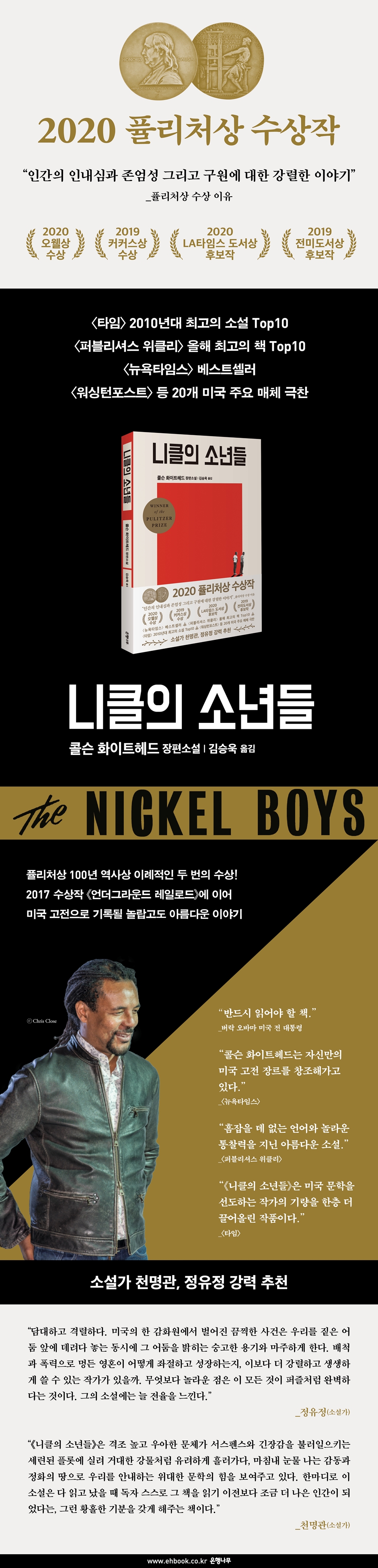
2020 Pulitzer Prize Winner "A powerful story of human perseverance, dignity, and redemption" _Pulitzer Prize Committee An unprecedented two Pulitzer Prizes in the 100-year history! Following the 2017 winner, "The Underground Railroad," this is a surprising and beautiful story that will be recorded as an American classic. Colson Whitehead's novel, "The Nickel Boys," winner of the 2020 Pulitzer Prize, has finally been published in Korea. Colson Whitehead, who was recognized as a leading American writer after sweeping major literary awards including the Pulitzer Prize, Andrew Carnegie Medal, and Arthur Clarke Award for his 2017 novel “The Underground Railroad,” has now received the monumental honor of winning his second Pulitzer Prize for his new work, “The Nickel Boys,” after three years. In the 100-year history of the Pulitzer Prize, only three authors have been nominated twice: Booth Tarkington, William Faulkner, and John Updike. Colson Whitehead becomes the fourth person in history to win the award and the first African-American to do so twice. The novel sheds light on the discrimination and violence of the Jim Crow era through the protagonist, Elwood, who is sent to a reformatory after an unexpected incident, and tells a story about human dignity and courage. The outstanding realism that fuses reality and imagination, and the flowing yet powerful writing style, bring back to life the emotion that literature can bring. Lauded as “a beautiful novel of impeccable language and astonishing insight,” The Nickel Boys won the Kirkus Medal and the Orwell Award, was a finalist for the National Book Award and the LA Times Book Award, and was named one of Time’s Top 10 Best Novels of the 2010s and Publisher’s Weekly’s Top 10 Best Books of the Year. "The Nickel Boys," a wake-up call to the deep-rooted discrimination in American society, will resonate deeply with readers and become a 21st-century classic. |
- You can preview some of the book's contents.
Preview
index
prolog
Part 1
Part 2
Part 3
Epilogue
Author's Note
Part 1
Part 2
Part 3
Epilogue
Author's Note
Detailed image
Into the book
“To call a place like this a school?” said Professor Carmine.
A person can hide a lot in an acre of dirt.
--- p.12
“We must believe in our souls.
We are important people.
“Because we are meaningful and valuable beings, we must not lose this dignity and pride as we walk the journey of life each day.” The record kept turning.
--- p.39
The springs in the mattress creaked with each swish of the whip.
Elwood clung to the bed, gritting his teeth into his pillow, but passed out before the beating was over.
So later when people asked him how many times he had been hit, he couldn't answer.
--- p.92
“The trick to surviving here is the same as outside.
You watch how other people play, and figure out a way around them like an obstacle course race.
“If you want to walk out from here.”
--- p.108
'We must believe in our soul.
We are important people.
We are meaningful people.
We are valuable people.
"We must walk through life each day with this pride and self-esteem." If he doesn't have this pride, what does he have? This time, he won't hesitate.
--- p.226
He wanted to be accepted beyond his dark skin color.
I wanted someone who looked like me, someone I could call a comrade.
Someone who will call him a comrade.
A person who knows that the same future is coming.
Even though the pace is slow, a person who keeps pace with hand-written protest signs and speeches in front of a future filled with back alleys and bitter days.
A person can hide a lot in an acre of dirt.
--- p.12
“We must believe in our souls.
We are important people.
“Because we are meaningful and valuable beings, we must not lose this dignity and pride as we walk the journey of life each day.” The record kept turning.
--- p.39
The springs in the mattress creaked with each swish of the whip.
Elwood clung to the bed, gritting his teeth into his pillow, but passed out before the beating was over.
So later when people asked him how many times he had been hit, he couldn't answer.
--- p.92
“The trick to surviving here is the same as outside.
You watch how other people play, and figure out a way around them like an obstacle course race.
“If you want to walk out from here.”
--- p.108
'We must believe in our soul.
We are important people.
We are meaningful people.
We are valuable people.
"We must walk through life each day with this pride and self-esteem." If he doesn't have this pride, what does he have? This time, he won't hesitate.
--- p.226
He wanted to be accepted beyond his dark skin color.
I wanted someone who looked like me, someone I could call a comrade.
Someone who will call him a comrade.
A person who knows that the same future is coming.
Even though the pace is slow, a person who keeps pace with hand-written protest signs and speeches in front of a future filled with back alleys and bitter days.
--- p.245
Publisher's Review
“Even after death, those guys were a pain in the ass.”
About the truth of the past buried deep in the ground
A mysterious secret graveyard is discovered on the Nickel Campus in Tallahassee, Florida.
As suspicious remains with fractured skulls and shotgun shells embedded in their ribs emerge, and national media outlets focus on the case, victims from Nickel begin to speak out.
Elwood Curtis, who lives in New York, watches the series unfold and realizes that it is finally time to reveal the truth.
Feeling a duty to tell the world about the incredible things that my past self and my friend had gone through.
"The Nickel Boys" describes the events that took place at Nickel Reformatory, moving back and forth between the past and present, centering on Elwood.
The shift in perspective between the 1960s, when racial discrimination policies were implemented, and the present 2010s vividly contrasts the past and present, revealing truths that have been previously unknown or ignored.
The novel, which includes important milestones in the civil rights movement, such as the bus boycott and Martin Luther King Jr.'s speeches, as well as evidence of covert violence in reformatories, is read as both a chronicle and a valuable historical document.
Colson Whitehead says in his author's note that he was inspired to write the novel by the story of Dozier School for Boys in Marianna, Florida.
At Dozier Boys' School, which opened in 1900, habitual violence and sexual abuse by janitors was committed, which even resulted in the deaths of students, but the school and the government covered it up.
This truth was revealed to the world decades later through research by the University of South Florida's Department of Archaeology.
The author has finally completed a novel that takes his literary achievements to the next level, adding an even more powerful message to the vivid realism and outstanding imagination he demonstrated in his previous work, "Underground Railroad."
Restored by Colson Whitehead, considered one of the greatest writers of his time
America's Past, Present, and Progressive Future: A Past Stained by Discrimination
The author shows the scene of the black civil rights movement in the 1960s through Elwood's childhood.
Elwood wears out the Martin Luther King Jr. record he received as a Christmas present, dreaming that one day, guests of color will proudly walk through the front door of the Richmond Hotel where his grandmother Harriet works.
I was moved by the images of the protesters in Life magazine, and I listened intently to every word of Mr. Hill, who is passionate about human rights activism.
Elwood, who believes that it is right to right what is wrong, finds the courage and will to confront the absurdity of the world.
Elwood was inclined to one principle.
Dr. King gave form, sound, and meaning to that principle.
There's a huge force trying to keep the blacks down, like Jim Crow, and there's a smaller force trying to keep you down, Elwood.
For example, other people around you.
In the face of such great and small forces, you must stand tall and not lose yourself.
(…) Some people smile and fool you into giving them empty promises, while others take away your self-esteem.
You must remember who you are.
Page 39
But fate's twist of fate sends Elwood to the Nickel Reformatory.
Elwood's goal of entering university is to be constantly frustrated by the classes that are far below his level and the unsanitary facilities.
Even within the same reformatory, the fact that black boys received worse clothing, worse dormitories, and worse food shows that there are also differences in misfortune based on skin color.
However, the author does not portray the future only pessimistically.
Martin Luther King's speeches, quoted throughout, give Elwood hope and courage to move forward even in the darkness where there is no light.
The belief that things will eventually improve even when it seems like they won't change can sometimes feel foolish, but that uprightness gives someone else the will to live.
Turner, a friend Elwood meets at Nickel, rejects Elwood's way of thinking as idealistic, but is gradually influenced by his will.
And as the story reaches its final moments, Elwood's ideals change Turner's life forever.
Colson Whitehead once said in an interview that "The Nickel Boys" is "a story about the powerful abusing the weak and getting away with it, never being held accountable."
The phenomenon of the strong trampling on the weak without proper punishment is likely a phenomenon that occurs amidst all imbalances of power, including racial discrimination.
The author painfully confronts the reality that “racism and human evil are ongoing and will continue for years to come,” but urges us to hold onto hope and move forward without giving in to despair.
Even though the past may be tainted and the present may seem bleak, his message that the future will be progressive gives us hope and the ability to dream of a better future.
About the truth of the past buried deep in the ground
A mysterious secret graveyard is discovered on the Nickel Campus in Tallahassee, Florida.
As suspicious remains with fractured skulls and shotgun shells embedded in their ribs emerge, and national media outlets focus on the case, victims from Nickel begin to speak out.
Elwood Curtis, who lives in New York, watches the series unfold and realizes that it is finally time to reveal the truth.
Feeling a duty to tell the world about the incredible things that my past self and my friend had gone through.
"The Nickel Boys" describes the events that took place at Nickel Reformatory, moving back and forth between the past and present, centering on Elwood.
The shift in perspective between the 1960s, when racial discrimination policies were implemented, and the present 2010s vividly contrasts the past and present, revealing truths that have been previously unknown or ignored.
The novel, which includes important milestones in the civil rights movement, such as the bus boycott and Martin Luther King Jr.'s speeches, as well as evidence of covert violence in reformatories, is read as both a chronicle and a valuable historical document.
Colson Whitehead says in his author's note that he was inspired to write the novel by the story of Dozier School for Boys in Marianna, Florida.
At Dozier Boys' School, which opened in 1900, habitual violence and sexual abuse by janitors was committed, which even resulted in the deaths of students, but the school and the government covered it up.
This truth was revealed to the world decades later through research by the University of South Florida's Department of Archaeology.
The author has finally completed a novel that takes his literary achievements to the next level, adding an even more powerful message to the vivid realism and outstanding imagination he demonstrated in his previous work, "Underground Railroad."
Restored by Colson Whitehead, considered one of the greatest writers of his time
America's Past, Present, and Progressive Future: A Past Stained by Discrimination
The author shows the scene of the black civil rights movement in the 1960s through Elwood's childhood.
Elwood wears out the Martin Luther King Jr. record he received as a Christmas present, dreaming that one day, guests of color will proudly walk through the front door of the Richmond Hotel where his grandmother Harriet works.
I was moved by the images of the protesters in Life magazine, and I listened intently to every word of Mr. Hill, who is passionate about human rights activism.
Elwood, who believes that it is right to right what is wrong, finds the courage and will to confront the absurdity of the world.
Elwood was inclined to one principle.
Dr. King gave form, sound, and meaning to that principle.
There's a huge force trying to keep the blacks down, like Jim Crow, and there's a smaller force trying to keep you down, Elwood.
For example, other people around you.
In the face of such great and small forces, you must stand tall and not lose yourself.
(…) Some people smile and fool you into giving them empty promises, while others take away your self-esteem.
You must remember who you are.
Page 39
But fate's twist of fate sends Elwood to the Nickel Reformatory.
Elwood's goal of entering university is to be constantly frustrated by the classes that are far below his level and the unsanitary facilities.
Even within the same reformatory, the fact that black boys received worse clothing, worse dormitories, and worse food shows that there are also differences in misfortune based on skin color.
However, the author does not portray the future only pessimistically.
Martin Luther King's speeches, quoted throughout, give Elwood hope and courage to move forward even in the darkness where there is no light.
The belief that things will eventually improve even when it seems like they won't change can sometimes feel foolish, but that uprightness gives someone else the will to live.
Turner, a friend Elwood meets at Nickel, rejects Elwood's way of thinking as idealistic, but is gradually influenced by his will.
And as the story reaches its final moments, Elwood's ideals change Turner's life forever.
Colson Whitehead once said in an interview that "The Nickel Boys" is "a story about the powerful abusing the weak and getting away with it, never being held accountable."
The phenomenon of the strong trampling on the weak without proper punishment is likely a phenomenon that occurs amidst all imbalances of power, including racial discrimination.
The author painfully confronts the reality that “racism and human evil are ongoing and will continue for years to come,” but urges us to hold onto hope and move forward without giving in to despair.
Even though the past may be tainted and the present may seem bleak, his message that the future will be progressive gives us hope and the ability to dream of a better future.
GOODS SPECIFICS
- Publication date: December 11, 2020
- Page count, weight, size: 268 pages | 382g | 150*210*20mm
- ISBN13: 9791191071238
- ISBN10: 1191071235
You may also like
카테고리
korean


korean

![GQ KOREA Mark (Monthly): December [2025]](http://librairie.coreenne.fr/cdn/shop/files/8ef265dbbfbf186523ed75ba7319009d.jpg?v=1765340328&width=3840)


