

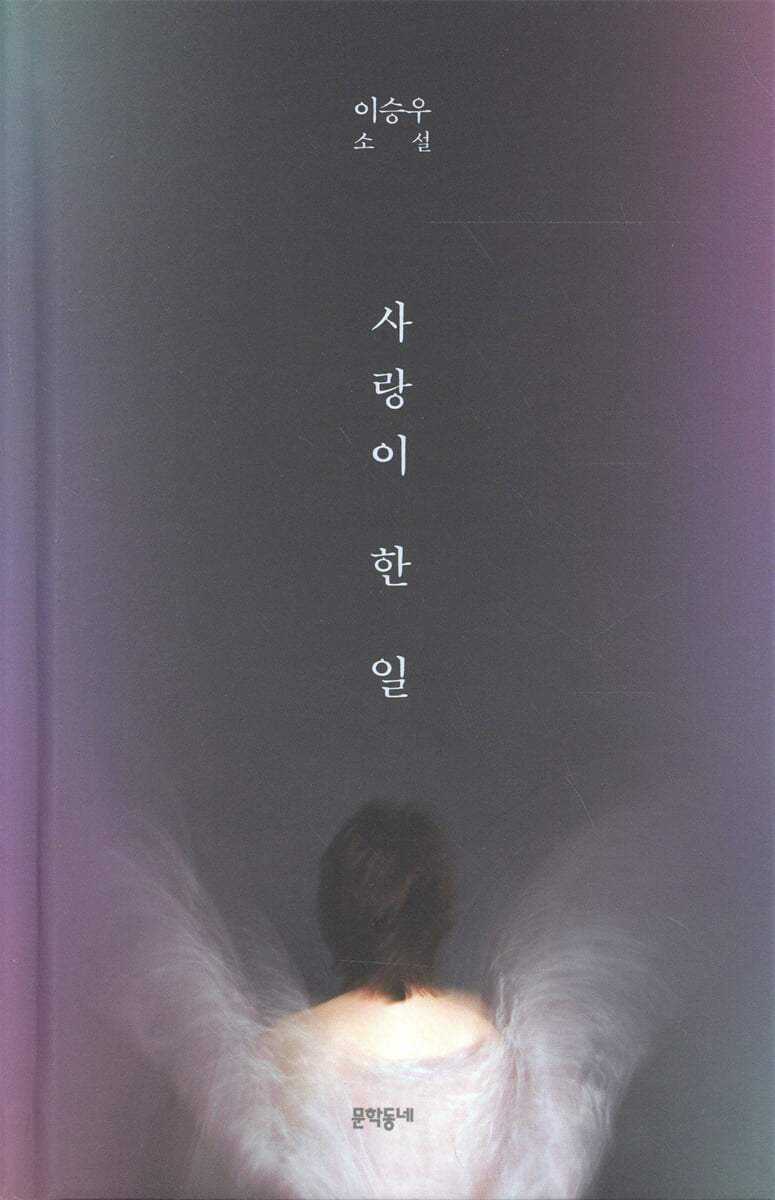
What love did
 |
Description
Book Introduction
- A word from MD
-
Novelist Lee Seung-woo's first novel collectionA collection of short stories based on the Book of Genesis.
The author reveals that this story began with an attempt to understand the story of Abraham offering his only son Isaac as a sacrifice.
Through his novels, he rereads and rewrites the mind of God and the question of faith as a human text, and offers the key of 'love' as a way to solve this eternal task.
November 17, 2020. Novel/Poetry PD Park Hyung-wook
“Love does not test or overcome trials,
It's about jumping into the test.
“It is truly scary.”
40 Years of a Writer's Life: The Ultimate Questions Within That Time
Lee Seung-woo's "Genesis"-themed short story collection
Novelist Lee Seung-woo has achieved unparalleled success by filling his nearly forty-year career with a search for salvation beyond longing.
He is proving that the adjectives and praise given to him and his work, such as “torso of ideas” (Kim Yun-sik), “Korea’s most powerful candidate for the Nobel Prize in Literature” (Le Clézio), “a moving and weighty novel that erupts from a quiet and serious soul” (Le Monde), and “the first Korean novel to be included in the Gallimard Folio series,” are not excessive at all, as he serves his life through his novels.
He delves into the "other side of life" with a religious and ideological insight that is rare in Korean novels, and in his new collection of short stories, he confronts life's ultimate questions by putting "Genesis" at the forefront.
This is a dense work that rereads and rewrites "Genesis" as a text of "humanity" rather than "God," and the word "love" becomes the keyword within it. Therefore, it can be said that this book mobilizes the entire world of author Seungwoo Lee's works.
This is my eleventh collection of short stories and my first collection of serialized short stories, What Love Did.
This collection of short stories was born from an attempt to understand the story in Genesis about Abraham sacrificing his only son, Isaac.
Every time I read that scene, my heart sank and I cringed.
It was difficult for both the god who demanded sacrifice and the father who obeyed that demand to understand.
Instead of entering the mind of the god who demands the sacrifice or the father who obeys the demand, I tried to understand and believe this incomprehensible and unbelievable story by entering the mind of the son who is offered as a sacrifice by that demand.
So, my method of translation was to approach the mind of God, that is, the problem of faith, through the human mind, that is, through the novel.
'Love' was the key I discovered, and so I could begin this burdensome task of paraphrasing.
_From the author's note
It's about jumping into the test.
“It is truly scary.”
40 Years of a Writer's Life: The Ultimate Questions Within That Time
Lee Seung-woo's "Genesis"-themed short story collection
Novelist Lee Seung-woo has achieved unparalleled success by filling his nearly forty-year career with a search for salvation beyond longing.
He is proving that the adjectives and praise given to him and his work, such as “torso of ideas” (Kim Yun-sik), “Korea’s most powerful candidate for the Nobel Prize in Literature” (Le Clézio), “a moving and weighty novel that erupts from a quiet and serious soul” (Le Monde), and “the first Korean novel to be included in the Gallimard Folio series,” are not excessive at all, as he serves his life through his novels.
He delves into the "other side of life" with a religious and ideological insight that is rare in Korean novels, and in his new collection of short stories, he confronts life's ultimate questions by putting "Genesis" at the forefront.
This is a dense work that rereads and rewrites "Genesis" as a text of "humanity" rather than "God," and the word "love" becomes the keyword within it. Therefore, it can be said that this book mobilizes the entire world of author Seungwoo Lee's works.
This is my eleventh collection of short stories and my first collection of serialized short stories, What Love Did.
This collection of short stories was born from an attempt to understand the story in Genesis about Abraham sacrificing his only son, Isaac.
Every time I read that scene, my heart sank and I cringed.
It was difficult for both the god who demanded sacrifice and the father who obeyed that demand to understand.
Instead of entering the mind of the god who demands the sacrifice or the father who obeys the demand, I tried to understand and believe this incomprehensible and unbelievable story by entering the mind of the son who is offered as a sacrifice by that demand.
So, my method of translation was to approach the mind of God, that is, the problem of faith, through the human mind, that is, through the novel.
'Love' was the key I discovered, and so I could begin this burdensome task of paraphrasing.
_From the author's note
- You can preview some of the book's contents.
Preview
index
One Night in Sodom
Hagar's Song
What love did
Hunger and gluttony
Jacob's Ladder
Commentary│The Mimesis of Fearful Love_Seo Young-chae (Literary Critic)
Author's Note
Hagar's Song
What love did
Hunger and gluttony
Jacob's Ladder
Commentary│The Mimesis of Fearful Love_Seo Young-chae (Literary Critic)
Author's Note
Into the book
It is an incident that happened because of love.
I should have not loved you or loved you a little less.
---From "What Love Did"
People have no sense of balance, and love has no sense of balance.
A person in love is someone who doesn't know how to keep balance.
---From "Hunger and Gluttony"
Your silence is cowardly.
Don't fake your pain.
Is there anything more abominable than the disguise of pain used by the one who inflicts pain to absolve himself of guilt?
Words swirled and surged through her mind.
You can't do this to us.
This is not right.
---From "Hagar's Song"
People who are possessed by terrible beliefs that cannot be easily captured easily do terrible things that cannot be easily done.
Ideologies and religions often function as belief systems that motivate deviant human behavior.
At this time, the beliefs provided by this ideology and religion are a kind of alibi.
---From "One Night in Sodom"
“Please don’t do this.
“This is an evil deed.” An evil deed is evil whether or not the doer is aware of its evilness.
An evil act is evil whether the motive for the act is plausible or not.
Evil deeds are the evil of deeds.
---From "One Night in Sodom"
Given this nature of love, it is likely that someone who says they love fairly is synonymous with saying that no one truly loves.
So, we shouldn't protest, "Why don't you love me?" or ask, "Why don't you love me like someone else, as much as someone else, or more than someone else?"
No one has the right to demand love.
Blood, law, institutions, and customs can enforce duties and roles, but they cannot do so for love.
Only that which is spontaneous is love.
Spontaneity is not smooth or uniform, it is bumpy.
What is smooth and uniform is involuntary, imposed, manufactured, forced.
---From "Hunger and Gluttony"
But it was different from the sacredness I used to feel under the stars in the night sky or on the steep cliffs of the vast wilderness.
The sacredness he felt was like a breath.
It feels like someone is there.
Life, so to speak.
Not nature, but personality.
Fear and trembling dominated all his senses and nerves.
He opened his eyes in surprise.
What is this! he shouted.
He thought he screamed, but his voice was stuck in his throat.
---From "Jacob's Ladder"
He did not know that what happened was not all there was, that everything had a first moment, that there were many things that had not yet happened but would eventually happen when the conditions were ripe, that there were things that happened without being desired and appeared without being dreamed of, just as there were heavenly interventions that transcended the will of the earth.
I should have not loved you or loved you a little less.
---From "What Love Did"
People have no sense of balance, and love has no sense of balance.
A person in love is someone who doesn't know how to keep balance.
---From "Hunger and Gluttony"
Your silence is cowardly.
Don't fake your pain.
Is there anything more abominable than the disguise of pain used by the one who inflicts pain to absolve himself of guilt?
Words swirled and surged through her mind.
You can't do this to us.
This is not right.
---From "Hagar's Song"
People who are possessed by terrible beliefs that cannot be easily captured easily do terrible things that cannot be easily done.
Ideologies and religions often function as belief systems that motivate deviant human behavior.
At this time, the beliefs provided by this ideology and religion are a kind of alibi.
---From "One Night in Sodom"
“Please don’t do this.
“This is an evil deed.” An evil deed is evil whether or not the doer is aware of its evilness.
An evil act is evil whether the motive for the act is plausible or not.
Evil deeds are the evil of deeds.
---From "One Night in Sodom"
Given this nature of love, it is likely that someone who says they love fairly is synonymous with saying that no one truly loves.
So, we shouldn't protest, "Why don't you love me?" or ask, "Why don't you love me like someone else, as much as someone else, or more than someone else?"
No one has the right to demand love.
Blood, law, institutions, and customs can enforce duties and roles, but they cannot do so for love.
Only that which is spontaneous is love.
Spontaneity is not smooth or uniform, it is bumpy.
What is smooth and uniform is involuntary, imposed, manufactured, forced.
---From "Hunger and Gluttony"
But it was different from the sacredness I used to feel under the stars in the night sky or on the steep cliffs of the vast wilderness.
The sacredness he felt was like a breath.
It feels like someone is there.
Life, so to speak.
Not nature, but personality.
Fear and trembling dominated all his senses and nerves.
He opened his eyes in surprise.
What is this! he shouted.
He thought he screamed, but his voice was stuck in his throat.
---From "Jacob's Ladder"
He did not know that what happened was not all there was, that everything had a first moment, that there were many things that had not yet happened but would eventually happen when the conditions were ripe, that there were things that happened without being desired and appeared without being dreamed of, just as there were heavenly interventions that transcended the will of the earth.
---From "Jacob's Ladder"
Publisher's Review
“So, it was God’s love, God’s excessive love, that created that.”
Rereading/writing through repetition and expansion, as a text of 'human' rather than 'god'
This collection of five short stories is chronologically arranged with the title story, "What Love Did," which deals with the story of Abraham sacrificing Isaac, at the center, as the author has stated.
The first two are "One Night in Sodom," the story of Lot in Sodom who gives his daughter to the scoundrels, and "The Song of Hagar," the story of Hagar who is unjustly cast out with her son Ishmael. The last two are "Hunger and Gluttony" and "Jacob's Ladder," which can be said to be a novelistic commentary on the strange hunger that Isaac feels and his favoritism towards his twin sons, Jacob and Esau.
Let's leave the main points of "Genesis" as they are, and focus on the points where the author raises questions and the way he resolves them.
The first two, "One Night in Sodom" and the title piece, "What Love Did," first captivate readers with their unique writing style.
In the case of "One Night in Sodom," the sentences of the five scenes showing the destruction of Sodom are repeated.
What follows are dense and persistent sentences that are closer to logical argument than sentences from a novel.
It is a refreshing shock to see the author's detailed, inferential, and convincing process of filling in the narrative gaps in the biblical text, and then completing it in a novel.
The repetition of sentences, like drawing concentric circles, gradually expands the work, and the waves that come from it open the reader's eyes to new perspectives.
“If you get too close, your field of vision narrows, and if you get buried, your field of vision disappears altogether.
As if to say, “Insiders do not only see the inside, but also do not see the inside well.”
The repeated sentences in the title work, "What Love Did," function differently from those in "One Night in Sodom."
If "One Night in Sodom" follows the story, but the author pushes the flow at his own pace, "What Love Did" repeats a single sentence, "It happened because of love," and passionately shows the internal struggle of the narrator, Isaac, who tries to understand both God's command to "sacrifice your son, your only son, Isaac, whom you love," and his father Abraham who followed that command.
The son who almost died at the hands of his father asks and answers his own questions.
"It happened because of love"? Love for whom, whose love?
If that love had been a little less, God would not have made such a demand of my father, and my father Abraham would not have obeyed and offered me as a sacrifice, and then God would not have told my father to 'stop'.
It is not difficult to sacrifice something or someone you do not love, and therefore it is not required, but it is difficult to sacrifice something or someone you do love.
So it is required.
Everything that is required of us is hard.
no.
It is essentially impossible to 'offer' anything or anyone you do not love.
Because giving something you don't love to someone is not giving, it's throwing it away.
Even if it takes the form of offering, it is not offering.
Letting go isn't always easy, but giving up is truly difficult.
Because it is a symbolic expression of giving oneself.
Because offering is a symbolic expression of giving oneself, giving something or someone that one loves, that belongs to oneself but is more precious than oneself, that is precious.
Giving something or someone that is less valuable or cherished than oneself cannot be an act of self-giving.
Anything or anyone that belongs to him and is more precious than himself is something or someone that he loves.
Only love can be offered to anything or anyone that is loved.
That is why it is difficult to offer.
Things that are easy to do when you're not in love become difficult to do when you're in love. _Pages 99-100, "What Love Has Done"
“This is not right.
“You are not right.”
The power of mimesis demonstrated by the novel's master
All a human being can do when faced with a command from God that is so difficult to accept is to ask and ask again, to doubt, to ponder, to try to understand, and to pour his or her entire being into it.
The author, who gave voice to Isaac, who was not in the position of Abraham obeying God's unreasonable command, but as a sacrificed person without knowing why, could therefore rewrite the same motif as something 'all too human.'
Another character who asks, "Why are you doing this to me?" is Hagar in "The Song of Hagar."
Hagar, who was unjustly cast out with her son Ishmael, resents the voice of God who had promised blessings and descendants.
“This is not right.
“You are not right.” The speakers in the work, which consists of the speaker’s monologue along with “What Love Did,” break away from the rigid text and gain a new voice.
"Hunger and Gluttony" is the story of the old Isaac and his two sons, Esau and Jacob.
The gist of the story is that Jacob, the second son, rather than the eldest son, deceives his father Isaac and attempts to usurp the patriarchal rights, and after many incidents, Jacob repents and succeeds to the throne.
However, author Seungwoo Lee focuses on a different point.
Why did Isaac favor his eldest son Esau?
The scars left on him from almost dying by his father's blade, and the taste of the wild animal meat caught by his half-brother Ishmael, which was a comfort to him.
That was projected onto the eldest son, who was a hunter.
However, Isaac's favoritism and blessing went astray, and Jacob, the second son who received a blessing that was not his, ran away from home.
“Almost for the first time, he came to his place in the wilderness of night, in great fear and deep loneliness, when he felt abandoned and alone in the world, an orphan and a wanderer.” “I will be with you.
With the words, “I will protect you wherever you go.”
The collection of short stories concludes with "Jacob's Ladder," the story of Jacob, who did not receive favor from his father but was favored by God.
Why did the author focus on scenes from the Bible that have been altered and (re)interpreted over thousands of years?
Walter Jens and Hans Küng's lecture on literature, Literature and Religion, explains the relationship between literature and religion as follows:
“Ambiguity, ambivalence, discordant agreement, mutual illumination, and dialectics stretch between heaven and earth, a tense and fearful relationship.” For author Seungwoo Lee, who has studied theology and written novels for a long time, and especially for him who “thinks that writing novels is a kind of paraphrase,” it may be natural that there is nothing like the Bible to rewrite and rewrite what has already been written, to throw himself into that “tensed and fearful relationship.”
The Old Testament, a literary text of overwhelming scale, and the narrative recreated by Seungwoo Lee's fingertips, the two overlap and create new meaning.
In short, what readers will learn from this book is “another kind of knowledge that literature produces through mimesis” (Seo Young-chae, commentary).
Rereading/writing through repetition and expansion, as a text of 'human' rather than 'god'
This collection of five short stories is chronologically arranged with the title story, "What Love Did," which deals with the story of Abraham sacrificing Isaac, at the center, as the author has stated.
The first two are "One Night in Sodom," the story of Lot in Sodom who gives his daughter to the scoundrels, and "The Song of Hagar," the story of Hagar who is unjustly cast out with her son Ishmael. The last two are "Hunger and Gluttony" and "Jacob's Ladder," which can be said to be a novelistic commentary on the strange hunger that Isaac feels and his favoritism towards his twin sons, Jacob and Esau.
Let's leave the main points of "Genesis" as they are, and focus on the points where the author raises questions and the way he resolves them.
The first two, "One Night in Sodom" and the title piece, "What Love Did," first captivate readers with their unique writing style.
In the case of "One Night in Sodom," the sentences of the five scenes showing the destruction of Sodom are repeated.
What follows are dense and persistent sentences that are closer to logical argument than sentences from a novel.
It is a refreshing shock to see the author's detailed, inferential, and convincing process of filling in the narrative gaps in the biblical text, and then completing it in a novel.
The repetition of sentences, like drawing concentric circles, gradually expands the work, and the waves that come from it open the reader's eyes to new perspectives.
“If you get too close, your field of vision narrows, and if you get buried, your field of vision disappears altogether.
As if to say, “Insiders do not only see the inside, but also do not see the inside well.”
The repeated sentences in the title work, "What Love Did," function differently from those in "One Night in Sodom."
If "One Night in Sodom" follows the story, but the author pushes the flow at his own pace, "What Love Did" repeats a single sentence, "It happened because of love," and passionately shows the internal struggle of the narrator, Isaac, who tries to understand both God's command to "sacrifice your son, your only son, Isaac, whom you love," and his father Abraham who followed that command.
The son who almost died at the hands of his father asks and answers his own questions.
"It happened because of love"? Love for whom, whose love?
If that love had been a little less, God would not have made such a demand of my father, and my father Abraham would not have obeyed and offered me as a sacrifice, and then God would not have told my father to 'stop'.
It is not difficult to sacrifice something or someone you do not love, and therefore it is not required, but it is difficult to sacrifice something or someone you do love.
So it is required.
Everything that is required of us is hard.
no.
It is essentially impossible to 'offer' anything or anyone you do not love.
Because giving something you don't love to someone is not giving, it's throwing it away.
Even if it takes the form of offering, it is not offering.
Letting go isn't always easy, but giving up is truly difficult.
Because it is a symbolic expression of giving oneself.
Because offering is a symbolic expression of giving oneself, giving something or someone that one loves, that belongs to oneself but is more precious than oneself, that is precious.
Giving something or someone that is less valuable or cherished than oneself cannot be an act of self-giving.
Anything or anyone that belongs to him and is more precious than himself is something or someone that he loves.
Only love can be offered to anything or anyone that is loved.
That is why it is difficult to offer.
Things that are easy to do when you're not in love become difficult to do when you're in love. _Pages 99-100, "What Love Has Done"
“This is not right.
“You are not right.”
The power of mimesis demonstrated by the novel's master
All a human being can do when faced with a command from God that is so difficult to accept is to ask and ask again, to doubt, to ponder, to try to understand, and to pour his or her entire being into it.
The author, who gave voice to Isaac, who was not in the position of Abraham obeying God's unreasonable command, but as a sacrificed person without knowing why, could therefore rewrite the same motif as something 'all too human.'
Another character who asks, "Why are you doing this to me?" is Hagar in "The Song of Hagar."
Hagar, who was unjustly cast out with her son Ishmael, resents the voice of God who had promised blessings and descendants.
“This is not right.
“You are not right.” The speakers in the work, which consists of the speaker’s monologue along with “What Love Did,” break away from the rigid text and gain a new voice.
"Hunger and Gluttony" is the story of the old Isaac and his two sons, Esau and Jacob.
The gist of the story is that Jacob, the second son, rather than the eldest son, deceives his father Isaac and attempts to usurp the patriarchal rights, and after many incidents, Jacob repents and succeeds to the throne.
However, author Seungwoo Lee focuses on a different point.
Why did Isaac favor his eldest son Esau?
The scars left on him from almost dying by his father's blade, and the taste of the wild animal meat caught by his half-brother Ishmael, which was a comfort to him.
That was projected onto the eldest son, who was a hunter.
However, Isaac's favoritism and blessing went astray, and Jacob, the second son who received a blessing that was not his, ran away from home.
“Almost for the first time, he came to his place in the wilderness of night, in great fear and deep loneliness, when he felt abandoned and alone in the world, an orphan and a wanderer.” “I will be with you.
With the words, “I will protect you wherever you go.”
The collection of short stories concludes with "Jacob's Ladder," the story of Jacob, who did not receive favor from his father but was favored by God.
Why did the author focus on scenes from the Bible that have been altered and (re)interpreted over thousands of years?
Walter Jens and Hans Küng's lecture on literature, Literature and Religion, explains the relationship between literature and religion as follows:
“Ambiguity, ambivalence, discordant agreement, mutual illumination, and dialectics stretch between heaven and earth, a tense and fearful relationship.” For author Seungwoo Lee, who has studied theology and written novels for a long time, and especially for him who “thinks that writing novels is a kind of paraphrase,” it may be natural that there is nothing like the Bible to rewrite and rewrite what has already been written, to throw himself into that “tensed and fearful relationship.”
The Old Testament, a literary text of overwhelming scale, and the narrative recreated by Seungwoo Lee's fingertips, the two overlap and create new meaning.
In short, what readers will learn from this book is “another kind of knowledge that literature produces through mimesis” (Seo Young-chae, commentary).
GOODS SPECIFICS
- Publication date: November 10, 2020
- Format: Hardcover book binding method guide
- Page count, weight, size: 248 pages | 318g | 120*188*20mm
- ISBN13: 9788954675574
- ISBN10: 8954675573
You may also like
카테고리
korean


korean

![GQ KOREA Mark (Monthly): December [2025]](http://librairie.coreenne.fr/cdn/shop/files/8ef265dbbfbf186523ed75ba7319009d.jpg?v=1765340328&width=3840)


